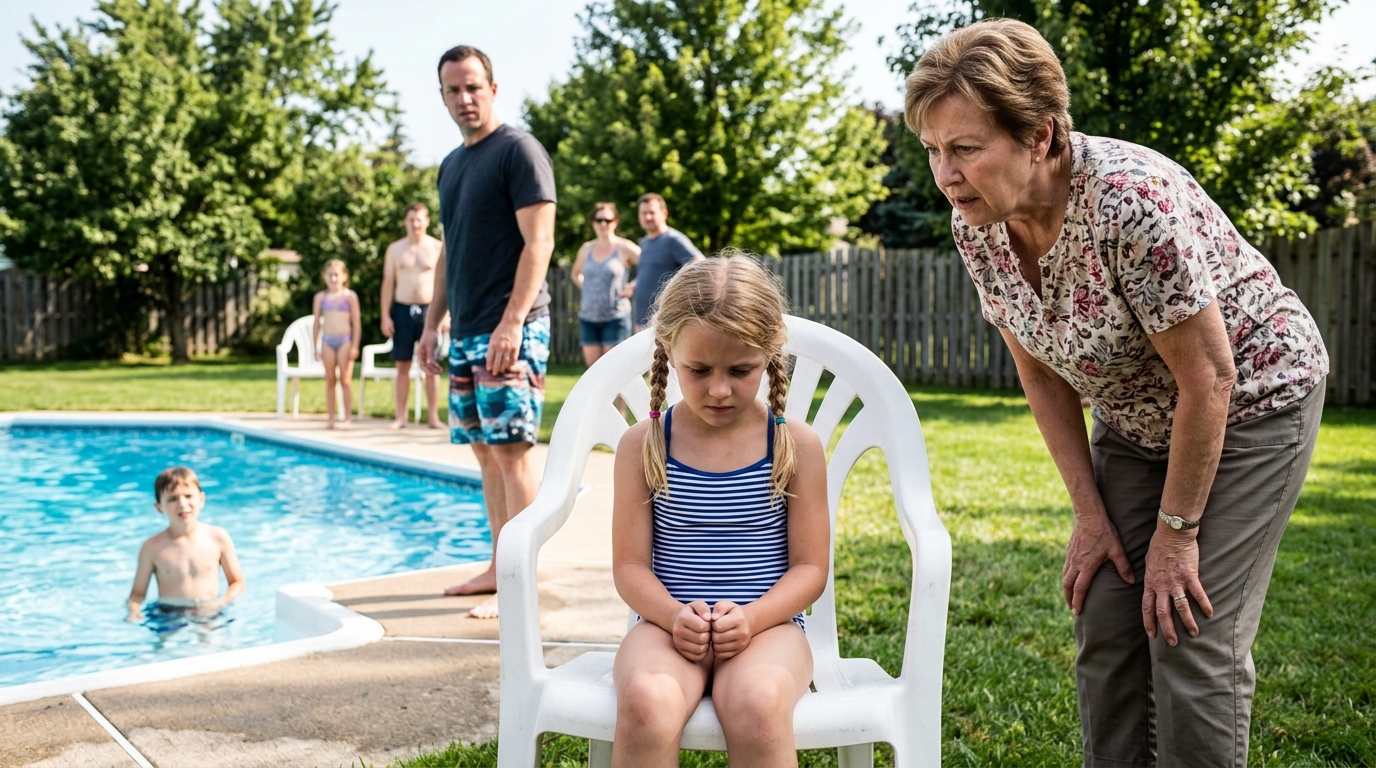
The Girl Who Wasn’t Playing
Laughter floated across the backyard like nothing bad had ever happened there.
Children splashed in the pool, shrieking every time someone cannonballed from the shallow step. Sunlight glittered across the water in bright, broken pieces. Balloons bobbed near the patio rail. White umbrellas shaded tables covered with fruit, lemonade, cupcakes, and plates of untouched sandwiches.
From a distance, the Harper family summer party looked perfect.
The kind of perfect people posted online.
A big house.
A sparkling pool.
Smiling relatives.
Children running barefoot through the grass.
At the edge of the patio, Evelyn Harper watched quietly from beneath a wide umbrella.
She was seventy-two, elegant in a pale blue dress, with silver hair pinned neatly at the back of her head and a pearl bracelet clasped around one wrist. Everyone called her Mrs. Harper, even family friends, because there was something about her that made people straighten slightly when she entered a room.
But to the little girl sitting alone by the garden chair, she was Grandma.
Evelyn noticed her before anyone else did.
Not because the child was crying.
Not because she was calling for attention.
Because she was too still.
Eight-year-old Lily Harper sat beside a chair near the rose bushes, wearing a yellow swimsuit under a white cover-up. Her knees were pressed together. Her small hands gripped the edge of the seat. Her face was pale in a way the summer heat could not explain.
Around her, cousins splashed and shouted.
But Lily did not move.
She only watched.
Taking everything in.
Not part of it.
Evelyn set down her glass of iced tea and walked toward her.
“Sweetheart,” she asked gently, “why aren’t you playing?”
Lily’s eyes lifted slowly.
For a moment, she looked as though she might say something practiced.
Something safe.
Then her lips trembled.
“My tummy hurts.”
Her voice was barely a whisper.
Fragile.
Almost lost beneath the sound of the pool.
Evelyn lowered herself into the chair beside her.
“Since when?”
Before Lily could answer, a man’s voice cut across the patio.
“She’s fine.”
Too quick.
Too defensive.
The atmosphere shifted.
Only slightly at first.
The kind of shift most people ignore because parties train people to keep smiling.
Evelyn turned.
Her son, Daniel Harper, stood near the grill with a spatula in one hand and a forced smile on his face. He was forty-two, handsome, successful, and polished in the way men become when they learn charm is easier than honesty.
“Daniel,” Evelyn said slowly, “I asked Lily.”
“I said she’s fine.”
His tone tightened.
Controlled.
But wrong.
Lily’s fingers dug harder into the chair.
Evelyn noticed.
She always noticed hands.
Hands told the truth before mouths were brave enough.
She leaned closer to her granddaughter.
“Lily, tell Grandma. Since when does your tummy hurt?”
The girl’s eyes filled with tears.
Her lips moved once.
No sound came.
Daniel stepped forward.
“Mom, don’t make a scene.”
Evelyn did not look at him.
Lily swallowed.
“They told me…”
A pause.
Too long.
Too heavy.
The children in the pool shouted again, but somehow the sound felt far away now.
“They told me not to tell anyone.”
Silence crashed over the backyard.
The laughter vanished.
The water seemed to still.
Evelyn’s face changed.
Not with panic.
With focus.
“Who told you?”
Lily did not answer directly.
Instead, she slowly raised her gaze and looked past Evelyn.
Toward the patio doors.
Toward Daniel.
And then—
toward the woman standing behind him.
Daniel’s wife.
Marissa.
The woman had gone completely still.
Her smile was gone.
Her hands rested lightly over the front of her white linen dress, but her fingers were no longer relaxed.
They were clenched.
Evelyn turned toward her son.
“What did she mean?”
Daniel opened his mouth.
But Lily spoke first.
Softly.
Terrified.
“They said if I told Grandma, Mommy’s letter would disappear.”
The entire backyard froze.
Because Lily’s mother had been dead for three years.
And everyone knew Evelyn had never seen that letter.
Video: A Little Girl Said Her Stomach Hurt at a Pool Party—Then Whispered That Her Family Told Her Not to Tell Grandma
The Letter No One Wanted Evelyn to Read
The party did not end immediately.
That was the strangest part.
People do not always react to truth as quickly as they should. Sometimes they pretend confusion is manners. Sometimes they look away because looking directly would demand courage.
The children were called out of the pool by nervous parents.
Someone turned off the music.
A cousin quietly lowered the lid on the cooler.
The surface of the pool shimmered under the sunlight, bright and beautiful, as if nothing had changed.
But everything had.
Evelyn stayed seated beside Lily.
She did not touch the child yet.
Not because she didn’t want to.
Because Lily looked like someone who had learned that comfort could have consequences.
“Sweetheart,” Evelyn said gently, “what letter?”
Lily’s eyes darted toward Daniel again.
He stepped forward.
“That’s enough.”
Evelyn lifted one hand.
“Take one more step, Daniel, and you will regret it.”
The sentence was quiet.
No one mistook it for softness.
Daniel stopped.
Marissa moved beside him, her expression smoothing back into something almost maternal.
“Evelyn,” she said, “Lily has been having stomach issues for a few days. She gets anxious at big gatherings. You know how children can be when they want attention.”
Lily flinched.
Evelyn saw it.
Her eyes hardened.
“Do not describe my granddaughter like that again.”
Marissa’s lips tightened.
Daniel tried another approach.
“Mom, please. She’s tired. She needs to lie down.”
“No,” Evelyn said. “She needs a doctor.”
That made both Daniel and Marissa react.
Not much.
But enough.
Daniel’s face sharpened.
“A doctor isn’t necessary.”
Marissa added quickly, “We already spoke to Dr. Keller. He said it was probably nerves.”
Evelyn turned slowly toward her.
“When?”
Marissa blinked.
“What?”
“When did you speak to Dr. Keller?”
“This morning.”
Evelyn’s voice dropped.
“That’s interesting.”
Daniel stiffened.
“Why?”
“Because Dr. Keller retired last month.”
The silence that followed was not accidental.
It spread through the patio like a stain.
Marissa’s smile flickered.
“I meant his office.”
“No,” Evelyn said. “You meant the name you thought I would trust.”
Daniel’s jaw tightened.
“Mom, stop interrogating my wife.”
Evelyn looked at him then.
Really looked.
For years, she had excused his impatience.
He was grieving, she told herself, when Lily’s mother died.
He was overwhelmed.
He was rebuilding.
He was trying.
But lately, her son had become harder to reach. He canceled visits. He screened phone calls. He said Lily was busy, tired, sick, sleeping, at a lesson, at a playdate, anything except available.
And Marissa always stood nearby.
Smiling.
Explaining.
Managing.
Evelyn looked back at Lily.
“What letter did your mother leave?”
Lily’s lower lip trembled.
“The blue one.”
Evelyn’s heart missed a beat.
Lily’s mother, Claire, had loved blue stationery. Before she died, she wrote letters to everyone: to Daniel, to Lily for future birthdays, to Evelyn, to her own sister, to friends.
Evelyn had received none.
Daniel told her Claire had been too weak near the end.
He said she had meant to write but never finished.
Evelyn had grieved that silence privately.
Now Lily was saying there had been a blue letter.
“Where is it?” Evelyn asked.
Lily whispered, “In Mommy’s music box.”
Daniel’s voice snapped.
“Lily.”
The child jerked as if struck.
Evelyn rose.
Slowly.
At seventy-two, she did not move quickly unless she had to.
But when she stood, everyone in that backyard seemed to understand that the party was over.
“Bring me the music box,” she said.
Daniel laughed once.
Short.
Unconvincing.
“Mom, you can’t just come into my house and demand—”
“This house,” Evelyn said, “was bought with Claire’s inheritance.”
Daniel went pale.
Marissa’s eyes narrowed.
Evelyn continued.
“And if my granddaughter says there is a letter from her dead mother being used to frighten her into silence, then yes, Daniel, I can demand a great deal.”
No one spoke.
Then Lily whispered:
“They moved it.”
Evelyn looked down.
“Who?”
Lily’s eyes filled.
“Daddy did.”
The House Claire Left Behind
Claire Harper had died at thirty-six.
Cancer.
Fast.
Cruel.
Unfair in the way illness often is to people who have already lived gently.
She had been Evelyn’s daughter-in-law, but in many ways Evelyn had loved her like a daughter. Claire was warm without being weak, soft-spoken without being easily controlled. She baked badly, laughed at herself often, and loved Lily with a tenderness that made everyone around them quieter.
The house belonged to Claire.
Not legally in the simple way people said at parties, but through a trust established by her late father. Claire had brought the money into the marriage. She had insisted the home remain protected for Lily if anything happened to her.
Evelyn knew that much.
She had been present when Claire’s father explained the structure.
The house could be used by Daniel as Lily’s guardian.
But it could not be sold or refinanced freely until Lily came of age.
Unless Lily was declared unable to inherit.
Unless her guardians petitioned for certain medical or psychological exceptions.
At the time, Evelyn thought the language sounded dramatic.
Now it sounded like prophecy.
After Claire died, Daniel changed.
At first, Evelyn understood.
Grief made him quiet.
Then bitter.
Then dependent on Marissa, who appeared nine months after the funeral as a “family friend” helping with Lily’s routine.
Within another year, Marissa had married him.
Evelyn tried to be polite.
She failed privately.
There was something about Marissa that never settled right. She was too smooth with adults, too sharp with service workers, too sweet when Daniel looked and too cold when he turned away. Lily stopped running into Evelyn’s arms during visits. She began asking permission with her eyes before answering questions.
Then the visits became fewer.
Evelyn told herself not to interfere.
She had raised her son.
He was Lily’s father.
She had no right to assume the worst.
That afternoon, standing by the pool with Lily pale beside her and Daniel blocking the patio doors, Evelyn understood that restraint had become another form of neglect.
She turned to her driver, Mr. Hayes, who had been waiting discreetly near the side garden.
“Bring the car to the front.”
Daniel’s voice sharpened.
“Where are you taking her?”
“To the hospital.”
“She is my daughter.”
“And Claire was her mother.”
The sentence hit him.
Daniel’s face flushed.
“You don’t get to use Claire against me.”
“No,” Evelyn said. “You already did.”
Marissa stepped forward.
“If you take Lily without permission, we’ll call the police.”
Evelyn looked at her.
“Please do.”
That stopped her.
Evelyn continued.
“I would very much like to explain to them why an eight-year-old with abdominal pain says she was told not to speak, why you lied about a doctor, and why a letter from her dead mother appears to have been hidden.”
A cousin near the snack table looked down.
A neighbor whispered something to her husband.
Daniel noticed the shift.
He had expected his mother to be emotional.
Maybe angry.
Not strategic.
“Mom,” he said, lowering his voice, “you’re misunderstanding. Lily has been difficult lately. She overhears things and twists them. Marissa and I are doing our best.”
Lily made a small sound.
Evelyn turned.
The girl’s arms had wrapped around her stomach now. Her face was damp with sweat.
That ended the argument.
Evelyn bent down.
“Can you stand?”
Lily nodded, then winced when she tried.
Evelyn’s heart turned cold.
She looked at Daniel.
“When did she last eat?”
Marissa answered.
“She had breakfast.”
“What?”
“Oatmeal.”
Lily whispered, “I didn’t.”
Marissa’s face tightened.
Evelyn’s voice went flat.
“What did she eat?”
Lily looked terrified.
“Only the pink drink.”
Daniel closed his eyes.
For one second.
Only one.
But Evelyn saw it.
The Pink Drink
At the hospital, the truth began with a plastic cup.
Lily described it to the emergency physician in a small, careful voice.
A pink drink.
Sweet.
Chalky.
Given to her every morning and sometimes before visits from Grandma.
“Who gave it to you?” the doctor asked.
Lily looked at Evelyn first.
Evelyn nodded.
“You can tell the truth.”
“Marissa.”
“Did your father know?”
Lily hesitated.
That hesitation hurt more than a clear yes.
Finally, she whispered, “He said it helped me stay calm.”
The doctor’s face did not change, but Evelyn saw his hand pause over the chart.
Blood work was ordered.
A toxicology screen.
A pediatric specialist.
A social worker.
Daniel and Marissa arrived thirty minutes later, furious but performing concern for the hospital staff.
Daniel demanded to see his daughter.
Marissa cried at the nurse’s station.
“She has anxiety,” Marissa said. “My mother-in-law is making this worse.”
The nurse listened politely.
Then asked, “Do you have the container for the supplement?”
Marissa blinked.
“Supplement?”
“The pink drink.”
Daniel answered too quickly.
“It’s just a children’s vitamin mix.”
The nurse held out her hand.
“We’ll need to see it.”
Neither of them produced it.
Evelyn sat beside Lily’s bed, one hand resting near her granddaughter’s foot. She did not touch unless Lily reached for her first.
The child slept in bursts.
Each time she woke, she asked the same question.
“Are they mad?”
Evelyn answered the same way.
“You are safe right now.”
Not “no.”
Not a lie.
Safe right now.
The blood tests showed dehydration, stomach irritation, and traces of a sedating compound that did not belong in a child’s daily routine.
Not enough to kill.
Enough to dull.
To weaken.
To make her tired, compliant, confused.
To make stomach pain seem like anxiety.
To make adults accept that Lily was “fragile.”
The social worker, a woman named Denise Cole, sat with Evelyn privately.
“Has there been any custody conflict?”
Evelyn laughed once.
Without humor.
“There is about to be.”
Denise studied her.
“Mrs. Harper, children rarely say ‘they told me not to tell anyone’ without reason. We are filing a mandatory report.”
“Good.”
“We will need to speak with Lily without family present.”
“Good.”
Denise seemed surprised by the absence of resistance.
Evelyn looked through the glass wall at Lily sleeping.
“I failed her by being polite for too long. I won’t fail her by being defensive now.”
That evening, while Daniel argued with hospital administration, Evelyn made three calls.
One to her attorney.
One to Claire’s sister, Julia.
One to the old housekeeper Daniel had dismissed after Claire’s death.
Her name was Rosa.
Rosa answered on the fifth ring.
When Evelyn said Lily’s name, the woman began to cry.
The Music Box in the Attic
Rosa arrived at the hospital before midnight.
She was in her sixties, with tired eyes and hands that twisted together as she spoke. She had worked for Claire’s family before Claire married Daniel. She had cared for Lily as a baby. Then, six months after Marissa moved in, she was accused of stealing a bracelet and dismissed.
Evelyn had heard the story at the time.
Daniel had sounded embarrassed.
Marissa had sounded wounded.
Rosa had sounded unreachable.
Evelyn had believed the version easiest to survive.
Now she sat across from Rosa in the hospital cafeteria and felt shame press against her ribs.
“I should have called you,” Evelyn said.
Rosa looked down.
“Yes.”
No politeness.
No forgiveness.
Just truth.
Evelyn accepted it.
“What did you see?”
Rosa took a breath.
“Mrs. Claire left letters. Many letters. She made me promise to keep the music box safe until Lily was older.”
Evelyn’s hands tightened around her paper cup.
“Did Daniel know?”
“Yes. But not everything. Mrs. Claire gave him some letters. She gave me others.”
“Why?”
Rosa looked up.
“Because near the end, she was afraid.”
Evelyn went still.
“Of Daniel?”
Rosa hesitated.
“Not only Daniel.”
Marissa had been around before Claire died.
That was the first secret.
She had not appeared as a family friend after the funeral.
She had been Daniel’s assistant at work while Claire was undergoing treatment. Claire suspected an affair. Rosa had overheard arguments. Daniel denied everything. Marissa sent flowers to Claire’s hospital room and signed the card with a heart.
Claire began documenting.
Bank statements.
Messages.
Trust concerns.
Medical decision notes.
She worried Daniel might remarry quickly and try to control Lily’s inheritance.
“She told me if anything happened, the blue letter should go to you,” Rosa said.
Evelyn’s throat tightened.
“But I never received it.”
Rosa shook her head.
“Because the music box disappeared the week after the funeral.”
“Daniel took it.”
“I think so.”
“Where?”
Rosa leaned closer.
“Not out of the house. He was too afraid to destroy it. Mrs. Claire told him once that copies existed. I think he hid it.”
Evelyn stood.
Rosa looked startled.
“Now?”
“Yes,” Evelyn said. “Now.”
Her attorney, Grace Monroe, met them at Claire’s house with a court-approved emergency access order by morning. Child protective services had already restricted Daniel and Marissa from removing items or being alone with Lily pending investigation.
Daniel tried to block them at the door.
He looked exhausted.
Angry.
Afraid.
“Mom, don’t do this.”
Evelyn looked at him.
“I already did.”
Marissa stood behind him in a silk robe, arms folded.
“You are tearing this family apart.”
Evelyn stepped inside.
“No. I am finally looking at the pieces.”
They searched Claire’s old bedroom first.
Nothing.
The study.
Nothing.
Lily’s playroom.
Nothing.
Then Rosa asked to see the attic.
Daniel’s face changed.
That was enough.
The attic was hot, dusty, and filled with boxes labeled in Marissa’s handwriting. Christmas. Tax files. Old clothes. Donations. Claire.
Evelyn went to the boxes marked Claire.
Most contained meaningless things.
Scarves.
Books.
A cracked lamp.
Then Rosa found a trunk hidden behind folded patio cushions.
Inside was the music box.
Blue enamel.
Silver clasp.
A tiny painted bird on the lid.
Evelyn’s hands shook when she opened it.
The music did not play.
The mechanism was broken.
Inside were letters.
Dozens.
Some addressed to Lily.
One to Julia.
One to Evelyn.
Written on blue paper.
Evelyn unfolded hers first.
My dear Evelyn,
If you are reading this, then I need you to do the thing I was too proud to ask while I was alive.
Protect my daughter from the people who will call control love.
Evelyn sat down hard on the attic floor.
The letter continued.
Daniel is not evil in the way stories make men evil. That is what makes this harder. He is weak where he wants to be admired. He follows whoever makes him feel least guilty.
Marissa understands this.
I believe she has been part of his life longer than he admits. I believe she will try to become necessary after I am gone. And I believe Lily’s inheritance will make her dangerous.
If Lily ever becomes strangely sick, withdrawn, or afraid to speak, do not accept the word anxiety until someone has checked what she is being given.
Evelyn pressed the letter to her chest and closed her eyes.
Claire had seen it.
Dying, exhausted, betrayed—and still she had seen clearly.
Grace Monroe, the attorney, examined the remaining papers. Among them were copies of trust documents, a record of Daniel’s affair with Marissa, bank irregularities, and a sealed statement naming Evelyn and Julia as preferred guardians if Lily’s father became compromised by financial or emotional coercion.
At the bottom of one page, Claire had written:
My daughter is not a bridge to my money.
The Father Who Looked Away
Daniel did not deny everything.
That almost made it worse.
When confronted with the music box, the letters, the test results, and Marissa’s false doctor claim, he did not rage as much as Evelyn expected.
He sat in the living room, elbows on knees, face in his hands.
Marissa did the talking.
The denying.
The attacking.
The explaining.
“She was difficult.”
“She refused to eat.”
“The drink was natural.”
“Daniel knew.”
“That old housekeeper is lying.”
“Claire was paranoid near the end.”
Evelyn listened until Marissa said Claire’s name one time too many.
Then she stood.
“Enough.”
Marissa turned.
“I beg your pardon?”
“You do not get to rewrite a dead woman in the house she left for her child.”
Daniel whispered, “Marissa.”
She ignored him.
“This entire family treated me like an intruder from the beginning.”
Evelyn looked at her.
“You were.”
Marissa’s face flushed.
Daniel finally lifted his head.
“Mom…”
Evelyn turned on him.
“No. You will not soften this.”
His eyes were red.
“I didn’t know she was giving Lily anything harmful.”
“Did you ask?”
He said nothing.
“Did you ask what was in the drink?”
No answer.
“Did you ask why your daughter was too tired to visit me?”
His jaw trembled.
“I thought Marissa knew what she was doing.”
Evelyn’s voice broke for the first time.
“You thought that because it was easier.”
Daniel flinched.
But Evelyn did not stop.
“Claire told me in that letter that you follow whoever makes you feel least guilty. I hated reading it because I wanted my son to be better than that. But she was right.”
Daniel’s face crumpled.
Marissa snapped, “Do not let her manipulate you.”
Evelyn looked at her.
“And there it is.”
Grace Monroe closed the music box gently.
“Mrs. Harper, the court can move quickly with these documents, the hospital findings, and Lily’s statement.”
Daniel looked up in panic.
“Move how?”
Grace’s face remained professional.
“Emergency protective custody. Temporary suspension of unsupervised parental access. Financial review of the trust. Investigation into medical neglect and possible poisoning.”
Marissa laughed.
“You cannot be serious.”
Grace looked at her.
“I rarely joke in attics.”
Evelyn almost smiled despite everything.
Daniel stood.
“Mom, please. She’s my daughter.”
Evelyn’s eyes filled.
“Yes. And that should have meant something before today.”
He stepped toward her.
“I love Lily.”
“I believe you.”
He froze.
Evelyn continued.
“But love that keeps looking away is not protection.”
That sentence destroyed him more than accusation would have.
Marissa saw it.
And for the first time, real fear crossed her face.
Because Daniel was weak.
Claire had known it.
Evelyn had denied it.
Marissa had used it.
But weakness can go two ways when cornered.
Daniel looked at his wife.
“What was in the drink?”
Marissa’s expression hardened.
“Don’t be ridiculous.”
“What was in it?”
“Daniel—”
“What was in it?”
The room went silent.
Marissa did not answer.
She did not need to.
Lily Finally Speaks Without Whispering
The court hearing happened three days later.
Lily wore a soft blue sweater Evelyn bought from the hospital gift shop because all her clothes at home felt “watched.” She sat beside a child advocate, swinging her feet slightly above the floor, one hand tucked into Evelyn’s.
Daniel sat across the room.
He looked destroyed.
Marissa sat beside an attorney, expression cold.
The judge listened to the doctor.
The social worker.
Rosa.
Grace Monroe.
Then, gently, the judge asked if Lily wanted to say anything.
No one forced her.
No one pressured.
For a moment, she only stared at the table.
Then she lifted her head.
“I don’t want the pink drink.”
Her voice was small.
But it filled the room.
“I don’t want Marissa to stand in my doorway at night.”
Daniel closed his eyes.
“I don’t want Daddy to say I’m confused when I remember things.”
A tear slipped down Evelyn’s cheek.
Lily continued.
“And I want Grandma to read Mommy’s letters.”
The judge granted temporary protective custody to Evelyn, with supervised visitation for Daniel pending further review and no contact from Marissa. The trust accounts were frozen. The house was placed under legal protection. A full investigation began.
Marissa was later charged after testing confirmed the compound in the drink had been obtained through a wellness clinic under false pretenses and administered without medical authorization. The intent was not to kill Lily, but to make her appear unstable, anxious, and physically unwell—useful groundwork for a petition Daniel and Marissa had quietly prepared to delay Lily’s future control of Claire’s trust.
Daniel avoided criminal charges at first by cooperating.
That did not absolve him.
Cooperation is not innocence.
He admitted he knew Marissa gave Lily calming drinks. He admitted he signed preliminary legal documents without reading them closely. He admitted he hid Claire’s music box because Marissa convinced him the letters would “poison Lily against them.”
Evelyn did not forgive him quickly.
Lily did not either.
But Daniel entered court-ordered therapy and parenting supervision. For the first time in his adult life, he was forced to look at the difference between being loving in feeling and safe in action.
Those are not the same thing.
Meanwhile, Evelyn read Claire’s letters to Lily one by one.
Not all at once.
Never too much.
There was a letter for Lily’s ninth birthday.
One for her first school dance.
One for the day she felt lonely.
One titled: When Someone Says You Are Too Sensitive.
That one made Evelyn cry so hard she had to stop halfway.
Claire had written:
People may call you sensitive when they want you to stop noticing what hurts. Do not stop noticing.
Lily listened with both hands wrapped around a stuffed rabbit.
“Mommy knew,” she whispered.
Evelyn nodded.
“Yes.”
“Why didn’t she stop it?”
Evelyn’s heart twisted.
“She tried in the ways she could.”
Lily thought about that.
“Did you try?”
The question pierced deeper because it was fair.
Evelyn did not lie.
“Not soon enough.”
Lily looked down.
Then she asked, “Will you now?”
Evelyn took her hand.
“Every day.”
The Pool Became Quiet for a Different Reason
A year later, Evelyn brought Lily back to the house.
Not to live.
Not yet.
The property remained in trust. Daniel had moved out during legal proceedings. Marissa was gone. The house felt hollow, stripped of the performance that had once made it look perfect.
Lily wanted to see the pool.
Evelyn asked twice if she was sure.
Lily said yes both times.
They walked into the backyard together.
The same patio.
The same umbrellas, folded now.
The same rose bushes.
The pool water was still, bright under the morning sun.
No cousins laughing.
No music.
No Daniel by the grill.
No Marissa watching from the doorway.
Lily stood near the chair where she had sat that day.
For a long time, she said nothing.
Then she said, “I thought everyone heard me.”
Evelyn looked down.
“When?”
“When I said my tummy hurt. I thought if I said it soft, someone would still hear.”
Evelyn closed her eyes.
Children should not have to measure volume against adult denial.
“I heard too late,” Evelyn said.
Lily nodded.
Not cruelly.
Honestly.
Then she touched the back of the chair.
“I want this gone.”
“Then it’s gone.”
“And the pink cups.”
“Yes.”
“And Mommy’s music box should not be in the attic.”
“No,” Evelyn said. “It should not.”
They moved the music box into Lily’s room at Evelyn’s house. A repairman fixed the tiny mechanism. When opened, it played a soft, imperfect melody. Lily listened to it every night for months.
The backyard pool party became family legend, but not in the way outsiders told it.
Online, after parts of the story became public through court filings, people called it “the pool party poisoning case.”
The phrase disgusted Evelyn.
It made it sound like a headline.
A twist.
A spectacle.
To Evelyn, it was the day her granddaughter whispered pain and almost went unheard.
So she built something from that shame.
The Claire Harper Child Advocacy Fund began as a small legal trust to help children in contested inheritance and guardianship cases receive independent medical review, safe interviews, and access to advocates outside the control of parents or stepparents accused of coercion.
Evelyn funded it privately.
Julia helped run it.
Rosa became its first family liaison.
On the wall of the office, they framed one sentence from Claire’s blue letter:
Protect my daughter from the people who will call control love.
Daniel visited Lily twice a month under supervision.
At first, she would barely look at him.
He accepted that.
To his credit, he did not demand forgiveness.
One afternoon, after nearly eighteen months, Lily asked him, “Why didn’t you believe me?”
Daniel cried.
Not loudly.
Not performatively.
Quietly.
“I didn’t want to believe I had let something bad happen.”
Lily looked at him for a long time.
“That’s not a good reason.”
“No,” he said. “It isn’t.”
It was the first conversation that did not end with Lily hiding behind Evelyn.
That was not forgiveness.
But it was truth.
And truth, Evelyn had learned, was the only ground safe enough to build anything on.
The Question That Saved Her
Years later, Lily remembered the party in flashes.
Sunlight on water.
Children laughing.
Her stomach hurting.
Marissa’s eyes.
Her father saying she was fine.
Grandma’s voice asking, “Since when?”
That question mattered.
Since when?
Not “Are you sure?”
Not “Don’t exaggerate.”
Not “You’re fine.”
Since when?
It was the first question that assumed her pain had a history worth hearing.
As Lily grew older, she read all of Claire’s letters. Some made her smile. Some made her angry. Some made her miss a woman she remembered mostly through scent, songs, and photographs.
The blue letter to Evelyn stayed in a glass case at the advocacy fund office. Lily asked for it to remain there.
“Mom wrote it to save me,” she said. “Maybe it can save somebody else too.”
Evelyn, older now and slower, still attended every foundation event she could. She never spoke as if she had been heroic. She refused that version.
When donors praised her for acting decisively, she corrected them.
“I acted late,” she said. “The work is making sure the next adult acts sooner.”
At one event, Lily, now sixteen, stood at the podium wearing a blue dress the color of her mother’s stationery.
She looked out at a room full of doctors, lawyers, social workers, judges, and families.
“My stomach hurt,” she said. “That was where the story started for everyone else. But for me, the story started when people taught me to make my pain smaller so adults would stay comfortable.”
The room went still.
She continued.
“I thought if I said I hurt, someone would ask why. But sometimes adults don’t ask because they’re afraid of the answer. My grandmother asked. That question changed my life.”
Evelyn sat in the front row, tears running down her face.
Lily smiled at her.
Then looked back at the audience.
“Children don’t always tell the whole truth at once. Sometimes they point with their eyes. Sometimes they whisper. Sometimes they say their tummy hurts because that is the only safe door they can open.”
She paused.
“So when a child opens even one small door, don’t close it for them.”
The applause came slowly.
Then strongly.
But Lily’s eyes stayed on Evelyn.
Later that night, they returned home and opened Claire’s music box.
The melody filled the room, imperfect but clear.
Lily rested her head on Evelyn’s shoulder.
“Do you think Mom would be proud?”
Evelyn kissed the top of her hair.
“I think she already knew you were brave.”
Lily smiled faintly.
“I wasn’t brave at the party.”
“Yes, you were.”
“I whispered.”
Evelyn held her closer.
“Sometimes whispering is all the courage a child has left.”
Outside, the night was calm.
No pool water.
No forced laughter.
No one watching from a doorway.
Just a grandmother, a girl, and a music box that had survived being hidden in an attic by people who thought silence could be locked away forever.
It couldn’t.
Claire’s letter survived.
Lily’s whisper survived.
Evelyn’s question survived.
And the perfect backyard party, with its sunlight and laughter and shining pool, became the day a child’s pain finally interrupted the performance.
Not loudly.
Not dramatically.
With four small words.
“My tummy hurts.”
And then the truth began.