The Boy at Window Six
The first thing I noticed was how quiet he was.
Children do not usually walk into private banks alone. Not into banks like Blackridge Trust, where the marble floors were polished so brightly they reflected the chandeliers overhead, and the clients wore watches worth more than my first house.
But he came in as if he had already rehearsed every step.
No parent.
No guardian.
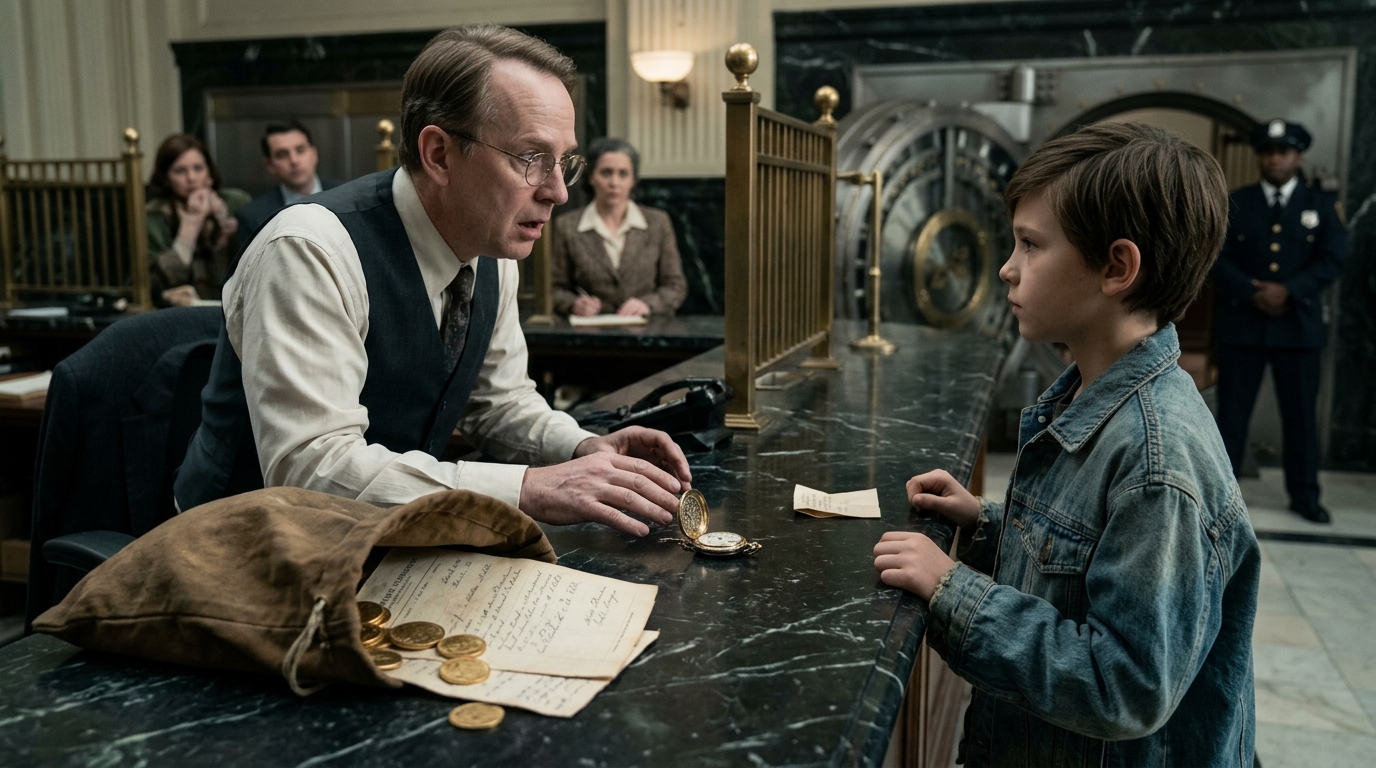
Just a boy in a faded denim jacket, standing in the middle of the lobby with snow melting off his sneakers.
He could not have been more than twelve.
Maybe thirteen.
His hair was dark and slightly too long. His face was pale from the cold. His hands were wrapped tightly around the handles of a large brown canvas sack that looked older than he was.
I was at Window Six, finishing a cashier’s check for a real estate broker who kept tapping his gold pen against the counter.
The broker glanced over his shoulder, saw the boy, and frowned.
People like that always noticed what didn’t belong.
The boy waited.
Not shifting.
Not fidgeting.
Not looking around like a curious child.
Just waiting.
When the broker finally left, I leaned toward the glass partition and forced the tired professional smile I had worn for thirty-one years.
“What do you need?”
The boy looked at me.
His eyes were too serious.
Too still.
For a moment, he did not answer.
Then he lifted the sack with both hands and placed it on the counter.
It landed heavily.
Not like clothes.
Not like books.
Like metal.
My smile faded.
The boy slowly unzipped the bag.
Inside were things no child should have been carrying through the snow.
Old handwritten papers tied with string.
Heavy gold coins wrapped in faded cloth.
A black leather ledger.
And an antique pocket watch with a cracked glass face.
The breath left my body.
I knew that watch.
I had not seen it in twenty-one years, but memory does not always fade the way we beg it to. Some memories wait. Some sharpen in the dark. Some return with the exact weight of a nightmare you thought you had survived.
The watch was silver, with a small black bird engraved on the cover.
A raven.
I heard my chair scrape back behind me.
The boy did not flinch.
“Where did you get these?” I asked.
“My dad’s,” he said.
His voice was low. Calm. Almost rehearsed.
“He told me if something happened to him, I should bring them here. He said you would know what to do.”
The lobby noise seemed to drop away.
The soft conversations.
The tapping shoes.
The muted ring of phones.
The security guard clearing his throat near the front doors.
All gone.
All I could hear was the blood rushing in my ears.
“What is your father’s name?” I asked.
The boy hesitated.
Not because he didn’t know.
Because he had been warned.
Finally, he said, “Thomas Vale.”
My stomach tightened.
That name was not supposed to exist anymore.
At least not inside Blackridge Trust.
I reached carefully for the papers.
My hands were not steady.
One page slipped loose from the bundle and slid across the counter until it stopped against the glass.
Across the top, in faded blue ink, was the name of a company that officially died two decades earlier.
Ravenhill Imports.
A company linked to missing money.
Missing records.
And one missing man.
A man who had walked into this bank after hours one rainy November night carrying that same pocket watch and asking for a private vault box under a false name.
A man I had helped.
A man who vanished before sunrise.
The boy reached into his jacket pocket and pulled out a folded note.
He placed it on the counter without a word.
I opened it.
There was only one line.
If my son is standing in front of you, it means they found me before I could reach the vault.
My fingers went cold.
Because Thomas Vale had not sent his son to a bank.
He had sent him to the scene of a crime.
And twenty-one years after I chose silence over courage, the truth had finally walked back through Window Six.
The Watch I Was Told to Forget
I locked my station.
I did it slowly, with the careful movements of a man trying not to announce panic.
The boy watched me.
“What’s your name?” I asked.
“Noah.”
“Noah Vale?”
He nodded once.
“Is your mother with you?”
His jaw tightened.
“No.”
“Where is she?”
“Gone.”
The word landed with a flatness that told me not to ask the next question in the lobby.
I looked toward the front of the bank.
Dennis, our security guard, stood near the bronze doors with his hands folded in front of him. He was pretending not to watch us, which meant he absolutely was.
Beyond him, the morning clients moved through the bank in their expensive coats, unaware that a child had just placed a ghost on my counter.
“Take the bag,” I said quietly. “Follow me.”
Noah zipped it up and lifted it again.
The sack was heavy enough that his shoulder dipped under the weight, but he did not complain.
We walked away from the teller windows, past the private banking offices, past the framed portraits of Blackridge founders who looked down from the walls like judges. My own reflection followed me in the dark glass of the conference rooms.
Gray hair.
Tired eyes.
A suit that fit worse than it used to.
I looked like a harmless old bank employee.
That had saved me for years.
It had also damned me.
I brought Noah into the small document review room near the vault corridor and closed the door.
The room smelled like printer toner, old paper, and coffee burned too many times on the warmer.
“Sit,” I said.
He didn’t.
Instead, he placed the sack on the table and stood behind it like it was the only thing keeping him upright.
I picked up the pocket watch.
The metal was colder than it should have been.
I pressed the release.
The cover sprang open.
The hands had stopped at 2:17.
They had been stopped there twenty-one years ago too.
I remembered because I had stared at that watch while Thomas Vale sat across from me in the manager’s office, soaked from the rain and shaking badly enough that he spilled coffee on the rug.
I had been twenty-nine then.
A junior accounts officer.
Ambitious.
Cowardly.
The kind of man who knew something was wrong and still waited for someone more important to say it first.
Thomas had not used his real name that night.
He called himself Samuel Gray.
He said he needed a private box.
No questions.
No statements.
No electronic trail.
The old branch manager, Victor Harlan, should have refused. Instead, he took Thomas into the back, called me in as witness, and made me process the paperwork manually.
A false name.
A cash payment.
A vault box entered under legacy client privilege.
Thomas kept looking toward the hallway that night, as if he expected someone to break through the doors.
“Whatever happens,” he told Harlan, “the boy gets it when he comes.”
I had thought he meant a son someday.
But Noah was not born then.
At least, I didn’t think he was.
I looked up at him now.
“How old are you?”
“Twelve.”
Thomas Vale had disappeared nine years before Noah was born.
That should have been impossible.
My throat tightened.
“Noah,” I said carefully, “when did you last see your father?”
He looked down at the sack.
“Three nights ago.”
The room seemed to tilt.
Thomas Vale had been declared dead in 2006.
His disappearance had been tied to the collapse of Ravenhill Imports, a shipping company accused of laundering millions through private accounts. The newspapers called him a fugitive. Blackridge called him a disgraced client. The police called it an unresolved financial disappearance.
But if Noah was telling the truth—
Thomas had been alive all this time.
Hidden.
Hunted.
Waiting.
“Where did he give you this?” I asked.
“At the house.”
“What house?”
He finally looked at me.
“The one under the road.”
A chill moved through me.
“What does that mean?”
Before he could answer, someone knocked on the door.
Not a polite knock.
Two sharp taps.
Then the door opened.
Margaret Ellery, senior vice president of private accounts, stood in the doorway.
Her silver glasses rested low on her nose. Her pearl earrings caught the overhead light. Her smile was calm.
Too calm.
“Martin,” she said. “Dennis said you brought a young visitor back here.”
I stepped slightly in front of the bag.
“Just helping him with a family matter.”
Her eyes moved to Noah.
Then to the canvas sack.
The smile remained.
But something behind it sharpened.
“What family?”
Noah did not answer.
Margaret looked back at me.
“Martin. A word.”
“No.”
It came out before I could soften it.
Her expression changed.
Barely.
But enough.
For the first time in thirty-one years, I had refused her.
The silence that followed felt dangerous.
Then Margaret stepped into the room and closed the door behind her.
“You don’t know what you’re touching,” she said softly.
And that was when I realized she had known the watch would come back someday.
The Name Inside the Ledger
Margaret Ellery had been at Blackridge longer than I had.
Not by much.
But long enough to know where the bodies were buried.
People thought banks kept money.
They were wrong.
Banks kept secrets.
Money was just the polite wrapping around them.
Margaret stood between me and the door, her posture perfect, her hands folded neatly in front of her navy suit.
“Noah,” she said gently, “you must be very frightened.”
The boy’s eyes hardened.
“I don’t know you.”
“No. But I knew your father.”
He flinched.
Small.
Quick.
But I saw it.
So did Margaret.
“Where is Thomas?” she asked.
Noah said nothing.
“Did he tell you to come directly here?”
Nothing.
“Did he tell you to ask for Mr. Hale specifically?”
That made him look at me.
I felt shame burn hot across my chest.
Thomas had remembered my name.
All these years.
After what I failed to do.
“Margaret,” I said, “leave the room.”
Her head turned slowly.
“Don’t be foolish.”
“That’s not a request.”
She smiled with pity.
“Martin, whatever guilt you’ve been nursing over that night, do not mistake it for bravery now.”
There it was.
That night.
She knew.
Maybe she always had.
I placed the pocket watch back on the table.
“What happened to Thomas Vale?”
Her smile vanished.
“You need to stop saying that name inside this building.”
Noah reached into the sack and pulled out the black ledger.
“My dad said to show him this if anyone tried to stop me.”
Margaret went still.
Not tense.
Still.
Like a statue.
I took the ledger carefully.
The leather cover was cracked, but the initials on the corner were clear.
R.I.C.
Ravenhill Imports Company.
I opened it.
The first pages were filled with shipping entries.
Ports.
Dates.
Container numbers.
Invoices.
Then the handwriting changed.
The later pages were not shipping records.
They were payments.
Shell accounts.
Political donations.
Private trust transfers.
Names.
So many names.
Judges.
Police officials.
Hospital board members.
Bank directors.
And near the bottom of one page, written beside an amount larger than my house was worth, I saw a name that made the room feel suddenly airless.
Eleanor Hale.
My wife.
I stared at it.
No.
That was not possible.
Eleanor had died five years ago of ovarian cancer. She had been a school librarian. She hated banks. She hated secrets. She hated men who lied to survive their own comfort.
“What is this?” I whispered.
Margaret’s face had changed completely now.
No smile.
No polish.
Only calculation.
“You don’t want to know.”
But I did.
God help me, I did.
I turned the ledger toward Noah.
“Do you know why my wife’s name is in here?”
Noah swallowed.
“My dad said you’d ask that.”
My hands tightened on the ledger.
“What did he say?”
Noah reached into the sack again and removed a second envelope.
This one had my name written on it.
Martin Hale.
Not typed.
Handwritten.
In Thomas Vale’s hand.
My breath shook as I opened it.
Inside was a photograph.
Old.
Grainy.
Taken at night.
Three people stood beside the rear entrance of Blackridge Trust.
Victor Harlan, the old branch manager.
Thomas Vale, younger and thinner than I remembered.
And my wife Eleanor.
Alive.
Standing between them.
Holding the same black ledger in her hands.
On the back of the photograph, a note was written in blue ink.
Your wife didn’t die before telling the truth. She died because she tried to.
I sat down hard.
The chair creaked beneath me.
Eleanor had been gone five years.
I had mourned her.
Buried her.
Visited her grave every Sunday with white lilies because she loved simple things and never cared for roses.
And now a dead man’s son had walked into my bank carrying proof that she had been part of the one secret I had spent twenty-one years trying to forget.
My vision blurred.
“Martin,” Margaret said quietly, “give me the ledger.”
I looked up.
She had moved closer.
Too close.
Behind her, through the glass slit in the door, I saw Dennis the guard standing in the hallway.
Not casual now.
Waiting.
Margaret extended her hand.
“If you give it to me now, I can still protect you.”
“From who?”
Her eyes flicked toward Noah.
Then back to me.
“From the people who killed your wife.”
The words should have shocked me.
They didn’t.
Some part of me had already known.
Maybe since the moment I saw Eleanor’s name in that ledger.
Maybe since the night she died, when the hospital misplaced her wedding ring and the police report came back too clean.
Maybe since twenty-one years ago, when Thomas Vale looked me in the eye and said, “If they come for me, remember the boy.”
I had not remembered.
I had buried it.
Until the boy stood in front of me.
Noah suddenly grabbed my sleeve.
His fingers were ice cold.
“My dad said there’s another note,” he whispered.
“Where?”
He pointed to the pocket watch.
“Inside the bird.”
I looked down at the raven engraved on the silver cover.
My thumb found the tiny seam beneath its wing.
I pressed.
A hidden compartment clicked open.
Inside was a narrow strip of paper, rolled so tightly it looked like thread.
I unfolded it.
One sentence.
Vault 9 is not a box. It is a room.
Margaret saw it at the same time I did.
Her face drained of color.
Then the bank alarm went off.
The Room That Wasn’t on the Map
The alarm was silent to the clients.
It was not the kind that screamed through the lobby.
Blackridge did not like scenes.
Instead, a small red light began flashing above the document room door.
Lockdown.
Internal.
Controlled.
The kind used when a high-risk client became a liability.
Margaret stepped back.
“Martin,” she said, “listen to me very carefully. You are going to hand me the ledger, the watch, and the boy.”
Noah moved behind me.
I stood.
“No.”
The word felt different this time.
Not accidental.
Chosen.
Margaret’s voice hardened.
“You think this is redemption? It isn’t. It’s suicide.”
“Maybe.”
Her eyes narrowed.
“Your wife understood eventually.”
That sentence hit like a fist.
“What does that mean?”
“It means good people always think truth is enough.” She looked almost sad. “It isn’t.”
Dennis opened the door.
He had removed the snap on his holster.
“Mr. Hale,” he said, “step away from the child.”
I looked at Dennis.
Thirty years of Christmas parties. Retirement cards. Conversations about baseball. His daughter’s graduation photo still sat inside his security booth.
“How much did they pay you?” I asked.
His jaw tightened.
“Don’t make this ugly.”
“It became ugly when you pointed your hand toward a child.”
He looked away.
Just once.
That was all I needed.
I grabbed the ceramic coffee mug from the table and threw it at the overhead light.
Glass exploded.
The room plunged into half-darkness.
Noah moved when I moved.
Good boy.
I shoved the ledger into his sack, grabbed the pocket watch, and pushed open the side archive door behind the copier. Most employees forgot it existed. I did not.
Old buildings have memory.
So do frightened men.
We ran into the records corridor.
Behind us, Margaret shouted my name.
Not afraid.
Furious.
The corridor was narrow, lined with file cages and dead printers. Fluorescent lights buzzed overhead. My knees screamed with every step. I was sixty years old and had spent more time counting wire transfers than running from armed guards.
Noah was faster.
But he kept looking back to make sure I was still there.
“Don’t slow down,” I snapped.
“My dad said not to leave you.”
That nearly broke me.
We reached the service elevator.
I punched the basement button.
Nothing.
Lockdown had killed it.
“Stairs,” I said.
We took the emergency stairwell down.
One flight.
Two.
Three.
Blackridge’s public vault level was basement one.
But Vault 9 was not a box.
It was a room.
And if Thomas had hidden that message inside the watch, then he meant the old sub-basement.
The one no client knew existed.
The one sealed after the flood of 1998.
The one Victor Harlan told me never to mention again.
We reached basement two.
The air changed immediately.
Colder.
Damp.
The walls were older down there, concrete instead of marble, pipes exposed along the ceiling like veins.
Noah’s breathing grew sharp.
“Is this the vault?”
“No,” I said. “This is where the bank hides what the vault can’t explain.”
At the end of the corridor stood an iron door with a keypad.
No label.
No camera.
That told me it mattered.
I tried the old emergency code.
Denied.
I tried Victor Harlan’s employee number.
Denied.
Then I remembered Eleanor.
Her name in the ledger.
Her photograph outside the bank.
Her secret life moving in the shadows of mine.
With shaking fingers, I typed her birthday.
The keypad flashed green.
The lock opened.
For a moment, I could not move.
Eleanor had known.
She had been here.
Maybe many times.
Noah pushed the door gently.
It opened into darkness.
I found the light switch.
Rows of old safe deposit cabinets lined the walls, but most had been ripped open years ago. Metal drawers hung out like broken teeth. The floor was stained from old water damage.
At the center of the room sat a steel table.
On it were boxes.
Photographs.
Cassette tapes.
Hard drives.
A child’s red scarf.
A cracked pair of glasses.
And a stack of missing persons flyers.
My heart sank.
This wasn’t a vault.
It was an archive.
Not of money.
Of people.
I picked up the top flyer.
Clara Benton.
Disappeared, 2004.
Next.
Samuel Ortiz.
Disappeared, 2005.
Next.
Miriam Lake.
Disappeared, 2005.
Then a file marked Ravenhill.
Inside were photographs of shipping containers. Some at ports. Some in private warehouses. Some on Blackridge-owned land.
I opened another file.
My wife’s handwriting covered the margins.
Follow the trust transfers.
Not laundering.
Inheritance theft.
Children removed.
Parents declared unstable.
Assets redirected.
I looked at Noah.
His face had gone pale.
“My dad said the bank stole families.”
I could not answer.
Because he was right.
Ravenhill Imports had not been a dead company.
It had been a machine.
A machine that moved people, erased heirs, redirected fortunes, and buried records inside the most trusted bank in the city.
Thomas Vale had tried to expose it.
Eleanor had helped him.
And I had processed the false vault box that gave them enough time to hide the evidence.
Then I saw a folder at the far end of the table.
Noah Vale.
My blood went cold.
I opened it.
Inside was a birth certificate.
A custody order.
A medical evaluation.
A death certificate.
All prepared.
All unsigned.
Noah stepped closer.
“What is it?”
I couldn’t speak.
Because the death certificate was dated tomorrow.
Before I could hide it, he saw his own name.
The boy staggered back.
“They were going to say I died?”
The iron door slammed behind us.
Margaret stood in the entrance with Dennis beside her.
Her eyes moved to the death certificate in my hand.
Then to Noah.
“You weren’t supposed to see that yet,” she said.
The Last Client of Blackridge Trust
For a second, nobody moved.
The old vault room hummed around us.
Pipes rattled overhead. Somewhere behind the walls, water dripped steadily into the dark.
Noah stood frozen beside the steel table, staring at the paper that declared him dead before anyone had touched him.
I stepped in front of him.
Margaret watched me with something close to disappointment.
“You still don’t understand,” she said.
“I understand enough.”
“No. You understand the crime. Not the scale.”
Dennis shut the iron door.
The sound echoed like a coffin lid.
Margaret walked slowly into the room, passing the safe deposit cabinets, the files, the photographs of people whose lives had been turned into administrative problems.
“Ravenhill was never just a company,” she said. “It was a service.”
“For who?”
“For families who had too much to lose.”
The answer was so casual it sickened me.
“Disputed heirs. Unwanted spouses. Children born outside the plan. Whistleblowers. Addicts with trust funds. Elderly parents who refused to sign.” She looked at the files almost fondly. “Blackridge provided discretion.”
“You murdered people.”
“Some died,” she said. “Most were relocated.”
Noah whispered, “Where’s my dad?”
Margaret looked at him then.
And for the first time, her mask softened.
Not with pity.
With recognition.
“Thomas Vale was the only client who became a problem twice.”
“Where is he?” Noah demanded.
Margaret glanced at Dennis.
That glance told me enough.
Thomas was alive.
Or had been very recently.
I moved before they expected it.
Not toward Margaret.
Toward the table.
I grabbed the old cassette recorder sitting beside the files and threw it at Dennis’s face.
He cursed and raised his arm.
I lunged for his holster.
The gun came free halfway.
We struggled.
My shoulder hit the cabinet.
Pain shot down my spine.
Noah screamed.
The gun went off.
The sound was deafening in the sealed room.
For one terrible second, I thought the boy had been hit.
Then Dennis collapsed against the wall, clutching his leg.
The bullet had ricocheted into him.
Margaret backed toward the door.
I pointed the gun at the floor because my hands were shaking too badly to trust them anywhere else.
“No more,” I said.
She laughed quietly.
“Martin. You think one room stops this?”
“No.”
A new voice spoke from behind her.
“But it starts it.”
The iron door opened wider.
Detective Mara Kline stepped into the room with four uniformed officers behind her.
Margaret’s face changed.
For the first time, she looked truly afraid.
I stared at Mara, unable to understand.
She lifted a small device from her jacket pocket.
A tracker.
Then she looked at Noah.
“Your father told me you’d come here.”
Noah’s mouth fell open.
“My dad?”
Mara nodded.
“He came to me three days ago. Said he had one last chance to bring down Blackridge. He said if anything happened, I should follow the boy.”
“Where is he?” Noah asked.
Mara’s expression tightened.
“We found him this morning.”
The room went still.
Noah took one small step forward.
“Alive?”
Mara looked at me.
Then at the folder in my hand.
Then back at the boy.
“Yes,” she said softly. “But barely.”
Noah broke.
Not loudly.
Not dramatically.
His face simply folded inward, and suddenly he was a child again, not a messenger, not a witness, not a dead company’s last loose end.
Just a boy who wanted his father.
The officers moved in.
Dennis was disarmed.
Margaret was cuffed.
She said nothing as they took her past me.
But when she reached the door, she stopped.
“You’ll open one file,” she said. “Then another. Then another. And eventually you’ll understand why men like you always choose silence.”
I looked at the archive around me.
At the missing faces.
At the death certificate with Noah’s name.
At my wife’s handwriting, still fighting after death.
“No,” I said.
“I already understand.”
Her eyes narrowed.
“Do you?”
I stepped closer.
“I chose silence once because I thought fear would keep me safe. It didn’t. It just made me useful.”
For the first time, Margaret had no answer.
They led her out.
The investigation that followed did not fit neatly into headlines.
Blackridge Trust did not collapse in one day. Institutions that old do not fall like trees. They rot from the inside, then pretend the smell is tradition.
But the vault room changed everything.
The ledgers named judges, executives, police officials, probate attorneys, private doctors, and family offices across four states. The files connected missing people to trust disputes and sealed guardianship cases. The watch, the ledger, and Thomas Vale’s testimony became the first thread in a web so large that federal prosecutors needed three task forces to untangle it.
Thomas survived.
Barely.
He had been found in an abandoned maintenance tunnel beneath an old Blackridge storage property, dehydrated, beaten, and feverish. He had crawled there after escaping the men sent to kill him.
When Noah saw him in the hospital, he did not run.
He walked slowly to the bed, placed the pocket watch in his father’s hand, and whispered, “I did what you said.”
Thomas cried without making a sound.
I stood outside the room and looked away.
Some moments do not belong to witnesses.
Three weeks later, Mara called me to identify several items recovered from Vault 9.
One was Eleanor’s scarf.
Blue wool.
The one she wore the winter before she got sick.
Except she had not been sick then.
Not at first.
The medical records recovered from Blackridge showed that Eleanor’s cancer diagnosis had been delayed deliberately after she refused to surrender what she had learned. A doctor on Blackridge’s payroll had altered her scans, postponed treatment, and told her there was nothing urgent to worry about.
By the time she knew the truth, it was too late.
They had not shot my wife.
They had not crashed her car.
They had done something slower.
Cleaner.
Crueler.
They had let her die on paper before her body understood it.
For a long time after that, I could not enter the bank.
Not that there was much bank left to enter. Federal agents sealed the building. Clients screamed. Lawyers scattered. The marble lobby where people once guarded their valuables became a crime scene photographed from every angle.
Window Six made the news.
So did I.
Former teller helps expose decades-long inheritance trafficking scheme.
They made me sound brave.
I wasn’t.
I was late.
That is a different thing.
Months later, Noah and Thomas came to see me.
Not at Blackridge.
At a small diner near the river where I had started working part-time because retirement did not suit men with too much guilt and too little routine.
Thomas walked with a cane. Noah carried the old canvas sack, now empty except for the pocket watch.
He placed it on the table between us.
“My dad says it belongs to you now,” Noah said.
I shook my head.
“No. It belongs to your family.”
Thomas’s voice was rough from the damage done to his throat.
“It belonged to men who used time to bury people,” he said. “You used it to open the door.”
I looked at the watch.
The hands were still stopped at 2:17.
The hour Thomas first entered Blackridge.
The hour my life split into what I knew and what I refused to know.
I pressed the small knob and wound it.
Once.
Twice.
The hands trembled.
Then moved.
A tiny sound filled the booth.
Tick.
Tick.
Tick.
Noah smiled faintly.
For the first time, he looked his age.
Outside, snow began to fall against the diner windows.
Not hard.
Not dangerous.
Just soft white flakes drifting through the afternoon light.
I thought of Eleanor then.
Her handwriting in the margins.
Her scarf in the vault.
Her courage moving quietly through years of darkness until a boy in a denim jacket carried it back to me in a worn brown sack.
I still visit her grave every Sunday.
But now I bring two things.
White lilies.
And the truth.
Because some vaults are built to protect money.
Some are built to bury sins.
And some, if opened by the right hands at the right time, do what no bank in the world can stop.
They return the dead to the living.