The Child in the Rain
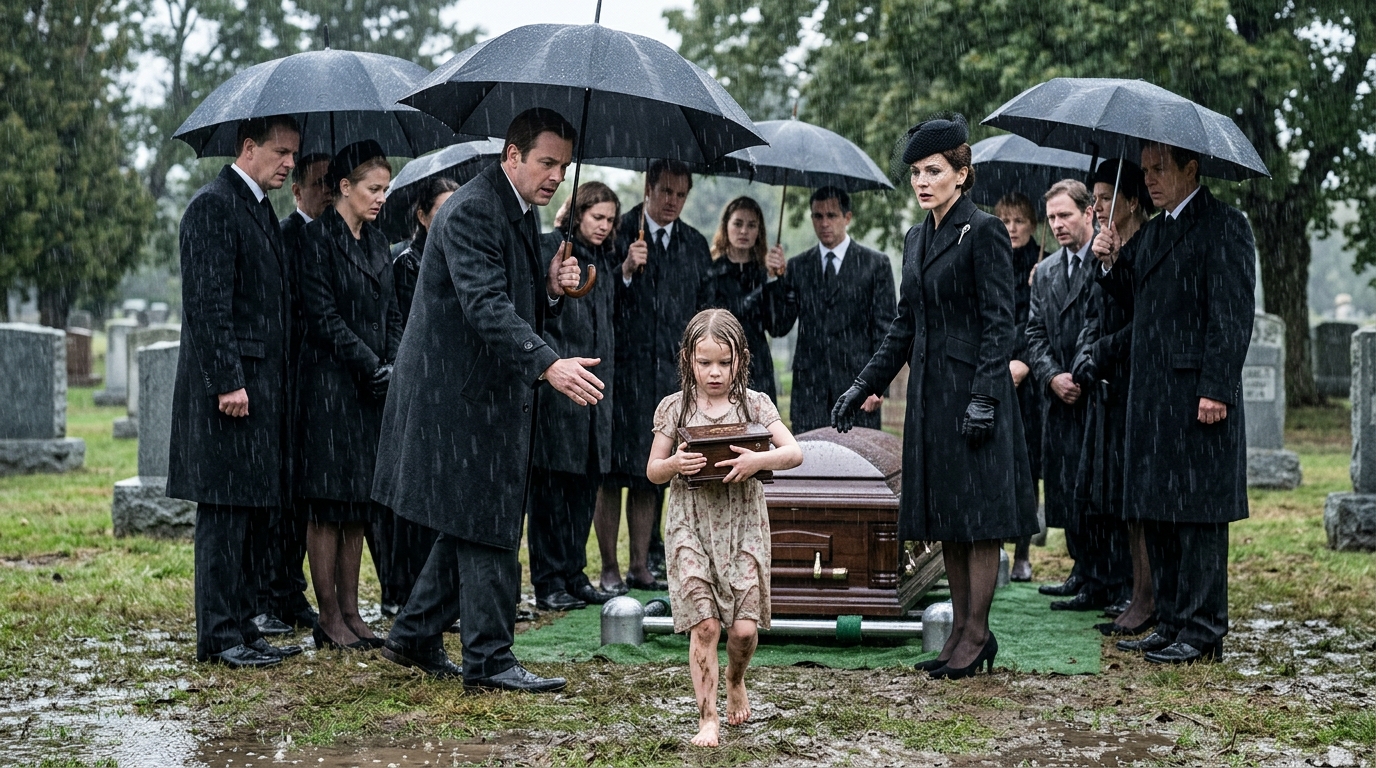
Rain fell so hard the cemetery paths shone like black glass.
Umbrellas clustered around the open grave, dark and polished, their edges trembling in the wind. Mourners stood shoulder to shoulder in long coats and quiet grief, speaking only in whispers, as if the dead man in the coffin might still hear them.
At the front stood the widow.
Vivian Ashcroft.
Elegant.
Controlled.
Dressed in black from her veil to her gloves.
She did not look broken.
She looked arranged.
One hand rested near the coffin as though she owned not only the house, the fortune, and the name, but even the sorrow gathering around the grave.
The man being buried was Daniel Ashcroft.
A self-made hotel magnate.
A philanthropist.
A man whose signature had built half the city’s skyline.
A man who, according to Vivian, had died suddenly and peacefully in his private study.
Everyone had come to honor him.
Business partners.
Judges.
Board members.
Charity directors.
Old friends who looked less sad than careful.
Then someone saw the child.
At first, she was only a small shape moving through the rain beyond the cemetery gate.
No umbrella.
No coat.
No shoes.
A little girl, no older than seven, walking through mud with an old music box clutched tightly against her chest.
Her dress was soaked and torn near the hem. Her hair stuck to her cheeks. Mud clung to her ankles. She looked too small for the storm and too determined for anyone to stop her.
A few mourners turned.
Then more.
Whispers rippled through the crowd.
“Who is that?”
“Where is her mother?”
“Security should get her.”
Vivian saw her last.
But when she did, her face changed.
Only for a second.
Not grief.
Not surprise.
Fear.
Then her voice cut across the rain.
“Stop that child.”
A man in a dark coat stepped forward quickly, blocking the path near the grave.
The little girl tried to move around him.
He caught her by the shoulder.
She twisted away, slipped in the wet grass, and fell to her knees.
Gasps rose from the mourners.
The music box nearly tumbled from her hands, but she hugged it harder, protecting it with her whole body.
Vivian’s mouth tightened.
“Remove her,” she said.
But the little girl looked past the man.
Past the mourners.
Past the coffin.
Her eyes locked on Vivian.
“My daddy said I had to come.”
The cemetery went still.
Even the rain seemed to soften around those words.
Vivian stepped forward.
“You are confused, sweetheart.”
The sweetness in her voice was perfect.
Too perfect.
The girl shook her head, tears mixing with rain on her cheeks.
“No. He told me.”
A murmur spread.
Daniel Ashcroft had no children.
Everyone knew that.
Vivian had spoken often, beautifully, about their private sorrow: the miscarriages, the failed adoptions, the empty nursery Daniel could never bring himself to dismantle.
Her tragedy had become part of her public image.
The generous widow who turned childlessness into charity.
The little girl lifted the music box with trembling hands.
“It has his voice.”
Vivian froze.
The man in the dark coat reached for the box.
The girl pulled it against her chest and screamed.
Not loudly.
Not dramatically.
Like a child who had already lost too much and knew this was the last thing she could not let them take.
An older woman near the front whispered, “Let her open it.”
Vivian turned sharply.
But it was too late.
The little girl’s fingers found the tiny brass latch.
Click.
A soft, broken melody began to play.
Then static.
Then a man’s voice emerged through the rain.
Warm.
Faint.
Unmistakable.
“My daughter…”
The cemetery became stone.
No one moved.
Not the mourners.
Not the man who had tried to stop her.
Not even Vivian.
The little girl looked up through tears.
“He remembered me.”
Vivian’s face drained of color.
“No,” she whispered. “No…”
The recording crackled again.
Daniel Ashcroft’s voice continued.
“If this box reaches my funeral, then Vivian lied.”
The Voice Inside the Music Box
The word hit the grave like thunder.
Lied.
For a moment, nobody spoke.
The priest stood beside the coffin, mouth slightly open, one hand still holding the prayer book. Rain gathered along the edges of the pages and blurred the ink.
Vivian took one step toward the child.
“Turn it off.”
The girl flinched but did not obey.
The recording continued, soft and distorted, but clear enough for every person near the grave to hear.
“My name is Daniel Ashcroft. If you are hearing this, then I did not get the chance to say these words while I was alive. My daughter’s name is Clara.”
The little girl closed her eyes.
As if hearing her name in his voice hurt and healed at the same time.
A wave of whispers moved through the mourners.
Clara.
Daughter.
Daniel Ashcroft.
Impossible.
Vivian’s attorney, Malcolm Reed, stepped forward from the second row. He was a thin man with silver glasses and the face of someone who had spent his life turning panic into paperwork.
“This is highly inappropriate,” he said. “The child is obviously being used by someone.”
The music box crackled again.
“I was told Clara died before I could hold her.”
Malcolm stopped.
Vivian’s gloved hand rose to her throat.
Daniel’s voice continued.
“I believed that lie for six years.”
Clara stared at the coffin.
Her small shoulders shook.
A woman near the back began crying quietly.
Not from grief for Daniel.
From the horror of understanding that the funeral had become a confession.
“My first wife, Elena, did not abandon me. She did not steal from me. She did not take our child and vanish. Vivian showed me documents. Death records. Hospital forms. Letters in Elena’s handwriting. I believed them because grief made me weak.”
Vivian whispered, “Enough.”
But nobody moved to stop the box.
The mourners were listening now.
Really listening.
“Three weeks ago, I found a photograph hidden in the east nursery wall. Elena holding Clara. Alive. Dated two years after the funeral Vivian made me attend.”
The old woman who had first spoken stepped closer.
Her name was Margaret Bell, Daniel’s older sister. She had been pushed out of the family business years earlier after accusing Vivian of controlling Daniel’s staff, doctors, and schedule.
Everyone had called Margaret bitter.
Now her face was pale with vindication.
“Vivian,” Margaret said quietly. “What did you do?”
Vivian did not look at her.
Her eyes stayed on the music box.
The recording lowered slightly, the melody warping under Daniel’s voice.
“I went looking for them. I found Elena first. Too late. She was sick. Hidden under another name. She told me Clara was alive. She told me Vivian had people watching her. She told me not to trust the house.”
Clara opened her eyes.
Her lips moved silently with the words, as if she had heard them many times.
Then Daniel said:
“I met my daughter one time.”
The child’s face crumpled.
“One afternoon in a church basement. She was wearing a blue sweater. She had mud on her shoes. She asked if I was really her father.”
The box crackled.
Daniel’s voice broke.
“I said yes.”
Several mourners began to cry now.
Even men who had come for politics and reputation looked away.
“I promised I would bring her home. I promised I would tell the world before Vivian could stop me.”
A long hiss of static followed.
Then his voice returned, weaker.
“If I died before doing that, Clara was to bring this music box to my funeral. Not to shame the dead. To protect the living.”
The child clutched the box closer.
Vivian suddenly lunged.
Fast.
Desperate.
She grabbed for the music box.
Margaret stepped between them.
So did the priest.
So did a young man in a gray overcoat no one had noticed until then.
He caught Vivian’s wrist before she reached Clara.
“Don’t,” he said.
Vivian stared at him.
Recognition flashed across her face.
“You.”
The man looked at the crowd.
“My name is Aaron Vale,” he said. “I was Daniel Ashcroft’s private investigator.”
Then he turned toward the coffin.
“And Daniel did not die peacefully.”
The Widow’s Perfect Story
The cemetery erupted.
Not loudly.
Rain swallowed most of the noise, but the shock moved like wind through the crowd.
Vivian pulled her wrist free.
“This is absurd,” she said. “Daniel was ill. Everyone knows that.”
Aaron looked at her.
“No. Everyone was told that.”
Malcolm Reed stepped forward.
“I strongly advise you to stop speaking.”
Aaron ignored him.
He crouched beside Clara.
“May I?”
The girl hesitated, then nodded.
Aaron carefully took the music box and pressed a hidden switch beneath the base.
A second compartment opened.
Inside was a small memory card wrapped in plastic.
Vivian’s face went white.
Aaron lifted it.
“Daniel hired me after finding the photograph in the nursery wall. He believed his wife had falsified records concerning Elena Marlowe and their daughter.”
Vivian’s voice was sharp now.
“Elena Marlowe was mentally unstable.”
Clara whispered, “No, she wasn’t.”
Everyone heard her.
The smallness of her voice made the accusation worse.
Aaron stood.
“Daniel also believed Vivian had been manipulating his medication.”
The priest made the sign of the cross.
Margaret turned on Vivian.
“His medication?”
Vivian looked at the open grave.
Then at the mourners.
Then, slowly, the mask returned.
This was the woman the city knew.
Beautiful in grief.
Elegant under pressure.
Wronged by spectacle.
“Do you all hear yourselves?” she asked. “A muddy child appears at a funeral with a toy box, and suddenly I’m accused of murder?”
“She is not muddy,” Margaret said. “She is your husband’s daughter.”
Vivian’s eyes flashed.
“My husband had no daughter.”
The cruelty of that sentence fell directly on Clara.
The girl lowered her head.
Aaron stepped forward.
“That is exactly what you needed everyone to believe.”
He opened a folder beneath his coat and removed several documents sealed in evidence sleeves.
“Birth certificate. Clara Elena Ashcroft. Father: Daniel Ashcroft. Mother: Elena Marlowe.”
Malcolm’s voice sharpened.
“Those could be forged.”
Aaron removed another page.
“DNA test. Completed eleven days ago. Daniel and Clara. Biological father and child.”
The cemetery went silent again.
This time, there was no room left for polite doubt.
Vivian’s perfect black veil trembled in the wind.
Margaret reached for Clara, but the child stayed where she was, knees in the wet grass, staring at the coffin.
“He was going to come get me,” she whispered.
Aaron’s expression softened.
“Yes.”
“When?”
“Tomorrow.”
That single word broke her.
Clara bent over the music box and sobbed.
Not like a child throwing a tantrum.
Like a child who had learned hope too late.
The rain struck her back.
No one knew what to do with such grief.
Then Aaron continued.
“Daniel moved to change his will this week. He planned to remove Vivian as sole beneficiary and name Clara his legal heir.”
Vivian turned toward him slowly.
“You have no proof.”
Aaron looked toward the cemetery gate.
“I have more than proof.”
Two black cars pulled up beyond the iron fence.
Detectives stepped out.
Behind them came a woman in a dark blue coat, holding a medical examiner’s case file against her chest.
Vivian took one step back.
Aaron said, “I have the exhumation order.”
Malcolm whispered, “Vivian…”
She slapped him.
Hard.
The sound cracked across the cemetery.
Everyone froze.
Vivian realized too late what she had done.
Her control had finally slipped in public.
Aaron looked at the detectives.
“Mrs. Ashcroft arranged for Daniel’s burial within forty-eight hours of death and refused an independent autopsy. His sister’s petition was denied by a judge connected to the Ashcroft Foundation.”
The woman in the blue coat stepped forward.
“Not anymore,” she said.
Vivian’s eyes widened.
Margaret whispered, “Daniel knew.”
Aaron nodded.
“He recorded everything.”
The music box, still playing faintly in Clara’s hands, clicked one final time.
Daniel’s voice returned for the last line.
“Vivian did not only steal my daughter. She is trying to bury the truth with me.”
The House That Hid Clara
Daniel’s funeral did not finish that day.
The coffin was taken away under court order.
The mourners remained in the rain long after the detectives escorted Vivian from the grave.
Not in handcuffs.
Not yet.
Women like Vivian rarely left in handcuffs at the first scene.
They left with lawyers, statements, and expressions of wounded dignity.
But the city had seen enough.
And more importantly, Clara had been seen.
Margaret brought the child to her car and wrapped her in a wool coat from the back seat. Clara barely spoke. She held the music box in her lap with both hands, as if someone might still try to take it.
Aaron followed them to the Ashcroft estate.
Not the main house.
Vivian had already locked that behind legal claims.
Instead, they went to Margaret’s small guest cottage on the edge of the property, the one Daniel had kept paying taxes on even after Vivian pushed his sister out.
Inside, Clara sat near the fireplace while Margaret washed the mud from her feet.
When Margaret saw the bruises around the child’s ankles, she stopped.
Her hands began to shake.
“Who did this?”
Clara looked down.
“The woman who kept the keys.”
“What woman?”
Clara looked at Aaron.
“The one at the white house.”
The white house was not the Ashcroft mansion.
It was a private facility funded by Vivian’s children’s charity.
Officially, it was a transitional residence for vulnerable mothers and children.
In truth, it was where Elena had been kept after Vivian forced her out of Daniel’s life.
Elena had been Daniel’s first wife in every way but legal recognition.
They had married privately overseas during one of Daniel’s early business expansions, before Vivian entered his company as legal counsel. When Daniel’s father contested the marriage, Vivian offered to “fix” the paperwork.
Instead, she buried it.
Elena became a liability.
Then Clara became a threat.
The white house provided the mechanism.
Women were labeled unstable.
Children were renamed.
Visitors were restricted.
Records were sealed under charity protection.
Daniel never knew because every letter from Elena was intercepted.
Every call was rerouted.
Every attempt to reach him was framed as harassment.
By the time Elena escaped with Clara, Vivian had already convinced Daniel his wife had died and their baby with her.
For years, Elena hid.
She moved from church basements to shelters to rented rooms under borrowed names. She carried the music box because Daniel had once given it to her when she was pregnant.
Inside it, he had recorded a message for their unborn child.
A simple message.
My daughter, if you ever hear this, know that I loved you before I knew your face.
Elena played it for Clara every birthday.
That was how Clara knew his voice.
That was why she did not hesitate at the funeral.
She had never known him.
But she had been loved by him in a box of old metal and music.
Daniel found them too late.
Elena was dying by then.
A lung illness left untreated because every hospital visit risked exposing Clara to Vivian’s network.
She gave Daniel the truth.
He gave Clara the updated recording.
And the next morning, Daniel collapsed in his study.
Vivian called it heart failure.
Aaron called it timing.
The exhumation proved poison.
Not dramatic.
Not fast.
A slow medication interaction arranged through Daniel’s private physician, Dr. Samuel Voss, who had been paid through a shell account connected to Vivian’s foundation.
Dr. Voss confessed first.
Cowards often do.
Vivian’s attorney flipped second.
The judge who denied Margaret’s first petition resigned before indictment.
By then, the music box had become famous.
The barefoot girl at the funeral.
The dead father’s voice.
The widow turning pale in the rain.
But headlines never held the worst parts.
They did not show Clara waking at night asking if Daniel was still in the ground.
They did not show Margaret learning how to braid a frightened child’s hair with hands that had not cared for a little girl in decades.
They did not show Aaron standing outside the cottage each evening because Clara felt safer knowing someone was watching the road.
Justice began in court.
Healing began much slower.
The Daughter He Remembered
Vivian Ashcroft’s trial lasted nine months.
She arrived every day in black.
Not mourning black.
Performance black.
Tailored.
Elegant.
Insultingly calm.
Her defense was simple.
Elena had lied.
Clara had been coached.
Daniel had been confused.
Aaron had manipulated evidence.
Margaret wanted revenge.
Then prosecutors played the music box recording.
After that, Vivian’s story began to crack.
They played Daniel’s later video testimony too, recovered from Aaron’s files. In it, he sat in his study, pale but determined, holding Clara’s birth certificate in one hand and the music box in the other.
“I let grief make me obedient,” he said. “That was Vivian’s greatest weapon. She did not need me cruel. She needed me broken.”
Clara watched from a separate room with Margaret.
She did not attend court until the final day.
At sentencing, she wore a simple blue dress and shoes that fit.
She carried the music box.
Vivian refused to look at her.
That was the closest thing to guilt she ever showed.
When the judge sentenced Vivian to life for murder, conspiracy, fraud, unlawful confinement, and crimes connected to Elena and Clara’s disappearance, the courtroom remained quiet.
No cheers.
No applause.
Only a long exhale from people who had been holding the truth too long.
Afterward, Margaret took Clara to Daniel’s real funeral.
This time, there were no cameras.
No public figures.
No performance.
Only a small gathering beneath the oak trees at the far edge of the cemetery.
The grave was no longer a stage.
It was just a place to say goodbye.
Clara stood beside the coffin, holding the music box.
For a long time, she said nothing.
Then she opened it.
The melody played softly.
Daniel’s first recording filled the air.
“My daughter, if you ever hear this, know that I loved you before I knew your face.”
Clara cried then.
Not like she had in the rain.
Not desperate.
Not afraid.
This grief was different.
It had a name now.
A place.
A father.
Margaret knelt beside her.
“He would have come for you sooner if he had known.”
Clara wiped her face.
“I know.”
“Do you?”
Clara looked at the coffin.
Then at the music box.
“He remembered me,” she said.
Three words.
Not everything.
But enough for that day.
Years later, Clara would learn the full shape of what had been stolen from her. The houses. The trust. The family name. The photographs Vivian destroyed. The letters Elena wrote and Daniel never received.
But Margaret did not give it to her all at once.
Children do not need the entire weight of truth dropped on them to prove adults are finally honest.
They need safety first.
Then answers.
Then time.
The Ashcroft mansion was never returned to its old life.
Margaret sold part of the estate and turned the main house into the Elena Marlowe Center, a legal advocacy home for mothers and children trapped in coercive guardianship and charity fraud cases.
Clara chose the name.
Not Daniel’s.
Not Ashcroft.
Her mother’s.
The old music box sits now in a glass case near the entrance, beneath a photograph of Daniel, Elena, and Clara taken during the only afternoon they were ever together.
Visitors often stop there.
They read the plaque.
They listen to the little recording button beside it.
Not the trial recording.
Not the accusation.
The first one.
The father’s voice.
My daughter.
Clara visits the cemetery every year on the day she walked through the rain.
She brings flowers for Daniel.
And for Elena.
She always takes off her shoes before stepping onto the grass near his grave.
Margaret once asked why.
Clara looked down at her bare feet, then toward the stone path shining after a light rain.
“Because that’s how he met me,” she said.
Margaret did not correct her.
Daniel had not met Clara at the funeral.
Not really.
But the world did.
And sometimes being seen is the first form of being brought home.
On Clara’s tenth birthday, Aaron gave her the restored music box.
The dents were repaired.
The mechanism cleaned.
The hidden recorder preserved.
He had added one thing beneath the lid.
A new engraving.
For Clara, who carried the truth through the rain.
She traced the words with one finger.
Then closed the box gently.
Outside, rain began to fall against the windows.
Clara did not flinch anymore.
She listened.
For a long moment, she simply listened.
Then she smiled.
Not because the past had become gentle.
It had not.
But because the sound no longer belonged only to the day she fell in the grass with everyone staring.
It also belonged to the day her father’s voice rose from the music box and refused to let a lie finish burying him.
And her.
That was the gift Daniel left behind.
Not money.
Not a name.
Not even revenge.
A voice.
A memory.
A final truth strong enough to reach his daughter after death and say what no widow, no grave, no storm could silence.
I remembered you.