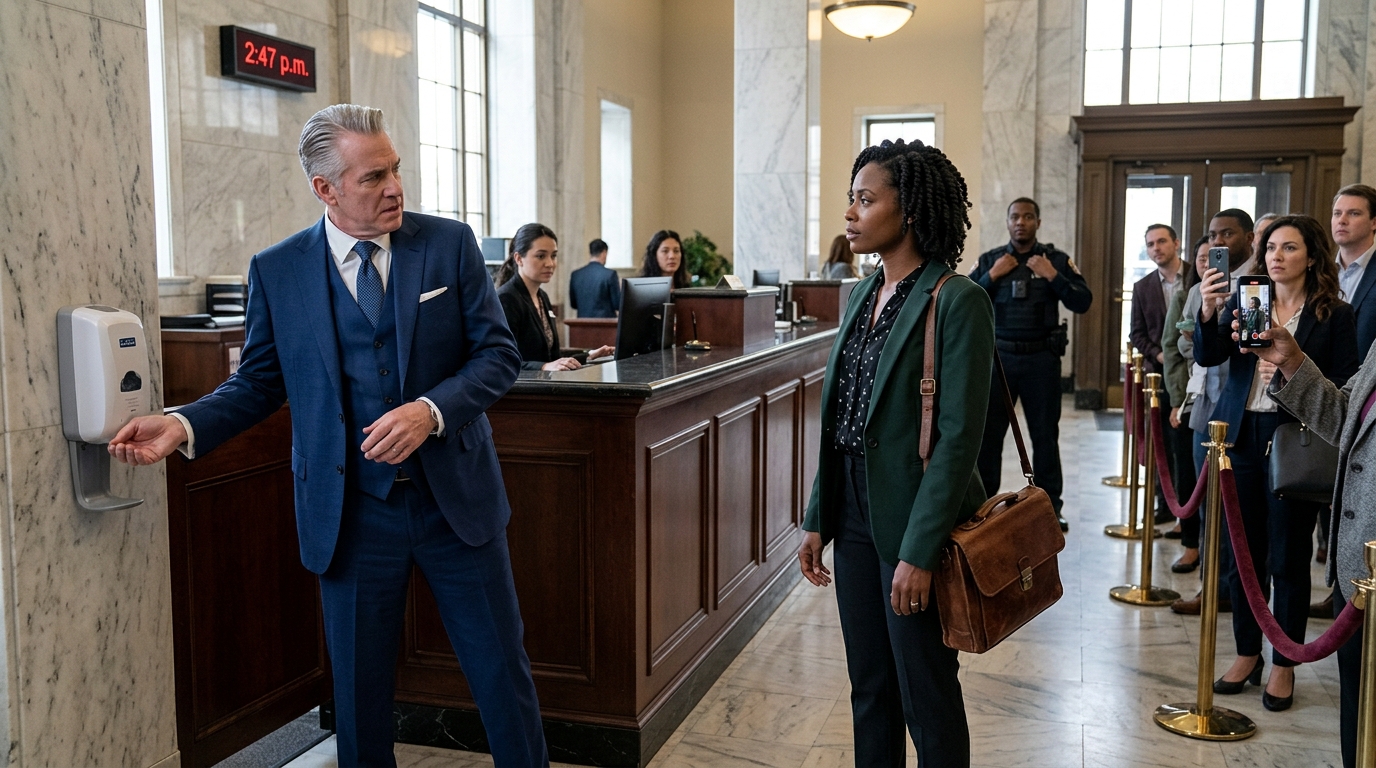
The Hand He Refused
“I don’t shake hands with staff.”
The words landed in the marble lobby like something dropped from a great height.
For three seconds, Dr. Amara Kingston’s hand remained in the air.
Not trembling.
Not withdrawing.
Just there.
Open.
Offered.
Ignored.
Around her, the lobby of First National Trust went still.
Twelve customers in line stopped talking. Three tellers froze mid-transaction. A security guard near the glass doors shifted his weight and instinctively touched the body camera clipped to his chest.
The branch manager, Regginald Whitmore III, looked at Amara’s outstretched hand as if it were something unsanitary.
Then he pulled his own perfectly manicured hand back.
Slowly.
Deliberately.
With a smile that told the room he wanted witnesses.
“I don’t shake hands with staff,” he repeated, louder this time.
Amara lowered her hand.
No flinch.
No gasp.
No wounded performance.
Just one quiet breath.
She stood in a simple charcoal blazer, a cream blouse, and low black heels that had seen more airports than ballrooms. A weathered leather briefcase hung from her shoulder. Her hair was pinned neatly at the nape of her neck. There were rain droplets on the sleeve of her blazer because no one had offered to take her coat when she arrived.
That had been the first sign.
The second was the way the receptionist looked past her twice before asking if she was there for housekeeping payroll.
The third was Regginald.
He had walked out of his glass office with the impatient confidence of a man who believed every room was already arranged in his favor.
Now he turned toward the hand sanitizer station beside the reception desk and pressed the dispenser twice.
“Hygiene protocols,” he muttered.
Just loud enough.
A woman in line lifted her phone.
The red recording light flickered on.
Amara saw it.
So did Regginald.
His posture changed immediately.
Not apologetic.
Performative.
He smiled toward the lobby, as if the insult had been a harmless misunderstanding and the crowd too simple to interpret it correctly.
“Now,” he said, smoothing the front of his navy suit, “how can we assist you today?”
Amara stepped closer to the polished counter.
“I’d like to schedule a private consultation about portfolio restructuring.”
Regginald’s eyebrows lifted.
“Portfolio restructuring.”
“Yes.”
“For yourself?”
“For the account I represent.”
His smile grew thinner.
“And what sort of account would that be?”
“A managed institutional portfolio.”
He looked at her briefcase.
Then her shoes.
Then her face.
That final glance lasted half a second too long.
“Ma’am,” he said, “our institutional services are handled by appointment only. High-net-worth and corporate clients have separate intake protocols.”
“I’m aware.”
“Wonderful. Then you understand we cannot have people simply walk in and request executive-level attention.”
Amara looked past him to the digital clock above the reception desk.
2:47 p.m.
On the monitor inside Regginald’s corner office, visible through the glass wall, a calendar reminder glowed:
Board meeting 3:35 p.m. Q3 performance review.
Forty-eight minutes.
Regginald needed this afternoon to go perfectly.
That was why Amara had chosen it.
“I called ahead,” she said.
He chuckled.
“I’m sure you did.”
One of the tellers looked down.
The security guard’s jaw tightened.
The woman recording raised her phone higher.
Amara opened her briefcase and removed a small black folder.
Regginald sighed before she even placed it on the counter.
“Let me guess. A complaint?”
“No.”
She slid the folder toward him.
“A transfer authorization.”
He picked it up with two fingers.
Annoyed.
Bored.
Already planning how quickly he could return to the office where his board packet waited.
Then he opened it.
His expression did not change at first.
He scanned the first page casually.
Then again.
Slower.
His eyes stopped on the letterhead.
Kingston Global Health Endowment.
Then on the authorized signatory line.
Dr. Amara Kingston, Chairwoman and Managing Trustee.
Then on the amount.
$3,000,000,000.
His fingers tightened around the folder.
The lobby seemed to shrink.
Amara looked at him calmly.
“I’d like to move the full portfolio out of First National Trust before your board meeting.”
The Account He Thought Was Small
Regginald did not speak.
That was how everyone knew something had gone wrong.
He had been loud until then.
Comfortably loud.
The kind of man who filled silence because he assumed silence belonged to people beneath him.
Now he stood behind the counter holding a folder that seemed to grow heavier with every second.
“I’m sorry,” he said finally.
The words came out wrong.
Not apologetic.
Disbelieving.
Amara tilted her head slightly.
“Are you?”
His eyes flicked toward the woman filming.
Then to the security guard.
Then back to the document.
“This must be routed through headquarters.”
“It already was.”
“That is not possible.”
“It is.”
His jaw tightened.
“Dr. Kingston—”
For the first time, he used her title.
The lobby noticed.
So did Amara.
“I was told this branch could process executive transfer verification,” she said.
“Yes, but—”
“But?”
He swallowed.
The number on the page had turned him pale.
Three billion dollars did not move like ordinary money. It moved like weather. It changed quarterly reports, board conversations, executive bonuses, shareholder confidence, and the career trajectory of every manager close enough to blame.
Regginald knew that.
He also knew his 3:35 p.m. board presentation depended on showing strong retention in institutional accounts.
Kingston Global Health Endowment was not just any account.
It funded hospitals, rural clinics, medical scholarships, maternal care programs, emergency vaccine research, and university fellowships across four continents. It had been with First National Trust for twenty-seven years.
Losing it would not be a transaction.
It would be an event.
Regginald lowered his voice.
“Perhaps we should continue this conversation in my office.”
Amara did not move.
“You mean the one I was not qualified to enter three minutes ago?”
A small sound moved through the lobby.
Not laughter.
Recognition.
Regginald’s face hardened.
“Dr. Kingston, I believe we got off on the wrong foot.”
“No,” she said. “You placed us there deliberately.”
The security guard looked down, trying not to smile.
Regginald leaned closer.
“Let’s not make this theatrical.”
Amara glanced at the phones now raised around the lobby.
“You already did.”
His smile disappeared.
For a moment, the polished manager was gone.
What remained was a man doing math under pressure.
“Fine,” he said. “If you want formal processing, we’ll begin formal processing.”
He turned to the nearest teller.
“Bring up institutional transfer verification.”
The teller, a young woman named Denise, hesitated.
“Sir, that requires dual authorization.”
“I know what it requires.”
Denise sat at her terminal, hands moving quickly.
Amara remained standing.
Regginald entered his override code.
The system loaded.
At first, the screen showed ordinary account information.
Then the file expanded.
A red notification appeared.
REPUTATIONAL RISK HOLD ACTIVE.
Regginald froze.
Denise stopped typing.
Amara watched him.
“What is that?” Regginald asked.
Denise looked frightened.
“Sir, it’s attached to the endowment account.”
“Remove it.”
“I can’t.”
“Why not?”
Denise swallowed.
“It says the hold was placed by Compliance and Civil Rights Review.”
That was when Amara opened the second flap of her briefcase.
She removed another folder.
This one was thicker.
Older.
Worn at the edges.
She placed it beside the transfer authorization.
“For the last eighteen months,” she said, “our office has documented complaints from minority clients, employees, contractors, and scholarship beneficiaries who were treated differently at this branch.”
Regginald’s face went still.
“Careful.”
Amara continued.
“Delayed appointments. Repeated identity challenges. Security called without cause. Loan applicants discouraged before intake. Black and Hispanic small-business owners routed away from commercial desks. Staff instructed to classify certain clients as ‘walk-in risk’ before reviewing assets.”
The lobby was silent now.
Completely.
Regginald whispered, “You don’t know what you’re accusing us of.”
“No,” Amara said. “I know exactly what I’m proving.”
Then Denise’s screen blinked again.
A new message appeared.
External auditor present.
Branch review now live.
Regginald turned toward Amara slowly.
And for the first time, fear replaced arrogance.
The Woman Who Came Prepared
Amara had not come to First National Trust because she wanted revenge.
That was what people later assumed.
The video made it look that way.
The insult.
The sanitizer.
The public humiliation.
The $3 billion transfer.
It was satisfying to watch if you did not know the history.
But Amara knew satisfaction was not the same as justice.
Her father had taught her that.
Dr. Joseph Kingston had been a surgeon in Atlanta before he became a hospital administrator, then a public health advocate, then the founder of the Kingston Global Health Endowment. He opened clinics in towns banks ignored. He funded mobile health units in places politicians only visited during campaigns. He believed money was a tool, not a throne.
When he died, Amara inherited not only control of the endowment, but his final warning.
Never trust an institution that smiles at your money and sneers at your people.
At first, she thought First National Trust was simply outdated.
Then the complaints began.
A Black clinic director in Mississippi was asked for three forms of ID to access an account he had managed for eleven years.
A Latina nonprofit founder was told she might be “more comfortable” with a community bank when applying for expansion financing.
A Nigerian-born physician was escorted out after questioning why his wire transfer was delayed for the fourth time.
A junior analyst named Tasha Reed filed an internal complaint alleging that Regginald Whitmore told staff to “protect the marble from the bus station crowd.”
Her complaint disappeared.
Then Tasha was fired.
Amara requested an internal review.
The bank sent apologies.
Then delays.
Then summaries with phrases like inconsistent service experience and training opportunity.
Not discrimination.
Never discrimination.
Power loves soft language.
So Amara changed strategy.
She hired outside auditors. She interviewed former employees. She collected videos, emails, branch memos, and customer statements. She waited until the evidence was no longer emotional.
It was structural.
Then she scheduled her visit.
Not through VIP channels.
Not through the private wealth entrance.
Through the lobby.
She wanted to know what happened when the bank saw her before it saw her balance.
Regginald gave her the answer in under four minutes.
Now he stood behind the counter as the branch review system opened records he did not know Amara had already seen.
Denise’s screen displayed internal tags.
WALK-IN RISK.
NONSTANDARD CLIENT.
REQUIRES SECURITY OBSERVATION.
POTENTIAL DOCUMENTATION ISSUE.
Amara pointed to the screen.
“These labels appear disproportionately on accounts held by Black and Hispanic clients, even when assets exceed branch average.”
Regginald’s mouth tightened.
“That is an operational classification.”
“It is a coded gatekeeping system.”
“That is your interpretation.”
“No,” said a voice from behind him. “It is ours too.”
Everyone turned.
A woman in a gray suit entered through the main doors with two attorneys and a man carrying a tablet.
She was older, silver-haired, and calm in a way that made Regginald look suddenly small.
“Elaine Porter,” she said. “Independent compliance monitor for the Kingston Endowment.”
Regginald’s face drained.
“You can’t conduct an audit in my lobby.”
Elaine looked around.
“Apparently, we can.”
Amara opened the final folder.
“This is my formal notice to remove all Kingston Global Health Endowment assets from First National Trust unless the board agrees, before close of business, to independent civil rights oversight, restitution review, reinstatement proceedings for wrongfully terminated staff, and public disclosure of discriminatory account flagging.”
Regginald laughed.
It was a bad choice.
Too thin.
Too desperate.
“You think the board will let one client dictate policy?”
Amara looked at the transfer form.
“One client?”
Elaine tapped her tablet.
“Fourteen institutional partners have signed contingent withdrawal letters.”
Regginald stopped laughing.
“Total exposure,” Elaine continued, “is $8.6 billion.”
The lobby erupted.
Phones lifted higher.
Customers whispered.
Denise covered her mouth.
Amara looked at Regginald.
“You refused to shake one hand,” she said. “You forgot how many hands were connected to it.”
The clock above reception changed.
3:12 p.m.
Twenty-three minutes until the board meeting.
Then Regginald’s office phone began to ring.
The Board Meeting That Started Early
The phone rang six times before Regginald moved.
Nobody told him to answer.
Nobody needed to.
Every person in the lobby understood the call was coming from above him.
He walked into his glass office with stiff shoulders and picked up the receiver.
Through the glass, the room watched his face.
At first, he spoke.
Then listened.
Then stopped speaking entirely.
Amara remained by the counter.
Denise whispered, “Dr. Kingston?”
Amara turned.
“Yes?”
The young teller’s eyes were wet.
“I’m sorry.”
Amara studied her.
“For what?”
Denise looked toward Regginald’s office.
“For not saying anything.”
There were many answers Amara could have given.
She chose the truest.
“Start now.”
Denise nodded.
Then she turned back to her terminal and printed the internal tags, transaction delays, appointment denials, and override logs before anyone could tell her not to.
The security guard did the same with his body camera file.
A customer in line said her husband’s business loan had been dismissed without review.
Another said her father had been asked whether he was “sure” he belonged in the premier client line.
Stories began rising from the lobby.
One after another.
Not dramatic.
Worse.
Ordinary.
That was how discrimination survived in polished places.
Not always through slurs shouted across counters.
Sometimes through delays.
Tone.
Extra questions.
Closed doors.
Smiles that never reached the eyes.
Regginald emerged from his office at 3:21 p.m.
His skin had gone gray beneath the careful tan.
“Dr. Kingston,” he said. “The board would like to speak with you.”
“I know.”
“They are prepared to discuss your concerns.”
“That is not enough.”
His jaw tightened.
“What do you want?”
“Your resignation.”
The lobby froze.
Regginald blinked.
Then smiled with pure disbelief.
“You’re serious.”
“Yes.”
“You think you can walk in here with a camera crowd and force me out?”
“No,” Amara said. “I think you already did that yourself.”
Elaine turned her tablet toward him.
On screen was an internal email.
From Regginald Whitmore III.
Subject: Lobby Standards.
The email read:
High-value clients expect a certain atmosphere. Staff should discourage nonaligned walk-ins from lingering near premier service areas. If they look like service personnel, redirect them before they create discomfort.
Regginald stared at it.
A second email appeared.
This one was worse.
Use hygiene station after contact when necessary. It signals standards without confrontation.
The lobby went silent in a different way now.
The sanitizer had not been improvised.
It had been policy.
His policy.
Amara looked at him.
“You did not mistake me for staff. You treated staff as something beneath human courtesy.”
For the first time, Regginald had no words.
At 3:28 p.m., the board meeting began early.
Not in the executive conference room.
On a video screen in the lobby.
The board chair, Margaret Ellison, appeared with five directors behind her.
Her face was pale.
“Dr. Kingston,” she said, “we have reviewed the preliminary materials.”
Amara nodded.
“And?”
Margaret swallowed.
“Mr. Whitmore has been placed on immediate administrative leave pending termination review.”
Regginald turned toward the screen.
“Margaret—”
She cut him off.
“Do not speak.”
The lobby heard it.
All of it.
Margaret continued.
“The board will vote today on independent oversight and emergency review of discriminatory practices across all branches.”
Amara’s voice remained calm.
“And restitution?”
“Yes.”
“Reinstatement review for terminated employees?”
“Yes.”
“Public disclosure?”
Margaret hesitated.
Amara reached for the transfer authorization.
Margaret said, “Yes.”
Regginald looked around the lobby.
At the customers.
At the tellers.
At the security guard.
At the woman whose hand he had refused.
His face twisted.
“You people have no idea what it takes to maintain standards.”
The sentence finished him.
Even Margaret closed her eyes.
Amara stepped closer.
“No, Mr. Whitmore. We know exactly what your standards cost.”
The Hand He Finally Needed
By evening, the video had spread everywhere.
Not the edited version.
The whole thing.
Amara’s hand offered.
Regginald pulling away.
The sanitizer.
The red recording light.
The transfer form.
The emails.
The board meeting starting early in the lobby.
People called it poetic.
Amara did not.
Poetry was too gentle a word for what had happened in that bank.
Regginald resigned before the termination vote finished.
His resignation letter mentioned “unfair public characterization” and “context collapse in the digital age.”
No apology.
None that mattered.
First National Trust lost the Kingston Global Health Endowment anyway.
Amara moved the full $3 billion over three weeks, not because the board refused reform, but because trust cannot be restored by panic.
The other institutions did not all withdraw.
Some stayed after the bank agreed to oversight.
Some left.
The total loss came to $4.2 billion.
Enough to force change.
Not enough to fix everything.
Money can pressure an institution.
It cannot cleanse it.
Tasha Reed was reinstated with back pay and later became regional director of equitable client access.
Denise was promoted after testifying about internal practices.
The security guard’s body camera file became part of a civil rights inquiry.
The customer who filmed the first insult testified before a state banking committee.
New rules followed.
Independent audits.
Transparent service metrics.
Branch-level discrimination reporting.
A ban on coded account tags.
Whistleblower protections.
First National Trust issued a public apology written by lawyers.
Amara read it once.
Then placed it in a drawer and forgot about it.
She cared more about what happened six months later.
A clinic director in Mississippi received expansion financing after being denied twice.
A small-business owner in Chicago got a loan review without being asked to prove she was “serious.”
A widowed father in Detroit accessed his late wife’s trust without being sent to three different departments because his last name “raised verification concerns.”
Those stories did not go viral.
They mattered more.
One year after the lobby incident, Amara returned to the same branch.
Not for a confrontation.
For a meeting.
The marble was still there. The chandeliers still shone. The counters were still polished. Banks rarely change their faces quickly.
But the lobby felt different.
The security guard nodded at her.
Denise, now assistant branch manager, came out from behind the counter.
She extended her hand.
“Dr. Kingston.”
Amara shook it.
Firmly.
Warmly.
The lobby continued moving around them.
No silence.
No spectacle.
Just ordinary respect.
That was the goal all along.
Near the old sanitizer station, now moved away from the reception desk, a small plaque had been installed.
Service begins with dignity.
Amara thought it was a little too polished.
A little too corporate.
But she allowed herself a small smile.
In the conference room, the bank presented its annual oversight report. The numbers were not perfect. Some branches still showed disparities. Some managers still needed removal. Some habits had simply learned quieter language.
Amara marked every weakness in the margins.
Afterward, as she left the building, someone called her name.
She turned.
Regginald Whitmore stood near the curb.
He looked different.
Less polished.
No expensive watch. No pocket square. No invisible stage beneath his feet.
For a moment, Amara considered walking away.
Then she waited.
He approached slowly.
“I wanted to say something,” he said.
She said nothing.
“I was wrong.”
The words sounded unfamiliar in his mouth.
Maybe that made them honest.
Maybe not.
Amara watched him.
He continued.
“What I did that day was humiliating.”
“Yes,” she said.
He swallowed.
“I have thought about it every day.”
“That is between you and your conscience.”
He looked down.
Then, awkwardly, he extended his hand.
Not confidently.
Not like a man offering reconciliation.
Like a man asking whether he was allowed to begin understanding the thing he once refused.
Amara looked at his hand.
The old lobby silence seemed to return for one second in her memory.
Then she looked back at his face.
“No,” she said.
His hand lowered.
She stepped past him.
Then stopped.
“You wanted a handshake after you lost power,” she said. “The test was what you did when you thought I had none.”
He closed his eyes.
She walked away.
Not angry.
Not triumphant.
Free.
At the curb, a young Black woman in a teller uniform was helping an elderly client into a car. A banker held the door open for a construction worker with paint on his boots. Inside, a man with a thick accent was being guided toward the premier desk without being asked twice if he had an appointment.
Small things.
Ordinary things.
The kind of things that should never have required three billion dollars to demand.
Amara climbed into her car and opened her briefcase.
Inside was her father’s old fountain pen.
She carried it to every major meeting.
On its side, he had engraved one sentence:
Make money answer to mercy.
That day in the lobby, Regginald Whitmore thought he was refusing to shake hands with staff.
He was wrong in every possible way.
He was refusing a woman.
A trustee.
A doctor.
A witness.
A daughter of a man who had taught her that wealth without dignity was just another locked door.
And when she opened that door, the sound traveled farther than anyone in First National Trust expected.