The Accusation Under the Candlelight
The violin stopped the moment the girl cried out.
That was the sound I remembered first.
Not the woman screaming.
Not the silverware striking porcelain as guests turned in their chairs.
Not even the sharp scrape of the hostess stand being knocked sideways near the entrance.
It was the violin.
One clean note hanging in the air, trembling beautifully for half a second, then dying as if the musician’s hands had forgotten what music was.
The dining room of La Corona glowed like a Roman dream. Gold leaf shimmered along the ceiling arches. Candlelight leaned against white tablecloths and crystal glasses. Waiters in black jackets moved between tables with the quiet obedience of shadows.
Everything in that room had been designed to make wealth feel sacred.
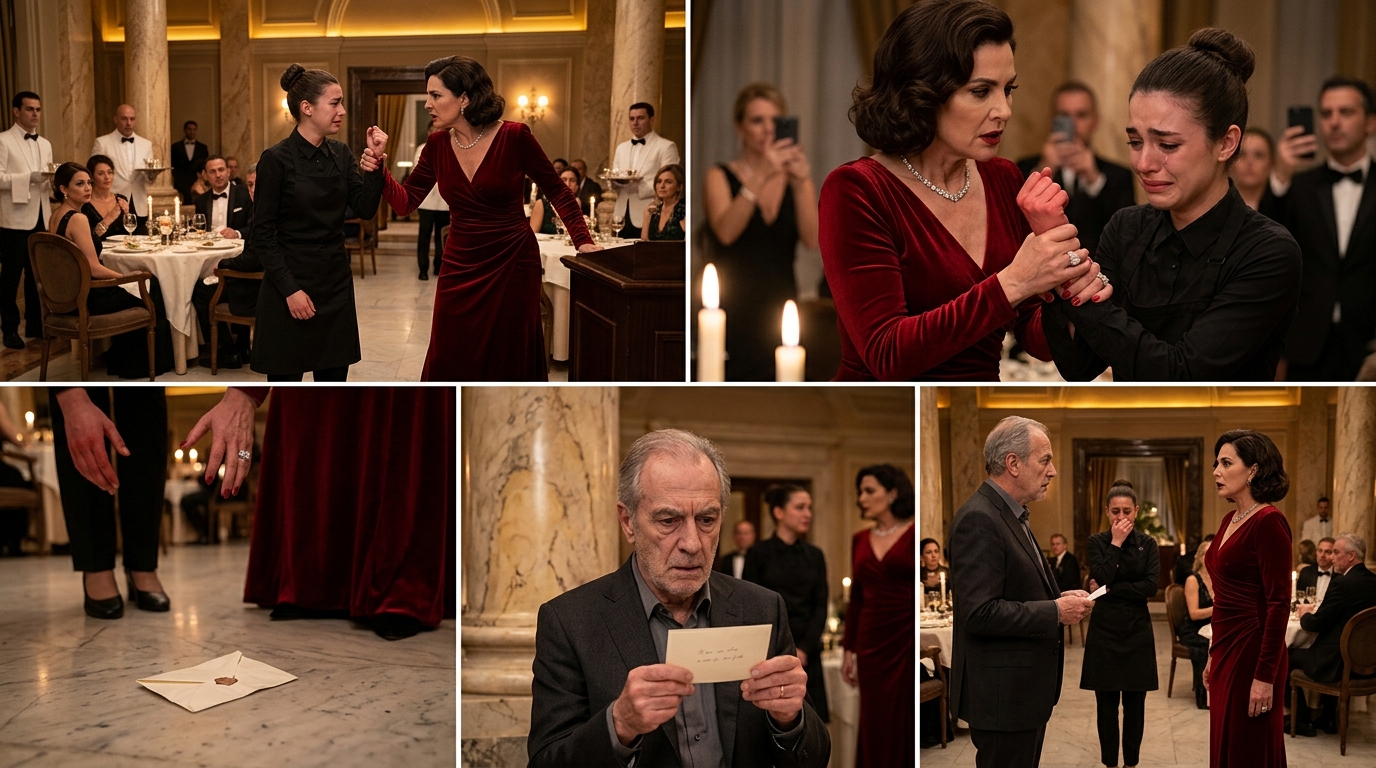
Then Valentina Bellandi dragged a young hostess into the center of it.
“Open your fingers right now!”
Her voice cut through the restaurant like a blade drawn across silk.
The girl stumbled forward, one wrist trapped in Valentina’s hand. She barely looked twenty-two. Her dark hair was pinned neatly at the nape of her neck, but loose strands clung to her tear-wet cheeks. Her free hand was clenched into a fist—not with guilt, but with terror.
“Show them where you hid my diamond ring!” Valentina screamed.
I stood halfway from my chair before I realized I had moved.
My name is Marco Bellandi.
For most of my life, I had been known as the quieter Bellandi brother. My younger brother, Alessandro, owned restaurants, hotels, vineyards, politicians, headlines. I owned books, regrets, and a small apartment overlooking the Tiber.
That night, I had only come to La Corona because Alessandro begged me.
“Valentina wants the family together,” he’d said.
That should have warned me.
Valentina never wanted family together unless there was something to perform.
She stood now in the center of the dining room wearing a deep red couture gown, diamonds at her throat, and a fury too precise to be spontaneous. Her fingers dug into the hostess’s wrist as if pain could produce proof.
“I didn’t take anything,” the girl sobbed. “Please, I didn’t.”
Valentina twisted harder.
“Open them.”
Guests turned sharply from their risotto and wine. A waiter froze with a silver tray still balanced on one hand. An old countess near the window lifted her opera glasses, not to help, but to see better. Phones began to rise around the room.
That was the ugliest part.
Not the accusation.
Not even the cruelty.
It was how easily everyone accepted the scene.
A rich woman was angry.
A poor girl was frightened.
So the room chose its side without needing evidence.
Alessandro stood at the head table beside his new wife. His face was pale. His hand hovered uselessly in the air, as if he could not decide whether to stop Valentina or protect the family name from another spectacle.
“Valentina,” he said. “Enough.”
She ignored him.
She pulled the hostess closer, dragging her beneath the chandelier.
“Show them what people like you do when you get close to real money.”
Those words struck harder than her grip.
The hostess stopped struggling for a second.
Something in her face changed.
Not anger.
Recognition.
As if she had been warned that one day someone would say exactly that.
I stepped forward.
“Let go of her.”
Valentina turned her head toward me.
Her eyes flashed.
“Stay out of this, Marco.”
“No.”
The room breathed in.
Bellandis did not correct one another in public. We ruined lives privately, as civilized people do.
Valentina smiled without warmth.
“She had access to my coat. My purse. My table. Now my diamond ring is gone.”
“Then call the police,” I said. “Don’t stage a trial between courses.”
A few guests lowered their phones.
Valentina’s mouth tightened.
The hostess whispered, “I didn’t steal it.”
Her name tag read Elena.
Elena Moretti.
The surname made something stir in me, but not enough to become memory yet.
Valentina seized Elena’s fist again.
“Open your hand.”
Elena shook her head, sobbing.
“Please.”
“Open it.”
Valentina pried at her fingers.
One.
Then another.
The girl cried out.
And then—
something slipped from her sleeve.
Not a ring.
Not jewelry.
A small sealed note.
It fell silently onto the marble floor between them.
For one heartbeat, no one moved.
The envelope was old. Cream-colored. Softened at the edges. Sealed with dark wax that had cracked but not broken.
I bent down before Valentina could reach it.
At first, I frowned.
Then I saw the handwriting on the front.
My breath stopped.
Marco.
Just my name.
Written in a hand I had not seen in twenty-three years.
My brother’s hand.
Not the bold signature he used on contracts.
Not the smooth autographs he gave journalists.
This was Alessandro’s private handwriting. Slanted. Impatient. The capital M drawn too sharply because he always pressed too hard when frightened.
I knew exactly when I had last seen that handwriting.
The night Sofia Moretti vanished.
The room went distant.
Valentina released Elena’s wrist instantly.
Elena stumbled backward, clutching her hand to her chest.
I stared at the envelope as if it had risen from a grave.
“This is my brother’s writing,” I said.
Alessandro’s face changed.
Not confusion.
Recognition.
I looked at Elena.
She was crying harder now.
“My mother told me never to open it,” she said.
The name came back fully.
Sofia Moretti.
Alessandro’s first fiancée.
The woman he was supposed to marry before she disappeared from a Bellandi estate dinner in 2001.
The woman my family called unstable.
The woman whose name Valentina hated.
Elena swallowed, her voice breaking.
“She told me not to open it unless his new wife accused me in public.”
The restaurant fell into a silence so heavy even the candles seemed to still.
I looked from the note to Valentina.
Then to my brother.
And in that moment, I understood one terrible thing.
This was not about a stolen ring.
This was about why my brother had written a message for the child our family swore never existed.
The Note Written Before the Vanishing
Alessandro took one step toward me.
“Marco,” he said softly, “give me the envelope.”
That softness terrified me more than panic would have.
My brother had built an empire on volume. Loud laughter. Loud entrances. Loud generosity. Loud grief when it suited him. He rarely lowered his voice unless he wanted something buried.
I held the envelope tighter.
“No.”
Valentina’s face sharpened.
“Marco, don’t be dramatic. That girl is manipulating you.”
Elena flinched at that girl.
The mark on her wrist was already turning red.
I looked at Alessandro.
“Did you write this?”
He did not answer quickly enough.
Valentina did.
“Of course he didn’t. Anyone can copy handwriting.”
I lifted the envelope.
“The wax seal is our father’s.”
That silenced her.
The Bellandi family seal had not been used since my father died. A crowned lion holding a key. Old-fashioned. Arrogant. Impossible to mistake.
Alessandro stared at the seal.
His hand trembled once.
Only once.
But I saw it.
The last time I saw my brother truly afraid was the night Sofia vanished.
She had been twenty-three, a singer’s daughter from Trastevere with black hair, a crooked smile, and a refusal to lower her eyes around rich people. My mother despised her. My father dismissed her. Valentina, then only a family friend with ambitious eyes, mocked her openly.
Alessandro loved her.
Or I thought he did.
Then came the engagement dinner at Villa Bellandi.
By midnight, Sofia was gone.
By morning, the story had already been arranged.
She had run away.
She had stolen jewelry.
She had written letters threatening Alessandro.
She had been unstable.
Wealth loves that word for women who know too much.
Unstable.
I asked questions for six months.
Then my father threatened to cut me from the family trust.
I was younger then.
Cowardice can dress itself as patience for years.
I opened the envelope.
Elena made a small sound.
Valentina stepped forward. “You have no right.”
I broke the seal.
Inside was one folded page.
Alessandro’s handwriting filled it in uneven lines.
Marco,
If you are reading this, then I failed to protect Sofia, and they have done what she feared.
Do not believe she left me.
Do not believe she stole anything.
Do not believe Valentina.
Sofia is carrying my child.
If the child ever comes to you, believe the mother before you believe our name.
There is a key hidden behind the Saint Michael panel in the cellar.
It opens the room my father told us never existed.
Inside are the papers that prove why they want Sofia gone.
Forgive me for not being brave sooner.
A.
The room blurred.
I read the last line twice.
Forgive me for not being brave sooner.
Alessandro closed his eyes.
Valentina whispered, “You idiot.”
Not to me.
To him.
The old violinist near the wall lowered his instrument completely. The guests had stopped pretending this was entertainment.
Elena stared at the letter as if it might explain her entire life.
“My mother said my father was dead,” she whispered.
Alessandro opened his eyes.
The pain that crossed his face looked real.
That made it worse.
“Elena,” he said.
Valentina snapped toward him.
“Don’t.”
He ignored her.
He stared at the hostess.
At her eyes.
Her mouth.
The shape of her face.
The truth arrived visibly, traveling through him like a slow blade.
“Sofia named you Elena,” he said.
Elena took a step back.
“How do you know that?”
His voice broke.
“Because if we had a daughter, she wanted to name her after the first woman who taught her to sing.”
Elena’s lips parted.
For a moment, she looked less like a humiliated hostess and more like a child standing at the edge of a life she had never been allowed to claim.
Then Valentina laughed.
The sound was cold, brittle, desperate.
“This is absurd. You’re all being played by a waitress with a convenient envelope.”
“Hostess,” Elena whispered.
Valentina turned on her.
“What?”
“I’m the hostess,” Elena said, still crying, but steadier now. “And you knew who I was when you grabbed me.”
The sentence changed the air.
Valentina’s eyes flickered.
Elena reached into the pocket of her uniform with her injured hand and pulled out something else.
A small photograph.
Not staged.
Not old enough to be from the night Sofia vanished.
In the picture, Sofia Moretti stood beside a narrow hospital bed, holding a newborn wrapped in a white blanket. Her face was younger than my memory had kept it, thinner, frightened, but alive.
On the back, in Sofia’s handwriting, was one sentence.
If they ever call my daughter a thief, show them who taught the family to steal.
Alessandro made a sound like he had been struck.
Valentina stepped back.
And from behind us, a voice spoke from the entrance of the restaurant.
“My God,” the old man said. “She really did keep the baby.”
I turned.
At the door stood Father Lorenzo, our family priest for forty years.
His face was ashen.
In his hand was Valentina’s missing diamond ring.
The Ring That Was Never Stolen
The ring glittered in Father Lorenzo’s palm.
Large.
Flawless.
Ridiculous.
A stone designed not to be loved, but to be seen.
Valentina stared at it.
Every person in the restaurant did too.
Father Lorenzo walked slowly toward the center of the room. He was eighty now, stooped at the shoulders, his black coat damp from the rain outside. I had known him since childhood. He baptized me, buried my father, and lied at more Bellandi weddings than I cared to count.
Tonight, he looked like a man who had come to confess before being dragged there.
“Where did you find it?” I asked.
He looked at Valentina.
“In the chapel vase.”
Valentina’s face hardened.
“That’s impossible.”
“No,” Father Lorenzo said quietly. “It is familiar.”
The restaurant understood before I did.
This had happened before.
A missing ring.
A poor woman accused.
A public disgrace.
I turned toward Alessandro.
“The night Sofia disappeared.”
His face had gone gray.
Father Lorenzo nodded.
“Valentina claimed her mother’s emerald bracelet had vanished. Sofia was accused in front of everyone. She ran from the dining room in tears.”
“I went after her,” Alessandro said.
Valentina’s head snapped toward him.
He looked sick now, but the words kept coming.
“I found her in the garden. She told me she was pregnant. She begged me to leave with her that night.”
“And did you?” Elena asked.
The question was soft.
It was also merciless.
Alessandro looked at his daughter.
“No.”
Elena’s face folded with hurt before she could hide it.
“No,” he repeated. “I went back inside to get the car keys. My father stopped me. Valentina came after that. They told me Sofia had stolen from us, that she had been using me, that she had threatened to sell stories to newspapers.”
He looked at the letter in my hand.
“I wrote that note because part of me knew they were lying.”
I felt an old anger rise in me.
“Part of you?”
He flinched.
Good.
“Part of you knew the woman you loved was pregnant with your child, and you let them call her a thief?”
“I was twenty-six.”
“You were a coward.”
The words landed harder because they were true.
Alessandro looked down.
“Yes.”
Valentina’s voice cut through the room.
“How touching. Now we’re rewriting history because a girl with a photo wants a fortune.”
Elena’s face tightened.
“I don’t want your money.”
Valentina smiled.
“Of course you do. They all say that before the lawyers arrive.”
Father Lorenzo closed his fist around the ring.
“You planted it tonight.”
Valentina turned on him.
“Be careful, Father.”
He looked older than ever.
But not weaker.
“I was careful for twenty-three years. That is why we are here.”
Alessandro stared at him.
“What did you do?”
Father Lorenzo crossed himself with a shaking hand.
“After Sofia ran from the dinner, your father ordered me to prepare a private marriage annulment statement. He wanted proof that the engagement had been entered under deception. He said Sofia had confessed to theft.”
“She didn’t,” Elena whispered.
“No,” the priest said. “She didn’t.”
His eyes filled.
“She came to the chapel that night. She was bleeding from the mouth.”
Alessandro staggered.
Elena went white.
Father Lorenzo continued, each word pulled from somewhere deep and rotten.
“She said Valentina had struck her. She said your father’s men were searching the grounds. She asked me to hide her until morning.”
“You hid her?” I asked.
“Yes.”
“Then why did she vanish?”
Father Lorenzo looked at Alessandro.
“Because by morning, she was gone from the chapel cellar. And I was told that if I spoke, another girl from Trastevere would be found with stolen jewels in her pocket and no one to defend her.”
Valentina’s smile had disappeared completely.
“You spineless old man,” she said.
The priest nodded slowly.
“Yes.”
That honesty silenced her.
Then he opened his fist and placed the diamond ring on the table.
“I found this in the chapel vase twenty minutes ago, exactly where the emerald bracelet was found the morning after Sofia disappeared.”
“How did you know to look there?” I asked.
Father Lorenzo turned to Elena.
“Because your mother came to me three weeks before she died.”
Elena stopped breathing.
“My mother died of pneumonia.”
The priest closed his eyes.
“No, child. She was poisoned slowly enough that no one poor would be autopsied.”
The restaurant erupted.
Valentina moved toward the exit.
Alessandro caught her arm.
“Did you kill Sofia?”
She looked at him.
For one second, the mask fell.
What remained beneath it was not rage.
It was contempt.
“She should have stayed buried.”
Elena made a broken sound.
Then Valentina twisted free and screamed toward the kitchen.
“Now!”
Two men in waiter jackets stepped from behind the service doors.
They were not waiters.
I knew it immediately by the way they moved.
And one of them was holding a knife.
The Cellar Behind Saint Michael
Panic turned the dining room into noise.
Chairs scraped back.
Women screamed.
A glass shattered near the bar.
The men in waiter jackets moved toward Elena, not Valentina. That told me everything. The ring, the accusation, the public humiliation—it had all been bait. If Elena broke, if she fought, if she ran, Valentina would have her scene.
A thief exposed.
A hysterical girl.
A convenient accident.
I stepped in front of Elena.
At sixty-two, I was no hero. My knees protested stairs. My shoulder still ached when rain came through Rome. But guilt had been sitting in my bones for twenty-three years, waiting for somewhere to go.
The first man lunged.
Alessandro moved before I did.
He grabbed a heavy silver wine bucket and swung it into the man’s arm. The knife clattered across the marble. The second man reached for Elena, but Father Lorenzo stepped between them, raising his walking cane with both hands.
“Run!” the priest shouted.
Elena did not run.
She grabbed the sealed letter from my hand and looked directly at me.
“The cellar,” she said. “The note said there’s a key.”
Valentina heard her.
So did Alessandro.
His face changed.
“Saint Michael,” he whispered.
We all knew the panel.
Every Bellandi child knew it.
In the wine cellar beneath the original family villa, there was a painted wooden panel of Saint Michael driving his sword into the dragon. Our father told us never to touch it. He said it was sixteenth-century art.
Our father lied about many things.
I grabbed Elena’s hand and pulled her toward the kitchen corridor.
Behind us, Alessandro shouted for someone to call the police. Guests were already calling. Recording. Crying. Running. Valentina screamed my brother’s name with a fury that sounded almost intimate.
We pushed through the kitchen, past cooks frozen over copper pans, past a dishwasher crossing himself, down the narrow stairs into the old cellar.
La Corona had not always been a restaurant.
Before my family turned it into luxury, it had been part of our Roman estate. The cellar remained original, with stone walls, arched ceilings, and wine racks older than most countries’ constitutions.
The air was cold enough to taste.
Elena’s hand shook in mine.
“She knew this would happen,” she whispered.
“Your mother?”
“She said rich people don’t fear truth. They fear proof.”
We reached the Saint Michael panel.
The painted angel looked down at us through dust, one golden wing cracked near the edge.
Alessandro arrived behind us, breathing hard.
I turned on him.
“Stay back.”
He did.
That surprised me.
Elena looked at the letter.
“There’s a key hidden behind the panel.”
I ran my fingers along the frame.
Nothing.
Alessandro stepped forward slowly.
“When we were boys,” he said, “Father kept a knife behind the right wing.”
I glared at him.
He lowered his eyes.
“I know I have no right to help. But let me.”
Elena stared at him.
The man who might be her father.
The man who failed her mother.
The man who had let her grow up without a name.
Finally, she nodded once.
Alessandro pressed the cracked edge of the painted wing.
A tiny wooden compartment clicked open.
Inside was an iron key, black with age.
Elena took it.
Behind the panel, hidden by the wine racks, was a narrow door I had never noticed.
The key turned with a groan.
The door opened.
Inside was a room without windows.
A desk.
A safe.
Filing cabinets.
And along one wall, framed photographs of women.
Dozens.
Not Bellandi wives.
Not family portraits.
Women I recognized from old rumors.
A maid dismissed after accusing my father’s cousin of assault.
A singer who performed at our vineyard and vanished from Rome.
A seamstress paid to leave the country after giving birth.
And Sofia Moretti.
Her photograph was clipped to a folder marked:
S. MORETTI — SUCCESSION THREAT.
Elena reached for it with trembling hands.
Inside were medical reports, letters, bank transfers, false theft accusations, witness statements, and one hospital record.
Birth: Elena Sofia Bellandi.
Father: Alessandro Bellandi.
Mother: Sofia Moretti.
My brother made a sound I had never heard from him before.
Not grief.
Not guilt.
Something deeper.
The sound of a man meeting the life he chose not to protect.
Elena stared at the birth record.
Then at him.
“Did you know?”
Alessandro’s eyes were wet.
“No.”
She slapped him.
The sound cracked through the cellar.
He accepted it without moving.
“You didn’t want to know,” she said.
That was worse.
Because it was true.
I opened another folder.
Then another.
The room was not only about Sofia.
It was a system.
Women erased to protect inheritances.
Children renamed to protect fortunes.
Poor girls accused of theft whenever they came too close to Bellandi blood.
On the desk lay an old ledger with my father’s handwriting on the first page.
Public disgrace is cheaper than legal settlement.
I felt sick.
Footsteps sounded on the cellar stairs.
Slow.
Measured.
Valentina entered alone.
Her red gown dragged against the stone floor like blood.
The chaos upstairs had not broken her.
It had only stripped away elegance.
She held a small pistol at her side.
Alessandro stepped in front of Elena.
Too late.
But still.
Valentina smiled.
“How noble. Twenty-three years after it mattered.”
The Child They Swore Never Existed
No one moved.
The cellar seemed to hold its breath.
Valentina stood beneath the cold yellow light, pistol loose in her right hand, diamonds still glittering at her throat. Behind her, distant sirens began to rise through the restaurant above us.
She heard them.
We all did.
It made her smile.
“You think police frighten families like ours?”
“Our family,” Alessandro said quietly. “Not yours.”
That struck her harder than he intended.
For the first time, Valentina looked wounded.
Then the wound curdled.
“You stupid man,” she said. “I saved you.”
“You destroyed Sofia.”
“Sofia was going to destroy everything.”
“She was carrying my child.”
“She was carrying leverage.”
Elena’s face went white.
Valentina turned to her.
“Don’t look so shocked. Love is the story poor women tell themselves when rich men get careless.”
Alessandro took one step forward.
“Enough.”
Valentina raised the gun.
He stopped.
I slowly reached toward the desk behind me, where the old ledger lay open.
Valentina saw.
“Touch that, Marco, and I will put a bullet in your brother before his daughter gets to forgive him.”
Elena’s voice trembled.
“I’m not forgiving anyone tonight.”
Valentina laughed.
Then she looked at Alessandro.
“She came to me, you know. Sofia. The morning after the engagement dinner.”
Alessandro froze.
Valentina’s smile widened.
“She wanted to see you. She thought if you heard she was pregnant, you’d choose her. So sweet.”
“What did you do?” he whispered.
“I told her the truth.”
Valentina stepped closer.
“I told her you had already agreed she was unstable. I told her your father had papers ready. I told her if she tried to claim the child, that child would spend life being called a bastard thief.”
Elena’s eyes filled.
“She still didn’t leave quietly,” Valentina continued. “I’ll give her that. She fought harder than expected.”
Father Lorenzo appeared in the doorway behind Valentina, unnoticed at first.
So did two police officers.
I saw them.
Valentina did not.
The priest’s eyes moved to mine.
Do not speak.
For once in my life, I listened.
Alessandro kept Valentina facing him.
“Where is Sofia?”
Valentina tilted her head.
“Dead.”
Elena made a sound.
Alessandro’s face broke.
“How?”
Valentina shrugged slightly.
“She became inconvenient again.”
The officers moved silently down the last steps.
Valentina continued, drunk now on the truth she had held too long.
“She came back after twenty years. Imagine that. Poor Sofia, with her proof and her brave little daughter. She thought a sealed note and a few documents could undo everything we built.”
“You poisoned her,” Elena whispered.
Valentina looked at her.
“Your mother should have taught you that timing matters more than courage.”
Elena stepped forward.
The gun shifted toward her.
That was when the officers moved.
“Drop the weapon!”
Valentina turned too fast.
The pistol rose.
Alessandro shoved Elena behind him.
A shot cracked through the cellar.
The sound was enormous in the stone room.
For one suspended second, I did not know who had been hit.
Then Alessandro staggered back.
Blood bloomed across his shoulder.
Elena screamed.
The officers tackled Valentina before she could fire again. The gun skidded across the floor and stopped against Sofia’s folder.
Valentina fought like a trapped animal, cursing, thrashing, spitting Alessandro’s name until the handcuffs closed around her wrists.
But I was on the floor beside my brother.
So was Elena.
Alessandro pressed one shaking hand to his wound.
It was bad, but not fatal.
He looked at Elena.
Not at me.
Not at Valentina.
At the daughter who had spent her whole life outside the doors his cowardice had kept locked.
“I’m sorry,” he whispered.
Elena’s tears fell onto the cellar floor.
“I know.”
His face softened with desperate hope.
Then she said, “That doesn’t make you my father yet.”
It was the truest mercy she could have offered.
Not forgiveness.
Possibility.
The trial began eight months later.
By then, Italy knew the Bellandi name for reasons our father would have called vulgar. The newspapers called it The Red Gown Scandal. Television panels discussed class, inheritance, vanished women, and the way wealthy families can turn accusations into weapons.
Valentina was convicted of attempted murder, conspiracy, evidence tampering, poisoning Sofia Moretti, and participating in a decades-long scheme to erase heirs born outside approved marriages.
My father was already dead.
That saved him from prison.
It did not save him from history.
The cellar documents reopened nine cases. Three living adults discovered they had Bellandi blood and stolen names. Two families received settlements large enough to buy the silence our family had once purchased from their mothers. One woman, now seventy, came to court and told the judge she had waited fifty years for someone to believe her.
Elena testified on the third day.
She wore a simple black dress and no jewelry.
When Valentina’s lawyer implied she had come forward for money, Elena looked at him with the same steady eyes Sofia had in her photograph.
“I was accused of stealing a ring I never touched,” she said. “But your client helped steal my mother, my name, and twenty-three years of my life. Which theft would you like to discuss first?”
The courtroom went silent.
Even the judge looked down to hide his expression.
Alessandro survived the gunshot.
Recovery gave him time to sit with consequences.
That was not the same as redemption.
He signed over Sofia’s share of the estate to Elena without condition. She refused at first, then accepted only after creating a legal fund for women whose accusations had been buried by powerful families.
She did not take the Bellandi surname.
Not immediately.
Maybe not ever.
At La Corona, the marble floor where the note fell was replaced after the police finished with it. Valentina’s blood-red gown vanished into evidence storage. The violinist returned on quiet nights, though he never again played during family dinners.
I still go there sometimes.
Not often.
Only when Elena asks.
She no longer works as a hostess. She studies law now. She says she wants to become the sort of person her mother needed and never had.
One evening, nearly a year after the accusation, she invited me to the restaurant before opening.
The dining room was empty.
No guests.
No cameras.
No Valentina in red.
Just candlelight waiting to be lit.
Elena stood in the center of the room holding the sealed envelope. The wax was broken now. The paper inside had been preserved in glass, but the envelope remained with her.
“I used to hate this place,” she said.
“I don’t blame you.”
“My mother told me never to come here unless I had no choice.”
“And now?”
She looked around.
“Now I think she sent me here because she knew fear lives longer when it stays outside the door.”
I did not answer.
She handed me a small framed copy of Sofia’s photograph.
The one from the hospital.
Sofia holding newborn Elena, tired and frightened and alive.
“I want this placed near the cellar door,” Elena said. “Not hidden. Not dramatic. Just there.”
I took it carefully.
“She should have been seen,” Elena whispered.
“Yes,” I said. “She should have.”
That night, before the restaurant opened, I hung Sofia’s photograph beside the cellar stairs.
Below it, Elena placed a small plaque.
It read:
For every woman they called a thief because she carried the truth.
When the first guests arrived, most walked past without reading.
Some stopped.
Some leaned closer.
Some looked uncomfortable and moved away quickly.
That was fine.
Truth does not need everyone to welcome it.
Only enough people to stop it from being buried again.
Later, as I left La Corona, I saw Elena standing at the hostess stand.
Not working.
Just standing there.
The place where Valentina had grabbed her wrist.
The place where the note had fallen.
The place where a public humiliation became the beginning of a family’s undoing.
Alessandro stood a few feet away, waiting but not approaching. He had learned, slowly, that presence was not entitlement. Elena glanced at him once, then nodded.
A small nod.
Not forgiveness.
Not yet.
But not exile either.
I stepped into the Roman night and heard the violin begin behind me.
This time, the note did not stop.
It rose through the dining room, trembling at first, then stronger.
And I thought of Sofia Moretti, accused, hunted, poisoned, but never fully erased.
Because she had hidden one letter.
Taught one daughter when to open it.
And trusted that someday, in a room full of people trained to look away, the truth would fall to the marble floor loudly enough for everyone to hear.