The Woman They Thought Didn’t Belong
The flight attendant laughed before the plane ever left the ground.
Not loudly.
Not enough to sound cruel to anyone who wasn’t listening.
But enough.
A short, polished laugh beneath the fluorescent lights of Gate B12, sharp enough to make the passengers nearby glance up from their phones.
“Business class?” Jessica Walsh asked, holding my boarding pass between two fingers.
Her smile was still there, but it had changed shape.
It was no longer customer service.
It was suspicion wearing lipstick.
My name is Maya Johnson.
I was forty-five years old, dressed in a navy blazer, white blouse, dark trousers, and low heels that had crossed more hangars, command centers, boardrooms, and military airfields than most people would ever see. My hair was pulled back neatly. My carry-on was regulation-size. My boarding pass was valid.
Seat 2A.
Business class.
Flight 447 from Atlanta to Los Angeles.
None of that should have required explanation.
But Jessica looked from the pass to my face, then back again, pausing just long enough for the people behind me to notice.
“Are you sure this is your seat?” she asked.
I did not blink.
“It has my name on it.”
A man behind me chuckled.
Another passenger shifted impatiently.
The gate agent beside Jessica glanced at the screen and gave the smallest nod.
Jessica ignored it.
“We’ve had a lot of passengers trying to board in the wrong group today,” she said.
“I am in the correct group.”
Her eyes dropped to my watch.
That always happened.
The watch was old, too large for current fashion, with a weathered leather strap and a scratched metal face. It had belonged to my father, then to me. It had flown over deserts, oceans, storms, and one night I still could not discuss without feeling my ribs tighten.
Jessica smiled again.
“Cute watch.”
“Thank you.”
“Vintage?”
“In a way.”
She leaned closer, lowering her voice enough to pretend she was being discreet.
“Economy is boarding after business, ma’am.”
The word ma’am had teeth in it.
A woman in line looked down at her shoes.
A young man near the window lifted his phone slightly.
A silver-haired woman seated near the gate, Mrs. Goldstein, watched everything without moving. Her eyes were sharp behind round glasses, the kind of eyes that had learned long ago that politeness could hide violence.
I held Jessica’s gaze.
“I am seat 2A.”
Behind me, someone muttered, “Here we go.”
That was when the young man with the phone began recording.
His name, I would learn later, was Blake Morrison. He had been filming airport clips for his travel page all morning. At first, I thought he was filming me for the same reason everyone else was watching.
Because a Black woman being questioned where she had every right to stand is, to some people, entertainment.
Jessica scanned my boarding pass again.
The machine beeped green.
Her smile stiffened.
“Well,” she said, handing it back, “looks like the system agrees with you.”
A few people laughed.
Not enough to be called laughter.
Enough to make the moment public.
I took the boarding pass.
“Systems usually do when people let them work.”
Jessica’s expression cooled.
I walked down the jet bridge without looking back.
Seat 2A waited at the front of the business cabin.
Wide leather seat.
Window view.
A bottle of water tucked into the side compartment.
The aircraft hummed softly around me, alive but not yet moving. Passengers filed past. Some glanced at me with curiosity. Some with irritation. Some with the brief, guilty look of people who had seen something wrong and chosen convenience over courage.
I placed my carry-on overhead and sat.
Across the aisle in 2D, Mrs. Goldstein settled carefully into her seat.
She looked at me over her glasses.
“I saw that,” she said.
I turned.
“Most people did.”
“Yes,” she replied. “But not everyone saw it correctly.”
I almost smiled.
Almost.
Jessica entered the cabin moments later, her expression bright again for the passengers in rows one and two.
“Can I get you something before takeoff?” she asked the man in 1A.
“Sparkling water?”
“Of course.”
She laughed at something he said.
Then she reached my seat.
The smile dimmed.
“Water?”
“Yes, please.”
She handed me the bottle already in the compartment.
No glass.
No napkin.
No eye contact.
Just enough service to deny neglect.
I turned my wrist and adjusted my father’s watch.
Mrs. Goldstein noticed.
“Pilot?” she asked softly.
I looked at her.
The question came without performance.
Without doubt.
That made me answer honestly.
“Once.”
Her eyes moved to the watch.
“Military?”
“Air Force. Then federal aviation safety.”
She nodded slowly.
“Then I suppose seat 2A is safer than it knows.”
I looked out the window.
Rain streaked across the glass.
Ground crews moved below in orange vests.
The aircraft pushed back from the gate at 9:17 a.m.
Three hours later, at 35,000 feet, every soul on that plane would understand why an old aviator’s watch was still on my wrist.
But at that moment, Jessica Walsh only saw a woman she believed had gotten above her place.
And that mistake would nearly cost 287 people their lives.
The Calm Before the Alarms
The first hour of Flight 447 was ordinary.
That was what made what came later feel unreal.
Ordinary is cruel that way.
It builds trust.
The aircraft climbed through gray cloud cover into sunlight. Atlanta fell away beneath us. The seatbelt sign switched off. Laptops opened. Children asked for snacks. A baby cried twice, then slept. The cabin settled into the gentle, false peace of commercial flight.
I reviewed documents on my tablet.
Not emails.
Not entertainment.
Documents.
Three months earlier, a confidential aviation safety file had crossed my desk involving irregular maintenance reports, falsified food-service chain logs, and unexplained pilot illness patterns on a handful of long-haul aircraft serviced through the same regional vendor network.
Most people would not connect those things.
That was why I had been asked to.
My current role was not glamorous. No uniform. No cockpit. No wings on my chest.
Officially, I worked as a senior federal aviation safety investigator.
Unofficially, I was the person agencies called when a pattern looked too ugly to be coincidence and too expensive for corporations to admit.
Flight 447 was not supposed to be part of that investigation.
I was flying to Los Angeles for a hearing.
A closed one.
The file in my briefcase contained sealed testimony from two mechanics and one catering supervisor who claimed safety procedures were being bypassed to protect contracts worth millions.
Captain Hayes’s name appeared once.
Not as a suspect.
As a pilot who had filed a concern.
First Officer Carter’s name appeared too.
He had requested an internal review of crew meals after two pilots on a separate route reported sudden illness.
That was why I noticed when Jessica served the cockpit meal.
It was a small thing.
A tray carried forward.
A sealed package.
A quick exchange near the cockpit door.
Nothing dramatic.
But I had spent too many years learning that disasters rarely begin with drama. They begin with normal steps no one questions.
At 10:42 a.m., Jessica came through the cabin collecting cups.
She was warm with the passengers in row one.
Efficient with me.
Dismissive with the elderly man in 3C who asked for help adjusting his screen.
Performative kindness, rationed by perceived value.
Blake Morrison, the young man who had recorded the gate incident, sat in 5A. I saw him glance toward me more than once. His phone was down now, but guilt was on his face like bad lighting.
By then, he had posted the clip.
I did not know that yet.
I did not know the caption either.
Gate agent and flight attendant question woman’s business seat. She handled it better than I would have.
By noon, the clip was already moving.
But at 35,000 feet, the internet did not matter.
The plane did.
At 12:19 p.m., I felt the first abnormal movement.
Not turbulence.
Turbulence has rhythm.
This was a slight, uneven dip followed by correction.
My eyes lifted from the tablet.
I waited.
The aircraft steadied.
Then dipped again.
Small.
But wrong.
The seatbelt sign flashed on.
A chime sounded.
Jessica’s voice came over the intercom, still professional.
“Ladies and gentlemen, the captain has turned on the fasten seatbelt sign. Please return to your seats and secure your seatbelts.”
Mrs. Goldstein looked at me.
I said nothing.
A minute later, Jessica walked quickly toward the front galley.
Too quickly.
Her face had lost its polish.
The cockpit door opened.
Only slightly.
I heard a male voice.
Strained.
Then Jessica slipped inside.
The door closed.
My pulse changed.
Old training is not memory.
It is muscle.
I closed my tablet.
From the front galley came a muffled sound.
Not a crash.
Not a scream.
Something worse.
Urgent silence.
Then Jessica emerged from the cockpit.
Her face was pale.
She did not look at me.
She went straight to the intercom.
“Ladies and gentlemen,” she said, voice trembling now, “if there is a licensed pilot on board, please press your call button immediately.”
The cabin froze.
For one second, no one reacted.
Then the murmurs began.
“Pilot?”
“What’s happening?”
“Is this serious?”
The plane dipped again.
Sharper this time.
A child cried out.
I unbuckled my seatbelt.
Jessica saw me stand.
Her expression hardened automatically, even through fear.
“Ma’am, sit down.”
I stepped into the aisle.
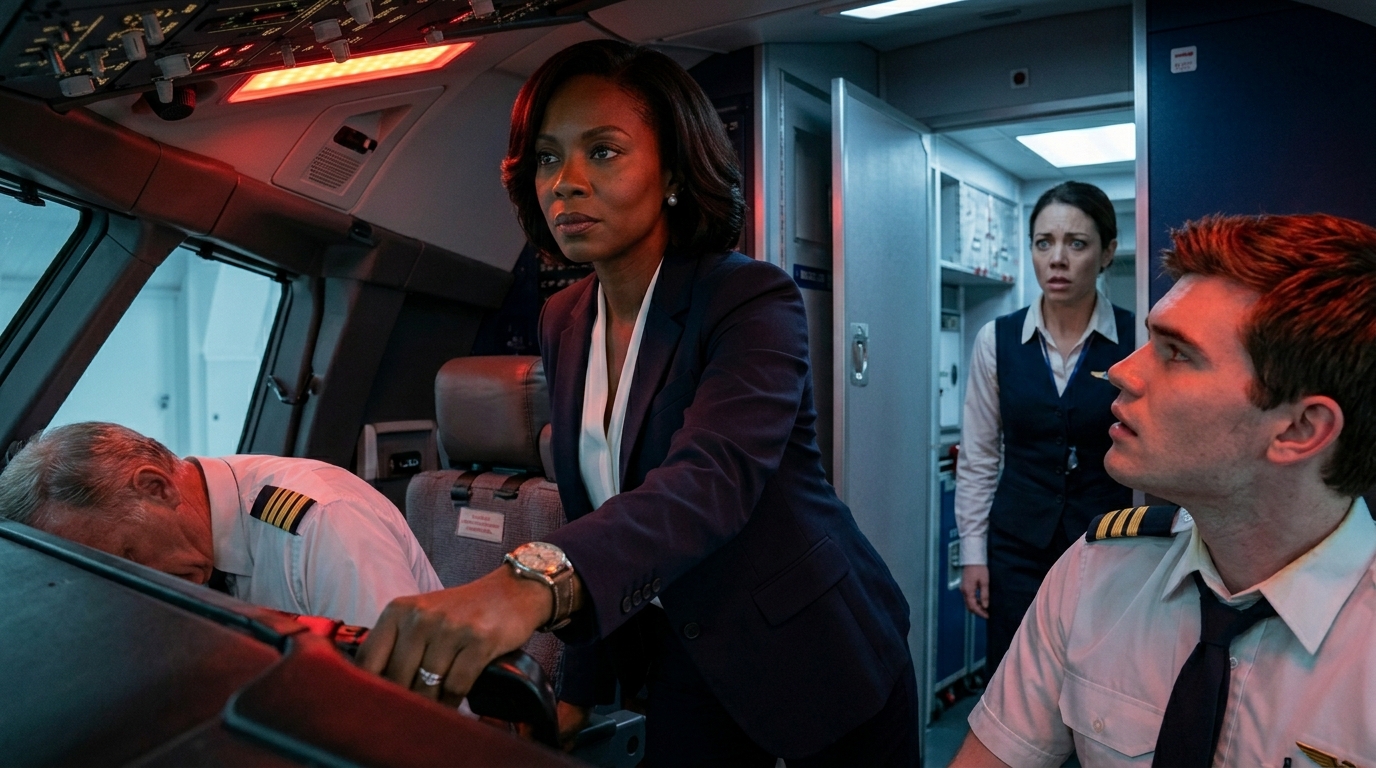
“This is Maya Johnson. I need cockpit access now.”
Jessica stared at me.
“No. I asked for a licensed pilot.”
“I heard you.”
“This is not the time—”
“I have over six thousand flight hours, military heavy aircraft certification, commercial multi-engine rating, and federal accident investigation authority. Move.”
Her mouth opened.
Nothing came out.
The man in 1A turned in his seat.
Mrs. Goldstein said clearly, “Let her through.”
Blake stood halfway in row five.
“She’s telling the truth,” he said. “Look at her watch.”
That was not evidence.
But fear makes people reach for symbols.
Jessica still did not move.
From behind the cockpit door came a sound that ended the argument.
An alarm.
Loud.
Sharp.
Repeated.
Then First Officer Carter’s voice, slurred and panicked through the partially open intercom line.
“Captain’s down. I can’t— I can’t see right—”
The cabin erupted.
Jessica turned back toward me, all arrogance gone.
Only terror left.
“You can fly?”
I looked at the cockpit door.
“No,” I said. “I can help keep us alive long enough for the airplane and air traffic control to do their jobs.”
That was the truth.
And it was enough.
The Door to the Cockpit
The cockpit smelled wrong.
Sweat.
Coffee.
Metal.
Fear.
Captain Hayes was slumped sideways in his seat, skin gray, shirt soaked through. His headset had slipped down around his neck. First Officer Carter was still upright, but barely. One hand gripped the armrest. The other pressed against his abdomen. His face shone with sweat. His eyes were unfocused.
The aircraft was still flying.
That was the first mercy.
The second was that the autopilot remained engaged.
I took the jumpseat long enough to assess what mattered.
Altitude.
Heading.
Speed.
Autopilot status.
Flight management display.
No fire warnings.
No depressurization.
No structural issue.
Human failure, not aircraft failure.
At least for the moment.
Jessica hovered behind me, breathing too fast.
“Don’t stand there shaking,” I said. “Get Marisol or your senior crew member. Secure the cabin. Find out if there’s a doctor onboard. Tell them both pilots are medically incapacitated. Do not say poisoned. Do not speculate. Move.”
She moved.
Good.
First Officer Carter tried to speak.
“Meal,” he muttered.
I leaned closer.
“What?”
“Both ate… crew meal…”
His jaw clenched.
A wave of nausea hit him so hard he nearly folded forward.
I helped secure his headset and spoke into the radio, keeping my voice flat.
“Atlanta Center, Flight 447 declaring emergency. Both pilots medically compromised. Qualified pilot passenger assisting from cockpit. Autopilot engaged. Request immediate vectors and medical priority.”
The reply came fast.
Controlled.
Professional.
The sound of people trained for nightmares.
“Flight 447, Atlanta Center, roger emergency. Say souls on board and fuel remaining if available.”
I scanned the paperwork clipped within reach.
“Two eight seven souls. Fuel approximately sufficient for destination, but requesting nearest suitable diversion.”
First Officer Carter whispered, “Memphis… closer.”
I checked the display.
Weather.
Distance.
Runway length.
Emergency support.
“Atlanta Center, request vectors to Memphis.”
The controller’s voice remained steady.
“Flight 447, expect vectors Memphis. Maintain current altitude. We have company and emergency personnel coordinating. Are you able to monitor aircraft systems?”
“Yes.”
I did not say easily.
I did not say confidently.
I did not say the last time I had sat in a cockpit with alarms sounding, two men died and I spent four years pretending my hands had stopped shaking.
The aircraft rocked slightly.
I looked at the displays.
Still stable.
Still ours.
Behind me, the cockpit door opened.
A man in a polo shirt entered with a medical bag.
“Cardiologist,” he said.
“Check the captain first.”
He moved immediately.
Marisol, the senior flight attendant, appeared behind him. Older, composed, eyes sharp.
“What do you need?”
“Cabin secure. Passengers seated. Any medical professionals assist with both pilots. Preserve cockpit meal trays. No one touches them. No one throws anything away.”
Her eyes narrowed.
“You think—”
“I think evidence matters when pilots collapse after eating the same meal.”
She nodded once.
Unlike Jessica, Marisol did not waste time being offended by urgency.
The next twenty minutes stretched into something outside time.
Air traffic control talked us down step by step.
A remote company pilot patched in by radio to assist with aircraft-specific procedures.
I did not fly by heroics.
That is what people misunderstand about aviation.
Planes are not saved by swagger.
They are saved by systems, checklists, calm voices, and people resisting the urge to become dramatic when discipline is required.
I monitored.
Confirmed.
Communicated.
Kept First Officer Carter conscious when I could.
Kept the cardiologist from moving Captain Hayes too much.
Kept my own breathing slow.
The cabin behind us had gone quiet.
Not peaceful.
Terrified.
But quiet.
At some point, Blake’s voice came through from the interphone after Marisol connected him.
“He says he recorded the gate incident,” Marisol told me. “And Jessica’s online post.”
“What post?”
Marisol hesitated.
“Later.”
“No. Now.”
A pause.
“She posted a photo of your boarding pass area before takeoff. Caption said, ‘Business class gets interesting when people forget where they belong.’ Blake screenshotted it before she deleted it.”
My hand tightened around the edge of the console.
Not now.
That was what I told myself.
Not now.
There would be time for anger if we landed.
Memphis Approach took over.
The runway was prepared.
Emergency vehicles standing by.
The remote pilot talked through what needed confirming.
I did not touch anything I did not need to touch.
First Officer Carter managed small tasks when his vision cleared, then sagged back when pain overtook him.
“Stay with me,” I told him.
He gave a weak laugh.
“You always this bossy?”
“Yes.”
“Good.”
The runway appeared ahead through scattered cloud.
Long.
Bright.
Waiting.
I looked at the old watch on my wrist.
My father’s watch.
He had worn it on his last flight.
I had worn it on mine.
Now it ticked quietly beneath the alarms, indifferent to fear.
The plane descended.
In the cabin, 287 people held their breath.
Jessica Walsh, who had laughed at me three hours earlier, sat strapped into her jumpseat with tears on her face.
And for the first time all day, she finally understood the difference between “just a passenger” and the person standing between her and the ground.
The Landing That Silenced the Cabin
The landing was not beautiful.
People later called it perfect.
It was not.
It was heavy.
Firm.
The kind of landing that makes every overhead bin rattle and every passenger grip the armrest with sudden religion.
But the landing gear held.
The aircraft stayed straight.
The runway stayed beneath us.
And when the engines finally roared into reverse and the plane slowed hard under the gray Memphis sky, the entire cabin erupted.
Not into cheers at first.
Into sobs.
People crying.
Praying.
Calling names.
A baby screaming because everyone else was screaming.
Only after the aircraft slowed to taxi speed did the applause begin, ragged and disbelieving.
I did not feel heroic.
I felt empty.
The kind of empty that comes after the body spends fear faster than the mind can count it.
Emergency vehicles surrounded us before we cleared the runway.
Paramedics boarded within minutes.
Captain Hayes was removed first.
Then First Officer Carter.
Both alive.
That word traveled through the cabin like oxygen.
Alive.
Alive.
Alive.
I remained in the cockpit until federal aviation safety personnel arrived to preserve evidence. Meal trays were sealed. Cups collected. Waste secured. Crew statements separated.
Jessica tried to speak to me near the forward galley.
“Maya—”
I turned toward her.
She flinched.
That angered me more than the insult had.
People like Jessica often mistake the arrival of consequence for danger.
“Ms. Johnson,” I said.
Her face crumpled.
“I’m sorry.”
“No,” I said.
She blinked.
“You are scared. That is not the same thing.”
Marisol stepped between us gently.
“Not here.”
She was right.
Not because Jessica deserved protection.
Because the investigation did.
Passengers filed out slowly.
Some stared at me.
Some thanked me.
Some avoided my eyes because they had laughed at the gate clip before fear taught them reverence.
Mrs. Goldstein stopped beside me.
She took my hand.
“My husband flew bombers,” she said softly. “He used to say the best pilots were the ones who sounded boring during emergencies.”
A tired laugh escaped me.
“I’ll take that as a compliment.”
“It is.”
Blake waited near the jet bridge entrance.
He looked ashamed.
“I posted the gate video,” he said.
“I know.”
“I thought people should see it. But I also… I didn’t say anything when it was happening.”
“No, you didn’t.”
He accepted that.
“I have Jessica’s post too.”
“Give it to the investigators.”
“I already did.”
I nodded.
Then he said, “I’m sorry she treated you like that.”
“She wasn’t alone.”
His face flushed.
“No. She wasn’t.”
The clip of the emergency did not go online immediately because investigators secured most passenger footage before release. But the gate video had already spread. By evening, the story had collided with the landing.
Flight attendant mocks Black woman in business class.
Same passenger helps land plane after pilots collapse.
That was the version the public loved.
It was simple.
Satisfying.
Almost comic in its reversal.
It was also incomplete.
Because the deeper story was not that Jessica had been wrong about me.
The deeper story was that she believed being wrong about me carried no risk.
The pilots recovered after treatment.
Preliminary findings suggested severe foodborne toxin exposure from contaminated crew meals. But within forty-eight hours, the investigation widened. The meals had been prepared through a vendor connected to the same safety file in my briefcase. Chain-of-custody logs had been altered. Temperature records falsified. Complaints ignored.
Captain Hayes had filed warnings.
First Officer Carter had raised questions.
Both were on the flight where the failure became impossible to bury.
I spent the next three days in Memphis giving statements, reviewing timelines, and refusing interviews.
Jessica was suspended.
Then terminated.
But the airline did not stop there, because the evidence did not stop with her.
Her deleted post became part of a broader inquiry into passenger bias, discriminatory service complaints, and crew escalation failures. The gate agent was suspended too. Several complaints from past passengers were reopened. People who had been dismissed as “difficult,” “confused,” or “aggressive” suddenly had records worth reading again.
Funny how survival makes institutions curious.
Two weeks later, I received a letter from Captain Hayes.
Not typed.
Handwritten.
Thank you for bringing us home.
Below that, a second line.
I’m sorry you had to be disrespected before anyone knew you were needed.
That line stayed with me longer than the first.
The Watch That Kept Ticking
The hearing in Los Angeles happened one month late.
By then, Flight 447 had become a case study, a headline, a training module, and a public argument about race, class, competence, and the dangers of assuming authority only wears familiar faces.
The vendor contract was suspended nationwide.
Executives resigned.
Two managers were indicted for falsifying safety logs.
A whistleblower from the catering facility came forward with documents showing repeated warnings had been buried because delays would cost money.
Money.
Again.
The old engine behind so much preventable harm.
Captain Hayes returned to flying eight months later.
First Officer Carter took longer, then became an outspoken advocate for stronger crew food safety procedures.
Marisol was promoted into safety training.
Jessica disappeared from public view for a while, then gave one carefully worded interview about “learning from unconscious bias.”
I did not watch it.
Not because people cannot learn.
Because I no longer had the appetite for being someone else’s lesson.
Blake sent me a message months later.
He had taken down the original gate video and reposted it with a longer caption admitting his own silence.
I saw what was happening and chose to film instead of intervene. That matters too.
It did.
Mrs. Goldstein sent me a small package.
Inside was a handwritten note and an old photograph of her late husband standing beside a bomber in 1968.
On the back, she had written:
For your wall of people who knew the sky was never just for one kind of person.
I framed it.
My father’s aviator watch continued ticking.
It had gained six seconds during Flight 447.
I never had it corrected.
Some things should remain marked by the moments they survived.
A year after the emergency landing, the airline invited me to speak at a safety summit.
I almost declined.
Then I learned Marisol had organized the panel.
So I went.
The room was full of pilots, flight attendants, gate agents, operations managers, regulators, and executives who looked deeply uncomfortable when I stepped to the podium.
Good.
Comfort is overrated in rooms built to discuss preventable harm.
I did not show the dramatic clips.
Not the alarms.
Not the landing.
Not the headlines.
I showed the gate video first.
Jessica questioning my seat.
The pause.
The smile fading.
The laugh.
The line about economy.
Then I paused the screen on my own face.
Calm.
Tired.
Already choosing whether to swallow one more insult.
“This,” I told them, “was the first safety failure of Flight 447.”
The room went still.
“Not because a rude comment can make an airplane descend. Because the same habit that makes you dismiss a passenger can make you dismiss information. Bias narrows your scan. It tells you where not to look. It teaches you which voices to ignore. And in aviation, ignoring the wrong voice can kill everyone.”
No one spoke.
I looked across the room.
“Jessica Walsh did not nearly crash that plane. The contaminated meals did not come from her. The falsified logs were not hers. But when the emergency came, she hesitated because she had already decided who I was. That hesitation mattered.”
I touched the watch on my wrist.
“My father taught me that flying is humility. Every checklist is an admission that memory fails. Every crew briefing is an admission that one person is not enough. Every safety system is built on the idea that truth can come from someone else’s seat.”
Then I looked directly at the front row of executives.
“So build systems where people are heard before they become useful to you.”
Months later, a young flight attendant wrote me an email.
She said she had been on the summit crew. She said the video made her ashamed because she recognized little habits in herself—warmer to some passengers, colder to others, quicker to believe certain complaints, slower to hear certain fears.
At the bottom, she wrote:
I am trying to widen my scan.
That phrase stayed with me.
Widen your scan.
In flying, it means do not stare at one instrument until everything else disappears.
In life, it means the same.
Years passed.
Flight 447 became something people referenced whenever they wanted a quick inspirational story.
They told it as a reversal.
Flight attendant mocks passenger.
Passenger saves plane.
Everyone learns a lesson.
But I lived the parts that did not fit neatly into the headline.
The old humiliation at the gate.
The cockpit smell.
Captain Hayes’s gray face.
Carter whispering through pain.
Jessica asking if I could fly after deciding I could not belong in seat 2A.
The heavy landing.
The applause that came only after competence became undeniable.
I never wanted applause.
I wanted a world where a Black woman in business class did not have to save a plane before people believed she belonged there.
On the anniversary of the landing, I took a commercial flight to Atlanta.
Personal trip.
No hearing.
No sealed file.
No emergency.
At boarding, the young gate agent scanned my pass and smiled.
“Welcome aboard, Ms. Johnson.”
No pause.
No doubt.
No performance.
Just ordinary respect.
I stepped onto the plane and found my seat.
2A again.
I sat by the window, adjusted my father’s watch, and watched the ground crew move below.
A little boy across the aisle pointed at the watch.
“Are you a pilot?”
His mother looked embarrassed.
“Don’t bother her.”
I smiled.
“It’s all right.”
The boy waited.
I looked at the runway.
Then back at him.
“Once,” I said.
His eyes widened.
“Were you scared?”
I thought of Flight 447.
Of alarms.
Of Jessica’s face.
Of the runway rushing up beneath us.
“Yes.”
The boy looked surprised.
“But you still did it?”
I touched the old watch.
“That’s what training is for.”
He considered this with great seriousness.
Then asked if airplanes had horns.
His mother apologized.
I told him they had better things.
Outside, the engines began to hum.
The sound moved through the cabin, familiar and deep.
The watch kept ticking.
The plane pushed back.
And for once, no one had to be proven wrong before letting me pass.