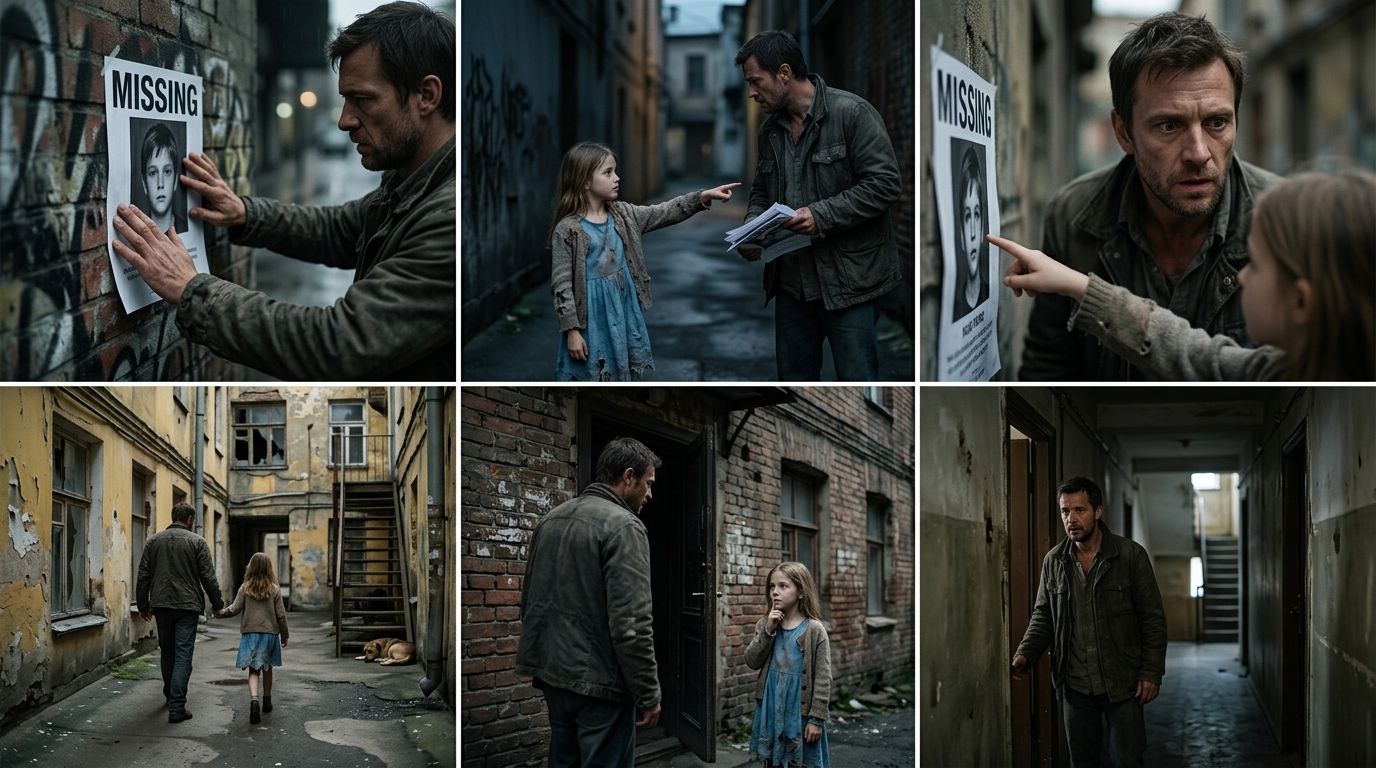
The Girl Who Pointed at the Poster
For twelve nights, Daniel Mercer barely slept.
He had walked until the soles of his shoes split.
Train stations.
Bus depots.
Shelters.
Underpasses.
Police precincts.
Abandoned storefronts.
Alleys where the air smelled like old rain, rust, and things people pretended not to see.
Everywhere he went, he carried the same stack of posters under his arm.
His son’s face looked up from every sheet.
Big brown eyes.
Missing front tooth.
Messy hair that never stayed combed no matter how much Daniel tried.
Across the top, in bold black letters, was the word that had taken over his life.
MISSING.
NOAH MERCER, AGE 7.
LAST SEEN: EASTRIDGE MARKET PARKING LOT.
Daniel had printed thousands.
He had taped them to brick walls until his fingers bled. He had stapled them to telephone poles in the rain. He had shoved them into the hands of strangers who looked away too quickly. He had begged shop owners, bus drivers, street vendors, security guards, anyone with eyes and a memory.
Most people were kind for five seconds.
Then life pulled them away.
That was the cruelty of missing children.
The parent stays in the moment forever.
The world keeps moving.
On the twelfth evening, Daniel stood in an alley behind a row of shuttered shops, pressing another poster against a peeling yellow wall. His hands shook from exhaustion. His jaw was covered in gray stubble. His coat smelled like wet cardboard and coffee he had spilled two days earlier and never noticed.
He had not gone home except to shower and change shirts.
Even then, he could not stay.
Noah’s room was too quiet.
The dinosaur lamp still sat beside the bed. One sneaker still lay under the chair. His half-finished drawing of a spaceship was still taped to the wall, a crooked rocket flying toward a green moon.
Daniel pressed the tape harder against the poster.
“Please,” he whispered.
He did not know who he was talking to anymore.
God.
Noah.
The city.
The wall.
Then a small voice behind him said, “Sir?”
Daniel turned.
A girl stood at the mouth of the alley.
She was maybe ten.
Maybe younger.
Hard to tell.
Her blue dress was faded and torn near the hem. One sleeve hung loose at the shoulder. Her shoes were too large and soaked dark from puddles. Her hair had been cut unevenly, as if someone had done it quickly with dull scissors.
She stared at the poster.
Not at him.
At Noah.
Daniel’s chest tightened.
“Have you seen him?”
The girl stepped closer, cautious as a stray animal deciding whether a hand meant food or pain.
“Sir,” she said softly, “that boy lives in my house.”
Daniel’s heart did not leap.
It stopped.
His hand jerked against the poster, ripping one corner.
“What did you say?”
She pointed at Noah’s face.
“He cries at night.”
Daniel could not breathe.
The alley stretched around him. The sound of traffic faded. His fingers went numb around the tape roll.
The girl continued, voice low and matter-of-fact, as if she were describing rain.
“He calls for his dad.”
Daniel’s knees almost gave way.
Noah had a habit nobody outside the family knew.
When he woke from nightmares, he never called for help.
He never called for his mother.
His mother had died when he was three.
He called for Daniel.
Dad?
Always small.
Always scared.
Always certain Daniel would come.
The girl had not guessed.
She had heard him.
Daniel tore the poster from the wall and stepped toward her.
“Where?”
The girl looked down the alley.
Fear crossed her face for the first time.
“You have to be quiet.”
“I will.”
“The lady with the red ring comes back before dark.”
Daniel froze.
The woman who had taken Noah had been caught on one grainy security camera outside Eastridge Market. The footage was bad. A blurred coat. A bent umbrella. A hand on Noah’s shoulder.
But one detail stood out.
A large red ring on her right hand.
Daniel had stared at that frame until the image burned behind his eyes.
“Show me,” he said.
The girl turned and ran.
Daniel followed.
They moved through alleys, across a vacant lot, past a sleeping stray dog beneath a rusted staircase. The city changed with every block. Bright storefronts gave way to boarded windows. Cafes gave way to warehouses. The sidewalks cracked. The streetlights flickered. Hope, Daniel thought, would hesitate to walk here alone.
At the end of a narrow lane stood a building that looked abandoned.
Four stories.
Broken windows.
Paint stripped by weather.
A front door hanging slightly crooked on its hinges.
The girl stopped at the entrance.
“He’s upstairs,” she whispered. “But you can’t make noise.”
Daniel’s hands trembled.
“What’s your name?”
“Mia.”
“Mia, are there adults inside?”
She nodded.
“Not right now.”
“How many children?”
Her face changed.
Too much knowledge for a child.
“Depends on the day.”
The words went through him like cold water.
Daniel stepped inside.
The corridor smelled of mold, dust, old medicine, and something sour beneath it all. The floorboards groaned under his weight. Somewhere above them, pipes knocked inside the walls.
Then he heard it.
A voice from upstairs.
Faint.
Hoarse.
Small.
“Dad?”
Daniel grabbed the railing so hard splinters bit into his palm.
Noah.
Alive.
Above him.
Calling.
Daniel started up the stairs.
Mia caught his sleeve.
“Wait,” she whispered. “If you run, the floor screams.”
So Daniel climbed slowly, one hand over his mouth to keep the sound in his chest from breaking free.
The Room With the Locked Window
Noah was in the third room on the second floor.
Daniel knew before Mia pointed.
The door had a chair wedged beneath the handle.
Not locked.
Blocked.
As if whoever held the children wanted escape to feel close enough to hurt.
Daniel moved the chair carefully.
His hands were no longer shaking.
That frightened him later.
In the moment, his body had become one purpose.
Open the door.
Find his son.
Do not collapse.
The room was small.
A mattress on the floor.
A cracked window nailed shut.
A plastic cup.
A blanket.
And Noah.
He was sitting against the wall with his knees tucked to his chest, wearing the same green hoodie he had worn the day he disappeared. It hung loose on him now. His hair was messy. His lips were dry. One cheek was bruised yellow near the jaw.
For one second, Noah only stared.
Then his face crumpled.
“Dad?”
Daniel crossed the room in three steps and dropped to his knees.
Noah crashed into his arms.
The sound that came out of Daniel did not feel human. He held his son so tightly Noah squeaked, and Daniel loosened his grip immediately, terrified of hurting the body he had spent twelve days imagining he would never hold again.
“I’m here,” Daniel whispered into his hair. “I’m here. I’m here. I’m here.”
Noah sobbed against his shoulder.
“I called you.”
“I know.”
“I called every night.”
“I know, buddy. I heard you now. I came.”
Noah pulled back, eyes wide and panicked.
“We have to go before she comes back.”
Daniel wiped his face with both hands.
“Who?”
“The red lady.”
Mia stood in the doorway, watching with an expression Daniel could not bear.
Not jealousy.
Not exactly.
Something worse.
A child watching another child get the reunion she had stopped expecting for herself.
Daniel reached toward her.
“Mia, come with us.”
Her eyes flicked down the hall.
“There are others.”
Daniel went still.
“How many?”
“Two downstairs. Sometimes baby Eli. But he got taken yesterday.”
Noah clutched Daniel’s coat.
“She said if I was good, she’d give me a new family.”
Daniel’s stomach turned.
He pulled out his phone.
No signal.
Of course.
The building walls were thick, wet, and dead.
“Mia, is there a back way out?”
She nodded.
“But it goes past the medicine room.”
“What medicine room?”
Noah whispered, “She makes kids sleep there.”
Daniel stood.
“Show me.”
Mia led them down the hall.
Daniel carried Noah. His son was too weak and too scared to walk quickly, though he insisted he could. Daniel did not argue. There would be time later for small independence. Now there was only survival.
The medicine room was at the end of the corridor.
Inside were boxes.
Plastic bins.
A cot.
A small refrigerator humming in the corner.
On a folding table sat children’s backpacks, shoes, hair ties, toys, and folded clothes labeled with masking tape.
Daniel saw Noah’s red backpack.
Then he saw others.
A purple backpack with unicorn stickers.
A tiny pair of rain boots.
A stuffed rabbit missing one ear.
Mia stood very still.
“That one was Ava’s,” she said, pointing to the rabbit.
Daniel swallowed.
“Where is Ava?”
Mia did not answer.
That was answer enough.
He opened the nearest drawer.
Papers.
Photographs.
Copies of birth certificates.
School forms.
Medical records.
Missing posters.
His own son’s poster was there, folded in half, with notes written across it in red ink.
Father persistent.
No ransom contact.
Hold until transfer.
Daniel forced himself not to react.
Not yet.
He opened his camera app and began recording.
Every drawer.
Every label.
Every document.
He filmed Noah’s backpack. The medicine bottles. The child profiles. The nailed window. The chair under the door.
Then Mia grabbed his arm.
“She’s back.”
At first, Daniel heard nothing.
Then the front door downstairs groaned.
A woman’s voice floated upward.
Bright.
Irritated.
“Children? I’m home.”
Noah buried his face in Daniel’s neck.
Mia whispered, “She knows when doors move.”
Daniel looked around.
No signal.
One staircase.
Children downstairs.
A woman with the red ring below them.
And somewhere in that building, proof that this was not one kidnapping.
It was a system.
The woman’s footsteps sounded on the stairs.
Slow.
Confident.
Daniel moved Noah behind him.
Mia grabbed the red backpack and shoved it into Daniel’s hands.
“If she sees you,” she whispered, “don’t say you’re his father first.”
“Why?”
Mia’s eyes filled with fear.
“Because she likes making fathers beg.”
The Woman With the Red Ring
She appeared at the top of the stairs wearing a burgundy coat and black gloves.
The red ring caught the weak hallway light immediately.
Large.
Oval.
Dark as blood.
Daniel knew it before he knew her face.
She was older than the security footage suggested, maybe late fifties, with silver hair pinned neatly at the back of her head and a warm, practiced smile that had probably opened doors for years. She carried a paper grocery bag in one arm.
For one second, she looked surprised.
Then the smile returned.
“Oh,” she said. “Mia.”
Mia shrank back.
The woman’s eyes moved to Daniel.
Then to Noah peeking from behind him.
Then to the phone in Daniel’s hand.
Her smile thinned.
“You must be Mr. Mercer.”
Daniel kept the phone recording at his side.
“You know who I am.”
“Of course I do. You’ve made quite a mess of the neighborhood with all those posters.”
Noah trembled behind him.
Daniel forced his voice to remain level.
“And you took my son.”
The woman looked almost disappointed.
“Children are not luggage, Mr. Mercer. They cannot be taken unless someone leaves them unattended.”
Daniel stepped forward.
Mia whispered, “No.”
He stopped.
The woman noticed and laughed softly.
“There we are. The little ones learn faster.”
“What is your name?” Daniel asked.
“Clara Voss.”
The name meant nothing.
Then it did.
A week earlier, a retired detective had mentioned a charity called Voss Family Placement Services. It had closed years ago after licensing violations, though no charges stuck. Daniel had barely registered it. He had been drowning in tips, rumors, and false sightings.
Now the founder stood in front of him with his son behind her doors.
Clara tilted her head.
“You look exhausted.”
“I am.”
“You should have gone home.”
“I did. He wasn’t there.”
Her expression cooled.
Downstairs, something creaked.
Children.
Daniel remembered.
Two downstairs.
He could not rush Clara.
Not with Noah behind him.
Not with Mia frozen beside the medicine room.
Not without knowing whether someone else was in the building.
Clara set the grocery bag on the floor.
“Where are you taking him?”
“With me.”
“To what? A house full of grief? A father who loses track of him in parking lots? A child who cries himself sick because his mother is dead?”
Daniel’s face tightened.
She smiled.
“There it is. Guilt is so easy to find in good fathers.”
Noah whispered, “Dad, don’t listen.”
Daniel did not look back.
Clara took one step closer.
“I place children where they are wanted.”
“You sell them.”
“I rescue them from chaos.”
“You lock them in rooms.”
“Only the difficult ones.”
Mia flinched.
Daniel saw it.
So did Clara.
Her eyes moved to the girl.
“You went outside.”
Mia’s face went pale.
Clara’s voice sharpened.
“After everything I taught you?”
Daniel stepped between them.
Clara’s gaze flicked back to him.
The red ring flashed as she removed one glove.
“You have no idea what I know about you,” she said. “Your wife died. You work too much. Your son’s school records say he started wetting the bed after her funeral. You hired babysitters and fired three of them. You missed one parent conference and two therapy appointments.”
Daniel felt every sentence strike a wound that already existed.
Clara moved closer.
“You think love is enough because you want it to be. But children need more than a father who prints posters after failing to watch.”
Noah began crying silently.
Daniel’s anger went white and cold.
“You don’t get to call this rescue.”
Clara smiled.
“Then call the police.”
Daniel held up his phone.
“No signal.”
“I know.”
She took another step.
“But I called them.”
Daniel froze.
Clara’s smile widened.
“You’re an angry father who broke into a building where vulnerable children are housed under private emergency protection. You assaulted a care provider. You attempted to remove minors. By the time officers arrive, you will be the danger.”
Mia whispered, “She does this.”
Daniel believed her.
Clara had built a machine where paperwork arrived faster than truth.
Then a sound came from the floor below.
A tiny cough.
Noah looked toward the stairs.
“The little boy,” he whispered.
Daniel’s mind sharpened.
There were still children downstairs.
Clara had called police.
She expected control.
She expected him to react like a desperate father.
She had studied him.
But she had not studied what grief had made him good at.
For twelve days, Daniel had learned to ask for help from anyone who might listen.
He had spoken to reporters.
Volunteers.
Retired cops.
Bus drivers.
Neighborhood women.
Shop owners.
One of them had told him something he had almost forgotten.
Old buildings often had dead zones inside.
But rooftops had signal.
Daniel looked at Mia.
“Fire escape?”
Her eyes widened.
Clara saw it.
“No.”
Daniel grabbed Noah with one arm and shoved his phone into Mia’s hand with the other.
“Run up, not down.”
Mia hesitated.
“Go!”
She bolted toward the end of the hall.
Clara lunged.
Daniel blocked her.
For the first time, the warm mask vanished completely.
“You stupid man,” she hissed.
Daniel looked her in the eyes.
“No. I’m a father who finally found the right witness.”
The Rooftop Signal
Mia was faster than both of them.
She flew up the narrow back stairs toward the roof, clutching Daniel’s phone like it was something holy. Clara screamed her name, but the girl did not stop.
Daniel kept his body between Clara and the stairwell.
Noah clung to his coat.
“Dad—”
“Stay behind me.”
Clara backed away, breathing hard.
“You think one child with one phone changes anything?”
Daniel listened.
Above them, a metal door banged.
The roof.
Then silence.
Then, faintly, Mia’s voice.
“My name is Mia Carter. I’m at the old Braddock building on West 19th. There are kids here. Noah Mercer is here. The lady with the red ring has us.”
Clara’s face changed.
Not fear yet.
Rage first.
Then fear.
Daniel exhaled.
Signal.
Mia was live.
The phone had opened to his emergency contact group, the one hundreds of volunteers had used for search updates. Reporters were in it. A detective was in it. Noah’s school principal. His sister. Half the neighborhood.
Clara heard the distant voice and rushed toward the stairs.
Daniel caught her arm.
She slapped him across the face with her free hand.
The red ring cut his cheek.
Noah screamed.
Daniel did not let go.
Downstairs, a child began crying.
Then another.
The building was waking.
Clara twisted violently.
“You have no idea what you’ve done.”
“I hope not,” Daniel said. “I hope it’s bigger than I can imagine.”
Sirens were not immediate.
They never are.
The minutes between the call and rescue stretched like hours.
Mia stayed on the roof, still speaking into the phone. Later, Daniel would learn she had propped it against a broken vent and turned the camera toward the street sign, then cried while giving names of children she remembered.
Ava.
Theo.
Benji.
Sasha.
Baby Eli.
Some had gone away.
Some were still there.
Some she did not know.
That livestream moved faster than Clara’s police report.
By the time the first officers arrived, neighbors were already gathering outside. Volunteers from Daniel’s search group were racing toward the block. A local reporter who had covered Noah’s disappearance was broadcasting from her car before she even parked.
Clara tried to compose herself before the officers entered.
She smoothed her coat.
Put her glove back on.
Touched her hair.
When two uniformed officers reached the second floor, she stepped forward with tears in her eyes.
“Thank God. This man broke in. He’s trying to take a child.”
Noah shouted, “He’s my dad!”
The officer stopped.
Daniel lifted both hands.
“My name is Daniel Mercer. This is my missing son, Noah Mercer. The girl on the roof called it in. There are other children downstairs. This woman is Clara Voss. Check the red ring against the Eastridge Market footage.”
The younger officer looked uncertain.
The older one looked at Noah.
Then at the bruises.
Then at Clara.
“Ma’am,” he said, “step away from the child.”
Clara’s face hardened.
“I have emergency placement documents.”
“I said step away.”
For the first time, her power failed in front of the children.
Noah pressed himself against Daniel.
Mia came down from the roof with tears on her face and Daniel’s phone still live in her hand.
Outside, voices were growing louder.
“Police are here!”
“They found Noah!”
“There are kids inside!”
A detective pushed through the officers minutes later.
Detective Alana Briggs.
Daniel had spoken to her every day since Noah disappeared. She had been careful, professional, and increasingly furious at the lack of leads.
The moment she saw Noah, her face cracked.
Just slightly.
“Is he okay?”
“No,” Daniel said. “But he’s alive.”
Briggs looked at Clara.
Recognition moved across her face.
“Clara Voss.”
Clara lifted her chin.
“Detective.”
“You were supposed to be barred from child placement work.”
“I run private care coordination.”
Briggs stepped closer.
“You run cages with paperwork.”
The officers searched the building.
They found two children in a locked room downstairs.
A boy of six and a girl of nine.
They found medication, sedatives, forged school transfer forms, fake guardianship letters, and a binder labeled ACTIVE HOLDS.
They found Daniel’s posters.
Dozens of them.
Some marked with notes.
Father high visibility.
Delay transfer.
Possible media risk.
They found pictures of other missing children whose faces had once been taped to other walls, held by other parents, cried over in other kitchens.
And in the back office, behind a file cabinet, they found a locked metal case.
Inside were red rings.
Not one.
Seven.
Identical.
Clara was not the only woman people had seen.
The ring was a signal.
A uniform for a network that hid in plain sight.
The Children Who Were Finally Named
The first night after Noah was found, Daniel did not sleep.
Neither did Noah.
They sat together in the hospital room under soft fluorescent lights while doctors checked dehydration, bruising, medication levels, and the thousand invisible injuries that do not show on scans.
Noah refused to let go of Daniel’s sleeve.
Daniel did not ask him to.
Mia was in the room next door.
She had no parent waiting.
That fact bothered Noah even through his own exhaustion.
“Dad,” he whispered sometime after midnight.
“Yes?”
“Mia saved me.”
“I know.”
“She said nobody was looking for her.”
Daniel looked through the glass wall toward the hallway.
Detective Briggs stood there speaking with a child advocate. Mia sat in a chair too big for her, wrapped in a hospital blanket, staring at the floor.
Daniel’s throat tightened.
“We’re looking now.”
The investigation that followed did not feel like victory.
Victory is too clean a word.
What came next was names.
Files.
Interviews.
Reopened missing child reports.
Search warrants.
Parents called in the middle of the night.
Some reunited.
Some devastated.
Some learning their child had passed through Clara’s network months earlier and vanished again into another state, another forged document, another locked room no one had found yet.
The red ring network had operated for years under the cover of emergency placements, private adoption referrals, and “temporary care coordination.” It preyed on chaos—custody disputes, overwhelmed shelters, undocumented families afraid of police, children labeled runaways, foster system gaps, grieving parents blamed for small mistakes.
Clara Voss did not see herself as a monster.
That came out later.
In interrogation, she said children needed order.
She said some parents did not deserve them.
She said wealthy families could provide stability.
She said the system was broken and she simply moved faster than the courts.
Detective Briggs asked her how many children she sold.
Clara replied, “Placed.”
Briggs leaned forward.
“No. Sold.”
Clara did not answer.
Mia became the key witness.
Not because adults wanted to put that burden on her.
Because she remembered.
She remembered hallways, names, cars, nicknames, songs other children sang when they were scared. She remembered the smell of the medicine room. She remembered which woman wore which red ring. She remembered a baby called Eli who had a birthmark on his shoulder and a girl named Sasha who had hidden a button in the wall.
No child should have to remember so much.
But because Mia did, children were found.
Three weeks after Noah came home, Daniel stood in his kitchen making pancakes at two in the morning because Noah had woken from a nightmare and wanted breakfast.
The pancakes burned.
Noah ate them anyway.
That was when the doorbell rang.
Daniel looked through the camera.
Detective Briggs stood outside with Mia beside her.
Mia wore new shoes, a clean sweater, and the same wary expression.
Daniel opened the door.
Noah ran past him.
“Mia!”
She stood stiffly at first.
Then Noah hugged her, and she slowly hugged him back.
Briggs looked at Daniel.
“Temporary emergency placement fell through,” she said quietly. “She asked for Noah.”
Daniel understood what she was really asking.
Not legally.
Not permanently.
Not yet.
Just tonight.
A child who had saved his son needed somewhere to sleep where no one locked the door.
Daniel stepped aside.
“Mia,” he said gently, “do you like pancakes?”
She glanced toward the kitchen.
“They smell burned.”
“They are.”
Noah said, “He’s bad at them.”
For the first time, Mia smiled.
Only a little.
Enough.
Months passed.
Clara Voss and three others were indicted on kidnapping, trafficking, child endangerment, fraud, unlawful confinement, and conspiracy charges. More arrests followed. The red ring became a symbol the city learned to hate. Posters came down slowly, replaced by news articles, court notices, and in some neighborhoods, photos of children brought home.
Daniel kept one poster.
The ripped one from the alley.
He framed it.
Not because he wanted to remember Noah missing.
Because he wanted to remember who found him.
At the bottom of the frame, he taped a second picture.
Mia in the blue dress.
Taken from a still of the livestream, wind whipping her hair on the rooftop as she held the phone toward the city and told the truth while adults were still catching up.
One year later, Daniel and Noah returned to the alley.
Not alone.
Mia came too.
Her dress was gone now. She wore jeans, a yellow jacket, and sneakers she had chosen herself. She lived with Daniel and Noah under a foster arrangement that had become, slowly and carefully, something warmer than paperwork.
They stood before the wall where Daniel had taped the poster.
Fresh paint covered most of it now.
But one small strip of old yellow remained near the corner.
Noah touched it.
“This is where she told you?”
Daniel nodded.
Mia looked embarrassed.
“I almost didn’t.”
Daniel turned to her.
“Why did you?”
She shrugged.
“He cried for you.”
Noah looked down.
“I was scared.”
“I know,” Mia said.
Then, after a pause, she added, “I was too.”
Daniel knelt in front of them both.
For a moment, he saw them as they had been that night.
One boy locked in a room.
One girl in a torn dress carrying a truth too large for her body.
One father so close to losing everything that his heart stopped before it learned to hope again.
“I need you both to know something,” he said.
Noah leaned against him.
Mia crossed her arms, pretending not to need the words.
Daniel said them anyway.
“Adults failed you before that night. A lot of adults. But you found each other. And you got loud enough for the rest of us to finally listen.”
Mia looked at the ground.
“I wasn’t loud.”
“No,” Daniel said. “You were brave.”
She did not answer.
But she did not argue.
Later, they walked home together past the old train station, the corner store, the alley where posters had once fluttered in the rain. Daniel held Noah’s hand. Noah held Mia’s sleeve. Mia pretended not to notice.
That was how healing often began in their house.
Not with speeches.
With small permissions.
A nightlight left on.
A bedroom door kept open.
Pancakes made badly at unreasonable hours.
A girl asking if she could keep her shoes beside the front door because she had never owned shoes that were only hers.
A boy waking from a nightmare and calling for his dad, then remembering his dad was already there.
People later called Daniel lucky.
They said it with kindness.
He understood what they meant.
But luck was not the right word.
Luck had not walked through alleys in a faded blue dress.
Luck had not heard a boy crying through floorboards.
Luck had not climbed to a rooftop with a phone and named children into the wind.
Mia had.
And because she did, Noah came home.
Because she did, other doors opened.
Because she did, a red ring that once meant fear became evidence in a courtroom.
On the anniversary of the rescue, Daniel took the children to the park.
No cameras.
No reporters.
No speeches.
Just sunlight, swings, and paper cups of lemonade from a vendor near the gate.
Noah ran ahead.
Mia stayed beside Daniel.
After a while, she said, “Do you think my poster was ever anywhere?”
Daniel’s chest tightened.
He had searched.
There had been no poster.
No official missing report that matched her name.
No family yet found.
Only a gap where a child should have been missed.
He answered carefully.
“I don’t know.”
She nodded like she had expected that.
Then he added, “But there’s one now.”
She looked up.
“What?”
Daniel pulled out his phone and showed her the photo on his lock screen.
Mia and Noah at the kitchen table, both laughing at a stack of burned pancakes.
Under it, Daniel had typed:
FOUND.
Mia stared at it for a long time.
Then she leaned against his side.
Not much.
Just enough.
Across the park, Noah turned and shouted, “Dad! Mia! Come on!”
Mia looked at Daniel.
“He calls for both of us now.”
Daniel smiled.
“Yes,” he said. “He does.”
And for the first time since the alley, the word missing no longer felt like the center of the world.
It was still there.
In memory.
In court records.
In the framed poster on Daniel’s wall.
But it had been answered by something stronger.
A girl who refused to stay silent.
A father who followed.
A boy who kept calling.
And a family that began in a broken building, with one whispered sentence in an alley:
That boy lives in my house.