The Whisper Beside the Bed
“There’s something under the floor.”
The words barely left the little girl’s mouth.
Still, they sent a chill down Officer Daniel Miller’s spine.
He had heard children say frightening things before.
Monsters in closets.
Faces in windows.
Footsteps in attics.
Voices coming through vents.
Most of the time, there was an explanation that became smaller once the lights came on. Tree branches. Old pipes. A neighbor’s television. A dream still clinging to the room after morning.
But this was different.
The girl was not screaming.
She was not performing fear for attention.
She sat in the corner of her bed, knees pulled to her chest, fingers wrapped around a worn brown teddy bear so tightly that the seams strained under her grip.
Her name was Lily Carter.
Seven years old.
Pale face.
Dark hair tangled from sleep.
Eyes fixed on the polished wood floor beside her bed.
Not under the bed.
Not at the closet.
The floor.
Behind Officer Miller, Lily’s mother let out a weary breath.
Sarah Carter looked exhausted in the doorway, arms folded around herself, sweater sleeves pulled over her hands. Her face carried the drained expression of a parent who had not slept properly in days and had already apologized too many times for needing help.
“She’s been saying that all week,” Sarah murmured. “It’s just another nightmare, Officer. I’m sorry for wasting your time.”
Miller did not answer immediately.
He kept looking at Lily.
“Lily,” he said gently, “what do you mean by something?”
The child’s fingers tightened around the teddy bear.
“It moves at night.”
Sarah closed her eyes.
“Lily—”
Miller lifted one hand slightly.
Not sharply.
Just enough to stop her.
“What does it sound like?” he asked.
Lily swallowed.
“Like scratching.”
“An animal?”
She shook her head.
Her voice dropped so low Miller had to lean closer.
“Like fingers.”
The room seemed to cool.
Sarah rubbed both hands over her face.
“This started after we moved her bed. The house is old. It creaks. I told her pipes make sounds.”
Miller nodded as if considering that.
Then he smelled it.
Faint.
Metallic.
Not strong enough for Sarah to notice after living with the house’s old wood, old paint, old dust.
But Miller had spent years entering rooms where something was wrong before anyone could name it.
Metal.
Damp.
Something sealed too long.
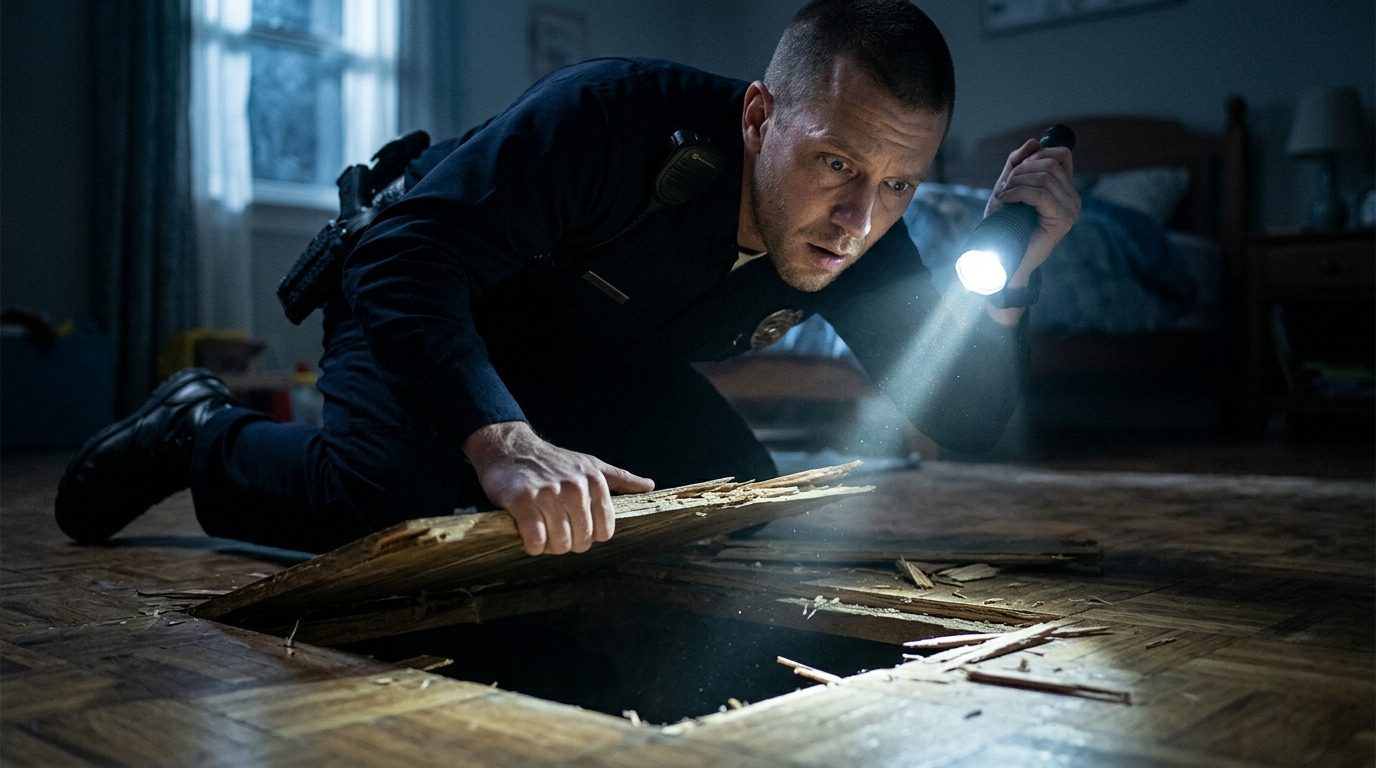
He crouched near the floorboards.
The leather of his duty belt creaked in the silence.
His flashlight clicked on, cutting a white beam across the parquet.
At first, the floor looked normal.
A little scratched.
A little worn.
Then the light caught a seam near the bedpost.
Not a natural gap.
A line.
Too straight.
Too clean in some places, too rough in others.
Like someone had lifted the wood recently and tried to push it back exactly as it was.
Miller’s pulse slowed.
That was how his body worked when danger appeared.
Not faster.
Slower.
Focused.
“Sarah,” he said without looking up, “how long have you lived here?”
“Three months.”
“Do you rent?”
“Yes.”
“Who has keys?”
She frowned.
“The landlord. Me. My sister has a spare. Why?”
Miller pressed two fingers into the seam.
The board shifted.
Not much.
Enough.
Lily whimpered.
“I told you.”
Sarah stepped forward.
“What is it?”
“Stay back for a second.”
He worked his fingers deeper into the gap and pulled.
The wood did not simply lift.
It snapped.
A narrow section of flooring came up, exposing a dark hollow below.
Cold air rose from the opening.
The smell became stronger.
Metallic.
Stale.
Human.
Miller aimed the flashlight into the hidden space.
At first, he saw dust.
Then a piece of cloth.
Then a small hand.
Then two eyes staring back at him from the dark.
His blood turned to ice.
For half a second, training left him.
Only instinct remained.
The eyes blinked.
Alive.
Terrified.
A child’s face, filthy and pale, stared up from the narrow space beneath the floorboards.
Then Miller saw the other thing.
A wire stretched across the opening.
Not a normal wire.
Not part of old construction.
Something recently placed.
Something connected to a small device taped beneath the floor, close enough that one careless movement could trigger whatever the person who built this hiding place had planned.
Miller’s voice cracked through the room.
“Everybody back!”
Sarah screamed.
Lily burst into tears.
Miller scrambled away from the opening, one arm thrown out to keep Sarah from rushing forward.
He was not reaching for his handcuffs.
Not yet.
He was reaching for his radio.
For backup.
For bomb squad.
For paramedics.
For everyone between that hidden child and death.
Because whatever was under Lily Carter’s floor was not a nightmare.
It was a crime scene.
And someone had designed it to stay buried.
The Boy Beneath the Boards
The first thing Miller did was get Lily and Sarah out of the bedroom.
The second thing he did was block the hallway.
The third was call it in properly.
Not animal complaint.
Not welfare check.
Not child nightmare.
Possible trapped juvenile. Hidden subfloor compartment. Possible device. Need fire, EMS, bomb unit, detectives. Immediate response.
Dispatch went quiet for half a beat.
Then the channel came alive.
Sarah stood near the stairs with Lily clutched against her chest, face bloodless.
“What did you see?” she whispered.
Miller did not answer right away.
He kept his body between them and the bedroom.
“Sarah, listen to me carefully. Did anyone do work in Lily’s room recently?”
Her lips parted.
“I… the landlord fixed a heating vent two weeks ago.”
“What’s his name?”
“Paul Hargrove.”
“Where does he live?”
“Next door. The blue house.”
Miller’s stomach tightened.
Next door.
Too close.
“Does he come in often?”
Sarah nodded slowly, horror dawning in her eyes.
“He said the house was old. Said he needed to check pipes. He had access before we moved in. Sometimes I’d come home and smell sawdust, but he said he was repairing settling boards.”
Lily sobbed into her mother’s sweater.
“He told me not to tell.”
Miller’s head snapped toward her.
Sarah froze.
“Who did?”
Lily shook harder.
“The floor man.”
Miller lowered his voice.
“Lily, did Mr. Hargrove talk to you?”
She nodded without lifting her face.
“When?”
“At night.”
Sarah made a sound like the air had been knocked from her lungs.
Miller crouched several feet away.
Not too close.
Not while Lily was shaking.
“What did he say?”
Lily looked at the bedroom door.
“He said if I told Mommy, the boy would stop breathing.”
Sarah covered her mouth.
Miller closed his eyes for one second.
Just one.
Then he opened them.
The boy.
Not thing.
Not monster.
Boy.
Backup arrived within minutes, though it felt longer.
Officer Ruiz took Sarah and Lily downstairs.
Firefighters cleared the front rooms.
Paramedics waited near the porch.
The bomb technician arrived with careful hands and a face that told Miller everything he needed to know: the device under the floor was crude, but real enough to treat seriously.
The hidden boy did not speak while they worked.
He only stared.
Every few seconds, Miller leaned low enough for the boy to see him from a safe angle.
“My name is Officer Miller,” he said. “We see you. We’re not leaving.”
The boy blinked slowly.
His lips moved.
No sound.
Miller continued.
“You don’t have to talk. Just stay still. Help is here.”
The device was neutralized after fourteen minutes.
Fourteen minutes that felt like a year.
When the technician finally gave the all-clear, firefighters widened the opening with tools, removing boards piece by piece.
The compartment was worse than Miller imagined.
It was not a small crawlspace.
It connected to a hidden passage running beneath the old duplex-style foundation, narrow and low, patched with newer plywood in places. Someone had built a concealed holding space beneath Lily’s bedroom, accessible through the vacant storage room in the landlord’s house next door.
Inside were water bottles.
Blankets.
A plastic bucket.
A child’s shoe.
And the boy.
He could not have been more than ten.
Thin.
Shaking.
Hair matted.
Wrists marked from restraint but not freshly bound.
He wore a faded green sweatshirt with a school logo Miller recognized before his mind was willing to finish the thought.
Miller had seen that sweatshirt in a missing poster.
Every officer in the city had.
Caleb Ward.
Missing thirteen months.
Disappeared walking home from a library program.
His mother had come to the station every Friday for months until grief made her voice too soft to carry through the lobby.
Miller backed away as paramedics lifted Caleb carefully through the floor.
The boy flinched at every movement.
When they placed him on the stretcher, he turned his head toward Lily’s teddy bear lying on the bed.
His eyes locked onto it.
Miller noticed.
“Lily,” he called softly toward the hallway.
Sarah had refused to leave the house completely. She stood at the top of the stairs with Ruiz, shaking.
Lily peeked from behind her mother.
Caleb looked at her.
For the first time, he spoke.
Barely.
“She heard me.”
Lily began crying again.
“I told them,” she whispered.
Caleb’s eyes filled.
“I know.”
That was when the entire hallway went silent.
Because everyone understood at once.
For a week, a little girl had been dismissed as frightened.
But she had not been imagining scratching.
She had been hearing a missing child trying to stay alive beneath her floor.
The Man Next Door
Paul Hargrove was not home when officers entered the blue house.
That frightened Miller more than finding him would have.
The back door was open.
A mug of coffee sat half-full on the kitchen table.
A radio scanner hissed softly near the window.
On the wall beside it were newspaper clippings.
Not many.
Only selected ones.
Missing boy search enters fourth week.
Family pleads for Caleb Ward’s return.
Police ask public for tips after library disappearance.
And, more recently:
Single mother rents restored home on Birch Lane.
There were photos too.
Sarah unloading boxes.
Lily on the porch.
Miller standing outside the house that morning.
Taken from across the street.
Fresh.
The search widened immediately.
Roadblocks.
K-9 units.
Detectives.
A helicopter.
Neighbors came out onto porches in robes and slippers, whispering as police moved between the two houses.
Sarah sat in an ambulance with Lily wrapped in a blanket beside her.
Her face looked empty now.
Shock had taken the place of fear.
“I let him in,” she whispered when Miller approached.
He leaned against the ambulance door.
“You didn’t know.”
“He came to fix her window. He brought cookies the day we moved in.”
“You didn’t know.”
Sarah looked at the house.
“She said there was something under the floor.”
“You called us.”
“After a week.”
“You called.”
That was all he could give her.
Not absolution.
Not blame.
Just the truth that mattered most tonight.
She had called.
And because she had, Caleb Ward was alive.
Lily sat beside her mother, Teddy clutched again, eyes fixed on the stretcher being loaded into another ambulance.
“Is he going to die?” she asked.
Miller crouched beside her.
“He’s going to the hospital. The doctors are going to help him.”
“He scratched because I said I was scared.”
Miller frowned.
“What do you mean?”
Lily looked down.
“The first night, I cried because I thought it was a monster. Then I said, ‘If you’re not a monster, scratch three times.’”
Miller’s throat tightened.
“And did he?”
She nodded.
“Then I told him I’d get help.”
Sarah began crying silently.
Lily’s voice broke.
“But nobody believed me.”
Miller looked at the little girl.
He had no easy answer.
Adults failed children in ordinary ways every day.
Too busy.
Too tired.
Too certain.
Too eager to name fear as imagination.
He said, “You kept telling the truth.”
Lily sniffed.
“Even when Mommy got sad?”
“Yes.”
“Was I brave?”
Miller’s voice softened.
“Braver than a lot of grown-ups.”
The detective in charge, Angela Brooks, approached with a grim expression.
“Danny.”
Miller stood.
“What did you find?”
“Storage room connects to the crawlspace. Looks like he built access years ago. Maybe before the Carters moved in.”
“Years?”
“Caleb might not be the first.”
Miller felt cold move through him again.
Brooks nodded toward the blue house.
“We found children’s belongings in a locked cabinet. Different ages. Some old.”
Miller looked at Lily.
Then at Sarah.
Then back at Brooks.
“Where’s Hargrove?”
“Car missing. BOLO is out.”
Miller’s hands curled.
Hargrove had been watching.
He must have heard the radio call.
Maybe seen the patrol car pull up.
Maybe watched from the blue house as Miller entered Lily’s bedroom.
He had run before the floor opened.
But he had made one mistake.
He left Caleb alive long enough for a frightened little girl to hear him.
The Mother at the Hospital
Caleb’s mother arrived at the hospital forty-six minutes after the call.
Miller knew because he checked his watch when she ran through the emergency entrance.
Her name was Denise Ward.
She had aged ten years in the thirteen months since her son disappeared.
Miller remembered her from the station.
The same blue coat.
The same worn handbag.
The same eyes that had once searched every officer’s face for the answer none of them could give.
Tonight, those eyes were wild with impossible hope.
“Where is he?” she cried. “Where is my son?”
A nurse guided her toward the treatment area.
Miller stood back.
This was not his moment to enter.
But he heard the sound when Denise saw Caleb.
A mother’s cry.
Not like television.
Not dramatic.
Raw.
Almost animal.
A sound dragged from the deepest place grief can hide.
“Caleb!”
The boy was weak, dehydrated, and frightened, but conscious.
When his mother reached him, he lifted one trembling hand.
That was all.
She folded over him like her body was trying to become shelter.
Miller turned away.
Officer Ruiz wiped her eyes beside him.
Nobody teased her for it.
Some cases deserved tears.
Detective Brooks arrived later with news.
Hargrove had been caught near the county line after crashing his car into a ditch during a police pursuit. He was alive. Injured. In custody.
Miller absorbed that quietly.
Good.
Not because he wanted vengeance.
Because trials require breathing defendants.
The investigation uncovered more than one crime.
Hargrove had owned both houses for years. The hidden passage between them had likely been part of an old bootlegging structure from a century earlier. He discovered it during renovations and turned it into something monstrous.
Caleb survived because Hargrove kept him hidden after the initial search moved elsewhere, using the abandoned crawlspace to control where he could be heard.
The arrival of Sarah and Lily had changed his routine.
Lily’s bedroom sat directly above the concealed compartment.
Caleb heard her crying the first night.
She heard him scratch back.
Two children separated by wood, fear, and the failures of every adult who had not looked closely enough.
At the hospital, Lily asked to see Caleb.
Detectives hesitated.
Doctors hesitated.
Denise Ward said yes.
So, with Sarah beside her, Lily entered Caleb’s room carrying Teddy.
Caleb looked smaller in the hospital bed.
Clean now.
Still pale.
Lily stood near the doorway.
“I’m sorry I thought you were a monster.”
Caleb’s lips twitched.
It was almost a smile.
“I’m sorry I scared you.”
Lily stepped closer and held out the teddy bear.
“You can hold him if you want. He’s good when things are scary.”
Caleb looked at his mother.
Denise nodded through tears.
He took the bear carefully.
For the first time since being found, his shoulders seemed to relax.
Miller watched from the hallway.
Detective Brooks stood beside him.
“You okay?”
He shook his head.
“No.”
She nodded.
“Good answer.”
He looked at her.
“We almost dismissed it.”
“But you didn’t.”
“I almost did.”
Brooks looked through the glass at Lily and Caleb.
“Almost is where a lot of lives are lost. Tonight it wasn’t.”
Miller hoped that would comfort him.
It did not.
Not fully.
Maybe it was not supposed to.
The Floor They Refused to Cover Again
The trial lasted eight months.
Hargrove’s defense tried to paint him as unstable, isolated, misunderstood, mentally unwell in ways that explained but did not excuse. The evidence was too strong. The hidden passage. The device. The belongings. The clippings. The scanner. Caleb’s testimony, given carefully through specialists. Lily’s statement.
The little girl who had been told all week that it was only a nightmare told the courtroom what she heard.
Three scratches.
A pause.
Three scratches again.
Then a whisper through the floorboards on the fourth night.
Help.
She could not make out the word fully at first.
But she felt it.
That was how she explained it.
“I felt like the floor was sad,” Lily said.
The courtroom went silent.
No adult phrase could improve on that.
Hargrove was convicted and sentenced to life in prison.
Other cases were reopened. Some led to answers. Some did not. The belongings found in his cabinet gave several families new grief and, in a few cases, long-denied closure.
Caleb’s recovery was slow.
People wanted miracle.
They always do.
They wanted the boy found, reunited, safe, smiling by the next morning.
But trauma does not obey headlines.
Caleb feared small rooms.
He panicked at floor creaks.
He slept with lights on.
He attended therapy.
So did Lily.
So did Sarah.
Because hearing a child beneath your floor and not being believed leaves a wound too.
Sarah moved out of the house immediately.
No one blamed her.
The city condemned the property after the investigation, but Lily asked one question before they left.
“What happens to the floor?”
Sarah looked at Miller, who had come to return one of Lily’s drawings collected as evidence.
“I don’t know, sweetheart.”
Lily’s face tightened.
“I don’t want them to just fix it.”
Miller understood.
Some things should not be covered too quickly.
Months later, after legal proceedings ended, the city demolished the passage between the two houses. The space where Lily’s bedroom had been was preserved briefly for investigators, then cleared.
At Lily’s request, a small section of the lifted floorboards was saved.
Not by Hargrove’s house.
Not as a morbid display.
But as part of a training exhibit at the police academy.
The plaque read:
Listen before explaining fear away.
Officer Miller hated seeing his name included in the case study.
He knew how close he had come to accepting the nightmare explanation.
But Detective Brooks told him that was exactly why the story mattered.
“Good police work isn’t never assuming,” she said. “It’s noticing when your assumption doesn’t fit.”
A year after Caleb was rescued, Denise Ward invited Lily and Sarah to Caleb’s birthday.
He turned eleven.
There was cake.
Too many balloons.
A backyard full of people trying very hard not to cry.
Caleb still moved carefully through the world, but he laughed when Lily gave him a new teddy bear wearing a tiny police hat.
“This is for backup,” she said.
Caleb smiled.
“I still have the old one.”
“You can have two.”
“Is that allowed?”
Lily looked very serious.
“For emergencies.”
Miller attended for ten minutes.
He planned to leave quickly.
Denise would not let him.
She hugged him so fiercely his uniform creased.
“Thank you for believing her,” she whispered.
Miller looked across the yard at Lily and Caleb.
“I almost didn’t.”
Denise pulled back.
“But you did.”
He nodded.
This time, the words helped a little.
Years passed.
Lily grew older.
Caleb did too.
They did not become storybook best friends, because real life is not that neat. But every year on Caleb’s birthday, Lily sent a card with three small scratch marks drawn inside.
Caleb always sent one back.
Three marks.
A pause.
Three more.
Their private language.
Proof that someone had heard.
Officer Miller became Detective Miller eventually.
He trained younger officers to pay attention to rooms.
Not just people.
Rooms tell stories.
A chair placed oddly.
A smell that does not belong.
A seam in the floor.
A child holding a teddy bear too tightly.
At the academy, he sometimes stood before the saved floorboards and told the story of Birch Lane.
He never exaggerated.
He did not need to.
He told them about Sarah apologizing for wasting time.
About Lily whispering.
About the metallic smell.
About the seam.
About the hidden eyes.
About shouting everybody back.
Then he paused and said:
“The easiest mistake would have been kindness without curiosity. I could have told that child she was safe, told the mother to get some rest, and left. I would have felt reasonable. I would have been wrong.”
The recruits always went quiet at that part.
Good.
He wanted the silence to stay with them.
Because the world was full of people, especially children, elderly people, disabled people, frightened people, whose warnings arrived in forms adults found inconvenient.
Nightmares.
Drawings.
Repetition.
Strange sentences.
Refusals to enter rooms.
Stories about sounds under floors.
Sometimes fear is imagination.
Sometimes it is memory.
Sometimes it is evidence that has not learned adult language yet.
Years later, Lily visited the academy exhibit with Sarah.
She was thirteen then, taller, still carrying herself with a little caution but no longer looking like fear lived directly beneath her skin.
She stood in front of the floorboards for a long time.
Miller, now in plain clothes, watched from a distance.
Finally, Lily turned to him.
“I used to hate that floor.”
“I know.”
“I still kind of do.”
“That’s fair.”
She looked back at the boards.
“But if it hadn’t made noise…”
Miller nodded.
“We might not have found him.”
She swallowed.
“Do you think the house was bad?”
Miller considered the question carefully.
“No. I think a bad man used it. And I think two kids were braver than he expected.”
Lily smiled faintly.
“Caleb says I was louder than him.”
“You were.”
“I was crying.”
“Crying can still be loud.”
She seemed to like that.
Sarah slipped an arm around her daughter.
Lily leaned into her.
The exhibit lights reflected off the old wood.
The seam was still visible.
The place Miller’s fingers had pulled.
The place the truth came up.
People loved the shocking version of the story.
The officer lifting the boards.
The hidden child staring back.
The shout.
The rescue.
The arrest.
But Miller always remembered the beginning.
A little girl in pajamas.
A teddy bear crushed against her chest.
A tired mother apologizing.
And a sentence so small it almost disappeared before anyone took it seriously.
There’s something under the floor.
That was the lesson.
Not that monsters hide in old houses.
Most do not.
The lesson was that sometimes truth comes quietly.
Sometimes it whispers from beneath what looks solid.
Sometimes the person hearing it is a child no one wants to worry.
And sometimes saving a life begins with refusing to laugh at what fear is trying to say.