The Rose on the Church Steps
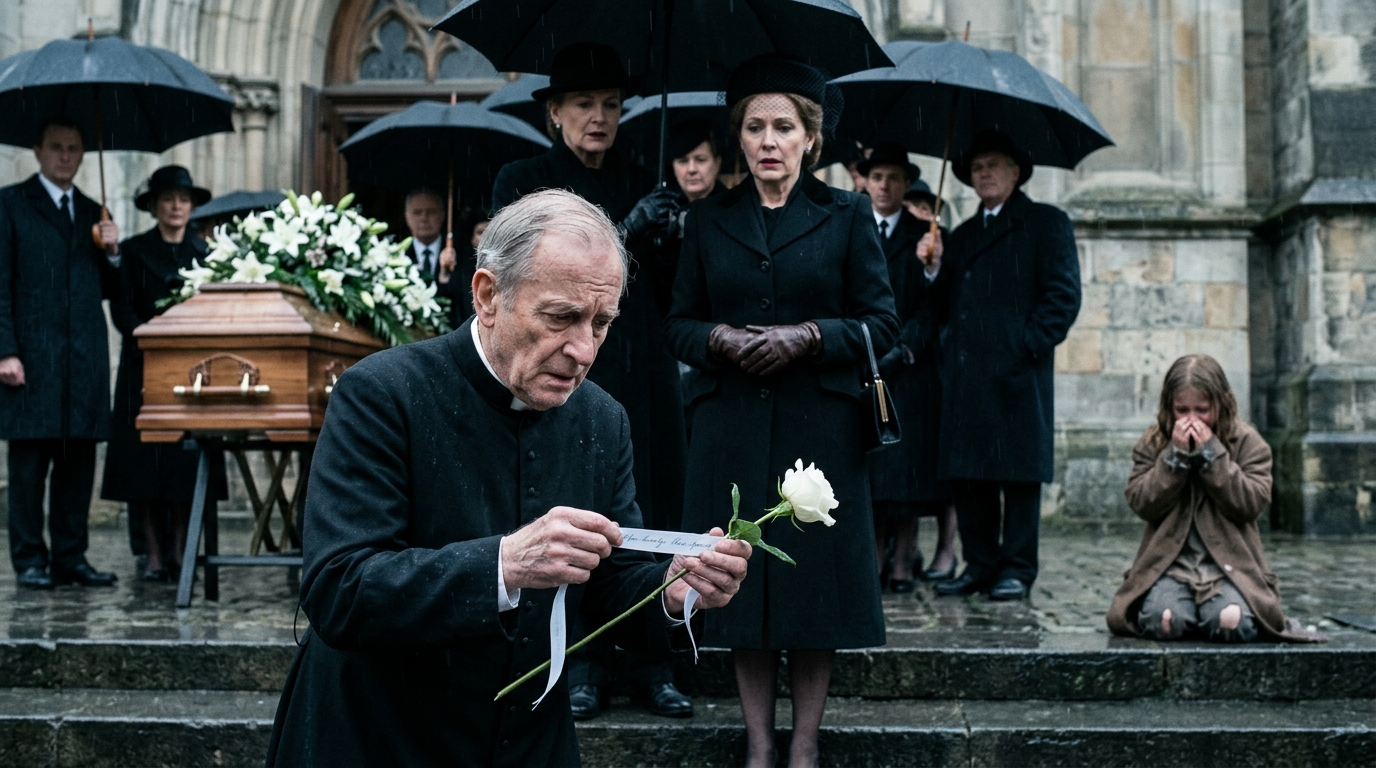
Rain drizzled gently over the church steps, darkening the old stone beneath a sea of black umbrellas.
The church itself looked more like a cathedral than a place of mourning. Tall European arches. Carved doors. Stained-glass windows glowing dimly under the gray sky. White lilies framed the flower-adorned coffin at the top of the steps, their petals trembling under the cold rain.
The man inside the coffin was Alistair Vale.
A name that meant power.
Hotels.
Shipping.
Private foundations.
Old money wrapped in newer money.
His portrait had appeared in newspapers for decades beside words like visionary, benefactor, titan, and philanthropist. People said he built half the city’s waterfront and donated enough to hospitals for entire wings to carry the Vale name.
But on that rainy morning, he was only a body beneath polished wood.
Around the coffin stood mourners dressed in expensive sorrow.
Tailored black coats.
Pearl earrings.
Leather gloves.
Faces composed in that icy way wealthy people sometimes wear grief, as if even pain must obey etiquette.
At the front stood his widow, Vivienne Vale.
Elegant.
Severe.
Untouchable in a black veil that softened nothing about her face.
She held a white handkerchief but had not used it once.
Beside her stood a man in a dark overcoat, Alistair’s nephew and heir apparent, Dominic Vale. He kept his eyes on the coffin, but his jaw was tight, his expression strained.
The priest began the final prayer.
His voice rose softly against the rain.
Then the little girl appeared.
At first, no one noticed her.
She came from the lower street, moving slowly between the umbrellas and parked cars, her small shoes splashing through shallow puddles. Her coat was too thin and soaked through. Her hair clung to her cheeks. She held one white rose in both hands as if it were something holy.
She looked no older than nine.
Maybe ten.
Small.
Stiff.
Terrified.
But she did not turn back.
A few mourners glanced at her and frowned.
The closer she came to the coffin, the quieter the whispers became.
Vivienne saw her.
Her expression sharpened instantly.
“Keep her away from the coffin,” she snapped, voice cutting through the priest’s prayer, “before she turns this into a spectacle.”
The guests turned.
Phones emerged.
Not out of compassion.
Out of appetite.
The little girl stopped halfway up the steps, trembling in the rain.
The rose shook in her hands.
“I’m not here to make trouble,” she whispered.
Vivienne’s eyes narrowed.
“Then leave.”
The girl swallowed.
“My mother said this flower had to touch his coffin if he died before he knew.”
The words were quiet.
But they moved through the crowd like cold wind.
Dominic lifted his head.
The priest stopped speaking.
Vivienne’s face hardened.
“Before he knew what?”
The child’s lips trembled.
She looked at the coffin.
Then back at the widow.
“My mother said he had to know she didn’t lie.”
Something changed in Vivienne’s expression.
Only for a second.
A flash of fear beneath fury.
Then she stepped forward, moving faster than anyone expected.
Before the little girl could protect it, Vivienne snatched the rose from her hands.
“Enough.”
The child gasped.
“No!”
Vivienne hurled the rose down onto the wet stone.
It landed near the priest’s shoes, petals bruised by rain.
The girl dropped to her knees immediately, reaching for it with shaking fingers.
“No, please,” she sobbed. “She said it had to touch the coffin.”
No one moved to help her.
That was the cruelest part.
Not Vivienne’s anger.
Not the rose falling.
The silence of people who saw a child kneeling in the rain and decided dignity belonged only to the dead rich man in the coffin, not the living girl at their feet.
Then the priest noticed something.
A thin ribbon tied around the stem.
It had been hidden beneath the petals, wrapped carefully as if by hands that had taken time even while running out of hope.
The priest bent down.
Vivienne’s voice cracked.
“Father, don’t.”
But he already had the rose in his hand.
Slowly, he untied the ribbon.
Rain dotted the fabric.
Black ink marked the pale silk.
The priest read the words.
His face went white.
His lips parted.
Dominic stepped closer.
“What is it?”
The priest looked at the girl.
Then at the coffin.
Then at Vivienne.
His voice trembled when he read aloud:
“If he is buried before the truth, tell him his daughter still lives.”
The rain seemed to stop.
Or perhaps everyone simply forgot to hear it.
Vivienne’s complexion drained of color.
Dominic turned toward the little girl in horror.
The child knelt on the stone, sobbing silently now, her eyes fixed on the coffin.
And in that heavy silence, everyone finally understood.
She had not come to disrupt the funeral.
She had come carrying the truth the dead man had never been allowed to hear.
The Name on the Ribbon
The priest’s hands shook as he held the ribbon.
“Child,” he said softly, “what is your name?”
The girl wiped her cheeks with the back of her sleeve.
“Clara.”
The name struck Dominic visibly.
He looked at Vivienne.
She did not look back.
“Clara what?” the priest asked.
The little girl hesitated.
Her fingers curled around the wet rose.
“Clara Bell.”
Several mourners whispered.
Bell.
It was not a name that belonged among the Vales.
It belonged to smaller streets, rented rooms, unpaid bills, women who worked two jobs and still apologized for being late with rent.
Vivienne seemed to recover.
Only outwardly.
Her voice turned cold again.
“This is absurd. Someone sent this child here to extort a grieving family.”
Clara’s face crumpled.
“I’m not lying.”
Vivienne looked at the crowd.
“Of course she has been coached.”
The priest’s expression hardened.
“Mrs. Vale, she is a child.”
“And children can be used.”
Dominic took one step toward Clara.
Vivienne snapped, “Dominic, don’t.”
That made him stop.
Not because he obeyed her.
Because her panic was too obvious.
He looked down at the ribbon in the priest’s hand.
“Who was your mother?” he asked Clara.
The girl’s voice was small.
“Evelyn Bell.”
This time, the name did not merely ripple through the mourners.
It struck.
Dominic went still.
The old priest closed his eyes briefly, as if he had heard a ghost speak.
Vivienne’s gloved hand tightened around her handkerchief.
“No,” she whispered.
Clara looked up.
“You knew her?”
Dominic turned toward Vivienne.
“You told us Evelyn left the country.”
Vivienne’s expression sharpened.
“That woman left many things.”
The priest looked at her.
“Vivienne.”
The widow turned on him.
“Do not use that tone with me at my husband’s funeral.”
The priest stepped closer, still holding the ribbon.
“I remember Evelyn Bell.”
Several guests leaned in.
The priest’s voice grew lower.
“She came to this church eleven years ago. Pregnant. Frightened. She asked to speak with Alistair Vale.”
Clara’s eyes widened.
Vivienne’s face hardened into a mask.
“She was unstable,” Vivienne said.
“She was desperate,” the priest replied.
Vivienne’s voice rose.
“She was a liar.”
The little girl flinched as if slapped.
Dominic noticed.
So did the priest.
The priest bent and handed the rose back to Clara.
“Your mother gave you this?”
Clara shook her head.
“She died three weeks ago.”
The words broke through the funeral like a second death.
“She wrote it before the hospital,” Clara whispered. “She said if Mr. Vale died before she could find him, I had to bring the rose. She said the priest would remember.”
The priest covered his mouth for one moment.
“I should have done more,” he murmured.
Vivienne seized on the weakness.
“No, Father. You should have done less. You should have refused her when she first came here with her fantasies.”
Clara stood, suddenly angry through her tears.
“They weren’t fantasies.”
Her small hand reached into her coat.
Dominic stepped forward instinctively, but she only pulled out a plastic pouch.
Inside was a folded photograph, protected from the rain.
She held it toward the priest.
“My mother said to show this if they called her a liar.”
The priest took it carefully.
Dominic moved close enough to see.
The photograph was old.
Worn.
But clear.
It showed a younger Alistair Vale standing in front of a small seaside cottage. He was not in a suit. Not surrounded by wealth. He wore a simple sweater, hair windblown, face softened by a smile no public portrait had ever captured.
Beside him stood a young woman with dark hair.
Evelyn Bell.
She was pregnant.
Alistair’s hand rested gently over her belly.
On the back of the photograph, in faded blue ink, were words written in Alistair’s own hand:
For Evelyn and our little star.
I will make this right.
A.V.
Dominic stared.
The priest crossed himself.
Vivienne reached for the photograph.
Dominic pulled it away before she could touch it.
Her eyes flashed.
“Give that to me.”
“No,” Dominic said quietly.
It was the first time anyone had openly refused her that morning.
Vivienne looked around.
Too many phones.
Too many witnesses.
Too much rain and truth slipping beyond her control.
Then Clara spoke again.
“There’s another thing.”
Everyone turned.
She reached beneath her collar and pulled out a thin chain.
On it hung a small silver locket.
Dominic inhaled sharply.
The priest whispered, “Dear God.”
Vivienne’s face emptied.
The locket was not expensive by Vale standards.
But it was unmistakable.
A small oval silver locket with a blue enamel star on the front.
Dominic knew it because Alistair had worn one just like it for years after his first wife died.
Only this one was smaller.
A matching piece.
Clara opened it with trembling fingers.
Inside was a tiny photograph of Alistair.
And on the other side, a curl of baby hair wrapped in silk thread.
“My mother said he gave it to her before I was born,” Clara whispered. “She said he promised to come back.”
The coffin sat between them all.
Silent.
Polished.
Too late.
Dominic looked at Vivienne.
“What did you do?”
The Widow’s Perfect Lie
Vivienne Vale had built her life on control.
Not love.
Not loyalty.
Control.
She married Alistair when he was already powerful but not yet untouchable. She learned his weaknesses early: guilt, loneliness, and a sentimental faith in people who had not earned it.
He wanted to be seen as good.
Vivienne wanted to be seen as necessary.
Together, they built an empire that smiled in public and tightened behind closed doors.
But Evelyn Bell had been different.
Dominic remembered her now in fragments.
A woman at the edge of family events.
A temporary archivist hired to help Alistair organize old foundation records.
Quiet.
Warm.
Too genuine for rooms full of people who performed sincerity.
Alistair had looked happier that year.
Dominic had been young, but not blind.
Then Evelyn vanished.
The family story came quickly.
She had stolen foundation documents.
She had tried to blackmail Alistair.
She had invented a pregnancy.
She had run away when confronted.
Alistair became colder after that.
He never spoke of her again.
Or rather, Vivienne never allowed anyone to speak of her again.
Now, on the church steps, with the coffin behind her and a homeless child holding a rose before her, that old story began to rot in the open air.
Vivienne lifted her chin.
“This is grief manipulation,” she said. “A dead woman has sent her child to humiliate us at a funeral.”
Clara whispered, “My mother didn’t send me to humiliate you.”
“Then what did she send you for?”
Clara looked at the coffin.
“To say goodbye for both of us.”
Something in Dominic’s face broke.
Vivienne rolled her eyes.
“Touching.”
The priest’s voice hardened.
“Enough.”
She turned toward him.
“You are forgetting who paid for this church restoration.”
The priest looked at the coffin.
“No. I am remembering who this church is meant to serve.”
A murmur moved through the crowd.
Vivienne’s eyes narrowed.
Dominic stepped closer to Clara.
“Did your mother tell you why Alistair never came back?”
The girl nodded slowly.
“She said letters stopped.”
“What letters?”
Clara reached into the plastic pouch again and removed a bundle tied with string.
Old envelopes.
Some opened.
Some returned.
Some marked with stamps.
Some never mailed.
Dominic took them.
His hands shook when he saw the addresses.
Alistair Vale.
Vale House.
Vale Foundation Office.
Private residence.
The earliest letters were written in Evelyn’s careful handwriting.
Alistair, I waited where you told me.
Alistair, the doctor says the baby is strong.
Alistair, someone came to my room and told me to leave the city.
Alistair, please tell me if you changed your mind yourself. I will accept it if it comes from you.
Alistair, she was born today. I named her Clara because you said light should have a name.
Dominic swallowed hard.
Then he saw the final envelope.
It had been opened.
Not by Alistair.
The seal was broken roughly, then taped again.
Across the front was a note in Vivienne’s handwriting:
Do not deliver. Return to sender. Fraudulent harassment.
Dominic looked at her.
“You intercepted them.”
Vivienne’s face did not change.
“She was dangerous.”
“She had his child.”
“She had a claim she could not be allowed to use.”
The sentence came too quickly.
Too honestly.
The crowd heard it.
Phones caught it.
Vivienne realized her mistake a second too late.
Dominic’s voice dropped.
“A claim?”
She said nothing.
The priest looked at her with horror.
Dominic stepped closer.
“What claim, Vivienne?”
She looked toward the coffin, then back at Clara.
Her lips tightened.
“Alistair was weak. He would have destroyed everything for sentiment.”
“For his daughter?”
“For a scandal.”
Clara’s eyes filled again.
“I’m not a scandal.”
Dominic turned toward her.
“No,” he said softly. “You’re not.”
That kindness shattered what little composure the girl had left. She clutched the rose to her chest and began to sob.
Dominic looked at the coffin.
His uncle, the man he had admired and feared, lay inches away from the truth he never received.
Then the church doors opened.
A woman in a gray coat hurried out, rain beading on her hair.
She was older now, but the priest recognized her instantly.
“Marta?”
Vivienne went rigid.
Marta Vale had worked as Alistair’s private secretary for nearly thirty years.
She had retired suddenly after a stroke, or so the family said.
But now she stood on the church steps, breathing hard, clutching a leather folder to her chest.
Her eyes found Clara.
Then the rose.
Then Vivienne.
“I am too late,” Marta whispered.
The priest stepped toward her.
“Too late for what?”
Marta opened the folder.
“To give him the letter he wrote before she buried it.”
The Letter in the Secretary’s Folder
Vivienne moved first.
Fast.
Too fast for a grieving widow.
She reached for Marta’s folder, but Dominic blocked her.
“Don’t.”
Vivienne stared at him.
“You forget yourself.”
“No,” he said. “I think I’m remembering this family too clearly.”
Marta’s hands trembled as she removed a sealed envelope from the folder.
The paper was thick.
Cream-colored.
Marked with Alistair’s personal crest.
The seal had been broken and resealed.
Marta looked at the priest.
“I found it in Vivienne’s locked correspondence cabinet after Mr. Vale died. I had a key from years ago. I wasn’t sure if I should come.”
Her eyes filled.
“Then I saw the child.”
Vivienne’s voice was low.
“You old fool.”
Marta flinched, but did not stop.
She handed the envelope to Dominic.
His name was written across the front.
Dominic Vale — if Evelyn cannot be found.
Dominic went pale.
He opened it.
The letter inside was dated ten years earlier.
Several mourners stepped closer despite themselves.
Dominic read silently at first.
Then, after the first few lines, his voice broke.
He read aloud.
Dominic,
If this reaches you, it means I have failed again.
Evelyn Bell was not a liar.
The child is mine.
A sound moved through the crowd.
Vivienne looked away.
Dominic continued.
I was told she took money and left the country. I believed it because believing it allowed me to survive my own cowardice. Years later, I found one letter Vivienne failed to destroy. Evelyn said our daughter had been born.
I searched quietly. Too quietly. That is my shame.
Every investigator I hired found nothing, or said they found nothing. I now believe someone close to me blocked the search.
If I die before I find them, do not let Vivienne bury this with me.
Do not let my daughter grow up nameless to the house that should have protected her.
Her name may be Clara.
If she is alive, she is my heir.
The word heir hit the steps like thunder.
Vivienne’s face turned ghostly pale.
Dominic read the final lines.
And if Evelyn is dead, let this family remember: the poorest woman in this story had more honor than all of us.
A.V.
The paper shook in Dominic’s hands.
Clara stared at him.
“She said he didn’t know.”
Dominic could barely answer.
“He knew too late.”
The priest closed his eyes.
Marta began crying quietly.
Vivienne looked at the crowd, at the phones, at the coffin, at the folder, at the little girl whose existence had just overturned a carefully arranged inheritance.
Then her grief mask finally fell.
“You think this changes anything?” she said.
Dominic turned.
Vivienne’s voice sharpened.
“A letter. A ribbon. Some old photograph. Do you think courts hand over estates because a child appears in the rain?”
Clara stepped back.
Dominic moved in front of her.
“No one is taking her anywhere.”
Vivienne laughed.
“She is not one of us.”
The priest looked at the child’s soaked coat.
Then at the lilies around the coffin.
“Thank God for that.”
Several mourners gasped.
Vivienne’s eyes flashed with hatred.
Marta reached into the folder again.
“There is more.”
Vivienne’s face changed.
For the first time, she looked afraid.
Marta pulled out a second document.
“Mr. Vale amended his will eight years ago. Quietly. He placed a sealed provision with the family solicitor. Vivienne contested it privately and stalled the filing.”
Dominic took the document.
He recognized the solicitor’s stamp.
Marta continued.
“It states that if a child named Clara Bell or any child born to Evelyn Bell is found, a trust is to be established immediately. Housing. Education. Protection. And a full investigation into why she was separated from him.”
Clara’s lips parted.
“I don’t understand.”
Dominic knelt before her, rain soaking his trousers.
“It means he looked for you.”
Her face crumpled.
“But he didn’t come.”
“I know.”
The truth did not heal that.
Nothing could.
Not fully.
Dominic did not pretend otherwise.
“He failed you,” he said. “And so did we.”
Vivienne snapped, “Speak for yourself.”
Dominic stood.
“I am.”
He looked at the mourners.
“And I am speaking for this family now.”
Vivienne’s laugh was sharp.
“You?”
He turned toward her.
“Yes. Me. The nephew you planned to use as a clean heir while burying a child in poverty.”
Her face hardened.
“You will regret this.”
“No,” Dominic said. “I already regret not asking questions sooner.”
Then he looked toward the priest.
“Father, may Clara place the rose on the coffin?”
The priest’s eyes filled.
“Yes.”
Vivienne stepped forward.
“No.”
Dominic did not raise his voice.
“If you touch her again, I will have you removed from my uncle’s funeral.”
The wealthy widow stared at him.
The crowd watched.
For the first time that morning, no one protected her.
Clara walked to the coffin slowly.
The rose trembled in her hands.
She reached up.
Dominic gently lifted her so she could place it on the polished wood among the lilies.
The white rose lay there, rain-damp and bruised, ribbon untied but still wrapped loosely around the stem.
Clara touched the coffin.
Her voice was barely audible.
“My mother said you liked white flowers.”
The priest bowed his head.
Dominic turned away.
Even the phones lowered.
Because some moments are too human to be owned by a screen.
The Daughter the Funeral Couldn’t Bury
The funeral did not continue as planned.
How could it?
The priest finished the prayer, but the words carried a different weight now.
Alistair Vale was lowered into the family crypt not as the perfect philanthropist the program described, but as a flawed man who had found the truth too late and hidden enough of it to leave a child standing in the rain.
Clara did not attend the burial inside the crypt.
She waited outside with Marta.
Dominic stayed with her.
Vivienne entered with the family, but emerged looking smaller, not from grief, but from the sudden absence of control.
By afternoon, the story had reached the news.
By evening, the ribbon’s inscription had been quoted across the country.
If he is buried before the truth, tell him his daughter still lives.
People loved that line.
They repeated it as if it were poetry.
Clara did not love it.
To her, it was not poetry.
It was the last job her dying mother gave her.
The days that followed were loud.
Lawyers.
Reporters.
DNA testing.
Emergency guardianship proceedings.
Estate freezes.
Investigations into intercepted letters and suppressed documents.
Vivienne hired attorneys who used phrases like fraudulent claim, emotional manipulation, and inheritance opportunism.
Then the DNA results returned.
Clara Bell was Alistair Vale’s daughter.
The legal tone changed overnight.
Vivienne’s attorneys became quieter.
Dominic’s became busier.
Marta testified.
So did the priest.
Old correspondence was recovered from storage units, private files, and one locked cabinet Vivienne had forgotten to empty.
A fuller picture emerged.
Evelyn Bell had never tried to extort anyone.
She had tried to reach the father of her child.
Vivienne had intercepted letters, blocked appointments, threatened landlords, and used private investigators not to find Clara, but to keep mother and daughter far enough away that Alistair’s conscience could not reach them.
Alistair had learned pieces years later.
Too late.
Too quietly.
He had tried to repair the truth through documents because he lacked the courage to break his own household open while alive.
That failure became part of the public record too.
Dominic insisted on it.
“We will not clean his image by dirtying hers,” he told the family solicitor.
Clara moved first into temporary housing arranged through the court, then into a small townhouse with a guardian recommended by Marta and approved by child services. Dominic visited only when invited. He learned quickly not to arrive with too many gifts.
The first time he brought expensive toys, Clara stared at them and said, “You can’t buy the funeral back.”
He took them away.
The next time, he brought one book and a sandwich.
That went better.
Vivienne fought the trust.
She lost.
She fought the public correction of Evelyn’s name.
She lost that too.
The Vale Foundation issued a formal statement acknowledging that Evelyn Bell had been wrongfully discredited and that Clara had been denied recognition due to deliberate interference by members of the Vale household.
Dominic wrote the statement himself.
Clara asked for one change.
Where it said “Miss Bell experienced hardship,” she crossed it out and wrote:
My mother was made to suffer.
Dominic kept her wording.
Months later, a memorial plaque for Evelyn Bell was placed in the church garden near the white lilies.
Not grand.
Not expensive.
Clara chose the words.
Evelyn Bell
She told the truth even when no one opened the door.
On the day the plaque was installed, the old priest stood beside Clara.
“I should have opened the door wider,” he said.
Clara looked up at him.
“You opened it at the funeral.”
“Too late.”
She touched the carved letters.
“My mom said late is better than never, but only if people stop pretending it was on time.”
The priest smiled sadly.
“She was wise.”
“She was tired.”
Both were true.
Years passed.
Clara grew.
She did not become a fairy-tale heiress.
Real children do not transform overnight because money discovers them.
She remained wary.
She hated cameras.
She flinched at raised voices.
She kept the funeral ribbon in a small wooden box beside her bed.
Sometimes she took it out and read the words, not because she needed reminding that Alistair was her father, but because she needed reminding that her mother had not died unheard.
Dominic became her legal family slowly.
Not father.
Not uncle at first.
Just Dominic.
Then Dom, on good days.
He accepted every version.
On Clara’s fourteenth birthday, he gave her a white rosebush for the church garden.
She rolled her eyes.
“Very symbolic.”
He looked embarrassed.
“I thought so too after I bought it.”
She laughed.
It was the first time he heard her laugh without sadness attached.
They planted it near Evelyn’s plaque.
The old priest blessed it.
Marta brought tea in a thermos.
No reporters were invited.
Vivienne left the city after losing most control over the Vale estate. She retained wealth, because people like her often do, but not power over Clara’s trust, not leadership of the foundation, and not the public story.
That last loss hurt her most.
Years later, people still told the story of the homeless girl at the funeral.
They remembered the rose thrown onto wet stone.
The priest reading the ribbon.
The widow turning pale.
The shocking reveal that the dead millionaire’s daughter was alive.
But Clara remembered the moment differently.
She remembered her knees hitting the cold church steps.
She remembered reaching for the flower while adults watched.
She remembered thinking she had failed her mother because the rose had not touched the coffin.
Then she remembered the priest picking it up.
The ribbon opening.
The silence changing.
That was when she learned something she carried for the rest of her life:
Sometimes truth does not need to arrive loudly.
Sometimes it arrives soaked in rain, tied to a flower, held by trembling hands.
Sometimes it is thrown down by the powerful.
And sometimes, if one person bends to pick it up, an entire family’s lie finally has to stand trial in the open air.
On the tenth anniversary of Evelyn Bell’s death, Clara returned to the church alone.
She was nineteen then.
Tall.
Composed.
Still carrying her mother’s eyes.
The white rosebush had grown strong near the garden wall, blooming even in weather that bent other flowers low.
Clara cut one rose carefully.
Then she walked to the Vale crypt.
Alistair’s name was carved in stone beside generations of people who had never known poverty, hunger, or unanswered letters.
For a long time, Clara stood there.
She did not hate him anymore.
Not exactly.
But she did not forgive him fully either.
She had learned that love, failure, cowardice, and longing could live in the same person.
That made grief harder.
It also made it more honest.
She placed the white rose beneath his name.
No ribbon this time.
No message.
No demand.
Just a flower.
Then she whispered, “She was my mother.”
The crypt was silent.
Clara nodded once, as if receiving an answer she no longer needed.
Outside, rain began to fall gently over the church steps.
She opened her umbrella and walked past the place where she had once knelt with a broken heart and a bruised rose.
The stone was clean now.
No trace of that morning remained.
But Clara knew better.
Some stains do not stay on stone.
They move into records.
Into corrected names.
Into trusts that cannot be stolen.
Into gardens where women once erased are finally remembered.
Into girls who grow up knowing the truth was almost buried, but wasn’t.
Because a dying mother tied a message to a white rose.
And her daughter was brave enough to bring it through the rain.