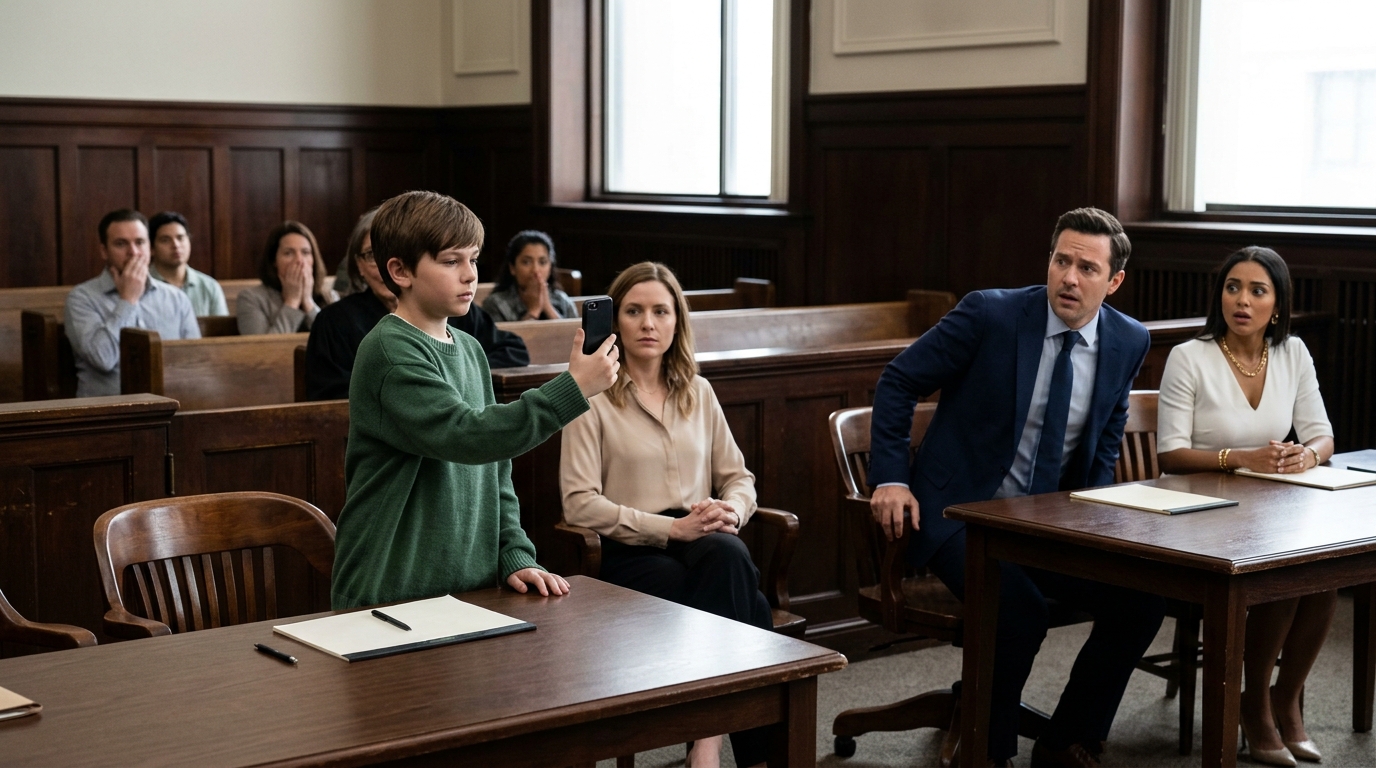
The Recording in Court
“My son wants to live with me.”
Bradley said it as if the sentence hurt him.
That was always his greatest talent.
He could make a lie sound like sacrifice.
He sat across the courtroom in a navy suit that looked expensive enough to imply honesty. His tie was perfectly knotted. His hair had been styled with the careful precision of a man who believed appearance could become evidence if presented confidently enough.
Beside him sat Sienna, his new wife, draped in crisp white, gold jewelry catching the courtroom lights each time she moved her hand to touch his arm. She looked like a woman posing for sympathy.
I sat at the other table in a plain beige blouse and tailored trousers, my hands folded in my lap.
Not because I felt calm.
Because I had spent three years learning that stillness frightened Bradley more than tears.
My name is Natalie Carter.
I am thirty-four years old.
And for three years, I let my ex-husband believe he had shattered me.
Not because I was weak.
Not because I had given up.
Because I learned something about men like Bradley: they reveal more when they think they have already won.
The courtroom smelled like old wood, floor polish, and paper. Dark mahogany panels lined the walls, giving every word a heavier weight. The air conditioning hummed softly overhead. Somewhere behind me, someone shifted in the gallery, and even that small rustle felt loud.
Judge Elena Ramirez sat at the bench, reading through the file with the kind of silence that made lawyers straighten their backs.
She was not dramatic.
She did not need to be.
In family court, her reputation was simple: she listened longer than most people expected, then spoke only when she was ready to make someone regret wasting the court’s time.
Bradley dabbed at one eye with a folded handkerchief.
“Your Honor,” he said, voice trembling at the edges, “I take no pleasure in saying this. But Natalie has become unstable. I have tried to be patient. I have tried to co-parent peacefully. But I have to protect my son.”
My son.
He always said it that way in court.
Not our son.
My son.
As if Leo were property under dispute.
Sienna leaned closer to him.
“We just want to give Leo stability,” she added softly. “He deserves a peaceful home.”
A peaceful home.
I looked at Leo.
He sat beside my attorney, Ms. Monroe, wearing a slightly oversized green sweater and black sneakers. At eleven years old, he still had the roundness of childhood in his face, but his eyes had become older than they should have been.
That was Bradley’s doing.
Children of manipulative parents learn to read rooms before they learn algebra.
Leo’s hands rested in his lap.
Too still.
Too prepared.
Judge Ramirez looked over her glasses.
“These are serious allegations,” she said. “Before we move into financial disclosures, I would like to hear from the child.”
Bradley shifted.
It was small.
Barely noticeable.
But I saw it.
His eyes slid toward Leo with the familiar warning look he had used at dinner tables, school events, hospital visits, and custody exchanges.
Do what I told you.
Or else.
Leo stood slowly.
My heart began to pound.
The courtroom seemed to shrink around him.
Judge Ramirez softened her voice.
“Leo, do you understand why we are here today?”
“Yes, Your Honor.”
“Your father has represented to the court that you have expressed a desire to live primarily with him. Is that true?”
The silence pressed into my ears.
Leo looked at his father.
Bradley gave him the smallest nod.
Then Leo turned back to the judge.
“No, Your Honor.”
Bradley’s chair scraped against the polished floor as he jumped up.
“Your Honor, the boy is confused. He’s been influenced—”
“Sit down, Mr. Carter,” Judge Ramirez said.
Her voice was not loud.
It did not need to be.
Bradley sat.
Leo reached into his pocket and pulled out his phone with both hands.
He held it carefully, as if it were not a device but a match in a room full of gasoline.
“Your Honor,” he said, “may I play a recording from last night?”
The judge froze for half a second.
So did Bradley.
Sienna’s hand slipped from his arm.
Ms. Monroe looked at me.
I did not move.
Judge Ramirez leaned back slightly.
“Ms. Monroe?”
My attorney stood.
“Your Honor, my client was not aware until this morning that Leo had this recording. Given the nature of the allegations being made by Mr. Carter, we believe the court should hear it. We are prepared to provide the device for review and authentication.”
Bradley’s attorney, Ms. Hale, rose quickly.
“Objection, Your Honor. We have no foundation, no context, and no indication this was lawfully obtained.”
Judge Ramirez looked at Leo.
“Leo, did you make this recording yourself?”
“Yes, Your Honor.”
“Were you present during the conversation?”
“Yes.”
“Was it your phone?”
“Yes.”
The judge’s gaze moved toward Bradley.
Then back to my son.
“I will hear enough to determine relevance. Play it.”
Leo tapped the screen.
The recording crackled.
Then Bradley’s voice filled the courtroom.
Harsh.
Controlled.
Nothing like the trembling father he had performed minutes earlier.
“Tomorrow, you tell the judge you hate your mother.”
My breath stopped.
Bradley went white.
The recording continued.
“If you don’t, I’ll call the bank and have her evicted. I’ll make sure she ends up on the street.”
Someone in the gallery gasped.
Leo stood perfectly still.
His small thumb rested near the edge of the phone.
“You’ll tell them she’s unstable,” Bradley’s recorded voice said. “Or I’ll cut off your insurance. Do you understand me?”
Then Sienna’s voice appeared in the background.
Light.
Irritated.
“Bradley, don’t scare him too much. Just make sure he knows Natalie can’t protect him.”
The courtroom went colder than stone.
I watched Sienna’s face collapse.
The recording continued.
Bradley again.
“She has nothing without me. No house. No coverage. No school fees. No lawyer who can actually fight. One word from me, Leo, and she loses everything. So tomorrow, you do exactly what I told you.”
Then Leo’s small voice in the recording.
“What if I tell the truth?”
A pause.
Then Bradley laughed.
A sound I knew too well.
“Truth is what adults can prove.”
The audio stopped.
Leo lowered the phone.
For several seconds, no one spoke.
Even the air conditioning sounded too loud.
Judge Ramirez removed her glasses slowly.
Bradley’s handkerchief sat crumpled in his fist.
His perfect face was no longer perfect.
It was naked.
Three Years of Silence
People think silence means surrender.
Sometimes it does.
But sometimes silence is a drawer where you keep evidence until the right door opens.
Three years earlier, when Bradley first left me for Sienna, he did not leave quietly.
He wanted me reduced.
Not heartbroken.
Reduced.
There is a difference.
Heartbroken people still have dignity.
Reduced people are easier to control.
At first, he played generous.
He told friends we were separating “amicably.”
He told my mother he would always take care of Leo.
He told me I should be grateful he wasn’t making things ugly.
Then the bank called.
Our mortgage payment had been reversed.
The joint account was empty.
The health insurance portal suddenly listed me as removed.
Leo’s school sent a notice about unpaid tuition.
Bradley claimed it was an administrative error.
Then he sent me a text.
You should be nicer if you want things handled smoothly.
That was the first time I understood the divorce was not about marriage ending.
It was about punishment.
Bradley had always loved control more than love.
During our marriage, he controlled it gently at first.
He chose the restaurants.
The friends.
The vacations.
The car I drove.
The way I dressed for company dinners.
When I objected, he smiled and called me sensitive.
When I cried, he called me unstable.
When I got quiet, he called it proof.
By the time he left, he had already spent years building a version of me that made my pain look like evidence against me.
And Sienna helped him polish it.
She was not the innocent new wife who believed his lies.
She enjoyed them.
She sent me messages pretending concern.
Natalie, I know transitions are hard, but Leo needs calm energy.
Natalie, maybe therapy would help you regulate.
Natalie, Bradley says you’ve been spiraling. We’re praying for you.
Each message was written for a future courtroom.
I knew that.
So I stopped answering emotionally.
I answered like a woman building a file.
Noted.
Please communicate through the parenting app.
Please confirm pickup time.
Please provide insurance documentation.
Please return Leo’s asthma medication.
The calmer I became, the angrier Bradley grew.
He called me cold.
Then uncooperative.
Then alienating.
Then unstable because, according to him, “normal women show emotion.”
I gave him none he could use.
But Leo saw more than I wanted him to.
He saw the notices.
The tension.
The way I took extra shifts at the library archives after Bradley delayed support payments.
He saw me stretch groceries until payday.
He saw me tell him I wasn’t hungry.
He saw me smile at school meetings with a migraine pounding behind my eyes because Bradley had spent the previous night texting threats disguised as concern.
I tried to protect him from the details.
But children hear what doors cannot hold.
One night, about a year after the divorce, Leo found me sitting on the kitchen floor beside a stack of bills.
He did not say anything at first.
Then he sat beside me and placed his small hand over mine.
“Dad says you’re bad with money.”
I closed my eyes.
“No, sweetheart.”
“Then why does he say it?”
I looked at him.
Because your father uses money the way other people use fists.
I did not say that.
Instead, I said, “Sometimes adults say things that make themselves feel less guilty.”
Leo nodded slowly.
He understood too much.
That was what I hated most.
Not the divorce.
Not the money.
Not even Bradley’s lies.
I hated that my son was learning strategy when he should have been learning peace.
So I documented everything.
Bank notices.
Insurance changes.
Screenshots.
School emails.
Voicemails.
Parenting app messages.
Receipts.
Every canceled payment.
Every threat.
Every time Bradley claimed he wanted more custody but failed to show up for Leo’s appointments, games, conferences, or therapy sessions.
I gave everything to Ms. Monroe.
And then we waited.
Because Bradley was careful in writing.
But careless when he felt powerful.
Men like him always are.
Leo’s Choice
I did not ask Leo to record his father.
I need that to be clear.
I never wanted my son to become evidence.
No child should have to gather proof against a parent.
But Bradley made a mistake the night before court.
He got too confident.
He requested an unscheduled dinner with Leo and claimed he wanted “one peaceful conversation before the hearing.”
My attorney advised against it.
But Leo wanted to go.
He said, “I want to hear what he says when he thinks I’m alone.”
That sentence broke my heart.
“You don’t have to do this,” I told him.
Leo looked at me with those old eyes.
“I know.”
“I don’t want you involved.”
“I’m already involved, Mom.”
I hated that he was right.
The dinner took place at Bradley’s house.
Sienna was there.
So was the new marble kitchen.
The one Bradley claimed he could not afford while delaying support payments.
Leo told me later that dinner was quiet at first.
Too quiet.
Then Bradley sent the housekeeper away and turned off the television.
Sienna sat at the kitchen island with a glass of white wine, watching.
Bradley began gently.
“You know I love you, buddy.”
Leo nodded.
“You know your mom has been struggling.”
“I don’t think she has.”
Bradley’s smile thinned.
“That’s because she hides it from you.”
Then came the speech.
The one in the recording.
The threats.
The eviction.
The insurance.
The instruction to lie.
Leo had started recording when Bradley said, “Tomorrow is important, and you need to be smart.”
He kept the phone face down beside his leg.
My brave, terrified boy sat in that kitchen recording the man who should have protected him.
When I picked him up that night, he was pale.
He hugged me harder than usual.
Then he handed me the phone.
“I’m sorry,” he said.
I thought he meant for being late.
Then I listened.
By the end, I was sitting on the edge of his bed, shaking so badly I could barely hold the device.
“Leo,” I whispered, “you should not have had to do that.”
He looked at the floor.
“I know.”
“Were you scared?”
“Yes.”
I pulled him into my arms.
He did not cry at first.
Then he did.
Not loudly.
Just quietly against my shoulder, like a child who had been holding himself together for too long.
“I don’t want to live with him,” he whispered. “I don’t even want weekends if Sienna is there.”
My throat closed.
“Then we tell the truth tomorrow.”
“What if the judge doesn’t believe me?”
I kissed the top of his head.
“Then we keep telling it.”
But sitting in that courtroom the next morning, listening to Bradley perform sorrow, I understood Leo’s fear.
Bradley looked believable if you did not know him.
He looked wounded.
Responsible.
Stable.
He looked like the kind of father a judge might trust.
Until his own voice filled the courtroom.
The Lie Falls Apart
Bradley’s attorney recovered first.
Ms. Hale stood, though her face had gone pale.
“Your Honor, we request a recess. This recording raises significant issues, and my client has not had an opportunity to review—”
Judge Ramirez lifted one hand.
“I will grant a recess shortly. But first, I want the device placed with the court clerk for preservation.”
Leo looked at me.
I nodded.
He walked to the clerk and handed over his phone.
His hand trembled only slightly.
Judge Ramirez turned to Bradley.
“Mr. Carter, do not speak to the child.”
Bradley’s mouth snapped shut.
Then she turned to Sienna.
“Mrs. Carter, that instruction applies to you as well.”
Sienna looked like she might be sick.
Judge Ramirez called for a twenty-minute recess.
The moment she left the bench, the courtroom erupted into murmurs.
Ms. Monroe leaned toward me.
“Breathe.”
I realized I had not been.
Leo returned to my side.
I wrapped my arms around him.
For once, I did not care who saw.
Across the room, Bradley whispered furiously to his attorney. Sienna stared at the table, all her gold jewelry suddenly looking like costume pieces after a failed performance.
When court resumed, Judge Ramirez’s face had changed.
Not dramatically.
But enough.
She looked at Bradley the way judges look at people who have mistaken the courtroom for a stage.
“Mr. Carter,” she said, “before we proceed, I want to address several matters.”
Bradley’s attorney stood again.
“Your Honor, we maintain our objection to the recording and request time to examine its admissibility.”
“That will be addressed,” the judge said. “However, the court has now heard a recording in which your client appears to threaten housing, medical insurance, and financial support in order to influence the child’s testimony. That raises immediate concerns regarding coercion, emotional harm, and possible witness intimidation.”
Bradley’s face went gray.
“Your Honor, may I explain?”
“No.”
One word.
Flat.
Final.
Judge Ramirez continued, “Mr. Carter, you made allegations regarding Ms. Carter’s instability. You also represented that Leo wished to live with you. At this stage, both representations are now seriously undermined.”
Sienna leaned toward Bradley and whispered something.
Judge Ramirez’s eyes moved to her.
“Mrs. Carter, if you speak again while I am addressing the parties, you will be removed.”
Sienna sat back.
The judge turned to Leo.
“Leo, I want you to know something. What you did today was difficult. But from this moment forward, it is the adults’ responsibility to handle this. Do you understand?”
Leo nodded.
“Yes, Your Honor.”
“You are not responsible for protecting either parent from consequences.”
His chin trembled.
That sentence seemed to reach a place in him I could not.
Then Judge Ramirez ordered a temporary modification.
Bradley’s unsupervised visitation was suspended pending investigation.
All communication with Leo had to occur through a court-approved therapeutic supervisor.
Insurance coverage was to be maintained immediately, with proof filed within forty-eight hours.
Any attempt to interfere with housing, schooling, or medical care would result in sanctions.
A guardian ad litem would be appointed.
Financial disclosures would be expedited.
And the recording would be preserved for review.
Bradley stared at the table.
For the first time in three years, he had no script.
The Documents He Forgot I Had
The recording did not end the case.
People think one dramatic moment fixes everything.
It does not.
It opens the door.
You still have to walk through carrying boxes of evidence.
Two weeks later, we returned for an emergency hearing.
This time, Bradley looked less polished.
His suit was still expensive, but his confidence no longer filled it.
Sienna did not wear white.
She wore gray and kept her hands clasped tightly in her lap.
Ms. Monroe came prepared.
So did I.
When Bradley claimed the recording had been “taken out of context,” Ms. Monroe introduced the bank notices.
When he claimed he never threatened housing, she introduced the email from his attorney referencing the mortgage leverage he had denied using.
When he claimed insurance removal had been accidental, she produced three separate policy modification requests signed electronically from his office.
When he claimed he had always paid support, she showed the months he delayed payments within days of arguments.
When he claimed I had alienated Leo, she showed appointment logs, missed visit records, school events Bradley skipped, and messages where I offered additional time he declined.
Each document landed quietly.
That was the beauty of paper.
It did not shout.
It did not shake.
It did not get accused of being emotional.
It simply stayed true.
Judge Ramirez listened.
Bradley shrank.
Then Ms. Monroe introduced something even I had not expected to use that day.
Sienna’s messages.
Not to me.
To Bradley.
Obtained through financial discovery because she had used a shared business device linked to Bradley’s accounts.
Ms. Monroe read one aloud.
If Natalie loses the townhouse, Leo will naturally prefer us. Stop paying just long enough to scare her.
Another.
She acts calm because she thinks documentation matters. Make her look cold in court.
Another.
The boy is soft. Pressure him alone, not in front of Natalie.
Sienna began crying before the third message ended.
Not from remorse.
From exposure.
Judge Ramirez removed her glasses again.
That was becoming a bad sign for anyone across from me.
“Mrs. Carter,” she said, “your involvement in pressuring this child is now part of the record.”
Sienna whispered, “I was only supporting my husband.”
Judge Ramirez looked at her.
“No. You were supporting coercion.”
Bradley’s attorney requested another recess.
This time, the judge denied it.
By the end of the hearing, Bradley’s access to Leo remained supervised. He was ordered to cover all missed support, restore full insurance protections, pay temporary legal fees, and submit to a parenting evaluation.
The judge also referred the matter for review of possible witness intimidation and financial abuse within the custody proceedings.
Bradley looked stunned.
Maybe because, for the first time, words like abuse were being applied to him in a room where charm could not soften them.
Outside the courtroom, he tried one last performance.
“Natalie,” he called.
I stopped, but did not turn fully.
He lowered his voice.
“Think about what you’re doing. This will hurt Leo.”
I looked at him then.
“No, Bradley. What hurt Leo was needing to record his own father to be believed.”
His face tightened.
“You’ve turned him against me.”
I shook my head.
“You did that when you told him truth was what adults could prove.”
Then I walked away.
Leo was waiting near the elevator with Ms. Monroe.
He looked exhausted.
Too exhausted for eleven.
I knelt in front of him.
“It’s over for today.”
“Not forever?”
“No,” I said honestly. “Not forever.”
He nodded.
“Okay.”
I brushed his hair back.
“But you don’t have to carry it alone anymore.”
For the first time in weeks, he leaned into me without checking who was watching.
The Home He Chose
The final custody order came months later.
Primary custody remained with me.
Bradley received limited supervised visitation with a path toward therapeutic reunification only if Leo’s therapist recommended it and Leo felt safe.
The court found that Bradley had attempted to manipulate the child’s testimony, used financial pressure to destabilize my home, and failed to act in Leo’s emotional best interest.
Sienna was barred from participating in visits unless specifically approved by the therapist.
Bradley hated that.
Of course he did.
Control hates boundaries.
But he could not charm his way around a court order written by a judge who had heard his real voice.
The townhouse was saved.
Insurance restored.
School fees paid.
Legal fees awarded.
Slowly, the panic that had lived under my skin for three years began to loosen.
Not vanish.
Loosen.
Trauma does not leave because a judge signs paper.
It leaves slowly.
In grocery aisles where you realize your card will not be declined.
In quiet mornings when no threatening message arrives.
In your child sleeping through the night.
In opening mail without your hands shaking.
Leo began therapy twice a week.
At first, he hated it.
Then he pretended to hate it.
Then one day, he came home and said, “Dr. Patel says I’m not responsible for Dad’s feelings.”
I kept stirring soup so he would not see me cry.
“She’s right.”
He sat at the counter.
“I know. But it feels mean.”
“It’s not mean to let adults own their choices.”
He thought about that.
“Do you own yours?”
The question pierced me.
“Yes,” I said. “I own that I stayed quiet too long sometimes because I thought it would protect you.”
He looked down.
“I know you were trying.”
“I was.”
“But sometimes I felt alone.”
I turned off the stove.
Then I sat beside him.
“I am so sorry.”
He leaned against me.
“I know.”
That was the beginning of real healing.
Not the courtroom.
Not Bradley’s downfall.
That conversation.
Because my son finally had room to tell me the truth without trying to protect me from it.
A year later, Leo chose to see Bradley for one supervised session.
I drove him.
I waited in the parking lot with a book I did not read.
When he came out, he looked tired but steady.
“How was it?”
He shrugged.
“He said he was sorry.”
I waited.
“Then he said he didn’t mean it like that.”
I closed my eyes briefly.
Leo buckled his seatbelt.
“I told him apologies with excuses don’t count.”
I looked at him.
He smiled faintly.
“Dr. Patel says I’m getting good at boundaries.”
I laughed.
Then cried a little.
He pretended not to notice, which was kind of him.
Years passed.
The recording became part of family history, but not the center of it.
I did not want Leo defined by the worst night he spent in his father’s kitchen.
So we built other memories.
Pancakes on Sundays.
Bad movies.
Science fairs.
A trip to the coast where Leo got sunburned and insisted the ocean was “aggressively wet.”
His first school debate.
His first heartbreak.
His first college acceptance letter.
Bradley remained in his life in careful, limited ways. Sometimes better. Sometimes not. He never became the father Leo deserved, but Leo learned that someone else’s limitations did not measure his worth.
Sienna left Bradley eventually.
I heard about it through a mutual acquaintance and felt nothing dramatic.
No victory.
No pity.
Only a distant recognition that houses built on performance eventually become exhausting to live in.
On Leo’s eighteenth birthday, he asked me if I still had the phone with the recording.
“I do,” I said.
“Can we delete it?”
The question surprised me.
“Are you sure?”
He nodded.
“I don’t need it anymore.”
We sat together at the kitchen table.
The same table where I once sorted bills in fear.
The same table where Leo once asked if I was bad with money.
I opened the old phone.
The recording was still there.
A file name made of numbers and a date.
Leo looked at it for a long time.
Then he pressed delete.
The phone asked if we were sure.
He smiled sadly.
“Even phones know trauma needs confirmation.”
I laughed through tears.
He pressed confirm.
The file disappeared.
Not the memory.
Not the lessons.
Just the file.
That was enough.
Later that night, after his friends left and the house was quiet, Leo stood in the doorway of the kitchen.
“Mom?”
“Yes?”
“I did want to live with you.”
I looked up.
He smiled.
“I mean, obviously. But I don’t think I ever said it like that.”
My throat tightened.
“You didn’t have to.”
“I know. But I want to.”
He walked over and hugged me.
He was taller than me by then.
Still my child.
Always my child.
“I wanted to live with you,” he said. “Because you felt like home. Even when things were scary.”
I held him as tightly as I could.
For three years, Bradley had tried to convince the world that stability meant money, suits, polished lies, and the ability to control every room.
But Leo had known better.
Stability was the mother who documented quietly.
The table where truth could be spoken.
The small home that stayed warm despite threats.
The parent who did not ask a child to lie to prove love.
People still like the dramatic version of the story.
The judge asking if my son wanted to live with me.
Leo standing.
The recording.
Bradley’s face when his own voice betrayed him.
The courtroom holding its breath.
But I remember something quieter.
The night before court, when Leo handed me his phone with shaking hands.
The way he said, “I’m sorry,” as if protecting himself had somehow hurt me.
That was the moment I understood what Bradley had truly stolen.
Not money.
Not peace.
Not even time.
He had stolen childhood seconds and turned them into strategy.
So I spent the years after giving those seconds back wherever I could.
In pancakes.
In late-night talks.
In therapy appointments.
In laughter.
In safe silence.
In letting my son be a child again, then a teenager, then a man who knew truth did not need to be weaponized to matter.
Bradley once said truth was what adults could prove.
He was wrong.
Truth existed before the recording.
Before the judge.
Before the documents.
Before the courtroom finally listened.
The recording did not create the truth.
It only made Bradley unable to bury it.
And when my son stood in that courtroom with his phone in his hand, he did not just expose his father’s lie.
He gave both of us our voices back.