The Cane on the Floor
The bikers were sure they had picked the safest target in the room.
Old.
Alone.
Cane in hand.
Quiet enough to seem harmless.
That was why the biggest one walked down the diner aisle with a grin.
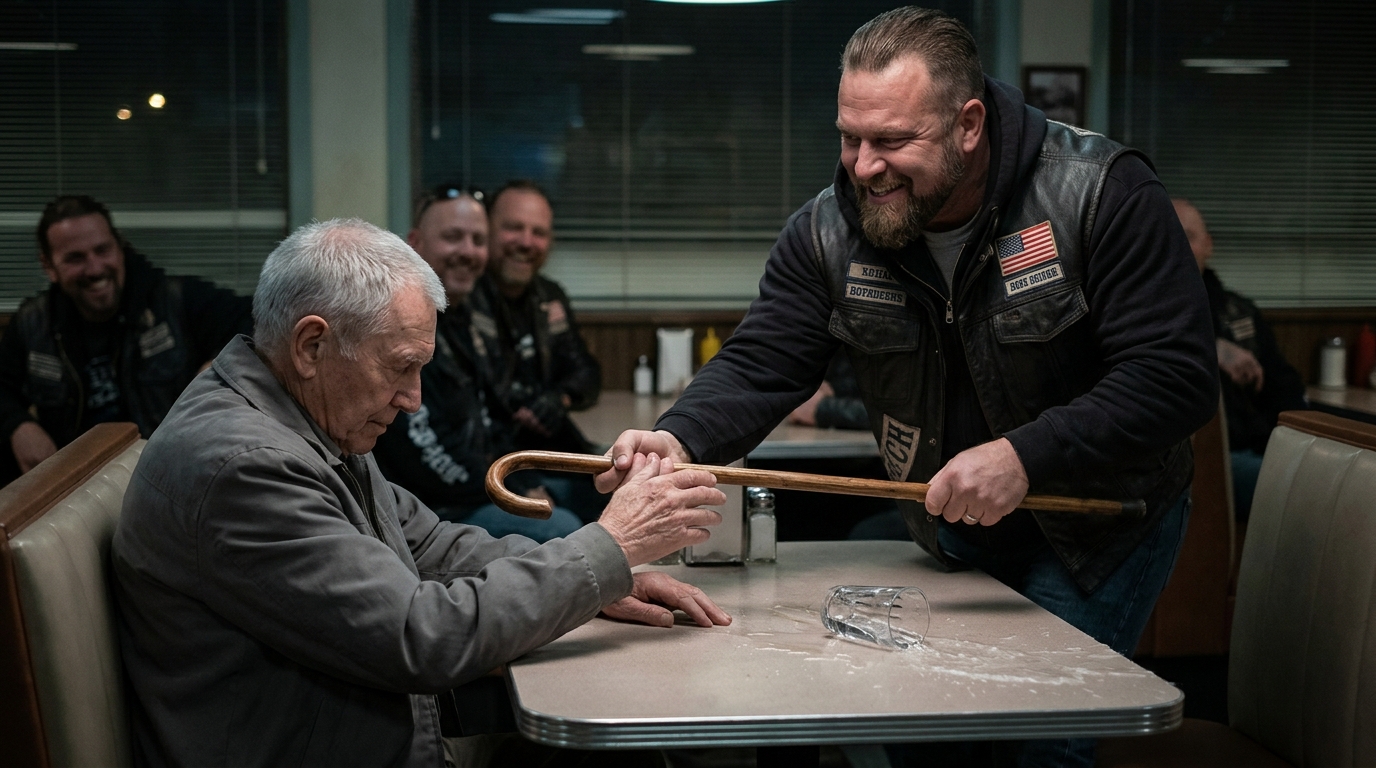
His boots struck the black-and-white tile loudly enough to make coffee cups tremble in their saucers. The patch on his leather vest read IRON JACKALS, stitched in red thread across his back. He moved like a man who believed every room became his the moment he entered it.
The old man sat in the last booth by the window.
A half-finished bowl of soup sat in front of him. A glass of water stood near his right hand. His cane leaned against the booth beside him, polished dark wood, silver handle worn smooth by years of use.
He wore an old brown jacket.
Plain shirt.
Weathered face.
White hair combed back neatly.
Nothing about him suggested danger.
Nothing about him suggested money.
Nothing about him suggested that the room should have protected him.
That was the problem.
People often decide who deserves protection by how much trouble they might cause if harmed.
The diner was full enough to witness the cruelty, but not brave enough to interrupt it.
A waitress near the counter froze with a coffee pot in her hand.
Two truckers at the far table lowered their forks.
A young mother pulled her little boy closer.
The old man did not look up when the biker stopped beside him.
The biker leaned one hand on the table.
“You deaf, old timer?”
The old man slowly lifted his eyes.
They were pale blue.
Calm.
Too calm.
“I hear fine.”
The bikers behind him laughed.
The big one smiled wider.
“Then you heard us ask for the booth.”
The old man glanced at the empty booths nearby.
“No,” he said. “I heard you make noise.”
The laughter changed.
Not stopped.
Changed.
The big biker’s smile thinned.
His name, according to the patch on his chest, was RAZOR.
He looked maybe thirty-five, thick-necked, broad-shouldered, with the restless cruelty of a man who had mistaken fear for respect too many times.
“Careful,” Razor said. “You don’t want to fall.”
The old man stirred his soup once.
“Son, at my age, falling is rarely the worst thing in the room.”
A few people looked down to hide nervous smiles.
Razor saw that.
His pride could not survive even a small laugh that was not his.
So he reached down, grabbed the old man’s cane, and yanked it away.
The movement was fast.
Mean.
Designed not only to take the cane but to strip dignity with it.
The old man’s hand tightened around empty air.
The diner went silent.
Razor lifted the cane high.
“Look at that,” he said, turning to his crew. “Grandpa’s got a fancy stick.”
The Iron Jackals roared.
One of them slapped the table.
Another whistled.
The waitress whispered, “Please don’t.”
Razor ignored her.
He spun the cane once, clumsily, like a prop. Then, with his free hand, he knocked the old man’s glass of water across the table.
The glass hit the edge, shattered, and spilled water over the booth.
Shards mixed with the puddle.
Soup sloshed onto the old man’s sleeve.
Razor laughed before the sound of breaking glass had even faded.
Then he dropped the cane onto the floor.
Not accidentally.
Not casually.
He discarded it like trash.
The silver handle struck the tile with a sharp crack.
The old man did not move.
The bikers laughed harder.
Pointing.
Scoffing.
Confident.
The whole diner seemed to shrink around the noise.
The old man looked down at the spilled water first.
Then at the broken glass.
Then at the cane lying on the floor.
For several seconds, he remained perfectly still.
He did not shout.
He did not beg.
He did not reach down for the cane.
Instead, with deliberate slowness, he reached into the inside pocket of his jacket and removed a small black device.
It was not quite a phone.
Not exactly a key.
Something between the two.
A compact radio unit, old-fashioned but well maintained.
He pressed one button.
Raised it to his ear.
And spoke in a steady voice that sliced through the laughter.
“It’s me. Bring them.”
The diner went quiet around the edges.
Not silent yet.
But aware.
Razor stared at him.
“What’s that supposed to mean?”
The old man lowered the device.
He looked at the cane on the floor.
Then at Razor.
“You had five seconds to put the cane back.”
Razor blinked.
Then laughed.
The others laughed with him, but weaker now.
Near the front window, one biker closest to the door glanced outside.
Then back at the old man.
Then outside again.
Something in the parking lot had changed.
The old man sat still, soup dripping from his sleeve, water spreading across the table, broken glass shining near his elbow.
And then the first engine sounded.
Low.
Deep.
Heavy.
Not one of the Iron Jackals’ bikes.
Something older.
Larger.
A second engine joined it.
Then a third.
Then ten.
The laughter died completely.
Razor turned toward the window.
Headlights appeared at the far end of the road.
One row.
Then another.
Chrome rolling through the rain-gray afternoon like a memory that had decided it was done being buried.
The old man finally bent, picked up the cane himself, and wiped the silver handle with a napkin.
His hand lingered over the dent Razor had made.
Then he looked up.
“Now,” he said quietly, “you’re going to learn why that cane mattered.”
The Men Who Arrived Without Laughing
The first motorcycle pulled into the diner parking lot with a slow, deliberate turn.
Then another.
Then another.
Within one minute, the entire front window was filled with bikes.
Not flashy.
Not new.
Many were old Harleys with scuffed saddlebags, weathered leather seats, and flags mounted on the back. Some carried veteran plates. Some carried memorial ribbons. Some were ridden by men with white beards and stiff knees. Some by women with gray hair braided beneath helmets.
None of them looked amused.
On the back of their jackets was a patch different from the Iron Jackals’.
A black road.
A silver star.
One word across the top:
FOUNDERS.
Razor’s grin had vanished.
One of his bikers muttered, “Who the hell are they?”
The old man did not answer.
The diner door opened.
A tall woman entered first.
She was in her sixties, broad-shouldered, with silver hair tucked beneath a black bandana. A scar ran from the corner of her mouth to her jawline. Her vest carried the same silver-star patch.
Behind her came a man with an oxygen tube tucked under his nose, moving slowly but with eyes sharp enough to cut.
Then another.
Then another.
They filled the entrance one by one, not crowding, not shouting, not threatening.
Just arriving.
That made it worse.
A mob needs noise.
Authority can stand in silence.
The woman looked across the diner.
Her gaze landed on the old man.
Then on the water across his table.
Then on the broken glass.
Then on Razor.
Her expression hardened.
“Who touched Saint?”
Razor frowned.
“Saint?”
The old man sighed, as if the name embarrassed him.
The woman stepped forward.
“Harlan ‘Saint’ Mercer.”
Razor’s face went blank.
Some of the Iron Jackals exchanged confused glances.
But one of them — a younger man near the jukebox — went pale.
He knew the name.
The woman saw him.
“At least one of you reads history.”
Razor tried to recover.
“Look, lady, your old friend was running his mouth.”
The oxygen-tube man moved slightly.
The woman lifted one hand, stopping him.
Then she spoke to Razor with remarkable calm.
“That old man you just humiliated built the first roadside shelter for riders in this state. He wrote the charter your fake little club stole half its language from. He buried more brothers than you’ve made friends. And that cane you threw on the floor was carved from the handlebar of a bike that burned saving children from a bus wreck in 1987.”
Razor’s mouth opened.
No sound came.
The old man looked down at the cane.
For the first time, pain crossed his face.
Only briefly.
But enough.
The waitress near the counter whispered, “Oh my God.”
The silver-haired woman walked closer to the booth.
“You okay, Harlan?”
The old man nodded.
“I’ve had worse soup.”
The corner of her mouth twitched.
“You always say something stupid when you’re angry.”
“I’m not angry.”
She looked at the broken glass.
“Yes, you are.”
The old man did not deny it.
Razor shifted his weight.
“Okay, fine. I didn’t know it was some memorial stick.”
The old man’s eyes lifted.
“Cane.”
“What?”
“It is a cane. Not a stick.”
Razor rolled his eyes, but less confidently.
“Fine. Cane.”
The silver-haired woman turned.
“Pick it up.”
“I didn’t—”
“Pick up the glass.”
The diner froze.
Razor stared at her.
“You don’t order me around.”
She stepped closer, reading the front of his vest.
“Razor. Iron Jackals. Local chapter.”
Her eyes narrowed.
“Who chartered you?”
Razor smirked, grateful for something he thought he understood.
“We chartered ourselves.”
A few of his men gave weak nods.
The old man leaned back.
“That explains the manners.”
The younger biker by the jukebox looked more frightened by the second.
The woman turned toward him.
“You. Name.”
He swallowed.
“Eddie.”
“You know who we are, Eddie?”
Eddie nodded.
“Then tell your president what happens when a self-patched crew abuses elders under a stolen code.”
Razor snapped, “Shut up, Eddie.”
Eddie did not.
His voice shook.
“They call a council.”
Razor scoffed.
“A council? What is this, a movie?”
The old man lifted the black device again and set it on the table.
“No. It’s a record.”
The device’s small red light was blinking.
Razor stared at it.
“What?”
The old man’s voice stayed calm.
“You were recorded from the moment you walked in.”
Razor’s face changed.
“And because you chose to wear a back patch while assaulting an elderly disabled man in public, this becomes club business, criminal business, and community business.”
The diner remained silent.
The silver-haired woman looked at the waitress.
“Ma’am, did they threaten anyone else?”
The waitress hesitated.
Razor turned toward her.
“Careful.”
The old man’s cane struck the floor once.
Not loudly.
But the sound carried.
The waitress lifted her chin.
“They came in twice before. Didn’t pay last week. Knocked over a chair. Called my cook names.”
The cook, a thin man visible through the kitchen window, nodded.
Razor’s eyes darted around.
His room was disappearing.
The old man looked at him.
“You had five seconds to put the cane back.”
Razor swallowed.
“And now?”
The old man stood slowly.
He needed the cane.
He hated that everyone saw it.
But he stood.
“And now you have as long as it takes to understand why a man should never mistake quiet for weakness.”
The Cane’s First Owner
The cane had once been part of a motorcycle named Mercy.
That was not its official name.
Motorcycles do not come with names like that.
Riders give them names after enough miles, enough breakdowns, enough nights when the machine carries them through weather that should have stopped them.
Mercy had belonged to Joseph “Preacher” Bell.
Preacher was not a preacher.
Not formally.
He cursed too much, drank too much coffee, and once punched a vending machine hard enough to lose a fingernail. But he had a way of showing up when people were hurting and saying exactly one sentence that made them breathe again.
Harlan Mercer had met him after the war.
Back then, Harlan was young, angry, and alive in ways he did not know how to handle. He rode too fast. Slept too little. Worked odd jobs. Picked fights he did not care about winning.
Preacher found him outside a VA hospital one night, sitting on the curb with his helmet beside him and his hands shaking.
“You planning to ride like that?” Preacher asked.
Harlan told him to mind his business.
Preacher sat down beside him.
“Brother, shaking hands on a bike are my business.”
That was the beginning.
The two of them built the first version of the Founders Brotherhood not as a gang, not as a business, not as a way to scare towns.
They built it as a promise.
No rider stranded.
No widow ignored.
No child afraid of the sound of engines.
No elder disrespected.
No patch worn by a man who used it to feel big by making others small.
For years, they rode highways helping people nobody saw.
Broken-down families at midnight.
Veterans who needed rides to treatment.
Kids who needed holiday gifts.
Women whose violent husbands suddenly reconsidered when fifty motorcycles parked outside the shelter.
Then came the bus wreck.
Summer of 1987.
A church bus full of children lost brakes on a mountain road during rain. It jackknifed near a guardrail, engine smoking, front doors jammed. Harlan, Preacher, and six other riders were passing the opposite direction.
Preacher ran in first.
Of course he did.
He helped pull children through a broken rear window while fuel spread beneath the bus.
Harlan remembered the smell.
Gasoline.
Rain.
Hot metal.
Fear.
Then the fire caught.
Preacher shoved the last child toward Harlan.
A little girl with braids and a yellow dress.
Then something inside the bus exploded.
Mercy, parked too close, burned with him.
After the funeral, Harlan took one twisted handlebar from the wreckage.
Years later, when his hip failed and his balance went with it, Preacher’s widow had the metal set into the handle of a cane.
“You always leaned on him anyway,” she told Harlan.
He had laughed.
Then cried alone in his garage.
That cane was not a decoration.
It was not a fancy stick.
It was a brother’s last ride turned into support.
And Razor had thrown it onto a diner floor for entertainment.
The silver-haired woman, whose road name was Mercy after Preacher’s bike, told the story while the Iron Jackals stood in the diner surrounded by witnesses, phones, and the weight of a history they had never earned.
By the time she finished, Razor no longer looked smug.
But shame and pride do not always arrive together.
Sometimes pride fights longer.
“Look,” he said, voice tight, “I didn’t know.”
Harlan looked at him.
“That seems to be your favorite defense.”
“What do you want? An apology?”
The diner went still.
Mercy smiled without warmth.
“Careful. You’re one sentence from needing one.”
Harlan lifted his hand slightly.
Mercy stopped.
Then Harlan looked at Razor.
“I want you to understand something. An apology is not a password that lets you walk out unchanged.”
Razor stared at him.
“You broke a glass,” Harlan said. “You frightened the staff. You stole support from a disabled elder. You mocked what you did not understand. And you did it wearing a patch, which means you did not merely shame yourself.”
His eyes moved over the Iron Jackals.
“You shamed everyone you claim to ride with.”
One of Razor’s bikers lowered his head.
Another stepped back from the group.
The waitress placed a broom and dustpan near the counter.
No one touched them.
Harlan looked at Razor.
“Start there.”
Razor blinked.
“What?”
“Clean the glass.”
The biker’s face flushed.
“I’m not your waiter.”
“No,” Harlan said. “A waiter would already have done it.”
The line landed hard.
Someone in the diner nearly laughed, then stopped.
Razor looked toward the door.
Outside, more Founders stood beside their bikes.
Not blocking him.
Not touching him.
Just watching.
He looked back at Harlan.
Then at the glass.
Then, slowly, he bent down.
The room watched him pick up the pieces.
The Lesson No One Could Outrun
Police arrived ten minutes later.
Not because the Founders wanted spectacle.
Because Harlan had called them before the engines arrived.
He knew the difference between justice and intimidation.
He had spent half his life teaching younger riders that power without discipline becomes the thing people fear for good reason.
The responding officer was a woman named Carla Ruiz.
She walked into the diner, looked at the room, then at Harlan.
“Mr. Mercer.”
“Officer Ruiz.”
Razor’s head snapped up.
“You know him?”
Officer Ruiz looked at him.
“My father got sober because this man drove him to meetings for six months. So yes.”
Razor looked back down.
The waitress gave a statement.
So did the truckers.
So did the mother with the child.
So did Eddie, the younger Iron Jackal, voice shaking as he admitted the group had been harassing small businesses for weeks.
Razor glared at him.
Eddie did not stop.
Something had cracked open inside him.
Maybe fear.
Maybe conscience.
Maybe the realization that following the loudest man in the room had brought him somewhere ugly.
Razor was cited for assault, harassment, property damage, and disorderly conduct. The other bikers involved received citations depending on their actions. The diner owner pressed charges for unpaid tabs and previous damage once the waitress felt safe enough to tell the truth.
But the larger reckoning happened outside the law.
That evening, the Founders called a public rider council at the old fairground pavilion.
Anyone wearing a patch in the county was invited.
So were the diner staff.
So were local veterans.
So were families who had complained about the Iron Jackals before and been ignored.
Harlan did not sit on a throne.
He sat on a folding chair near the front, cane across his knees.
Razor stood before him with his vest removed.
That mattered.
A patch is supposed to represent belonging.
When it becomes a shield for cruelty, it no longer belongs on a man’s back.
Mercy spoke first.
Then Officer Ruiz as a community liaison.
Then the diner waitress, whose name was Ruth.
Her hands shook when she took the microphone.
“I’ve served truckers, bikers, pastors, drunks, politicians, and teenagers after football games,” she said. “I know the difference between loud and dangerous. Those boys came in wanting everyone to know they could make us afraid.”
Razor looked at the ground.
Ruth continued.
“When they took Mr. Mercer’s cane, I felt ashamed because I was scared to help him. I don’t want anyone to feel that way in my diner again.”
The crowd applauded softly.
Not for performance.
For courage.
Then Harlan stood.
It took him a moment.
The cane helped.
Everyone waited.
He looked at the younger riders gathered in the pavilion.
“You think a motorcycle makes you powerful?”
No one answered.
“It doesn’t.”
His voice carried clearly.
“A motorcycle makes you visible. That’s all. What you do with being seen decides whether people feel safer when you arrive or relieved when you leave.”
Razor swallowed.
Harlan’s gaze landed on him.
“You wanted a room to fear you. Congratulations. For a few minutes, it did.”
The words were quiet.
That made them worse.
“Then what?” Harlan continued. “You walked out bigger? Stronger? More of a man because an old one had to reach for the floor?”
Razor’s jaw tightened.
But he did not speak.
Harlan lifted the cane slightly.
“This belonged to a man who died pulling children from fire. He was not gentle because he was weak. He was gentle because he knew what strength was for.”
The pavilion was silent.
“Strength is not how hard you can make people flinch. Strength is how much fear you can remove from a room.”
For a long time, no one moved.
Then Harlan looked at Razor.
“You have two roads.”
Razor lifted his eyes.
“One road is legal consequences, shame, and whatever story you tell yourself in ten years about how everyone overreacted.”
The old man’s face hardened.
“The other road is harder.”
Razor’s voice came rough.
“What road?”
“You make restitution. You apologize without excuses. You work at the diner until every cent of damage and unpaid meals is repaid. You attend six months of community rides under supervision, not as a member, not with a patch, but as labor.”
Razor stared.
Mercy added, “And you take every bullying-prevention escort call we assign. Schools, shelters, elder centers. You stand quietly. You carry boxes. You learn who patches are supposed to protect.”
Razor laughed once, bitterly.
“So I become your servant?”
Harlan shook his head.
“No. You become useful.”
That sentence did something to the room.
Maybe because usefulness is a harder invitation than humiliation.
Razor looked around.
His crew would not meet his eyes.
Eddie stepped forward first.
“I’ll do it.”
Razor glared at him.
Eddie looked at Harlan.
“I’m sorry. For laughing. For not stopping it. For the diner.”
Harlan studied him.
Then nodded.
“That is a beginning.”
One by one, three other Iron Jackals stepped forward.
Razor remained still.
Pride chained him longer than anyone else.
Finally, Mercy said, “You don’t have to choose tonight.”
Razor looked relieved.
Then she continued.
“But until you do, you ride alone.”
That hit him.
Hard.
A biker without a crew is just a man with noise.
Razor stared at the ground.
Then, slowly, he stepped forward.
“I’ll clean the diner.”
Harlan waited.
Razor’s face twisted.
“And I’m sorry.”
Harlan did not move.
Razor forced himself to continue.
“I’m sorry for taking your cane. For the glass. For disrespecting Ruth’s place.”
He looked at the diner waitress.
“I’m sorry.”
Ruth folded her arms.
“I heard you.”
Not accepted.
Not forgiven.
Heard.
That was enough for the first night.
The Room That Changed When He Returned
Three weeks later, Razor walked into the diner again.
Alone.
No vest.
No grin.
No crew behind him.
Ruth stood behind the counter with a coffee pot in her hand.
The room went quiet.
Not afraid.
Watching.
Razor looked smaller without performance.
He carried a toolbox in one hand and a paper bag in the other.
He stopped near the last booth.
The table had been repaired. The glass replaced. The floor clean.
Harlan sat there again, eating soup.
Same booth.
Same calm.
Same cane leaning beside him.
Razor approached slowly.
“I fixed the back door hinge,” he said.
Ruth looked at him.
“It only squeaks a little now.”
“I’ll come back tomorrow.”
“You’re scheduled at seven.”
“I know.”
He placed the paper bag on Harlan’s table.
Harlan looked at it.
“What’s that?”
“Rubber foot for the cane. Better grip.”
Harlan’s eyes narrowed.
“You think my cane needs improvement?”
Razor’s face went red.
“No. I mean— I noticed the bottom was worn. I asked the medical supply place what would help. I can take it back.”
Harlan let him suffer for three seconds.
Then reached into the bag.
The rubber foot was plain.
Practical.
Thoughtful.
He nodded once.
“Thank you.”
Razor exhaled.
It was not forgiveness.
But it was the first thing he had given that did not demand fear in return.
Over the next months, the Iron Jackals changed or disappeared.
Some left.
Some complained that the club had gone soft.
Good.
Soft men often accuse discipline of softness.
Eddie stayed.
He became the one most serious about the work. He rode escort for children going to court. He delivered groceries to seniors. He fixed ramps. He listened more than he spoke.
Razor struggled.
Often.
He hated being corrected.
Hated being supervised.
Hated apologizing when he failed.
But he kept showing up.
The first time he helped at an elder center, an old woman asked him to move chairs. He almost snapped. Then saw Harlan watching from across the room.
He moved the chairs.
The second month, he spoke at a high school assembly about bullying and power. The students expected jokes. He gave none.
“I thought being feared meant nobody could hurt me,” he said. “Turns out it just meant nobody trusted me enough to tell me the truth.”
Harlan, sitting in the back row with his cane, looked down so no one would see his eyes soften.
The diner became safer too.
Not because bikers guarded it every night.
Because people knew Ruth would not stand alone if trouble came.
A small sign appeared near the register:
LOUD IS WELCOME. CRUEL IS NOT.
Ruth said Harlan wrote it.
Harlan said Ruth made it sound better.
Mercy said both of them were annoying.
One year after the incident, the Founders held a memorial ride for Preacher Bell.
They ended at the diner.
Harlan placed the cane on the table beside a framed photograph of Preacher smiling beside his burned old bike before the accident.
Razor stood near the back, hands clasped, vest still absent.
He had not earned a new patch.
Not yet.
Maybe not ever.
But he had earned the right to stand in the room.
That mattered.
After the memorial, he approached Harlan.
“I never asked,” Razor said.
Harlan looked up.
“What?”
“What you meant when you called and said, ‘Bring them.’”
Harlan smiled faintly.
“I meant bring witnesses.”
Razor frowned.
“Not backup?”
“Witnesses are backup.”
Razor considered that.
Then nodded slowly.
“I used to think witnesses were a problem.”
“I know.”
“Now?”
Harlan reached for his cane.
“Now you’re learning that what happens in front of people should be something you can live with afterward.”
Razor looked toward Ruth, who was laughing with Mercy behind the counter.
Then at Eddie helping a child choose pie from the display case.
Then at the old photograph of Preacher.
“I still think about throwing the cane.”
“You should.”
“I’m ashamed.”
“You should be.”
Razor flinched.
Harlan stood carefully.
“But shame is only useful if it teaches your hands what not to do next time.”
Razor swallowed.
“Yes, sir.”
Harlan started toward the door.
Then paused.
“Razor.”
“Yeah?”
“Your real name?”
The big man looked uncomfortable.
“Caleb.”
Harlan nodded.
“Caleb. Come by Sunday. Ruth needs the storage shelves fixed.”
Razor blinked.
“You asking or assigning?”
Harlan smiled.
“Yes.”
For the first time, Razor laughed without trying to make anyone smaller.
Years later, people still told the story of the old man in the diner who called in a wall of bikers after a bully stole his cane.
They loved the dramatic version.
The black device.
The engines.
The old patch.
The bully freezing.
The line about five seconds.
But Harlan remembered something else.
The sound of the cane hitting the floor.
Not because it embarrassed him.
Because for one sharp second, he felt Preacher’s absence like fire all over again.
The cane was only wood and metal to Razor.
But to Harlan, it was a brother’s hand still helping him stand.
That was the lesson he wanted younger riders to understand.
Everything you touch may carry a story.
A cane.
A booth.
A diner.
A person sitting alone.
Cruelty is often born from assuming nothing sacred is hidden inside what looks ordinary.
Harlan died five years later.
Peacefully.
In his sleep.
At his funeral, the diner closed for the day.
Ruth placed his usual soup bowl at the last booth by the window. Mercy laid the cane across the table. Eddie stood beside the door, now wearing a Founders support patch he had earned slowly and honestly.
And Caleb — no longer Razor to anyone who mattered — stood outside directing arriving riders into neat rows.
He had rebuilt the Iron Jackals into something smaller, humbler, and useful. They repaired wheelchairs now. Built ramps. Escorted grieving families. Guarded shelters during court transitions.
On the back of Caleb’s vest was a new patch.
Not stolen.
Earned.
A black road.
A small silver star.
And beneath it, stitched in plain white thread:
LOUD IS EASY. HONOR IS WORK.
During the service, Mercy told the diner story.
People laughed in the right places.
Cried in others.
Then Caleb stepped forward.
He looked at the cane resting beside Harlan’s photograph.
“I once thought that cane was just something an old man needed,” he said.
His voice shook.
“I learned it was something a better man had earned. I learned that taking support from someone doesn’t make you strong. It just proves you don’t know what strength is.”
He looked at Ruth.
“I’m sorry again.”
Ruth wiped her eyes.
“I heard you again.”
Everyone smiled.
That was their language now.
Not easy forgiveness.
Remembered accountability.
After the funeral, Mercy handed Caleb the rubber cane tip he had once bought for Harlan.
“Keep it,” she said.
He stared at it.
“I can’t.”
“You can. Not as a relic. As a reminder.”
He closed his fist around it.
Outside, engines started one by one.
Not roaring at first.
Just waking.
A long line of riders followed Harlan’s hearse down the road past the diner, past the old bridge, past the veterans hall, past the children’s shelter Preacher had once helped build, and finally toward the cemetery where generations of road stories rested beneath stone.
Caleb rode near the back.
That was where he chose to be.
Not leading.
Learning.
And as the engines rolled under the open sky, he understood something Harlan had tried to teach from the booth that day.
Power is not proven by how quickly people move when you enter.
Power is proven by whether people feel safe enough to stay.
The old man had not needed to shout.
He had not needed to fight.
He had only pressed a button and called for witnesses.
Because honor, when built over a lifetime, does not arrive alone.
It comes on old motorcycles.
In weathered jackets.
With scarred hands.
With quiet eyes.
With people who remember what you stood for long after your body needs a cane to stand at all.
And sometimes, the most dangerous man in the room is not the one who laughs the loudest.
It is the one who gives you five seconds to do the right thing.
And already knows what he will do if you don’t.