The Night the Maid Broke the Rule
“Go to sleep!”
Sebastian Vale’s voice thundered through the marble corridor like a door slamming inside a cathedral.
The mansion swallowed the sound and threw it back colder.
Beyond the tall windows, rain streamed down the glass in silver lines. Inside, the hallway glowed with soft golden lights, polished floors, carved walls, and old portraits of dead Vales who had never looked warm even when painted by expensive hands.
At the end of the corridor, behind a half-open bedroom door, his twin daughters lay beneath silk sheets.
Evelyn and Elise Vale.
Seven years old.
Identical dark curls.
Identical pale cheeks.
Identical wide eyes fixed on the ceiling as if something invisible had pinned their attention there.
They did not cry.
That was what frightened the staff most.
Children who cry can be comforted.
Children who scream can be held.
But the twins had become silent in a way no child should be silent.
For three months, they had not slept properly.
Not once.
Doctors came from the city.
Then from other countries.
Neurologists.
Sleep specialists.
Child psychologists.
Private consultants whose hourly fees would have fed entire neighborhoods.
They used words Sebastian hated because none of them changed anything.
Acute insomnia.
Stress response.
Possible trauma.
Neurological irregularity.
Environmental trigger.
The girls remained awake.
Night after night.
Eyes open.
Bodies still.
Tiny hands clutching the edges of their blankets as if sleep itself had become dangerous.
Sebastian had not always shouted.
At first, he begged.
He sat beside their beds and whispered stories until his voice cracked. He played soft music. He brought warm milk. He promised trips, ponies, new rooms, new doctors, anything their frightened eyes seemed to ask for.
But three months of watching your children vanish behind exhaustion can turn fear into anger.
And Sebastian Vale had always been better at anger.
The nannies stood frozen in the corridor.
No one entered the room after eight o’clock.
That was the rule.
It had been introduced by Miss Celia Hart, the mansion’s new household director, who said overstimulation at night made the twins worse. No maids. No cooks. No gardeners passing near the children’s wing. No unnecessary voices.
Only doctors.
Only approved staff.
Only silence.
The rule made sense on paper.
Everything cruel sounds reasonable when written properly.
Maria Santos knew that.
She had served in the Vale household for fourteen years. Quiet. Careful. Nearly invisible. She was the maid who knew which teacup Sebastian preferred, which hallway creaked after rain, which portrait hid a cracked wall, and which rooms still smelled faintly of lavender because Mrs. Vale had loved that scent.
Mrs. Vale.
Amelia.
The twins’ mother had died six months earlier.
A fall from the east balcony, the family said.
An accident, the newspapers said.
A tragedy, the doctors said.
Maria had said nothing.
Not then.
Not when the coffin left the mansion.
Not when Sebastian stopped entering the nursery.
Not when Celia Hart moved into the household director’s office three weeks after the funeral and began controlling the children’s wing like a locked ward.
But tonight, Maria had heard something the others missed.
Not a scream.
Not a cry.
A tiny sound beneath the floor.
Three soft scratches.
Then a pause.
Then three again.
The same sound she had heard two nights earlier while polishing the corridor outside the twins’ room.
The same sound one of the girls had whispered about before a nanny told her not to invent stories.
Something comes when the room gets cold.
Maria did not believe in ghosts.
But she believed in frightened children.
And she believed in old houses with hidden spaces.
Sebastian stood outside the bedroom, one hand braced against the doorframe, eyes bloodshot from three months without peace.
“Sleep,” he said again, but the word broke this time.
It sounded less like an order and more like a man begging the universe to obey.
Inside the room, Evelyn and Elise did not move.
Maria stepped forward.
One of the nannies grabbed her sleeve.
“Maria,” she whispered. “No one is allowed.”
Maria gently pulled free.
“I know.”
She walked past Sebastian.
He turned sharply.
“What are you doing?”
Maria did not answer.
She entered the room carrying no medicine.
No blanket.
No book.
No tray.
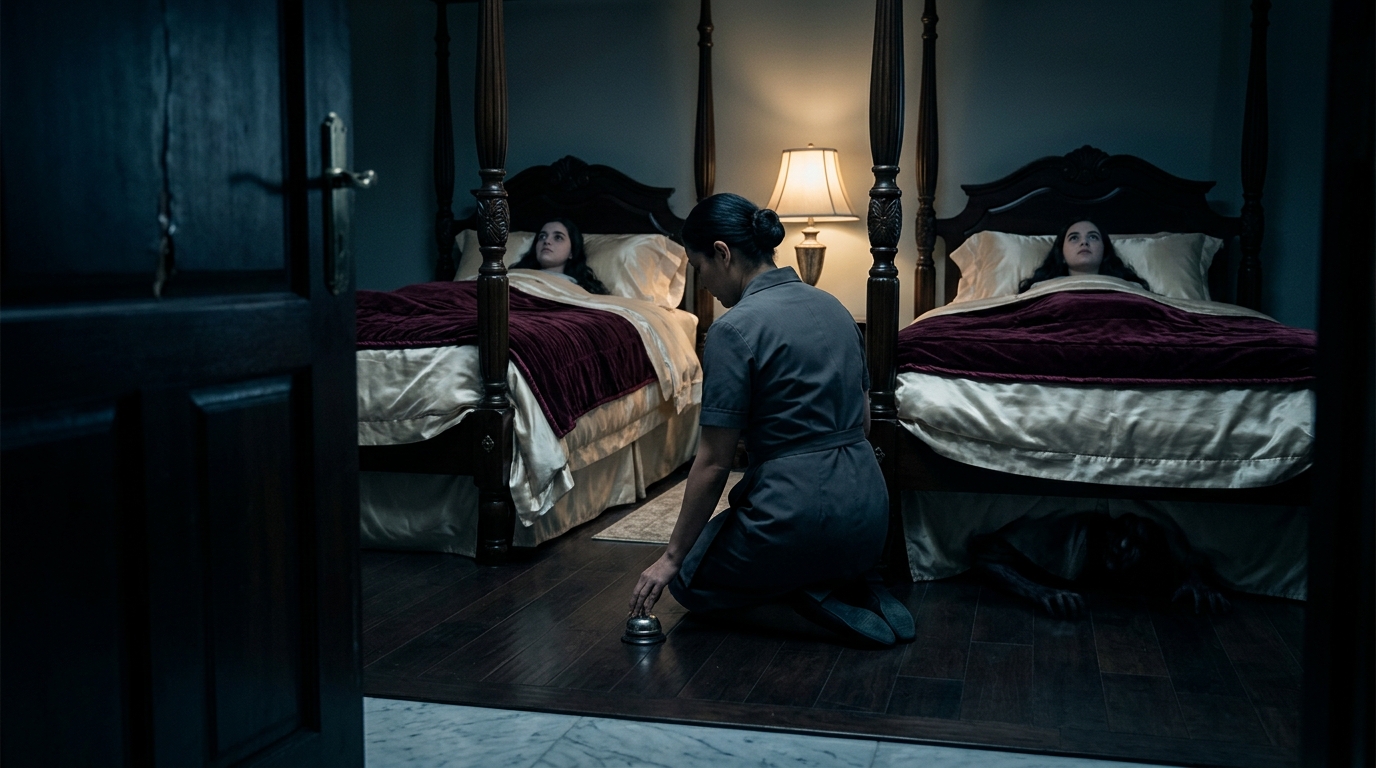
She crossed the polished hardwood floor between the two beds and knelt.
Sebastian followed to the doorway.
“Maria, get out.”
For the first time in fourteen years, she ignored him.
Her hand slipped into the pocket of her apron.
She took out a small silver bell.
Old.
Tarnished.
The handle worn smooth by use.
Sebastian froze.
He knew that bell.
Amelia had kept it beside the twins’ cradle when they were babies. She said the sound was too sharp to ring at night, so she used to place it on the floor before singing, telling the girls the bell was there to catch bad dreams before they reached the bed.
After her death, the bell vanished.
Sebastian had assumed it had been packed away with the rest of her things.
Maria set it gently on the floor between the beds.
She did not ring it.
Instead, she bowed her head and began to hum.
The tune was soft.
Old.
Almost too simple.
A lullaby Amelia used to sing when the twins were small.
The effect was immediate.
The air in the room seemed to change.
The girls’ fingers loosened slightly around the sheets.
Their eyes, which had been fixed on the ceiling, shifted toward Maria.
Sebastian’s breath caught.
Maria hummed the second line.
The room temperature dropped.
Not emotionally.
Physically.
A cold draft swept across the floor so sharply that the curtains stirred though the windows were closed.
One nanny gasped from the hallway.
Sebastian stepped into the room.
“What is happening?”
Maria lifted one hand without stopping the tune.
Wait.
The twins’ eyes rolled back for one terrifying second.
Then both girls whispered at the same time:
“She’s under us.”
Sebastian’s heart slammed against his ribs.
Then something moved beneath the beds.
A faint scrape.
Wood against wood.
Not imagination.
Not pipes.
Not a dream.
Something under the floor shifted.
Sebastian’s face drained of color.
He lunged toward the nearest bed, but Maria turned on him with a fierceness he had never seen in her.
“No,” she whispered. “If you shout, he will run.”
The billionaire who could command boardrooms, lawyers, police chiefs, and entire companies stood frozen in his daughters’ bedroom while the quietest maid in his house pointed at the floor.
And beneath the beds, something scraped again.
The Passage Below the Nursery
Sebastian had never known there was a crawlspace beneath the children’s room.
That was the first humiliation.
Not public.
Private.
The kind that comes when a man realizes he owns a house but does not understand it.
Maria did.
She moved to the rug between the twin beds and pulled it aside.
Beneath it, the hardwood floor looked normal except for one section near the silver bell where the grain ran slightly against the rest. She pressed her fingertips along the seam, found a hidden notch, and lifted.
A narrow panel rose with a soft click.
Sebastian stared.
“How did you know that was there?”
Maria’s eyes did not leave the opening.
“Mrs. Vale showed me years ago. She said old houses keep old secrets.”
A cold current rose from below.
Sebastian crouched, grabbing the flashlight from his phone.
The beam cut through darkness.
At first, he saw only dust.
Then wires.
Thin black wires taped beneath the floorboards.
A small speaker hidden in the cavity.
A metal tube connected to the air vent system.
And beyond it, something worse.
A narrow service passage stretching beneath the room toward the east wing.
Fresh marks showed in the dust.
Someone had been crawling there.
Recently.
Sebastian whispered, “No.”
Maria reached down and pulled the small speaker free.
It was connected to a tiny playback device.
She pressed one button.
A whisper filled the room.
A woman’s voice.
Soft.
Distorted.
Almost like Amelia’s.
Don’t sleep.
If you sleep, Mommy disappears.
The twins whimpered.
Sebastian nearly dropped the flashlight.
Maria pressed stop quickly.
The room went silent except for Sebastian’s breathing.
His face had changed completely.
No anger now.
Only horror.
The girls had not been staring at the ceiling because illness had emptied them.
They had been fighting sleep because someone had taught them sleep was betrayal.
Sebastian turned toward the hallway.
“Celia.”
Maria’s voice sharpened.
“Not yet.”
He looked at her.
“She did this?”
“I don’t know.”
That was not entirely true.
Maria suspected.
She had suspected for weeks.
But suspicion without proof was dangerous in a house where the rich could call loyalty insolence and make people vanish from payroll before breakfast.
Sebastian gripped the edge of the bed.
“Who else knows about this passage?”
Maria’s face tightened.
“Old staff. Some contractors. Mrs. Vale. And anyone who searched her rooms after she died.”
The words struck him.
After she died.
The twins watched from their beds, trembling now.
Evelyn whispered, “Daddy?”
Sebastian turned instantly.
“Yes, sweetheart?”
“Are we bad?”
His face broke.
“No.”
Elise’s lip quivered.
“Miss Celia said Mommy can’t rest if we sleep.”
Sebastian closed his eyes.
Maria lowered her head.
There it was.
The first spoken truth.
Sebastian moved to the space between their beds and knelt, lowering himself until he was not looming over them.
“No,” he said, voice shaking. “No, my loves. Mommy would never want you afraid to sleep.”
Evelyn looked toward the floor panel.
“She talks under the bed.”
“That was not Mommy.”
“But it sounded like her.”
“I know.”
Elise pulled the sheet to her chin.
“Miss Celia said if we tell, you’ll send us away to the hospital.”
Sebastian’s body went still.
Maria watched him absorb it.
Every time the girls had refused to speak to doctors.
Every time they had stiffened when Celia entered.
Every time he had interpreted their silence as illness.
He had been standing beside the person teaching them fear.
A faint noise came from the passage below.
Not the speaker.
Not the vent.
A real movement.
Sebastian swung the flashlight toward it.
For one instant, the beam caught a gloved hand retreating into the darkness.
Maria grabbed the bell from the floor and stood.
This time, she rang it.
Once.
The sound was small but piercing.
Every person in the hallway jumped.
Sebastian shouted, “Lock the east wing doors!”
The nannies scattered.
Security guards who had been posted downstairs came running.
The mansion, for the first time in months, woke up.
The Woman Who Made Rules
Celia Hart was found in the east wing dressing room seven minutes later.
Not running.
That was important.
She was too clever to run.
She stood before the mirror in a silk blouse and tailored trousers, holding a cup of tea with hands that did not shake. Her silver-blonde hair was pinned neatly. Her expression showed irritation, not fear.
At least at first.
Sebastian entered with Maria behind him.
Two security guards stood at the door.
Celia looked up.
“Sebastian, what is this commotion? The girls need quiet.”
The word quiet nearly made him lose control.
He stepped forward.
“There is a passage under their beds.”
Celia blinked.
A perfect little blink.
“Is there?”
Maria watched her closely.
No surprise.
Only adjustment.
Sebastian held up the speaker device.
“Someone put this beneath the floor.”
Celia’s eyes moved to it.
Then away.
“That is disturbing.”
“Very.”
“You should call the police.”
“I will.”
Her gaze sharpened slightly.
“Then why are you here?”
“Because the girls said your name.”
For the first time, Celia’s composure shifted.
Not much.
But enough.
She set down her tea.
“Children under medical distress say many things.”
Maria stepped forward.
“They said you told them their mother could not rest if they slept.”
Celia’s face cooled.
“Maria, you are a maid. I understand you cared for Mrs. Vale, but you are crossing a line.”
Sebastian turned to Maria.
“Did Amelia give you the bell?”
Celia’s eyes flashed.
Maria nodded.
“Three days before she died.”
Sebastian stared at her.
“What?”
Maria reached into her apron again and pulled out a folded cloth pouch. Inside was a small key, a photograph, and a note written in Amelia Vale’s handwriting.
Sebastian recognized it instantly.
His wife’s hand.
Uneven at the end, as if she had been frightened.
Maria handed it to him.
Sebastian opened it.
If anything happens to me, keep the bell near the girls. They know the song. It calms them.
Do not trust Celia with the children’s wing.
Sebastian looked up slowly.
Celia’s expression hardened.
Maria spoke quietly.
“Mrs. Vale gave it to me because she was afraid.”
The room seemed to contract.
Sebastian’s voice dropped.
“Afraid of what?”
Maria looked at Celia.
“Of being declared unstable before she could change the trust.”
Celia gave a sharp laugh.
“This is absurd.”
Sebastian turned back to the note.
The trust.
Amelia’s family money had not gone directly to him when she died. It had been placed in a protected trust for the twins. Sebastian controlled his own fortune, but Amelia’s inheritance belonged to the girls.
Unless they were declared medically incompetent under certain conditions.
Unless long-term specialized care became necessary.
Unless their appointed household guardian and medical administrator petitioned for expanded control.
Sebastian felt sick.
Celia had been pushing for a private neurological facility for weeks.
She had called it compassionate.
She had said the girls needed full-time monitoring.
She had placed documents on his desk twice, asking him to authorize medical trusteeship so expenses could be handled smoothly.
He had nearly signed.
Maria spoke again.
“Mrs. Vale suspected someone was using her recordings.”
Sebastian looked at her.
“What recordings?”
“She recorded lullabies for the girls when she traveled. Celia had access to the nursery archive.”
Celia’s voice sharpened.
“I was her household director. Of course I had access.”
“And after Mrs. Vale died,” Maria continued, “those recordings disappeared.”
Sebastian looked at the device in his hand.
The distorted voice under the floor.
Amelia’s voice turned into a weapon.
His hand closed around the device so tightly the plastic cracked.
Celia saw it and finally took a step back.
“Sebastian, grief is making you irrational.”
He laughed once.
Cold.
“You chose the wrong word.”
Maria looked toward the dressing table.
There, half-hidden beneath a folded scarf, was a small remote control.
She walked toward it.
Celia moved quickly.
Too quickly.
“Don’t touch that.”
The security guards stepped forward.
Maria picked it up.
Sebastian pressed one button.
From somewhere deep beneath the nursery floor, the vent system clicked.
A cold draft swept through the corridor.
Another button.
The whisper device activated faintly through the floor below.
Don’t sleep.
The guards stared.
Celia said nothing.
Sebastian looked at her.
“How long?”
Her mouth tightened.
“You don’t understand what I saved this family from.”
Maria whispered, “Saved?”
Celia’s mask broke.
“She was going to remove me. After everything I did for this house, she was going to send me away like staff.”
“You are staff,” Sebastian said.
Celia flinched as if struck.
“I kept this house functioning while Amelia played saint. I handled the doctors, the donors, the board dinners, the staff. I knew the children’s routines better than she did.”
Maria’s eyes filled with fury.
“No. You knew their vulnerabilities.”
Celia ignored her.
Her gaze stayed on Sebastian.
“When Amelia died, you were useless. Drowning in grief. The girls needed structure. The estate needed management. I stepped in.”
“You tortured my daughters.”
“I kept control.”
The words hung there.
Honest at last.
Sebastian’s voice was barely audible.
“Security, call the police.”
Celia’s face changed.
“Sebastian.”
“Now.”
The guards moved.
Celia turned to Maria with hatred.
“You should have stayed invisible.”
Maria held the silver bell tightly.
“I was invisible,” she said. “That is why I saw everything.”
The Truth About the Balcony
The police came before midnight.
Then detectives.
Then child trauma specialists.
Then an ambulance not for emergency treatment, but to document the girls’ condition and remove them from the bedroom safely.
For the first time in months, Evelyn and Elise left the children’s wing wrapped in blankets, each holding one of Sebastian’s hands.
Maria walked behind them with the silver bell.
Celia Hart was taken from the mansion at 1:13 a.m.
She did not confess to killing Amelia.
Not that night.
But once investigators opened the east wing passage, the rest of the house began to speak.
The hidden corridor beneath the nursery led to a service stairwell connected to the old balcony access.
The same balcony where Amelia had fallen.
For six months, the official story had been simple.
Rain.
Loose slipper.
Tragic accident.
But hidden in the passage was a torn piece of silk caught on a nail.
Amelia’s scarf.
The one she had worn the night she died.
There were also old scuff marks near the service door, partially cleaned but still visible under forensic light.
And in Celia’s locked office, detectives found draft documents transferring temporary medical oversight of the twins to a private care institution owned by a company tied to Celia’s brother.
They found invoices for audio equipment.
Vent controls.
A modified playback device.
And files labeled E/E Sleep Compliance.
Evelyn and Elise.
Their suffering had been organized in folders.
Sebastian vomited when Detective Ramos told him.
He did not do it in front of the girls.
He made it to the downstairs bathroom, locked the door, and broke apart alone over the sink.
For three months, he had shouted at his children to sleep.
For three months, he had believed doctors who said the cause might be deep inside their brains.
For three months, he had allowed Celia to control the room, the staff, the rules, the narrative.
He had been rich enough to hire the best help.
But not humble enough to listen to the maid.
That truth stayed with him longer than anger.
The twins were moved to the sunroom suite on the opposite side of the house. Bright windows. No floor passages. No hidden vents. No locks except the ones they controlled.
Maria slept on a cot outside the room the first week because the girls asked her to.
Sebastian slept in a chair inside the room because they asked him to as well.
The first night, neither girl slept.
Of course they didn’t.
A bell and an arrest do not undo months of terror.
But something changed.
At 2:40 a.m., Elise whispered, “Daddy?”
Sebastian sat up instantly.
“Yes?”
“If I sleep, will Mommy be mad?”
His throat closed.
“No.”
Evelyn asked, “How do you know?”
He looked toward Maria.
She nodded.
Sebastian reached for the silver bell on the bedside table.
“Because your mother gave this to Maria to protect you. Not to frighten you.”
He set it on the floor between the beds.
Then, very softly, Maria hummed the lullaby.
This time, no cold air came.
No whisper rose from beneath the floor.
No hidden hand moved in darkness.
Only the rain at the windows.
Only a father holding his daughters’ hands.
Only a maid humming the song their mother had left behind.
At 3:06 a.m., Elise fell asleep.
At 3:12, Evelyn followed.
Sebastian did not move for four hours.
He watched their chests rise and fall.
He cried without sound.
Maria stood in the doorway and cried too.
The Bell That Stayed
Celia Hart was charged with child endangerment, psychological abuse, fraud, unlawful surveillance, and evidence tampering. The investigation into Amelia’s death took longer.
It took months.
Then a year.
Then another.
Eventually, a grand jury heard enough evidence to bring charges related to Amelia’s fall. Celia maintained it was an accident. Prosecutors argued she had confronted Amelia near the balcony after learning the trust would be changed, and that the cover-up began before the funeral flowers had wilted.
The trial was ugly.
Wealth always makes truth expensive.
But the twins never testified in open court. Sebastian refused to let the world turn their trauma into entertainment. Their statements were handled through specialists, privately, carefully, with protections he should have insisted on from the beginning.
Maria testified.
Her voice shook at first.
Then steadied.
She spoke of Amelia’s fear.
The bell.
The hidden note.
The scratches beneath the nursery.
The night she broke the rule.
Celia’s attorney tried to humiliate her.
“You were a maid, correct?”
Maria looked at him.
“Yes.”
“So you had no medical training?”
“No.”
“No authority in the household?”
“Not on paper.”
“And yet you believed you knew better than doctors?”
Maria turned toward the jury.
“No. I believed the children.”
That answer ended the line of questioning better than any lawyer could have.
Sebastian testified too.
Not as a billionaire.
Not as a man accustomed to control.
As a father who had failed to see what was happening inside his own house.
When asked what changed the night Maria entered the room, he said:
“I stopped listening to titles. I listened to the person who had been paying attention.”
Celia was convicted on multiple charges. The final ruling regarding Amelia’s death gave the family partial justice, though Sebastian learned that no verdict can resurrect the person whose voice had been stolen and twisted beneath a child’s bed.
After the trial, he changed the house.
Not redecorated.
Changed.
The children’s wing was rebuilt.
The hidden passages were sealed except for one preserved section documented for legal record.
The staff rules were rewritten.
Any employee could report concerns directly to outside counsel.
No household director could control access to the children without oversight.
Doctors were still welcome.
But so were teachers, caretakers, maids, cooks, and anyone else who noticed something the powerful had missed.
Maria was offered money to retire.
She refused.
Then Sebastian offered her a new title.
Director of Child Welfare and Household Safety.
Maria laughed for the first time in months.
“That sounds too long.”
“Then choose your own.”
She thought about it.
“Maria is enough.”
So that was what everyone called her.
Not maid.
Not staff.
Maria.
The twins recovered slowly.
They had nightmares.
They feared vents.
They hated cold rooms.
They asked the same questions over and over because children repeat pain until someone proves the answer will not change.
Did Mommy love us?
Yes.
Did we make her disappear?
No.
Will Celia come back?
No.
Can we sleep?
Yes.
Will you be here?
Always.
Sebastian answered every time.
Even when exhausted.
Especially when exhausted.
Years later, people still told the story of the billionaire’s sleepless twins and the maid with the silver bell.
They loved the eerie version.
The cold room.
The humming.
The girls’ eyes rolling back.
The movement under the beds.
The hidden passage.
The villain exposed.
But Sebastian remembered the beginning differently.
He remembered his own voice echoing through the marble corridor.
Go to sleep.
He remembered how small his daughters looked beneath silk sheets.
He remembered Maria walking past him with quiet rebellion in her eyes because love sometimes has to disobey rules written by fear.
Most of all, he remembered the first peaceful morning after they slept.
Sunlight entered the room slowly.
Evelyn woke first.
She blinked at the ceiling.
Then turned to him.
“Daddy?”
He had fallen asleep in the chair, neck stiff, hand still resting near the bell.
“Yes?”
“I dreamed.”
His heart stopped.
“What did you dream?”
She smiled faintly.
“Mommy was in the garden.”
Elise stirred beside her.
“She said the bell worked.”
Sebastian covered his face.
The girls did not understand why he cried.
Or perhaps they did.
Children understand more than adults want to admit.
The silver bell remained in their room after that.
Not under lock.
Not in a display case.
On the floor between the beds every night until they no longer needed it.
Then on a shelf.
Then, years later, on Evelyn’s desk when she left for boarding school because she said old things that survived lies deserve to see new places.
Sebastian kept Amelia’s note framed in his study.
Not where guests could see.
Where he could.
If anything happens to me, keep the bell near the girls. They know the song. It calms them.
Do not trust Celia with the children’s wing.
Under it, he placed another line, written in his own hand:
Listen before power explains fear away.
The mansion changed after that.
It was still large.
Still expensive.
Still full of marble and portraits and rooms no family truly needed.
But it was quieter in a different way.
Not the silence of fear.
The silence of children sleeping safely.
On rainy nights, when the wind pressed against the windows and old pipes made old-house sounds, Sebastian sometimes walked to the twins’ door and paused.
Not to check if they were obeying sleep.
To remind himself that peace cannot be commanded.
It must be protected.
And sometimes the person who protects it is not the billionaire with doctors on call and wealth at his fingertips.
Sometimes it is the reserved maid who hears three scratches beneath the floor.
The woman who remembers an old lullaby.
The one who carries a tarnished silver bell in her pocket.
The one brave enough to walk past power and kneel between two frightened beds.
Because the truth was never in the doctors’ reports.
It was under the floor.
And Maria was the only one humble enough to listen.