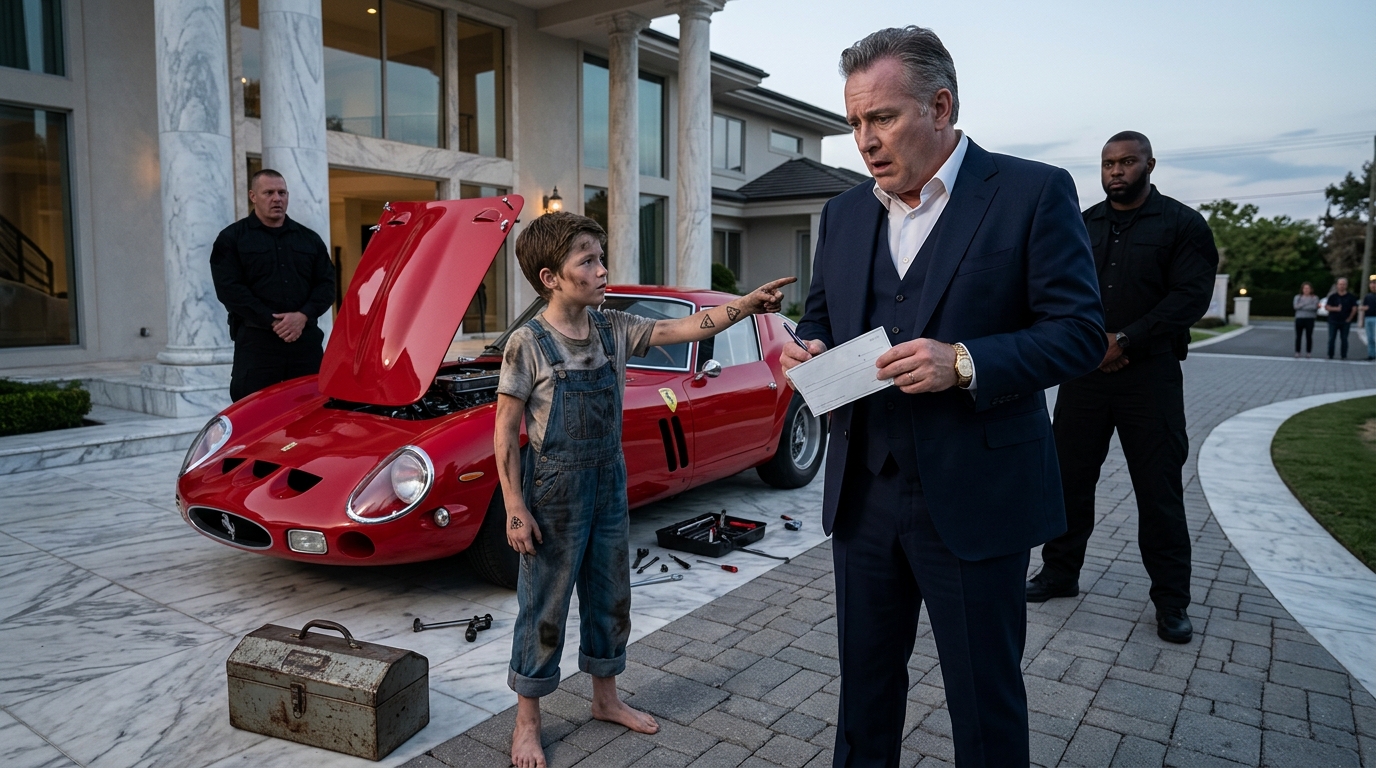
The Boy at the Mansion Gate
“GET THAT TRASH OUT OF HERE!”
Victor Hale’s voice exploded across the marble driveway, bouncing off the white columns of his mansion and cutting through the laughter of the guests gathered near the courtyard.
The party had been arranged for one purpose.
To show power.
There were champagne towers beneath golden lights, women in silk gowns, men in tailored suits, and a line of luxury cars parked like trophies along the circular drive.
But none of them mattered as much as the red machine sitting in the center of the courtyard.
Victor called it the Red Viper.
A rare, custom-built masterpiece worth more than most people’s homes.
Half a million dollars in polished metal, imported parts, and engine work so precise that even seasoned mechanics approached it with reverence.
Tonight, it had failed to start.
For forty minutes, Victor’s private mechanics had hovered over the open hood, sweating under the lights while guests pretended not to notice the humiliation.
Then the barefoot boy appeared.
He was no older than twelve.
Small.
Grease-smeared.
Thin enough that his oversized jacket hung from his shoulders like it belonged to someone who had vanished.
In one hand, he carried a battered metal box.
It looked older than he was.
The guards caught him near the garage entrance, where he had been standing too close to the Red Viper, watching the mechanics with unsettling focus.
One guard grabbed him by the collar.
Another laughed.
“A kid thinks he can fix Mr. Hale’s car.”
That joke traveled quickly.
Within seconds, half the courtyard had turned toward the boy.
Victor Hale descended the marble steps with a glass of whiskey in one hand and a look of disgust on his face.
He was a man used to being obeyed before he finished speaking.
Sixty-two years old.
Silver hair.
Sharp suit.
Sharper eyes.
A billionaire whose factories, hotels, and private investments had made his name sound less like a person and more like a weather system.
People adjusted when Victor Hale entered a room.
The boy did not.
He simply stared at the engine.
Victor’s lip curled.
“Who let him in?”
The head guard straightened.
“He slipped through the service side, sir.”
Victor looked at the child’s bare feet.
Then at the grease on his hands.
Then at the battered box.
“Get that trash out of here.”
The guards shoved the boy backward.
He stumbled, but did not fall.
A few guests laughed.
One woman lifted her phone.
One of the mechanics, embarrassed by his own failure, smirked and said, “Maybe he’s here to teach us.”
More laughter.
The boy looked at Victor.
“I can start it.”
The courtyard went still for half a second.
Then the laughter returned louder.
Victor stared at him.
“What did you say?”
The boy lifted his chin.
“I can start the car.”
A mechanic wiped his forehead with a rag.
“This engine has been dead for an hour.”
“It isn’t dead,” the boy said.
The mechanic’s smile faded.
The boy pointed toward the engine.
“You’re feeding it wrong.”
Victor’s eyes narrowed.
“You know what this machine is?”
The boy looked at the red car.
Then at Victor.
“My father did.”
That sentence passed through the courtyard unnoticed by most people.
But Victor heard something in it.
Not enough to understand.
Enough to irritate him.
“You have ten seconds before I have you thrown into the street.”
The boy took one step toward the car.
The guards moved to stop him.
Victor lifted one hand.
Not because he believed the child.
Because humiliation, when aimed at someone powerless, amused him.
“Let him try,” Victor said coldly. “Let everyone see what happens when street rats touch machines they can’t even dream of owning.”
The boy walked to the Red Viper.
Bare feet against marble.
Battered box in hand.
No fear.
No hurry.
He set the box down beside the front tire and opened it.
Inside were old tools wrapped in cloth.
Not toy tools.
Real ones.
Worn smooth by use.
The boy selected a small wrench, leaned over the engine, and slid one grease-darkened hand deep between the wires and valves.
The mechanics stiffened.
“Hey,” one snapped. “Don’t touch that line.”
The boy ignored him.
His fingers moved with disturbing confidence.
Not guessing.
Not searching.
Remembering.
He tilted his head slightly, listening to something no one else could hear.
Then he turned the wrench once.
Slowly.
A single calculated click.
The sound was tiny.
But somehow everyone heard it.
The boy stepped back.
“Try it now.”
Victor gave the mechanic a mocking look.
The mechanic, face red, reached into the driver’s side and pressed the ignition.
For one breath, nothing happened.
Then the engine roared to life.
Not coughed.
Not sputtered.
Roared.
Deep.
Clean.
Furious.
The courtyard exploded in gasps.
The guests stepped back.
The champagne glasses trembled.
The mechanics stared into the open hood as if the boy had performed witchcraft.
Victor’s smirk vanished.
The Red Viper purred beneath the lights, alive again, its engine note smooth as thunder rolling under glass.
The boy wiped his hand on his jacket.
Victor stared at him.
“How did you know?”
The boy said nothing.
Victor walked toward him slowly.
The guests watched, sensing the shift but not understanding it.
Victor reached into his inner jacket pocket, removed a checkbook, and tore out a blank check.
His hand trembled.
He held it out.
“Anything,” he whispered. “Name your price.”
The boy did not look at the check.
He looked at Victor’s chest.
Then raised one grease-smeared finger and pointed directly at him.
“I didn’t come for money.”
Victor’s face tightened.
The boy pulled back his sleeve.
On the inside of his wrist was a small mark.
A pale crescent-shaped scar curving around a tiny dark birthmark, like a half-moon guarding a star.
Victor looked down.
The blood drained from his face.
The check slipped slightly in his hand.
The boy’s voice stayed steady.
“My mother said you would recognize it.”
Victor took one step back.
The engine kept roaring.
The guests kept staring.
And suddenly, the debt between them was no longer about money.
It was about a name Victor Hale had spent twelve years trying not to hear.
The Mark He Couldn’t Deny
Victor Hale had seen that mark before.
Not on the boy.
On his daughter.
Clara Hale had been born with the same tiny dark birthmark near her wrist, a family trait that appeared every few generations. Victor’s mother had called it the Hale star.
When Clara was little, she used to press her wrist to his and ask why he didn’t have one too.
Victor would laugh and tell her, “Because you got all the magic.”
That was before he became the kind of man who mistook control for love.
Clara had been his only child.
His pride.
His weakness.
His heir.
She was supposed to inherit the Hale estate, marry someone acceptable, sit beside him at charity galas, smile for cameras, and continue the family name exactly as he designed it.
Instead, she fell in love with Mateo Vega.
Mateo was a mechanic.
Not just any mechanic.
The mechanic.
The only man who had ever understood the Red Viper better than Victor’s own engineers.
Mateo had been hired years earlier to restore the car after three specialists failed. He was quiet, brilliant, and poor in a way Victor believed should come with humility.
But Mateo had no interest in bowing.
That bothered Victor.
Clara loved him for it.
Victor hated him for the same reason.
At first, he tried money.
A promotion.
A private garage.
A contract overseas.
Anything to move Mateo far enough away from Clara that affection might die from distance.
Mateo refused.
Then Clara became pregnant.
That was when Victor stopped pretending.
He brought Mateo into the old garage, the same garage where the Red Viper now sat, and made his offer clear.
Leave.
Take the money.
Disappear before the child is born.
Mateo stood there with grease on his hands and looked Victor in the eye.
“Your daughter is not a business problem.”
Victor struck him.
It was the first and only time he had ever done it.
He remembered the sound.
He remembered Clara appearing in the doorway afterward, face white with disbelief.
He remembered her saying, “If you make me choose, you won’t like who I choose.”
He remembered saying something cruel.
Something unforgivable.
Then she left.
For weeks, Victor expected her to return.
She did not.
Letters came.
He did not read them all.
Some he burned.
Some his attorney handled.
Some he sent back unopened because pride had convinced him silence was punishment.
Then one day, a report arrived.
Clara had died.
Complications, the document said.
No surviving child, the document said.
Mateo unreachable, the document said.
Victor signed the burial authorization without attending the funeral.
That was the version he had lived with for twelve years.
A daughter lost.
A grandchild that never lived.
A mechanic who vanished.
A shame buried deeply enough that no guest at any party would ever whisper about the Hale heir who chose a poor man over a fortune.
But now a barefoot boy stood in his courtyard with Clara’s mark on his wrist.
The same mark.
The same shape.
The same impossible little star.
Victor’s voice came out thin.
“What is your name?”
The boy held his gaze.
“Leo.”
Victor swallowed.
“Leo what?”
The boy reached into the battered metal box and removed a folded oil-stained envelope.
He held it out.
Victor did not take it at first.
The boy’s expression hardened.
“My mother said rich men always delay what they fear.”
The sentence struck Victor harder than any insult.
He took the envelope.
Inside was a photograph.
Clara.
Older than the last time he had seen her.
Thinner.
Tired.
But unmistakably Clara.
She sat outside a small workshop, holding a baby wrapped in a blue blanket. Beside her stood Mateo Vega, one arm around her shoulders, the other resting gently on the hood of an old red car.
On the back of the photograph were four words:
He has your eyes.
Victor’s fingers trembled.
The party had gone silent around him.
No one laughed now.
No one lifted a glass.
Even the mechanics stood frozen.
Victor looked at Leo.
“My daughter died.”
Leo’s jaw tightened.
“No.”
Victor shook his head.
“I received papers.”
“My mother lived eight years after you signed those papers.”
Victor stopped breathing.
Leo reached into the box again and removed something smaller.
A hospital bracelet.
Faded.
Plastic cracked with age.
The name printed on it was partially worn but still readable:
LEON HALE VEGA
Victor stared at it.
Hale.
His name.
Still there.
Not erased.
Not dead.
Not gone.
Only hidden from him.
Victor’s mouth opened, but no words came.
Leo looked toward the mansion.
“All this marble,” he said quietly, “and she died in a room with a leaking roof.”
The sentence split the courtyard open.
Victor’s blank check hung uselessly in his hand.
The Box Mateo Left Behind
The battered metal box had belonged to Mateo.
That was why Leo carried it like something sacred.
Inside were tools, letters, drawings, receipts, and small pieces of a life Victor had tried to reduce to an embarrassment.
Mateo had not vanished.
He had worked wherever he could.
Small garages.
Roadside repair shops.
Farm equipment yards.
Late-night towing lots.
He fixed engines for cash, traded labor for food, and taught Leo how to listen to machines before touching them.
“Engines talk,” Mateo used to say. “Most men just like the sound of themselves too much to hear.”
Leo had been six when he first held a wrench.
Seven when he could identify a misfire by sound.
Eight when his mother died.
Clara never told him everything while she was alive.
Children, she believed, should not be fed bitterness before they can understand grief.
But she told him enough.
That his grandfather was rich.
That he had a mansion with marble floors.
That he had loved her once, but loved control more.
That if Leo ever needed proof of who he was, the mark on his wrist and the papers in the box would be enough.
Mateo changed after Clara died.
Not cruel.
Never cruel.
But hollowed.
He kept working.
Kept teaching Leo.
Kept repairing the world one engine at a time because machines were easier than people. Machines broke honestly. People often did not.
Then, two months before the mansion party, Mateo got sick.
Fast.
Too fast for a man who had spent his life ignoring pain until pain had to shout.
On his last good evening, he called Leo to the workshop.
The Red Viper’s old repair manual lay open on the bench.
Leo had seen it before.
Mateo had kept notes in the margins.
Secret adjustments.
Custom modifications.
A line here.
A valve change there.
One hidden fuel-feed correction no one else knew about.
“Your grandfather’s mechanics will never find this,” Mateo said, tapping one page.
Leo frowned.
“Why would I care about his car?”
Mateo smiled sadly.
“Because men like Victor Hale listen when the thing they love most stops obeying them.”
Leo said nothing.
Mateo coughed into a cloth.
Then pulled the battered metal box closer.
“Your mother wanted you to decide for yourself whether to find him.”
“I don’t want him.”
“That may be true.”
“It is true.”
Mateo looked at him with tired eyes.
“But there is a difference between not wanting a man and letting him keep a lie.”
Leo looked down at his wrist.
The Hale star.
He hated it sometimes.
It felt like a brand from a family that had never fed him.
Mateo placed one rough hand over his.
“This mark is not his. It is yours. You decide what it means.”
After Mateo died, Leo lasted fourteen days in the workshop before the landlord locked the door.
He slept behind a tire shop.
Fixed bicycles for food.
Repaired a delivery scooter in exchange for a jacket.
Then he heard men at a gas station talking about Victor Hale’s party.
About the Red Viper.
About the billionaire showing off the machine restored by “some dead mechanic nobody remembers.”
That night, Leo opened Mateo’s box and read every note again.
Then he walked across the city barefoot because his shoes had split at the soles.
He did not go to Victor’s mansion to beg.
He went to make the engine speak.
And now it had.
The Red Viper idled in the courtyard like a witness.
Victor stood before Leo with the photograph in one hand and the hospital bracelet in the other.
His guests watched him shrink inside his expensive suit.
Then a voice cut through the silence.
“Mr. Hale.”
It was Victor’s attorney, Graham Bell.
He had been standing near the steps the entire time, face stiff, eyes narrowed behind silver glasses.
Victor turned.
Graham’s expression carried warning.
“Perhaps we should handle this inside.”
Leo looked at him.
Something changed in the boy’s face.
Not fear.
Recognition.
“You,” Leo said.
Graham froze.
Victor looked between them.
“You know him?”
Leo reached into the metal box again.
This time, he pulled out a letter.
Old.
Folded carefully.
“My mother wrote this before she died.”
He looked at Graham.
“She said if I ever saw the man with silver glasses, I should ask why he told the hospital my grandfather refused the baby.”
Victor went utterly still.
Graham’s face went pale.
Leo held out the letter.
Victor took it slowly.
The handwriting was Clara’s.
Father,
If this reaches you, it means Graham did not stop it.
I came to the house three times after Leo was born. I wrote. I called. I waited outside the gate with your grandson in my arms.
Graham told me you had read the letters and wanted nothing to do with us.
He told me you signed papers refusing contact.
He told me if I came back again, Mateo would be arrested for theft and I would lose the baby.
If that was truly your choice, then I hope one day you have to look at him and say it yourself.
If it was not, then you were not the only one who betrayed me.
Clara
Victor’s hand shook so violently the paper rustled.
He looked at Graham.
For the first time that night, the billionaire did not look powerful.
He looked old.
“What did you do?”
Graham stepped back.
“Victor, she was unstable. You were grieving. I protected the family.”
“The family?” Victor whispered.
“She would have ruined you.”
Victor’s voice cracked.
“She was my daughter.”
Graham looked toward the guests.
Too many witnesses.
Too many phones.
Too much truth.
He tried one final lie.
“You signed the refusal.”
Victor stared at him.
“I signed burial papers.”
Leo’s voice cut in.
“My mother said you always signed what men in suits placed in front of you when the truth was too painful to read.”
Victor flinched.
Because it was true.
And truth spoken by a child has a way of making excuses sound obscene.
The Name on the Gate
The party ended without announcement.
Guests left quietly.
The music stopped.
The champagne remained untouched.
The mechanics disappeared into the garage, suddenly very interested in not being part of history.
Graham Bell was escorted into Victor’s private office and told not to leave until investigators arrived.
For thirty years, he had controlled the ugly parts of Victor Hale’s life.
Settlements.
Silences.
Papers that made problems disappear.
But this time, the problem had walked in barefoot and started the engine.
Victor brought Leo inside the mansion.
The boy hesitated at the threshold.
Marble stretched beneath him.
A chandelier glittered overhead.
Portraits of serious-looking Hales lined the walls.
Leo looked down at his bare feet.
Victor noticed.
For the first time that night, shame moved through him without needing evidence.
“You can come in,” Victor said.
Leo looked up.
“I know.”
Then he stepped onto the marble.
Not as a beggar.
Not as trash.
As blood.
Victor asked the kitchen staff to bring food.
Leo ate carefully at first, then too quickly to hide how hungry he was.
Victor watched and hated himself more with every bite.
There are many kinds of guilt.
Some are loud and theatrical.
Victor’s was quiet and unbearable.
Because the boy did not act grateful.
That made the guilt worse.
He did not praise the house.
Did not marvel at the food.
Did not ask for anything.
He ate like someone who had learned not to trust generosity until it survived the first question.
“What do you want?” Victor finally asked.
Leo stopped chewing.
Victor pushed the blank check across the table.
“Money. A house. School. A trust. Anything.”
Leo looked at the check.
Then at Victor.
“My mother said you would try to pay before you apologized.”
Victor closed his eyes.
The words landed exactly where they were meant to.
He pulled the check back.
Then slowly lowered himself into the chair across from the boy.
“I am sorry.”
Leo stared at him.
Victor continued.
“I failed your mother.”
Leo did not blink.
“I believed what was easiest to believe. I let other people decide what truth I had to face. I signed papers I did not read because reading them would have forced me to hurt properly.”
His voice broke.
“I abandoned her.”
Leo’s mouth tightened.
“My father said hate is heavy.”
Victor nodded, tears in his eyes.
“He was right.”
“He also said forgiveness is not a receipt.”
Victor looked at him.
Leo’s eyes were steady.
“You don’t get to say sorry and own me.”
The sentence hurt.
It should have.
Victor lowered his head.
“No. I don’t.”
For the first time since entering the mansion, Leo looked uncertain.
“My mother wanted her name back.”
Victor looked up.
“What?”
“They told people she ran away with money. They said my father stole from you. They said I didn’t exist.”
His small hand tightened around the spoon.
“I want their names fixed.”
Victor nodded slowly.
“Yes.”
“No quiet correction.”
“No.”
“No charity speech.”
“No.”
“No saying she was troubled.”
Victor swallowed.
“No.”
Leo looked toward the hallway where the Hale portraits hung.
“She was your daughter.”
Victor’s face crumpled.
“Yes.”
“And Mateo Vega built your favorite car.”
“Yes.”
“And I’m not trash.”
Victor covered his mouth with one hand.
“No,” he whispered. “You are not.”
The next morning, the front gate of the Hale estate changed.
For decades, the iron arch had displayed one name:
HALE
By sunset, workers had removed the old brass plate from the private garage beneath the mansion and replaced it with a new one.
Not on the mansion.
On the garage.
Where the truth had begun.
It read:
THE CLARA HALE VEGA WORKSHOP
Restored in honor of Clara Hale Vega and Mateo Vega
Whose son brought the engine home
Leo stood beside Victor as the sign was installed.
He said nothing.
But his eyes stayed fixed on his mother’s name.
Not hidden.
Not erased.
Not whispered.
There.
The Engine That Remembered
The investigation into Graham Bell took months.
Then years.
Old files surfaced.
Letters Clara had written but Victor never received.
Hospital records altered through legal pressure.
Payments to administrators.
Threats sent to Mateo.
A refusal document Victor had never signed, bearing a forged signature so convincing only a forensic examiner could expose it.
Graham had not acted only out of loyalty.
He had acted to protect the Hale fortune from scandal and to protect his own position beside it.
Victor had allowed such men to grow powerful because they made his life easier.
That became part of the public record too.
Victor did not hide from it.
Not this time.
He held a press conference in front of the garage.
No grand ballroom.
No charity backdrop.
No polished speech about family healing.
He stood beside Leo, who wore new shoes but still carried Mateo’s battered metal box.
Victor faced the cameras.
“My daughter did not abandon this family,” he said. “This family abandoned her.”
The reporters went silent.
“Mateo Vega did not steal from me. He was a gifted mechanic and the man my daughter loved. He built the engine I displayed for years while allowing his name to be erased from it.”
His voice shook.
“And this boy, Leo Hale Vega, is my grandson. He owes me nothing. I owe him truth, protection, and the public restoration of his parents’ names.”
Leo looked down.
He did not smile.
Healing is not a camera moment.
But when Victor said his full name aloud, something in the boy’s shoulders loosened.
After that, things changed slowly.
Not magically.
Leo did not move into the mansion right away.
He refused.
Victor wanted to argue.
Did not.
Instead, he arranged safe housing with a guardian Clara had once trusted, a retired nurse named Mrs. Alina Reyes. Leo chose that.
Choice mattered.
He began school again.
He kept repairing engines.
He visited the Hale garage on Saturdays, where Victor had converted the space into a foundation supporting young mechanics from poor neighborhoods.
Not as charity.
As repayment.
The foundation’s first rule, written by Leo, was painted on the wall:
Never call dirty hands worthless.
Victor read it often.
He deserved to.
The Red Viper was no longer shown at parties.
It remained in the Clara Hale Vega Workshop, not as a trophy, but as evidence.
Mateo’s notes were framed beside it.
So was the photograph of Clara holding baby Leo.
The blank check Victor had offered that night was framed too, unsigned, beneath a small plaque:
Money was offered. Truth was required.
Leo thought the plaque was dramatic.
Victor agreed.
They kept it anyway.
Years later, people still told the story of the barefoot boy who walked into a billionaire’s mansion, fixed a half-million-dollar engine with one twist of a wrench, and made the rich man go pale with a mark on his wrist.
They loved the spectacle.
The insult.
The engine roaring.
The blank check.
The shocking reveal.
But Leo remembered other things.
The cold marble under his bare feet.
The way everyone laughed before the engine started.
The first time his mother’s full name appeared on the garage wall.
The first time Victor asked permission before calling him grandson.
That mattered most.
One evening, long after the scandal faded, Victor found Leo in the workshop alone.
The boy was older now.
Taller.
Still grease-streaked.
Still quiet.
He was tuning the Red Viper by ear.
Victor stood near the doorway.
Leo did not look up.
“You’re breathing too loud,” he said.
Victor smiled faintly.
“Your father used to say that.”
Leo’s hand paused.
Then continued working.
For a while, only the soft clicks of tools filled the garage.
Then Victor said, “I wish I had met you sooner.”
Leo wiped his hands on a rag.
“You mean you wish you had listened sooner.”
Victor closed his eyes.
“Yes.”
Leo nodded once.
It was not forgiveness.
Not exactly.
But it was truth without anger.
Sometimes that is the bridge before forgiveness.
The engine turned over.
This time, it did not roar for guests.
It purred in the quiet garage, surrounded by photographs, tools, old letters, and names that could no longer be erased.
Leo leaned over the engine, listening.
Victor watched him.
The same mark curved around the boy’s wrist.
The Hale star.
For years, Victor had thought legacy meant marble columns, machines, money, and his name on iron gates.
He had been wrong.
Legacy was this.
A child he had nearly lost to pride.
A daughter whose truth outlived silence.
A mechanic whose hands still taught through the son he raised.
An engine that remembered the man who built it.
And a barefoot boy who walked through humiliation carrying a battered metal box, not to ask for a fortune, but to demand something richer men fear more than poverty.
Accountability.
The boy tightened one final bolt.
A small click echoed through the workshop.
Victor looked at him.
Leo looked back.
Then, for the first time, he said it without bitterness.
“It’s fixed.”
Victor knew he was not only talking about the engine.
And he knew, painfully, that the boy was not entirely right.
Some things could never be fully fixed.
Clara would not return.
Mateo would not walk through the garage door.
Leo’s childhood would not be rewritten.
But some truths, once started, can keep running.
Like an engine given air after years of being choked.
Like a name restored to stone.
Like a family learning, too late but not never, that money can buy silence for a while.
But it cannot stop the sound of one wrench turning.
One engine roaring.
One child pointing at your chest and saying:
You owe more than cash.