The Sack That Wasn’t Filled With Rice
The rain poured down with such force that the world itself seemed harsher.
The black iron gate rattled in the wind.
Water streamed along the stone pathway, turning every step into a cold shimmer beneath the storm.
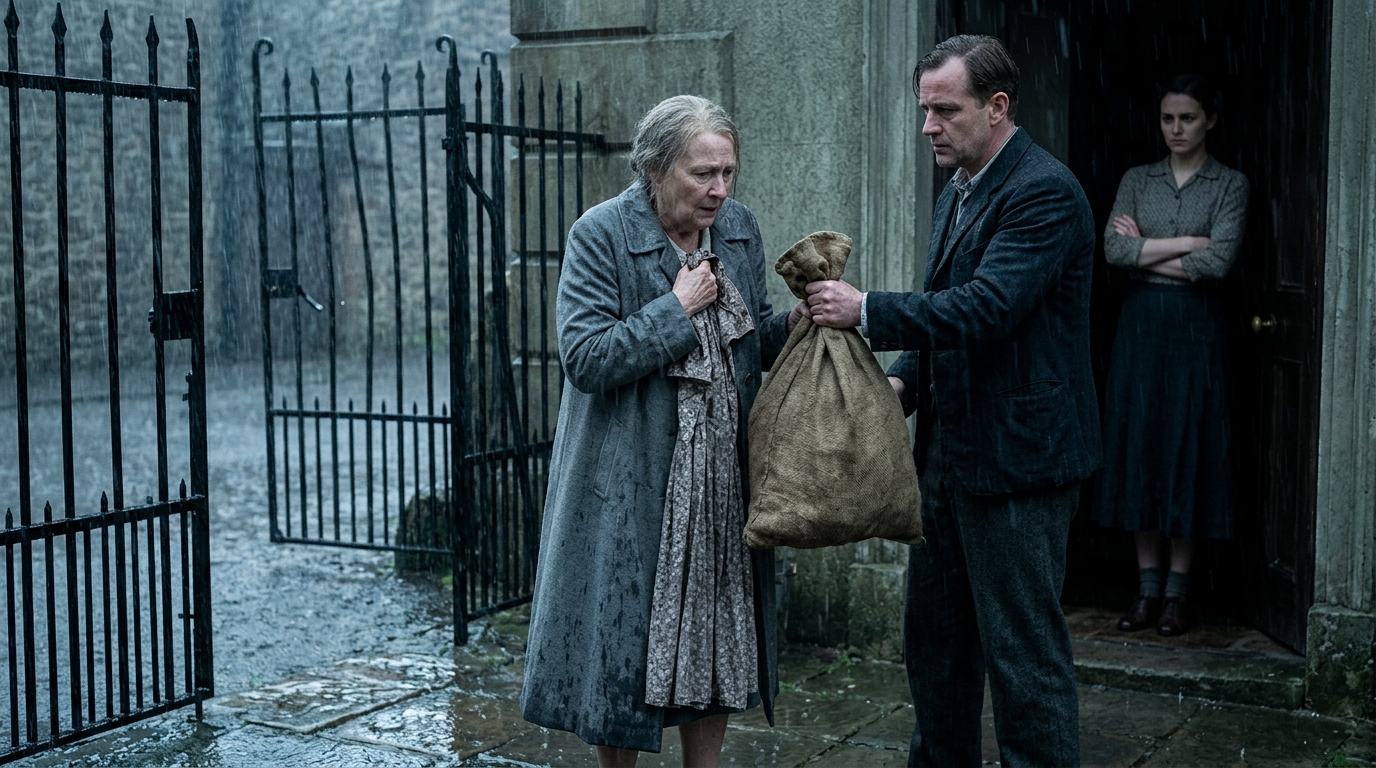
And in the middle of it all stood an elderly mother in a gray coat, soaked through to the skin, one hand pressed to her chest as if she could feel her heart preparing to break again.
Her name was Eleanor Whitman.
Seventy-one years old.
Small.
Careful.
The kind of woman who apologized when someone else stepped on her foot.
She had raised her son alone after his father died, working night shifts in a laundry, cleaning church kitchens, sewing torn curtains for neighbors who paid her in coins and leftovers. She had never owned much, but she had given everything.
Especially to Daniel.
Daniel had once been the boy who ran barefoot down their old hallway shouting, “Mom, look what I made!”
He had once fallen asleep with his head in her lap after nightmares.
He had once promised that when he grew up, he would buy her a house with yellow curtains and a garden full of roses.
Now he stood behind the iron gate of a mansion that belonged more to his wife than to him, his face pale under the rain, his eyes refusing to meet hers.
He did not embrace her.
He did not kiss her forehead.
He did not invite her inside.
Instead, he pushed a heavy burlap sack into her arms so abruptly that she nearly stumbled backward.
“Take the rice and go, Mom.”
That was all.
No tenderness.
No explanation.
No warmth.
Only the cold tone men use when they are trying to hide pain from someone who knows them too well.
Eleanor stared up at him through the rain.
For one brief second, something in her face faltered.
Not because of the sack.
Because of the distance.
Because mothers know when their sons are not being cruel from the heart, but from somewhere deeper, darker, and more desperate.
Behind Daniel, sheltered beneath the glow of the doorway, stood his wife, Vanessa.
Younger.
Elegant.
Still.
Her arms were crossed, her face unreadable.
But her presence cut through the rain like a knife.
Daniel glanced back at her.
Just once.
Quickly.
Fearfully.
Then he stepped away from his mother as if staying near her one second longer might force him to say something he was not allowed to say.
Eleanor nodded.
She always nodded.
Even when it hurt.
Even when the world asked her to accept pain quietly.
Even now, in the rain, when all she wanted was for her son to look at her like he used to before life, money, marriage, and fear turned him into someone she barely recognized.
“All right,” she whispered.
Daniel’s jaw trembled.
Only for a moment.
Then he turned away.
The gate closed between them.
Eleanor stood there holding the sack.
A sack of rice.
Or so she thought.
She walked home alone, clutching it to her chest as rain soaked her sleeves and dripped from her chin. The road from Daniel’s mansion to her small house was long, but she hardly felt her feet. Shame weighed more than the storm.
She did not cry outside.
She had learned not to.
Poor people learn to save tears for rooms with doors.
Only when she reached her little house did she allow herself to break.
The room was dimly lit.
A wooden table.
A narrow bed.
A window streaked with rain.
A kettle on the stove that had not boiled in two days because tea felt wasteful when money was low.
Eleanor set the burlap sack on the table with both hands. Her fingers trembled as she untied the rope.
She expected rice to spill out.
Nothing did.
She froze.
Slowly, she opened the sack wider.
Inside was not rice.
There was only a white envelope.
One envelope.
Wrapped in plastic to protect it from the rain.
On the front, written in Daniel’s hand, was a single word:
Mom.
Her breath caught.
She sat down before her knees gave out.
With shaking hands, she opened the envelope.
Money slid out first.
A thick stack of bills.
More than she had seen in years.
Enough to repair the roof.
Enough to pay her overdue electricity.
Enough to buy medicine without cutting pills in half.
But beneath the money was a folded note.
Eleanor opened it carefully.
The first line struck her like a blow to the chest.
I’m sorry, Mom.
She pressed a hand to her mouth.
Rain tapped against the window behind her.
The room seemed to sway.
She read on.
I couldn’t say it in front of her.
I told you it was rice because she watches everything.
Please don’t come back for me.
Please don’t ask where I got this.
Just leave before dark.
Eleanor’s eyes filled instantly.
That was not a son dismissing his mother.
That was a son trying to protect her from something far worse.
Her fingers trembled harder as she unfolded the rest of the note.
If I stay, she’ll keep taking everything.
If I run, she’ll come after you first.
So I’m sending you away before I do something stupid.
A broken sound escaped Eleanor’s throat.
She kept reading.
By the time you read this, I’ll either be gone… or she’ll know.
The blood drained from her face.
She turned toward the rain-splattered window.
And there he stood.
Daniel.
Still by the gate in the distance, visible through the narrow line of sight between the trees and the road.
Alone.
Soaked.
Not moving.
Not like a cruel son.
Like a terrified little boy trapped inside a grown man’s body.
He raised a shaking hand to his face and wiped away tears no one was meant to see.
Then Vanessa stepped out behind him.
Into the rain.
In her hand was a gun.
The Woman at the Doorway
Eleanor stopped breathing.
For one awful second, she could not move.
Her mind rejected the image.
Vanessa was elegant dinner parties, polished nails, white silk blouses, charity lunches, perfect smiles in front of neighbors.
Vanessa was not a gun in the rain.
But the woman at the gate was holding one.
And Daniel did not turn around.
He already knew she was there.
That was what frightened Eleanor most.
He knew.
He had been waiting.
Not for rescue.
For consequence.
The note slipped from Eleanor’s hand onto the table.
Her first instinct was to run toward him.
Every part of her body screamed to open the door and go back into the storm, to reach her son, to stand between him and whatever Vanessa had become.
But the last words of the note held her still.
If I run, she’ll come after you first.
So I’m sending you away.
Eleanor looked at the money.
Then at the envelope.
Then at the small plastic-wrapped bundle still hidden inside the burlap sack.
She had not noticed it before.
Her fingers moved quickly now.
Inside the bundle was a phone.
Daniel’s old phone.
Cracked at the corner.
Powered off.
Taped to it was another note.
Call Uncle Raymond. Not police first. He’ll know what to do.
Eleanor’s hands shook so badly she nearly dropped it.
Uncle Raymond.
Her younger brother.
Retired detective.
The man Daniel had once idolized as a child, following him around during family gatherings asking about badges, sirens, and “catching bad guys.”
Raymond had not been invited to Daniel and Vanessa’s wedding.
Vanessa had said she wanted an intimate ceremony.
Eleanor had believed her.
Now she wondered how many people Vanessa had removed from Daniel’s life before Eleanor realized she was being removed too.
She turned on the phone.
It still had 12% battery.
There was only one number saved in the emergency contact list.
RAY.
Eleanor pressed call.
He answered on the second ring.
“Daniel?”
“No,” Eleanor whispered. “It’s me.”
There was a pause.
“Ellie? Why do you have Daniel’s phone?”
She looked out the window.
Daniel still stood at the gate.
Vanessa stood behind him, gun low at her side.
“Ray,” Eleanor said, voice breaking, “Vanessa has a gun.”
The air on the other end changed.
Raymond’s voice became calm in the way only trained men become calm when panic would waste time.
“Where are you?”
“My house. I can see the gate from the window.”
“Is Daniel with you?”
“No. He’s still outside their house.”
“Is she pointing it at him?”
“Not yet. It’s in her hand.”
“Listen to me carefully. Do not go outside.”
“He’s my son.”
“And you will help him by staying alive.”
Eleanor covered her mouth.
Raymond continued, “Did Daniel leave you anything else?”
“Money. A note. His phone.”
“Anything on the phone?”
“I don’t know.”
“Check photos. Recordings. Anything recent.”
Eleanor put him on speaker and opened the phone.
The gallery held dozens of images.
Bank statements.
Bruises on Daniel’s arm.
A broken picture frame.
A smashed laptop.
Screenshots of messages.
Vanessa: If you send your mother one dollar, I’ll make sure she loses that shack.
Vanessa: You think anyone will believe you over me?
Vanessa: I know what happened to your father, Daniel. Don’t make me use it.
Eleanor’s heart slammed.
“What happened to his father?” Raymond asked sharply.
Eleanor froze.
She had not spoken of Daniel’s father, Thomas, in years.
Thomas had died when Daniel was thirteen.
Officially, it was ruled a workplace accident at the construction company where he had worked.
But Raymond had never believed that.
Neither had Eleanor.
There had been whispers.
Missing reports.
A supervisor who vanished.
A settlement offer delivered too quickly.
And a lawyer from a powerful family who warned Eleanor that grieving widows should think of their children before asking dangerous questions.
That lawyer’s last name had been Vale.
Vanessa’s maiden name.
Eleanor whispered, “Ray… she knows about Thomas.”
Raymond went silent.
Then said, “I’m on my way. I’m calling officers I trust. Do not hang up. Do not go outside.”
But Eleanor was already looking at the window.
Daniel had turned.
Vanessa had raised the gun.
The Secret She Used as a Chain
Vanessa had not started by threatening Daniel with a gun.
People like Vanessa rarely begin with the obvious weapon.
They begin with guilt.
Then isolation.
Then money.
Then shame.
Only when all else fails do they show the metal in their hand.
When Daniel first married her, Eleanor tried to believe her son had found someone strong.
Vanessa was confident where Daniel was gentle.
Organized where he was trusting.
Strategic where he was sentimental.
“She knows how to handle life,” Daniel said once, smiling in a way that made Eleanor swallow her concern.
At first, Vanessa’s control looked like care.
She took over the bills.
She organized Daniel’s calendar.
She chose which relatives were “healthy” for them to see.
She told Daniel he needed boundaries with his mother.
Then she began to count.
How many times Eleanor called.
How much money Daniel sent.
How long he stayed when he visited.
Whether he looked sad afterward.
“She makes you feel guilty,” Vanessa said.
Daniel defended Eleanor at first.
Then less.
Then not at all.
Eleanor blamed marriage.
Work.
Stress.
Herself.
Maybe she called too much.
Maybe she visited too often.
Maybe old mothers did not know when to step back.
Then Daniel changed.
He stopped laughing easily.
Stopped fixing things around Eleanor’s house.
Stopped staying for tea.
His eyes always looked tired, but alert, as if part of him was listening for footsteps no one else could hear.
Three months before the night of the storm, he came to Eleanor’s house alone.
No warning.
No Vanessa.
He fixed the kitchen window that had swollen in the frame, then sat at the table staring at his hands.
“Mom,” he said quietly, “did Dad really fall?”
Eleanor’s body went cold.
“What?”
“The accident. Did Dad fall because he made a mistake?”
Eleanor turned away.
The kettle was not even on, but she pretended to busy herself.
“That was a long time ago.”
“That isn’t an answer.”
Her hands shook.
Daniel noticed.
“Mom.”
She closed her eyes.
“I don’t know.”
He stared at her.
“What does that mean?”
“It means your father was going to report something at the site. Something dangerous. He told me if anything happened to him, I should call Raymond.”
Daniel’s face went pale.
“Why didn’t you?”
“I tried.”
“And?”
She could still remember the lawyer’s polished shoes on her cheap kitchen floor.
The envelope he placed on the table.
The words he used.
Your son has a future, Mrs. Whitman. Do not bury him beside his father.
“They threatened you,” Daniel whispered.
Eleanor nodded.
He stood so fast the chair scraped the floor.
“Who?”
She did not answer.
She did not have to.
Daniel left that day with a face she did not recognize.
Two weeks later, Vanessa came to Eleanor’s house.
Alone.
She stood in the doorway smiling.
“Daniel tells me you’ve been digging up old grief.”
Eleanor felt the old fear return.
Vanessa stepped inside without being invited.
“My family has survived worse stories than yours,” she said. “But Daniel hasn’t.”
Eleanor looked at her.
“What does that mean?”
“It means if you tell him too much, he’ll do something reckless.”
Vanessa smiled.
“And if he does, I’ll make sure everyone knows instability runs in the Whitman bloodline.”
Eleanor said nothing.
Vanessa moved closer.
“His father was called careless in the records. It would be very easy to make the son look worse.”
That was the first time Eleanor understood.
Vanessa did not merely know the secret.
She owned pieces of it.
Or thought she did.
And she had been using that secret to keep Daniel from leaving.
That night, Eleanor called Daniel.
He did not answer.
The next day, he arrived at her gate with the sack.
Cold voice.
Flat face.
Vanessa watching.
Take the rice and go, Mom.
Now, through the rain, Eleanor saw what the words had truly meant.
Run.
Live.
Forgive me.
The Gun in the Rain
“Daniel,” Vanessa said.
Her voice carried strangely through the storm.
Eleanor could not hear every word from the window, but Daniel’s phone, still connected to Raymond, began to buzz with a live audio recording.
He had set something up.
A second device near the gate.
Maybe hidden in the stone planter.
Maybe already recording before Eleanor arrived.
Daniel had not only sent her away.
He had prepared proof.
Raymond heard it too.
“Ellie,” he said through the speaker, “stay where you are. Officers are two minutes out.”
On the phone’s screen, a file appeared.
LIVE GATE AUDIO.
Vanessa’s voice came through, cracked by rain but clear.
“You should have let her leave cleanly.”
Daniel’s voice was quieter.
“She’s gone.”
“No,” Vanessa said. “She’s reading by now.”
Daniel did not answer.
“She knows too much because you told her too much.”
“I didn’t tell her anything.”
“You always tell her without words. That pathetic face. That guilt. You think I don’t see it?”
Eleanor gripped the table.
Daniel’s voice shook.
“Put the gun down.”
Vanessa laughed.
“Now you’re brave?”
“I’m tired.”
“Of me?”
“Of being afraid of you.”
Silence.
Then Vanessa’s voice lowered.
“You should be afraid. Do you know what happens if I turn those files over? Your father’s name dragged back through court. Your mother accused of taking settlement money. Your uncle exposed for hiding evidence. You think truth is clean? Truth ruins everyone it touches.”
Daniel answered, “No. Lies did that.”
Eleanor began to cry silently.
Raymond’s voice came through the speaker.
“Keep listening. Don’t move.”
Vanessa said, “You stole from me.”
“It was my money.”
“Our money.”
“You were going to drain the accounts and blame me.”
“I was protecting what I built.”
“What you built?” Daniel’s laugh was broken. “You built a cage.”
The audio crackled.
Rain slammed the window.
Through the blurred glass, Eleanor saw Daniel take one step back.
Vanessa followed.
Gun raised higher now.
Eleanor’s knees nearly gave out.
Then blue and red light flashed faintly beyond the trees.
The police were coming.
Vanessa saw it too.
Her head snapped toward the road.
For the first time, her perfect composure broke.
“You called them?”
Daniel said nothing.
Vanessa lifted the gun fully.
Not at the road.
At Daniel.
Eleanor screamed.
Inside the little house, the sound tore from her like something physical.
On the phone, Raymond shouted, “Ellie, stay inside!”
But Eleanor was already at the door.
She threw it open.
Rain hit her face.
The money, the notes, the phone — all left on the table behind her.
She ran.
Her old knees screamed.
Her coat dragged heavy with water.
She nearly slipped on the path, caught herself on the fence, and kept going.
“Daniel!”
Her voice cut through the storm.
Daniel turned.
Vanessa turned too.
That one second saved him.
The first police car skidded to a stop near the gate.
Raymond’s truck came right behind it, tires spraying water.
Officers stepped out with weapons drawn, shouting commands.
“Drop the gun!”
Vanessa froze.
Her eyes darted.
Daniel slowly raised his hands.
“Vanessa,” he said, voice breaking, “don’t.”
For one terrible moment, Eleanor thought Vanessa would fire.
Instead, Vanessa pointed the gun at herself.
The officers shifted.
Daniel’s face went white.
“Vanessa, no.”
Eleanor stopped several yards away, gasping, soaked, trembling.
Vanessa looked at all of them — Daniel, Eleanor, the officers, Raymond running toward the gate — and smiled through the rain.
“You’ll all thank me when this disappears.”
Raymond’s voice rang out.
“It won’t disappear.”
Vanessa’s eyes snapped to him.
Raymond held up Daniel’s phone.
“Everything is recorded.”
The smile vanished.
“Every word,” Raymond said.
Vanessa looked at Daniel.
Then Eleanor.
Then the flashing lights.
The gun lowered by an inch.
An officer moved at once.
Then another.
In seconds, Vanessa was disarmed and restrained against the wet stone wall.
No shot fired.
No blood.
Only rain.
Only breath.
Only Daniel collapsing to his knees as if the strings holding him upright had been cut.
Eleanor reached him before anyone else.
She fell beside him in the mud and took his face in both hands.
For a moment, he was not a grown man.
He was her boy.
Her Daniel.
The child who had once cried when thunder shook their apartment windows.
“I’m sorry,” he sobbed. “Mom, I’m sorry.”
She pulled him into her arms.
“You sent me away to save me.”
“I hurt you.”
“You saved me.”
“I almost didn’t.”
“But you did.”
He clung to her like the rain might pull him apart.
Raymond stood above them, breathing hard, eyes wet but focused.
Officers read Vanessa her rights behind the gate.
The mansion lights glowed coldly through the storm.
The burlap sack had not held rice.
It had held the first honest thing Daniel had managed to give his mother in years.
A warning.
An apology.
A way out.
And proof.
What the Rain Couldn’t Wash Away
The investigation lasted months.
Vanessa was charged with threats, coercive control, unlawful possession of a weapon, financial abuse, and obstruction related to evidence hidden in her family’s old legal files.
But the larger truth went deeper.
Daniel’s father, Thomas Whitman, had not died because he was careless.
Raymond had kept copies from the old case, hidden for decades because he lacked one missing piece: proof that the Vale family’s lawyer had threatened Eleanor and altered statements after the accident.
Vanessa had found that proof in her late father’s files.
Instead of exposing it, she used it.
She used it against Eleanor.
Against Daniel.
Against the memory of a dead man.
She thought secrets were weapons because that was how her family had always handled truth.
Daniel’s recordings changed everything.
The live gate audio.
Screenshots.
Messages.
Financial records.
Photographs.
The note in the sack.
The old legal files Vanessa had referenced while threatening him.
Together, they reopened Thomas Whitman’s case and exposed a pattern of intimidation tied to the construction company that had buried him under paperwork and shame.
Eleanor testified.
So did Raymond.
Daniel did too.
He trembled through half of it, but he did not stop.
When asked why he gave his mother the sack, he said:
“Because I needed her to leave before my wife realized I had chosen the truth.”
The courtroom went silent.
Eleanor sat in the front row, clutching a handkerchief in both hands.
She cried when Thomas’s name was formally cleared.
Not loudly.
Not dramatically.
Just with the quiet exhaustion of a woman who had carried a lie so long that the truth felt almost too heavy to hold.
Afterward, Daniel moved into Eleanor’s small house for a while.
Not because he had nowhere else to go.
He had the mansion.
He had money.
He had lawyers telling him what assets he could claim.
But he did not want marble.
He wanted the old wooden table.
The narrow bed.
The rain-streaked window.
The room where his mother had opened the sack and learned the truth hidden inside his cruelty.
The first morning after he came home, Eleanor woke to the smell of toast burning.
She hurried into the kitchen.
Daniel stood by the stove, panicked, waving a towel at the smoke.
“I was trying to make breakfast.”
Eleanor stared.
Then laughed.
He looked embarrassed.
“I ruined it.”
“Yes,” she said, still laughing through tears. “Terribly.”
He smiled for the first time in months.
Maybe years.
Healing did not come quickly.
Daniel startled at footsteps.
Eleanor cried when he went quiet too long.
Some nights, he woke from dreams and sat at the kitchen table until dawn.
Some mornings, she found him holding the old envelope, rereading his own note like he needed to remember the moment he decided not to disappear.
He began therapy.
So did Eleanor.
Raymond came by every Thursday with groceries and terrible jokes.
The mansion was eventually sold.
Daniel kept none of Vanessa’s furniture.
But he kept the black iron gate.
Not physically.
In memory.
He said it was the place where he nearly broke and the place where he finally chose differently.
A year later, Daniel brought Eleanor a new sack of rice.
A real one.
He placed it on her kitchen table carefully and stepped back.
She looked at him.
He looked at her.
For one second, both of them remembered the rain.
Then Eleanor raised an eyebrow.
“Should I be worried?”
Daniel laughed softly.
“No notes this time.”
“No money?”
“No.”
“No armed wife at the gate?”
His smile faded, but only a little.
“No.”
She opened the sack.
Rice spilled into the tin container she kept beneath the table.
Plain.
White.
Ordinary.
Beautifully ordinary.
Eleanor ran her fingers through the grains.
“I used to think ordinary days were boring,” Daniel said.
She looked at him.
“And now?”
“Now I think they’re mercy.”
She nodded.
Because she understood.
Years later, people still told the story of the son who shoved a sack into his mother’s arms and told her to leave in the rain.
They loved the twist.
No rice.
Money.
A note.
A warning.
The window.
The gun.
The police lights at the gate.
But Eleanor remembered something quieter.
The way Daniel glanced back before hurting her.
The way his hand shook when he closed the gate.
The way the first line of the note said, I’m sorry, Mom.
She kept that note in a small wooden box beside Thomas’s cleared case file.
Not because she needed proof Daniel loved her.
He told her now.
Often.
Awkwardly at first.
Then more easily.
She kept it because some apologies are not endings.
They are doorways.
That note had opened one.
It led out of fear.
Out of silence.
Out of the cage Vanessa built.
Out of the lie that buried Thomas.
Out of the rain.
On stormy nights, Eleanor sometimes stood by the window and watched water run down the glass.
Daniel would find her there and say, “Thinking about it?”
She would answer honestly.
“Yes.”
Then he would stand beside her.
Not trapped at a gate.
Not pretending cruelty.
Not hiding tears.
Just her son.
Alive.
Free.
Home.
And somewhere in the kitchen, the tin of rice sat full beneath the table.
Only rice now.
No secrets.
No warnings.
No goodbye.
Just food.
Simple proof that the house was no longer surviving on fear, but on ordinary mercy.
And love, finally spoken before it had to be hidden.