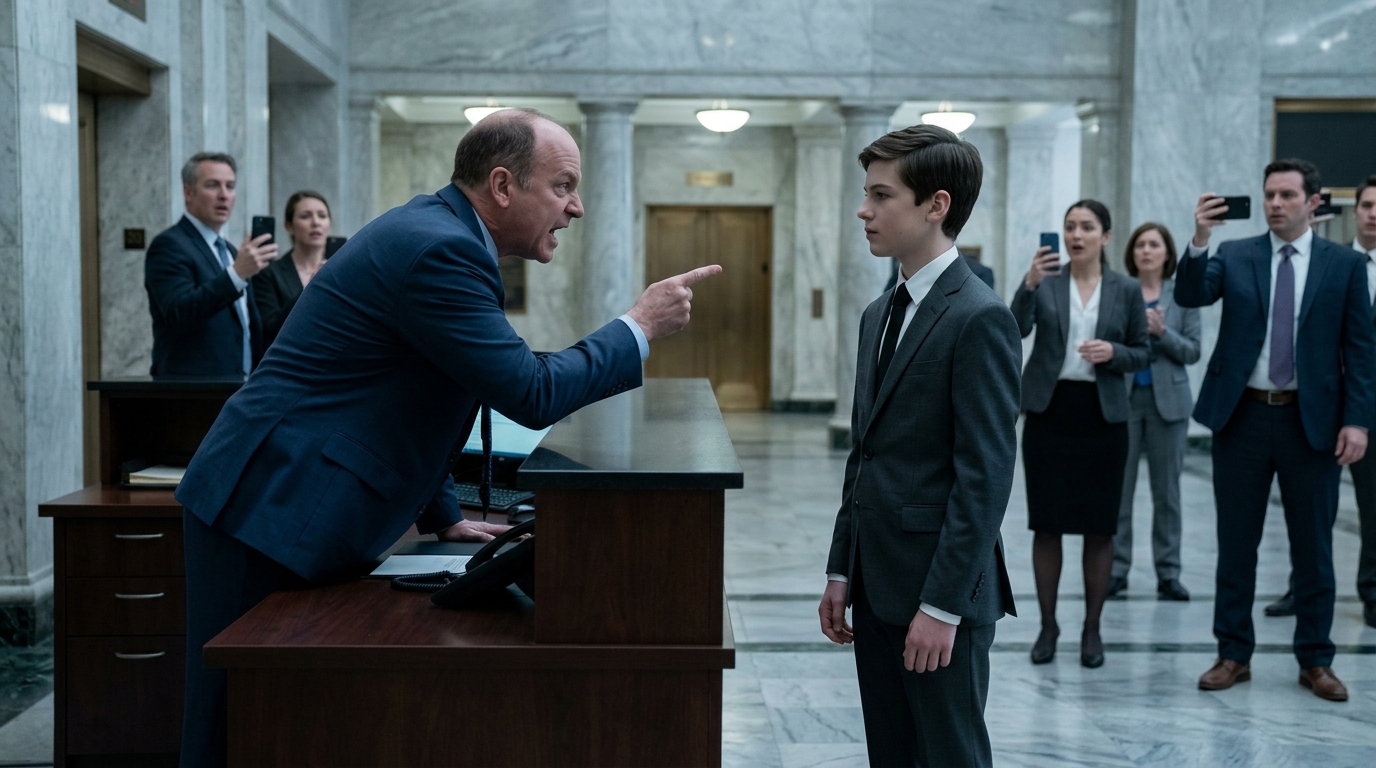
The Boy in the Marble Lobby
“HEY, BE CAREFUL, KID!”
The man’s voice cracked through the marble lobby so sharply that conversations stopped mid-sentence.
The lobby of Aureon Private Bank was designed to make ordinary people feel smaller.
Black marble floors.
Gold-veined pillars.
A glass ceiling thirty stories high.
Silent elevators that carried billionaires to private vault rooms above the city.
At the center of it all stood a boy who looked far too young to belong there.
He could not have been more than thirteen.
Maybe fourteen.
He wore a sharp dark suit, perfectly tailored but plain. No tie. No flashy watch. No nervous parent beside him. His shoes were polished, his hair neatly combed, and his expression carried the unsettling calm of someone who had come prepared for a moment everyone else would misunderstand.
A few clients turned their heads.
Then more.
Phones appeared almost instantly.
People could sense drama before they understood it.
At the main reception desk, Victor Sloane leaned forward with a smirk.
Victor was not the bank’s highest-ranking executive, but he behaved as if marble itself had given him authority. His suit was expensive. His cufflinks were platinum. His right eye, faintly darker than the left, carried the bank’s classified neural-interface implant — an encrypted retinal assistant used only by top-tier account directors.
It gave him access to client identities, vault certifications, compliance alerts, hidden account structures, and risk flags faster than any normal employee could process.
Victor loved that eye.
He loved how clients reacted when they saw the faint blue scan shimmer across his iris.
It made him seem less like a banker and more like a gatekeeper to a world others could not enter.
Now he looked at the boy and saw nothing worth respecting.
“Careful,” Victor repeated, louder this time. “This is not a school lobby.”
The crowd murmured.
The boy did not flinch.
He walked to the desk and placed a plain brown envelope on the polished surface.
“Check it,” he said.
His voice was low.
Almost a whisper.
Victor looked at the envelope.
Then at the boy.
Then at the growing audience behind him.
He smiled.
“Check what?”
The boy slid the envelope closer.
“My account.”
A few people laughed.
Victor enjoyed that.
“Your account?”
“Yes.”
Victor picked up the envelope between two fingers as if it might stain him.
“You lost, kid? The student banking branch is six blocks away.”
The boy’s face remained still.
“I’m in the right place.”
Victor’s smile sharpened.
“You understand this is Aureon Private Bank? Minimum client relationship starts at fifty million.”
The boy glanced around the lobby once.
“I know.”
That answer irritated Victor more than fear would have.
Children should become nervous when corrected by powerful adults.
This one did not.
Victor opened the envelope.
Inside was a single card.
No logo.
No color.
Just matte black metal with one line of engraved text:
EIDOLON-7 TRUST ACCESS REQUEST
Victor’s smirk froze.
Only for a second.
Then it returned.
“Where did you get this?”
“It’s mine.”
Victor laughed.
“This is not a toy.”
“I know.”
Victor placed the card on the scanner.
He did it partly to prove the boy wrong.
Partly because something in the card’s weight had disturbed him.
His fingers flew over the keyboard with theatrical speed, each movement designed to belittle the child standing before him.
“Let’s see what little fantasy you brought into my lobby.”
The scanner pulsed.
A blue line moved across the card.
The screen flickered.
Victor’s right eye lit up.
A thin ring of digital blue glowed around his iris.
Then the rhythm broke.
His fingers stopped.
The eye flickered once.
Then again.
The glow intensified, scanning at a speed no human mind should need.
Victor’s mouth opened slightly.
The screen filled with access layers.
Then more.
Then more.
His implant began processing warnings so quickly that tiny reflections flashed across his pupil.
Aureon clients nearby leaned forward.
The laughter died.
Victor’s hand began to shake.
“This is impossible,” he whispered.
The boy did not move.
The screen displayed no ordinary balance.
No trust fund.
No youth account.
No inherited portfolio.
Instead, it showed something buried beneath Aureon’s deepest account structure.
A root account.
The kind that should not appear in lobby systems.
The kind that predated the current bank.
The kind that had no listed owner because its owner was supposed to be dead.
Victor’s breathing changed.
His glowing eye twitched.
Then the system issued a line in red:
BENEFICIARY PRESENT.
BIOLOGICAL AND LEGAL MATCH CONFIRMED.
OVERRIDE AUTHORITY ACTIVE.
Victor looked from the screen to the boy.
Then back again.
The crowd went utterly silent.
The boy leaned closer.
“I told you,” he said. “It’s my account.”
The system lights behind the desk flickered.
A low alert tone began somewhere deeper in the building.
Victor’s face drained of color.
“What did you do?” he stammered. “Who… who are you?”
The boy’s eyes locked onto Victor’s glowing iris.
“My name is Noah Vale.”
The name hit Victor like a physical blow.
The boy placed one hand on the desk.
“And your eye just recognized the person you helped erase.”
The Account That Shouldn’t Exist
Aureon Private Bank had been built on secrets.
Not advertised secrets.
Not gossip.
Real secrets.
Hidden trusts.
Offshore vault structures.
Asset shields.
Inheritance corridors.
Discreet family offices.
The kind of financial architecture that allowed dynasties to survive scandals, deaths, divorces, wars, and children who grew into disappointments.
The Eidolon Trust was one of those secrets.
Almost no one at Aureon knew it existed.
Victor Sloane knew.
That was why his face had gone pale.
Eidolon-7 had been created fifteen years earlier by Dr. Elias Vale, a technology billionaire whose company had built the neural-security system now used by banks, defense contractors, and governments.
Before Elias Vale disappeared in a private jet crash, he created a trust structure unlike anything Aureon had ever handled.
It did not simply hold money.
It held control.
Patents.
Voting rights.
Artificial intelligence infrastructure.
Biometric security roots.
And a hidden emergency protocol that could override Aureon’s internal systems if the legal beneficiary ever appeared in person.
That beneficiary was supposed to be Elias Vale’s son.
Noah.
But Noah Vale had supposedly died with his mother in a house fire when he was eighteen months old.
That was what the records said.
That was what the courts accepted.
That was what Aureon filed.
That was what Victor helped certify.
Now Noah stood in front of him wearing a dark suit and a face that belonged to the dead.
Victor swallowed hard.
“Noah Vale is dead.”
The boy did not blink.
“That was convenient for you.”
Victor lowered his voice.
“You need to leave.”
The boy tilted his head.
“Before the system finishes?”
Victor’s right eye flickered violently.
Behind the desk, every terminal in the lobby froze.
Then each screen turned black.
One by one, white text appeared.
EIDOLON PROTOCOL INITIALIZED.
A security guard stepped forward.
“Sir?”
Victor lifted a shaking hand.
“Do not touch him.”
That frightened the guard more than an order would have.
Victor never sounded afraid.
The boy reached into his inner jacket pocket and removed a second item.
A small silver drive.
Old-fashioned.
Almost ridiculous in a room full of biometric scanners and quantum encryption.
“My father said machines are easiest to corrupt when men think they’re smarter than paper.”
Victor stared at the drive.
The boy placed it beside the black card.
“My mother kept the paper.”
A woman in the crowd whispered, “Is this some kind of performance?”
No one answered.
The bank’s massive glass elevator opened at the far end of the lobby.
Three executives stepped out.
Then two security officers.
Then a woman in a white suit with silver hair and a face as cold as winter.
Margaret Crane.
Aureon’s chief legal officer.
Victor turned toward her with visible relief.
“Margaret, this is a breach.”
She did not look at him.
She looked at the boy.
At the card.
At the screen.
Then at Victor’s glowing eye.
Her expression changed.
Not fear.
Recognition.
“You came,” she whispered.
The boy looked at her.
“You knew?”
Margaret Crane’s throat moved.
“I knew someone might.”
Victor snapped, “Don’t speak to him.”
Margaret’s eyes hardened.
“You no longer have authority to instruct anyone.”
The lobby stirred.
Victor’s face twisted.
“What?”
Margaret stepped toward the desk.
“Eidolon Protocol suspends all account-side executive authority pending beneficiary verification.”
“The beneficiary is dead.”
Margaret looked at Noah.
“Apparently not.”
Victor leaned closer to her, voice low and dangerous.
“You know what this will trigger.”
“Yes,” she said. “That is why I tried to make you tell the truth ten years ago.”
The boy watched them carefully.
His calm had not vanished, but something behind his eyes shifted.
A child hearing adults confirm a nightmare he had carried alone.
Victor’s voice dropped further.
“If that protocol opens, it takes down half the bank.”
Noah said, “Only the guilty half.”
The glowing blue ring in Victor’s iris pulsed again.
This time, it did not obey him.
It projected a light panel above the desk.
Aureon’s private client authentication records appeared in midair.
Names.
Dates.
Certifications.
Fraud flags.
And one file blinking at the top:
NOAH ELIAS VALE — DEATH CERTIFICATION REVIEW
Victor reached for the keyboard.
The system rejected him.
ACCESS DENIED.
He tried again.
DENIED.
His digital eye flared blue.
Then red.
Margaret Crane looked at him.
“Victor, step away from the terminal.”
He laughed once, bitter and shaken.
“You think a dead man’s child walks in here and suddenly he owns the truth?”
Noah looked at him.
“No.”
The boy picked up the silver drive.
“I walked in because I already had it.”
The Woman Who Raised a Dead Boy
Noah Vale did not remember the fire.
He remembered smoke only because adults told him he should.
He remembered dreams of heat.
He remembered a woman humming in the dark.
He remembered waking in motel rooms, train stations, basements, and once in the back of a repair shop that smelled like oil and rain.
The woman who raised him was named Mara Quinn.
She was not his biological mother.
She was his father’s former systems engineer.
And for twelve years, she let the world believe she was no one important.
That was how she survived.
Mara had worked under Elias Vale during the creation of the Eidolon neural-security network. While other engineers worshiped the beauty of the system, Mara feared its weakness.
Not technical weakness.
Human weakness.
A perfect system in corrupt hands becomes a perfect weapon.
Elias knew that too.
That was why he built the root account.
A hidden trust key tied to his child’s biometric identity, legal inheritance, and a failsafe archive of every executive action taken against the Vale estate after his death.
“If they ever erase him,” Elias told Mara, “the system will remember.”
At the time, she thought he was being paranoid.
Then the jet exploded over the Atlantic.
Then Elias’s wife, Clara, died in the house fire.
Then baby Noah was declared dead.
Mara was there that night.
Not inside the nursery, as the official report claimed.
Outside the service wing, where Clara Vale pushed the child into her arms and said, “Run.”
The fire had not started in the nursery.
It started in the server annex.
Someone wanted the family dead and the physical backup drives destroyed.
Mara ran.
She kept running.
For years, she raised Noah under different names.
Eli.
Nathan.
Jonah.
Whatever kept him safe.
She taught him code before multiplication.
Encryption before cursive.
Banking structures before teenage rebellion.
She told him very little about his father until he was old enough to hate the truth without being consumed by it.
Then she got sick.
The kind of sickness that arrives quietly and refuses negotiation.
In her final year, Mara prepared him.
She gave him the brown envelope.
The black card.
The silver drive.
The suit.
“People will look for a child,” she told him. “So arrive like someone invited.”
Noah asked her, “What if they laugh?”
Mara smiled sadly.
“Let them. Laughter makes people careless.”
Three nights before she died, she told him the last part.
“Victor Sloane certified your death.”
Noah stared at her.
“Why?”
“Because if you were dead, your father’s voting rights transferred to temporary trustees.”
“Who controlled them?”
“Aureon.”
“And him?”
“Among others.”
Noah looked down at the black card.
“Did my father know?”
“Your father suspected everyone. That’s why he built Eidolon.”
Mara reached for his hand.
“Noah, listen to me. You are not going there for revenge.”
He said nothing.
“Revenge burns too fast. You are going there for restoration.”
“What if they try to stop me?”
“They will.”
“What if I’m scared?”
“You will be.”
He looked up.
Mara’s face softened.
“Courage is not feeling like a hero. It’s doing the next correct thing while your hands are cold.”
Now, in Aureon’s marble lobby, Noah’s hands were cold.
But steady.
He inserted the silver drive into the terminal.
Victor shouted, “Stop him!”
The guard moved.
Margaret Crane raised one hand.
“If you touch that child, you will be interfering with a legally active trust protocol and a federal evidence archive.”
The guard stopped immediately.
Victor turned on her.
“You traitor.”
Margaret’s voice stayed flat.
“No. Just late.”
The drive connected.
The system froze.
Then the building lights dimmed.
A voice emerged from the lobby speakers.
Not robotic.
Human.
Recorded years ago.
Elias Vale.
“If this protocol is active, then my son is alive, and someone has committed the unforgivable error of assuming a child can be erased by paperwork.”
Noah’s face shifted for the first time.
His father’s voice.
He had heard old recordings before.
But never here.
Never like this.
Victor closed his eyes.
Elias’s voice continued.
“To my son, Noah, if you are hearing this, I am sorry that my precautions were necessary. You are not a ghost in someone else’s records. You are my heir, my child, and the only person with root authority over what I built.”
The crowd stood motionless.
Phones were still raised, but no one seemed excited anymore.
They were not watching drama now.
They were watching a dead man testify.
The recording changed.
“To Aureon Private Bank: if any officer of this institution certified my son’s death without direct biological proof, the archive will release all associated records to federal authorities, regulatory bodies, and named independent counsel.”
The screens flashed.
ARCHIVE RELEASE PENDING.
Victor whispered, “No.”
Noah looked at him.
“Yes.”
The Eye That Betrayed Him
Victor’s implant had never failed him before.
It had opened vaults.
Approved transfers.
Flagged impostors.
Whispered risk profiles through encrypted pulses only he could see.
Now it betrayed him in front of everyone.
The blue glow in his iris fractured.
Thin lines of red pulsed through it.
The Eidolon system had seized the implant because Victor had used it ten years earlier to falsify biometric confirmation of Noah Vale’s death.
He had scanned a burned body fragment from the house fire.
Not enough for identity.
Not enough for certainty.
But enough, if a man wanted the conclusion more than the truth.
The implant recorded everything.
Eidolon remembered.
A holographic log opened above the desk.
Victor Sloane — manual override.
Death certificate packet approved.
Biological certainty: 41%.
Override note: acceptable under emergency estate conditions.
Linked transfer: Vale voting rights temporary control.
Recipient: Aureon Transitional Asset Board.
Gasps moved through the lobby.
Victor’s face turned gray.
Margaret Crane closed her eyes.
“You knew the certainty was only forty-one percent.”
Victor said nothing.
Noah stared at the log.
The number hit him harder than he expected.
Forty-one percent.
His life had been erased on less than half a truth.
He looked at Victor.
“You knew I might be alive.”
Victor’s voice was low.
“You have no idea what was happening then.”
Noah stepped closer.
“I was eighteen months old.”
Victor flinched.
Noah continued.
“You decided a baby was inconvenient.”
Victor’s jaw tightened.
“Your father built something dangerous.”
“My father built something you wanted.”
“You think he was innocent?” Victor snapped. “Elias Vale created a system that could control identity, finance, security, governments. Men like him always pretend they build locks for protection until they realize keys make them gods.”
Noah’s voice stayed quiet.
“So you stole the key.”
Victor laughed bitterly.
“We saved the company.”
Margaret said, “You profited from a child’s death record.”
Victor turned toward her.
“And you stayed.”
The accusation landed.
Margaret did not deny it.
“I did.”
Noah looked at her.
“Why?”
Her face tightened.
“Because I was afraid. Because I had two daughters in college. Because Victor and the board told me challenging the certification would destroy the bank and anyone tied to it.”
Her voice broke slightly.
“And because cowardice sounds reasonable when powerful men call it stability.”
Noah studied her.
Then looked back at Victor.
“Who ordered the fire?”
Victor’s expression went still.
The lobby seemed to lean in.
Victor said nothing.
The system answered.
A file opened.
CLARA VALE FIRE INVESTIGATION — SEALED MATERIALS.
Security footage appeared across the lobby screens.
Old.
Grainy.
A service corridor.
Smoke.
A woman running with a baby in her arms.
Mara.
Then another frame.
A man entering the server annex twenty minutes before the fire.
His face turned toward the camera.
Victor.
The crowd erupted in whispers.
Victor stepped back.
“No.”
Noah’s voice hardened.
“You were there.”
Victor’s glowing eye flashed faster now, overloaded by authentication locks, evidence release, and his own rising panic.
“I didn’t start the fire.”
The system opened another file.
Audio.
Victor’s younger voice filled the lobby.
“Destroy the annex, not the residence. Clara and the child leave in the morning. We only need the drives gone.”
Another voice answered.
“Too much risk.”
Victor replied, “Then control it.”
The audio cut.
Noah stood perfectly still.
Victor’s lips parted.
“I didn’t know they were inside.”
Noah’s eyes filled, but he did not cry.
“My mother was.”
Victor swallowed.
“I didn’t order her death.”
“You ordered the fire.”
The words struck like a verdict.
Margaret Crane turned to the security chief.
“Lock the building exits.”
Victor moved.
Not toward Noah.
Toward the private elevator.
The security chief stepped into his path.
Victor shouted, “I am still executive director!”
Every screen in the lobby answered at once.
AUTHORITY REVOKED.
His eye flashed bright blue.
Then went dark.
Victor screamed.
Not from pain exactly.
From the sudden loss of the system he had mistaken for himself.
For the first time in years, his right eye looked ordinary.
Human.
Terrified.
The Owner of the Account
Federal agents arrived within twenty minutes.
Someone had called them.
Maybe Margaret.
Maybe Eidolon itself.
Noah never learned which.
Victor Sloane was taken from the lobby in handcuffs, still insisting he had protected the bank, the economy, the system, the future — every grand word people use when they cannot say greed.
Margaret Crane surrendered her own files voluntarily.
So did two other executives before the day ended.
The archive release did not destroy Aureon, though for several hours the financial world behaved as if it might.
Regulators seized records.
Reporters gathered outside.
Clients panicked.
Boards held emergency meetings.
But the bank survived because the truth, however destructive, had been built into the foundation by the dead man everyone had underestimated.
Elias Vale had not created Eidolon only to guard money.
He had created it to guard the one thing money most often corrupts.
Identity.
Noah spent the first night after the protocol in a secure hotel suite with Margaret Crane in the next room, two federal agents outside, and Mara’s silver drive on the table.
He did not sleep.
At 3:12 a.m., he replayed his father’s message.
To my son, Noah…
He stopped it there.
Played that line again.
To my son.
Again.
To my son.
For twelve years, he had lived as a false name.
Now the world knew the real one.
But truth did not feel like triumph.
It felt enormous.
Heavy.
Too large for a boy who still remembered Mara coughing blood into a handkerchief while teaching him how to knot a tie.
The next morning, Margaret knocked.
Noah opened the door.
She looked older than she had in the lobby.
“I brought the full trust summary.”
He let her in.
She placed the folder on the table.
“You now control the Vale estate, controlling shares in Eidolon Systems, and the root account structures your father built.”
Noah looked at the folder.
“I’m thirteen.”
“I know.”
“That seems like a problem.”
Despite everything, Margaret almost smiled.
“It is legally complex.”
He sat.
“What happens to Aureon?”
“That depends partly on you.”
He looked up.
“Me?”
“The trust has authority to force restructuring, remove board members, appoint oversight, and convert certain assets into a foundation if you choose.”
Noah stared at the city beyond the window.
A city full of people whose lives could be changed by invisible systems.
Accounts opened.
Loans denied.
Identities verified.
Benefits frozen.
Security cleared.
Doors opened or closed because glowing eyes like Victor’s decided who was real.
“My father built something dangerous,” Noah said.
Margaret did not answer quickly.
“Yes,” she said finally. “He did.”
Noah appreciated the honesty.
“Mara said tools become dangerous when cowards want power.”
Margaret lowered her eyes.
“She was right.”
Noah touched the black card.
“Then we change what it does.”
The legal process took years.
Noah did not run the companies directly. Independent guardians, trustees, ethical technologists, court monitors, and regulators formed a structure around him.
But the first directive came from him.
No identity system under Vale control could be used without human appeal.
No death certification could be processed through emergency estate transfer without full biological certainty and independent review.
No bank officer could override personhood for asset convenience.
The rule was named Mara’s Law.
Noah insisted.
“She kept me alive,” he told the board. “My father built the lock. She carried the key.”
Aureon’s lobby changed too.
The marble remained.
The pillars remained.
But the main desk no longer had one gatekeeper with a glowing eye deciding who belonged.
Above the reception area, engraved into black stone, were words from Elias Vale’s archive:
No system is honest if it cannot admit who it erased.
Years later, people still told the story of the boy in the suit who walked into Aureon Private Bank with a brown envelope and made a man’s digital eye glow blue with fear.
They loved the spectacle.
The marble lobby.
The mocking banker.
The impossible account.
The systems overloading.
The dead father’s voice.
The executive arrested under his own security lights.
But Noah remembered something smaller.
Victor saying kid like it meant nobody.
The scanner accepting the card.
His father’s voice saying my son.
The strange loneliness of getting back a name after everyone who loved that name was gone.
He kept Mara’s battered silver drive in a locked case, beside the first brown envelope.
Not in a vault.
On his desk.
A reminder that the most powerful evidence in the world had once fit in the pocket of a dying woman’s coat.
When Noah turned twenty-one, he visited Aureon again.
No cameras.
No announcement.
The lobby was still beautiful.
Still intimidating.
But different.
At the reception desk, a young clerk looked up and smiled.
“Good morning. How can I help you?”
Noah placed the black card on the counter.
The clerk scanned it.
Her screen changed.
Her eyes widened, but she did not smirk.
She did not joke.
She did not ask if he was lost.
“Mr. Vale,” she said carefully. “Welcome back.”
Noah looked across the marble lobby where, years earlier, people had lifted phones to record a child being humiliated.
Then he looked at the clerk.
“Thank you.”
The system did not overload this time.
No eye glowed.
No alarm sounded.
No one was erased to protect a fortune.
The account opened quietly.
As it should have from the beginning.
And somewhere beneath layers of code, law, memory, and grief, Eidolon recognized its owner without fear.
Not because he was powerful.
Because he was real.
And this time, no man behind a desk could make the truth disappear.