The Woman Who Asked for a Son
She walked into a diner packed with bikers and asked for something no one expected.
The room had been loud only seconds before.
Coffee cups clinked against saucers. Boots scraped softly beneath tables. The grill hissed behind the counter. A jukebox near the back wall played an old country song half the room seemed to know by heart.
The diner sat off Route 19, the kind of place truckers found by habit and bikers claimed by memory. Its windows were dusty, its coffee was strong, and its waitress, Ruth, could silence grown men with one look over her reading glasses.
That morning, six bikers occupied the corner table beneath the faded neon beer sign.
They were not young men.
Not reckless boys in leather trying to prove something.
These were men who had survived storms, mistakes, hospitals, funerals, and roads that did not forgive arrogance.
At the head of the table sat Bear.
His real name was Caleb Morrison, though almost no one used it anymore. He was built like a doorframe, broad and weathered, with a gray beard, scarred hands, and eyes that did not need to narrow to make men reconsider their choices.
Beside him sat Tank, Crow, Bishop, Little Joe, and Mason.
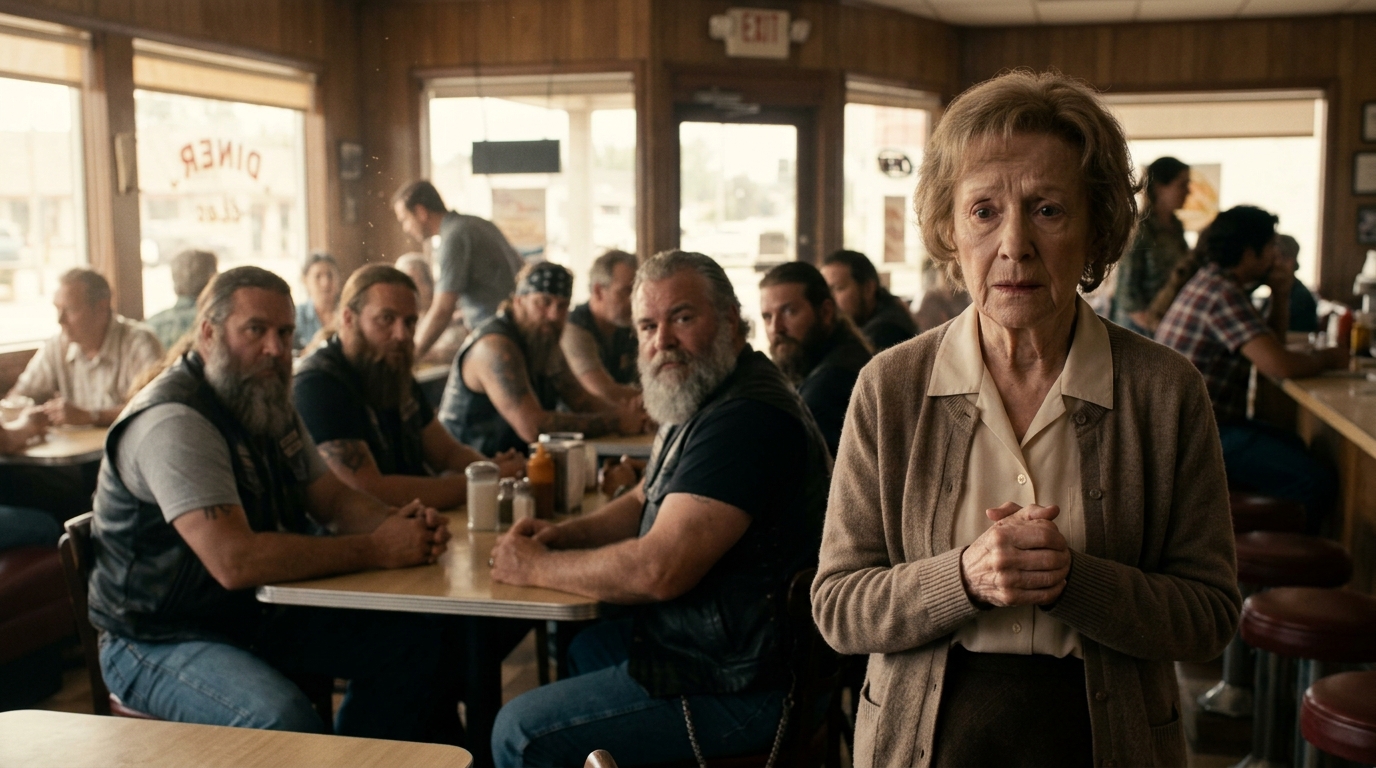
They were halfway through breakfast when the diner door opened and the cold came in with her.
Margaret stood just inside the entrance.
Small.
Delicate.
Dressed in an old beige coat buttoned unevenly at the front.
Her silver hair was pinned back, but loose strands clung to her temples from the damp wind outside. She clutched a worn leather purse against her chest, and her shoes looked too thin for the weather.
At first, no one noticed her.
Then she spoke.
“Please… I need your help.”
Her voice trembled.
But it carried.
The diner went quiet.
Not gradually.
All at once.
Forks paused.
A man at the counter stopped stirring sugar into his coffee.
Ruth turned from the register.
Every head shifted toward Margaret.
She swallowed hard, as if the silence had nearly frightened her back out the door. But she did not run.
Her gaze moved across the diner and stopped at the bikers’ table.
Bear did not move.
Neither did the others.
They only watched.
Not cruelly.
Not mockingly.
Carefully.
Bear set his coffee cup down.
“What kind of help?”
His voice was low.
Calm.
The kind of calm that made a room trust it before it understood why.
Margaret took one step closer.
Her hand quivered around the strap of her purse.
“I know this sounds strange.”
Tank leaned back slightly.
“Ma’am, strange walked in here years ago and never left.”
A few people might have laughed on another day.
No one did now.
Margaret looked at Bear.
“Would you pretend to be my son… just for today?”
The silence that followed was harder than the first.
It pressed against the windows.
Even the jukebox seemed too loud now.
Bear did not answer immediately.
He studied her face.
The watery eyes.
The trembling mouth.
The careful posture of someone trying not to look terrified.
He had seen that posture before.
In women outside courtrooms.
In kids at shelters.
In old men signing papers they did not understand.
People trying to stay polite while fear tightened around their ribs.
“Why?” he asked.
Margaret’s eyes dropped.
“My son is gone.”
Something flickered across Bear’s face.
Margaret continued.
“He died four years ago. Since then, my nephew has been helping with my accounts.”
Ruth, still behind the counter, muttered, “That never ends well.”
Margaret’s voice broke.
“He says I’m confused. He says I can’t live alone anymore. He brought papers this morning. If I sign them, he gets my house, my bank account, everything. He said if I refuse, he’ll have me declared incompetent by Friday.”
Bear’s jaw tightened.
“Why come here?”
Margaret looked toward the window.
“Because he thinks I’m alone.”
The words landed softly, but everyone felt them.
She looked back at Bear.
“I only need someone to stand beside me while I speak to Mr. Lawson, my attorney. Someone he won’t bully. Someone who can say he’s family.”
Little Joe frowned.
“You want us to lie to a lawyer?”
Margaret shook her head quickly.
“No. Not lie. Just… pretend long enough for me to be heard.”
Tears gathered in her eyes.
“I am not confused. I am not helpless. But when I say no, nobody hears an old woman. They only hear a problem waiting to be managed.”
Bear looked at the table.
No one spoke.
Then the diner door burst open.
Cold white light spilled across the floor.
“There you are.”
The voice was sharp.
Confident.
Too confident.
A man stepped inside.
Clean coat.
Polished shoes.
Dark hair carefully styled.
A phone in one hand, leather folder in the other.
He smiled as though he owned the room, or at least believed money could rent it for the next five minutes.
“Margaret,” he said. “You scared me.”
She flinched.
Bear saw it.
So did every biker at the table.
The man moved farther into the diner, his smile widening for the audience.
“My aunt has been confused lately,” he announced. “I apologize if she disturbed anyone.”
Margaret whispered, “I didn’t disturb anyone.”
The man ignored her.
“I’ll take you home now.”
He reached for her arm.
Bear stood.
Slowly.
He did not slam the table.
Did not raise his voice.
He simply rose, and somehow the room rearranged itself around him.
Tank stood next.
Then Crow.
Then Bishop.
Then Little Joe and Mason.
Chairs scraped.
Boots shifted.
No one lunged.
No one threatened.
But the space between Margaret and the man suddenly had walls made of leather and silence.
Bear looked at him.
“You looking for our mother?”
The man stopped.
His smile faltered.
Only for a second.
But it was enough.
Margaret looked up at Bear, shock spreading across her face.
“What did you say?” the man asked.
Bear stepped forward.
“I asked if you were looking for our mother.”
The man gave a short laugh.
“Your mother?”
Bear nodded toward Margaret.
“That’s what I said.”
The diner held its breath.
The man’s confidence did not disappear completely.
But something underneath it shifted.
A crack.
A calculation.
He looked at Margaret, then at the bikers, then at the phones now rising quietly around the room.
“This is ridiculous,” he said.
Bear’s voice stayed calm.
“No. Ridiculous is chasing an old woman into a diner with papers she doesn’t want to sign.”
The man’s eyes hardened.
“You have no idea what this is about.”
Bear glanced at the folder.
“Then explain it.”
The man smiled again, but it came too late.
“My aunt is unwell.”
Margaret whispered, “I am not.”
Bear’s eyes never left him.
“She said no.”
The man leaned closer.
His voice lowered.
“You don’t know who I am.”
Tank stepped beside Bear.
“That’s usually the first thing men say when they’re about to become less important.”
A few people in the diner murmured.
The man’s face flushed.
“My name is Preston Vale. I’m her legal next of kin.”
Margaret lifted her chin.
“No, you are not.”
Preston turned toward her.
The mask slipped.
“Don’t start.”
Bear saw it then.
The real man.
Not the concerned nephew.
Not the polished helper.
The man underneath.
The one Margaret had been running from.
Bear reached for the empty chair beside him and pulled it back.
“Margaret,” he said gently, “sit with your sons.”
For one suspended second, she only stared.
Then she walked to the bikers’ table.
And sat down beside Bear.
The Papers He Wanted Signed
Preston did not like losing control.
That was obvious immediately.
He stood in the middle of the diner, gripping the leather folder as if it contained not documents, but the version of reality he preferred.
Margaret sat at the corner table, hands folded tightly in her lap.
Bear took the chair beside her.
The others stood around them in loose formation, not blocking Preston exactly, but making clear that any path to Margaret would now require permission.
Ruth came over with a fresh cup of coffee and set it in front of Margaret.
“Cream?”
Margaret blinked, startled by kindness.
“Yes, please.”
Ruth poured.
Then turned to Preston.
“You buying anything?”
He stared.
“What?”
“This is a diner. You either sit and order or stop dripping arrogance on my floor.”
Someone at the counter coughed to hide a laugh.
Preston’s jaw clenched.
“I’m here to collect my aunt.”
Bear’s gaze sharpened.
“She’s not luggage.”
Preston drew a breath, forcing calm back into his face.
“Gentlemen, this is a family matter. My aunt has dementia symptoms. She wanders. She forgets. She becomes paranoid. I have medical concerns.”
Margaret whispered, “I have arthritis.”
Preston ignored her.
“She has been targeted before. I’m sure you understand why a woman her age should not be making financial decisions while confused.”
Bear looked at Margaret.
“Are you confused?”
She straightened.
“No.”
“What day is it?”
“Tuesday.”
“Where are you?”
“Ruth’s Diner, off Route 19.”
“Who is he?”
“My late sister’s son. Preston Vale.”
Bear nodded.
“Sounds pretty clear.”
Preston’s smile tightened.
“That proves nothing.”
Margaret reached into her purse and pulled out a folded appointment card.
“I called my attorney myself. Mr. Lawson said if I came by before noon, he would review everything.”
Preston stepped forward.
“You are not going anywhere.”
The room changed.
Not loudly.
But all at once.
Bear stood again.
Preston stopped.
Margaret’s voice shook, but she kept speaking.
“He brought papers at breakfast. He said if I didn’t sign, he would tell the court I left the stove on and forgot my own address.”
Ruth folded her arms.
“Did you leave the stove on?”
Margaret looked down.
“No. He turned the knob after I made tea. Then he took a picture.”
A low sound moved through the bikers.
Not words.
Something darker.
Preston snapped, “That is completely false.”
Margaret looked up at him.
“You said nobody would believe me.”
The diner fell silent.
A woman in the booth near the window lowered her phone slightly, eyes wide.
Preston’s face hardened.
“You are embarrassing yourself.”
Bear leaned closer.
“No. You are.”
Preston looked around.
Perhaps he finally understood that the room was no longer his stage.
So he changed tactics.
He softened.
“Aunt Margaret,” he said, voice suddenly gentle, “you’re tired. You haven’t been yourself since Daniel died. I know you miss him. I miss him too.”
Margaret flinched at the name.
Her son.
Daniel.
Bear noticed.
Preston continued, “This is exactly what we talked about. You get scared, you invent enemies, and then you run to strangers.”
Margaret’s lips trembled.
For a moment, she looked small again.
That was how men like Preston won.
They did not only threaten.
They used the names of the dead like tools.
Bear placed one scarred hand on the table.
“Daniel was your son?”
Margaret nodded.
“He rode?”
Her eyes lifted.
“He did.”
“What club?”
She looked confused.
“No club. Not officially. He used to ride alone. But he helped bikers sometimes. Fixed engines. Bought meals when he could.”
Bear went very still.
“What was his last name?”
“Whitaker.”
Tank looked sharply at Bear.
Margaret added softly, “Daniel Whitaker.”
The table changed.
Every biker looked at Bear.
Preston noticed.
“What?”
Bear sat down slowly.
His voice came out different.
Lower.
Heavier.
“Your son had a blue Triumph?”
Margaret’s eyes widened.
“Yes.”
“Wore an old denim vest with a stitched red star inside the collar?”
She covered her mouth.
“How do you know that?”
Bear looked away for a moment.
When he looked back, his eyes were wet.
“Because your boy saved my life.”
Margaret stopped breathing.
The whole diner seemed to lean closer.
Bear’s voice softened.
“Five years ago. Rainstorm outside Amarillo. My bike went down under a logging truck. Daniel pulled me out before the gas caught. Stayed with me until the ambulance came.”
Margaret’s hand shook against the coffee cup.
“He never told me.”
Bear smiled sadly.
“He wasn’t the kind who would.”
Tank spoke quietly.
“He fixed three of our bikes that same weekend and refused payment.”
Crow nodded.
“He gave Little Joe his gloves because Joe lost his in the storm.”
Little Joe swallowed hard.
“Still have them.”
Margaret’s eyes filled.
Bear looked at Preston.
“So when I say she’s our mother, I’m not pretending.”
Preston’s face had gone pale.
Bear stood again.
“Her son was our brother.”
The Lawyer Waiting Downtown
Preston tried to leave then.
Not dramatically.
Just a slight backward step toward the door.
Bishop moved first, placing himself near the entrance with a calmness that made the movement feel accidental.
Ruth lifted the diner phone.
“You want me to call Sheriff Dale or Mr. Lawson first?”
Preston snapped, “You people have no authority to detain me.”
Bear shook his head.
“No one’s detaining you. Door’s right there.”
Bishop stepped aside, smiling faintly.
“But we are taking Margaret to her lawyer.”
Preston pointed at Margaret.
“She is under my care.”
Margaret stood.
“No.”
It was one word.
Small.
But it carried.
Preston turned toward her.
“Aunt Margaret—”
“No,” she said again.
This time stronger.
“I asked you for help after Daniel died. You answered by taking my checkbook. You said it was easier. Then you moved my statements to your address. Then you told me bills were higher than they were. Then my savings disappeared.”
Preston’s face sharpened.
“Careful.”
Margaret clutched her purse.
“I was careful for four years. I was quiet. I was grateful. I let you talk over me because I thought family meant patience.”
She looked at Bear.
“Then this morning, he told me Daniel would be ashamed of me.”
Bear’s jaw tightened.
Preston said, “This is emotional manipulation.”
Margaret looked back at him.
“Yes. It is. But not from me.”
No one spoke for a second.
Then Ruth said, “Well, damn.”
The whole diner exhaled.
Bear gently touched Margaret’s elbow.
“Ready?”
She nodded.
The bikers did not surround her like guards.
They walked with her like sons.
Bear on one side.
Tank on the other.
Ruth handed Margaret a napkin-wrapped biscuit for the road.
“You look like you forgot breakfast.”
Margaret took it with both hands.
“Thank you.”
Ruth looked at Preston.
“You want one too?”
He glared.
“No.”
“Shame,” she said. “You look like you could use something decent in you.”
Outside, the bikes waited in a line beside Margaret’s old sedan.
The cold wind moved across the parking lot.
Margaret looked at the motorcycles.
“Oh.”
Bear smiled.
“You don’t have to ride. We’ll follow your car.”
She touched the hood of her sedan.
“My Daniel loved motorcycles.”
“I know.”
“He said men who ride together don’t leave each other behind.”
Bear’s face changed.
“He was right.”
Preston stood near his own car, phone pressed to his ear, speaking rapidly.
Bear ignored him.
They drove downtown in formation.
Margaret’s sedan in the center.
Bikers front and back.
By the time they reached Lawson & Pierce Legal Services, three sheriff’s vehicles were already parked outside.
Mr. Lawson waited at the door.
He was an older man with a bow tie, worried eyes, and a folder in his hand.
He hurried to Margaret.
“Thank God. I was about to call again.”
Margaret blinked.
“Again?”
He looked at Bear, then back at her.
“Your nephew called claiming you were missing and unstable. But Daniel left instructions with me years ago. If any relative attempted to declare you incompetent, I was to verify directly with you before accepting any filing.”
Margaret’s breath caught.
“Daniel did that?”
Lawson’s eyes softened.
“He loved you very much.”
Preston arrived seconds later, angry and pale.
“Mr. Lawson, I demand—”
The sheriff stepped out of his vehicle.
“Preston.”
Preston stopped.
“Sheriff Dale.”
The sheriff nodded toward the folder in Preston’s hand.
“Those the papers?”
Preston’s expression changed.
“I don’t know what you’ve been told.”
Lawson opened his own file.
“I’ve been told enough to review Margaret’s accounts.”
Preston swallowed.
Margaret stood between Bear and Tank, not hiding now.
Lawson continued.
“Margaret, I need to ask you plainly. Did you authorize your nephew to transfer funds from your savings into Vale Property Holdings?”
She shook her head.
“No.”
“Did you authorize him to list your house for private sale?”
Her hand flew to her mouth.
“No.”
“Did you authorize him to file a preliminary petition for emergency guardianship?”
Tears filled her eyes.
“No.”
The sheriff looked at Preston.
Preston took one step back.
Bear spoke quietly.
“Running won’t make you look innocent.”
Preston glared at him.
“You people have no idea who you’re interfering with.”
The sheriff sighed.
“Preston, you keep saying that like it improves your situation.”
The Son Who Planned Ahead
Inside the law office, Margaret sat at a conference table while Mr. Lawson spread documents before her.
Bear remained by the door.
Not hovering.
Not intruding.
Just there.
Preston waited in another room with the sheriff and a deputy. His attorney had been called, though his confidence seemed to shrink with every passing minute.
Lawson slid a sealed envelope across the table.
“Daniel left this with me two months before his accident.”
Margaret stared at it.
Her son’s handwriting was on the front.
Mom, if Preston ever makes you doubt yourself.
Her hand trembled.
“I don’t know if I can.”
Bear stepped forward.
“You don’t have to read it alone.”
She looked up at him.
The big biker.
The stranger.
The son who was not pretending anymore.
She nodded.
Bear sat beside her.
Margaret opened the envelope.
The letter was short.
Mom,
If you are reading this, I was right to be worried.
Preston has been asking too many questions about the house, the insurance, and your accounts. I don’t trust him.
I know you hate conflict. I know you want to believe family will do the right thing if you love them enough.
But some people see kindness as a door they can walk through with muddy boots.
If he tries to take control, go to Mr. Lawson.
If you are scared, find riders.
I mean that.
I helped some men once. Good men. Rough around the edges, but good. One of them was called Bear. If you ever meet him, trust him.
Tell him Daniel says he still owes me a cup of coffee.
Love,
Your son
Margaret began to sob.
Bear covered his face with one hand.
Tank looked out the window.
Even Mr. Lawson removed his glasses and wiped his eyes.
“He knew,” Margaret whispered.
Lawson nodded.
“He suspected. He tried to prepare protections, but after the accident…”
His voice trailed off.
Daniel’s accident had been ruled mechanical failure.
A brake issue on a mountain road.
Bear looked up slowly.
“What kind of mechanical failure?”
Lawson hesitated.
“Brake line damage.”
The bikers exchanged glances.
Bear’s voice dropped.
“Damage or wear?”
Lawson’s face tightened.
“The report said wear.”
Bear stood.
“Daniel fixed engines for fun. He wouldn’t ride with worn brake lines.”
Margaret looked at him, fear dawning.
“What are you saying?”
Bear did not answer quickly.
He did not want to put a nightmare in her hands without proof.
But the room had already changed.
The old story was no longer stable.
Lawson opened another folder.
“Daniel asked me to hold copies of some documents. He said if anything happened to him, I should give them to Margaret if Preston ever moved against her.”
He laid out bank records, photographs, and a small flash drive.
“There are notes here about Preston’s debts. Private loans. Failed real estate speculation. A rejected offer to purchase Margaret’s property through a shell company.”
Bear looked at the shell company name.
Vale Property Holdings.
The same company that had received Margaret’s transferred funds.
Daniel had known Preston was circling.
Then Daniel died.
And Preston became helpful.
Bear’s hands curled into fists at his sides.
Margaret whispered, “My son didn’t crash?”
Lawson’s voice was gentle.
“We don’t know that.”
Bear looked at the sheriff through the glass wall.
“But we can find out.”
The investigation began that afternoon.
Preston’s financial accounts were subpoenaed.
Margaret’s emergency guardianship petition was frozen.
The sale of her house was blocked.
Her funds were protected.
And Daniel Whitaker’s accident report was reopened.
The bikers stayed in town.
All six of them.
They rented rooms at the roadside motel, parked their bikes outside Margaret’s house, fixed her porch railing, replaced her mailbox, and took turns driving her to appointments.
At first, Margaret tried to refuse.
“I can’t ask this of you.”
Bear tightened a screw on her porch step.
“You didn’t.”
Tank carried groceries into her kitchen.
“Daniel did.”
Little Joe brought flowers for the table because he remembered Daniel saying his mother liked yellow ones.
Mason repaired the old heater.
Crow installed security cameras.
Bishop made terrible coffee and insisted it was an acquired taste.
For the first time in four years, Margaret’s house sounded alive.
Not loud.
Alive.
Our Mother
Preston was arrested three weeks later.
Not for Daniel’s death.
Not yet.
The investigators needed more.
But he was charged with financial exploitation, fraud, coercion, and attempting to obtain guardianship under false claims.
The evidence was overwhelming.
Bank transfers.
Forged signatures.
Real estate filings.
A staged stove incident captured by a neighbor’s camera.
Messages to a private evaluator asking how quickly an elderly woman could be declared incompetent if she was “emotionally unstable.”
When deputies escorted him from his office, Preston shouted that Margaret was confused and being manipulated by criminals.
The local paper printed a photograph of Bear standing beside Margaret outside the courthouse.
The headline read:
Bikers Help Elderly Woman Stop Alleged Guardianship Scheme
Margaret hated the attention.
Bear hated it more.
Ruth framed the article and hung it behind the diner counter anyway.
“History,” she said.
Bear grumbled.
“Propaganda.”
She pointed at him with a coffee pot.
“Sit down before I write a bigger headline.”
The investigation into Daniel’s accident took longer.
Six months.
Then nine.
A retired mechanic from two counties over came forward after seeing the news. Preston had brought him a motorcycle shortly after Daniel’s death, asking if brake line damage could be made to look like road wear. The mechanic refused. Preston paid cash and left.
That statement opened the door.
Forensic review of old photos found tool marks inconsistent with ordinary wear.
A witness remembered seeing Preston near Daniel’s garage the night before the crash.
Preston denied everything.
But men like Preston often leave trails while convincing themselves they are smarter than grief.
He had searched online for motorcycle brake failure days before the accident.
He had increased pressure on Margaret’s accounts within two weeks after Daniel died.
He had paid down a private debt one month later.
The murder charge came almost a year after Margaret walked into Ruth’s Diner.
When she heard, she sat at her kitchen table with Bear beside her and did not speak for a long time.
Then she said, “I knew grief was heavy.”
Bear waited.
“I didn’t know truth could be heavier.”
He nodded.
“It can be.”
“What do I do with it?”
He looked toward the framed photo of Daniel on the shelf.
“You let other people help carry it.”
Preston’s trial was brutal.
Margaret testified.
So did Mr. Lawson.
So did Bear.
When Bear took the stand, the prosecutor asked how he knew Daniel.
Bear told the story of the storm outside Amarillo.
The bike down.
The gasoline.
Daniel pulling him from the wreck.
Daniel refusing money.
Daniel joking that if Bear ever wanted to repay him, he should buy his mother coffee someday because she worried too much and slept too little.
In the courtroom, Margaret covered her mouth and wept.
The prosecutor asked, “Did you consider Daniel Whitaker family?”
Bear looked at Margaret.
“Yes.”
“Why?”
Bear’s answer was simple.
“Because family is who comes back for you.”
Preston was convicted.
Not only for stealing from Margaret.
For Daniel.
The sentence did not bring Daniel back.
No sentence could.
But it gave Margaret something she had been denied for four years.
The right shape of the truth.
After the trial, the bikers escorted Margaret back to Ruth’s Diner.
The place was packed.
Not with curiosity.
With people who had been waiting to stand with her.
Ruth had reserved the corner table.
Daniel’s photograph sat in the center beside a cup of coffee.
Bear paid for it.
“He said I owed him one,” he told Margaret.
She smiled through tears.
Then Ruth brought out a pie with candles stuck unevenly into the crust.
Margaret blinked.
“What is this?”
Ruth shrugged.
“Your birthday was last month. You were busy getting justice.”
The whole diner laughed gently.
Margaret looked around.
At Bear.
Tank.
Crow.
Bishop.
Little Joe.
Mason.
Ruth.
The sheriff.
Mr. Lawson.
People who had not been family by blood but had shown up when blood betrayed her.
Bear raised his coffee.
“To Daniel.”
Everyone lifted their cups.
Margaret whispered, “To my son.”
Bear looked at her.
“Our brother.”
The diner answered as one.
“Our brother.”
Years later, people still told the story of the elderly woman who walked into a biker diner and asked six rough men to pretend to be her sons.
They loved the scene.
The silence.
The nephew bursting through the door.
Bear standing and saying, “You looking for our mother?”
The way the whole diner shifted.
The way power changed hands without a single punch thrown.
But Margaret remembered something smaller.
The chair Bear pulled out for her.
Ruth asking if she wanted cream.
The first time someone said Daniel’s name without using it as a weapon.
The biscuit wrapped in a napkin.
The coffee cup placed beside her son’s photograph.
She kept that cup in her kitchen cabinet.
Never used it.
Just kept it.
On Sundays, the bikers still came by sometimes.
Not all at once.
That would have overwhelmed the neighbors, and Ruth said six motorcycles before church let out was “socially aggressive.”
But one or two would visit.
Bear repaired things that did not need repairing.
Tank pretended he liked her lemon cookies.
Little Joe brought yellow flowers.
Mason cleaned the gutters badly until Margaret made him climb down and let a professional do it.
She called them boys.
They pretended to hate it.
They did not.
On the anniversary of Daniel’s death, they rode to the cemetery together.
Margaret stood before her son’s grave with Bear beside her.
For a long while, neither spoke.
Then she said, “I asked you to pretend.”
Bear looked down.
“No, ma’am.”
She turned to him.
He smiled faintly.
“You asked the wrong question.”
“What should I have asked?”
He looked at Daniel’s name carved into stone.
“Will you remember my son with me?”
Margaret’s eyes filled.
“And would you have?”
Bear’s voice softened.
“Every time.”
The wind moved through the cemetery grass.
Somewhere beyond the hill, motorcycles waited in a quiet line.
Margaret reached for Bear’s hand.
He took it gently.
Her hand was small in his.
But steady now.
Not because grief had ended.
Not because truth had fixed everything.
Because she was no longer standing alone inside it.
That day in the diner, she had asked for borrowed sons.
What she found was something older and stronger than pretending.
A promise Daniel had left on the road years before.
A debt paid in coffee, courage, and the kind of family that does not need blood to recognize a mother when she walks through the door asking for help.