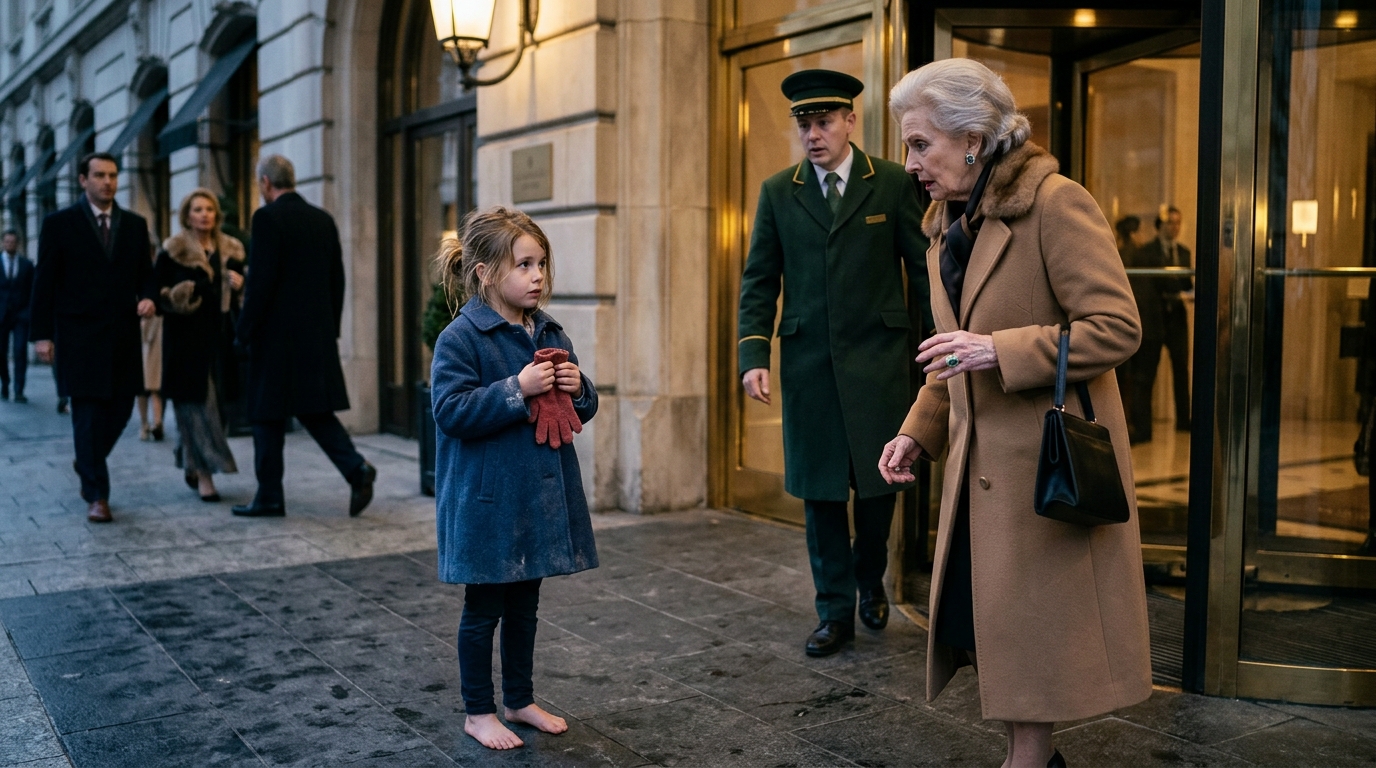
The Glove at the Grand Hotel Door
The glove was so small it looked like it belonged to a child who had lost more than winter.
It was pale gray wool, frayed at the fingertips, damp from the street, and clutched to a little girl’s chest as if it were the only warm thing left in the world. She stood barefoot on the stone steps outside The Westbridge Grand, shivering beneath the gold glow of the hotel entrance while guests swept past in silk scarves, polished shoes, and perfumes expensive enough to make poverty feel like an insult.
I noticed her before anyone else did.
That was my job.
My name is Samuel Reid, and for twenty-seven years, I opened doors for people who believed doors existed to obey them. Politicians, film stars, bankers, widows with diamonds at their throats, men who smiled at charity galas and ruined lives before breakfast. The Westbridge Grand trained its staff to see everything and react to almost nothing.
But that little girl was impossible not to see.
She was maybe eight years old. Thin. Dark-haired. Wearing a coat too large for her shoulders and no shoes at all. Her toes were red from the cold. Her cheeks were streaked with old tears and city grime. She wasn’t begging. She wasn’t crying.
She was waiting.
The guests did what guests do.
They looked once.
Then away.
A woman in a silver gown pulled her fur wrap tighter, as if the child’s need might stain it. A young man laughed into his phone and stepped around her. A businessman frowned at me, silently asking why this inconvenience had not already been removed from the scenery.
I stepped forward.
“Sweetheart,” I said gently, “are you lost?”
The girl looked up at me.
Her eyes were too old.
“I need to see the woman with the blue ring.”
My hand paused on the brass door handle.
At The Westbridge, there was only one woman people described that way.
Mrs. Eleanor Westbridge.
Hotel owner. Society matriarch. Widow of a shipping magnate. Mother of the late Caroline Westbridge, whose death had haunted the building for nearly a decade.
Eleanor’s sapphire ring was famous. Not because it was the largest jewel in the city, though it might have been. Because it had belonged to her daughter. After Caroline died, Eleanor wore it every day like grief made visible.
“You know Mrs. Westbridge?” I asked.
The girl shook her head.
“My mom did.”
Something in her voice made me look more closely at the glove.
It was old. Not just worn by use, but old in the way objects become when they have crossed years in hidden places. The wool had faded unevenly. A tiny pearl button hung by a thread at the wrist.
Before I could ask another question, the glass doors opened behind me.
Warm air rushed out.
So did Eleanor Westbridge.
She moved like the hotel still belonged to her bones. Cream wool coat. Perfect silver hair. Black leather handbag. The sapphire ring on her right hand caught the chandelier light and broke it into blue fire.
The girl saw the ring.
Her whole body went still.
Not admiration.
Recognition.
She took one step toward Eleanor.
“My mom,” she whispered.
Eleanor looked down with mild annoyance at first, the way wealthy people look at children they expect to be asking for coins.
Then the girl lifted the glove.
Slowly.
Carefully.
She pointed from the glove to the ring.
“She had this.”
The night changed.
I felt it before I understood it.
Eleanor’s face emptied.
All the polish vanished from it. The practiced softness. The public sorrow. The elegant impatience. For one second, she was not a matriarch at the entrance of her hotel.
She was a woman seeing a ghost.
Her hand closed around her handbag so tightly the leather creaked.
“What did you say?”
The girl opened the glove with trembling fingers.
Inside the lining, where no one would look unless they had been told, was a name stitched in faded blue thread.
C. WESTBRIDGE.
My mouth went dry.
I had seen that stitching before.
Nine years earlier, I had stood beside the service entrance while a black hearse waited in the rain. There had been no body to bury after the mountain accident. Only personal effects. A burned coat. A scarf. A child-sized winter glove Caroline had kept from her own childhood, because the family said she was sentimental like that.
I remembered because I carried the box myself.
I remembered because Eleanor had watched me place it in the funeral car.
I remembered because she told me not to drop it.
Eleanor stared at the glove.
Then at the child.
Her hand began to tremble.
“That glove,” she whispered, “was buried with the coat.”
The girl’s eyes filled with tears.
“Then why did my mom give it to me?”
The doorman beside me, young Patrick from night shift, crossed himself.
A black car slowed at the curb.
Eleanor saw it and seemed to wake from the trance.
Her fear sharpened into action.
She grabbed the girl’s shoulder.
Not cruelly.
Desperately.
“Where is your mother?” she asked.
The girl flinched.
“She told me to come here if she didn’t wake up.”
Eleanor’s face collapsed.
Before I could speak, the black car stopped fully in front of the hotel.
The rear door opened.
Eleanor looked at me, and for the first time in twenty-seven years, Mrs. Westbridge did not give me an order.
She begged.
“Samuel,” she whispered, “do not let my son see that child.”
The Name Stitched Where No One Looks
I moved because fear tells the truth faster than money does.
“Inside,” I said to the girl.
She hesitated.
“My name is Emma.”
“Emma,” I said, keeping my voice low, “you need to come inside now.”
Eleanor looked toward the black car again.
A man stepped out.
Marcus Westbridge.
Eleanor’s only surviving child.
Caroline’s older brother.
He was tall, polished, and smiling before his feet even touched the curb. Men like Marcus learned early that a smile could be a lockpick. The public saw him as the hotel’s future. Staff saw something else.
We saw how quickly housekeepers became invisible around him.
We saw how lawyers arrived after midnight.
We saw how people who questioned his decisions were transferred, demoted, or quietly bought away.
Marcus looked toward the entrance.
His smile thinned when he saw his mother standing with me and the barefoot girl.
I opened the glass door and guided Emma into the lobby.
Warmth swallowed us.
The hotel smelled of lilies, lemon polish, and money. Guests moved beneath chandeliers, unaware that something ancient and ugly had just stepped out of the cold with bare feet and a glove.
Eleanor followed close behind.
“Samuel,” she said, “take her to the staff office.”
I looked at her.
“No.”
Her eyes flashed.
For a moment, the old Eleanor returned.
“Excuse me?”
“I’m not hiding a child in a staff office until you tell me what this is.”
Emma clutched the glove tighter.
Eleanor looked toward the entrance.
Marcus was coming inside.
His eyes were locked on Emma.
Then, softly, Eleanor said, “Room 614.”
I froze.
No guest had stayed in Room 614 for nine years.
Not officially.
It was Caroline’s room.
Not a hotel suite. Not anymore. The Westbridge family had kept private apartments on the sixth floor since the building opened in 1923. After Caroline’s death, Eleanor sealed her rooms exactly as they were. Staff were told never to enter. Not housekeeping. Not maintenance. Not security.
Only Eleanor had the key.
At least, that was what I thought.
Emma reached into her coat pocket and pulled out a brass key attached to a blue ribbon.
Eleanor’s face turned gray.
“Where did you get that?”
“Mom kept it under the floorboard,” Emma said. “She said if I ever found the hotel, I had to find the blue room.”
The blue room.
I had heard Caroline call it that once when she was seventeen. The year before she disappeared from public life. The year before the mountain accident.
She had come through the lobby barefoot after an argument with Marcus, laughing like a girl trying not to cry.
“Samuel,” she had said, “if anyone asks, I’m in the blue room pretending my family doesn’t exist.”
I had smiled then.
I had not known it was a warning.
Marcus entered the lobby.
“Mother,” he called. “Everything all right?”
Eleanor turned.
Her posture changed instantly.
Shoulders straight.
Chin lifted.
Grief returned to its proper place.
“Of course,” she said.
Marcus’s gaze slid to Emma.
“Who is this?”
“A lost child,” I said.
He looked at me.
That was a mistake on my part.
Doormen are not supposed to answer questions meant for owners.
His eyes cooled.
“Then why is she holding my sister’s glove?”
Emma stepped back behind me.
So he recognized it too.
Eleanor inhaled sharply.
Marcus smiled.
It was small.
Private.
A smile for people who understood too much.
“Mother,” he said quietly, “may I speak with you upstairs?”
“No.”
The word left Eleanor before she could soften it.
The lobby seemed to pause around us.
Marcus’s smile disappeared.
“Samuel,” he said, “call security.”
I did not move.
“Samuel,” he repeated.
I looked at Emma’s bare feet on the marble floor.
Then at the glove.
Then at Eleanor’s hand, where Caroline’s sapphire ring trembled under the lights.
“No, sir.”
Marcus stared at me as if furniture had spoken.
Eleanor’s eyes filled with something like gratitude.
Or guilt.
Maybe both.
Then Emma whispered, “He came to our apartment.”
Every face turned toward her.
Marcus did not move.
Emma looked at him.
“He came after Mom showed me the newspaper picture. She said if he found us, I had to run.”
Eleanor swayed slightly.
I caught her elbow.
Marcus laughed.
A soft, disgusted sound.
“This is absurd. Mother, she’s been coached.”
Emma opened the glove again.
This time, she pulled out a folded strip of paper tucked deep in the lining.
I had not seen it before.
Neither had Eleanor.
Emma handed it to me.
The paper was brittle and torn from something larger. On it were three words in a woman’s handwriting.
Ask Samuel Reid.
My name.
The lobby floor seemed to tilt beneath me.
Eleanor whispered, “Caroline.”
Marcus stepped forward.
I folded the paper into my palm.
He saw it.
“Give that to me.”
“No.”
His face changed.
Not anger yet.
Something colder.
A decision.
He looked past me toward the security desk and lifted two fingers.
The hotel guards began walking toward us.
Emma grabbed my coat.
Eleanor turned to me, voice shaking.
“Take her upstairs.”
Marcus moved faster.
“Do not take one step toward that elevator.”
For the first time in twenty-seven years, I broke every rule The Westbridge Grand had taught me.
I picked up the barefoot girl in my arms and ran.
The Room They Sealed After the Funeral
The service elevator was slow.
It had always been slow, groaning between floors like an old man being asked to carry one more secret. That night, with Emma in my arms and Marcus’s footsteps striking the marble behind us, it felt impossibly slow.
Eleanor was behind me.
For a woman in heels and a tailored coat, she moved with surprising speed.
“Hold the door,” she gasped.
I jammed one hand against the elevator panel as she slipped inside.
The doors began to close.
Marcus reached us just in time.
His hand shot between the doors.
For one terrifying second, the elevator opened again.
He stood inches away.
Calm now.
Too calm.
“Mother,” he said. “Don’t embarrass yourself.”
Eleanor’s face was pale, but her voice held.
“You killed her.”
The words hit him.
Not visibly.
But enough.
His hand withdrew.
The doors closed.
The elevator rose.
Emma buried her face against my shoulder.
Eleanor leaned against the wall, breathing hard.
Neither of us spoke.
Because the sentence was still in the elevator with us.
You killed her.
At the sixth floor, Eleanor took the brass key from Emma with shaking fingers and led us down the private corridor. The hallway smelled of dust and old flowers. The carpet was deep blue. The portraits along the wall were family portraits, not hotel art.
Caroline was everywhere.
At six, holding a pony’s reins.
At twelve, standing beside Marcus with a forced smile.
At twenty-three, wearing the sapphire ring now on Eleanor’s hand.
Emma stared at the last portrait.
“That’s my mom.”
Eleanor made a sound like pain.
“She was,” Emma said, louder now. “That was my mom.”
I looked at Eleanor.
The old woman pressed one hand to the wall.
“I didn’t know,” she whispered.
I wanted to believe her.
I also wanted to remember that powerful people often survive by not knowing things on purpose.
Room 614 opened with a soft click.
The blue room waited behind it.
Nothing had been touched.
The curtains were drawn. A white dressing table sat beneath a mirror clouded with age. Books lined one wall. A blue velvet chair faced the window. On the bed lay a folded sweater, as if Caroline had stepped out for tea nine years earlier and might still return.
Emma slid from my arms.
She walked into the room slowly.
A child entering her mother’s ghost.
On the bedside table was a framed photograph turned face down.
Eleanor reached for it, then stopped.
Emma picked it up.
The photo showed Caroline standing in front of The Westbridge Grand, younger than in the portraits, hair loose, coat open over a plain white dress.
She was pregnant.
Very pregnant.
Emma looked at Eleanor.
“You said she was dead before me.”
Eleanor covered her mouth.
I stared at the picture.
The public story had been clear: Caroline Westbridge died in a mountain road accident nine years ago. No husband. No child. A tragic heiress lost too young.
But the photograph said otherwise.
Emma was eight.
The math screamed.
A noise came from the hallway.
Not footsteps.
A keycard beep.
Marcus had overridden the private lock.
Eleanor moved quickly to the wardrobe.
“Samuel, help me.”
We pushed it across the door just as the handle turned from outside.
Marcus struck the door once.
“Mother.”
Eleanor ignored him.
She went to the blue velvet chair and pulled at the seam beneath the cushion.
The fabric tore open.
Inside was a packet wrapped in oilcloth.
She pulled it out with trembling hands.
“I looked for this after the funeral,” she whispered. “He said she must have burned everything before she left.”
“Before she died,” I corrected.
Eleanor did not look at me.
“No,” she said. “Before she left.”
That was when I understood.
The accident had not killed Caroline.
It had explained her disappearance.
Eleanor opened the packet.
Inside were letters.
A birth certificate.
A hospital bracelet.
And a small digital recorder.
The birth certificate listed the mother as Caroline Rose Westbridge.
The child as Emma Caroline Hale.
No father named.
Eleanor touched the paper like it might cut her.
“My granddaughter,” she whispered.
Emma stood very still.
In the hallway, Marcus’s voice hardened.
“Open the door, or I will have security break it down.”
Eleanor picked up the recorder.
Her hands shook so badly she could barely press play.
Caroline’s voice filled the room.
Thin.
Breathless.
Terrified.
“If anyone finds this, Marcus knows. He knows about Emma. He knows I refused to sign the transfer. He said if I didn’t disappear, he would make sure my daughter did. Mother, if you’re listening, I tried to tell you, but you chose him every time.”
Eleanor staggered back.
The door shook under another blow.
Caroline’s voice continued.
“Samuel Reid is the only one at the hotel who was kind to me when I was a girl. If Emma ever comes to the door, trust him before you trust blood.”
Emma looked at me.
I could not speak.
The door cracked.
Marcus’s voice came through the wood.
“Last warning.”
Then the recorder clicked.
Caroline whispered one final sentence.
“The glove is proof. The grave is empty.”
The Ring That Paid for Silence
Eleanor sat down on the edge of the bed as if her legs had forgotten their purpose.
“The grave is empty,” she repeated.
The words did not sound like a discovery.
They sounded like punishment.
I turned toward the window.
Six floors below, police lights were not there.
No rescue.
No consequence.
Only traffic sliding past the hotel entrance and guests under umbrellas, still believing luxury meant safety.
Marcus struck the door again.
The wardrobe shifted.
Emma ran to me.
I placed her behind the bed.
Eleanor looked at the sapphire ring on her hand.
Caroline’s ring.
“Why are you wearing it?” I asked.
She stared at me.
It was a cruel question.
It was also the right one.
Her eyes filled.
“Marcus gave it to me after the funeral. He said Caroline had left it in the coat pocket.”
Emma whispered, “My mom had a picture of it.”
Eleanor looked at her.
“She said a man took it,” Emma continued. “The night we ran. She said he took it because Grandma would believe the ring before she believed her.”
The old woman closed her eyes.
That was exactly what had happened.
The ring had been a message, and Marcus had rewritten it into proof of death.
Another blow hit the door.
The wardrobe scraped backward.
I grabbed the fireplace poker from the hearth.
It felt ridiculous in my hand.
Too small for what was coming.
Then Eleanor stood.
Something had changed in her.
Not courage, exactly.
Courage is often noble in stories.
This was uglier.
Guilt finally finding a task.
She removed the sapphire ring and placed it in Emma’s palm.
“This belonged to your mother,” she said.
Emma stared at it.
“I don’t want it.”
Eleanor flinched.
“I understand.”
“No,” Emma said, closing Eleanor’s fingers back around it. “You have to tell them where you got it.”
The old woman’s face crumpled.
A child had done what decades of power could not.
She had made the truth simple.
The door burst inward.
The wardrobe tipped.
Marcus entered first, two security men behind him.
His eyes went to the oilcloth packet.
Then to the recorder.
Then to the ring in Eleanor’s hand.
For one second, he looked less like a hotel heir and more like a cornered animal.
“Give me everything,” he said.
I raised the poker.
The security men looked almost embarrassed for me.
Marcus laughed softly.
“Samuel, don’t be stupid.”
Eleanor stepped between him and Emma.
“Did you kill Caroline?”
Marcus’s face hardened.
“She was alive when I left her.”
That answer told us enough.
Eleanor gasped.
Marcus’s voice sharpened.
“She was going to destroy us. She wanted to give half the voting shares to a child whose father she wouldn’t even name. She wanted to turn the hotel into some shelter for women and children, as if Grandfather built this place for runaways.”
Emma’s grip tightened around my coat.
I felt her shaking.
Marcus pointed at her.
“That child was supposed to stay gone.”
Eleanor slapped him.
The sound cracked through the room.
He turned back slowly.
For a moment, I thought he might strike his mother.
Instead, he smiled.
“You always were sentimental after the damage was done.”
Then he nodded to the guards.
“Take the girl.”
I swung the poker.
Not well.
Not cleanly.
But hard enough to catch the first man across the shoulder. He cursed and stumbled into the dressing table. The mirror shattered. Emma screamed.
The second guard lunged toward me.
Eleanor grabbed the oilcloth packet and threw it toward the open window.
“No!” Marcus shouted.
It was the first uncontrolled sound he had made.
The packet hit the window frame and burst open. Papers scattered, caught by cold air, flying out into the night like pale birds.
Not all of them.
But enough.
Birth certificate copies.
Letters.
Photos.
They drifted down toward the hotel entrance.
Toward guests.
Toward cameras.
Toward the city.
Marcus shoved past his mother.
I stepped into him.
We hit the floor together.
He was younger than me, stronger than me, but rage makes men sloppy. I had spent twenty-seven years lifting luggage, standing in winter, and holding doors against wind. My hands knew weight. My body knew stubbornness.
We rolled into the bedframe.
The recorder skidded across the floor.
Emma grabbed it.
Marcus saw her.
His face changed.
He reached for her.
Eleanor picked up the broken mirror frame and struck him across the back with all the strength guilt had left her.
Marcus collapsed to one knee.
Sirens sounded below.
Not distant.
Close.
Emma had the recorder in both hands.
I did not know when she had pressed it.
But Caroline’s voice was playing again, louder now through the room.
“The glove is proof. The grave is empty.”
In the doorway, Patrick from night shift appeared with two police officers behind him.
His face was white.
“I called them,” he said.
Marcus looked up from the floor.
His mouth was bleeding.
His empire had not fallen yet.
But for the first time, I saw the foundation crack.
An officer stepped forward.
“Marcus Westbridge, keep your hands where we can see them.”
Marcus laughed.
“You have no idea who I am.”
Eleanor stood above him, the sapphire ring closed in her fist.
“Yes,” she said, voice breaking. “We finally do.”
The Girl Who Came Back From the Cold
The grave was opened three days later.
By then, the story had reached every screen in the city.
Guests outside The Westbridge Grand had filmed the papers falling from the sixth-floor window. One woman picked up Caroline’s birth certificate before hotel security could take it. A journalist staying in suite 302 recorded Marcus being led through the lobby in handcuffs.
And Emma’s glove became the image no one could stop looking at.
Tiny.
Gray.
Worn nearly through.
A child’s object that had outlived a family lie.
The grave sat in the Westbridge private cemetery, behind iron gates and winter-dead hedges. For nine years, Eleanor had visited it every Sunday. She had laid white roses over a coffin that held a coat, one glove, and the story her son needed her to believe.
When the coffin was opened, Caroline was not inside.
Neither was the coat.
That was the second lie.
The buried box was nearly empty.
Inside was a hotel towel, ash, and a small bundle of burned fabric chosen to look like evidence from a crash.
Eleanor fainted when she saw it.
Emma did not cry.
She stood beside me in borrowed shoes, holding the glove with both hands.
“What does it mean?” she asked.
I looked at the empty coffin.
“It means your mother tried to come back.”
The investigation found the rest slowly.
Truth rarely arrives whole. It comes in ugly pieces.
Caroline had refused to sign over her voting shares to Marcus. She had become pregnant, hidden the pregnancy, and planned to leave the Westbridge family before Emma was born. Marcus discovered it. He staged a mountain accident, used the family’s influence to suppress questions, and forced Caroline into hiding by threatening the baby.
For years, Caroline lived under the name Mara Hale.
She cleaned offices.
Waited tables.
Moved cities whenever Marcus’s people came too close.
She kept the glove because it was the one thing from her childhood Marcus did not know she had taken back. She stitched her initials inside it again after Emma was born. She told her daughter that if anything ever happened, the glove would know where to go.
Three weeks before Emma arrived at the hotel, Caroline contacted Eleanor.
Not directly.
Through a lawyer.
She offered proof that she was alive and asked for protection for Emma.
The lawyer died in a hit-and-run two days later.
Caroline disappeared the next week.
Emma found her mother unconscious in their apartment and ran to a neighbor. By the time police arrived, Caroline was gone. The official report said overdose. No body was released to Emma. No proper records matched. The case had been moving toward silence until a barefoot child walked to The Westbridge Grand with a glove.
Marcus went to trial the following year.
The charges reached back across nearly a decade: conspiracy, fraud, kidnapping, obstruction, witness intimidation, evidence tampering, and murder connected to the death of Caroline’s lawyer. Prosecutors could not prove he personally killed Caroline.
Not yet.
That was the wound left open.
But they proved enough to take his freedom.
Eleanor testified against her own son.
She walked into court wearing no jewelry.
When the prosecutor asked why she had worn Caroline’s ring for nine years, Eleanor closed her eyes.
“Because I wanted grief more than truth,” she said.
It was the most honest thing I ever heard her say.
Emma sat in the front row beside a court-appointed guardian and held the gray glove in her lap. She did not look at Marcus when the sentence came down. Life in prison for the charges they could prove. More investigations pending for those they could not.
Afterward, the Westbridge empire changed because it had no choice.
The hotel board removed the family from direct control. Hidden accounts were opened. Settlement funds were created for staff who had been threatened into silence. Room 614 became evidence first, then a memorial, then something Eleanor insisted Caroline would have wanted.
A shelter for mothers and children fleeing powerful men.
Caroline’s name went above the door.
Not Westbridge.
Her chosen name.
Mara House.
Emma visited only once before she left the city with her foster guardian.
She walked through the lobby in warm boots, a red coat, and gloves that actually fit. Guests still stared, though for different reasons now. People had seen her face on the news, always blurred at first, then hidden entirely after the court ordered privacy.
She stopped at the entrance where I had first seen her.
The stone steps were warmer that day. Spring had begun pressing green through the planters.
Eleanor stood a few feet away, smaller than she had once seemed.
“I’m sorry,” she said to Emma.
Emma looked at her for a long time.
Children understand apologies differently than adults. Adults measure words. Children measure whether the world changes afterward.
Finally, Emma said, “Did you love her?”
Eleanor’s face broke.
“Yes.”
“Then why didn’t you believe her?”
The question had no soft answer.
Eleanor did not invent one.
“Because believing her would have cost me everything I thought I was.”
Emma nodded slightly, as if that made sense and changed nothing.
Then she opened her coat pocket and pulled out the old glove.
She held it out to Eleanor.
The old woman shook her head.
“No. That belongs with you.”
Emma looked down at it.
“My mom said it knew where to go.”
Then she placed it in Eleanor’s hands.
“It got me here. Now you keep it where people can see it.”
That afternoon, Eleanor had a small glass case installed in the lobby, near the entrance but not behind velvet ropes. Inside, beneath a simple brass plate, she placed the gray glove, Caroline’s ring, and a copy of the stitched name from the lining.
The plate did not mention wealth.
It did not mention legacy.
It did not mention tragedy.
It said only:
For every child who was told no one would believe them.
Months later, I still opened doors at The Westbridge Grand.
The guests still came with their diamonds, their silk scarves, their quiet scandals. The chandeliers still shone. The marble still reflected shoes more expensive than rent. Wealth did not vanish because one rich man went to prison.
But something had changed.
At least at the door.
Staff no longer looked away from children standing in the cold.
Eleanor came through the lobby less often now. When she did, she stopped at the glass case every time. Sometimes she stood there for only a few seconds. Sometimes longer. She never wore the sapphire ring again.
One winter evening, nearly a year after Emma first appeared, snow began falling over the city.
I was outside beneath the awning when a young mother carrying a sleeping child paused at the display inside the lobby. She read the plate. Looked at the glove. Then held her child a little tighter.
That was when I understood why Caroline had sent Emma to the door instead of the police, instead of a court, instead of some office where papers vanish.
Doors are simple.
They open.
Or they don’t.
For years, The Westbridge Grand had opened its doors only for those who looked like they belonged.
Then a barefoot girl arrived with a glove no grave could hold.
And the door finally opened for the truth.