The Photograph on the Cobblestones
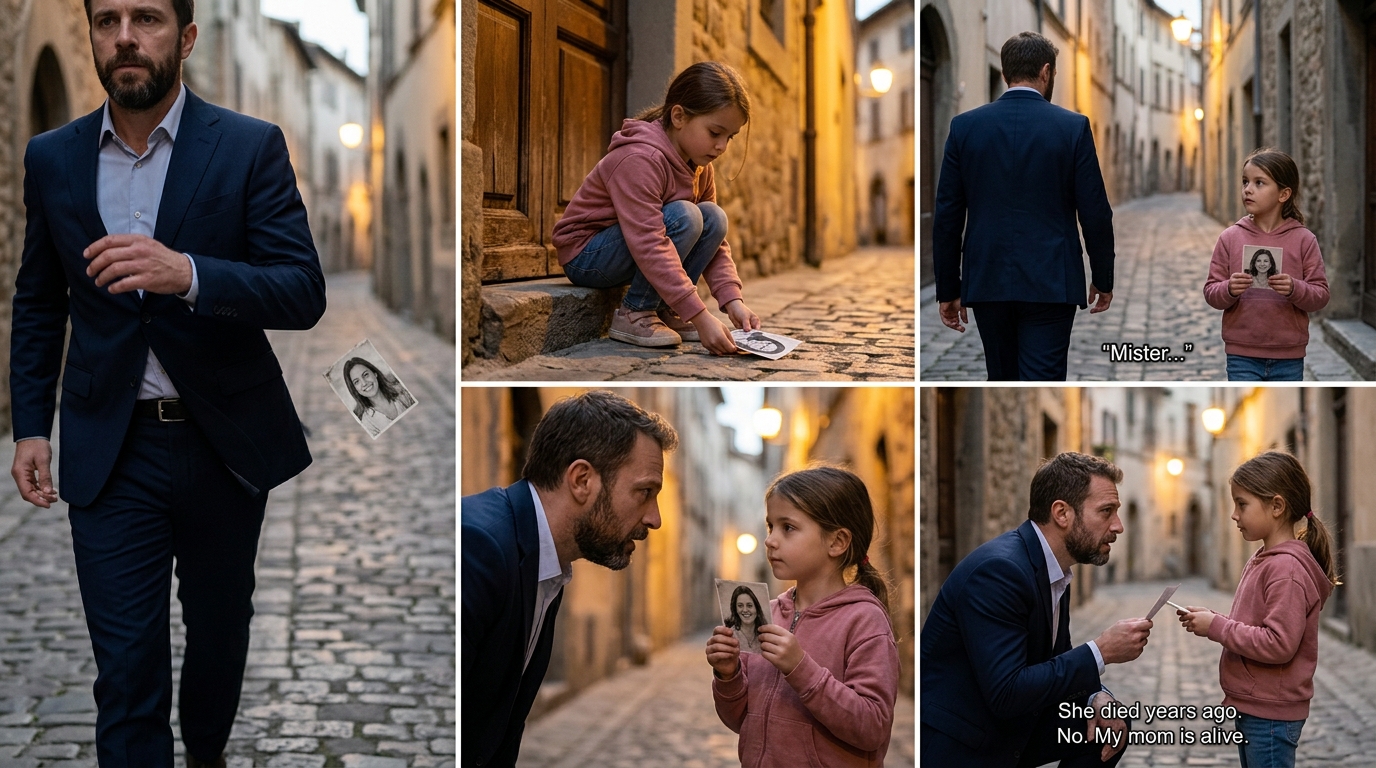
The photograph slipped from my coat pocket on a street I had not meant to walk down.
I did not notice at first.
Grief makes a man careless with everything except pain.
The old quarter was glowing that evening, all narrow cobblestone lanes and golden restaurant windows, the air damp from afternoon rain. People moved around me in soft clusters, laughing over dinner reservations and weekend plans, their lives continuing with insulting ease.
Mine had stopped three years earlier.
I walked fast because slowing down meant thinking.
And thinking meant seeing Evelyn again.
Her face in the hospital bed.
Her wedding ring in a plastic envelope.
The closed coffin.
The priest’s voice saying ashes to ashes while my knees nearly gave out beneath me.
I had carried her photograph in my coat since the day she died. Not in my wallet. Not on my phone. Those felt too ordinary. This one was small, printed on thick paper, the corners softened from years of being touched.
Evelyn in a white summer dress.
Laughing at something I had said.
One hand lifted to shield her eyes from the sun.
Alive in a way memory could never quite preserve.
That evening, the photograph fell.
A gust of wind lifted it from the cobblestones and sent it skidding behind me.
I kept walking.
Then a child’s voice stopped me.
“Mister…”
Soft.
Uncertain.
Too small to belong to the question that followed.
“Why do you have a picture of my mommy?”
The street went silent in my mind.
Not the real street.
The real street kept breathing.
A bicycle bell rang somewhere behind me. A waiter laughed in a doorway. A bus groaned around the corner.
But inside me, everything stopped.
My shoulders tightened before I turned.
A little girl stood on a low stone step outside a closed flower shop.
She wore a pink hoodie with one sleeve darker than the other, as if she had spilled something and tried to scrub it out. Her shoes were too big. Her hair was cut bluntly at her chin, uneven in a way that suggested no adult had taken her to a salon.
In both hands, she held my photograph.
Her eyes were fixed on Evelyn’s face.
Not curious.
Not confused.
Recognizing.
I walked toward her slowly, as if one wrong step might shatter the air between us.
“What did you say?”
My voice barely sounded like mine.
The girl looked up.
Her eyes were green.
Evelyn’s green.
My heart lurched so violently I had to stop.
She held the photograph against her chest for a moment, protective and certain.
“My mommy,” she said.
I shook my head once.
No.
Not because I did not hear her.
Because the world could not be that cruel.
“That’s my wife,” I whispered. “Her name was Evelyn.”
The little girl frowned.
“Her name is Eva.”
My throat closed.
Eva.
That was what Evelyn used to call herself when we traveled somewhere nobody knew the family name. She said Evelyn sounded like someone who had inherited silver and secrets. Eva sounded like someone who could start over.
“She died,” I said.
The girl shook her head.
No hesitation.
No doubt.
“No. My mom is alive.”
A cold pressure gathered behind my ribs.
“What’s your name?”
She hesitated, glancing down the lane as if someone might be watching.
Then she said, “Mila.”
“Mila,” I repeated.
The name entered me like a key turning in a lock I had never known existed.
“How old are you?”
“Six.”
Six.
Evelyn had died three years ago.
That should have made the claim impossible.
But nothing about the child’s face felt impossible.
It felt like something hidden had finally stepped into the light.
I crouched before her.
“Where is your mother now?”
Mila’s fingers tightened around the photograph.
“She told me to wait by the flower shop if I got lost.”
“Lost from where?”
Her chin trembled.
“The men came.”
The street seemed to narrow around us.
“What men?”
She looked past me.
Her face changed instantly.
Fear.
Pure and practiced.
A black sedan rolled slowly into the lane, too expensive for the old street, too quiet for the cobblestones. Its tinted window lowered just enough for me to see the outline of a man inside.
Mila grabbed my sleeve.
“They found me,” she whispered.
And before I could ask another question, the sedan door opened.
The Girl Who Shouldn’t Exist
I picked Mila up before I knew I was going to do it.
She was light.
Too light.
She wrapped both arms around my neck without arguing, which frightened me more than if she had screamed.
A child who trusts a stranger quickly has either known great kindness or great danger.
Mila felt like the second.
The man from the sedan stepped onto the cobblestones. He was broad, clean-shaven, wearing a dark suit with no tie. Not a tourist. Not a driver. Not police.
Security.
Private.
The kind my family used when lawyers were too slow and threats needed polished shoes.
“Mr. Whitmore,” he called.
My blood went cold.
He knew my name.
My full name was Adrian Whitmore, though for the past three years I had tried to live as if the Whitmore part were a coat I could remove. My father’s name opened boardrooms, hospitals, courtrooms, and doors that should have stayed locked.
It had also closed Evelyn’s coffin.
I tightened my hold on Mila.
The man lifted his hands slightly.
“We only need the child.”
Mila buried her face in my shoulder.
“No,” she whispered.
The word made my decision for me.
I ran.
Not gracefully.
Not heroically.
I ran like a man carrying the first impossible proof that his life had been built around a lie.
The old quarter twisted into narrow lanes behind the restaurants. I knew them from years ago, when Evelyn and I used to come here to pretend we were ordinary. We would eat cheap pasta, buy flowers we didn’t need, and laugh about how my father would call it sentimental waste.
I cut through a passage between a bakery and a wine shop.
The man shouted behind us.
Another car door opened.
Footsteps followed.
Mila clung to me, silent except for one small breathless sound every time I turned too sharply.
At the end of the passage was an iron gate.
Locked.
Of course.
I kicked it once.
Pain shot up my leg.
I kicked again.
The old latch snapped.
We stumbled into a courtyard behind an apartment building. Laundry hung from lines overhead, damp and pale in the evening light. A woman on a balcony shouted something, but I was already moving toward the service exit.
My phone buzzed.
Unknown number.
I ignored it.
It buzzed again.
Then a text appeared across the screen.
Do not bring her to the police.
I stopped so abruptly Mila bumped her head against my chin.
A second message appeared.
If you want to know why Evelyn is alive, come to St. Agnes Market. Stall 14. Alone.
My hands went numb.
Evelyn.
Not Eva.
Evelyn.
Whoever sent the message knew the name I had whispered on the street less than two minutes ago.
Or they had known long before.
Mila lifted her head.
“Is it Mommy?”
I looked at the phone.
Then at the alley behind us.
The men were still searching.
“No,” I said.
But I no longer knew what was true.
I carried her through the back streets until we reached the old market. Most stalls had closed for the night. Metal shutters rattled in the wind. The smell of fish, spices, and wet stone lingered under the awnings.
Stall 14 sold antique books during the day.
At night, it was dark.
An elderly woman stepped from behind the shutter holding a paper cup of tea.
She looked at Mila first.
Her face crumpled with relief.
“Oh, thank God.”
Mila reached for her.
“Aunt Ruth.”
Aunt.
Not grandmother.
Not neighbor.
Aunt.
The woman took Mila from my arms with trembling tenderness, then looked at me like she had been dreading my face for years.
“You’re Adrian.”
“Where is my wife?”
Ruth closed her eyes.
Not in confusion.
In sorrow.
“That depends,” she said quietly, “on whether you still work for your father.”
The words struck deeper than she knew.
“I haven’t spoken to him in eight months.”
“Good.”
“Where is Evelyn?”
Ruth did not answer immediately.
She pulled a folded envelope from inside her coat and handed it to me.
The paper was old.
Soft at the edges.
My name was written across the front in Evelyn’s handwriting.
Adrian, if you are reading this, then Mila found you before they found her.
My breath broke.
Mila found you.
The child was not an accident.
She was a message.
I opened the letter with shaking hands.
The first line nearly dropped me to my knees.
I did not die in that fire. Your father made sure you believed I did.
The Funeral Without a Body
There had been no fire in my memories.
That was the first thing my mind refused.
Evelyn died after a car accident on the coast road.
That was what I had been told.
Her car went over the barrier during a storm. The wreck burned before emergency crews arrived. The body was identified through dental records. The coffin was sealed because the remains were too damaged for viewing.
I had repeated those facts so many times they became a wall inside me.
But Evelyn’s letter broke through it line by line.
Your father discovered the clinic records before I could tell you. He knew about Mila. He knew I had changed the trust documents. He knew I had recorded everything.
I read the sentence again.
Mila.
My eyes moved to the little girl curled against Ruth’s side.
She watched me with Evelyn’s eyes and a stranger’s caution.
“Is she mine?” I whispered.
Ruth’s face softened.
“She is.”
The market seemed to tilt.
Six years old.
My daughter.
Alive all this time.
I reached for the nearest counter to steady myself.
Ruth continued quietly, “Evelyn was pregnant when she left you.”
“She didn’t leave me.”
“No,” Ruth said. “She ran from your father.”
That hurt because it fit too well.
My father, Julian Whitmore, controlled the Whitmore Trust with the precision of a surgeon and the morality of a locked vault. He loved legacy the way some men love God. When Evelyn married me, he smiled at the wedding as if welcoming her into the family.
Later, he offered her money to leave.
I found out by accident.
Evelyn told me she refused.
I confronted him.
He said she was not fit for the family.
I did not know then that “not fit” meant dangerous.
Ruth led us through the back of the stall into a storage room. A single lamp burned on a crate. Mila sat in the corner with a blanket and a biscuit, watching me carefully.
Ruth handed me a second envelope.
“This is why she ran.”
Inside was a copy of an old trust amendment.
The Whitmore Trust transferred voting control only through a legitimate blood heir. If I died without a child, control passed to my cousin Marcus, who had worked under my father since college.
But if I had a child—
My child inherited controlling interest after my father’s death.
I stared at the document.
“My father already had me.”
Ruth shook her head.
“You were going to dissolve the foundation holdings. Evelyn helped draft the papers.”
I remembered that fight.
The foundation owned private hospitals, rehabilitation centers, elder care homes. Evelyn had discovered irregularities in patient billing, forced guardianship transfers, missing settlement funds. She begged me to investigate.
I was cautious.
Too cautious.
I told her we needed proof.
She said proof was disappearing.
Three weeks later, she was dead.
Except she wasn’t.
“She found records,” Ruth said. “Enough to bring down your father and half the board. Then she found out she was pregnant.”
My throat tightened.
“And he tried to kill her.”
“He tried to make her vanish.”
Ruth’s voice grew colder.
“He paid a doctor to claim she miscarried. Paid a coroner to sign a false identification after the crash. Paid police to close the file before you could question anything.”
I could barely hear over the blood rushing in my ears.
“She let me believe she died?”
Ruth looked at Mila.
“She let you grieve because the alternative was letting him find your daughter.”
The truth was cruel.
But not simple.
That made it harder to hate.
“What happened tonight?” I asked.
Ruth’s jaw tightened.
“Evelyn was found.”
“Where?”
Before Ruth could answer, the metal shutter outside rattled.
Once.
Then again.
Mila stood instantly.
Too instantly.
Ruth went pale.
“Back room,” she whispered.
The shutter slammed upward.
Men entered the market stall.
Three of them.
The man from the sedan stood in front.
Behind him was Marcus Whitmore.
My cousin.
My father’s chosen heir.
He smiled when he saw me.
Not surprised.
Pleased.
“Adrian,” he said. “You always did follow ghosts better than instructions.”
Then his eyes moved to Mila.
The smile vanished.
“There she is.”
The Woman Behind the Locked Door
I stepped in front of Mila.
It was instinctive.
Too late, maybe.
Six years too late.
But instinctive.
Marcus noticed.
His mouth curved with disgust.
“Careful,” he said. “Attachment makes this harder.”
“She’s my daughter.”
The words came out before I had earned them.
Mila’s hand tightened around Ruth’s sleeve.
Marcus laughed softly.
“Biology is such a sentimental trap.”
He looked at the men.
“Take the child.”
I grabbed the nearest object, an iron bookend shaped like a lion, and swung.
The first man went down with a sound I would remember later and feel nothing about.
The second lunged for Mila.
Ruth threw hot tea in his face.
Mila screamed.
The room exploded into motion.
Marcus cursed.
One man grabbed me from behind, driving me into the shelf. Pain shot through my ribs. Books spilled across the floor. Ruth dragged Mila toward the rear exit, but Marcus caught the girl’s hoodie.
Something inside me snapped.
I drove my elbow backward, felt cartilage break, then turned and slammed the man’s head into the wooden counter.
Marcus had Mila by the arm.
She was kicking.
Fighting.
Evelyn’s daughter.
My daughter.
I crossed the room in three strides.
Marcus pulled a gun.
Everything stopped.
Mila froze.
Ruth froze.
Even the wounded men stopped moving.
Marcus pressed the gun near Mila’s shoulder.
“Don’t be stupid.”
My hands lifted slowly.
My heart pounded so hard the room blurred.
“She’s a child.”
“She’s a legal complication.”
That phrase told me the whole shape of him.
He had been raised by my father too.
Different house.
Same sickness.
“What do you want?” I asked.
Marcus smiled.
“The files. The girl. Your signature confirming that any child claiming to be yours is fraudulent.”
“You think I’ll sign that?”
“I think you’ll sign anything when you see Evelyn.”
My breath stopped.
Mila stopped crying.
“Mommy?”
Marcus’s smile widened.
“She’s alive,” he said. “For now.”
The market door opened behind him.
Another figure entered.
An older man in a black overcoat, silver cane in hand, rain shining on his shoulders.
My father.
Julian Whitmore looked exactly as he had in every boardroom memory of my life.
Immaculate.
Cold.
Certain the world had already agreed with him before he spoke.
His eyes moved over the wrecked stall, the injured men, Ruth, Mila, then finally me.
“Son,” he said.
I had not heard that word from him in years.
It sounded obscene.
“Where is she?” I asked.
He did not pretend not to understand.
“At the house.”
My childhood home.
A limestone mansion on Hawthorne Hill with locked gates, private security, and more rooms than warmth.
“Let them go,” I said. “I’ll come with you.”
“Of course you will.”
His gaze shifted to Mila.
“But she comes too.”
“No.”
My father tapped the cane once.
The sound silenced the room.
“Adrian, you have spent your life confusing reluctance with morality. You hesitate. You grieve. You let women turn your guilt into policy. I will not allow a six-year-old and a dead wife’s delusions to dismantle what generations built.”
“She’s not dead.”
“No,” he said. “And that has been deeply inconvenient.”
Mila stared at him.
Her little face pale, but steady.
“My mommy said bad men use calm voices.”
For the first time, my father looked directly at her.
Something flickered in his expression.
Not guilt.
Recognition.
She looked too much like Evelyn.
Maybe too much like me.
“Your mother always did enjoy teaching poetry to problems,” he said.
He gestured to Marcus.
“Bring them.”
They took us through the service alley to the waiting sedan.
Ruth was left behind, bleeding but alive, because my father understood witnesses could be managed later. The mistake, I realized, was arrogance. He had stopped fearing ordinary people long ago.
On the drive to Hawthorne Hill, Mila sat between me and Marcus. My father sat across from us, cane resting across his knees.
Mila did not speak.
Neither did I.
But when her small hand found mine in the dark car, I held it.
At the mansion, they led us through the side entrance, past the blue sitting room, past the portrait gallery, down to the old wine cellar.
My father opened a reinforced door with a thumbprint scanner.
Inside was a room I had never seen.
White walls.
Medical bed.
Security camera.
A woman sitting in a chair near the far wall.
Thin.
Pale.
Hair cut shorter than I remembered.
But alive.
Evelyn.
She lifted her head.
When she saw me, her face broke.
When she saw Mila, she stood so fast the chair fell behind her.
“Mila.”
The child tore free from Marcus and ran.
Evelyn dropped to her knees and caught her.
I stood in the doorway, unable to move, watching my dead wife hold our daughter in a locked room beneath my father’s house.
Then Evelyn looked over Mila’s shoulder and whispered the words that made my father finally lose his calm.
“Adrian, the files are already out.”
The Files Evelyn Died to Protect
My father did not shout.
That would have made him human.
Instead, his face emptied.
A blankness slid over him, smooth and terrible.
“What did you do?” he asked.
Evelyn held Mila tighter.
“What you taught me,” she said. “I planned ahead.”
Marcus moved toward her, but my father raised one hand.
“Explain.”
Evelyn looked at me.
For one impossible moment, the years vanished.
She was not the ghost in the photograph.
Not the woman in the coffin.
Not the fugitive.
She was my wife, terrified and brave, asking me silently whether I would finally see what she had tried to show me.
“I sent copies to Ruth,” she said. “To federal investigators. To three journalists. To the families whose settlements you stole. And to Adrian’s attorney.”
My father’s mouth tightened.
“You’re bluffing.”
“No,” she said. “You made me disappear once. I learned from it.”
My phone buzzed in my pocket.
So did Marcus’s.
Then my father’s.
One after another, alerts lit the room.
Whitmore Foundation Accused of Patient Trust Fraud.
Missing Heiress Alive After False Death Certificate.
Federal Probe Opened Into Julian Whitmore’s Medical Holdings.
My father looked at the screen.
For the first time in my life, I saw uncertainty cross his face.
Not fear.
Not yet.
But the beginning of it.
Marcus lunged for Evelyn.
I moved first.
I hit him with everything I had spent years swallowing.
Grief.
Guilt.
Cowardice.
Regret.
We crashed into the medical cart. Instruments clattered. Mila screamed. Evelyn pulled her behind the bed.
My father reached into his coat.
For the first time, the silver cane was not enough.
He had a gun.
The door behind him burst open.
Ruth stood there with two police officers and a woman in a federal jacket.
Blood streaked Ruth’s temple.
Her hands shook.
But she was smiling.
“I told you,” she said, looking at Evelyn. “Old women are good at being ignored.”
The federal agent aimed her weapon at my father.
“Julian Whitmore, put the gun down.”
He looked around the room.
At Evelyn.
At Mila.
At me.
At the officers.
At the phone in his hand, still glowing with the collapse of his empire.
For one brief second, I thought he might fire.
Then Mila stepped from behind the bed.
Small.
Trembling.
Furious.
“You hurt my mommy,” she said.
That did what guns and headlines had not.
My father looked at her and finally saw not a legal obstacle, not a trust complication, not a child to erase.
He saw a witness.
A living one.
His hand lowered.
The trial lasted thirteen months.
The world learned that the Whitmore Foundation had stolen millions from patient settlements, manipulated guardianship claims, and used private facilities to hide whistleblowers until documents could be destroyed.
Evelyn testified for two days.
Ruth testified for one.
Families came forward with stories that had been dismissed for years.
My father’s attorneys tried to paint Evelyn as unstable, vengeful, delusional.
Then prosecutors played the video Evelyn had recorded the night she faked her death.
She was bruised, pregnant, terrified, and still speaking clearly.
“If I die, Julian wins. If I disappear, my daughter lives long enough for the truth to find her father.”
In the courtroom, I could not look at her.
Not because I blamed her.
Because I knew how deeply I had failed.
When it was my turn to testify, the prosecutor asked me when I first believed Evelyn was alive.
I could have said the market.
The letter.
The cellar.
Instead, I told the truth.
“When my daughter picked up a photograph and called my dead wife Mommy.”
Mila sat beside Evelyn in the front row, swinging her legs beneath the bench, too young to understand legal strategy, old enough to understand that bad men were finally being made to answer.
My father was convicted on fraud, kidnapping, obstruction, conspiracy, and falsifying a death record.
Marcus took a plea.
Of course he did.
Men like Marcus believe loyalty is permanent until prison becomes personal.
Afterward, there was no simple happiness.
People expect reunions to heal everything at once.
They don’t.
Evelyn had survived three years in hiding, six years as a mother under false names, and months of captivity after my father found her. I had survived a fake grave and the knowledge that I had trusted the man who built it.
Mila had survived being taught to run before she learned to ride a bike.
We moved slowly.
At first, Evelyn and Mila stayed with Ruth.
I visited every day.
Not as a husband reclaiming a wife.
Not as a father claiming a child.
As a man asking permission to enter a life that had continued without him because it had to.
Mila tested me.
Children do that when love arrives late.
She asked if I knew how she liked her toast.
I didn’t.
She asked if I knew her favorite bedtime story.
I didn’t.
She asked if I knew Mommy cried when she heard sirens.
I didn’t.
Each answer hurt.
Each answer was necessary.
So I learned.
Toast with butter all the way to the edges.
The story about the moon rabbit.
Sirens meant sit closer but don’t ask too many questions.
One evening, months after the trial, we returned to the cobblestone lane.
The flower shop was open this time. Buckets of roses and tulips stood beneath warm lights. The air smelled of rain and petals.
Mila stood on the same stone step where she had found the photograph.
I stood beside Evelyn.
For a while, none of us spoke.
Then Mila reached into her coat pocket and pulled out the photo.
The old one.
Evelyn laughing in the white summer dress.
She handed it to me.
“You dropped this,” she said.
I took it carefully.
My throat tightened.
“I did.”
She looked up at me with those green eyes that had broken my world open and given it back differently.
“You shouldn’t lose Mommy again.”
Evelyn turned away, crying softly.
I crouched in front of Mila.
“No,” I said. “I shouldn’t.”
Mila studied me with the serious expression of a child deciding whether an adult’s promise was worth keeping.
Then she placed her small hand on my cheek.
“I’ll help you remember.”
That was when I cried.
Not in court.
Not when the verdict came.
Not even when I first saw Evelyn alive.
I cried on a cobblestone street while my daughter held my face and offered to help me remember the woman I had never stopped loving.
The city moved around us.
People passed.
A waiter laughed in a doorway.
The evening lights glowed gold against the wet stones.
And for the first time in years, the photograph in my hand did not feel like proof of what I had lost.
It felt like the beginning of what had survived.