The Girl Who Did Not Belong
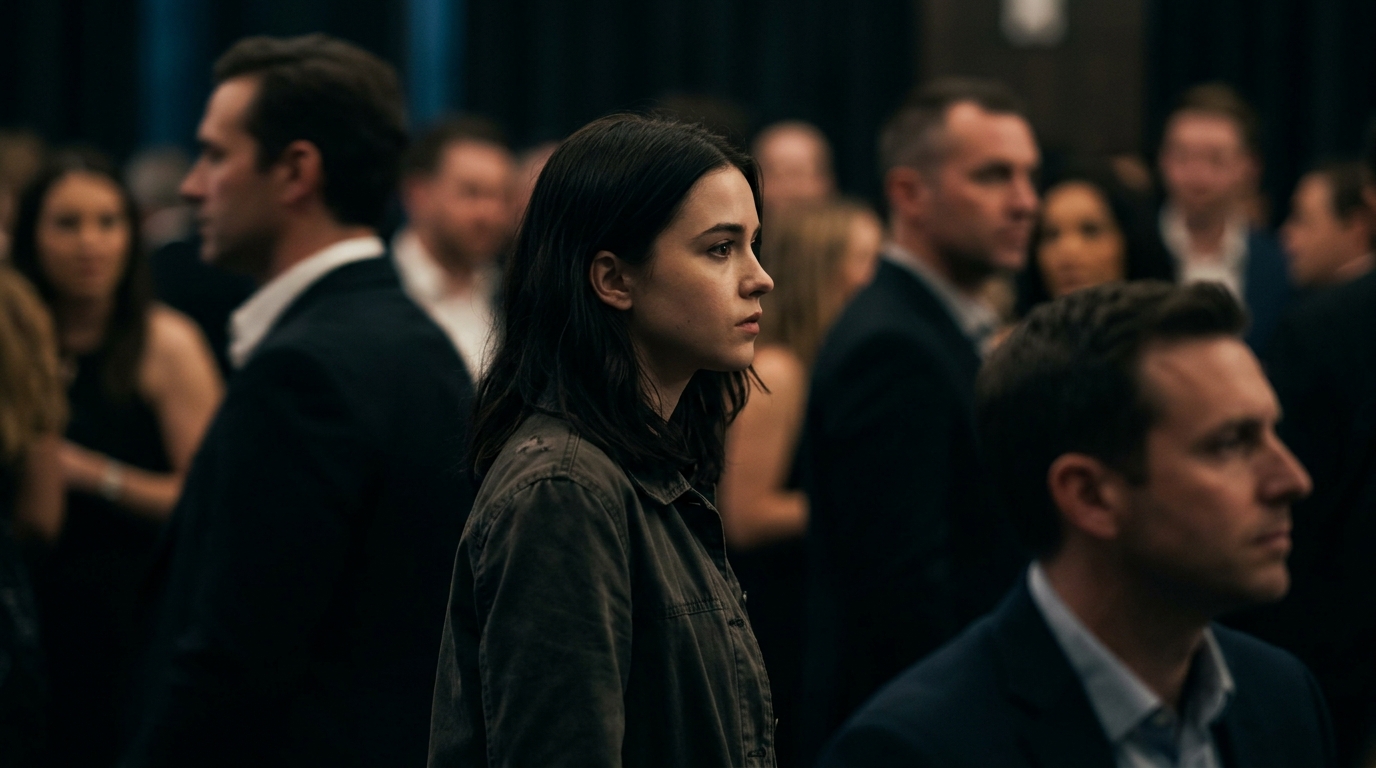
No one noticed the girl when she entered the room.
That was how rooms like that worked.
They noticed diamonds.
They noticed last names.
They noticed champagne poured into crystal flutes and men whose fortunes made waiters stand straighter.
But a small girl in a faded blue cardigan could pass beneath all that gold light like a shadow.
The charity dinner was being held in the west ballroom of the Ashford Club, a private old-money institution downtown where portraits of dead men looked down from the walls as if still deciding who was allowed to breathe their air. Candlelight trembled over white tablecloths. A string quartet played near the marble staircase. Women laughed softly behind jeweled hands. Men in tailored jackets leaned close to one another, speaking in the low tones of influence.
The girl did not belong there.
Everyone knew it.
Too small.
Too quiet.
Too careful with every step.
Her shoes were clean but worn thin at the toes. Her hair had been brushed carefully, though one side had come loose. She held both hands in front of her, fingers clasped around something she was trying to hide.
At first, people ignored her.
Then she reached the center tables.
That was when the whispering began.
“Whose child is that?”
“Is she lost?”
“Wrong room.”
She heard them.
I saw that she heard them.
But she did not flinch.
My name is Julian Ashford, and I was seated at the head table that night because my family name was carved into the building, the foundation, the invitations, and most of the lies that had survived inside them.
I was forty-two years old, heir to a fortune I had spent my adult life trying to make useful, and still foolish enough to believe philanthropy could wash old blood from old money.
Beside me sat Celeste Vane.
Elegant.
Brilliant.
Beautiful in the exact way society rewards because it never requires explanation.
We were not married yet, but everyone in the room knew we would be soon. Celeste had grown up near my family, advised our foundation, managed half our public partnerships, and made herself indispensable after my mother died.
She was smiling when the girl approached.
Then she saw the child’s face.
The smile vanished so quickly I almost missed it.
The girl stopped beside my chair.
She did not look at Celeste.
She looked only at me.
For several seconds, she said nothing.
The string quartet continued playing, though the violinist’s eyes had shifted toward us. Forks paused above plates. A waiter froze with a silver tray near his shoulder.
I tried to soften my voice.
“Are you looking for someone?”
The girl nodded.
“You.”
A faint ripple moved through the table.
Celeste placed her hand lightly over mine.
“Julian, perhaps security should—”
“No,” I said.
The girl reached into her cardigan pocket.
Celeste’s fingers tightened on my hand.
That was my first warning.
The girl slowly set something on the table between my wineglass and the folded place card bearing my name.
A silver locket.
Small.
Oval.
Tarnished at the edges.
The room seemed to tilt.
I stared at it.
The locket had a tiny dent near the clasp and a carved crescent moon on the front. I knew that crescent. I had touched it as a boy when I was scared, when storms shook the windows at Ashford House, when my mother told me old family things carried old family strength.
My hand moved to my neck before I could stop it.
Beneath my collar, hidden under my shirt, hung the same locket.
Identical.
I pulled it free.
Silver.
Oval.
Same crescent.
Same dent near the clasp.
A breath caught in my throat.
“That’s not possible.”
The girl leaned closer.
Calm.
Almost relieved.
“My mom said you’d say that.”
The words landed harder than the locket.
Beside me, Celeste stopped breathing.
I turned toward her.
Her face had gone pale.
Not confused.
Not surprised.
Recognizing.
The girl finally looked at her.
For the first time, fear crossed the child’s face.
Then she whispered, “Mom said if she was sitting beside you, I had to show it in front of everyone.”
The ballroom went silent.
Not because they understood.
Because Celeste did.
And whatever had just resurfaced was something she had spent years making sure stayed buried.
The Locket With Two Names
I picked up the locket with fingers that felt strangely far from my body.
It was cold.
Heavier than I remembered.
The silver had darkened with age, but the crescent moon remained clear. I turned it over slowly.
On the back, etched in tiny letters, was one name.
Lila.
My sister’s name.
The room disappeared for a second.
Lila Ashford had been dead for twenty-three years.
That was the first sentence of the family story.
The second was that she drowned at Lake Mira during a summer storm.
The third was that my father never recovered.
The fourth was that my mother never spoke her name again without becoming too quiet for the room to bear.
I had been nineteen when Lila died.
She was seventeen.
Bright, impulsive, stubborn, and too kind for the family she had been born into. We had worn matching lockets as children, a ridiculous old Ashford tradition my grandmother insisted on. Mine had Julian engraved inside. Hers had Lila.
After the lake accident, her locket was found on the dock.
That was what I had been told.
My father placed it in a small velvet box and locked it away.
Or so I believed.
I opened the locket on the table.
Inside was not a photograph.
It was a folded strip of paper, so tiny and soft from being opened many times that it looked like cloth.
The girl watched me carefully.
“My mom said not to let anyone take it.”
Celeste’s voice returned, smooth but thin.
“Julian, this is cruel. Someone is exploiting a child with old family jewelry.”
I did not look at her.
“Do you know her?”
“Of course not.”
The girl said, “You do.”
Celeste turned toward her.
The look she gave that child was not anger.
It was warning.
I unfolded the paper.
The handwriting inside was shaky, uneven, but unmistakable.
Lila’s.
Jules,
If a child brings you this, believe her before you believe anyone sitting beside you.
I did not drown.
I was sent away.
Celeste knows why.
The paper blurred in my hand.
The guests around us had become statues.
The chairman of the foundation stared at his plate. A senator’s wife covered her mouth. The old violinist stopped playing entirely.
Celeste stood abruptly.
“This is disgusting.”
The girl flinched.
I rose too.
“Sit down, Celeste.”
She looked at me as if I had slapped her.
“Excuse me?”
“Sit down.”
The command came from somewhere in me I did not recognize.
For years, Celeste had been the person who remembered what I forgot, answered questions before I needed to ask them, managed uncomfortable conversations, softened difficult donors, arranged apologies that never quite admitted fault.
Now she looked like a woman whose entire life had depended on me never giving her an order in public.
The girl touched the locket on the table.
“My mom said there’s another message inside yours.”
My breath stopped.
I looked down at the locket around my neck.
For twenty-three years, I had worn it as grief.
I had never opened it again after Lila died.
I told myself it hurt too much.
Maybe that was true.
Maybe some part of me had been afraid of what grief might contain if opened.
I pressed the tiny clasp.
It stuck.
Then gave.
Inside was the photograph I remembered: Lila and me as children, muddy from the garden, grinning beneath an apple tree.
Behind the photograph was a second piece of folded paper.
My hands began to shake.
Celeste whispered, “Julian, don’t.”
I turned toward her.
“What did you do?”
She said nothing.
The girl watched me with a terrible patience.
I unfolded the paper.
Lila’s handwriting again.
Jules,
Father says the baby cannot stay.
Celeste heard everything.
If I vanish, do not let them tell you I chose it.
Find Mira.
She knows where the child went.
Love,
Lila
The name Mira struck the air like a bell.
Lake Mira.
The place where my sister supposedly drowned.
But Mira was not only a lake.
Mira Vale had been Lila’s closest friend.
A scholarship student.
A girl my father called unsuitable.
A girl who disappeared from town three months after Lila’s funeral.
I looked at the child.
“What is your mother’s name?”
Her lips trembled.
“Mira.”
Celeste backed away from the table.
This time everyone saw it.
The girl continued, voice smaller now.
“She died last week.”
The locket slipped from my fingers and struck the plate with a sharp silver sound.
The girl swallowed hard.
“Before she died, she told me my real mother’s name was Lila Ashford.”
The Woman Beside Me
People imagine betrayal arrives loudly.
It rarely does.
It sits beside you for years.
It remembers your coffee order.
It touches your wrist during funerals.
It tells you to rest when you are grieving and slowly becomes the person who explains your own life back to you.
Celeste stood beside my chair with one hand at her throat.
The entire ballroom watched her.
For the first time since I had known her, she had no performance ready.
I looked at the girl.
“What’s your name?”
“Evelyn.”
The name hit me with cruel tenderness.
Evelyn had been my mother’s name.
Lila would have chosen it.
Of course she would have.
I stepped closer, but Evelyn stepped back.
I stopped immediately.
Children who come carrying proof have already learned adults can be dangerous when cornered.
“I won’t hurt you,” I said.
Her eyes moved to Celeste.
“That’s what people said to Mom.”
Celeste’s face tightened.
“Your mother was paid very well to keep quiet.”
The sentence left her before she could stop it.
A gasp moved through the room.
Evelyn went pale.
I turned slowly.
“What did you just say?”
Celeste closed her eyes.
Only for a moment.
When she opened them, the mask had returned, but it no longer fit.
“She was not her mother,” Celeste said. “She was a woman who took money to raise a child that never should have existed.”
Evelyn made a small sound.
I stepped between them.
“Do not speak about her like that.”
Celeste laughed once.
It was brittle.
“You don’t even know what happened.”
“Then tell me.”
She looked around the ballroom.
At donors.
Trustees.
Reporters invited to cover the foundation gala.
Old friends.
Old enemies.
People who had spent years admiring the Ashford family’s elegance without ever asking what it cost.
Celeste lowered her voice.
“Not here.”
I looked at the little girl standing beside a table where she had no place card, no family, and apparently no one left in the world who had told her the truth before dying.
“Yes,” I said. “Here.”
The foundation chairman cleared his throat.
“Julian, perhaps we should move this into a private room.”
“No.”
The word silenced him.
I picked up both lockets and placed them side by side on the white tablecloth.
Mine.
Lila’s.
Two small silver witnesses.
Then I looked at Celeste.
“You were there the night Lila disappeared.”
Her jaw tightened.
“I was seventeen.”
“You heard my father.”
“We all heard your father. He was not a quiet man.”
“What baby?”
Celeste looked at Evelyn.
For a second, something like pity crossed her face.
Then fear swallowed it.
“Lila had a child.”
The room went still.
I felt the sentence enter me slowly, tearing through every version of the past I had survived.
“A daughter,” I said.
Celeste did not answer.
Evelyn whispered, “Me.”
My knees nearly failed.
Lila had been pregnant.
Lila had given birth.
Lila had lived long enough to write the notes.
And I had mourned her while her child grew up somewhere outside the locked gates of our world.
I turned back to Celeste.
“What happened to my sister?”
Celeste looked toward the service doors.
I followed her gaze.
Two men in dark suits had appeared near the back wall.
Private security.
Not club security.
Family security.
My father’s old kind.
I had not employed men like that in years.
Celeste had.
Of course she had.
Evelyn saw them too.
She grabbed the locket.
“My mom said if men came, run.”
The first man began walking toward us.
I took Evelyn’s hand.
For a second, she resisted.
Then let me.
Celeste said sharply, “Julian, don’t be foolish.”
I looked at her.
“I was foolish for twenty-three years.”
The man quickened his pace.
The ballroom stirred, guests finally realizing this was no longer a scandal to observe.
I pulled Evelyn toward the side exit.
She stumbled but kept moving.
Behind us, Celeste shouted my name.
Then another voice rose from near the service corridor.
Old.
Rough.
Familiar.
“Leave the child alone.”
Everyone turned.
A woman in a black catering uniform stepped from the shadows carrying a silver tray like a shield.
Her hair was white now.
Her face older.
But I knew her.
Mira Vale.
The woman Evelyn had just told me was dead.
She looked directly at me.
“I’m sorry, Julian,” she said. “Your sister made me promise not to come back unless the girl had no other way in.”
The Promise Behind the Garden Wall
Evelyn dropped my hand and ran to Mira.
“Mom?”
The word broke halfway.
Mira caught her, tray clattering to the floor, and held the girl so fiercely that anyone watching understood biology had nothing to do with motherhood in that moment.
“You said you died,” Evelyn cried.
Mira pressed her face into the girl’s hair.
“I said if they thought I died, they might stop looking long enough for you to reach him.”
The security men halted.
Not because they felt sympathy.
Because every phone in the room had risen.
Celeste saw the cameras and went rigid.
Mira lifted her face.
Rain had streaked her makeup. Her catering uniform was too large. Her hands shook, but her eyes were steady.
She looked at me.
“I tried to send letters.”
“I never got them.”
“I know.”
Celeste whispered, “Mira.”
The way she said the name was almost pleading.
Mira turned toward her.
“You should have told him.”
Celeste’s face twisted.
“I was a child.”
“So was Lila.”
That sentence ended something.
Mira reached into her apron and pulled out a key.
Not modern.
Iron.
Blackened with age.
“The garden wall,” she said to me. “Your sister hid the rest where you used to climb through as children.”
I remembered immediately.
Ashford House had a walled garden behind the old orangery. Lila and I had discovered a loose stone there when we were small. We used to hide marbles, notes, stolen biscuits, once even a dead sparrow we held a funeral for because Lila said every creature deserved witnesses.
“You have proof?” I asked.
Mira nodded.
“Enough.”
Celeste stepped toward her.
“Mira, stop.”
Mira held Evelyn closer.
“No.”
One of the security men moved again.
This time, half the room shouted.
“Don’t touch her!”
“Back up!”
“Everyone is recording!”
The man stopped.
Power looks different when it realizes the room has changed sides.
I turned to the foundation chairman.
“Call the police.”
He hesitated.
I looked at him.
“Now.”
He took out his phone.
Celeste began backing toward the side doors.
I saw it.
So did Mira.
“She knows where the file is,” Mira said.
Celeste froze.
“What file?” I asked.
Mira looked at me with exhausted sorrow.
“The trust amendment.”
The phrase pulled another memory loose.
My grandfather’s trust had required all direct heirs to be named before age eighteen. If Lila had a child, that child would inherit her share. But after Lila’s death, my father consolidated everything under me, then later under the foundation.
If Evelyn was Lila’s daughter, half the family estate had been stolen from her.
“Your father wanted the baby gone,” Mira said. “Lila refused. She was going to leave with me after the birth. Celeste heard him threaten her.”
Celeste’s voice cracked.
“I didn’t know he would do it.”
I turned toward her.
“Do what?”
She did not answer.
Mira did.
“He sent Lila away after the birth. Told everyone she drowned. Told me the baby would be killed if I didn’t leave with her and disappear.”
Evelyn clung to Mira.
The ballroom had gone completely silent.
My sister had not drowned.
She had been removed.
Erased.
Possibly killed later.
And I had spent my life turning the Ashford name into a foundation while the child it robbed stood outside its doors.
I looked at Celeste.
“You let me mourn her.”
Tears filled her eyes.
“I thought I was protecting you.”
“No,” Mira said. “You were protecting yourself.”
Celeste’s face hardened then.
Pain becoming cruelty.
“You have no idea what his father was.”
“I know exactly what he was,” Mira said. “That’s why I ran.”
Sirens sounded outside the club.
Celeste turned toward the nearest exit.
I moved first.
Not fast.
Not dramatically.
Just enough to stand between her and the door.
“Where is the file?”
She laughed softly through tears.
“You still don’t understand. If that girl is recognized, the foundation collapses. The board, the estate, every hospital wing, every scholarship, every donation under your sister’s share—years of good undone because one dead girl had a secret child.”
Evelyn flinched at dead girl.
Mira held her tighter.
I looked around the ballroom.
At the donors.
The trustees.
The portraits.
The flowers.
All the respectable structures built over one buried life.
“Then let it collapse,” I said.
Celeste stared at me.
Outside, police entered the lobby.
But before they reached us, Evelyn stepped forward with Lila’s locket in her hand.
She opened it again and removed a second scrap of paper tucked behind the first.
Mira gasped.
“I didn’t know that was there.”
Evelyn unfolded it.
Her hands shook.
In Lila’s handwriting were two lines.
Jules, if Celeste says she protected you, ask her what she took from the nursery.
Ask her why my baby’s blanket was burned but not my body.
Celeste covered her mouth.
And I knew then that the worst truth had not yet arrived.
The Nursery That Burned Without a Child
Ashford House had not burned down.
Not all of it.
Only the old east nursery.
It happened one month after Lila disappeared.
I had been away at university, drowning myself in classes because home had become a museum of grief. My father called and said a wiring fault had started a small fire in the east wing. No one was hurt. A few old things were lost.
Lila’s childhood books.
The cradle.
The baby blankets my mother had once stored for future grandchildren.
I had not questioned it.
Grief makes convenient fools of the living.
Two hours after the ballroom confrontation, police escorted us to Ashford House.
The estate rose behind iron gates beneath a moonless sky, its windows glowing softly across the lawn. I had not lived there in years. Too many ghosts. Too many portraits. Too much of my father in the walls.
Mira sat beside Evelyn in the back of the car, one arm around her shoulders.
Celeste rode separately with police.
Not arrested yet.
Not free either.
The walled garden waited behind the orangery, overgrown now, though the old stone path remained. I found the loose stone by touch more than memory. My fingers knew where to press.
It shifted.
Behind it was a rusted metal box wrapped in oilcloth.
For a moment, I could not move.
Mira came to stand beside me.
“She made me promise,” she said.
“Why didn’t you take it?”
“Because your father searched everything I carried. Lila said the only safe place was somewhere he thought belonged to childhood.”
I opened the box.
Inside were documents, photographs, a hospital bracelet, a bloodstained ribbon, and a small cassette recorder sealed in plastic.
Evelyn stood behind Mira, watching with wide eyes.
I lifted the first document.
Birth certificate.
Child: Evelyn Lila Ashford.
Mother: Lila Ashford.
Father: blank.
Witness: Mira Vale.
A second document followed.
Trust amendment.
Signed by Lila.
Naming her daughter as direct heir.
I sat down on the stone path.
Not because I wanted to.
Because my legs stopped believing in me.
Mira pressed the cassette recorder into my hand.
“Listen.”
I did.
Lila’s voice came through the static.
Young.
Weak.
Alive.
“Jules, if you hear this, I am sorry. Not because I left, but because I could not bring you with me. Father says the child is shame. I say she is mine. He says the estate will survive me. I say let it burn before it eats my daughter too.”
Evelyn began crying silently.
My sister’s voice continued.
“Celeste heard him say he would make the baby disappear. She promised to help me. Then she told him where we were hiding.”
A small sound escaped me.
Mira looked away.
“I do not know if she meant to betray me or only save herself. Maybe both. People do terrible things when powerful men teach them fear is love.”
The tape crackled.
“If Mira lives, trust her. If my daughter lives, tell her she was wanted. Tell her I held her. Tell her the first thing she did was grab my finger like she was making a promise.”
Evelyn looked down at her own hand.
The recording faded, then returned.
“And Jules, if Father tells you I drowned, remember this. I was never afraid of water. I was afraid of the house.”
The tape clicked off.
The garden was silent.
Then a voice spoke from behind us.
Celeste.
Two officers stood with her near the entrance, but she had heard enough.
“I didn’t know he would kill her.”
Mira turned.
“You knew he took her.”
Celeste’s face crumpled.
“He said he was sending her away. He said she would come back when she stopped being hysterical.”
“Where?” I asked.
Celeste looked at me.
Her eyes were empty now.
“The Briarwell Clinic.”
Mira made a sound of horror.
The name meant nothing to Evelyn.
It meant everything to me.
Briarwell had been a private psychiatric facility funded by the Ashford Foundation for decades. Quiet. Expensive. Remote. The place rich families sent inconvenient breakdowns to become permanent medical histories.
I felt sick.
“You visited her,” Mira said.
Celeste whispered, “Once.”
“And?”
“She begged me to tell Julian.”
I stood.
The old stones beneath my feet seemed to shift.
“What did you do?”
Celeste cried then.
Not beautifully.
Not usefully.
“I told myself she was unstable. I told myself your father knew best. I told myself you were already broken and the truth would destroy you.”
I looked at the woman I had nearly married.
“No,” I said. “The lie did.”
The investigation began that night.
Briarwell Clinic had closed eight years earlier, but records survived in storage because institutions that erase people often keep files longer than memories. Police found Lila’s admission under an assumed name. Sedation logs. Visitor records. Discharge papers signed after her death.
Cause listed: respiratory failure.
No family notified.
Body released to Ashford family representative.
Celeste Vane.
The nursery fire had burned baby items, not a body.
A staged destruction of evidence.
My father was dead, beyond trial.
Celeste was not.
The Family That Returned Through a Locket
The trials took nearly a year.
Celeste pled guilty to obstruction, concealment of evidence, and conspiracy to falsify records tied to Lila’s disappearance. Her lawyers argued she had been a frightened teenager under the control of my father.
That was true.
It was not the whole truth.
Mira testified for three days.
Her voice never rose.
She told the court how Lila gave birth in a private room with no doctor on record. How my father stormed in after the delivery. How Celeste promised to distract him and instead returned with men from the estate. How Lila shoved the baby into Mira’s arms and whispered, Run.
Mira ran.
She raised Evelyn in rented rooms, cheap apartments, and places where no one asked for too many documents. She told her stories about a mother who loved moons, gardens, and lockets. She worked nights. Cleaned offices. Served food. Took cash jobs because paper trails could become traps.
“She was never mine by law,” Mira said on the stand. “But she was mine every time she cried.”
Evelyn did not testify in court.
I refused to allow it unless absolutely necessary.
She had already carried enough proof into rooms full of adults.
The trust case moved separately.
The board fought, of course.
Boards always fight when morality threatens budgets.
They argued that restoring Evelyn’s inheritance would destabilize hospitals, scholarships, and public programs. They said the modern foundation had done good. They said punishing the present for the past would harm innocent beneficiaries.
I listened.
Then I gave Evelyn what should have been hers before anyone could convince me to negotiate with theft.
Half the Ashford estate assets were transferred into a new trust under court supervision, controlled for Evelyn’s benefit and for programs chosen by a child advocacy board Mira helped design.
The first thing Evelyn requested was simple.
No building should carry the Ashford name unless it also carried Lila’s.
So the foundation changed.
Not smoothly.
Not politely.
But completely.
The Lila Ashford Trust opened its first center eighteen months later.
Not in the ballroom.
Not near the club.
In the neighborhood where Mira had raised Evelyn for most of her life.
It provided legal help for young mothers, medical advocacy for children, and emergency housing for families fleeing powerful people who knew how to make threats sound official.
At the opening, reporters wanted a photograph of Evelyn and me standing beneath the sign.
She refused.
“I don’t want to be the story,” she said.
She was thirteen by then.
Still small.
Still quiet.
But not out of place anymore.
So the first public photo showed Mira instead, standing beside the entrance with both silver lockets displayed in a glass case behind her.
Mine.
Lila’s.
Two pieces of proof that had waited longer than any of us deserved.
People often ask if Evelyn came to live with me.
That question always reveals how much people misunderstand repair.
No.
She stayed with Mira.
Mira was her mother.
Not by blood.
By every night of fever.
Every school form.
Every meal skipped so Evelyn could eat.
Every lie told to keep her safe from people with my last name.
I became her uncle.
Slowly.
Awkwardly.
At first, she called me Mr. Julian.
Then Julian.
Then, once, by accident, Uncle Jules.
She pretended not to notice.
So did I.
But later that night, I cried in the old garden beside the loose stone.
The ballroom at the Ashford Club reopened months after the scandal, though it never felt the same. Good. It should not have. We removed the portraits of men who had built themselves into walls and replaced them with photographs of the people the trust now served.
On one wall, we placed a portrait of Lila.
Not the formal one my father had commissioned before her disappearance.
A small candid photograph Mira had kept.
Lila laughing with her hair loose, one hand resting over her newborn daughter wrapped in a cream blanket beneath a crescent moon mobile.
Evelyn chose the frame.
Plain silver.
“No gold,” she said. “Gold makes things look like they’re pretending.”
She was right.
The last time I saw Celeste before sentencing, she asked to speak with me privately.
I almost refused.
Then I went.
Not for her.
For the version of myself who once would have married a lie because it knew how to sit beside me.
She looked smaller in the visiting room.
No pearls.
No polished calm.
Just a woman who had spent her life calling survival love until the law gave it another name.
“I did care for you,” she said.
“I know.”
That seemed to hurt her.
Perhaps she wanted denial.
Hatred is sometimes easier to carry than complexity.
“I was afraid of your father,” she whispered.
“So was Lila.”
She lowered her eyes.
“I know.”
I stood to leave.
“Julian.”
I stopped.
“Do you think she would have forgiven me?”
I looked at her for a long moment.
Then I told the truth.
“I think Lila would have cared more about whether Evelyn was safe than whether you were forgiven.”
Celeste cried.
I left.
Years later, on Evelyn’s sixteenth birthday, she asked to visit the walled garden at Ashford House.
Mira came with us.
We stood by the loose stone where Lila had hidden the box.
Evelyn wore the silver locket around her neck now. Lila’s locket. Mine remained under my shirt, as always, but it no longer felt like grief alone.
Evelyn touched the crescent moon.
“Did she really hold me?”
Mira answered before I could.
“Yes.”
Evelyn looked at her.
“Do you remember?”
Mira smiled sadly.
“She was exhausted. Furious. Terrified. And the moment they put you in her arms, she told you not to let anyone in this family teach you to apologize for being alive.”
Evelyn laughed softly.
“That sounds like her.”
It did.
Though she had never known Lila, somehow it did.
The evening light moved over the garden wall.
For the first time in years, Ashford House did not feel like a place that had swallowed my sister.
It felt like a place that had failed to keep her buried.
Evelyn slipped the locket open and looked at the tiny paper inside, now preserved behind clear film.
My mom said you’d say that.
Those had been the words that ended one life and began another.
Not because a locket proves love.
Objects cannot do that.
People do.
Mira proved it by running.
Lila proved it by hiding the truth where childhood had once been safe.
Evelyn proved it by walking into a room that did not want her and placing silver on the table.
And I proved it late.
But late, if it finally protects the child everyone tried to erase, is better than never.
That night, as we left the garden, Evelyn paused at the old gate and looked back at the house.
“Wrong room,” she said quietly.
I turned.
“What?”
She smiled a little.
“That’s what someone whispered at the dinner when I walked in.”
I remembered.
Then Evelyn looked at Mira, then at me, then at the locket against her chest.
“They were wrong,” she said.
And for the first time, I believed the Ashford house had heard her.