The Girl at the Biker Table
The bell above the diner door rang sharply.
Too loud for a place that had been quiet only a second before.
“Hey—!”
The waitress barely got the word out.
Every head turned.
A little girl stood at the entrance.
She could not have been more than seven.
Her brown coat was too large for her small frame. Rainwater clung to the ends of her hair. Her shoes were scuffed, one lace dragging across the floor. She was breathing quickly, but she did not look lost.
That was the unsettling part.
She looked afraid.
But not confused.
Her gaze was fixed straight ahead.
On the biker table.
The low afternoon noise of Maggie’s Diner faded into nothing. Forks froze halfway to mouths. Coffee cups hovered above saucers. The old ceiling fan clicked twice, then seemed suddenly too loud.
At the back of the diner sat eight bikers.
Not young men trying to look dangerous.
Older men.
Quiet men.
Men with weathered hands, gray in their beards, and eyes that did not need to prove anything.
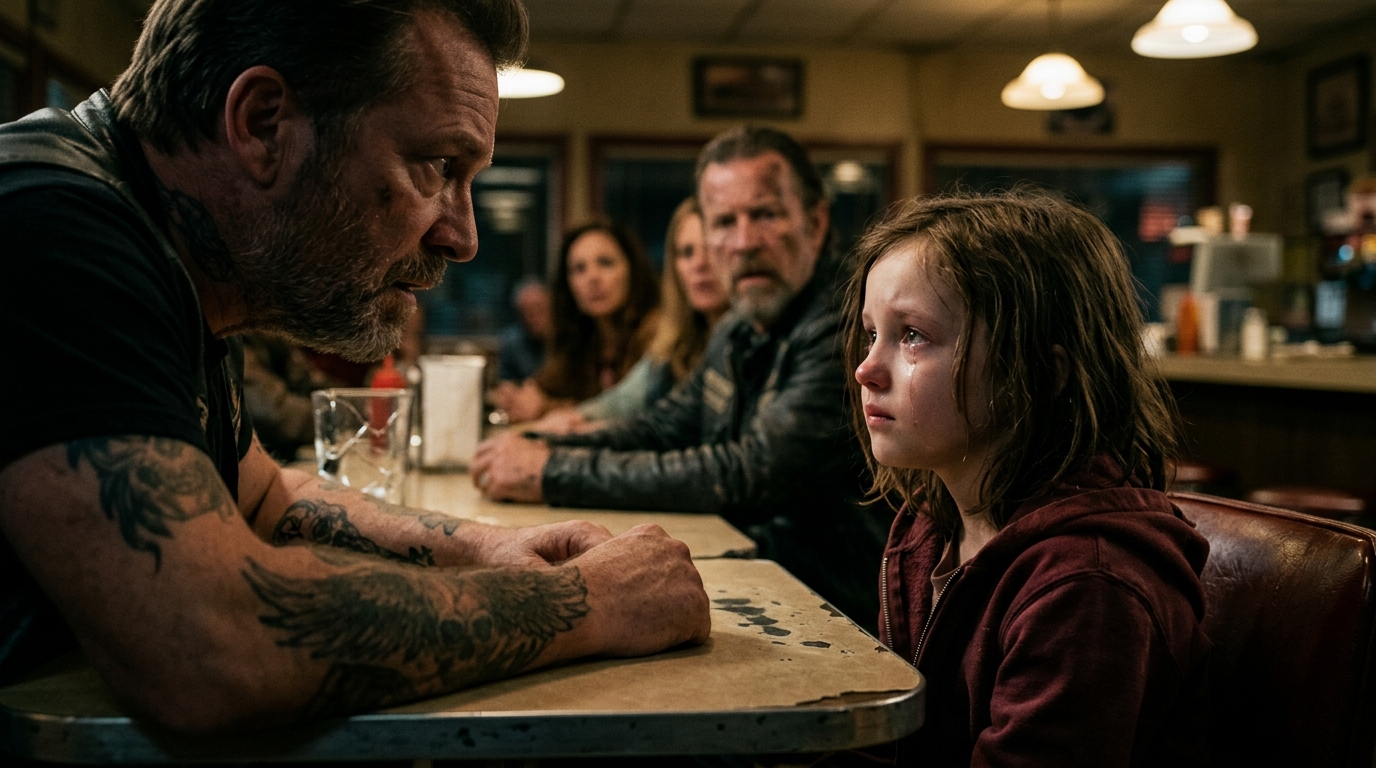
At the center of the table sat Caleb Mercer.
Most people called him Reaper.
He hated the name, but he had stopped arguing with it years ago.
He wore a black leather vest over a dark shirt, his arms covered in old ink. On his left forearm was a tattoo faded with time: a broken compass wrapped in wings, with one word beneath it.
HOME.
The little girl saw that tattoo and began walking.
Slow.
Cautious.
Certain.
A few of the bikers shifted uncomfortably as she approached. One set his coffee down without taking his eyes off her. Another, a heavy man named Bear, leaned back just enough to see the door behind her.
No one else entered.
The girl stopped in front of Caleb.
Close enough to touch his sleeve.
Close enough to feel the heat of the coffee cup near his hand.
Her own hand rose slowly.
Pointing.
At his tattoo.
“My dad had this.”
Her voice was soft.
Delicate.
But it carried.
Caleb went still.
Not surprised.
Not yet.
Still in the way a man becomes when an old wound hears its own name before anyone says it.
“Kid,” he said quietly, “what did you say?”
She stepped closer.
Too close.
The waitress near the counter whispered, “Sweetheart, maybe you should—”
Caleb raised one hand slightly.
The waitress stopped.
The girl looked directly into his eyes.
“He said you would remember him.”
The table went completely still.
Bear’s jaw tightened.
A lean biker near the window muttered, “That’s not possible.”
Caleb leaned forward.
Slowly.
His eyes narrowed, studying the little girl’s face as if something in it terrified him.
“What was his name?”
The question came out low.
Measured.
Like the answer could shatter something.
The girl swallowed.
Tears gathered in her eyes now, but she did not look away.
“Daniel Hayes.”
The name dropped into the diner like a stone through glass.
A cup slipped from someone’s hand.
It shattered on the floor.
No one reacted.
No one could.
Caleb’s face changed.
Shock first.
Then fear.
Then something much deeper.
Recognition.
He looked down at the tattoo on his arm.
Then back at the girl.
His voice barely escaped.
“We buried him.”
The little girl shook her head slowly.
“No,” she whispered. “You didn’t.”
Silence closed in from every side.
The kind that leaves no escape.
Caleb’s hand tightened around the edge of the table.
Bear leaned forward.
“What do you mean, we didn’t?”
The girl reached into the pocket of her coat.
Every biker at the table tensed.
But she pulled out only a small folded piece of cloth.
She opened it carefully.
Inside was a metal ring.
Not jewelry.
A motorcycle ring.
Old.
Scratched.
Blackened at the edges.
Caleb stared at it.
His lips parted.
Bear whispered, “No way.”
The girl placed it on the table.
“My dad said if I ever got scared, I should find the men with the compass wings.”
Caleb did not touch the ring at first.
He stared at it like it might burn him.
Then, with two fingers, he turned it over.
On the inside, barely visible, were three letters.
D.H.
Daniel Hayes.
The man they had mourned.
The brother they had buried.
The ghost who had just sent his daughter into Maggie’s Diner.
Video: A Little Girl Pointed at a Biker’s Tattoo—Then Said the Man They Buried Was Still Alive
The Man They Buried in the Rain
Daniel Hayes had been more than a club member.
He had been the reason half of them were still alive.
Twelve years earlier, the Black Compass Motorcycle Club was not what outsiders imagined. They were mechanics, truckers, veterans, welders, roofers, men and women who had grown tired of watching bad people frighten good ones.
They rode funeral escorts for families who had no one else.
They fixed porches for widows.
They stood outside courtrooms when frightened witnesses had to testify.
They found runaway kids before predators did.
And when local police were too slow, too busy, or too connected, people sometimes came to them first.
Daniel Hayes had been their calm center.
He was not the biggest.
Not the loudest.
But he noticed everything.
A car parked too long across the street.
A man whose smile changed when a child entered the room.
A woman flinching before anyone raised a hand.
He had been a father before he ever had a child.
At least, that was how Caleb remembered him.
Daniel and Caleb had served together overseas. They came home carrying different pieces of the same war and found, in motorcycles, something like forward motion. Daniel was the one who designed the compass-wing tattoo.
“Because we don’t just ride,” he said once. “We bring people home.”
Then came the warehouse fire.
Eight years ago.
A cold November night.
A storage building near the old rail yard went up in flames after a child trafficking investigation Daniel had been quietly helping with. The club had been gathering evidence against a private “youth transport” company moving missing children across county lines.
Daniel had gone to meet an informant.
He never came back.
The fire burned so hot that identification became difficult. Police said dental records confirmed the body was Daniel’s. Caleb was called to the morgue. He signed forms with hands that would not stop shaking.
They buried Daniel three days later in rain.
His coffin was closed.
His ring was missing.
That had bothered Caleb.
Daniel never took that ring off.
But grief is a powerful sedative.
It makes people accept explanations because the alternative is too unbearable.
The authorities said the ring must have melted, been lost, or never been found.
The investigation into the youth transport company collapsed after the fire.
The informant disappeared.
A police lieutenant retired early.
The local news called Daniel’s death a tragic accident connected to “unsafe storage conditions.”
Caleb knew better.
He just could not prove it.
For years, he visited Daniel’s grave on the anniversary of the fire.
He poured coffee into the grass because Daniel hated whiskey and said people only poured it on graves to feel dramatic.
He told Daniel about the club.
About cases.
About people they helped.
About all the ways the world kept being ugly and still worth fighting.
And now a little girl was standing in front of him with Daniel’s ring.
Caleb looked at her.
“What’s your name?”
“Lily.”
The name hit him strangely.
Daniel had once said if he ever had a daughter, he would name her Lily because his mother used to grow them behind the house.
Caleb swallowed.
“Lily Hayes?”
She nodded.
Bear leaned back, rubbing both hands over his face.
One of the younger bikers whispered, “Jesus.”
Caleb kept his voice steady.
“Where is your father?”
Lily looked toward the diner window.
Rain streaked down the glass.
“He told me not to say until I knew it was you.”
Caleb’s eyes sharpened.
“How would you know?”
She looked at his tattoo again.
“Because yours has the broken needle.”
Caleb froze.
On his tattoo, the compass needle had a tiny break near the tip. A mistake from the original artist. Daniel had teased him about it for years.
No one outside the old club knew that.
Caleb pushed his chair back.
The legs scraped against the floor.
“Who brought you here?”
Lily’s lips trembled.
“No one.”
“You came alone?”
She nodded.
“From where?”
She hesitated.
Then whispered:
“The house with no windows.”
The House With No Windows
No one liked that phrase.
The waitress, Maggie, quietly locked the front door.
Not to trap Lily.
To protect her.
Caleb guided the girl into the booth beside him and removed his leather jacket, wrapping it around her shoulders. She disappeared inside it, tiny and shaking.
Doc, the club’s retired nurse, slid into the seat across from her.
“Lily,” she said gently, “are you hurt?”
The girl shook her head.
“Hungry?”
A small nod.
Maggie was already moving.
Within minutes, there was a bowl of chicken soup, toast, water, and a cup of hot chocolate on the table. Lily reached for the soup like someone who had learned not to trust food until it was directly in front of her.
Caleb’s expression darkened.
“Slow,” Doc said softly. “Your stomach needs time.”
Lily obeyed.
Barely.
Caleb waited until she had taken several careful bites before speaking again.
“Tell me about the house.”
Lily kept her eyes on the soup.
“It’s not a house like this.”
“Like what?”
“Like people live there.”
Bear leaned forward.
“Where is it?”
She shook her head.
“I don’t know roads. We always go at night.”
“We?”
Her spoon stopped.
“There are other kids.”
The diner seemed to lose air.
Doc’s face changed first.
Then Caleb’s.
“How many?” he asked.
Lily whispered, “Six.”
Bear muttered something under his breath.
Caleb leaned closer.
“And your father is there?”
She shook her head quickly.
“No. He was.”
“What does that mean?”
Lily looked at the ring on the table.
“He comes and goes. Sometimes they lock him downstairs.”
The words made no sense.
Yet every man at that table believed them immediately.
Children invent monsters in strange shapes.
But they rarely invent logistics.
Downstairs.
Locks.
Night drives.
No windows.
Those were not fairy-tale details.
Those were memories.
Caleb asked, “Who are they?”
Lily’s face tightened.
“The people with white vans.”
Bear looked at Caleb.
The old case rose between them like smoke.
White vans.
Youth transport.
Children moved at night.
A company that vanished after Daniel’s supposed death, then reappeared under new names in other counties.
Caleb’s voice dropped.
“Did your father send you?”
Lily nodded.
“He said I was small enough to get out.”
Doc closed her eyes briefly.
Caleb fought the urge to punch the table.
“What happened?”
The girl’s voice became very quiet.
“They took him yesterday. He came back bleeding. He said if he didn’t come back tonight, I had to run.”
“And did he come back?”
Lily shook her head.
No tears now.
Just exhaustion.
“He told me to follow the road until I saw lights. Then ask for the compass wings.”
Caleb looked at Bear.
“Call Ramirez.”
Bear was already reaching for his phone.
Detective Paul Ramirez had once been a rookie patrol cop who owed Daniel his life after a domestic violence call went bad. Now he worked major crimes and answered when the Black Compass called, even if he complained every time.
Bear stepped away from the table.
Caleb turned back to Lily.
“Can you draw where you came from?”
She nodded.
Maggie brought paper and crayons from behind the counter.
Lily drew slowly.
A road.
A fence.
A building shaped like a rectangle.
A hill behind it.
A tall sign with only one letter she remembered.
K.
Then she drew a water tower.
Caleb stared at it.
He knew that water tower.
So did every old biker at the table.
Kincaid Grain.
An abandoned processing site forty miles outside town.
The same area where Daniel had been heading the night he disappeared.
The Grave That Lied
Detective Ramirez arrived in seventeen minutes.
He walked into Maggie’s Diner soaked from rain, badge clipped to his belt, eyes sharp beneath tired brows.
When he saw Lily wrapped in Caleb’s jacket, his face softened.
Then he saw Daniel’s ring on the table.
His expression changed completely.
“Where did that come from?”
Caleb did not answer.
He did not need to.
Ramirez looked at Lily.
“Sweetheart, can you tell me your name?”
She looked at Caleb first.
Caleb nodded.
“Lily Hayes.”
Ramirez went still.
He looked at Caleb.
“That’s not funny.”
“No one’s laughing.”
Ramirez sat down slowly.
“I was at his funeral.”
“So was I.”
“Caleb…”
“We buried the wrong man.”
The detective’s jaw tightened.
The words were insane.
But the ring was there.
The tattoo detail was there.
The child had drawn Kincaid.
Ramirez asked careful questions. Not too many. Not fast. He had interviewed enough children to know that pressure can damage truth as badly as disbelief.
Lily told him about the white vans.
The basement.
The other children.
The man they called Mr. Vale.
The woman with the blue clipboard.
The locked room where her father sometimes disappeared.
She said Daniel had taught her to count exits in every place she entered.
She said he told her the men with the compass wings would look scary, but they would stop for a child.
Caleb looked away when she said that.
Ramirez called for backup.
State police.
Child recovery unit.
A tactical team.
Ambulances.
Not because he distrusted the bikers, but because this was no longer a club matter.
This was an operation.
While Ramirez made calls, Caleb stepped outside under the diner awning.
Rain fell hard now, turning the parking lot into black glass.
Bear followed him.
For a while, neither spoke.
Then Caleb said, “I signed the paper.”
Bear leaned beside him against the wall.
“What paper?”
“The morgue release.”
Bear exhaled.
“We all believed it.”
“I signed it.”
“Because they told us he was dead.”
Caleb stared into the rain.
“I should have asked about the ring.”
Bear’s voice softened.
“We were standing in a storm beside a closed coffin. Grief doesn’t leave much room for detective work.”
Caleb closed his eyes.
Daniel had been alive.
Maybe trapped.
Maybe tortured.
Maybe forced to watch the world mourn him while the case he died for kept breathing.
And worse—
he had a daughter.
A daughter who had grown up in hiding, captivity, fear, and night roads while Caleb poured coffee over an empty grave.
“I’m going to kill whoever did this,” Caleb said quietly.
Bear nodded.
“I know.”
Caleb opened his eyes.
Bear continued, “But not before we find him.”
That was why Bear was still useful.
He knew how to keep rage pointed toward the work.
Kincaid Grain
They reached the Kincaid site after midnight.
The official convoy staged half a mile back with lights off. Rain had thinned to a mist. The abandoned grain facility rose beyond the trees, dark and hulking against the cloudy sky.
The water tower Lily had drawn stood behind it, its peeling letter K barely visible in the moonlight.
Caleb rode in the lead truck with Ramirez.
He hated not being on his bike.
He hated waiting.
He hated the idea that Daniel might be somewhere inside that building, breathing or not breathing, while men with radios whispered strategy.
But children were inside.
That mattered more than rage.
Lily stayed at the diner with Doc, Maggie, and a uniformed officer. She had cried when Caleb left, gripping his sleeve again.
“Bring my dad back,” she whispered.
Caleb crouched in front of her.
“I will find him.”
“That’s not the same.”
He looked into her eyes.
No child should have known the difference.
“You’re right,” he said. “I’ll do everything I can.”
She nodded once, accepting the only honest promise he could give.
At Kincaid, the team moved in silently.
Two white vans were parked near the rear loading bay.
One had fresh mud on the tires.
Ramirez gave the signal.
The first door was breached at 12:41 a.m.
Everything happened quickly after that.
Shouts.
Boots.
Flashlights cutting through darkness.
A man running through a side exit and colliding with Bear, who had been allowed to assist with perimeter identification but not entry.
Bear later described it as “gravity helping justice.”
Inside, the facility had been converted.
Not professionally.
Functionally.
Temporary walls.
Cots.
Locks.
Storage rooms turned into holding spaces.
Medical supplies.
Files.
Children’s clothing in plastic bins.
A room with six mattresses.
Five children were found there, frightened but alive.
The sixth mattress was empty.
Lily’s.
Ramirez’s team found three adults trying to destroy papers in an office.
The woman with the blue clipboard was arrested there.
Mr. Vale was found behind a locked interior door, holding a gun and shouting that he had legal authority over everyone on the property.
He did not.
What he did have was a ledger.
Names.
Payments.
Transfers.
Routes.
And near the bottom of one page, a name Caleb recognized.
D. Hayes.
Status: Noncompliant asset.
Caleb nearly lost control when Ramirez showed him.
“Where is he?” Caleb demanded.
Mr. Vale smiled with blood on his lip.
“You’re too late.”
Caleb stepped forward.
Ramirez blocked him.
“Don’t.”
Caleb’s hands curled.
Mr. Vale kept smiling.
“He should have stayed buried.”
Then, from somewhere below the floor, a sound echoed.
Three knocks.
Slow.
Deliberate.
A pause.
Then three more.
Caleb froze.
Daniel had a signal from their service days.
Three knocks meant alive.
Three more meant trapped.
Caleb turned toward the sound.
“Basement.”
The Man Beneath the Floor
The basement entrance had been hidden beneath a movable shelving unit.
The tactical team pulled it aside and found a narrow stairwell leading down into concrete darkness.
The air below smelled of mold, rust, and old water.
Caleb was not supposed to go down.
Ramirez told him twice.
Caleb ignored him twice.
On the third time, Ramirez looked at him and said, “Stay behind me or I cuff you.”
Caleb stayed behind him.
Barely.
They found Daniel in a locked utility room.
Alive.
Barely.
He was thinner than Caleb remembered. His beard was longer, streaked with gray. One eye was swollen. His wrists were marked from restraints. His right shoulder hung awkwardly, like it had been injured and never set properly.
But when the flashlight hit his face, he smiled.
A cracked, impossible smile.
“About time,” he rasped.
Caleb could not move.
For eight years, he had imagined Daniel as bones beneath wet earth.
Now the dead man was sitting against a concrete wall, alive enough to be sarcastic.
Caleb dropped to his knees.
“You son of a—”
Daniel laughed once, then coughed hard.
Ramirez called for medics.
Caleb reached for him, then stopped, afraid to hurt him.
Daniel lifted his left hand weakly.
Caleb grabbed it.
Hard.
Both men held on.
For a moment, neither spoke.
Then Daniel whispered, “Lily?”
“She got out.”
Daniel’s eyes closed.
The relief that moved through him looked almost painful.
“She found you?”
“She walked into Maggie’s and scared ten years off my life.”
Daniel smiled faintly.
“That’s my girl.”
Caleb’s throat burned.
“We buried you.”
Daniel opened his eyes.
“I know.”
“What happened?”
His gaze moved toward the ceiling.
“Vale had friends. Police. Medical examiner. Transport officials. They needed Daniel Hayes dead, so they made me dead.”
“The body?”
“Informant. Already killed when I got there. Same build. Same dental work altered enough to pass if no one looked too hard.”
Caleb’s jaw tightened.
“I should have looked harder.”
Daniel’s grip tightened weakly.
“Don’t.”
Caleb looked at him.
Daniel’s eyes were fierce despite everything.
“Don’t waste time making their lie your fault.”
That nearly broke him.
Medics arrived.
They lifted Daniel carefully onto a stretcher.
As they carried him toward the stairs, Daniel turned his head toward Caleb.
“My ring?”
Caleb pulled it from his pocket.
“Your daughter brought it.”
Daniel’s eyes filled.
“She hated giving it up.”
“She said you told her to.”
“I told her it would bring you.”
Caleb placed the ring in Daniel’s palm.
Daniel closed his fingers around it.
“It did.”
Lily Sees Her Father Again
They took Daniel to St. Mary’s under police guard.
Lily arrived an hour later.
Doc brought her wrapped in a blanket, hair brushed by Maggie, eyes wide with terror.
Caleb met her in the hallway.
“He’s alive,” he said before she had to ask.
Her knees buckled.
He caught her.
For a second, she clung to him as if the floor had disappeared.
“Can I see him?”
“He’s hurt. There are doctors.”
“Can I see him?”
Caleb looked at Doc.
Doc looked at the nurse.
The nurse looked through the glass at Daniel, who had refused sedation until he saw his daughter.
“Yes,” the nurse said softly. “For a minute.”
Lily walked into the room slowly.
Daniel lay in the bed, bruised, bandaged, pale under the hospital lights.
When he saw her, his face changed.
Every hard line broke.
“Lilybug,” he whispered.
She ran then.
The nurse tried to stop her from climbing onto the bed, but Daniel lifted one arm and Lily folded herself against him carefully, sobbing into his chest.
“You came back,” she cried.
Daniel closed his eyes.
“I told you I would try.”
“You didn’t come.”
“I know.”
“I waited.”
“I know.”
Her small fists tightened against the hospital blanket.
“I was scared.”
Daniel pressed his lips to her hair.
“So was I.”
Caleb stood near the door, unable to look away and unable to breathe properly.
Bear wiped his face and claimed allergies.
Doc did not bother pretending.
Ramirez stood in the hall, speaking into his phone, already building the next stage of the case.
Because Kincaid was not the whole network.
It was one node.
One storage point.
One house with no windows among many.
The ledger would open more doors.
Some children would be found.
Some would not.
Some families would learn the truth.
Some truths would arrive too late.
That was the kind of work Daniel had nearly died doing.
Now he had survived to finish it.
The Empty Grave
Two weeks later, Caleb drove to the cemetery alone.
Daniel was still in the hospital.
Lily was safe in protective care with Doc and Maggie taking turns spoiling her until Daniel could make decisions. The other children from Kincaid were receiving medical care, interviews, and reunification support.
Vale was in custody.
The woman with the blue clipboard had started talking.
Three officials had already resigned.
One had vanished.
The case was far from over.
But Caleb needed to see the grave.
It sat near the back of the cemetery under an old oak tree.
Daniel Hayes.
Brother. Protector. Friend.
Gone but never forgotten.
Caleb stood in front of it with two coffees.
One for him.
One for the ground.
He had done this every year.
Now he felt foolish.
Then angry at feeling foolish.
Then sad beyond either.
He crouched and placed one cup beside the stone.
“You dramatic bastard,” he said.
The wind moved through the grass.
For a while, he said nothing else.
Then:
“I’m sorry.”
He hated how small the words sounded.
“I know you told me not to make it my fault. I heard you. I’m ignoring you for a minute.”
A crow called somewhere behind the oak.
Caleb looked at the name carved in stone.
“Your girl found us.”
His voice broke.
“She walked right up to my table like she owned the room. You would’ve laughed.”
He wiped his face with one hand.
“She has your eyes. And your terrible sense of timing.”
The cemetery remained quiet.
Caleb took the second coffee and poured it into the grass.
Then he stood.
“We’re changing the stone.”
A week later, the grave was opened under official order.
The body inside was identified properly this time.
The informant Daniel had gone to meet.
A man named Peter Voss, no relation to Vale, who had tried to expose the network and paid for it with his life.
His surviving sister was found in Oregon.
She came to the reburial.
Daniel attended in a wheelchair.
Lily sat beside him, holding his hand.
Caleb stood behind them with the Black Compass.
Peter received his own grave, his own name, his own truth.
Daniel’s old stone was removed.
Lily asked if they could keep a piece.
Daniel said no.
“Why?” she asked.
He looked at the place where his name had been carved into a lie.
“Because I’m not there.”
The Compass Wings
Months passed before Daniel could ride again.
His injuries were worse than he admitted.
Old fractures.
Nerve damage.
Malnutrition.
A shoulder that would never fully recover.
Nightmares he did not tell Lily about, though she probably knew anyway.
He moved into a safe house first.
Then into a small rental near Maggie’s Diner.
Caleb visited every day at first, then every other day when Daniel threatened to fake his death again just to get some peace.
Lily started school under protection.
She carried a small drawing in her backpack: a compass with wings.
When asked what it meant, she said, “It means people can come home.”
The Black Compass changed after Kincaid.
They had always helped people quietly.
Now they worked with official task forces, survivor advocates, child recovery specialists, and investigators who had once dismissed them as vigilantes.
Caleb hated meetings.
Bear hated paperwork.
Doc loved telling both of them to stop whining because children had been rescued and forms were not fatal.
Daniel, still recovering, became a consultant on the case.
No one knew the network better.
Not because he had studied it from the outside.
Because he had survived inside it.
At the first meeting, a federal agent asked him how he stayed alive for eight years.
Daniel looked at Lily, who was drawing at the corner table under Doc’s supervision.
“I had something to send out,” he said.
The agent thought he meant evidence.
Caleb knew he meant his daughter.
One year after Lily walked into Maggie’s Diner, the club gathered there again.
Same table.
Same coffee.
Different silence.
Daniel sat beside Caleb.
Lily sat between them, eating fries with the seriousness of a judge.
Bear leaned across the table.
“You know, technically, you owe us eight years of coffee.”
Daniel raised an eyebrow.
“I was kidnapped.”
“Excuses.”
Lily giggled.
Caleb looked at Daniel’s forearm.
The tattoo was still there.
Faded.
Scarred.
But there.
A broken compass wrapped in wings.
HOME.
Daniel noticed him looking.
“Thinking of getting yours fixed?”
Caleb glanced at the broken needle on his own tattoo.
“No.”
Daniel smiled faintly.
“Good.”
Lily looked between them.
“Why?”
Caleb leaned back.
“Because the mistake helped you know it was me.”
She considered that.
Then nodded.
“Then it’s not a mistake anymore.”
No one spoke for a moment.
Daniel looked down at his daughter.
“No,” he said softly. “I guess it isn’t.”
Outside, motorcycles lined the wet curb.
Inside, the diner hummed with ordinary life again.
Forks against plates.
Coffee pouring.
Maggie arguing with a customer about pie.
Rain tapping the windows.
But everyone who had been there remembered the day the little girl walked in.
The bell.
The footsteps.
The tattoo.
The name that should have belonged only to a grave.
Daniel Hayes.
They remembered the glass falling and no one reacting.
The ring on the table.
The drawing of the water tower.
The basement knocks.
The hospital reunion.
The empty grave.
And the truth that had waited eight years for a child brave enough to carry it through the door.
Lily had not known the whole story when she stepped into that diner.
She only knew what her father told her:
Find the compass wings.
Tell them my name.
Don’t let fear turn you around.
So she didn’t.
And because one little girl refused to turn around, the dead came home, the hidden were found, and the grave that lied finally lost its name.