The Boy at the Golden Safe
Crystal chandeliers burned above the ballroom like captured stars.
Beneath them, the rich laughed softly into champagne flutes, their voices floating over marble floors, white roses, and gold-trimmed tables arranged with the exact arrogance of people who believed beauty could make cruelty look elegant.
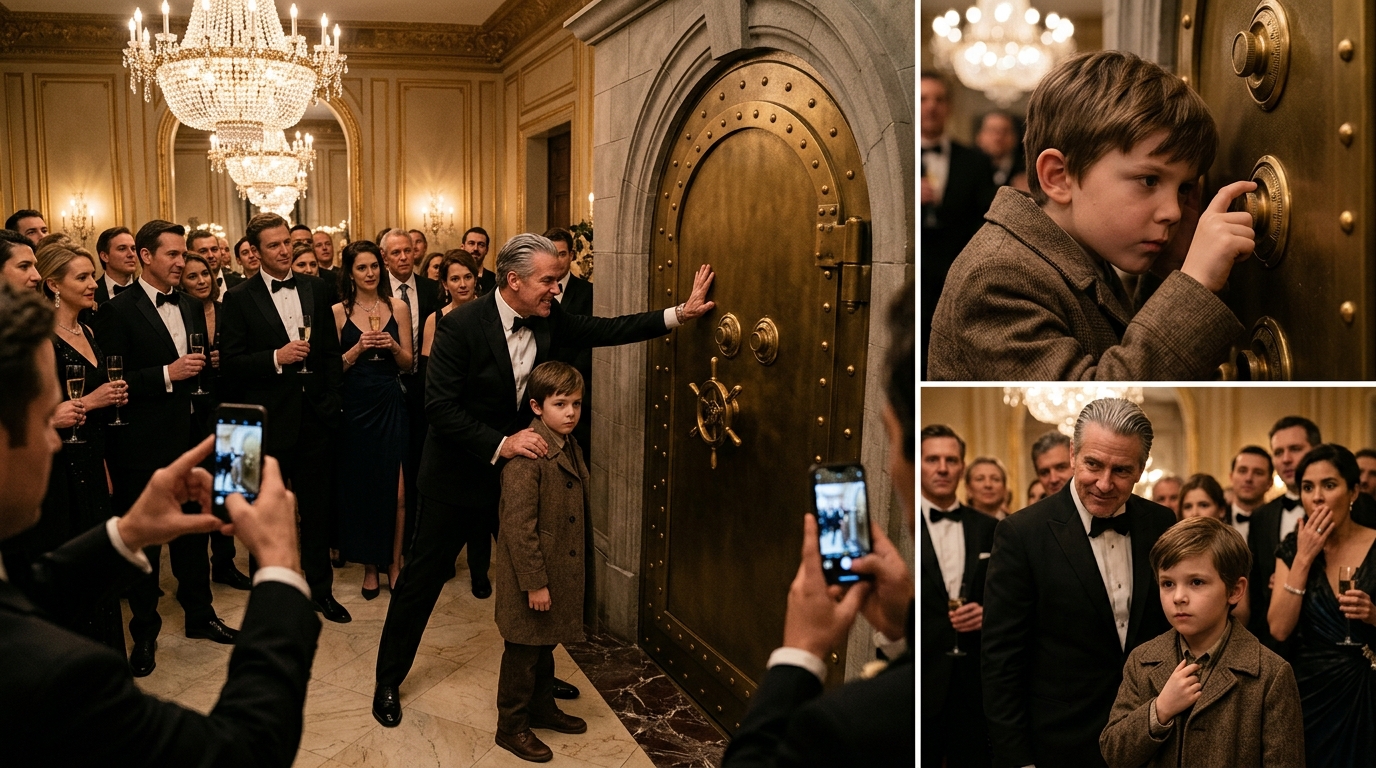
At the center of the ballroom stood the safe.
Not hidden.
Displayed.
A colossal golden vault door mounted into the far wall beneath a velvet curtain, polished so brightly it reflected every face in the room. Guests had been admiring it all night, whispering about its history, its weight, its impossible lock.
It was not merely a safe.
It was a trophy.
Victor Harrow had made sure of that.
He stood beside it in a black tuxedo, one hand resting on the golden surface like a king touching a conquered throne. He was broad-shouldered, silver-haired, and smiling with the confidence of a man who had spent twenty years turning other people’s losses into his own legend.
The Harrington Foundation Gala was supposed to celebrate him.
Hotel magnate.
Art collector.
Philanthropist.
Self-made billionaire, according to magazines that never asked who had been stepped on during the making.
Then Victor noticed the boy.
Small.
Still.
Out of place.
He stood near the side entrance in a brown tweed coat too old-fashioned for his age. His shoes were polished but worn at the edges. His hands were folded calmly in front of him.
He could not have been more than eleven.
A waiter moved toward him, confused.
Victor laughed.
“Wait.”
The room turned.
Victor’s eyes gleamed with the kind of amusement that made people nervous before they knew why.
“Don’t remove him,” he said. “Let’s see what he wants.”
The boy did not move.
Victor walked across the ballroom slowly, enjoying the attention. Cameras lifted. Guests leaned closer. They expected charm. A harmless rich man’s joke. Maybe a charitable moment fit for the morning papers.
Instead, Victor placed one heavy hand between the boy’s shoulder blades and pushed him toward the golden safe.
The child stumbled once but did not fall.
Laughter fluttered through the room.
Victor slapped the vault door.
The sound cracked across the ballroom.
“I’ll give you ten thousand dollars,” he announced, “if you can get it open.”
The laughter grew louder.
Someone near the champagne table began recording.
The boy looked at the safe.
Not with wonder.
Not with fear.
Recognition.
That was the first thing Victor missed.
The boy stepped closer.
His small fingers touched the cold golden surface with a familiarity too quiet to notice unless one knew what guilt looked like when it began to wake.
The laughter thinned.
The boy leaned in and pressed one ear against the lock.
Victor grinned.
“Go on, little man. Impress us.”
The boy did not answer.
He listened.
The ballroom became curious.
Then uneasy.
The boy’s fingers moved across the dial in small, careful turns.
Left.
Pause.
Right.
Pause.
Another turn.
Deep inside the mechanism, something shifted.
Click.
The room froze.
Victor’s smile faltered.
Not vanished.
Not yet.
But cracked.
The boy turned his head slightly.
“Are you certain?”
A murmur moved through the guests.
Victor forced a laugh.
“Open it.”
The boy placed one hand on the handle.
His face remained calm.
Too calm.
A second click echoed from inside the vault.
Victor stepped closer.
His voice dropped.
“Who taught you that?”
The boy kept turning the mechanism.
“My father constructed this safe.”
The words moved through the ballroom like cold wind.
Victor’s hand shot out.
He seized the boy’s arm.
“Stop.”
The boy looked up at him.
No fear.
No surprise.
Only a stillness that made Victor’s grip tighten.
“Why?” the boy asked. “Is your name still inside?”
Victor went pale.
Every guest saw it.
The great Victor Harrow, whose smile had survived lawsuits, bankruptcies, funerals, and betrayals, suddenly looked like a man hearing footsteps behind a locked door.
Then came the final sound.
A loud metallic click.
The vault door shifted.
Slowly.
On its own.
Victor whispered, “No… it can’t open without two keys.”
For the first time, the boy smiled.
“You have one.”
He reached into his coat and pulled out an old brass key on a frayed chain.
Gasps rippled through the ballroom.
Victor stared at it as if it were a dead man’s hand.
“Where did you get that?”
The boy’s voice remained steady.
“From the woman you paid to vanish.”
The Key From the Woman Who Vanished
Victor did not release the boy immediately.
That was his second mistake.
The first had been laughing.
The boy’s name was Caleb Mercer, though almost no one in that ballroom knew it yet.
To most of them, he was simply a child in a brown coat interrupting the evening’s entertainment.
To Victor Harrow, he was something else entirely.
A loose end.
Caleb looked down at Victor’s hand gripping his sleeve.
Then back up.
“You’re hurting me.”
The sentence was soft.
It carried anyway.
Several guests shifted uncomfortably.
Victor let go.
He recovered quickly, or tried to. He turned toward the crowd with a laugh that sounded half a second too late.
“This is a prank,” he said. “A clever one. Maxwell, did you arrange this?”
Across the room, Maxwell Reed did not smile.
He was the evening’s honorary chair, an old banker with white hair, a cane, and the rare power of being too rich to flatter anyone. He had been watching the boy since the first click.
“No,” Maxwell said. “I did not.”
The silence deepened.
The vault door opened another inch.
Inside, darkness waited.
Caleb slipped the brass key into the second lock beneath the main dial.
Victor moved again.
This time, two security men stepped forward with him.
But Maxwell lifted one hand.
“Let the child finish.”
Victor glared at him.
“You don’t understand what you’re interfering with.”
Maxwell’s eyes narrowed.
“That sentence usually means I understand enough.”
Caleb turned the key.
The vault door gave a low groan.
Heavy.
Old.
Awake.
The guests stepped back instinctively as the golden door swung open.
Inside were rows of boxes, ledgers, sealed files, and one framed photograph resting upright on a velvet shelf.
Caleb pointed.
“Tell them who’s in the picture.”
Victor did not move.
A woman in a silver gown stepped forward.
Her name was Celia Harrow.
Victor’s wife.
She had been smiling all night with a fixed, polished patience, but now her face held confusion more than fear.
“Victor?” she whispered.
He did not answer.
Celia reached into the vault and lifted the frame.
The moment she looked at it, she screamed.
The sound tore through the ballroom.
The photograph showed Victor Harrow twelve years younger, standing beside a woman in a blue dress.
In her arms was a newborn baby.
The baby wore a tiny hospital bracelet.
Beside them stood another man, thinner, darker-haired, with kind eyes and grease under his fingernails.
The boy in the ballroom had those eyes.
Caleb looked at Victor.
“That’s my mother,” he said. “That’s my father. And that’s you.”
The room went still.
Victor’s mouth opened.
No sound came.
Caleb stepped closer to the vault.
“My mother said you would pretend not to remember. She said rich men call old photographs fake when the truth has no lawyer.”
Maxwell’s expression sharpened.
“What was your father’s name?”
Caleb looked at him.
“Elias Mercer.”
That name changed the room.
Not for everyone.
But for the older guests.
For the bankers.
For the attorneys.
For the men and women who had been around long enough to remember the story before Victor owned it.
Elias Mercer had been the engineer credited in no documents and whispered about in too many.
He designed vault systems no one could crack.
Then he disappeared.
Officially, he died in a workshop fire.
Unofficially, Victor Harrow became very rich shortly afterward.
The golden safe began to look different.
Less like a trophy.
More like evidence.
Victor finally found his voice.
“Elias Mercer was a thief.”
Caleb reached into the vault and pulled out a slim black ledger.
“No,” he said. “He was your partner.”
Then he opened the ledger to the first page.
Written across the top, in careful ink, were four words:
For my son, Caleb.
The Files Behind the Gold
Victor lunged for the ledger.
He never reached it.
Maxwell’s cane struck the marble once.
Hard.
Security stopped—not because Victor ordered them to, but because every phone in the ballroom was now pointed at the vault.
That was the difference between private cruelty and public collapse.
Cruelty thrives in controlled rooms.
But this room was no longer controlled.
Caleb placed the ledger on a nearby table.
His hands were small, but steady.
“My father built this safe for three people,” he said. “Himself, my mother, and Mr. Harrow.”
Victor’s face darkened.
“You don’t know what you’re talking about.”
“My mother knew.”
At the word mother, something in Caleb’s voice shifted.
Not weakness.
Grief.
Her name was Anna Mercer.
Once, she had worked as Victor Harrow’s private bookkeeper. Before that, she was Elias Mercer’s wife. Before that, according to the old photograph, she was a young woman holding her newborn son while standing beside two men who had supposedly trusted each other.
Caleb took a folded letter from his coat pocket.
The paper was worn soft from being opened too many times.
“My mother said I should only read this in front of witnesses.”
Victor took one step back.
Caleb began.
“If Caleb is standing in front of the golden safe, then I failed to protect him from the past, but I succeeded in keeping him alive long enough to open it.”
The ballroom listened.
Every face.
Every camera.
Every breath.
Caleb continued.
“Elias built the Harrow Vault before Victor Harrow became a billionaire. It was not commissioned as art. It was built to protect the original partnership documents for Harrow-Mercer Security Systems.”
Maxwell whispered, “Harrow-Mercer.”
Celia turned slowly toward Victor.
“You told me Mercer was an employee.”
Victor’s jaw clenched.
Caleb read on.
“Elias owned forty-nine percent of the company and full rights to the locking mechanism. Victor wanted both. When Elias refused to transfer ownership, Victor accused him of theft, arranged false debt records, and paid men to burn the workshop.”
A woman near the back gasped.
Victor’s voice rose.
“This is fiction.”
Caleb looked up.
“My father recorded everything.”
He reached into the vault and removed a small metal box.
It was dented.
Smoke-stained.
Surviving.
Inside were cassette tapes, old data drives, and sealed envelopes marked with dates.
Maxwell stepped closer.
“May I?”
Caleb nodded.
Maxwell lifted the first envelope.
His hands trembled.
Not with age.
Recognition.
“This is Elias’s seal.”
Victor’s eyes darted toward the side doors.
The exits were now blocked by guests, staff, and two men in dark suits who had entered quietly during the chaos.
Maxwell saw them and smiled faintly.
“Federal agents?” Victor asked, voice thin.
Maxwell looked at Caleb.
“I assume your mother planned that too?”
Caleb nodded.
“She said rich rooms only become honest when someone outside is already listening.”
The agents moved forward.
One woman lifted her badge.
“Victor Harrow, no one leaves with documents from this room.”
Victor looked at the open vault.
Then at Caleb.
Then at the photograph still in Celia’s shaking hands.
“You have no idea what that woman did,” he said.
Caleb’s face changed.
For the first time, anger showed.
“My mother raised me in motel rooms because of what you did.”
Victor laughed bitterly.
“She took money.”
“She took proof.”
The boy’s answer landed hard.
Caleb reached into the vault one last time and pulled out a small blue baby blanket, folded around a hospital bracelet.
His voice softened.
“She took me.”
The federal agent looked at the bracelet.
Then at the ledger.
Then at Victor.
Caleb spoke into the silence.
“She said you paid her to vanish, but not because she was guilty. Because if anyone knew I existed, the partnership clause would activate.”
Maxwell closed his eyes.
He remembered.
Everyone could see it.
“What clause?” Celia whispered.
Maxwell opened the ledger.
His voice was grave.
“If Elias Mercer died before his shares were transferred, his ownership passed to his legal heir.”
He looked at Caleb.
“His son.”
The Man Who Built the Safe
The truth did not come out neatly.
It never does.
First came denial.
Then legal threats.
Then Victor’s attempt to laugh the entire thing away as a staged extortion scheme.
But the vault kept speaking.
Every file inside had been preserved behind gold for twelve years, waiting for the only two keys that could open it.
Victor had kept one.
Because he was arrogant.
Because he believed no one else would ever return with the second.
Anna Mercer had kept the other.
Because she was smarter than he was.
The brass key on Caleb’s chain had passed through shelters, pawnshops, church basements, motel drawers, and the lining of an old winter coat. Caleb’s mother had carried it against her chest until the week before she died.
Cancer took her slowly.
Fear took longer.
Before she passed, she told Caleb the story in pieces.
Your father built beautiful things.
Your father trusted one bad man.
Your father put the truth where greed would guard it.
When I am gone, find the golden safe.
Caleb did not come alone.
That was another thing Victor learned too late.
The federal agents were there because Anna had mailed copies of three documents to Maxwell Reed two months earlier.
Maxwell had known Elias.
Not well enough to save him.
That guilt showed in his face as he stood beside Caleb, reading the files.
“I heard rumors,” Maxwell said quietly. “After the fire. I asked Victor about them.”
“And?” the federal agent asked.
Maxwell looked at Victor.
“He told me Elias had lost his mind.”
Victor’s old pattern.
Madness.
Theft.
Instability.
All the words powerful men use when they need honest people to sound unreliable.
But Elias Mercer had prepared for that too.
One of the tapes was played through the ballroom’s sound system.
At first, there was only crackling.
Then Elias’s voice filled the room.
Calm.
Tired.
Alive.
“My name is Elias Mercer. If this recording is being heard, then Victor has either killed me or convinced the world I betrayed him.”
Celia lowered herself into a chair.
Victor stood perfectly still.
Elias continued.
“The vault cannot be opened by force. It requires Victor’s key and Anna’s key because I wanted my partner to understand something: truth only stays buried while the guilty and the grieving remain apart.”
Caleb stared at the speaker.
It was the first time he had ever heard his father’s voice.
Anna had described it.
Warm.
Patient.
A little rough when he was tired.
But hearing it made Caleb’s face fold inward.
He did not cry loudly.
He simply stood there with both hands clenched at his sides, trying to be as brave as the adults in the room suddenly needed him to be.
The recording continued.
“I have placed inside this vault the original partnership contract, invention assignments, insurance records, payment transfers, and my son’s birth acknowledgment. Caleb Mercer is my child. If I am gone, he owns what I built.”
Victor whispered, “Turn it off.”
No one did.
Elias’s voice sharpened.
“Anna, if you are hearing this with Caleb, I am sorry. I should have run when you told me to. I thought law would protect us because I had never watched money bend it up close.”
The tape clicked.
Then ended.
Silence followed.
Not shock now.
Shame.
The kind that spreads unevenly through a room when people realize they had admired a thief because the stolen thing was polished before they saw it.
Celia looked at Victor.
“Did you kill him?”
He did not answer.
But he looked toward the vault.
Toward the rows of documents.
Toward the agents.
Toward the boy.
And in that silence, his empire began to fall.
The Name in the Picture
Victor was not arrested that night.
Not immediately.
That disappointed the crowd, though no one admitted it.
People like dramatic justice when they are not responsible for making it happen.
But federal investigations do not move like applause.
They move like locks.
One click at a time.
The ballroom was cleared. The vault sealed. The files cataloged. The tapes copied. The photograph taken as evidence.
Caleb sat in a side room wrapped in a hotel blanket while a federal child advocate asked questions gently.
He answered most.
Not all.
Some questions belonged to his mother, and she was gone.
When asked why he agreed to be pushed toward the safe instead of speaking first, he looked at the advocate and said:
“Because he needed to laugh before he listened.”
That sentence traveled through the investigation like a match in dry grass.
Victor had laughed.
The whole room had laughed.
And in doing so, they gave Caleb what Anna knew he would need.
Witnesses.
The files inside the vault exposed everything.
The original Harrow-Mercer partnership agreement.
Victor’s forged transfer attempts.
Payments to the men who set the workshop fire.
Insurance claims filed before the fire occurred.
A false police statement accusing Elias of embezzlement.
A sealed adoption inquiry for “Mercer child — locate and contain.”
Anna had not merely vanished.
She had been hunted.
For twelve years, she moved Caleb from town to town, never staying long enough for school photos, sports teams, birthdays with neighbors, or any of the ordinary things children should be allowed to keep.
She cleaned offices at night.
Worked diners.
Slept in shelters when money ran out.
And every year on Caleb’s birthday, she showed him the brass key and said:
“One day, this opens your father’s truth.”
Caleb used to think that meant treasure.
It did not.
It meant grief with documents.
It meant a room full of strangers learning his father was not a thief.
It meant standing in front of the man who ruined his family and watching fear replace laughter.
Victor’s trial lasted nearly a year.
By then, the media had given the story several names.
The Golden Vault Scandal.
The Boy With the Brass Key.
The Safe That Opened a Billion-Dollar Lie.
Caleb hated all of them.
Maxwell became his temporary guardian during the case.
Not because he deserved redemption.
He said that himself.
“I failed your father,” Maxwell told Caleb one evening.
They were sitting in the old library of Maxwell’s home, where rain touched the windows and the recovered photograph rested on the table between them.
Caleb looked at him.
“Did you know?”
“I suspected.”
“That’s not the same.”
“No,” Maxwell said. “It is worse than knowing in some ways. Suspicion gives cowards permission to wait.”
Caleb thought about that.
Then nodded once.
He appreciated honesty more than comfort.
The court eventually restored Elias Mercer’s name and ownership rights to his estate. Victor was convicted of conspiracy, fraud, evidence tampering, arson-related charges, and financial crimes connected to the stolen company.
The murder charge took longer.
The man who set the workshop fire testified after Victor’s accountant turned over hidden payments.
By then, Victor’s hair had gone fully white.
He looked smaller in court.
Not poor.
Not ruined enough.
Just reduced.
Celia divorced him before sentencing.
At the final hearing, Caleb wore the same brown tweed coat from the ballroom. It fit better now because he had gained weight. His shoes were new, but he kept the old brass key around his neck.
The judge asked if he wanted to speak.
Caleb stood.
He unfolded one page.
“My mother told me not to hate Mr. Harrow,” he read. “She said hate is heavy, and I was already carrying enough.”
He looked at Victor.
“But she also said forgiveness is not the same as silence.”
Victor stared down.
Caleb continued.
“My father built a safe because he thought truth needed protection. My mother carried the key because she thought I deserved to know him. I’m here because they were both right.”
The courtroom was silent.
Caleb folded the paper.
“That’s all.”
It was more than enough.
The Vault That Became a Door
Two years later, the golden safe no longer stood in Victor Harrow’s ballroom.
The mansion was sold after the bankruptcy proceedings.
The chandeliers went to auction.
The art disappeared into private collections.
The ballroom became part of a cultural center funded by the Mercer Restoration Trust, created from recovered assets Victor had stolen.
Caleb chose what happened to the safe.
People expected him to melt it down.
Or hide it.
Or keep it as a monument to victory.
He did none of those things.
He had it moved to the entrance hall of the new Elias Mercer School of Design and Engineering, a free technical program for children from families who could not afford private education.
The golden surface remained scratched.
The old lock remained visible.
The two keyholes stayed where they were.
Beside it, a plaque read:
Built by Elias Mercer.
Opened by Caleb Mercer.
A reminder that what is stolen can still return with the right key.
Caleb visited the school often.
Not as a symbol.
He hated being called that.
He liked the workshop rooms best.
The smell of wood, solder, metal filings, and pencil shavings made him feel closer to a father he never truly knew but had somehow carried all his life.
On the first anniversary of the school’s opening, Maxwell handed him something wrapped in cloth.
Caleb opened it carefully.
Inside was the framed photograph from the vault.
Restored.
Victor had been removed.
Not erased dishonestly.
Just cropped away from the center.
Now the image showed Elias Mercer standing beside Anna, who held newborn Caleb in her arms.
A family, before the world broke it.
Caleb stared at it for a long time.
“Is that wrong?” Maxwell asked. “Removing him?”
Caleb shook his head.
“No.”
Then, after a pause:
“He put himself in the picture. He didn’t belong there.”
Maxwell’s eyes filled.
“No. He didn’t.”
Caleb hung the photograph in the school library.
Not in the lobby.
Not where reporters could pose beside it.
In the library, where children sat quietly and learned things that might one day save them.
Years passed.
Caleb grew taller.
His voice changed.
The tweed coat was folded away in a cedar box, along with his mother’s letters and the brass key.
But he never stopped visiting the vault.
Sometimes he brought students to it and explained the mechanism. How sound mattered. How pressure changed resistance. How a lock could be designed to defend against force but yield to memory.
He never began with Victor.
He began with Elias.
“My father believed a safe should protect more than valuables,” he would say. “It should protect what someone cannot afford to lose.”
One afternoon, a little girl in the engineering program raised her hand.
“What did you lose?”
Caleb looked at the vault.
Then at the children watching him.
He could have said his father.
His mother.
His childhood.
His name.
All true.
None complete.
Instead, he touched the brass key beneath his shirt.
“I lost the chance to know the people who loved me,” he said. “But they left me enough to find my way back.”
The girl thought about that.
Then asked, “Did opening it make you happy?”
Caleb smiled faintly.
“No.”
The children looked confused.
He continued.
“But it made the truth stop being lonely.”
That was the best answer he had.
The ballroom night became a story people told for years.
A rich man laughing.
A boy touching a golden safe.
A click.
A key.
A photograph.
A scream.
But Caleb remembered it differently.
He remembered his mother’s hand placing the brass key around his neck.
He remembered her voice, weak but certain.
When they laugh at you, let them. Laughter makes arrogant people careless.
He remembered stepping toward the safe, not because he was fearless, but because every child eventually reaches the door their parents could not open for them.
He remembered Victor’s face when the final lock released.
Not because it was satisfying.
Because it proved something Caleb needed to know.
The truth had waited.
His father had waited.
His mother had carried him to that moment through every mile of running.
And when the vault door finally opened, it did not simply reveal files, ledgers, or old gold.
It gave a stolen family back its name.