The Flyer Behind the Counter
“I need one room.”
My voice sounded wrong even to me.
Too rough.
Too tired.
Too close to breaking.
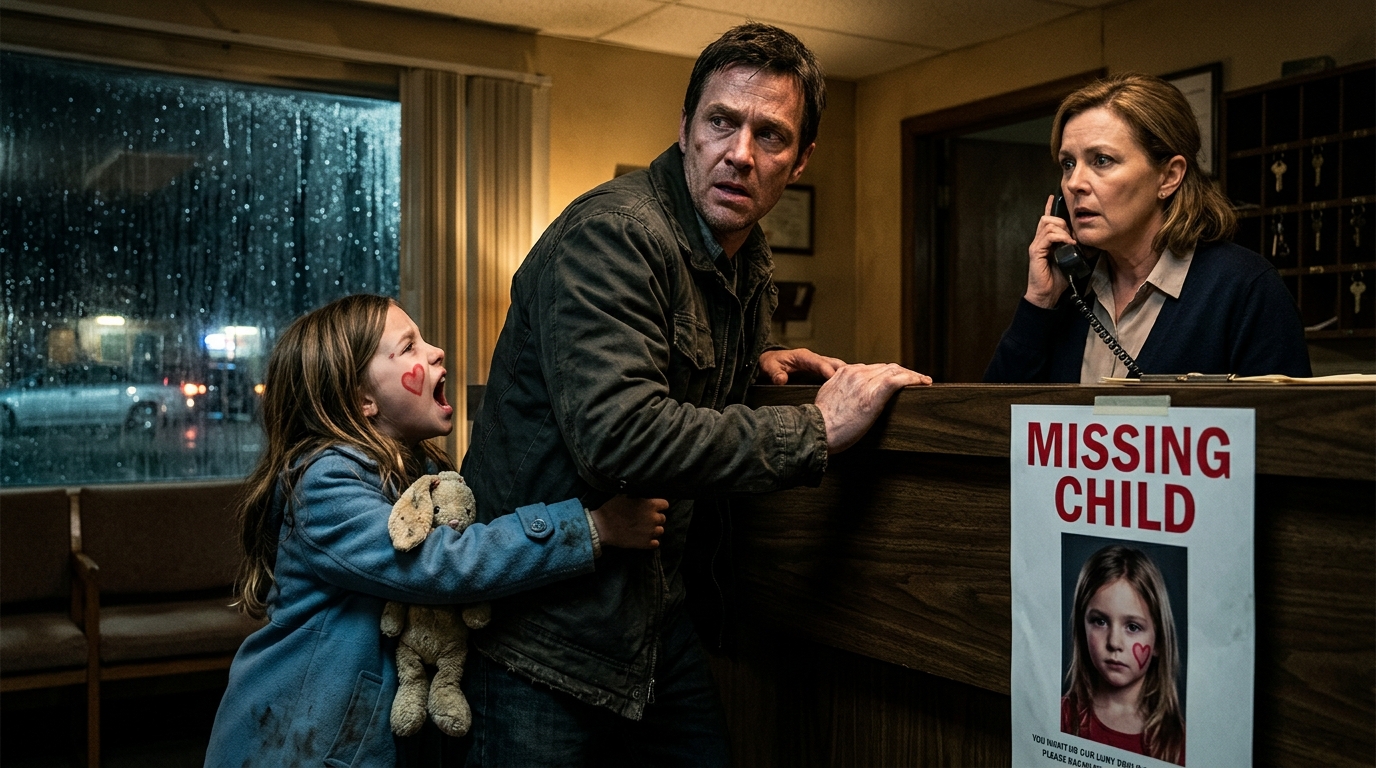
Rain hammered the motel windows so hard the glass looked like it was breathing. Water ran in silver sheets beneath the neon sign outside, turning the parking lot into a shallow black river. The old vacancy light flickered red across the lobby tiles.
VACANCY.
NO VACANCY.
VACANCY.
Like even the sign couldn’t decide whether to let us in.
The clerk stood behind the counter, one hand resting near the register, the other holding a pen she had stopped moving the second we walked through the door.
Her name tag said MARLA.
She looked about fifty, maybe older, with sharp eyes and gray-streaked hair pulled into a tight bun. She had the kind of face that had seen too many late-night travelers and learned to separate tired from dangerous.
And right now, she was deciding which one I was.
I didn’t blame her.
My jacket was soaked through. My beard was uneven. My knuckles were split from the steering wheel and the crash and everything that had happened before the rain started. Mud streaked my jeans. Blood dried dark along my sleeve.
Beside me, my daughter stood silent.
Ellie.
Eight years old.
Too small for the storm she had just survived.
She clutched a worn-out stuffed bunny against her chest, its one floppy ear nearly torn free, its fur gray from years of being loved too hard. Her hair stuck damply to her cheeks. A tiny pink heart was painted beside her left eye, faded now, smeared by rain and tears.
Marla’s gaze locked on that heart.
She stopped looking at me.
That was when I knew.
Something was wrong.
“I can pay cash,” I said quickly, reaching into my pocket.
Marla didn’t answer.
Her eyes moved from Ellie’s face to the space beneath the counter.
Slowly, carefully, she opened a drawer.
I felt the lobby temperature drop.
Not because of the rain.
Because of the way she moved.
Like she had practiced this moment in her head and hoped it would never happen.
She pulled out a single sheet of paper.
A flyer.
The paper was wrinkled at the corners, printed in black and white except for one small detail highlighted in color.
A pink heart painted on a child’s cheek.
My breath caught before I even read the words.
MISSING CHILD.
ELLA GRACE WHITMORE.
AGE 8.
LAST SEEN WEARING A DENIM JACKET AND HOLDING A STUFFED BUNNY.
POSSIBLY TRAVELING WITH AN ARMED MALE SUSPECT.
The photo stared back at us.
Same eyes.
Same smile.
Same heart on the cheek.
Same bunny.
My daughter’s face.
But not her name.
My hand tightened on the counter until my knuckles turned white.
“What the hell is that?” I whispered.
Marla picked up the phone.
“I’m calling the police.”
“No,” I said.
My voice came out too sharp.
Too desperate.
Exactly how a guilty man sounds.
Marla stepped back.
“Don’t move.”
Ellie made a small sound beside me.
I turned toward her, but she wasn’t looking at me.
She was looking at the phone.
At Marla’s hand.
At the numbers being pressed.
Then Ellie screamed.
“No! Stop! That’s my father!”
The sound tore through the lobby.
Not loud like a tantrum.
Raw.
Animal.
Terrified.
Marla froze with the phone halfway to her ear.
Ellie lunged forward and grabbed my jacket, burying her face against my side as if the clerk was the danger, not me.
The phone receiver hung in Marla’s hand.
Rain battered the windows.
The neon light flickered red across Ellie’s wet hair.
Marla looked from the flyer to my daughter.
Then to me.
And for the first time, doubt entered her eyes.
Not trust.
Not yet.
But doubt.
“What’s her real name?” Marla asked.
I swallowed.
“Ellie Reed.”
The clerk’s face tightened.
“The flyer says Ella Whitmore.”
“That’s not her name.”
“Then why is her picture on it?”
I looked down at Ellie.
She was trembling so hard I could feel it through my coat.
I had lied to strangers for twelve hours.
To a gas station attendant.
To a toll booth worker.
To a state trooper who nearly looked too long at the back seat.
But now, under the yellow motel lights, with my daughter clinging to me and her face printed under the word missing, I realized the lie had outrun us.
I reached slowly into my jacket.
Marla stiffened.
“Don’t.”
“It’s not a weapon.”
“Hands where I can see them.”
I obeyed.
Then Ellie lifted her head and whispered, “Daddy, show her the picture.”
My chest tightened.
I didn’t want to.
Because the picture was the only proof I had.
And the worst thing I owned.
But I took out my phone, opened the cracked screen, and pulled up the video from three hours earlier.
The last video my wife ever recorded.
Marla hesitated.
Then leaned forward just enough to see.
On the screen, my wife, Hannah, stood in our kitchen with blood at the corner of her mouth and terror in her eyes.
She whispered one sentence before the video cut to black.
“If they show Ellie’s face on the news, don’t trust the police.”
Marla stopped breathing.
And somewhere outside, in the rain beyond the motel window, headlights rolled slowly into the parking lot.
The Room at the End of the Hall
Marla lowered the phone without hanging it up.
The receiver clicked softly against the counter, still connected, still dangerous.
Outside, the headlights stopped.
One vehicle.
Maybe two.
The rain made everything hard to see.
I stepped in front of Ellie without thinking.
Marla noticed.
Whatever fear she had of me shifted slightly. Not gone. Just redirected.
“Who is after you?” she asked.
I looked toward the window.
“People with enough power to put my daughter on a missing flyer before anyone reported her missing.”
Marla’s mouth tightened.
“That doesn’t answer my question.”
“No,” I said. “It answers the only part that matters.”
She stared at me for one long second.
Then she reached beneath the counter again.
This time, she pulled out a key.
Room 12.
“End of the hall,” she said. “Back side. No window facing the lot.”
I didn’t move.
“Why are you helping us?”
“I’m not,” she said. “Not yet.”
She slid the key across the counter.
“I’m giving myself five minutes to decide whether you’re a liar.”
That was fair.
Five minutes was more mercy than I expected from anyone that night.
I grabbed the key and guided Ellie toward the hallway.
The motel smelled like damp carpet, old cigarettes, and bleach. Every step made the floorboards creak beneath us. Ellie kept one hand wrapped around my sleeve, the stuffed bunny crushed under her other arm.
Room 12 was small and cold.
Two beds.
A flickering lamp.
A framed painting of a sailboat that looked like it had never seen water.
I locked the door behind us and shoved the dresser in front of it.
Ellie sat on the edge of the nearest bed.
For the first time since we left home, she looked eight years old.
Not brave.
Not quiet.
Not careful.
Just a child with soaked shoes and too many secrets in her eyes.
“Is Mom dead?” she asked.
I closed my eyes.
That was the question I had been outrunning harder than the men behind us.
“I don’t know,” I said.
The lie tasted worse because it was gentle.
Ellie looked down at the bunny.
“She told me not to cry.”
I sat beside her.
“She said that?”
Ellie nodded.
“She said if I cried, they would know I knew.”
My stomach folded in on itself.
Hannah had always been calm in emergencies.
Too calm, sometimes.
She was a county records clerk before we married. She believed in documents, copies, backups, and locked drawers. She kept receipts for groceries from five years ago and knew every password we had ever used.
Three days ago, I had thought that was just who she was.
Careful.
Organized.
A little paranoid.
Then I came home and found our back door open.
Then I found blood on the kitchen tiles.
Then I found Ellie hiding inside the laundry room cabinet with Hannah’s phone wrapped in a dish towel and one instruction whispered over and over.
Don’t call 911.
I had done it anyway.
That was my first mistake.
The dispatcher knew my daughter’s location before I said my name.
The first police car arrived in four minutes.
Too fast for our county road.
Too fast for a call they had supposedly just received.
The officer who stepped out wasn’t from our town.
He looked at Ellie before he looked at the blood.
Then he said, “There she is.”
Not “Is she hurt?”
Not “Where is your wife?”
There she is.
I hit him with a cast iron pan before he reached the porch.
We ran after that.
We had been running ever since.
A soft knock came at the motel room door.
Three taps.
Then two.
Then one.
Marla’s voice came low through the wood.
“It’s me.”
I moved the dresser just enough to open the door a few inches.
She slipped inside carrying towels, a first aid kit, and a folder.
Her face was pale.
“You have less than five minutes,” she said. “A deputy just came into the lobby with two men in suits.”
My blood went cold.
“Did they ask for us?”
“They showed me the flyer.”
She placed the folder on the bed.
“I told them I hadn’t seen you.”
For the first time, I looked at her differently.
Not like a clerk.
Like a person who had just chosen a side without being sure it was the right one.
“Why?”
Marla looked at Ellie.
“Because she didn’t look at you like a kidnapped child.”
Then she opened the folder.
Inside were three more missing child flyers.
Different children.
Different towns.
Same format.
Same warning.
POSSIBLY TRAVELING WITH AN ARMED MALE SUSPECT.
I stared at the pages.
“What is this?”
Marla’s voice dropped.
“I’ve seen that flyer before.”
She pointed to the second page.
A boy with freckles and frightened eyes.
“Six months ago. A father came through here with his son. Same story. Rainy night. Cash. Scared kid. Missing flyer came in by fax before they arrived.”
“What happened to them?”
Marla looked away.
“The police came.”
The room went silent.
“And?”
Her jaw tightened.
“The next morning, the news said the father died resisting arrest. The boy was returned to his legal guardian.”
Ellie whispered, “What happened to the boy?”
Marla didn’t answer.
She didn’t have to.
A hard knock rattled the motel room door.
Not Marla’s pattern.
Three heavy strikes.
Then a man’s voice.
“Mr. Reed. Open the door.”
Ellie grabbed my hand.
The voice outside lowered.
“We just want to take Ella home.”
The Name They Gave My Daughter
My daughter’s name is not Ella.
It never was.
Hannah and I named her Ellie after my grandmother, Eleanor Reed, a woman who raised six children on a farm and once chased a burglar out of her kitchen with a rolling pin.
There was no Whitmore in our family.
No Ella Grace.
No legal guardian.
No rich aunt in the city.
At least, that was what I believed until Marla opened the motel bathroom window and pushed my daughter through it into the rain.
“Go,” she hissed.
The men outside slammed against the door.
The dresser scraped backward an inch.
I climbed out after Ellie, landing badly in the mud behind the motel. Pain shot through my knee. Marla came last, cursing under her breath, her uniform catching on the window latch.
We ran behind the building as the room door burst open behind us.
Flashlights cut through the rain.
“Reed!”
The deputy’s voice carried across the lot.
“Don’t make this worse!”
Marla led us to a maintenance shed behind the laundry room. Inside, it smelled like gasoline and wet cardboard. She pulled a tarp off an old blue sedan with rust along the fenders.
“Get in.”
I stared at her.
“This is your car?”
“This is nobody’s car,” she said. “That’s why it still runs.”
We got in.
The engine coughed twice, then turned over.
Marla killed the headlights and drove through a service path behind the motel, tires sliding in mud as shouts rose behind us.
Ellie sat in my lap in the back seat, shaking silently.
I held her so tightly I worried I might hurt her.
Marla didn’t speak until we reached the county road.
Then she said, “Tell me everything.”
I told her what I knew.
It wasn’t much.
Hannah had been acting strange for weeks. Locking herself in the basement office. Taking calls outside. Checking the road before opening curtains. She told me she was helping audit old county adoption records for a court case.
Two nights before everything happened, I woke up at 2:00 a.m. and found her scanning documents at the kitchen table.
When she saw me, she closed the laptop so fast the coffee spilled.
I asked if she was in trouble.
She said no.
Then she looked at Ellie’s bedroom door and started crying.
Hannah almost never cried.
The next day, she painted the little pink heart on Ellie’s cheek before school because Ellie had a class carnival.
That heart became the image on the flyer.
Which meant the photo had been taken that day.
After Hannah already knew.
Marla drove faster.
“You said your wife worked in records?”
“Yes.”
“What kind?”
“County family court. Birth certificates. Custody orders. sealed adoptions.”
Marla’s eyes met mine in the rearview mirror.
“There it is.”
“What?”
“Ella Grace Whitmore.”
I felt Ellie stiffen.
Marla continued, “That name sounds like money.”
She was right.
Whitmore was a name you saw on hospital wings and political donation plaques. Old money. Clean money. The kind that could make dirty things disappear.
I searched the name on my phone, but the signal flickered in the storm.
Only one result loaded before the page died.
Whitmore Foundation Announces Expanded Child Welfare Partnership.
The photo beneath showed a woman in a cream suit shaking hands with the governor.
Vivian Whitmore.
I had seen her before.
Not in person.
On television.
She ran a national child advocacy foundation. She gave speeches about protecting vulnerable children. She funded shelters, court programs, foster initiatives.
Her face was warm.
Her eyes were not.
Ellie whispered, “I saw her.”
My heart stopped.
“What?”
“At school,” Ellie said. “The day Mom painted my heart.”
Marla slowed slightly.
Ellie’s voice became smaller.
“She came to our classroom. She said she was taking pictures for charity. Mom got mad when I told her.”
Hannah had not been auditing records.
She had found something.
Something connected to Vivian Whitmore.
Something that made them rename my daughter before they took her.
My phone buzzed.
Unknown number.
For one dangerous second, I hoped it was Hannah.
It wasn’t.
A message appeared.
Return the child and walk away alive.
Another message followed immediately.
Your wife should have accepted the offer.
Marla whispered, “Oh my God.”
Then a third message came through.
She is not your daughter.
Ellie looked at the screen.
Her face emptied.
Not frightened.
Not confused.
Emptied.
Like a small trapdoor had opened beneath her entire life.
I turned the phone away.
“Don’t read that.”
But she had already seen it.
Her voice shook.
“Daddy?”
I held her face in both hands.
“You are my daughter.”
“But what if—”
“You are my daughter.”
The car headlights suddenly filled with white light.
A black SUV shot out from a side road and blocked the lane.
Marla slammed the brakes.
The sedan spun hard across wet asphalt.
Ellie screamed.
The car hit the ditch sideways.
Glass shattered.
Metal screamed.
For a moment, everything went black.
When I opened my eyes, Ellie was gone.
The Woman in the White Coat
I woke to rain on my face.
The windshield was cracked into a spiderweb. Steam hissed from the hood. Marla was slumped over the steering wheel, blood running from her temple.
The back door hung open.
Ellie was gone.
My body moved before my mind caught up.
I crawled out through broken glass, slipped in the mud, and staggered toward the road.
The SUV’s taillights glowed red through the rain.
A man held Ellie against his chest.
She was kicking.
Fighting.
Her bunny lay in the road between us.
I ran.
Not fast enough.
Never fast enough.
“El!”
She twisted toward my voice.
“Daddy!”
The man shoved her into the SUV.
The door slammed.
The vehicle sped away into the storm.
I stood in the road screaming until my throat tore.
Then Marla grabbed my arm.
“She dropped something.”
I looked down.
Not the bunny.
Something inside it.
The torn seam had opened during the struggle. A small flash drive had slipped out of the stuffing.
Hannah.
Of course.
Careful, paranoid, brilliant Hannah.
She had hidden the proof inside the one thing Ellie would never let go.
We drove to the only place Marla trusted.
Her brother’s closed repair shop outside Coldwater.
No cameras.
No customers.
No police.
Marla stitched her own forehead with shaking hands while I plugged the flash drive into an old office computer.
There were dozens of files.
Birth records.
Court orders.
Payment transfers.
Adoption reversals.
Death certificates.
And one folder labeled E.R.
Ellie Reed.
Inside was her original birth certificate.
Father: Nathan Reed.
Mother: Hannah Reed.
My knees nearly failed with relief.
Then I saw the second document.
A petition filed under emergency seal.
It claimed Ellie Reed was actually Ella Grace Whitmore, the kidnapped biological daughter of Vivian Whitmore’s late son, Charles.
The evidence included altered DNA records.
A fabricated hospital transfer.
A sworn statement from a doctor who had died two years earlier.
And a court order prepared but not yet signed, granting Vivian Whitmore emergency custody.
Marla leaned over my shoulder.
“She was going to steal your child legally.”
“No,” I said.
My voice sounded hollow.
“She already did.”
The next file was a video.
Hannah sat in our basement office, pale and exhausted, speaking directly into the camera.
“Nathan, if you’re watching this, they have Ellie.”
I covered my mouth.
Hannah swallowed hard.
“I found the pattern during the archive audit. Vivian Whitmore’s foundation has been identifying children who resemble deceased heirs, missing grandchildren, or disputed bloodlines. They use sealed courts, emergency welfare claims, and bought DNA reports to transfer custody. Some children go to wealthy families. Some disappear into private treatment centers. I don’t know how many.”
Marla whispered, “Jesus.”
Hannah’s voice broke.
“I flagged Ellie’s file because someone accessed her birth certificate using my login. Then I found the draft order. They chose her because she looks like Vivian’s granddaughter would have looked. Because she’s the right age. Because we are ordinary enough to erase.”
I couldn’t breathe.
Ordinary enough to erase.
That was the whole truth.
We weren’t important.
That made us perfect.
Hannah leaned closer to the camera.
“They offered me money first. Then they threatened you. Then they sent a deputy to our house with paperwork that didn’t exist in any public system yet. I copied everything. I hid the drive in Bunny because Ellie won’t go anywhere without him.”
She paused.
A sound came from somewhere behind her in the video.
A door opening.
Hannah turned, terrified.
Then she whispered the final words.
“Do not go to the police. Go to Marla Vance at the Red Lantern Motel. Her sister lost a child to them.”
The video cut.
I turned slowly toward Marla.
Her face had gone gray.
“You knew?”
Marla sat down hard.
“I suspected.”
Her voice was flat.
Deadened by old pain.
“My sister came through my motel six months ago with her son. The boy from the flyer I showed you. I called the police because I thought I was saving him.”
She stared at the wall.
“They killed his father in front of him. Then they sent him to a Whitmore facility. My sister disappeared two weeks later.”
The room was silent except for the rain.
Then the computer chimed.
Another file opened automatically.
A live location ping.
Hannah’s final backup had activated when the drive connected.
A map appeared.
One blinking red dot.
Whitmore Children’s Recovery Center.
Forty-two miles away.
Marla stood.
“I know that place.”
I grabbed my jacket.
“Then we go.”
She looked at me.
“Not alone.”
By dawn, six bikers from Marla’s brother’s veterans club, two retired nurses, one disgraced attorney, and a former state investigator were standing inside the repair shop, watching Hannah’s video on loop.
People Vivian Whitmore had hurt.
People nobody had believed.
People ordinary enough to erase.
And now, finally, angry enough to become evidence.
We reached the facility at 6:13 a.m.
It sat behind white fencing on a private hill, clean and quiet and surrounded by trees. The sign at the gate read:
WHITMORE CHILDREN’S RECOVERY CENTER.
A safe place to begin again.
I almost laughed.
The kind of laugh that turns into something worse.
We cut through the rear fence near the delivery entrance.
The former investigator, Callahan, carried printed copies of every document Hannah had stolen. The attorney had already sent them to three federal contacts, two journalists, and one judge who hated Vivian Whitmore more than he feared her.
We weren’t rescuing Ellie in secret.
We were dragging the truth into daylight.
Inside, the facility smelled like lemon cleaner and locked doors.
We found the first child in a room with no handle on the inside.
A boy.
Maybe nine.
He didn’t speak.
Then another.
A girl with a shaved patch near her temple.
Then two siblings asleep in separate beds under names that didn’t belong to them.
My rage became something cold enough to think clearly.
Then I heard Ellie.
Not crying.
Singing.
Softly.
The song I used to hum when she was little and afraid of thunderstorms.
I followed the sound down a white hallway to a room at the end.
A woman in a white coat stood beside the bed.
Vivian Whitmore.
Ellie sat behind her, pale but awake, clutching a paper cup with both hands.
Vivian turned when I entered.
She did not look surprised.
That was the worst part.
She smiled like she had been expecting me.
“Mr. Reed,” she said. “You have caused a great deal of trouble.”
I looked at Ellie.
Her eyes were open, but unfocused.
Drugged.
My hands curled into fists.
Vivian noticed.
“Careful,” she said softly. “One violent move, and every story they told about you becomes true.”
Behind me, Callahan stepped into the doorway with his phone raised.
Recording.
Marla stood beside him.
Vivian’s smile thinned.
“You people have no idea what you’re interfering with.”
“Child trafficking,” Marla said.
Vivian’s eyes hardened.
“Rescue.”
The word made me sick.
“You steal children.”
“I place children where they belong.”
“She belongs with me,” I said.
Vivian looked at Ellie with something almost like affection.
“No. She belongs to a better story.”
A better story.
That was all Ellie had been to her.
A face.
A replacement.
A grieving billionaire’s fantasy dressed up as charity.
Then Ellie moved.
Slowly.
Her small hand reached toward me.
“Daddy,” she whispered.
Vivian’s face changed.
Not fear.
Insult.
As if Ellie had embarrassed her.
That tiny shift told the room everything.
Sirens sounded outside.
Not local.
Federal.
Vivian looked toward the window, and for the first time, the woman who had stolen children through paperwork understood that paperwork had turned against her.
The Child Who Refused the Lie
Vivian Whitmore was arrested in a white hallway beneath a framed poster that read Every Child Deserves Safety.
She said nothing as they cuffed her.
People like Vivian rarely waste words once witnesses are no longer useful.
The facility director tried to shred files in a locked office. Callahan tackled him before the machine finished its first page. Two deputies from my county were arrested before noon. A judge resigned before sunset. The doctor who signed Ellie’s false DNA report was found at an airport with seventy thousand dollars in cash and a passport under another name.
The news called it a custody fraud scandal at first.
Then a child welfare conspiracy.
Then, when the first recovered children began telling their stories, something darker.
The Whitmore Network.
Hannah was found alive three days later.
Barely.
She had been held in a private medical wing under a false psychiatric commitment. Vivian’s people planned to declare her unstable, then use her supposed breakdown as proof that I had kidnapped Ellie after a domestic crisis.
The missing child flyer had never been a warning.
It was a weapon.
A way to turn every clerk, cashier, driver, and stranger into a watchtower.
A way to make good people help evil without knowing it.
Marla nearly broke when Hannah thanked her.
She kept saying she should have known sooner.
Hannah, still weak, took her hand and said, “You knew when it mattered.”
That stayed with me.
Because guilt is greedy.
It wants the past.
But sometimes all we get is the moment in front of us.
The trial took fourteen months.
Vivian wore cream every day, like a woman attending a charity luncheon instead of facing a federal indictment. She never raised her voice. She never cried. She let her attorneys speak of administrative errors, misunderstood placements, emergency protective actions.
Then prosecutors played Hannah’s video.
Then Marla testified.
Then the boy from the motel flyer walked into the courtroom holding his aunt’s hand.
His name was not the one on Vivian’s paperwork.
He said his real name clearly.
The room went silent.
One by one, the stolen children became real again.
Not cases.
Not files.
Not placements.
Names.
Birthdays.
Favorite songs.
Scars.
Families.
When Ellie testified, she wore a yellow sweater and held Bunny in her lap. The heart on her cheek was gone, but everyone in that courtroom remembered it.
The prosecutor asked her one question.
“When you saw the missing child flyer, what did you think?”
Ellie looked at me first.
Then at Hannah.
Then at Vivian.
“I thought grown-ups could write anything on paper,” she said softly. “But that didn’t make it true.”
Vivian was sentenced to life in federal prison.
The foundation was dismantled.
Its assets were transferred into a recovery fund for the families it had destroyed.
Marla took over the motel after the owner retired. She kept the same neon sign, but she changed one thing behind the counter.
No missing flyers stayed hidden in drawers anymore.
Every alert was checked twice.
Every child was asked, gently and privately, who made them afraid.
As for us, we went home slowly.
Not to the same house.
Too much had happened there.
We moved to a smaller place near the lake, where storms came across the water and Ellie could see them from her bedroom window without flinching.
For months, she slept with the light on.
For months, Hannah woke up screaming.
For months, I checked the locks three times a night and kept copies of Ellie’s birth certificate in places no one would ever think to look.
Healing did not feel like peace at first.
It felt like exhaustion.
Then routine.
Then one morning, I came downstairs and found Ellie at the kitchen table painting a tiny pink heart on Bunny’s cheek.
I froze.
She looked up at me.
“It’s okay,” she said.
I swallowed hard.
“Yeah?”
She nodded.
“They don’t own it.”
I sat beside her, unable to speak.
She dipped the brush again, careful and steady, making the small heart brighter.
Outside, rain tapped softly against the window.
Not violent.
Not warning.
Just rain.
Hannah came in behind me and rested her hand on my shoulder.
For a while, the three of us stayed there without saying anything.
A family.
Not because a document said so.
Not because a court confirmed it.
Not because blood needed proof.
Because when the world held up a lie with my daughter’s face on it, she still knew where to run.
And in the end, that was the truth no flyer could erase.