The Man Who Came Back Through the Door
Nora had mastered the art of disappearing while standing in plain sight.
Every evening, she moved through Le Varenne with a silver tray balanced over one shoulder, her black uniform pressed, her hair pinned neatly, her smile gentle enough to keep strangers from looking too closely.
She knew who preferred sparkling water without ice.
She knew which businessman ordered steak medium rare but always sent it back.
She knew which women smiled kindly and which ones left lipstick on crystal glasses while pretending the waitress was part of the furniture.
And she knew which men to avoid.
At the top of that list was Viktor.
Bald.
Broad.
Black leather jacket.
Hands too still when he was angry.
He never looked at the menu. Never asked for prices. Never lowered his voice. He entered every room like the walls had been built for him to lean against.
Nora had seen him two nights earlier outside her apartment, standing beneath a broken streetlamp, smoking in the rain while watching her window.
That was why her hands shook when he entered the restaurant that night.
The room was beautiful in the way expensive places always were.
Amber lights.
Soft jazz.
Wine catching candlelight.
Warm bread steaming beneath white linen.
Everything designed to convince wealthy people that ugliness could not reach them there.
Then Viktor looked at her.
Nora turned away quickly.
Table six needed water.
Table nine wanted another bottle of Bordeaux.
The corner booth had waved for the check.
Move.
Smile.
Breathe.
Don’t let him see fear.
But Viktor rose as she passed.
“Still hiding?” he said.
His voice was quiet.
That made it worse.
Nora froze with the tray in her hands.
“I’m working,” she whispered. “Please don’t do this here.”
For one second, she thought he might laugh.
Instead, his face darkened.
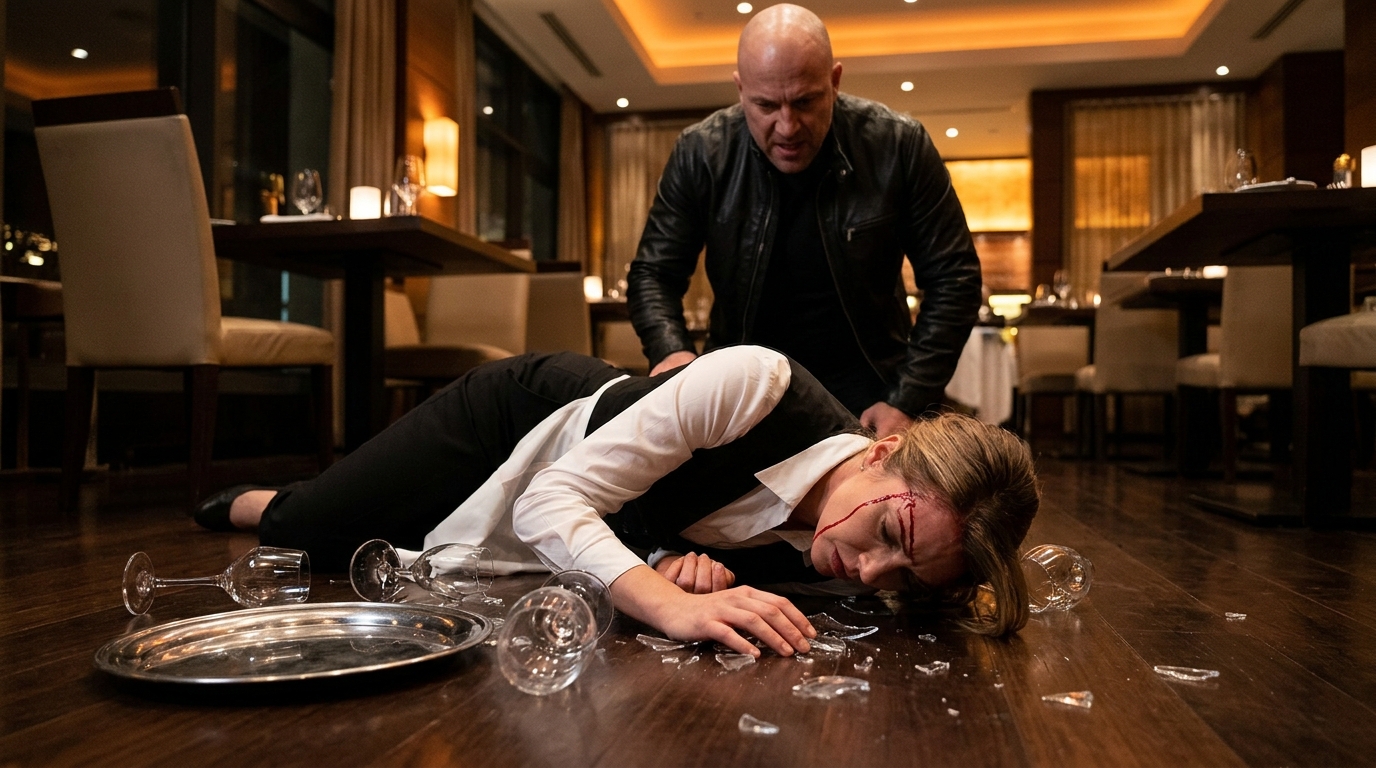
Then he shoved her.
Hard.
The tray flew from her hands.
Glasses shattered across the polished floor.
Water spilled like silver under the chandelier light.
Nora hit the ground shoulder first, then struck her forehead against the leg of a chair. Pain flashed white through her vision. The sound of broken glass seemed to stretch forever.
Then silence.
The entire restaurant froze.
Not because no one cared.
Because everyone knew men like Viktor.
Men who made witnesses feel like targets.
Nora tried to push herself up, but her palm slipped near a shard of glass. Blood ran warm down the side of her face and into her eyebrow.
“Help,” she whispered.
No one moved.
Viktor stood over her, breathing hard.
He looked around the restaurant slowly, daring someone to become brave.
Then the front door slammed open.
Cold night air rushed in, carrying blue light from the street.
Two men stepped inside.
The first wore a dark overcoat over a gray waistcoat. His hair was cut sharp at the sides, his beard neatly trimmed, his face calm in a way that made the room feel even colder.
Too calm.
The second man stayed half a step behind him, scanning exits, hands loose at his sides, ready for violence before violence had introduced itself.
Nora lifted her head.
And stopped breathing.
Five years.
Five years since she had seen that face.
Five years since Damian Vale kissed her forehead in the back room of a train station and said, “If I don’t come back, forget me.”
She had tried.
God help her, she had tried.
But now Damian stood in the doorway of Le Varenne, older, harder, wearing grief like armor.
His gaze found her on the floor.
The blood.
The broken glass.
The man standing above her.
Something in him went still.
The entire restaurant seemed to hold its breath with him.
Damian walked forward slowly.
Not rushing.
Not shouting.
Certain.
Viktor took one small step back.
Damian stopped beside Nora and looked down at her.
For one brief second, the dangerous calm broke.
Pain flashed across his face.
Then he looked up at Viktor.
“Who touched her?”
The room turned colder.
Viktor swallowed.
Nora, shaking and dizzy, stared up at Damian as if he were a ghost that had learned how to bleed.
“You came,” she whispered.
His jaw tightened.
“I never stopped.”
He crouched beside her.
As he did, something slipped from Nora’s apron pocket and landed on the broken floor between them.
A tiny bracelet.
Pink beads.
A silver charm.
One engraved letter.
D.
Damian stared at it.
Then at Nora.
Then back at the bracelet.
The color drained from his face.
And Nora realized the one secret she had fought five years to protect had just fallen at his feet.
The Bracelet with His Initial
For a moment, nobody else existed.
Not Viktor.
Not the customers.
Not the manager frozen near the bar.
Not the phones slowly rising to capture the scandal of a bleeding waitress and a powerful man kneeling over her.
Only Damian.
Only the bracelet.
Only Nora’s heart pounding so hard it hurt.
Damian picked it up carefully, as though the beads might break beneath his fingers.
“Where did you get this?”
His voice was quiet.
That was worse than anger.
Nora tried to sit up.
Pain stabbed through her shoulder.
Damian reached for her automatically.
She flinched before she could stop herself.
He saw it.
His face changed.
Not with offense.
With grief.
“Nora,” he said softly. “Who is D?”
She closed her eyes.
Five years of lies pressed against her ribs.
Five years of running.
Five years of rent paid in cash, names kept off forms, phones replaced, schools changed, curtains drawn at night.
All for a child who had Damian’s eyes.
Before Nora could answer, Viktor laughed.
It was a low, ugly sound.
“Well,” he said, wiping his mouth with his thumb. “Looks like she didn’t tell you everything.”
Damian rose.
Slowly.
His companion stepped closer, but Damian lifted one hand.
A warning.
Not now.
Viktor’s smile widened, though fear had begun working at the edges.
“She’s good at that. Hiding things. Hiding people.”
Nora’s blood turned cold.
“Don’t,” she whispered.
Viktor looked down at her.
There was satisfaction in his eyes now.
Cruel and bright.
“She didn’t tell you about the little girl?”
The restaurant murmured.
Damian did not move.
But something in his face collapsed inward.
“What little girl?”
Viktor tilted his head.
“Ask her.”
Damian looked at Nora.
She could have lied.
She had lied before.
She had told herself those lies were mercy. Protection. Survival. But under the chandelier light, with blood on her face and Damian holding the bracelet, they finally looked like what they were.
A cage.
Nora forced the words out.
“Her name is Daisy.”
Damian looked down at the charm.
D.
His lips parted slightly.
“How old?”
Nora’s voice broke.
“Four.”
The number struck him harder than a punch.
Five years since he vanished.
Four-year-old daughter.
The math did itself in the silence.
Damian turned away for half a second, one hand covering his mouth.
When he looked back, his eyes were wet.
Not weak.
Dangerous.
“Where is she?”
Nora shook her head.
“Safe.”
“Where, Nora?”
She looked at Viktor.
Damian followed her gaze.
And understood.
Viktor lifted both hands in mock innocence.
“Don’t look at me. I’m just here to collect what she owes.”
Damian stepped toward him.
“What does she owe?”
Viktor’s smile vanished.
“Not your business.”
The second man behind Damian spoke for the first time.
“It is now.”
His voice was flat.
Controlled.
Viktor finally looked at him properly.
Recognition flickered.
Then fear.
“Mateo Reyes,” he muttered.
The restaurant shifted again.
Even rich people knew that name.
Mateo Reyes had once run security for the Vale family before disappearing into private work that existed beneath corporate titles and above ordinary law enforcement. If Damian had brought Mateo, he had not come for dinner.
He had come expecting trouble.
Nora looked at Damian.
“Why are you here?”
His eyes did not leave Viktor.
“I heard he found you.”
The answer made her colder than the floor beneath her.
“How?”
Damian finally looked at her.
“Because I’ve been looking for you too.”
The manager rushed forward then, stammering about police and ambulances and guests. Damian ignored him, pulled a handkerchief from his coat, and pressed it gently against Nora’s bleeding forehead.
His hand trembled once.
Only once.
“I thought you were dead,” he said.
Nora swallowed.
“I was supposed to be.”
The words landed between them.
Damian’s eyes sharpened.
Before he could ask, Viktor lunged.
Not at Damian.
At Nora.
He reached for the bracelet.
Mateo moved like a shadow.
One twist.
One crack of bone against marble.
Viktor hit the floor face-down, gasping.
Customers screamed.
Damian barely looked at him.
He crouched again, voice low.
“Nora. Tell me what happened the night I disappeared.”
She stared at him.
At the man she had buried without a grave.
At the father of the child sleeping across the city under a false last name.
Then the restaurant doors opened again.
This time, police entered.
But Nora’s fear did not ease.
It sharpened.
Because the officer at the front was Detective Halloran.
The man Viktor worked for.
And the man who had told Nora five years ago that Damian Vale had ordered her death.
The Night Damian Vanished
“Step away from her.”
Detective Halloran’s voice cut through the restaurant with practiced authority.
He was tall, silver-haired, and clean in a way that made corruption look respectable. His badge hung from his belt. His hand rested near his weapon. Two uniformed officers stood behind him.
Nora’s stomach dropped.
Damian noticed.
Of course he did.
He had always been too good at reading the things she wanted to hide.
Halloran looked at Viktor on the floor, then at Damian.
“Mr. Vale,” he said. “You’ve been hard to reach.”
Damian’s expression did not change.
“I didn’t realize you were looking.”
“We’ve had an open file for years.”
“On what?”
Halloran smiled faintly.
“On you.”
The room seemed to tilt.
Nora tried to stand, but Damian held her gently in place.
Halloran continued, “Five years ago, you disappeared the same night a witness connected to your family’s laundering case vanished. Now you show up with a private enforcer and assault a man in a public restaurant.”
Mateo almost smiled.
Almost.
Damian’s voice remained calm.
“That man assaulted her.”
“Did he?”
Halloran looked around the restaurant.
Several people lowered their phones.
Fear moved quickly when badges entered the room.
Nora knew that kind of silence. It was the same silence from the night she lost everything.
Five years ago, she had been twenty-four and in love with Damian Vale, the youngest son of the Vale banking family. He was not supposed to notice waitresses, especially not one working private events at his father’s estate. But Damian had noticed everything.
The bruise on her wrist from a customer.
The books she carried in her bag.
The way she counted tips twice because rent was due.
He made her laugh before he ever made her trust him.
Then he found documents in his father’s safe.
Shell companies.
Offshore accounts.
A private list of women paid off, threatened, relocated.
Nora’s name appeared on one page.
Not because she had done anything.
Because she had overheard Damian’s father arguing with Viktor about a missing transfer.
Damian told her to pack.
He said they would leave together.
He kissed her forehead at the train station and told her to wait near platform nine.
“If I don’t come back, forget me.”
He never came back.
Instead, Halloran did.
He found Nora in the station bathroom, vomiting from fear and morning sickness she had not yet understood.
He showed her photos of Damian entering a black car.
He played an audio recording of Damian’s voice saying, “Take care of the girl.”
Then Halloran told her Damian had chosen his family.
He said Viktor was coming.
He said if she wanted the child inside her to survive, she needed to disappear and never speak Damian Vale’s name again.
Nora believed him.
Because grief believes the cruelest explanation when it arrives wearing authority.
Now Halloran stood in the restaurant, wearing the same calm face.
“Miss Avery,” he said, using the surname she had abandoned years ago. “You need medical care.”
Nora’s blood ran cold.
She had not used that name in four years.
Damian’s eyes shifted.
“You know him?”
Nora whispered, “He’s the one who told me you betrayed me.”
For the first time that night, Damian’s control cracked.
His gaze moved to Halloran.
“What?”
Halloran sighed.
“Nora has been through trauma. She’s confused.”
“She is not confused,” Damian said.
Halloran looked at the uniforms.
“Secure the scene.”
The officers moved forward.
Mateo stepped between them and Nora.
“Careful,” he said.
Halloran’s expression hardened.
“Are you interfering with police?”
Mateo reached into his coat slowly and pulled out a phone.
“No,” he said. “I’m live-streaming to federal internal affairs.”
Halloran stopped.
That single pause told Nora more than any confession could have.
Damian looked at Mateo.
Mateo nodded once.
Then Damian turned back to Halloran.
“You were on my father’s payroll.”
Halloran said nothing.
Nora stared at him.
All the years of fear shifted inside her, rearranging into something hotter.
“You lied to me,” she whispered.
Halloran’s eyes flicked to Viktor.
Then to the officers.
Then to the exits.
He was calculating.
Damian saw it too.
“Don’t run,” Damian said softly.
Halloran almost laughed.
Then Nora heard the sound.
A phone buzzing.
Not hers.
Viktor’s.
Still on the floor.
The screen lit near broken glass.
Incoming call.
UNKNOWN.
But the preview message beneath it was visible.
Did you get the child?
Nora stopped breathing.
Damian saw the message.
His face went white.
Then he looked at her.
“Nora,” he said, voice barely steady. “Where is Daisy?”
Before she could answer, the restaurant’s front window shattered.
Not from outside.
From a shot fired through the glass.
Panic exploded.
People screamed.
Bodies dropped.
Damian threw himself over Nora.
Mateo tackled Halloran.
And in the chaos, Viktor crawled toward the door with Nora’s bracelet clenched in his bleeding fist.
The Child They Were Hunting
Daisy was at St. Agnes House.
Not a school.
Not officially.
A shelter run by three nuns, two retired nurses, and a woman named Ruth who had once been a prosecutor before she decided saving women was better work than bargaining with men who hurt them.
Nora had brought Daisy there two weeks earlier after seeing Viktor outside the apartment.
She told Daisy it was a sleepover.
Daisy believed her because four-year-olds still believe mothers can turn terror into games if they smile hard enough.
Damian drove like a man outrunning five years of lies.
Nora sat beside him with bandages across her forehead and the bracelet clutched in her fist. Mateo followed in another car with Halloran restrained and bleeding from the mouth. Viktor had escaped the restaurant, but not before Mateo copied his phone.
The message had been enough.
Did you get the child?
Not Nora.
Not Damian.
The child.
Daisy was not collateral.
She was the target.
“Why?” Nora asked, though some part of her already knew.
Damian’s hands tightened on the wheel.
“My father’s trust.”
The words were quiet.
Ugly.
“The Vale Trust requires a direct heir from my line before the board vote next month. My brothers are dead. My father has no legitimate grandchildren.”
Nora turned toward him.
“Daisy.”
He nodded once.
“My father thought I was dead or unreachable. If he found out I had a daughter, he could claim control through guardianship.”
“Guardianship?” Nora’s voice cracked. “He tried to kill me.”
“He tried to erase anything he couldn’t control.”
That was the Vale family.
Nora understood that now.
Not wealth.
Not legacy.
Ownership.
Damian glanced at her.
“I didn’t leave you.”
She closed her eyes.
“I know.”
“No,” he said. “You need to hear it.”
The car cut through rain-slick streets.
He continued, voice rougher now.
“My father’s men grabbed me outside the train station. I woke up in a private clinic in Zurich under another name. They kept me sedated for months. By the time I got out, you were gone. Halloran told my people you had died in a fire.”
Nora turned sharply.
“A fire?”
“An apartment fire in Queens. Dental records confirmed.”
She covered her mouth.
“They gave me your death too.”
Two fake deaths.
Two grieving people.
One child born inside a lie.
Damian’s jaw tightened.
“I searched anyway.”
“For five years?”
“For five years.”
Nora looked away before tears could take her.
There would be time for grief later.
If they survived.
St. Agnes House stood behind an old brick church on a quiet side street. Its windows glowed warm against the rain. For one impossible second, everything looked safe.
Then Nora saw the open front gate.
Her heart stopped.
“No.”
Damian hit the brakes before the car fully reached the curb.
Nora was out first.
She ran across the courtyard, ignoring the pain in her shoulder, the blood beneath her bandage, the rain soaking through her uniform.
The front door stood open.
Inside, the hallway smelled of soup and floor polish.
A vase had shattered near the entry table.
Ruth lay on the floor, conscious but dazed, one hand pressed to her temple.
Nora dropped beside her.
“Daisy!”
Ruth grabbed her wrist.
“They took her through the chapel.”
The world went narrow.
Damian and Nora ran.
The chapel was empty except for one pink hair ribbon on the floor near the side door.
Daisy’s ribbon.
Nora made a sound that did not feel human.
Damian picked it up.
For one second, he closed his fist around it as if prayer could turn cloth into a child.
Then Mateo’s voice crackled through Damian’s phone.
“We got a location from Viktor’s phone. Dock 17. Private marina. They’re moving now.”
Damian looked at Nora.
No hesitation.
No fear.
Only decision.
They reached the marina in fourteen minutes.
Rain hammered the docks. Boats rocked violently against their lines. Sodium lights reflected in broken gold across the black water.
At the far end, a white yacht idled with engines running.
A man carried Daisy across the gangway.
She was awake.
Crying.
Her small voice rose through the storm.
“Mommy!”
Nora ran.
Damian caught her before she broke cover.
“Wait.”
“No!”
“If we rush, they take her below.”
“I don’t care!”
“I do,” Damian said, and his voice broke. “Because I just found her.”
That stopped her.
Only for a heartbeat.
Then Mateo appeared beside them, gun drawn.
“Three guards. Viktor on deck. Older man inside the cabin.”
Damian’s face turned colder than Nora had ever seen it.
“My father.”
Charles Vale stood inside the yacht’s lit cabin, one hand on a cane, watching through rain-streaked glass as his men dragged a screaming child toward him.
Daisy had never seen him before.
Still, she fought.
Tiny fists.
Kicking legs.
A pink sweater soaked dark with rain.
Nora saw the silver charm bracelet flash on her wrist.
The matching one.
D.
Damian saw it too.
Something ancient and violent moved through his face.
Mateo whispered, “On my mark.”
But Damian was already moving.
Not recklessly.
Not blindly.
Like a man who had spent five years imagining every possible version of this moment and hating all of them.
The first guard went down before he saw him.
The second turned, shouting.
Mateo fired once.
The shot cracked over the water.
The guard dropped his weapon and fell hard against the dock railing.
Viktor appeared on deck with Daisy in his arms and a gun pressed near her side.
“Stop!”
Everyone froze.
Nora’s lungs stopped working.
Daisy cried, “Mommy!”
Viktor’s face was slick with rain and blood.
“Back up,” he shouted. “All of you!”
Damian raised both hands.
His voice was calm.
Too calm.
“Let her go.”
Viktor laughed.
“You don’t give orders anymore, Vale.”
“No,” Damian said. “But she does.”
Viktor frowned.
Too late.
Daisy bit his hand.
Hard.
He screamed.
Nora moved.
Damian moved.
Mateo fired.
Everything happened at once.
Daisy dropped.
Damian caught her before she hit the deck.
Nora reached them a second later, falling to her knees, pulling her daughter into her arms with a sob that tore five years open.
Daisy clung to her.
“Mommy, I was brave.”
Nora kissed her wet hair again and again.
“Yes,” she cried. “Yes, baby. You were so brave.”
Damian knelt in front of them.
Daisy stared at him through tears.
She had seen pictures.
Only a few.
Hidden.
Whispered over.
Never explained fully.
Her tiny voice trembled.
“Are you Daddy?”
Damian’s face crumpled.
For the first time since Nora had known him, all the danger left him.
Only love remained.
“Yes,” he whispered. “If you’ll let me be.”
Before Daisy could answer, the yacht cabin door opened.
Charles Vale stepped out, silver cane tapping once against the deck.
He looked at Damian.
Then Nora.
Then Daisy.
His expression held no shame.
Only frustration.
“You have no idea what you’ve done,” he said.
Damian stood slowly, placing himself between his father and his daughter.
“No,” he said. “But I know what you did.”
The Name on the Trust
Charles Vale did not scream when federal agents arrested him.
Men like Charles rarely waste energy on scenes they cannot control.
He adjusted his cuffs.
Asked for his attorney.
Refused to look at Nora.
Refused to look at Daisy.
That told Nora everything.
He had not seen a child.
He had seen a signature he needed.
An heir.
A key to a trust.
A living piece of paperwork.
The trial began six months later.
By then, the story had already consumed the city.
Vale Banking Patriarch Accused of Kidnapping Grandchild.
Detective Linked to Five-Year Disappearance Cover-Up.
Hidden Heiress at Center of Billion-Dollar Trust Scandal.
Reporters loved that last phrase.
Hidden heiress.
Nora hated it.
Daisy was not an heiress.
She was a child who still woke up crying if a door slammed too hard.
A child who made Damian sit outside her bedroom every night for three weeks because she was afraid he would disappear again.
A child who asked why bad people knew her name.
The answer was too ugly for four years old.
So Nora told her the safest truth she could.
“Because you matter.”
Halloran cut a deal first.
Cowards often do.
He admitted he had taken payments from Charles Vale for years. He admitted he fabricated Nora’s disappearance, helped create the fake fire report, and warned Viktor when Nora resurfaced. He admitted Damian had been abducted and kept under medical control in a private foreign clinic until he escaped.
Viktor tried to stay silent.
Then Mateo’s recovered phone records tied him to the kidnapping attempt, the assault at Le Varenne, and two prior disappearances of people connected to the Vale family.
He talked after that.
Not from remorse.
From math.
Charles Vale did not talk.
He sat in court every day in a charcoal suit, cane beside him, face carved from old money and contempt.
Then Nora testified.
She wore a simple navy dress because Ruth said juries trusted navy. She walked past Charles without looking at him and took the stand with her hands folded so tightly her knuckles ached.
The prosecutor asked her what happened at the restaurant.
Nora told them.
The shove.
The glass.
The bracelet.
Damian’s return.
Then the prosecutor asked why she had hidden Daisy.
Nora looked at the jury.
“Because a man with money can make the world call you a liar before you open your mouth,” she said. “And I had a child who needed me alive more than I needed anyone to believe me.”
The courtroom went silent.
Damian sat in the front row with Daisy asleep against his chest, her pink bracelet bright against his dark coat.
When Charles’ attorney questioned Nora, he tried to make her sound unstable. Desperate. Manipulative. A waitress who had inserted herself into a powerful family for money.
Nora let him talk.
Then he asked, “Isn’t it true you kept Damian Vale’s daughter from him for financial leverage?”
Nora looked at Damian.
Then at Daisy.
Then back at the attorney.
“No,” she said. “I kept her alive.”
That was the line that made the jury stop taking notes.
Charles was convicted on all major counts.
Kidnapping.
Conspiracy.
Fraud.
Obstruction.
Witness intimidation.
The Vale Trust was frozen, audited, and placed under court supervision until Daisy came of age. Damian resigned from the family board and used his share to fund shelters, legal aid clinics, and a witness protection foundation named after Ruth, who survived her injuries and insisted the foundation’s first office be above a bakery.
As for Nora, she did not become rich overnight.
That was what tabloids expected.
Instead, she became free slowly.
Freedom looked like sleeping without a chair under the door.
Freedom looked like Daisy going to preschool under her real name.
Freedom looked like Damian asking permission before touching Nora’s hand because love, after fear, must learn gentleness again.
They did not rush back into what had been stolen from them.
Five years changed people.
Nora had become harder.
Damian had become quieter.
Both had survived believing the other had abandoned them.
Love did not erase that.
It simply stood beside it and refused to leave.
One evening, nearly a year after the trial, Damian took Nora back to Le Varenne.
The restaurant had replaced the glass.