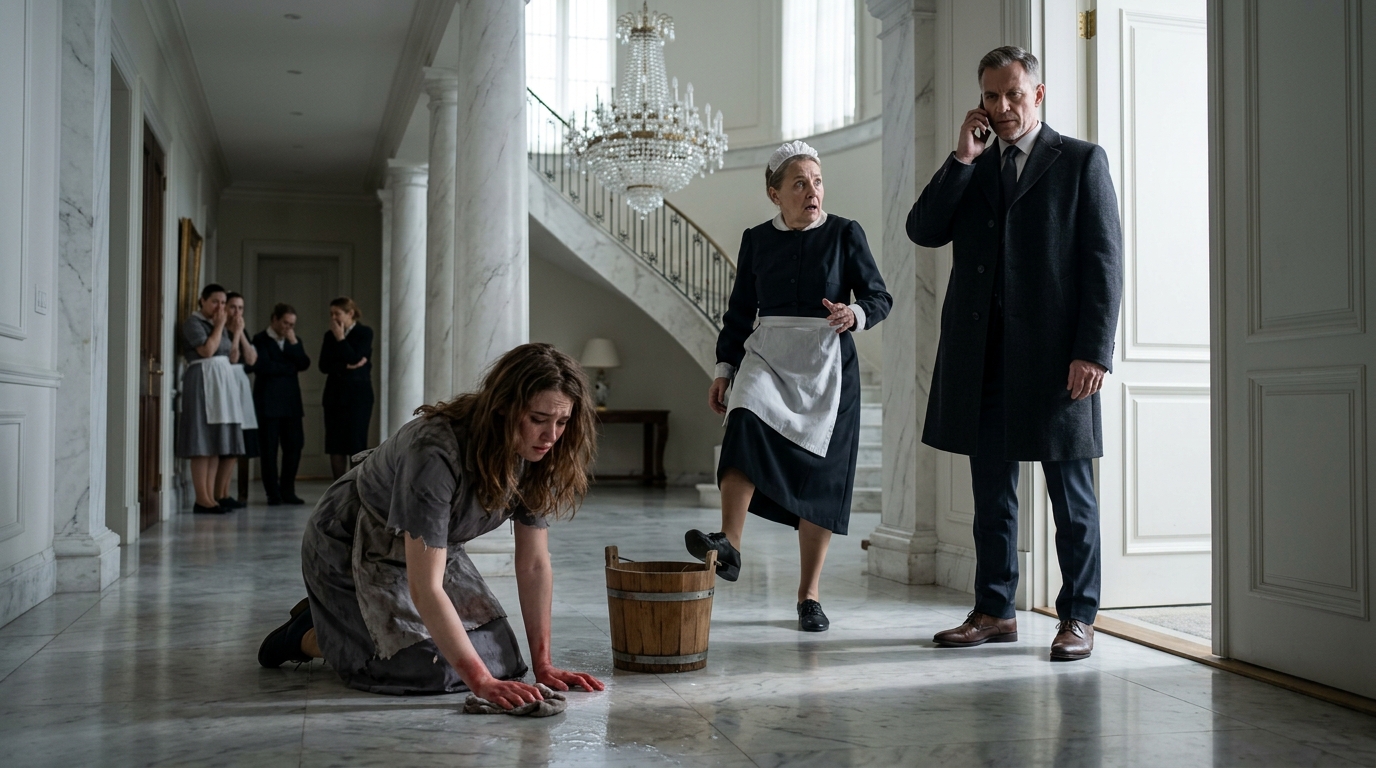
The Girl on the Marble Floor
“GET OUT OF THE WAY!”
The head maid’s voice cracked through the marble hall like a gunshot.
I stopped at the threshold.
For one moment, I thought I had entered the wrong house.
The chandeliers were still mine. The white marble staircase still curved upward beneath the stained-glass dome I had imported from Florence. The black iron banister still carried the same hand-forged lilies my late wife had chosen when we were young and foolish enough to believe beauty could protect a home.
Everything was exactly as I remembered.
Except for the girl on the floor.
She was on her knees near the entrance hall, bent over a gray bucket, scrubbing mud from the marble with a rag too thin to do any good. Her hands were red from icy water. Her sleeves were rolled unevenly. A strand of dark hair clung to her cheek.
She did not look up when I entered.
Not even when the maid shouted.
That was what broke something in me first.
Not the rag.
Not the bucket.
Not even the torn cuff of her dress.
It was the way she kept scrubbing.
Like humiliation had become so ordinary that it no longer deserved a reaction.
Behind her, two younger maids snickered.
One whispered, “Trash in the hallway.”
Another laughed into her palm.
The head maid, Mrs. Rowena Pike, stood with one hand on her hip and the other clutching a clipboard as if she were a queen overseeing punishment. She was broad-shouldered, severe, and dressed in a black uniform that looked more expensive than the girl’s entire existence.
I knew that uniform.
I had approved the design twenty years earlier when the Whitmore Estate first opened for public charity dinners.
My estate.
My house.
My name above the iron gates.
And on the floor—
My daughter.
“Faster,” Mrs. Pike snapped. “Guests arrive in two hours. If Lady Celeste sees one streak on that marble, you’ll sleep in the laundry room again.”
The girl flinched.
Barely.
But I saw it.
That tiny movement went through me like a blade.
Fifteen years.
I had been gone for fifteen years.
Every month, my attorney had received reports saying Amelia was safe, educated, loved, protected. Photographs had arrived twice a year: my little girl in clean dresses, beside tutors, in gardens, at piano recitals, always smiling gently for the camera.
I had believed them.
God help me, I had believed them because I needed to.
Because I was trapped an ocean away, recovering from a staged accident that left half the world believing I was dead and the other half hunting the money I had hidden before I disappeared.
I had built Whitmore Holdings from nothing.
Steel.
Shipping.
Real estate.
Hospitals.
Hotels.
A hundred companies folded into one empire.
But none of it mattered compared to the child I left behind.
Amelia had been five when I kissed her forehead and promised I would return before the roses bloomed again.
She was twenty now.
And she was scrubbing my floor.
Mrs. Pike stepped toward her, her polished shoe coming dangerously close to the bucket.
“Move it,” she said. “Or I’ll teach you again.”
The girl whispered, “Yes, ma’am.”
Her voice nearly destroyed me.
I knew that voice.
Older.
Quieter.
Hollowed by fear.
But beneath it, I heard the little girl who used to call me Papa from the top of the stairs.
My hand went into my coat pocket.
I took out my phone.
Mrs. Pike finally noticed me.
Her eyes moved over my travel-worn overcoat, my unshaven jaw, the scar across my temple, and the cane in my left hand.
She decided what I was before asking.
A deliveryman.
A beggar.
A problem.
“This is a private residence,” she said coldly. “You need to leave.”
I looked past her at my daughter.
“Amelia.”
The girl’s hand stopped.
Only for one second.
Then she scrubbed harder.
Mrs. Pike’s mouth tightened.
“Do not speak to the help.”
The help.
I stared at her.
The anger that rose in me was not hot.
It was cold.
Clean.
Ancient.
I called Marcus Vale, my private attorney.
He answered on the second ring.
“Elias?”
Mrs. Pike’s expression shifted slightly.
Only slightly.
I kept my eyes on her as she lifted her foot to kick the bucket toward Amelia.
Then I said exactly four words into the phone.
“Freeze the estate now.”
Mrs. Pike stopped mid-step.
The color drained from her face.
Because only one man alive had the authority to say those words.
And he had just walked back into his own house.
The Maid Who Knew My Name
For a moment, nobody moved.
The hall held its breath.
The maids stopped laughing.
Mrs. Pike lowered her foot slowly, as if the marble beneath it had become thin ice.
My daughter remained on her knees.
That hurt most.
Even after hearing the words, even after seeing the head maid go pale, she did not stand.
She had been trained not to.
Marcus’s voice sharpened through the phone.
“Elias, repeat that.”
“Freeze the estate now,” I said again. “All domestic accounts. All payroll accounts. All discretionary transfers. Lock the trust access. Notify the bank. No one moves a dollar.”
Mrs. Pike swallowed.
“Sir,” she said.
One word.
Different now.
Not rude.
Not commanding.
Afraid.
I ended the call and put the phone away.
Then I stepped toward Amelia.
The head maid moved instinctively to block me.
That was her second mistake.
I looked at her.
She stepped back.
Good.
I lowered myself slowly, my old injury screaming through my hip, until I was kneeling on the marble in front of my daughter.
She stared at the floor.
Her fingers clutched the wet rag so tightly her knuckles had gone white.
“Amelia,” I said softly.
Her lips trembled.
“I’m sorry, sir. I’ll finish before the guests arrive.”
Sir.
Not Papa.
Not Father.
Sir.
My breath caught.
“What did they tell you about me?”
She did not answer.
I reached for her hand.
She flinched before I touched her.
That small movement nearly made me lose the last of my restraint.
Behind me, Mrs. Pike whispered, “Miss Amelia has been unwell for years. She gets confused. Lady Celeste thought it best to keep her occupied.”
I turned my head slowly.
“Unwell?”
“Yes, sir. Emotionally unstable. After your passing, she became difficult. Violent at times. Ungrateful. Lady Celeste showed great mercy keeping her here.”
My passing.
So that was the lie they had given her.
Not missing.
Not delayed.
Dead.
I looked back at Amelia.
“Did they tell you I died?”
Her eyes lifted for the first time.
And there she was.
My little girl.
Buried beneath exhaustion, fear, and years of being made small.
But there.
Her eyes were her mother’s.
Gray at the edges. Green near the center. Impossible to forget.
“You’re not him,” she whispered.
The words were not an accusation.
They were protection.
Hope had hurt her before.
I understood that immediately.
“No,” Mrs. Pike said quickly. “Of course he isn’t. Miss Amelia, get back to work.”
I stood.
So did something darker inside me.
“Say one more word to her,” I said, “and you will leave this house in handcuffs.”
Mrs. Pike’s mouth opened.
No sound came out.
Footsteps clicked from the upper staircase.
Slow.
Elegant.
Measured.
I looked up.
Celeste Whitmore descended in a pearl-colored dress, one hand gliding along the banister as if posing for a portrait.
My second wife.
My widow, according to the world.
She had aged beautifully.
Of course she had.
Women who feed on lies often do.
Her expression was calm when she saw me.
Too calm.
Only her hand betrayed her.
It tightened slightly on the railing.
“Elias,” she said.
Not shock.
Not joy.
Not grief returning from the dead.
Recognition.
That told me everything.
She had known I was alive.
At least feared it.
Maybe for years.
Amelia looked from Celeste to me, confusion spreading across her face.
Celeste reached the bottom step.
“My God,” she said softly, now performing for the staff. “It really is you.”
I looked at her.
“Why is my daughter on the floor?”
Her eyes flicked to Amelia.
Cold.
Then back to me.
“She chose this.”
The lie was so cleanly delivered it almost sounded rehearsed.
“She chose to scrub floors?”
“She needed structure. After your disappearance, she became unstable. The doctors agreed routine would help.”
“What doctors?”
Celeste tilted her head.
“Elias, you’ve been gone fifteen years. You cannot walk in here and understand what we’ve endured.”
We.
That word nearly made me smile.
Before I could answer, Amelia spoke.
Small.
Hoarse.
“I didn’t choose it.”
The hall went still.
Celeste turned toward her.
Slowly.
That was when I saw the old fear return to Amelia’s face.
Not fear of punishment.
Fear of consequences she already knew too well.
Celeste smiled gently.
“Darling, you’re overwhelmed.”
Amelia’s hands shook.
But she looked at me.
For the first time, truly looked.
Then she said the sentence that turned the entire mansion cold.
“She told me if I ever said your name again, she’d lock me in Mother’s room.”
The Room They Kept Locked
My late wife’s room had been sealed the day she died.
Not by law.
By grief.
Margaret’s bedroom sat at the east end of the second floor, overlooking the rose garden she planted with Amelia when our daughter was still small enough to believe flowers could hear secrets.
After Margaret’s death, I could not bear to enter it.
Celeste knew that.
Everyone knew that.
But Amelia had said Mother’s room like it meant something else now.
Not memory.
Punishment.
I turned toward the staircase.
Celeste stepped in front of me.
“You need rest,” she said. “You’re not well.”
There it was.
The first thread of the old strategy.
Not angry.
Concerned.
Not guilty.
Protective.
Men like me were never attacked directly. We were managed. Declared fragile. Overwhelmed. Unstable. Surrounded by staff who would later swear we seemed confused.
I had seen fortunes stolen that way.
I simply never imagined it would happen inside my own house.
“Move,” I said.
Celeste’s smile thinned.
“Elias.”
I looked at the two security men now entering from the side corridor.
New men.
Not mine.
Hers.
“I said move.”
One guard stepped forward.
Amelia suddenly stood.
It happened so fast everyone turned.
She was thin.
Too thin.
But in that moment, with the wet rag still in her hand, she placed herself between me and the guard.
“Don’t,” she whispered.
Not to the guard.
To me.
Because she knew what they did to people who resisted.
That broke the spell.
The staff saw it.
The guards saw it.
Even Celeste saw it.
My daughter had spent years being forced to kneel, and the first time she stood, she stood to protect me.
I looked at the guard.
“You have ten seconds to leave this house.”
He hesitated.
Celeste snapped, “Stay where you are.”
The front doors opened behind us.
Marcus Vale entered with four men in dark suits and two uniformed sheriff’s deputies.
He had aged since I last saw him, but his eyes were still sharp enough to cut paper.
“Mr. Whitmore,” he said. “The estate accounts are frozen. The county judge has signed the emergency preservation order.”
Celeste’s face changed.
“What judge?”
Marcus ignored her and turned to the deputies.
“No one leaves with documents, devices, jewelry, or estate property.”
Mrs. Pike made a small sound behind me.
Marcus looked at her.
“Especially staff.”
The younger maids went pale.
Celeste’s voice hardened.
“You have no authority here.”
Marcus opened his leather folder.
“Actually, Lady Whitmore, your authority ended twelve minutes ago.”
He handed me a document.
I recognized it immediately.
The controlling trust.
The one I had written before leaving.
The one that guaranteed Amelia’s inheritance and gave Celeste temporary guardianship only until Amelia turned eighteen.
Amelia was twenty.
Celeste had no legal authority over her.
Not for two years.
I looked at Marcus.
“She kept control?”
He nodded grimly.
“Through medical incapacity filings.”
Celeste lifted her chin.
“Amelia was declared legally impaired by three specialists.”
Marcus removed another page.
“All three specialists were paid through shell accounts connected to your private foundation.”
Celeste’s expression did not change.
That was the terrifying part.
She was not cornered yet.
Not in her mind.
A woman like Celeste always had another locked door.
I started up the stairs.
This time no one stopped me.
Amelia followed, barefoot now, leaving faint wet prints on the marble behind her.
At the end of the east wing, Margaret’s door was locked from the outside.
A modern keypad had been installed beneath the antique brass handle.
My hands curled into fists.
“When were you put in here?” I asked.
Amelia did not answer immediately.
“Sometimes,” she whispered.
“How often?”
“When guests stayed. When inspectors came. When I asked about school. When I asked why my bank card never worked.”
I looked back at Celeste.
She stood at the far end of the hall, surrounded now by deputies and staff who no longer knew where to place their loyalty.
Marcus entered a master override code.
The lock clicked.
The door opened.
The smell hit me first.
Dust.
Old perfume.
Bleach.
And something sour beneath it.
Margaret’s room was no longer a shrine.
It was a cage.
The windows were screwed shut. The canopy bed had no sheets. There were scratch marks along the inside of the doorframe. A small mattress lay on the floor near the wardrobe.
Amelia stood beside me, staring down.
Shame moved across her face as if she had done something wrong by surviving it.
On the wall near the desk were pencil marks.
Dates.
Tallies.
Small sentences.
Papa isn’t dead.
I heard his voice in a dream.
If I forget my name, I lose.
Amelia Margaret Whitmore.
Amelia Margaret Whitmore.
Amelia Margaret Whitmore.
My vision blurred.
Then Marcus opened the wardrobe.
Inside were boxes.
Dozens of them.
Labeled in Celeste’s handwriting.
Letters.
Returned.
Photographs.
Medical.
Trust.
Marcus pulled down the first box.
Inside were letters.
My letters.
Hundreds of them.
Every letter I had sent from hiding.
Every birthday note.
Every apology.
Every promise.
Unopened.
Amelia reached in with trembling hands and picked up an envelope addressed in my writing.
To my dearest Amelia, on your ninth birthday.
She looked at it as if it were something alive.
Celeste spoke from the doorway.
“She was better when she didn’t hope.”
I turned.
And for the first time since entering my home, I truly wanted to destroy someone.
But before I could speak, Amelia opened the birthday letter.
A small key fell out.
Brass.
Old.
Stamped with Margaret’s initials.
Amelia stared at it.
Then whispered, “She searched for that key every night.”
Celeste’s face drained of color.
And suddenly I understood.
Margaret’s room had not been locked to keep Amelia in.
It had been locked to keep everyone away from whatever my first wife had hidden before she died.
The Key Margaret Left Behind
The key opened the rosewood music box on Margaret’s dressing table.
I remembered buying it for her in Vienna during the second year of our marriage. It played a soft, imperfect melody when opened, one Margaret said sounded like a child trying to sing through tears.
Celeste had searched the room for years.
She had emptied drawers.
Removed paintings.
Pulled books from shelves.
But she had never found the key because I had mailed it to Amelia inside a letter Celeste never allowed her to open.
The irony was almost enough to make me laugh.
Almost.
Marcus carried the music box to the desk.
Amelia stood beside me, clutching the birthday letter in one hand and the brass key in the other.
“Do it,” I said gently.
She inserted the key.
Turned it.
The lid opened.
The melody began.
Inside was a false bottom.
Marcus lifted it with a letter opener.
Beneath it lay a small stack of documents wrapped in blue ribbon, a flash drive, and Margaret’s wedding ring.
Amelia made a broken sound when she saw the ring.
Celeste moved from the doorway.
One deputy caught her arm.
“Do not touch me,” she snapped.
Marcus picked up the top document.
His face went still.
“What is it?” I asked.
He handed it to me.
It was a medical report from the week before Margaret died.
Not the one I had seen.
The official report said heart failure after a long illness.
This one said toxicology review pending.
I looked up slowly.
Marcus inserted the flash drive into his secure tablet.
A video file appeared.
Margaret.
Alive.
Sitting at this very desk.
Thin.
Pale.
Beautiful even as death circled her.
Her voice filled the room.
Elias, if you are seeing this, then Celeste has already convinced everyone that grief made me paranoid.
Amelia gripped my sleeve.
Margaret looked into the camera.
Celeste is not caring for me. She is poisoning me slowly and using my illness to gain access to the domestic trust. I found transfers from Amelia’s education fund into accounts under staff payroll, medical vendors, and false charities.
The room went silent.
On-screen, Margaret coughed into a cloth, then continued.
If I die before you return, do not trust the doctors she chooses. Do not trust Rowena Pike. And do not leave Amelia alone with her.
Mrs. Pike began sobbing in the hallway.
Not from remorse.
From fear.
The video continued.
There is one more thing. Celeste has been preparing incapacity papers for Amelia. She plans to declare her mentally unstable before she turns eighteen, then keep control of the estate indefinitely.
Margaret’s eyes filled.
My darling Amelia, if you hear this one day, please remember: none of this was your fault. You were never difficult. You were never broken. You were my brave girl.
Amelia covered her mouth.
A sound came out of her that no child should ever have to make.
The video ended with Margaret leaning closer to the camera.
Elias, I loved you. But I am begging you now—do not come back as a grieving husband. Come back as the man who built an empire from nothing. Burn the lie to the ground.
The screen went black.
No one spoke.
Then Marcus opened the next document.
Bank transfers.
Payroll fraud.
Forged medical declarations.
Staff bonuses.
Private security contracts.
Payments to three doctors.
Payments to Mrs. Pike.
Payments to a boarding school that Amelia had supposedly attended for eight years.
A school she had never seen.
My daughter had been photographed twice a year in borrowed uniforms, staged in front of buildings where she was never enrolled.
Celeste had not merely abused her.
She had built an entire paper life to hide the real one.
I turned toward Mrs. Pike.
She collapsed against the hallway wall.
“I was following orders,” she whispered.
Amelia looked at her.
For years, that woman had ruled her world.
Punished her.
Starved her.
Locked her away.
Called her trash in the home that belonged to her.
Now Mrs. Pike could not meet her eyes.
Celeste, however, did.
Her face was cold again.
“You think this changes anything?” she said. “That girl is damaged. No court will hand her an empire.”
Amelia stepped forward.
The room changed when she did.
Not dramatically.
Quietly.
Like a candle surviving wind.
“My name is Amelia Margaret Whitmore,” she said.
Celeste’s mouth tightened.
Amelia’s voice shook, but she did not stop.
“I am not your maid. I am not your patient. I am not your charity case. And I am not afraid of Mother’s room anymore.”
For the first time, Celeste had no answer.
Then Marcus’s phone rang.
He listened for ten seconds.
His expression darkened.
“What?” I asked.
He looked at me.
“Celeste filed emergency papers this morning claiming you are an impostor.”
Celeste smiled.
There it was.
The last locked door.
And she had already opened it.
The Heiress Stands Up
The emergency hearing happened that afternoon in my own library.
That was the judge’s idea.
Judge Eleanor Graves had known my family for thirty years and trusted no one inside it. She arrived with two clerks, a court reporter, and the expression of a woman who had canceled lunch to watch rich people lie badly.
Celeste’s attorney came too.
So did mine.
Mrs. Pike and four senior staff members were kept in the west sitting room under deputy supervision. Every phone in the house had been collected. Every computer secured. Every safe sealed.
Still, Celeste walked into the library as if attending a luncheon.
Calm.
Elegant.
Composed.
She claimed I was not Elias Whitmore.
She claimed I was a criminal impersonator exploiting a vulnerable young woman.
She claimed Amelia had suffered delusions for years and had likely been coached.
She even cried once.
Perfectly.
One tear.
Judge Graves watched without blinking.
Then she asked me to speak.
I gave fingerprints.
A blood sample.
The private family passphrase only Margaret and I had known.
The scar beneath my ribs from the factory accident when I was thirty-two.
The recording I had made with Marcus before entering witness protection.
The judge listened.
Then turned to Amelia.
“Miss Whitmore, do you wish to speak?”
Celeste stood.
“Your Honor, I strongly advise against subjecting her to—”
“Sit down,” Judge Graves said.
Celeste sat.
Amelia stood slowly.
She was wearing clean clothes now.
One of the younger maids had brought her a blue dress from a guest wardrobe. It did not fit perfectly, but she looked less like a servant and more like a young woman stepping into her own skin for the first time.
Her hands trembled.
She clasped them in front of her.
“My father is Elias Whitmore,” she said. “I remember his voice.”
Celeste’s attorney shifted.
Amelia continued.
“I was told he died. Then I was told I was selfish for crying. Then I was told I was sick because I kept saying he promised to come home.”
She looked at me only once.
Then back at the judge.
“I was locked in my mother’s room when guests came. I cleaned because Mrs. Pike said I owed Lady Celeste for keeping me. I was given medicine that made me sleep. I signed papers I couldn’t read. I was told if I went outside the gate, police would take me to a hospital forever.”
The court reporter’s keys clicked softly.
Amelia’s voice cracked.
But she stayed standing.
“I don’t know how to run an empire. I don’t know what money is mine. I don’t even know what school I was supposed to go to.”
She turned toward Celeste.
“But I know I did not choose this.”
The library went silent.
Judge Graves looked at Marcus.
“Show me the trust.”
He did.
The ruling came within the hour.
Celeste was removed from all estate authority.
Amelia’s medical incapacity filings were suspended pending criminal review.
I was reinstated as controlling trustee until Amelia chose her own independent counsel.
Mrs. Pike was arrested before sunset.
Three staff members confessed before midnight.
The doctors lasted two days.
Celeste lasted longer.
People like her always do.
She had friends on hospital boards, charity committees, bank panels, and judicial fundraising circles. She believed reputation was a wall high enough to outlast evidence.
It wasn’t.
Margaret’s video broke the case open.
The money trail widened it.
Amelia’s locked room ended it.
Celeste was charged with fraud, coercive control, unlawful confinement, medical abuse, elder financial exploitation, and later, after Margaret’s samples were retested, conspiracy connected to her death.
I attended every hearing.
Amelia attended only one.
The sentencing.
She sat beside me in the front row, hands folded, posture straight.
Celeste turned once to look at her.
Not sorry.
Never sorry.
Just offended that the servant had survived long enough to become the witness.
When the judge sentenced her to thirty-two years, Celeste closed her eyes as if bored.
Amelia did not smile.
Neither did I.
Justice is not joy.
It is a door opening.
What you do after walking through it is the harder part.
We did not stay in the mansion.
Not at first.
Amelia could not sleep there. Every hallway had a memory. Every polished surface reflected a version of herself she had been forced to become.
So I bought a small house near the lake.
Three bedrooms.
Wood floors.
No staff.
No marble.
No locked rooms.
The first morning, I found Amelia in the kitchen before dawn, washing dishes that were already clean.
I turned on the light gently.
She froze.
“I’m sorry,” she said automatically.
I hated those words.
Not because of her.
Because of everyone who taught her to use them as a shield.
“You don’t have to earn breakfast,” I said.
She looked down.
“I know.”
But knowing is not the same as believing.
So we learned slowly.
She learned she could sleep past six.
She learned hot water was not a reward.
She learned doors could be closed for privacy, not punishment.
I learned that fatherhood after fifteen stolen years is not reclaimed by blood or legal papers.
It is earned in quiet repetitions.
Breakfast.
Walks.
Therapy appointments.
Letting her choose.
Letting her say no.
Letting silence exist without filling it with guilt.
A year later, Amelia asked to visit the mansion.
I drove her myself.
The house looked different by then. Not physically. The chandeliers still hung. The marble still shone. The lilies still curved along the staircase.
But the fear had been removed.
That changes a house more than paint ever could.
Amelia stood in the entrance hall for a long time.
This was where I had found her.
On her knees.
Hands raw.
Head lowered.
She looked down at the exact place where the bucket had been.
Then she took one step forward.
And another.
At the center of the hall, she stopped.
“Do you hate this house?” I asked.
She thought about it.
“No.”
That surprised me.
She looked up at the stained-glass dome.
“I hate what they made it witness.”
We reopened the estate six months later.
Not as a private residence.
As the Margaret Whitmore House for Girls.
A protected home for young women leaving abusive guardianships, coercive domestic labor, and inheritance fraud cases.
No girl scrubbed floors there unless she spilled something herself and wanted to clean it.
No locked rooms.
No head maid.
No one slept in the laundry.
On opening day, Amelia stood on the front steps in a simple navy dress. Reporters gathered beyond the gate, but she did not speak to them.
She spoke to the girls.
Quietly.
Clearly.
“This house used to teach me fear,” she said. “Now it will teach someone else they are allowed to stand up.”
I stood behind her, not beside her.
That was her moment.
Not mine.
After the ceremony, when everyone had gone inside, Amelia walked back into the marble hall.
She knelt.
My heart lurched.
But this time, she was not scrubbing.
She placed one hand flat against the floor.
Then she whispered something I could not hear.
When she stood, her eyes were wet but steady.
“What did you say?” I asked.
She looked at me.
“I told the girl who used to kneel here that she can rest now.”
I could not speak.
She slipped her hand into mine.
For a moment, she was five again.
Then twenty.
Then both.
My daughter.
The heiress.
The survivor.
The girl they tried to turn into a servant in her own home.
Outside, sunlight moved through the stained glass and scattered color across the marble.
For the first time, the floor did not look cold.
It looked clean.