The Stain on the Gown
The glass shattered before anyone in the ballroom had time to breathe.
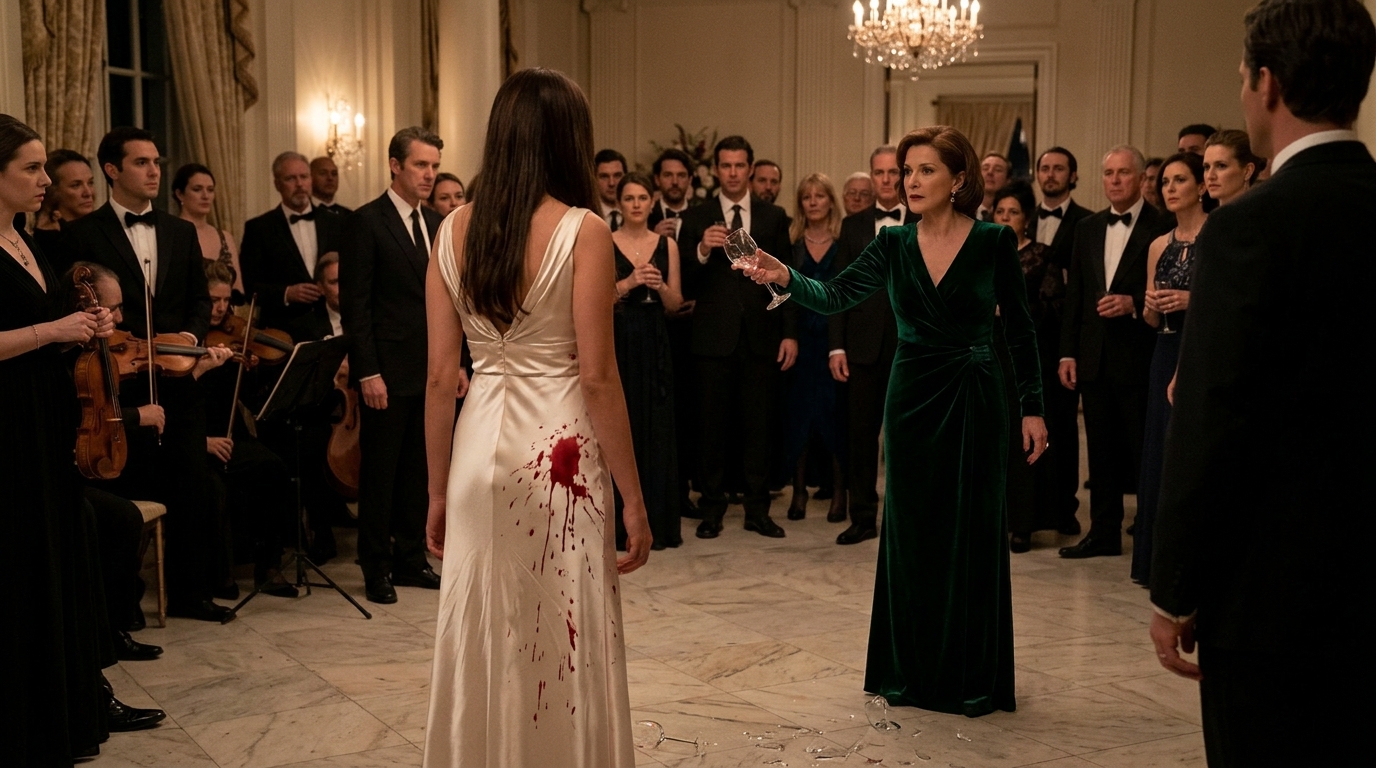
One second, I was standing near the front table beneath a chandelier dripping with crystal light. The next, crimson wine burst across my ivory gown, spreading over the silk like blood.
The room froze.
Then my mother gasped.
“Look what you made me do!”
Her voice was sharp, elegant, and perfectly timed.
That was the thing about Victoria Ross. Even her cruelty had posture.
Around us, two hundred guests turned to stare. Defense executives, retired officers, foundation donors, men in black tuxedos, women glittering in diamonds. The entire ballroom at the Harrington Hotel went silent except for the soft drip of wine falling from my dress onto the marble floor.
My brother Julian laughed first.
“Well,” he said, lifting his champagne glass, “now it has flair.”
A few people laughed with him because people like Julian never laughed alone. They checked the room first. They made sure power was laughing too.
My father did not laugh.
He didn’t need to.
Arthur Ross stood beside the stage, silver-haired, broad-shouldered, still carrying himself like the colonel he used to be. His face held no surprise. No sympathy. No embarrassment.
Only impatience.
“Go change, Elena,” he said quietly. “You look tacky.”
That cut deeper than the wine.
Not because it was loud.
Because it wasn’t.
I looked from my mother’s manicured hand to the broken glass at her feet. Her expression carried just enough regret for witnesses. Just enough shock. But her eyes were cold.
She had done it on purpose.
Of course she had.
Tonight was not just a gala. It was the Ross Family Veterans Legacy Ball, an annual spectacle my parents used to polish their name. My father gave speeches about sacrifice. My mother collected donations under soft lighting. Julian smiled for cameras and called veterans “our nation’s backbone” before quietly using their pain as a ladder.
And I was the stain they had never managed to remove.
The daughter who left home at eighteen.
The one who did not marry into wealth.
The one who did not return when summoned.
The one my mother introduced as “Elena, our private one,” as though privacy were a polite word for failure.
I felt wine cooling against my skin.
Sticky.
Heavy.
Humiliating.
The crowd waited for me to cry.
They wanted a scene. Or maybe they feared one.
I gave them neither.
My hands remained still at my sides. My breathing slowed. My face stayed calm because calm was the first thing the Army taught me.
Not bravery.
Not strength.
Calm.
The ability to stand inside chaos and not let it know your name.
My mother tilted her head, her diamond earrings trembling faintly.
“Elena,” she whispered, though everyone close enough could hear, “don’t make this worse.”
I almost smiled.
She had no idea how much worse it was about to become.
I glanced toward the stage where a sealed black folder rested beside the podium. Julian had placed it there fifteen minutes earlier, when he thought no one was watching. The folder had a small gold emblem stamped on the corner.
Ross Strategic Humanitarian Initiative.
A beautiful name for an ugly thing.
My father followed my gaze and his jaw tightened.
That was when I knew.
They were not just trying to humiliate me.
They were trying to remove me from the room.
I looked back at them.
“Okay,” I said.
One word.
Soft.
Measured.
My brother smirked. My mother’s shoulders relaxed. My father turned slightly away, already done with me.
No one followed as I walked across the ballroom.
No one stopped me.
No one asked if I was all right.
My heels echoed against the marble, each step carrying me farther from the music, the chandeliers, the whispers. The double doors opened into a corridor lined with oil portraits of old donors and dead generals. The air was colder there. Cleaner.
Behind me, the ballroom doors closed.
And for the first time all night, I let myself breathe.
Not shakily.
Not fearfully.
Precisely.
Because inside the trunk of my car, beneath a garment bag my family thought held another dress, was the one thing they had spent my entire life pretending I would never earn.
And once I put it on, the Ross family would never be able to put me back in my place again.
The Uniform in the Trunk
The garage beneath the Harrington Hotel smelled like gasoline, wet concrete, and expensive cologne.
The sound of the ballroom disappeared behind thick walls and steel doors. Down there, away from chandeliers and speeches, the truth felt easier to carry.
I unlocked my car with one click.
The trunk opened.
Inside, under a black garment cover, my dress blues waited.
Dark fabric.
Gold buttons.
Ribbons aligned with exacting precision.
And the shoulder boards.
Two silver stars.
For a moment, I just stood there.
Not because I was afraid.
Because even after all these years, the uniform still made me remember what it cost.
I remembered my first night at basic training, when I lay awake on a thin mattress while strangers cried quietly around me. I remembered my first deployment, the dust in my teeth, the sound of distant shelling, the way fear became a private language no one spoke out loud. I remembered the letters from my mother that never came. The phone calls my father ended early. Julian’s jokes about me “playing soldier” while he learned how to inherit boardrooms.
They had missed everything.
My first promotion.
My first command.
The funeral of Captain Morris, whose wife I held in the rain while a folded flag trembled in her hands.
The night I stayed awake for thirty-six hours coordinating an evacuation that saved ninety-two civilians from a collapsed district outside Kandahar.
The hearing where I testified against a contractor who had sold defective armor to soldiers under my command.
The moment a four-star general told me, “Ross, you are either going to make powerful enemies or become one.”
I became both.
But to my family, I was still the daughter who disappointed them by refusing to be decorative.
They had no idea that the Department of Defense had sent me to this gala.
They had no idea the “Ross Strategic Humanitarian Initiative” was already under federal review.
They had no idea I had spent the last eleven months tracking missing funds, falsified veteran housing reports, inflated medical supply invoices, and shell companies tied to my brother’s name.
Most importantly—
They had no idea that tonight, Julian planned to stand on that stage and announce a $180 million veteran rehabilitation contract that had been built on fraud.
Fraud my father helped hide.
Fraud my mother packaged as charity.
Fraud they had tried to pin on me.
I unzipped the garment bag.
The ruined gown hit the concrete a minute later.
I did not tear it off dramatically. That was not my way. I peeled the stained silk from my body in silence, folded it once, and laid it over the back seat like evidence.
Then I put on the uniform.
Shirt.
Jacket.
Medals.
Belt.
Shoes.
Everything in its place.
Everything earned.
When I pinned the first star onto my shoulder, the metal clicked softly.
When I pinned the second, the sound seemed louder.
Final.
My phone buzzed on the floor of the trunk.
A message from Colonel Hayes.
Position confirmed. Federal agents in place. Awaiting your signal.
I stared at the screen.
Then another message appeared.
They’re moving the folder early.
My pulse slowed.
Not quickened.
Slowed.
That was the part people misunderstood about danger. The closer it got, the quieter I became.
I picked up my phone and typed one sentence.
Hold until I’m inside.
Then I reached under the false bottom of the trunk and removed the second file.
This one was not black.
It was gray.
Unmarked.
Inside were bank transfers, surveillance photos, signed board minutes, medical procurement records, and a notarized copy of a document my family believed they had destroyed twenty-two years ago.
My grandmother’s trust amendment.
The document that proved I was not the family embarrassment.
I was the controlling heir.
My father had hidden that from me since I was nineteen.
Julian had built his entire life on an inheritance that was never legally his.
And tonight, with one forged signature, they planned to erase me from the trust permanently.
That was why my mother spilled the wine.
That was why my father told me to change.
That was why Julian laughed.
They thought humiliation would send me away before the announcement.
They thought I would disappear into a bathroom, cry quietly, and let the Ross family perform another perfect lie.
I closed the trunk.
Straightened my jacket.
Checked my reflection in the dark window.
For the first time all night, I recognized myself.
Then I walked back toward the elevator.
The doors opened with a soft chime.
A young valet inside glanced up, saw the uniform, and immediately stepped back.
“Ma’am,” he said.
Not Elena.
Not sweetheart.
Not the difficult daughter.
Ma’am.
I nodded once.
The elevator rose.
Third floor.
Fourth.
Ballroom level.
My reflection stared back from the brass doors. Calm eyes. Clean lines. Two stars catching the light.
When the doors opened, I could hear Julian’s voice through the corridor.
“And tonight, the Ross family is proud to announce a new chapter in our legacy of service…”
I stepped out.
Too late, I thought.
Not for me.
For them.
Because by the time my hand touched the ballroom door, my brother had already begun announcing the contract that would destroy him.
The Salute That Silenced the Ballroom
The ballroom doors opened slowly.
No one noticed at first.
Julian stood onstage under a wash of golden light, smiling like he had been born behind a podium. My father stood to his right. My mother sat at the front table, one hand pressed delicately to her chest, performing wounded dignity for anyone still whispering about the wine.
Then my heels struck the marble.
Once.
Twice.
Three times.
The sound moved through the room before I did.
Heads turned one by one.
A woman near the bar lowered her glass.
A retired lieutenant colonel sitting by the aisle straightened in his chair.
Someone whispered, “Is that Elena Ross?”
Then the room saw the stars.
Julian stopped mid-sentence.
His smile remained for half a second too long, still hanging on his face after the rest of him had gone pale.
My mother turned.
Her mouth opened.
No sound came out.
My father stared at my shoulders as if the stars were some kind of optical illusion.
“What is she wearing?” Julian muttered into the microphone.
His voice carried through the speakers.
A few nervous laughs fluttered and died.
Then General Mateo Alvarez rose from the center table.
He was a compact man in his sixties with a face carved by war and patience. He had commanded people who commanded people. He had buried friends on three continents and trusted almost no one.
He looked at me.
Then he stood at attention.
The entire room watched him raise his hand.
A salute.
Sharp.
Formal.
Unmistakable.
“Glad you could join us, Major General Ross.”
Silence detonated.
Not the ordinary kind.
Not awkward silence.
This was the silence of a room recalculating reality.
My mother’s fingers trembled so violently her bracelet flashed under the lights. Julian gripped the sides of the podium. My father took one step forward, then stopped.
“Major…” he said under his breath.
Then louder.
“Major General?”
I walked toward the stage.
Every step felt clean.
My ruined gown had made them comfortable. This uniform terrified them.
Julian leaned away from the microphone, but not far enough.
“This is insane,” he hissed. “You’re not—”
“I am,” I said.
My voice was not loud.
It did not need to be.
The sound system caught it anyway.
My mother stood abruptly, knocking her chair backward.
“Elena, this is inappropriate.”
I looked at her.
That was all.
She sat down.
My father’s face hardened, the old command voice rising in him like a reflex.
“You should have told us.”
A small laugh escaped me before I could stop it.
Not because anything was funny.
Because after thirty-four years of being unseen, he still believed ignorance was something I had done to him.
“I sent invitations to every promotion ceremony,” I said. “You returned the first two unopened.”
A ripple moved through the crowd.
My father’s jaw tightened.
Julian tried to recover.
“Ladies and gentlemen,” he said quickly, reaching for charm like a drowning man reaching for rope, “my sister has always had a flair for dramatic entrances. We are proud of her service, of course, but tonight is about the foundation and the veterans we serve.”
“The veterans you serve?” I asked.
The room sharpened around the question.
Julian looked at me.
A warning entered his eyes.
“Elena.”
I turned toward the stage.
“You asked me to change,” I said.
A pause.
My eyes moved from my mother to my father to my brother.
“So I did.”
No one laughed this time.
General Alvarez stepped away from his table and joined me near the stage. Two other officers followed. Not dramatically. Not aggressively. But deliberately enough that the people in the room understood this was no family interruption.
This was official.
Julian saw them.
His confidence cracked.
“General Alvarez,” he said, attempting a smile, “I’m sure whatever this is can be handled privately.”
“Privately,” I repeated.
That word had built the Ross family.
Private meetings.
Private accounts.
Private threats.
Private signatures on documents no one was meant to read.
I looked at the black folder on the podium.
“Is that the contract announcement?”
Julian’s hand moved toward it.
My father’s hand moved faster.
He picked up the folder.
“Enough,” he said.
There he was.
Arthur Ross.
The father who had never raised his voice because people had always obeyed the quiet version.
He descended from the stage, folder in hand, and stopped inches from me.
“You are embarrassing this family.”
“No,” I said. “You did that before I got here.”
His eyes flashed.
For the first time that night, I saw real emotion from him.
Not shame.
Fear.
He glanced at General Alvarez, then toward the exits.
And I realized something.
He had expected conflict.
He had expected me to object.
He had expected maybe even a legal challenge.
But he had not expected federal agents to be standing beside the waitstaff.
I turned slightly.
At the back of the ballroom, two men in dark suits stepped away from the wall.
My mother saw them.
Her face changed.
Julian saw them next.
The microphone picked up his whisper.
“No.”
My father clutched the folder tighter.
“Arthur,” my mother said, barely audible.
Her voice was no longer elegant.
It was thin.
Scared.
I reached into my jacket and removed the gray file.
The one they thought no longer existed.
Then I looked directly at my father.
“Before you announce your legacy,” I said, “maybe we should talk about what you stole from mine.”
And that was when my brother lunged for the black folder.
The File They Tried to Burn
Julian never learned how to lose quietly.
He grabbed the black folder from my father’s hand and turned toward the side exit, moving faster than anyone expected. For one brief second, the ballroom became motion and noise—chairs scraping, guests gasping, my mother shouting his name.
He made it six steps.
Colonel Hayes stepped out from behind a service door and blocked him.
Julian froze.
Hayes did not touch him. He didn’t need to.
“Mr. Ross,” Hayes said calmly, “I wouldn’t.”
Julian laughed once, breathless and ugly.
“You have no authority here.”
“That,” Hayes replied, “is a dangerous assumption.”
Two federal agents moved in.
This time, Julian tried to twist away.
They caught his arms.
The folder fell.
Papers slid across the marble floor.
A donor near the front picked one up before anyone could stop her. Her face drained as she read the top line.
“What is this?” she whispered.
I knew what she was holding.
Invoice 47-B.
Prosthetic limb distribution, Midwest Veterans Rehabilitation Network.
According to the paperwork, Ross Foundation funds had purchased 1,200 advanced prosthetic units for wounded veterans across four states.
In reality, only 312 had been delivered.
The rest existed only as numbers.
Numbers Julian converted into offshore accounts.
Numbers my father approved.
Numbers my mother turned into speeches about sacrifice.
The agent nearest Julian recovered the folder. Another moved toward the podium. A third approached my mother, who had gone very still at the front table.
The ballroom had changed completely.
Ten minutes earlier, these people had watched wine spread across my dress and decided it was entertainment.
Now they watched fraud spread across the floor and understood they were witnesses.
My father looked at me with open hatred.
“You have no idea what you’ve done.”
“I know exactly what I’ve done.”
“You destroyed us.”
I stepped closer.
“No,” I said. “I stopped letting you use my silence as shelter.”
His nostrils flared.
For a second, I saw the man I had feared as a child. The one whose disappointment filled every room. The one who could turn affection into a reward and absence into punishment. The one who made me believe love was something I had to earn by becoming useful.
Then I saw him clearly.
Just a man.
Old.
Cornered.
Afraid of documents.
My mother rose slowly.
“Elena,” she said, voice trembling now, “whatever you think happened, we can talk. As a family.”
Family.
That word again.
They used it like a locked door.
Like a weapon.
I opened the gray file.
“Do you remember Nana Margaret’s trust amendment?”
My mother’s lips parted.
My father went rigid.
Julian stopped struggling.
That was the real bomb.
Not the fraud.
Not the contract.
The inheritance.
My grandmother Margaret Ross had been the only person in that house who ever looked at me as if I was more than an inconvenience. She had taught me chess. Let me sit in her office while she reviewed ledgers. Told me, when I was fourteen, “Elena, never trust people who confuse money with blood.”
She died when I was nineteen.
My father told me she had left the family holdings to him, with Julian as successor. He said I had received a small educational trust and should be grateful.
I believed him.
For years.
Until a retired estate attorney contacted me eleven months ago with a guilty conscience and stage four cancer.
He sent me the amendment.
My grandmother had left controlling interest in Ross Legacy Holdings to me.
Not my father.
Not Julian.
Me.
Because she had seen what they were long before I did.
My father had hidden the amendment, pressured the attorney, and buried the record in a private archive under a different case number.
He stole my inheritance.
Then he used it to build a charity machine that stole from veterans.
I held up the notarized copy.
“The original was filed this morning with the probate court,” I said. “The injunction freezes Ross Legacy Holdings, the foundation accounts, and every shell entity tied to Julian’s procurement network.”
Julian’s face collapsed.
“You can’t do that.”
“I already did.”
My mother whispered, “No.”
I looked at her.
“Yes.”
She pressed one hand to her mouth.
Not because of the veterans.
Not because of the fraud.
Because the money was gone.
Or rather, it was no longer theirs.
My father stepped closer, lowering his voice so only I could hear.
“You think the uniform makes you untouchable?”
I met his eyes.
“No,” I said. “The evidence does.”
Then I reached into the file and removed one final document.
This was the one that had kept me awake for three nights.
Not the bank transfers.
Not the forged signatures.
Not the stolen trust.
A medical record.
My medical record.
From when I was seventeen.
My father saw it.
His face went white.
When I was seventeen, three weeks before reporting to West Point, I was hospitalized after a car accident on a rain-slick road outside Arlington. My parents told everyone I had been driving recklessly. They told the academy I was emotionally unstable. They told me my appointment had been withdrawn because I was not “fit for pressure.”
I rebuilt my path the hard way. ROTC. Night classes. Years of proving myself to strangers because my own family had made sure I started behind everyone else.
But the record in my hand told the truth.
I had not been driving.
Julian had.
Drunk.
Underage.
In my father’s car.
My parents switched the report.
They let me carry the shame so their son could stay clean.
I looked at Julian.
For the first time all night, he looked away.
The room blurred at the edges, not from tears, but from the violence of finally understanding my own life.
They had not just stolen my inheritance.
They had stolen my name.
My future.
My record.
And they had called it family.
I turned toward the crowd, holding the document in my hand.
“My brother was driving the night of the accident,” I said. “My father falsified the report. My mother signed the witness statement. And tonight, they planned to use my forged signature to transfer the last remaining voting shares out of my control.”
My mother made a broken sound.
“Please,” she whispered.
I looked at her for a long moment.
Then I said the one thing she had never expected from me.
“No.”
The federal agent beside her took a step forward.
But before he could speak, my father reached inside his jacket.
And every officer in the ballroom moved at once.
The Last Order I Gave My Family
“Hands,” Colonel Hayes barked.
The ballroom erupted.
Chairs scraped backward. Guests ducked. Someone screamed.
My father froze with one hand inside his jacket, eyes wide with sudden fury and disbelief. For one terrible second, I thought he had brought a weapon.
Then his hand came out holding a silver lighter.
A stupid, expensive, engraved lighter.
In his other hand, half-hidden against his body, was a folded sheet of paper.
The original trust amendment.
He had it on him.
Of course he did.
Men like my father never truly destroyed leverage. They kept it close, believing possession was the same as power.
“Arthur,” my mother cried.
He flicked the lighter open.
A small flame appeared.
The entire room held its breath.
My father looked at me across that tiny fire.
“You don’t get to win,” he said.
I stepped toward him.
Hayes moved as if to stop me, but I raised one hand.
Not now.
Not this.
My father’s hand shook slightly.
That gave him away.
He wanted me to plead.
He wanted one last moment where I became the daughter again and he became the judge.
So I gave him nothing.
“You can burn it,” I said. “Certified copies are already filed in three jurisdictions.”
His face twitched.
“The original doesn’t matter anymore.”
The flame trembled.
For the first time in my life, I watched my father understand that control had left his hand before he even opened it.
The agent behind him moved.
Fast.
The lighter hit the floor.
The paper followed.
Arthur Ross was forced against the side of the stage and cuffed beneath the same banner that read HONORING THOSE WHO SERVE.
No one spoke.
Not even Julian.
My mother sank into her chair as if her bones had dissolved. When an agent approached her, she looked smaller than I had ever seen her. Not innocent. Never innocent. Just stripped of the performance that had kept her beautiful for so long.
“Victoria Ross,” the agent said, “you are being detained pending charges of fraud, conspiracy, obstruction, and falsifying sworn statements.”
She looked up at me.
For one brief second, I thought she might apologize.
Instead, she whispered, “After everything we gave you?”
I stared at her.
And suddenly I was seventeen again, waking in a hospital bed with a fractured wrist and my mother smoothing my hair while telling me not to ruin Julian’s future.
I was nineteen, standing at my grandmother’s grave while my father told me to stop making grief about myself.
I was twenty-six, receiving a promotion while an empty row of seats behind me said everything my family never had to.
I was forty-two, standing in a ballroom with wine dried on my skin beneath a uniform they could no longer ignore.
“You gave me a reason to survive without you,” I said.
Her face crumpled.
Not from remorse.
From defeat.
The agents led them out one by one.
Julian first, still protesting, still insisting this was a misunderstanding.
My mother next, silent now, her diamond bracelet loose around her wrist.
My father last.
He stopped beside me as they escorted him past.
“You were never supposed to have this,” he said.
I looked at the two stars on my shoulders.
Then at the room full of witnesses.
“I know.”
That was all.
He waited for more.
Anger.
A curse.
A daughter’s wound.
I gave him nothing else.
After they were gone, the ballroom remained suspended in the strange aftermath of public collapse. No music. No speeches. No laughter. Just the quiet sound of people realizing they had applauded a family built on rot.
General Alvarez approached me.
“You all right, Ross?”
I almost gave the automatic answer.
Yes, sir.
Fine, sir.
Mission complete.
But my eyes drifted to the wine-stained gown visible through the open ballroom doors, still folded in the hallway where a staff member had placed it on a chair.
I thought about the woman who had walked into that room trying to give her family one last chance to tell the truth.
She felt very far away now.
“No,” I said honestly. “But I will be.”
He nodded, understanding more than he said.
By dawn, the story had already broken.
Ross Foundation accounts frozen.
Federal procurement investigation expands.
Decorated Major General exposes family fraud at veterans gala.
The headlines made it sound clean.
It was not clean.
Nothing about betrayal is clean.
The trials lasted fourteen months. Julian took a plea and still got twelve years. My mother’s attorneys tried to paint her as a socialite who signed whatever my father placed in front of her, until prosecutors played recordings of her coaching witnesses. She got eight.
My father fought longest.
He always did love a losing battle if it came with an audience.
The accident report was corrected. My grandmother’s trust was restored. The foundation was dissolved and rebuilt under independent veteran oversight. Every stolen dollar investigators could recover went where it should have gone in the first place.
To prosthetics.
Housing.
Trauma care.
Real lives.
Not galas.
Not chandeliers.
Not speeches.
On the day my father was sentenced, he refused to look at me.
That was fine.
I had spent most of my life being unseen by him.
By then, it felt almost peaceful.
Three weeks later, I returned to the Harrington Hotel alone.
Not for an event.
Not for justice.
For the gown.
The manager had kept it sealed in a garment box at my request. When he brought it out, he apologized again, though none of it had been his fault.
I took the box to my car and opened it in the same underground garage.
The stain had darkened with time.
Crimson against ivory.
Permanent.
I ran my fingers over the ruined silk.
For years, I thought healing meant removing the stain. Making the story clean. Pretending the damage had never touched me.
I know better now.
Some stains stay.
Some should.
They remind you where the lie ended.
I folded the gown carefully and placed it beside my uniform.
Then my phone buzzed.
A message from General Alvarez.
New oversight appointment approved. You ready for another fight?
I looked at the dark screen for a long moment.
Then I glanced at the uniform hanging in the trunk.
The stars caught the garage light.
Small.
Silver.
Steady.
I typed back one word.
Always.
Because that night in the ballroom, my family thought they were sending me away to change clothes.
They had no idea they were sending me back to myself.
And once I returned as who I really was—
there was nothing left of their lie to salute.