Henry thought he had rescued Shadow from spending his final years alone.
The old German Shepherd had arrived with cloudy eyes, tired bones, and a quiet sadness that seemed too heavy for one animal to carry. Henry understood that sadness. Since losing his wife, the house had become too still, too clean, too full of echoes.
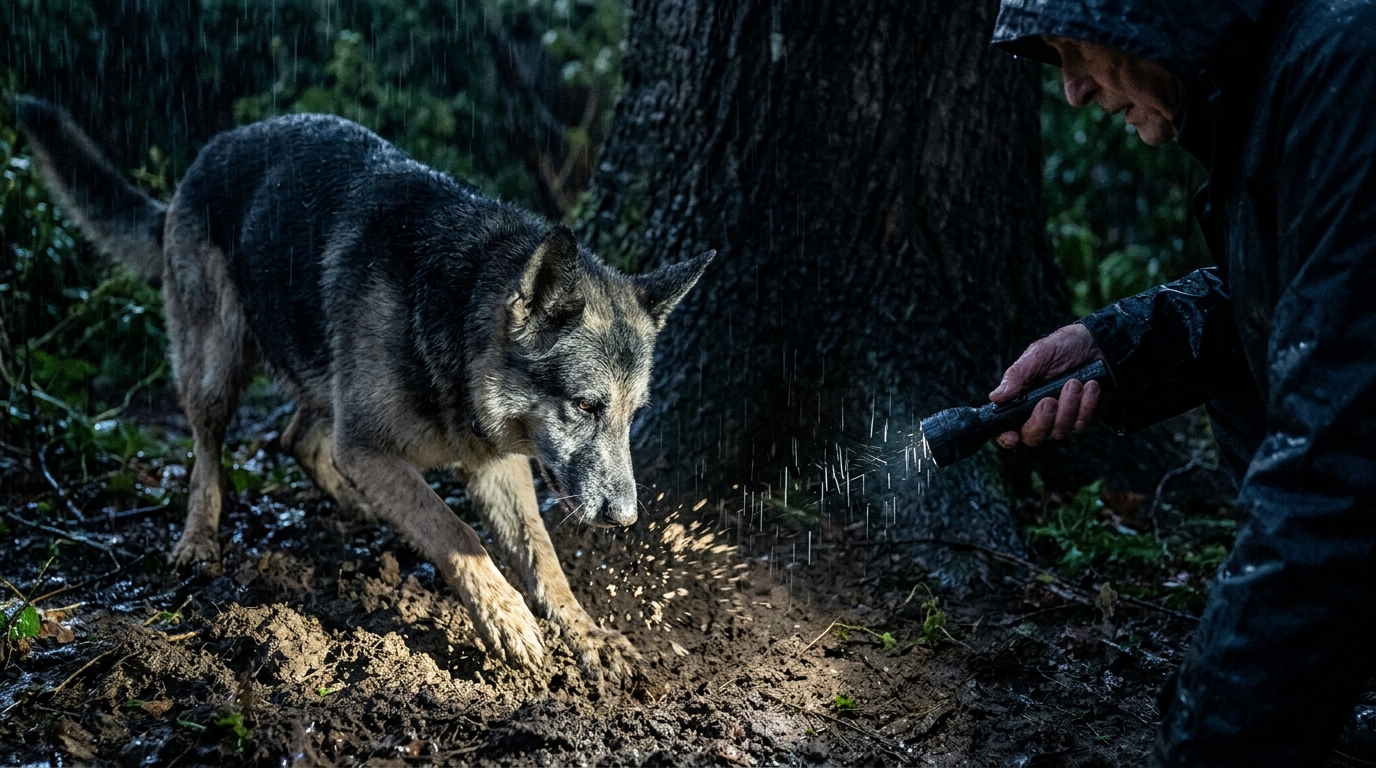
But one stormy night, Shadow began digging beneath the old oak tree as if something buried there had been calling him all along.
What Henry found in the dirt was not just a rusted box. It was the beginning of a message his late wife had left behind—and by morning, the dog who uncovered it was gone.
The Dog Who Wouldn’t Come Inside
“Shadow! Come back inside!”
Henry’s voice trembled across the backyard, nearly swallowed by the rising wind.
The storm had been building all evening. Dark clouds pressed low over the little town of Maple Ridge. Rain tapped against the porch roof, soft at first, then sharper, like impatient fingers. In the distance, thunder rolled beyond the hills.
Henry stood at the back door in his slippers and old cardigan, one hand gripping the doorframe.
At seventy-eight, he no longer liked going out in bad weather. His knees complained before the first step. His hands shook when the air turned cold. And ever since his wife, Eleanor, passed away, storms had felt louder in the house.
But Shadow would not come in.
The German Shepherd stood beneath the old oak tree at the edge of the yard, his gray muzzle low to the ground, his front paws tearing at the wet dirt.
He was nearly blind now.
Most days, he moved slowly through the house, bumping gently into chair legs, finding Henry by scent and sound. He slept beside the fireplace. He sighed like an old man. He followed Henry from room to room as if neither of them trusted silence anymore.
But tonight, he dug with a force Henry had not seen in him before.
“Shadow!” Henry called again. “Please, boy. Come inside before the rain gets worse.”
The dog did not even turn.
His paws scraped harder.
Mud flew behind him.
Lightning flashed.
For one bright second, the whole yard turned silver.
That was when Henry saw something among the roots.
Not a stone.
Not a bone.
A corner.
Metal.
Henry’s breath caught.
He stepped down from the porch, pulling his cardigan tighter around himself. The grass soaked through his slippers immediately. The cold made his fingers ache.
Shadow finally looked up.
His cloudy eyes found Henry’s shape in the dark, and his tail gave one slow wag.
Not playful.
Proud.
As if he had done exactly what he came to do.
“What did you find?” Henry whispered.
Shadow stepped back.
Beneath the oak roots was a small rusted box, half-covered in mud.
Henry knelt with difficulty, his knees sinking into the wet ground. He brushed away the dirt with trembling hands and lifted the box free. It was heavier than he expected.
The latch resisted at first.
Then gave.
Inside was a folded cloth, a small bundle of letters tied with blue ribbon, and a photograph sealed in a plastic sleeve.
Henry pulled out the photograph.
The storm seemed to vanish around him.
It was him and Eleanor.
Forty years younger.
Standing beneath that same oak tree.
Henry in a brown jacket, hair still dark, smiling awkwardly because he had never liked cameras. Eleanor beside him in a yellow dress, laughing at something just outside the frame.
On the back, written in Eleanor’s looping handwriting, were six words:
For when you forget the way home.
Henry’s throat tightened.
“Eleanor,” he breathed.
Shadow pressed his head gently against Henry’s knee.
The old man lowered one shaking hand onto the dog’s wet fur.
In that moment, Henry understood something he could not explain.
Shadow had not come into his life by accident.
And whatever was hidden in that box, Eleanor had not buried it for the past.
She had buried it for the day Henry would need to be found.
Video: The Old Dog Who Dug Beneath the Oak—And Led Henry Back to the Life He Thought Was Gone
The Box Eleanor Left Behind
Henry carried the box inside with Shadow walking slowly beside him.
The dog was soaked from the rain, but he seemed calmer now. He followed Henry into the kitchen, shook water across the linoleum, then lowered himself heavily beside the table with a deep sigh.
Henry did not scold him.
He barely noticed the mess.
His eyes stayed on the rusted box.
The kitchen light flickered once as thunder rolled overhead. Henry sat at the table where he and Eleanor had eaten breakfast for forty-six years. Her chair was still across from his. He had never moved it.
Some mornings, he still set two cups down by mistake.
He opened the folded cloth first.
Inside was Eleanor’s old blue scarf.
The one she wore on windy afternoons when she worked in the garden. Henry pressed it to his face, but time had taken most of her scent. Only dust and earth remained.
Then he untied the letters.
There were seven.
Each envelope had a date written on it.
Not dates from the past.
Instructions.
Open when the house feels too quiet.
Open when you stop answering the phone.
Open when you forget to eat.
Open when you think no one needs you anymore.
Henry’s eyes blurred before he reached the fourth envelope.
Shadow lifted his head.
The old dog watched him from the floor, ears slightly raised, as if he understood more than a dog should.
Henry opened the first letter.
My dearest Henry,
If you are reading this, then the oak finally gave up my secret.
I know you. You will pretend you are fine. You will tell people you are managing. You will keep the grass cut, pay the bills on time, and sit in that old house like being lonely is proof of loyalty.
It is not.
Henry covered his mouth.
He could hear her voice.
Soft.
Firm.
Loving him enough to argue even from beyond the grave.
The letter continued.
I buried this box because you never listen when I tell you important things directly. You always smile, kiss my forehead, and say, “We’ll talk about it tomorrow.”
So now tomorrow has come.
Promise me one thing.
Do not let this house become a place where love used to live.
Let it become a place where love continues.
Henry lowered the page.
The storm rattled the windows.
For months after Eleanor’s funeral, neighbors had come by with casseroles, flowers, and gentle invitations. Church lunches. Senior center events. Coffee at the diner.
Henry had thanked them all.
Then stayed home.
He told himself he was tired.
But really, he had been afraid.
Afraid of laughing without her.
Afraid of living past her.
Afraid that if he let new noise into the house, it would push out what remained of her memory.
Shadow rose slowly and placed his chin on Henry’s knee.
Henry stroked the dog’s head.
“You knew, didn’t you?” he whispered.
Shadow’s tail tapped once against the floor.
Henry opened the next envelope.
Inside was a small key.
Attached to it was a note.
The second promise is in the garden shed.
Henry looked toward the dark window.
The garden shed stood beyond the oak, half-hidden by overgrown bushes. Eleanor had used it for flowerpots, seed packets, tools, and all the little projects Henry never understood until they bloomed.
He had not opened it since she died.
Not once.
Shadow suddenly stood.
Despite his age, despite the storm, despite the mud still drying on his paws, he walked to the back door and looked over his shoulder.
Henry stared at him.
“No,” he said softly. “Not tonight.”
Shadow gave one quiet whine.
Then scratched once at the door.
Henry looked down at the key in his palm.
And for the first time in a long time, he did not feel like the house was empty.
He felt like someone was calling him forward.
The Shed Behind the Oak
The next morning, Shadow was gone.
Henry knew it the moment he opened his eyes.
The house felt different.
Too quiet.
Not the old quiet of grief, but the sharp quiet of something missing.
“Shadow?”
No answer.
Henry pushed himself out of bed faster than his knees liked. He checked the fireplace. The kitchen. The back hallway. The old rug near the front door where Shadow liked to sleep in the morning sun.
Nothing.
The back door was not open.
But the mudroom window was.
Only a few inches.
Enough for an old dog with stubborn purpose to push through if he wanted badly enough.
Henry’s heart began to pound.
He stepped outside in yesterday’s damp shoes and found paw prints in the soft ground.
They led past the oak.
Toward the garden shed.
“Shadow!”
His voice cracked.
The yard smelled of rain and wet leaves. The storm had passed, leaving the world washed pale and cold. The oak branches dripped slowly overhead.
Henry followed the prints to the shed door.
It was closed.
Locked.
For one terrible second, he thought he might find Shadow collapsed behind it.
His hands shook so badly it took three tries to get Eleanor’s key into the lock.
The door opened with a groan.
Dust shifted in the morning light.
Flowerpots lined the shelves. Rusted tools hung along the wall. A stack of old newspapers sat beside bags of soil hardened by time.
And on the workbench was a metal cash box.
Clean.
Not rusted like the one under the oak.
Henry stepped inside slowly.
On top of the box was another envelope.
Open this when Shadow brings you here.
Henry sat on an overturned bucket because his legs could no longer hold him.
He opened the envelope.
Henry,
If Shadow found the oak, then he found you.
I hope you are not angry with me.
I made arrangements years ago with Maple Ridge Rescue. Not because I wanted to replace anything. No one can replace what we were.
But I knew, my stubborn man, that after I was gone, you would need someone who could sit with sorrow without trying to fix it.
Old dogs understand old hearts.
Henry laughed once through his tears.
Shadow had come from Maple Ridge Rescue eight months after Eleanor died.
A volunteer had called and said there was an elderly German Shepherd nobody wanted. Too old. Nearly blind. Gentle, but sad.
Henry almost said no.
Then he saw Shadow lying in the shelter kennel, face gray, eyes cloudy, tail barely moving.
Two abandoned old souls looked at each other through the bars.
Henry brought him home that afternoon.
The letter continued.
There is one more thing in this shed.
Do you remember the plan we made when we were young?
The little house for old dogs.
The ones nobody came back for.
I never stopped thinking about it.
Henry froze.
He remembered.
Of course he remembered.
He and Eleanor had once dreamed of turning the back acre into a small sanctuary for senior rescue dogs. Nothing grand. A warm barn. A fenced field. A few soft beds. A place for animals too old to be chosen quickly.
But life happened.
Work.
Bills.
Illness.
Time.
The dream became one of those sweet things couples mention when they want to believe the future is endless.
Inside the cash box were documents.
A small savings account in Eleanor’s name.
A deed transfer for the unused back acre.
A handwritten list of local contractors.
And a folder marked:
Shadow’s House.
Henry touched the words.
His wife had planned it.
Quietly.
Patiently.
Knowing he might not have the strength to begin unless she left him a path.
But Shadow was still missing.
Henry stood, panic returning.
“Shadow!”
A faint bark answered.
Not from the shed.
From beyond the back fence.
Henry stumbled toward the sound.
At the edge of the property, behind the old bramble patch, he found a gap beneath the fence where Shadow had pushed through.
On the other side was a narrow trail leading toward the abandoned Miller farm.
Henry’s breath caught.
The Miller place had been empty for years.
Except now, from somewhere beyond the trees, Shadow barked again.
Urgent.
Insistent.
Calling him.
What Shadow Found at the Miller Farm
Henry called his neighbor, Tom Ellis, before following the trail.
He was grieving, not foolish.
Tom arrived ten minutes later in rubber boots and a flannel jacket, carrying a flashlight even though the sun had risen.
“What’s going on?” he asked.
“Shadow went through the fence.”
“At his age?”
Henry nodded toward the trail.
“He’s at the Miller place.”
Tom’s expression changed.
“No one’s been out there in years.”
“Someone has.”
The two men followed the muddy path through the trees. Henry moved slowly, leaning on his cane, but fear kept him going.
The Miller farm appeared beyond the brush like a memory the town had tried to forget.
Collapsed porch.
Broken windows.
Tall weeds.
An old red barn leaning slightly to one side.
Shadow stood near the barn door.
His fur was damp.
His paws were muddy.
But he was alive.
Henry nearly cried with relief.
“Shadow!”
The dog turned and wagged his tail once.
Then barked toward the barn.
Tom stepped closer.
A sound came from inside.
Small.
Faint.
Not a bark.
A whimper.
Henry’s chest tightened.
Tom pulled the barn door open.
The smell hit them first.
Old hay.
Cold wood.
Animal fear.
Inside, near the back wall, were dogs.
Five of them.
Thin. Dirty. Curled together in a nest of torn blankets and straw.
A small brown terrier lifted her head weakly. Two puppies pressed against her side. An older hound lay nearby, ribs showing beneath patchy fur. In the far corner, a white dog with one torn ear watched them without moving.
Henry covered his mouth.
Tom whispered, “Dear Lord.”
Shadow walked inside and lay down near the dogs as if he had been guarding them all night.
The terrier wagged her tail weakly when he approached.
Henry understood then.
Shadow had not disappeared.
He had gone to get help.
Tom called animal control.
Henry called Maple Ridge Rescue.
Within an hour, trucks lined the old farm road. Volunteers arrived with blankets, crates, water bowls, and gentle hands. The dogs were carried out one by one.
No shouting.
No rough movements.
Just quiet voices and careful work.
The rescue director, a woman named Claire Benson, knelt beside Shadow and checked him over.
“This old boy found them?” she asked.
Henry nodded.
“After digging up something my wife buried.”
Claire looked at him, confused, but did not press.
The sheriff arrived next.
Then more neighbors.
By noon, half the town seemed to know.
Someone had been leaving unwanted dogs at the abandoned farm. Senior dogs. Sick dogs. A mother with puppies. Animals too inconvenient to keep and too easy to hide.
The discovery spread through Maple Ridge quickly.
But that was not what shocked the town most.
The shock came when Claire searched the barn and found a faded wooden sign behind a stack of rotting boards.
Henry stood beside her as she wiped away dust and spiderwebs.
The sign read:
Eleanor’s Haven
A Home for the Ones Still Waiting
Henry stared at it.
His throat closed.
Claire looked at him gently.
“Henry,” she said, “your wife made this?”
He nodded slowly.
“I think she meant to.”
The old Miller farm.
The back acre.
The documents.
The dogs waiting in the barn.
It all fit together in a way that felt impossible and inevitable at once.
Eleanor had not only dreamed of a sanctuary.
She had chosen the place.
Maybe she had never finished the paperwork. Maybe illness stopped her before she could tell him. Maybe she had hoped one day they would walk out here together and begin.
Instead, Shadow had walked there for them.
Henry looked at the old dog lying beside the rescued terrier, his cloudy eyes half-closed, his body tired from the night’s work.
“He knew,” Henry whispered.
Tom placed a hand on Henry’s shoulder.
“Maybe he did.”
The Town That Finally Showed Up
The story of Shadow and the hidden dogs changed Maple Ridge almost overnight.
At first, people came out of curiosity.
They drove slowly past the Miller farm. They stood outside Harbor Diner talking about the old German Shepherd who dug up a box and found abandoned dogs by morning. They repeated pieces of the story, each version a little more magical than the last.
But curiosity alone does not build anything.
Henry knew that.
Eleanor had known it too.
So on Sunday morning, Henry did something he had not done since her funeral.
He went to church.
Not because he suddenly felt strong.
Because he had learned that waiting to feel strong was another way of staying alone.
At the end of the service, he stood in front of the congregation with Shadow lying at his feet.
The old dog slept through most of it.
People smiled softly at that.
Henry held Eleanor’s letter in one hand and the folder marked Shadow’s House in the other.
His voice shook when he began.
“My wife left me instructions,” he said. “Some of you knew Eleanor. So you know she had a way of making a plan sound like a favor.”
A few people laughed.
Gently.
Henry looked down.
“She wanted a place for old dogs. Dogs like Shadow. Dogs people say are too old, too slow, too much trouble. She wanted them to have warmth at the end.”
He paused.
Outside, sunlight came through the stained-glass windows and touched the aisle in soft colors.
“Yesterday, Shadow found five dogs at the Miller farm. He found them because old hearts know where loneliness hides.”
The church went still.
Henry lifted the folder.
“I can’t build this alone. I’m too old to pretend otherwise. But I can start. And I’m asking for help.”
For a moment, no one moved.
Then Tom Ellis stood.
“I can fix fencing.”
A woman from the bakery raised her hand.
“I can organize meals for volunteers.”
The high school principal said, “Students need service hours.”
A retired nurse offered to help with medication schedules.
A carpenter offered lumber.
A teenager offered to build a website.
By the time Henry sat down, the list had filled three pages.
Shadow slept through all of it.
That made people laugh again.
But Henry saw something else in their faces.
Guilt.
Many of them had known Henry was fading after Eleanor died. They had waved from driveways. Sent Christmas cards. Said, “Let us know if you need anything,” and then returned to their own busy lives.
They had not meant harm.
Most neglect is not cruel on purpose.
It is simply convenient.
But Shadow had forced them to look.
At the dogs.
At Henry.
At the kind of loneliness a town can pass every day without stopping.
Work began the next week.
The Miller barn was cleaned first.
Then repaired.
Then painted white with blue trim because Eleanor had loved blue.
The back field was fenced. Soft bedding was donated. The vet clinic offered discounted care. The local hardware store supplied materials at cost, then quietly forgot to send invoices for half of them.
The five dogs recovered slowly.
The terrier, whom Henry named Daisy, gained weight first.
The hound discovered he loved sleeping in sun patches.
The white dog with the torn ear took the longest to trust anyone, but Shadow visited him every morning and lay nearby without asking anything of him.
That was Shadow’s gift.
He did not demand healing.
He simply stayed close enough for it to begin.
Shadow’s Last Walk
Winter eased into spring.
The oak tree budded.
Eleanor’s Haven opened on a Saturday morning under a pale blue sky.
A hand-painted sign stood at the entrance, made from the old board found in the Miller barn. Beneath the name, someone had added:
Founded by Eleanor’s dream. Found by Shadow’s heart.
Henry cried when he saw it.
He did not try to hide it anymore.
There were seven senior dogs living at the sanctuary by then. Daisy and her puppies had moved into foster homes. The hound stayed. So did the white dog, who had finally allowed Henry to touch his head.
Shadow moved more slowly each week.
Some mornings, his legs trembled when he stood. His cloudy eyes saw less than ever. He slept longer beside Henry’s chair.
But whenever Henry visited the sanctuary, Shadow insisted on coming.
He would walk the fence line slowly, sniff the grass, check the barn door, then lie beneath the shade near the entrance as if greeting every dog who arrived.
One evening, just after sunset, Shadow stood at the back door and looked toward the oak tree.
Henry knew.
He did not know how.
But he knew.
“All right, boy,” he whispered.
He took Eleanor’s scarf from the hook near the door and wrapped it around his neck. Then he followed Shadow into the yard.
The old dog walked slowly.
Not to the shed.
Not to the fence.
To the oak tree.
The place where everything began again.
Henry lowered himself onto the bench Tom had built beneath the branches. Shadow lay down at his feet, then rested his head on Henry’s shoe.
For a while, they watched the evening settle.
No storm this time.
No thunder.
Only a soft wind moving through new leaves.
Henry reached into his pocket and pulled out the last letter from Eleanor’s box.
He had been saving it.
The envelope said:
Open when you are ready to keep living.
His hands trembled as he unfolded the page.
Henry,
If you made it this far, then I am proud of you.
Not for being brave every day.
No one is.
I am proud because you stayed.
Because you loved something after loss.
Because you let the world come back in.
If Shadow is still with you, kiss his gray head for me. If he is not, remember this: love does not leave just because the body gets tired.
It changes shape.
Sometimes it becomes a memory.
Sometimes it becomes a garden.
Sometimes it becomes an old dog digging in the rain because someone needs to remember where home is.
Henry pressed the letter to his chest.
Shadow gave one long sigh.
Henry looked down.
The old dog’s eyes were half-closed. His breathing was slow, peaceful, and tired.
“Thank you,” Henry whispered.
Shadow’s tail moved once against the grass.
A small sound.
A final answer.
By morning, Shadow was gone.
This time, he had not disappeared.
He had simply finished his work.
The whole town came to say goodbye.
Not because Shadow had belonged to everyone.
Because, in a way, he had brought everyone back to one another.
They buried him beneath the oak tree, near the place where he had found Eleanor’s box. Henry placed the blue scarf in the earth with him and kept the collar.
At Eleanor’s Haven, a small bronze plaque was added beside the entrance.
Shadow
The old dog who found what we had forgotten.
Years later, people in Maple Ridge still told the story.
About the storm.
The rusted box.
The missing dog.
The abandoned barn.
The sanctuary that grew from one old woman’s dream and one old dog’s stubborn heart.
But Henry never told it like a miracle.
He told it like a lesson.
Sometimes rescue does not look like saving someone from danger.
Sometimes it looks like an old dog refusing to come inside.
Sometimes it looks like a neighbor finally knocking on the door.
Sometimes it looks like a town remembering that love is not meant to stay buried.
And sometimes, if you are very lucky, it comes to you with gray fur, cloudy eyes, muddy paws, and just enough time left to lead you home.