The Key on the Gym Floor
The impact was louder than any weight hitting the floor.
A body struck the edge of the bench.
A cleaning bottle rolled away, spinning across the rubber mat.
Then everything stopped.
The music still thumped from the ceiling speakers, but it suddenly felt far away. Dumbbells hung in midair. Treadmills slowed under stunned feet. Conversations died one by one until the only sound left was the bottle wobbling to a stop near the lockers.
Then came the scream.
“DON’T TOUCH MY THINGS!”
Everyone turned.
Vanessa Cross stood in the middle of the women’s locker area entrance, one hand gripping a designer gym bag, the other pointing down at the cleaning woman she had just shoved.
Everyone knew Vanessa.
Even if they pretended they didn’t.
Fitness influencer.
Lifestyle brand owner.
Three million followers.
The kind of woman who filmed herself doing deadlifts in perfect lighting and called it discipline. The kind of woman who could walk into a room and make people adjust themselves—posture, clothing, expression—just because they knew she might be recording.
And now she was looking down at an old cleaning lady as if she had caught a criminal.
The cleaning woman struggled to sit up.
Her name was Rosa.
I knew because she worked mornings at the gym, always pushing the gray cart with the squeaky wheel. She was quiet. Polite. The kind of person most people saw only when something needed wiping.
Her hands shook as she reached for the spilled bottle.
“I wasn’t—”
“Then why were you in my locker?” Vanessa snapped.
The words cracked across the room.
Phones rose almost instantly.
That was the world now.
First shock.
Then recording.
I stood near the free weights, towel around my neck, still breathing hard from my set. I had seen the shove from the corner of my eye. I had not seen what happened before it.
But I knew one thing.
Rosa looked terrified.
Not guilty.
Terrified.
Vanessa stepped closer, voice rising just enough for every camera to catch it.
“You think because you clean here, you can go through people’s private property?”
Rosa shook her head.
“No, miss. I only—”
“You only what?”
A whisper moved through the gym.
“Stuff’s been missing.”
“I heard watches.”
“Maybe it was her.”
The judgment arrived faster than facts.
It always does.
Rosa’s eyes moved from face to face, searching for one person who might believe her. No one stepped forward.
Not the manager behind the desk.
Not the trainers.
Not the women holding phones near the stretching mats.
Not me.
Not yet.
Then Rosa slowly opened her trembling hands.
Something small slipped free.
A key.
It hit the floor.
Clink.
The sound was tiny.
But in that silence, it felt enormous.
Every eye dropped.
The key lay between Rosa and Vanessa, attached to a faded plastic tag.
Blue.
Scratched.
A number engraved across it.
Vanessa stared at it for half a second too long.
Then she laughed.
“There,” she said. “Proof.”
But something had changed in her voice.
The confidence was still there.
The performance was still there.
But underneath it—
a crack.
I moved before I decided to.
The crowd parted slightly as I walked forward.
No one stopped me.
I bent down and picked up the key.
The plastic tag felt cold against my fingers.
Old.
Worn smooth at one corner.
I turned it slowly.
And the gym disappeared.
Not literally.
But all the noise, the lights, the phones, the smell of sweat and disinfectant—it all seemed to pull back at once.
Because I knew that number.
C-217.
My chest tightened so violently I almost dropped it.
No.
No, that wasn’t possible.
I looked again.
Same number.
Same tiny scratch across the bottom of the tag.
Same blue plastic.
My sister used to spin that key around her finger while telling me I worried too much.
My little sister, Emily.
The girl who disappeared two years ago.
The girl police eventually said had probably left town voluntarily.
The girl I never believed had left anything voluntarily in her life.
I stood slowly.
Vanessa was watching me now.
Closely.
Too closely.
“That locker,” I said.
My voice sounded strange.
Low.
Flat.
Her expression flickered.
“You’re wrong.”
Too fast.
Much too fast.
I stepped closer.
“I recognize that number.”
The room went silent again.
Different this time.
Not gossip.
Not spectacle.
Something heavier.
My grip tightened around the key.
“It belonged to my sister,” I said.
A pause.
Then the words tore themselves out of me.
“The week she vanished.”
Gasps moved through the gym.
Rosa began to cry softly behind me.
Vanessa did not move.
Her face went pale.
For one brief second, her eyes told me everything.
Recognition.
Fear.
Memory.
Then she swallowed and whispered, “That can’t be true.”
But it was.
And she knew it.
I raised the key slightly.
Not like evidence yet.
Like a warning.
“Tell me why you have this.”
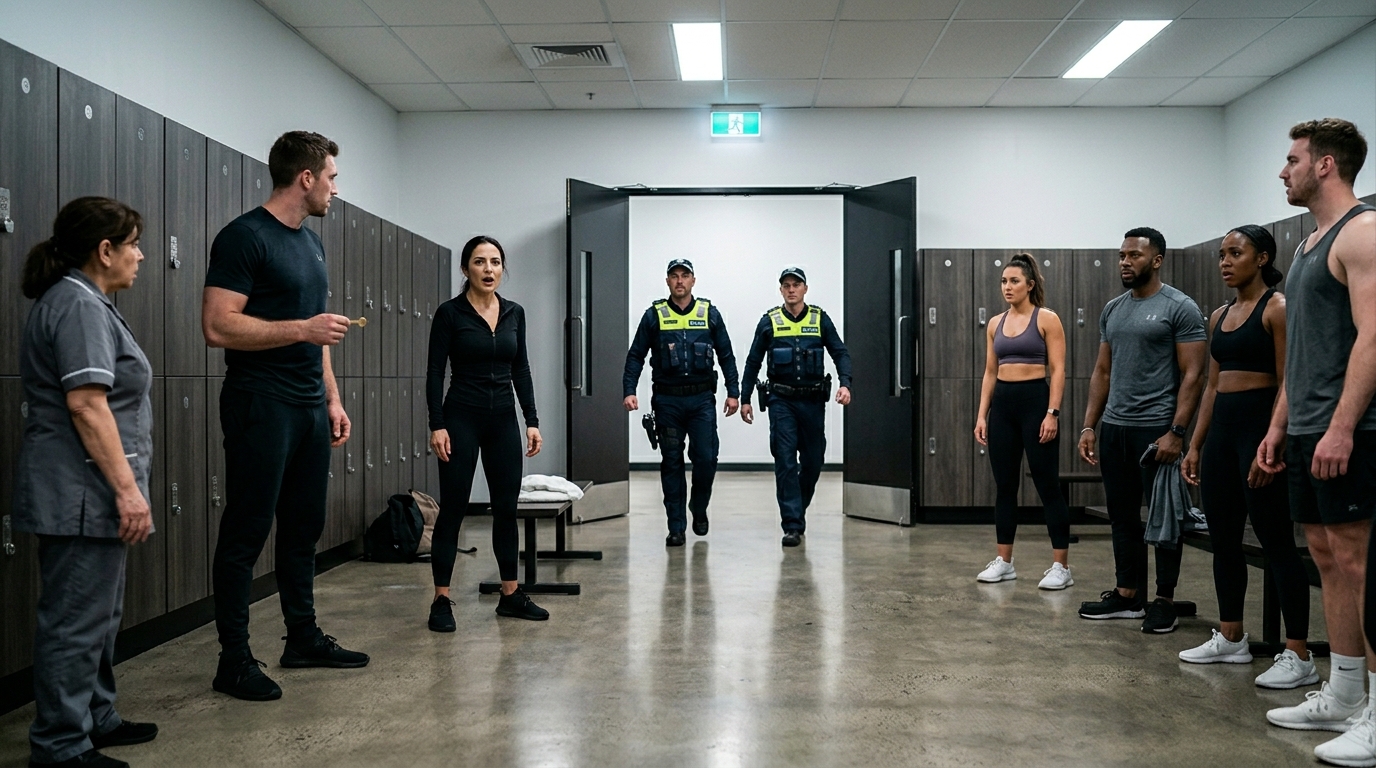
Before she could answer, the gym doors swung open behind us.
Hard.
Police entered fast.
Four officers.
Focused.
Purposeful.
Not confused.
Not responding to a random scene.
Coming for someone.
One officer looked straight at Vanessa.
And I understood.
This wasn’t coincidence.
Someone had been watching her before I ever picked up that key.
I leaned closer, the key clenched in my fist.
“…tell them what you did.”
Vanessa’s mouth opened.
No words came out.
Because for the first time since she walked into that gym, there was no camera angle that could save her.
The Locker That Should Have Been Empty
The lead officer’s name was Detective Laura Quinn.
She did not ask for silence.
She created it.
One look.
One raised hand.
One sentence.
“Everyone step back.”
People moved.
Even Vanessa.
Not far, but enough.
Detective Quinn’s eyes dropped to the key in my hand.
“Where did you get that?”
“She dropped it,” I said, nodding toward Rosa.
Rosa shook her head quickly.
“I didn’t steal it. I swear. I found it under the bench when I was cleaning. I was bringing it to the front desk.”
Vanessa snapped, “That is a lie.”
Detective Quinn turned toward her.
“Ms. Cross, you’ll get your turn.”
Something in Vanessa’s face tightened.
She was used to people letting her speak first.
Detective Quinn looked back at me.
“Your name?”
“Daniel Reeves.”
Her expression changed slightly.
Not surprise.
Recognition.
“You’re Emily Reeves’s brother.”
My stomach dropped.
“You know my sister?”
“I know her case.”
Case.
I hated that word.
Emily was not a case.
She was twenty-four years old.
She wore mismatched socks because she said matching them wasted life.
She sang badly in the car.
She wanted to open a bakery one day, even though she burned frozen pizza twice in one month.
And two years ago, she walked into this gym after work and never came home.
Her phone was found near the riverwalk.
Her purse was gone.
Her car was still in the gym parking lot.
Police found no blood, no witnesses, no useful footage.
The official theory became voluntary disappearance.
Mine never did.
I held out the key.
“This belonged to her.”
Detective Quinn did not take it with her bare hand. She pulled an evidence bag from her jacket and held it open.
“Drop it in.”
I did.
The plastic swallowed the key.
For some reason, that made my hands shake.
Vanessa gave a sharp laugh.
“This is absurd. Anyone could have had that key.”
Detective Quinn looked at her.
“Then you won’t mind opening the locker.”
Vanessa’s face went blank.
“What?”
“Locker C-217.”
“That isn’t my locker.”
Rosa lifted her head.
“Yes, it is.”
Vanessa turned on her.
“You don’t know anything.”
Rosa flinched.
I stepped between them.
Detective Quinn moved past us toward the locker aisle.
“Let’s find out.”
The gym manager, a nervous man named Paul with a headset and a sweat stain spreading beneath one arm, fumbled with the master access tablet.
“C-217 is listed as inactive,” he said.
Detective Quinn looked at him.
“Open it.”
“I need authorization from corporate for inactive lockers.”
She held up a warrant.
He stopped talking.
The locker row felt longer than it was.
Every step toward C-217 seemed to pull me two years backward.
Emily laughing at the front desk.
Emily texting me: Last workout then dinner?
Emily never showing up.
C-217 sat near the end of the row, low enough that Emily used to complain about crouching.
The manager unlocked it with shaking fingers.
The metal door clicked.
Detective Quinn pulled it open.
At first, it looked empty.
Too empty.
Then she crouched.
“There’s a false panel.”
My heart stopped.
A thin screwdriver appeared from her kit.
She worked the back corner loose.
The panel shifted.
Behind it was a narrow space.
Inside lay a plastic evidence sleeve.
Not police-issued.
Homemade.
Carefully sealed.
Detective Quinn removed it.
Inside was a silver bracelet.
A receipt.
And a folded napkin.
I saw the bracelet first.
Small crescent moon charm.
I had given it to Emily for her twenty-third birthday.
My legs nearly went out.
“That’s hers,” I whispered.
No one spoke.
Detective Quinn unfolded the napkin.
Three words were written in black marker.
Not Vanessa alone.
The room seemed to tilt.
Vanessa backed away.
Detective Quinn looked at her.
“Ms. Cross.”
Vanessa shook her head.
“No. Someone planted that.”
“Who?”
No answer.
The detective lifted the receipt.
It was from a downtown parking garage.
Timestamp: 11:48 p.m.
The night Emily disappeared.
On the back was another number.
Unit 42.
Detective Quinn’s jaw tightened.
“I knew it.”
I looked at her.
“Knew what?”
She glanced at Vanessa, then at me.
“For six months, we’ve been investigating missing women connected to temporary storage units, private gyms, and influencer-run wellness events.”
The words entered slowly.
Missing women.
Connected.
Not Vanessa alone.
I looked at the napkin again.
Not Vanessa alone.
“What does that mean?” I asked.
Detective Quinn’s face darkened.
“It means your sister may have found something bigger than anyone understood.”
Then Vanessa bolted.
The Woman Behind the Screen
She made it three steps.
That was all.
One officer caught her near the smoothie bar.
Another blocked the exit.
Vanessa screamed the second they touched her.
Not in fear.
In outrage.
“Do you know who I am?”
Detective Quinn walked toward her slowly.
“Yes,” she said. “That’s why we’re here.”
The phones were still recording.
This time, Vanessa noticed them differently.
Not as tools.
As threats.
Her face shifted, recalculating, searching for sympathy.
“I’m being harassed,” she said loudly. “This man is unstable. He’s obsessed with his sister’s disappearance and now he’s trying to frame me.”
Two years ago, that might have worked.
Maybe it did work.
People liked Vanessa.
They liked her videos.
They liked her morning routines, her clean meals, her expensive leggings, her captions about empowerment.
Emily had liked her too.
That was what destroyed me.
My sister joined this gym because Vanessa promoted it.
She took one of Vanessa’s “confidence coaching” sessions.
She told me Vanessa was intense, but inspiring.
Then, two weeks before she vanished, Emily called me late at night.
She sounded strange.
“Daniel,” she said, “have you ever met someone everyone loves, but something about them feels… wrong?”
I asked if she was talking about a guy.
She said no.
Then changed the subject.
I didn’t push.
I have punished myself for that every day since.
Detective Quinn ordered officers to clear the gym.
Customers protested, but not much. Fear had replaced curiosity.
Rosa sat on a bench, wrapped in a towel someone finally had the decency to give her. She looked at me with swollen eyes.
“I’m sorry,” she whispered.
I knelt in front of her.
“For what?”
“If I had brought the key sooner…”
“No,” I said. “You brought it today.”
She nodded, but her hands kept trembling.
Detective Quinn approached me.
“We need you to come with us.”
“To where?”
“The parking garage from the receipt.”
Vanessa laughed from beside the officers.
“You’re too late.”
The words struck me like ice.
Too late.
That was the first time I saw Detective Quinn lose her calm.
Only for a second.
But I saw it.
She turned toward Vanessa.
“What does that mean?”
Vanessa smiled.
Small.
Poisonous.
“It means you should have listened to the first girl.”
Detective Quinn’s expression hardened.
The first girl.
Not Emily.
Someone before Emily.
The parking garage sat eight blocks away.
Unit 42 was not a parking space.
It was a private storage cage in the basement level, rented under an LLC called VCross Media Logistics.
Vanessa’s company.
Police cut the lock.
The metal gate rolled open.
Inside were boxes.
Dozens of them.
Yoga mats.
Ring lights.
Old tripods.
Branded merchandise.
Normal things.
Too normal.
Then Detective Quinn found the cooler.
A large white medical cooler near the back.
Empty.
Cleaned.
But not clean enough.
There was dried blood beneath the handle.
The world narrowed.
“Is it hers?” I asked.
No one answered.
That was an answer.
Behind the cooler was a laptop bag.
Inside, police found a hard drive, three phones, and a small black notebook.
Detective Quinn opened the notebook first.
Names.
Dates.
Initials.
Locations.
Some crossed out.
Some circled.
One page near the middle had Emily’s name.
EMILY R. — asked about sponsorship accounts. Saw blue room. Needs handling.
Blue room.
I looked at Detective Quinn.
“What is the blue room?”
She did not answer quickly.
Then she said, “That’s what we’re trying to find.”
The hard drive answered before Vanessa did.
At the station, an evidence technician opened the first folder.
Videos appeared.
Not polished videos.
Not the kind Vanessa posted.
Raw footage.
Private footage.
Women in rooms with blue walls.
Women crying.
Women being pressured into signing influencer management contracts, settlement agreements, nondisclosure forms, debt acknowledgments.
Women who had joined wellness programs and ended up trapped in financial, emotional, and sometimes physical control.
Most were not famous.
That was the point.
Aspiring trainers.
Cleaners.
Single mothers.
Young women chasing visibility.
Women who could be threatened with debt, shame, deportation, custody, scandal, exposure.
Vanessa did not act alone.
The notebook named lawyers, managers, a private security firm, a doctor who signed anxiety evaluations, and a judge’s son who owned storage units across the city.
Then Emily appeared on the screen.
My sister.
Alive.
Standing in a blue-walled room.
Her hair tied back.
Crescent moon bracelet on her wrist.
She looked scared, but furious.
Vanessa’s voice came from off-screen.
“You should have taken the deal.”
Emily lifted her chin.
“You’re stealing from them.”
“You have no idea what you saw.”
“I copied the file.”
Silence.
Then Vanessa stepped into frame.
Smiling.
“Where is it?”
Emily smiled back.
And even terrified, even cornered, she looked like herself.
“Somewhere you’ll never look.”
The video ended.
I could not breathe.
Detective Quinn paused the screen.
“Daniel.”
I looked at her.
“What file?”
She held up the crescent bracelet from the locker.
The charm had a tiny seam along the edge.
A hidden compartment.
Inside was a microSD card.
Emily had hidden the evidence in the bracelet I gave her.
And for two years, Vanessa kept that bracelet without knowing it carried the thing that could destroy her.
The Blue Room
The microSD card was damaged.
Of course it was.
Nothing about truth arrives unbroken.
The technicians worked through the night recovering fragments.
I sat in the hallway outside the digital lab with cold coffee in my hand, watching police move through doors I could not enter.
Rosa sat beside me for part of it.
She had given her statement three times.
Each time, she said the same thing.
“I found the key under the bench. I was trying to turn it in.”
No one called her a thief anymore.
That should have felt good.
It didn’t.
Because public humiliation cannot be undone just because people eventually feel guilty.
At 3:14 a.m., Detective Quinn came out.
Her face told me before her mouth did.
They had found something.
“We recovered a location,” she said.
I stood.
“Where?”
“A private studio downtown. Registered as a content production space.”
“The blue room?”
She nodded.
My hands curled into fists.
“Was Emily there?”
“We don’t know.”
The building looked ordinary.
That scared me more.
A renovated brick studio with white walls, frosted windows, and a logo painted near the door.
CROSSFORM COLLECTIVE.
I had seen it on Vanessa’s social media.
A place for “women rebuilding power.”
A place for “safe transformation.”
A place where my sister may have been dragged into something she could not escape.
Police entered at dawn.
No dramatic music.
No shouting at first.
Just a battering ram.
A door breaking.
Boots on concrete.
Voices.
“Police!”
I was not supposed to be there.
But I was in the car across the street with Detective Quinn’s permission or exhaustion. Maybe both.
At 6:22 a.m., two officers brought out a woman wrapped in a blanket.
Then another.
Then a third.
Alive.
All alive.
But none of them were Emily.
My hope rose and collapsed over and over until I felt hollow.
Then Detective Quinn came out.
Her face was pale.
“Daniel.”
I got out before she finished saying my name.
Inside, the blue room was smaller than it looked on video.
That made it worse.
A camera tripod stood in one corner.
Blue acoustic panels lined the walls.
There was a table.
Two chairs.
A shelf of branded candles.
A locked cabinet.
Police had opened it.
Inside were personal items.
IDs.
Phones.
Jewelry.
Wallets.
Things taken from women to keep them obedient.
On the second shelf, beneath a makeup bag and a passport, was Emily’s phone.
I recognized the cracked corner.
My stomach dropped.
Detective Quinn picked up an evidence bag.
“There’s a recording.”
She hesitated.
“You don’t have to hear it now.”
“Yes,” I said.
The audio played from Emily’s phone.
Her voice was low, rushed.
“Daniel, if you find this, don’t blame yourself. I know you will. Stop it.”
I broke immediately.
Detective Quinn lowered her eyes.
Emily continued.
“I found the accounts. Vanessa is recruiting women through gym programs, then trapping them with fake debts and contracts. But she’s not the top. The money goes through Harlan Group. Look for the judge’s son. Look for the storage units.”
A sound in the background.
A door.
Emily breathed faster.
“I hid the backup in the bracelet. If you’re hearing this, maybe you found it. Maybe you found me. If not—”
Her voice cracked.
“I love you. Tell Mom I didn’t run.”
The recording ended.
I pressed both hands against my face.
For two years, people had told me Emily left.
Needed space.
Chose silence.
Started over.
But my sister had left me a command.
Tell Mom I didn’t run.
I would.
Even if it destroyed me.
The locked cabinet held another clue.
A transit receipt from the night Emily vanished.
Destination: North Harbor Storage.
Unit 88.
Detective Quinn closed her hand around the evidence bag.
“That facility belongs to Harlan Group.”
“The judge’s son?”
She nodded.
I looked around the blue room.
At the cameras.
At the chairs.
At the place where women were reduced to contracts and threats.
Then I asked the only question that mattered.
“Are we too late?”
Detective Quinn did not answer.
That was what frightened me most.
Unit 88
North Harbor Storage sat near the old docks, where the city smelled like rust, salt, and diesel.
Rows of metal doors stretched beneath gray morning light.
Unit 88 was at the far end.
The lock was new.
Expensive.
Detective Quinn cut it anyway.
The door rolled up.
At first, I saw only boxes.
Plastic tubs.
Old furniture.
Rolled carpets.
Then the smell hit.
Not death.
Thank God.
But chemicals.
Bleach.
Disinfectant.
Fear.
Police moved first.
I was held back by two officers.
I let them, though every nerve in my body screamed to push through.
Inside, they found a mattress.
A camera mount.
A portable heater.
A stack of legal forms.
And on the wall, scratched into the metal with something sharp, four words:
I didn’t run, Daniel.
My knees buckled.
An officer caught me.
I don’t remember his name.
I remember the sound that left me.
I remember Detective Quinn standing in the doorway with her jaw clenched.
I remember the wind pushing through the storage yard, rattling metal doors like bones.
Then someone called from inside.
“Detective.”
They found a second space behind a false wall.
No Emily.
But a map.
Routes.
Names.
A private transport line.
Dates marked every few months.
Women moved between storage units, studios, apartments, and so-called retreat houses until their debts, contracts, and identities were fully controlled.
Some were forced into content.
Some into unpaid labor.
Some into silence.
The ones who fought hardest disappeared from the system first.
Emily had fought hardest.
That was my sister.
The final page of the map listed one active location.
A farmhouse outside Briar County.
No cameras.
No cell service.
Owned by a shell company tied to Vanessa’s lawyer.
The raid happened that night.
This time, I was not allowed close.
No hallway.
No car outside.
No exceptions.
I waited at the station with my mother.
She had arrived from Ohio with the same photo of Emily in her wallet that she had carried for two years.
My mother did not cry when I told her about the bracelet.
She touched the crescent charm through the evidence bag and said, “She always was clever.”
Then we waited.
Hours.
The kind of hours that make clocks feel violent.
At 11:47 p.m., Detective Quinn walked into the room.
I stood.
My mother stood.
The detective’s eyes were wet.
“She’s alive.”
My mother made a sound I had never heard from her.
I sat down because my legs stopped working.
Alive.
One word.
A whole world.
Emily was not in the first ambulance.
Or the second.
She came in the third, wrapped in a blanket, thinner than memory, hair cut short, face bruised, eyes searching every doorway like the world might still be a trap.
Then she saw me.
“Daniel?”
I could not move.
For two years, I had imagined finding her a thousand ways.
Running.
Crying.
Holding her.
Asking where she had been.
But when it happened, I froze like the room had become glass.
Emily reached for me first.
That broke the spell.
I crossed the space between us and fell to my knees beside the stretcher.
Her hand was cold.
Too thin.
Alive.
“I told you I didn’t run,” she whispered.
I laughed and sobbed at the same time.
“I know.”
My mother reached us then.
She touched Emily’s face with both hands.
Not roughly.
Not desperately.
Like she was afraid her daughter might dissolve.
Emily closed her eyes.
“I tried to come home.”
“You did,” my mother whispered. “You did.”
Vanessa was arrested that same night.
So were eight others.
The lawyer.
The storage owner.
The doctor.
Two private security men.
A judge’s son who had spent years believing his family name was stronger than evidence.
He was wrong.
Emily had made sure of that.
The Woman Who Would Not Disappear
The trial lasted almost a year.
Vanessa’s lawyers tried to turn her into a victim of powerful men.
A manipulated influencer.
A brand face.
A woman in over her head.
Then prosecutors played the gym footage.
Not the old videos.
The day Rosa dropped the key.
The day Vanessa shoved a cleaning woman and called her a thief.
The day she looked at me and recognized the number on my sister’s locker.
That footage did what polished arguments could not.
It showed who Vanessa was when she thought the room belonged to her.
Rosa testified first.
Her voice shook, but she spoke clearly.
“I was cleaning. I found the key. She saw it and panicked.”
The defense asked if she had ever stolen anything.
Rosa looked at Vanessa.
“No,” she said. “But she tried to steal my name that day.”
I understood what she meant.
Thief.
Liar.
Illegal.
Unstable.
Desperate.
People like Vanessa did not only steal money.
They stole the words other people needed to defend themselves.
Emily testified behind a privacy screen.
Not because she was ashamed.
Because she deserved to speak without being consumed.
Her voice was steady when she described the blue room, the contracts, the threats, the storage unit, the farmhouse, the other women.
It broke only once.
When the prosecutor asked how she kept hope.
“My brother,” she said.
I stared at the floor.
Because I had spent two years feeling like I failed her.
Then she added, “I knew if one piece of me got out, he’d recognize it.”
The crescent bracelet sat in an evidence tray.
The key sat beside it.
Small things.
Huge enough to break an empire.
Vanessa received thirty-four years.
The others received less, but not little.
Harlan Group collapsed.
CrossForm Collective vanished from the internet within days, though not before thousands of people flooded every page with one sentence:
Tell them what you did.
Rosa became a witness advocate after the trial.
I asked her once why she didn’t quit cleaning sooner.
She smiled sadly.
“People always ask why poor women stay in hard places. They don’t ask why hard places are allowed to feed on poor women.”
I had no answer.
The gym closed for six months, then reopened under new ownership.
Locker C-217 was removed.
The manager asked if we wanted it.
Emily said no.
Then changed her mind.
Now the blue plastic tag hangs in her apartment, framed beside a note she wrote herself.
I did not disappear.
I survived.
Recovery was not simple.
It never is.
Emily came home, but not to the same life. She slept with lights on. She hated cameras. She could not stand the smell of lavender candles because Vanessa used them in the blue room.
Some days she laughed like the old Emily.
Some days she disappeared into silence so deep I had to remind myself not to pull her out before she was ready.
But she was here.
We had coffee on Sundays.
We fought about groceries.
She adopted an ugly orange cat and named it Lawsuit.
My mother pretended not to spoil both of them.
One year after the raid, we returned to the gym.
Not inside.
Just outside.
Rosa came too.
So did Detective Quinn.
The four of us stood near the entrance where the police had rushed in, where the world had shifted from public drama to something far darker.
Emily held the key in one hand.
The original.
Released from evidence.
She looked at it for a long time.
Then she handed it to Rosa.
Rosa shook her head.
“I can’t.”
“You found it,” Emily said. “You brought me back.”
Rosa started crying.
So did my mother.
So did I, though I looked away and pretended the wind was strong.
Emily smiled.
Not the old smile.
A new one.
Stronger in some places.
Broken in others.
Hers.
“Keep it,” she said. “Proof doesn’t always look important when it hits the floor.”
Rosa closed her fingers around the key.
Inside the gym, people lifted weights again.
Music played.
Rubber mats absorbed impact after impact.
But I would never hear that sound the same way.
Not after the day a cleaning woman was thrown against a bench.
Not after a tiny key struck the floor.
Not after a room full of strangers lifted their phones for humiliation and accidentally recorded the beginning of justice.
Vanessa Cross built her life on being watched.
In the end, being watched destroyed her.
But what saved my sister was not the cameras.
Not the crowd.
Not even the police walking in at exactly the right moment.
It was Rosa’s shaking hand.
A scratched blue key.
A number I never forgot.
And the fact that my sister, even trapped in the worst place of her life, knew one thing with absolute certainty.
If she left me a piece of the truth—
I would know it when I saw it.