The Ring That Hit the Coffin
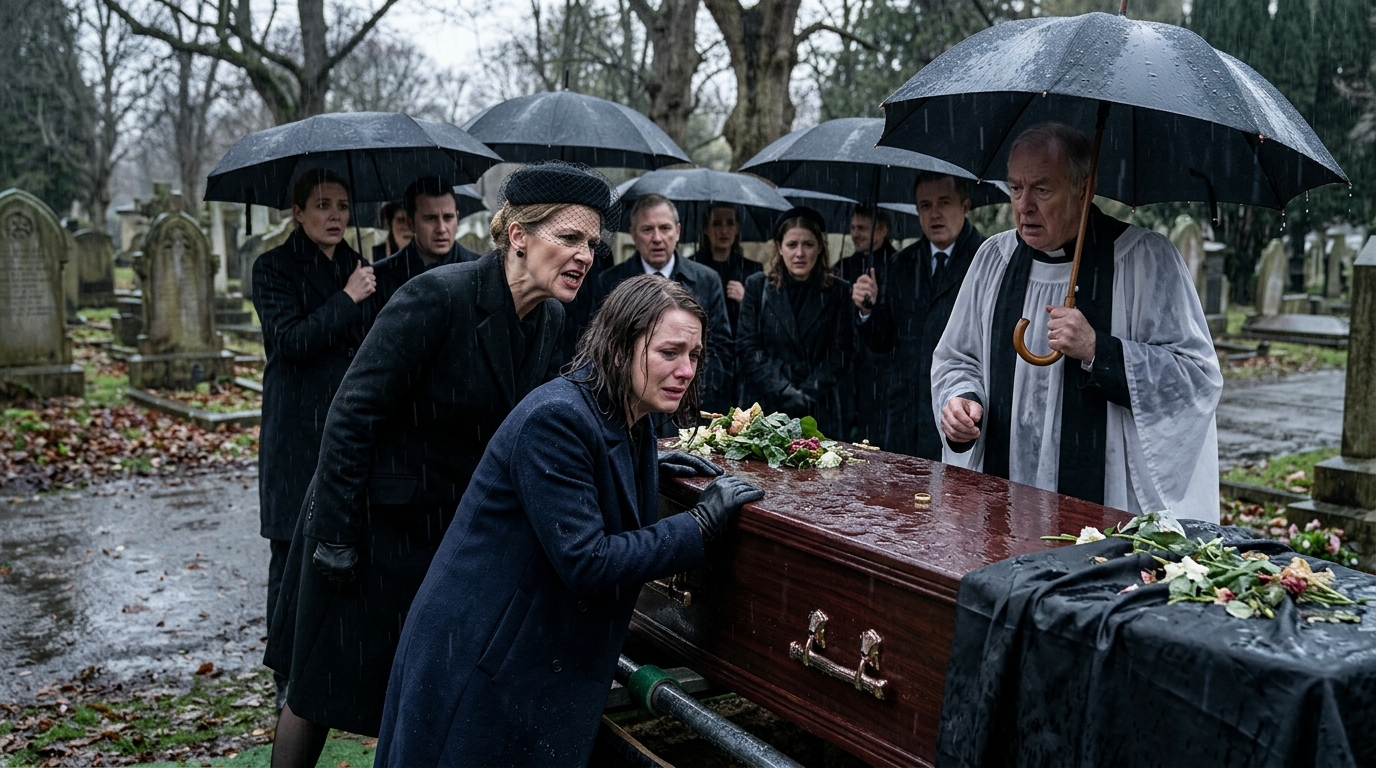
The rain had turned the cemetery into a field of black umbrellas and mud.
Cold water streamed down the edges of the tent. Wet leaves clung to the grass around the grave. The polished coffin sat above the open earth, covered in white roses that were already beginning to sag beneath the weather.
Everyone had come to bury Charles Whitmore.
Businessman.
Philanthropist.
Founder of Whitmore Shipping.
A man whose name appeared on hospital wings, scholarship programs, and the brass plaques of half the city’s charitable buildings.
To the public, Charles had been generous.
To his friends, powerful.
To his employees, demanding but fair.
To the woman standing at the foot of his coffin, he had been something far more complicated.
Her name was Anna Bell.
She stood in a dark coat, soaked through, one hand pressed against her chest as if holding herself together from the inside. She had not come with family. She had not spoken to anyone. She had simply walked up the muddy cemetery path during the final prayer and stopped at the edge of the mourners.
Then she started crying.
Not loudly.
Not dramatically.
But the kind of crying that breaks through the body before permission can stop it.
That was when the widow saw her.
Veronica Whitmore turned from beside the coffin like a blade finding its target. She was dressed in black silk, a pearl veil covering part of her face, her gloved hands folded perfectly a moment before they became fists.
At first, people thought she was only startled.
Then Veronica crossed the wet grass in three sharp steps.
Before anyone understood what was happening, she shoved Anna hard.
Anna’s body slammed against the side of the coffin.
The wood shuddered.
Umbrellas shifted.
Gasps cut through the rain.
“You will not cry over my husband!”
Veronica’s voice sliced through the cemetery, raw and furious.
Anna clutched the coffin’s edge with shaking hands, fighting to stay upright.
“Please…”
The word barely left her mouth.
Veronica stepped closer.
“You ruined his life.”
No one moved.
Charles’s son, Daniel, stood frozen near the front row. His wife covered her mouth. An elderly board member lowered his umbrella slightly, eyes narrowed. The priest, Father Thomas, looked from one woman to the other, alarm spreading across his face.
Anna did not argue.
She did not defend herself.
She simply reached into her coat.
A ripple of uneasy whispers moved through the mourners.
Her hand emerged holding something small.
Gold.
A ring.
Without hesitation, Anna threw it onto the coffin.
CLINK.
The sound cut through everything.
Sharper than the shove.
Sharper than the rain.
Sharper than Veronica’s accusation.
The ring bounced once against the dark wood and rolled between the white roses.
Father Thomas stepped forward, hesitant. He picked it up carefully, wiping rain from the band with his thumb.
At first, his expression was only confused.
Then it changed.
Completely.
“This ring…”
His voice was so low that those nearest him leaned closer.
Veronica’s breath caught.
Father Thomas stared at the gold band as if it had dragged him thirty years into the past.
“This ring was buried with his first wife.”
The shock did not explode through the crowd.
It spread slowly.
Heavily.
Inevitably.
Veronica staggered back half a step.
Not much.
But enough.
Anna lifted her head.
Rain ran down her face, mixing with tears, but her voice had steadied.
“Then tell them,” she said.
The cemetery fell silent.
Even the wind seemed to hold back.
Anna looked directly at Veronica.
“Tell them who opened her grave.”
The rain continued to pour.
The mourners no longer looked like mourners.
They looked like witnesses.
And beside the coffin of Charles Whitmore, the funeral stopped being a farewell.
It became the beginning of a trial no one had expected.
Video: Widow Shoves Crying Woman Into Coffin—Then a Ring Buried With the First Wife Exposes a Dark Secret
The Woman Everyone Thought Was the Mistress
Anna Bell had expected hatred.
She had prepared for it on the bus ride to the cemetery, hands clasped tightly in her lap, the ring hidden in the lining of her coat. She knew how she would look to them.
A strange woman arriving at a rich man’s funeral.
Alone.
Crying.
Uninvited.
People love simple explanations when grief becomes uncomfortable.
The widow would call her a mistress.
The mourners would believe it.
The family would look away because scandal is easier to dismiss when the dead man cannot defend anyone.
Anna had accepted all of that before she stepped through the cemetery gate.
What she had not expected was the shove.
The impact against the coffin left pain blooming across her ribs. Her palms were scraped from catching the edge. Her breathing came shallow now, but she kept her gaze fixed on Father Thomas and the ring in his hand.
He was still staring at it.
The old priest’s face had turned gray.
Daniel Whitmore finally stepped forward.
“Father,” he said, voice tight, “what do you mean?”
Father Thomas looked at him, then at the coffin, then at Veronica.
“I buried this ring twenty-six years ago.”
Veronica recovered quickly.
She always did.
“That is impossible,” she said.
Her voice was sharp, but not as steady as before.
“It may look similar, but it cannot be the same ring.”
Father Thomas shook his head slowly.
“It is the same.”
“How could you possibly know that?”
The priest turned the ring in his fingers and exposed the inner band.
“There is an inscription.”
Daniel moved closer.
Father Thomas read it aloud.
“To Eleanor, my first and only truth. C.W.”
The words fell like stones into the wet grass.
Everyone knew the name Eleanor.
Eleanor Whitmore had been Charles’s first wife.
Beautiful.
Private.
Beloved by the old families in town.
She had died in a house fire nearly three decades earlier, long before Veronica married Charles. The story had become part of Whitmore family lore: a tragic accident at the old lake house, a grief-stricken husband, a charity foundation created in Eleanor’s memory.
Charles had never spoken of that night publicly.
Veronica had spoken of it often.
Always with a sad, respectful tone.
Always positioning herself as the woman who helped him survive the unspeakable.
Anna looked at the coffin.
Then at Daniel.
“You were told your mother died in that fire,” she said.
Daniel’s face tightened.
His umbrella lowered slowly.
“I did not ask you.”
“No,” Anna said. “But she did.”
The mourners shifted.
Veronica’s eyes narrowed.
“What did you just say?”
Anna reached into her coat again.
This time, Veronica flinched.
But Anna pulled out only a folded photograph.
Old.
Water-damaged.
She held it toward Daniel.
He hesitated before taking it.
In the picture, a woman stood in front of a cottage porch, one hand resting on the shoulder of a young girl with dark hair. The woman’s face was partly turned, but her features were clear enough.
Daniel stopped breathing.
Because the woman in the photograph was Eleanor Whitmore.
Older than she had been in the framed portraits at home.
Thinner.
Tired.
But alive.
And the little girl beside her—
Daniel looked up at Anna.
Anna’s voice softened.
“My name is Anna Bell.”
A pause.
Then:
“But that is not the name I was born with.”
Veronica’s face lost color.
Anna looked at Daniel and said the words Charles had died before finding the courage to say in public.
“I am your sister.”
The First Wife Who Did Not Die in the Fire
The cemetery erupted.
Not with shouting.
Not at first.
With whispers.
Fast.
Confused.
Disbelieving.
The kind of whispers that spread through wealthy gatherings when scandal arrives wearing evidence.
Daniel stared at Anna as if his mind refused to join the pieces.
“My sister died,” he said.
Anna shook her head.
“No. You were told she died.”
“I was five.”
“I know.”
“My mother died in the fire.”
Anna’s voice trembled for the first time.
“No. She escaped it.”
Veronica stepped forward.
“This is deranged.”
Anna turned on her.
“You knew.”
“I have never seen you before today.”
“That part may be true,” Anna said. “But you knew about my mother.”
Veronica laughed sharply.
A brittle, ugly sound.
“This woman appears at my husband’s funeral, claims to be his secret daughter, and throws stolen jewelry onto his coffin. And all of you are standing here listening?”
A few mourners looked uncertain again.
Veronica saw it and pressed harder.
“Where did you get that ring?”
Anna looked at the priest.
“From my mother.”
Father Thomas frowned.
“But I placed it in Eleanor’s coffin.”
“No,” Anna said quietly. “You placed it in a coffin.”
The priest went still.
Daniel’s face changed.
Anna took a breath.
“My mother told me there was a fire, but not the way everyone said. She said Charles came to the lake house that night to end the marriage quietly. She had discovered forged documents connected to company money. She was going to take Daniel and leave.”
Daniel’s lips parted.
The rain struck harder against the tent.
Anna continued.
“She said they argued. She said someone else was there.”
Her eyes moved to Veronica.
Veronica’s expression did not change, but the hand holding her umbrella tightened.
Anna kept speaking.
“My mother woke up outside the house with burns on her arm and smoke in her lungs. A man who worked for your father helped her. He told her Daniel had been taken back to the city. He told her if she returned, she would be blamed for the fire, for the missing money, and for abandoning her child.”
Daniel whispered, “Why wouldn’t she come back?”
Anna’s face crumpled.
“She tried.”
The answer broke something in him.
“She tried twice. The first time, men came to the motel where she was hiding. The second time, a lawyer told her your father had declared her unstable and dangerous. She had no money. No family left who believed her. No proof.”
Anna touched her chest.
“And by then, she had me.”
Father Thomas made the sign of the cross quietly.
Veronica’s voice cut through.
“What a convenient story.”
Anna looked at her.
“No. Convenient is a sealed coffin.”
The priest lowered his gaze.
He looked suddenly much older.
Daniel turned to him.
“Father?”
Father Thomas swallowed hard.
“There was no viewing,” he said.
Daniel’s voice sharpened.
“I know that.”
“Your father said Eleanor was badly burned.”
“He told me that all my life.”
The priest closed his eyes.
“I was young then. Too young to question a grieving husband with money and influence. The coffin was sealed before it reached the church.”
The crowd became very quiet.
Anna’s voice lowered.
“My mother died last winter.”
Daniel looked at her.
“For years, she kept that ring hidden. She said it was the only thing she took from the lake house. The only proof that she was still herself.”
Anna looked toward the coffin.
“She told me not to hate Charles. She said fear made him a coward before greed made him cruel.”
Daniel flinched.
“She also told me something else before she died.”
Veronica stepped back.
Just one step.
Anna saw it.
“My mother said if Charles died before telling the truth, I should bring the ring to his grave. She said the priest would remember.”
Father Thomas clutched the ring more tightly.
Daniel stared at the gold band.
“But if my mother had the ring,” he said slowly, “then why did Father Thomas think it was buried with her?”
Anna looked at Veronica.
“Because someone needed everyone to believe Eleanor was dead.”
The Grave That Had Been Opened
The first sign that something was truly wrong came not from Anna.
It came from the cemetery caretaker.
An elderly man named Mr. Collins stood at the edge of the tent, rain dripping from the brim of his cap. He had been quiet until then, almost hidden among the mourners.
Now he stepped forward.
“Father Thomas,” he said.
Everyone turned.
His voice was rough from age and weather.
“There’s something you should know.”
Veronica’s head snapped toward him.
Mr. Collins did not look at her.
He looked at the priest.
“Two weeks ago, someone came about the old Whitmore grave.”
Daniel frowned.
“What old grave?”
“The grave beside this one,” Collins said.
He pointed toward a moss-dark headstone a few feet away.
Eleanor Whitmore.
Beloved Wife and Mother.
The stone had stood there for twenty-six years.
Cleaned every spring.
Decorated every anniversary.
A lie maintained by flowers.
Daniel stared at it.
“What do you mean someone came?”
Collins shifted uncomfortably.
“A request was made to inspect the burial vault. Said there were concerns about water damage.”
Veronica’s face hardened.
“That is routine.”
Collins finally looked at her.
“You told me it came from Mr. Whitmore.”
Veronica’s mouth opened.
Closed.
Daniel turned to her.
“You requested it?”
She straightened.
“Your father was concerned about the family plot.”
“My father was dying.”
“He was still capable of concern.”
Anna said, “Was the coffin opened?”
Mr. Collins looked down.
“I was told it would be handled by a private restoration service. I didn’t like it, but the paperwork had the Whitmore seal and Mrs. Whitmore’s signature.”
Daniel’s voice went cold.
“Which Mrs. Whitmore?”
The question hung there.
Veronica’s eyes flashed.
“I was Charles’s wife.”
Anna stepped closer.
“But you knew you weren’t the first.”
The rain battered the tent.
Mr. Collins swallowed.
“I checked afterward. The earth had been disturbed more than it should have been.”
Father Thomas whispered, “Dear God.”
Daniel looked at Anna.
“The ring was taken from the grave?”
Anna shook her head.
“No. The ring wasn’t there.”
Veronica’s breath caught.
Anna turned toward her.
“That is what frightened you, wasn’t it? You opened Eleanor’s grave because Charles said something before he died.”
Daniel looked sharply at Veronica.
“What did he say?”
Anna answered.
“He asked for Eleanor’s ring.”
Veronica’s face went completely still.
Anna continued.
“My mother received a letter six months ago. From Charles.”
Daniel’s face changed.
“A letter?”
Anna nodded.
“He wrote that he had lived too long with lies. He said he wanted to see her once before he died. She was already too sick to travel, so she wrote back. She included a copy of a photograph.”
Anna looked toward the coffin.
“After that, he sent one more letter. He said he was going to confess everything and return Daniel’s inheritance rights to both children.”
Daniel’s mouth tightened.
Both children.
The phrase struck him strangely.
He had spent his life as Charles Whitmore’s only heir.
Now, beside his father’s coffin, he realized his inheritance might have been built on another child’s erasure.
Veronica’s voice returned cold.
“You have no proof of any of this.”
Anna reached into her coat one final time.
This time, she pulled out a packet sealed in plastic.
Letters.
Photographs.
A medical record.
A birth certificate.
Daniel stepped forward slowly.
His hand shook when he took it.
At the top of the first letter was Charles’s handwriting.
Daniel knew it instantly.
My Eleanor,
If this reaches you, then God has given me less mercy than I asked for and more time than I deserve.
Daniel stopped reading.
His face drained.
Veronica’s voice sharpened.
“Daniel, don’t.”
He looked at her.
That was the wrong thing to say.
Because in that moment, everyone heard the fear beneath the command.
The Widow Who Inherited a Lie
Daniel read the letters in the church office an hour later.
The funeral never resumed.
No one knew how to go back to prayers after the dead man’s first wife seemed to have risen through paper, gold, and accusation.
The mourners remained outside under the tent, whispering in clusters. Some left. Most stayed. People always stay when a respected family begins cracking in public.
Inside the small stone church, Daniel sat at a wooden table with Anna across from him. Father Thomas stood near the window. Mr. Collins waited by the door, cap in both hands.
Veronica refused to sit.
She stood near the wall, arms folded, veil pushed back from her face, eyes burning.
Daniel read the first letter.
Then the second.
Then the third.
With each page, his father became less like the man in the obituary and more like a frightened stranger Daniel had never fully known.
Charles admitted that Eleanor had discovered company funds being moved through shell accounts. He admitted he had been manipulated by people inside the business, including Veronica’s older brother, then a financial adviser to Whitmore Shipping. He admitted that the lake house fire had begun after a confrontation.
He did not say he lit it.
But he admitted he let the world believe Eleanor died there because the alternative would have destroyed him.
I told myself you were safer away from me, Charles had written. That was the lie I used to survive my own cowardice.
Daniel’s hands trembled.
Anna watched him without satisfaction.
This was not victory for her.
This was the death of a second illusion.
Daniel reached the final letter.
It was addressed to him.
My son,
If you are reading this, then I have failed to speak while living.
Eleanor did not abandon you.
Your sister did not die.
I did not protect you from the truth. I protected myself from your hatred.
Veronica moved suddenly.
Daniel looked up.
“Don’t.”
She froze.
His voice had changed.
For the first time that day, he sounded like Charles Whitmore’s son in a way that had nothing to do with money.
He continued reading.
I kept Eleanor’s grave sealed because it was easier to mourn a wife than to face one I betrayed. If the grave has been opened, then someone feared what was not inside it.
Daniel lowered the page.
His eyes lifted to Veronica.
The room went very still.
Anna said quietly, “Your father knew.”
Veronica’s voice was low.
“This is grotesque.”
Daniel stood.
“What did he tell you?”
“He was delirious.”
“What did he tell you?”
Veronica’s eyes flicked toward the door.
Father Thomas shifted, blocking it without seeming to.
Daniel repeated the question.
This time softer.
“What did my father tell you before he died?”
For a moment, Veronica said nothing.
Then the polished widow cracked.
“He said her name.”
Anna closed her eyes.
Daniel’s jaw tightened.
“He said Eleanor?”
Veronica’s voice sharpened with old resentment.
“He said it again and again. Not mine. Not after twenty years. Hers.”
No one spoke.
“He asked where the ring was,” Veronica continued. “He said he had to make things right. He said Daniel had a sister. He said that woman was alive somewhere.”
She pointed at Anna as if the word sister burned her mouth.
“I thought he was hallucinating. Then I found a letter hidden in his desk.”
Daniel stepped closer.
“What did you do with it?”
“I protected this family.”
Anna laughed once, quietly.
Veronica turned on her.
“You don’t know what that means.”
“No,” Anna said. “I know exactly what people mean when they say that. It means they protected the version that benefited them.”
Veronica’s face reddened.
Daniel asked, “Why open the grave?”
Veronica looked at him as if he had betrayed her merely by asking.
“Because if the ring was there, he was confused. If the ring was in her coffin, then this woman’s story was impossible.”
“But it wasn’t there,” Father Thomas said.
Veronica’s eyes filled with rage.
“No. It wasn’t.”
Daniel looked at Anna.
“Because Eleanor had it.”
Anna nodded.
“My mother wore it on a chain until the day she died.”
Veronica whispered, “He was going to change everything.”
The sentence was almost too soft to hear.
Daniel stepped back.
Now he understood.
Charles had not only wanted to confess.
He had wanted to change the will.
The inheritance.
The company.
The family narrative.
All of it.
And Veronica, who had spent two decades standing beside a man haunted by another woman, had opened a grave to prove the haunting was madness.
Instead, she had proven the lie.
The Inheritance No One Expected
By sunset, the police had arrived.
Not because Anna demanded it.
Because Daniel did.
That mattered.
It changed how the officers entered the church. It changed how they handled the documents. It changed how they looked at Veronica, no longer as the grieving widow of a great man, but as someone who had tampered with a grave to protect an inheritance.
Veronica did not scream when they questioned her.
She did something worse.
She turned calm.
A dangerous calm.
She admitted nothing beyond requesting “routine inspection” of the burial vault. She insisted Charles had been delusional. She claimed Anna fabricated documents to gain access to the estate. She called Eleanor unstable, manipulative, and bitter.
Anna remained silent through most of it.
Then Veronica made one mistake.
She said, “Eleanor was always good at making men pity her.”
Father Thomas looked up sharply.
Daniel did too.
Anna’s eyes narrowed.
“How would you know?”
Veronica went still.
The room heard it.
The old connection.
The knowledge she had no right to possess if Eleanor had supposedly died before Veronica entered Charles’s life.
Daniel stepped toward her.
“You knew my mother.”
Veronica’s jaw tightened.
“No.”
“Yes,” Daniel said. “You did.”
Anna pulled another document from the packet.
A photograph this time.
Not of Eleanor.
Of Veronica.
Younger.
Standing at the edge of the lake house garden in a staff uniform.
Daniel stared.
Veronica’s face went white.
Anna placed the photograph on the table.
“My mother kept this too.”
Father Thomas leaned closer.
“My God.”
Veronica had not entered the Whitmore family after Eleanor’s death.
She had been there before.
A junior bookkeeper.
Hired through her brother.
Invisible to the family.
Present in the house.
Present in the accounts.
Present on the night everything burned.
Daniel’s voice was barely controlled.
“You were there.”
Veronica said nothing.
“You stood at her funeral.”
Still nothing.
“You married my father knowing she was alive?”
Veronica’s mask finally broke.
“He chose me.”
Anna shook her head.
“No. He chose silence. You chose to profit from it.”
Veronica’s eyes flashed.
“You think Eleanor was innocent? She was going to ruin him. Ruin all of us. She had no idea what kind of men she was threatening.”
Anna stood.
“My mother spent the rest of her life hiding from those men.”
Veronica laughed bitterly.
“And yet here you are, demanding sympathy from the family she abandoned.”
Daniel slammed his hand on the table.
“She did not abandon me.”
The room fell silent.
The words seemed to shock even him.
For nearly three decades, Daniel had carried a child’s wound: my mother left me, then died, then became holy because the dead are easier to forgive than the absent.
Now he understood.
His mother had been taken from him twice.
First by fear.
Then by a lie carved in stone.
The investigation that followed lasted months.
The grave was formally opened under court order.
The coffin contained remains, but not Eleanor’s.
A woman never identified at the time had been buried under her name. She was later linked to an old missing-person case connected to one of Veronica’s brother’s shell companies.
The lake house fire was reopened.
So were financial crimes within Whitmore Shipping from that era.
Veronica’s brother, long retired in another country, became a person of interest.
Veronica fought every accusation, but the grave-opening request, Charles’s letters, Eleanor’s records, and the photograph of her at the lake house decades earlier made innocence difficult to perform.
Charles’s final will was found in a safe-deposit box two weeks after the funeral.
He had changed it three months before his death.
Daniel remained heir to part of the company, but half of Charles’s private estate had been placed in trust for Anna Bell, born Anna Eleanor Whitmore.
There was also a provision creating a fund for women fleeing coercion, financial crimes, and domestic intimidation.
At the bottom of the will, Charles had written one sentence by hand:
This does not repair what I broke. It only stops the lie from inheriting everything.
Daniel read it alone first.
Then he brought it to Anna.
She did not smile.
She only sat quietly, the paper in her lap, and said, “My mother should have lived to see this.”
Daniel answered, “Yes.”
It was the first thing they fully agreed on.
The Grave That Finally Told the Truth
One year later, the cemetery looked different.
Not warmer.
Cemeteries rarely look warm.
But honest, perhaps.
The false headstone had been removed.
Eleanor’s name no longer marked a grave that had never held her. Instead, a new stone stood beneath an old oak near the edge of the cemetery, where sunlight reached in the afternoon and wildflowers grew without permission.
Eleanor Whitmore Bell.
Beloved Mother.
Truth Keeper.
At the bottom, in small letters, were the names of both her children.
Daniel and Anna.
They stood there together on the anniversary of Charles’s burial.
Not as strangers.
Not fully as siblings yet either.
That takes time.
Blood may be instant, but family is built slowly when lies have lived longer than trust.
Daniel brought white roses.
Anna brought the gold ring.
For months, she had kept it in a small box beside her bed, unable to decide whether it belonged with her, her mother, or the grave that had once claimed it falsely. The ring had become too heavy to wear and too meaningful to hide.
Father Thomas joined them quietly.
He was older now in a way that guilt can age a person. He had testified during the investigation, admitting that he had accepted a sealed coffin because powerful men told him not to ask questions.
“I was afraid of offending the family,” he told Anna once.
Anna had replied, “You offended the truth instead.”
He had accepted that.
Now he stood beside them, hands folded.
“Are you certain?” he asked.
Anna looked at the ring.
The inscription glowed faintly in the pale sun.
To Eleanor, my first and only truth. C.W.
She thought of her mother wearing it on a chain beneath plain dresses, in rented rooms, in clinics, in fear, in endurance. She thought of Charles writing letters too late. She thought of Veronica opening a grave and finding it empty of the proof she needed.
Then she shook her head.
“No. It shouldn’t be buried again.”
Daniel looked at her.
Anna closed her fist around the ring.
“She kept it above ground for a reason.”
Later, the ring was placed in a glass case at the legal aid foundation created from the Whitmore fund, beside copies of Eleanor’s letters and a photograph of her with Anna as a child. Not as a relic of romance. As evidence.
People who came through the foundation’s doors often stopped to read the inscription.
Some cried.
Some didn’t.
But they understood.
A woman had been erased from her own life.
A grave had carried her name.
A family had mourned a lie.
And the truth returned because her daughter refused to let the wrong woman cry alone beside the coffin of the man who had failed them both.
Veronica was eventually convicted of grave tampering, obstruction, and conspiracy tied to the forged estate documents discovered after Charles’s death. The older crimes were harder to prove fully after so many years, but enough came to light to destroy the version of herself she had spent decades polishing.
She lost the estate.
She lost the name.
Most importantly, she lost control of the story.
And perhaps that was the punishment she feared most.
As for Daniel and Anna, they never pretended healing was simple.
The first time he invited her to the Whitmore house, she stood at the gate for nearly five minutes, unable to enter a place her mother had described only in fragments.
The first time he called her “my sister,” she cried in the car afterward.
The first time they visited Eleanor’s old cottage together, Daniel found a carving in the window frame.
D + A.
He traced the letters, confused.
Anna smiled sadly.
“My mother used to tell me I had a brother named Daniel. She said one day I’d meet him.”
Daniel had to sit down.
He had spent his childhood believing he had no one but his father.
His mother, it turned out, had kept him alive in stories even when she could not reach him.
On the second anniversary of the funeral, Daniel returned alone to the cemetery where Charles had been buried. The grave was simple now. Veronica’s elaborate arrangements had long been removed. No white roses. No public mourners. No cameras.
He stood before his father’s stone and felt neither hatred nor forgiveness.
Only the strange heaviness of knowing a man can love you and still build your life on a lie.
Anna arrived a few minutes later.
She did not ask if he wanted company.
She simply stood beside him.
After a while, Daniel said, “Do you think he loved her?”
Anna looked toward Eleanor’s grave across the path.
“Yes.”
“Then why did he do it?”
She took a long breath.
“Because some people love what is good, but choose what is easy.”
Daniel closed his eyes.
The answer hurt because it was true.
The rain began softly then, not like the storm from Charles’s funeral, but enough to darken the stone.
Anna opened her umbrella.
Daniel almost laughed.
“What?”
She lifted an eyebrow.
“I spent my whole life watching my mother get rained on in stories. I’m done with it.”
Daniel smiled despite himself.
They stood together beneath the umbrella.
Brother and sister.
The widow’s accusation had brought Anna to the coffin as a disgrace.
The ring had turned her into evidence.
The truth had turned her into family.
And the grave that once held a lie had finally done what graves are supposed to do.
It gave the living somewhere honest to stand.