Chapter 1: The Boy in the Marble Lobby
The luxury bank was hushed, sleek, and uninviting.
Everything inside seemed designed to remind ordinary people they did not belong there.
Marble floors gleamed beneath crystal chandeliers.
Glass walls reflected polished shoes and expensive watches.
Soft classical music played quietly from hidden speakers.
Clients stood in line holding leather portfolios, gold cards, and the calm expressions of people who had never worried about overdraft fees.
Then the doors swung open.
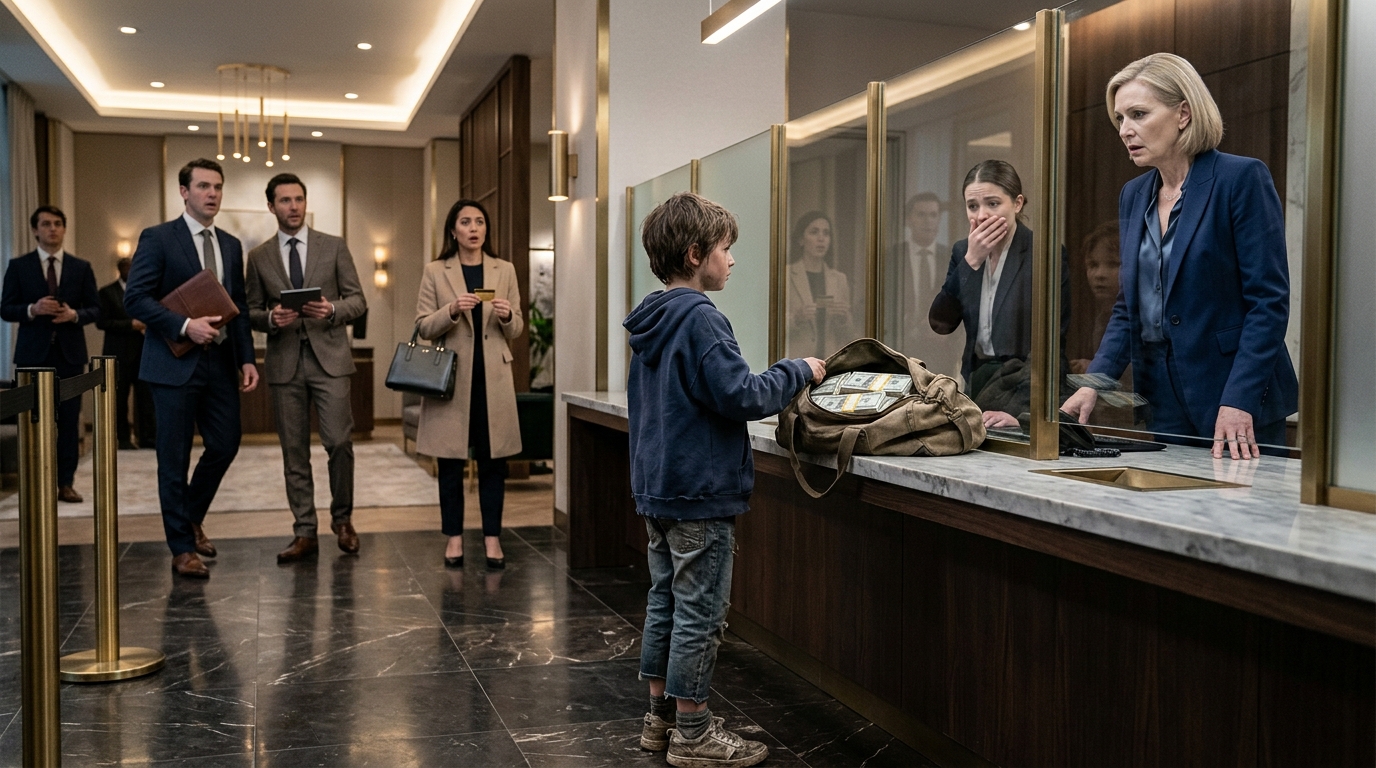
A small boy stepped inside.
He could not have been more than ten.
His hoodie was damp from the rain. His sleeves were too short. His shoes were barely holding together, the soles lifting at the front with each step.
Behind him, he dragged a tattered brown bag.
It scraped across the marble floor with a rough, ugly sound that did not belong in such a flawless place.
Every head turned.
The boy stopped just inside the entrance.
For a moment, he looked overwhelmed by the lights, the silence, the polished counters, the cold stares.
Then he tightened his grip on the bag and walked forward.
A woman near the front of the line wrinkled her nose.
A man in a navy suit pulled his coat closer, as if poverty could stain fabric.
At the counter, a young bank employee named Claudia spotted him and immediately scowled.
“This isn’t a shelter, kid,” she snapped.
Her voice was loud enough for everyone nearby to hear.
A few clients chuckled.
The boy said nothing.
He kept walking.
Claudia leaned over the counter, eyes hard.
“Did you hear me? You can’t drag garbage in here.”
The boy stopped in front of her.
His face was pale.
His fingers were red from the cold.
But his eyes were steady.
“I need to speak to Miss Evelyn Carter.”
Claudia laughed once.
“You need to leave.”
The boy looked down at the bag.
Then back at her.
“My mother said not to leave until I gave this to her.”
A man in line muttered, “Unbelievable.”
Claudia’s patience vanished.
“Security.”
The guard near the entrance moved forward.
The boy stepped back quickly, not from guilt, but fear.
The kind of fear that had already lived inside him before he entered the bank.
“Please,” he said. “I’m not here to steal.”
Claudia looked him up and down.
“With what? That bag?”
The boy’s lips trembled.
Then, slowly, he knelt on the marble floor and unzipped the tattered bag.
The sound seemed impossibly loud.
Everyone watched.
The zipper opened.
Inside were thick stacks of cash.
Not loose bills.
Not a handful of stolen money.
Stacks.
Bundled.
Organized.
Wrapped tightly in old bank bands.
The room went silent.
Claudia’s mouth fell open.
The guard stopped mid-step.
A woman dropped her phone into her purse.
The boy stood again, gripping the bag’s handle.
“I told you,” he said softly. “I need Miss Evelyn.”
Behind the glass offices, a door opened.
A senior bank manager stepped out.
She was in her late forties, elegant but tired-looking, with dark hair pinned neatly and a silver nameplate on her jacket.
Evelyn Carter — Senior Operations Manager
She had come out because of the commotion.
Then she saw the boy.
Then the bag.
Then the old bank bands around the money.
Her expression changed.
Not curiosity.
Recognition.
She walked toward the counter slowly.
“Who are you?” she asked.
The boy reached into the bag and pulled out a sealed envelope from beneath the cash.
He placed it carefully on the counter.
Evelyn glanced down.
The envelope was addressed to her.
Her exact name.
Written in handwriting she had not seen in eleven years.
All color drained from her face.
The boy looked at her and said:
“My mother told me to bring this to you if anything happened to her.”
Evelyn’s fingers shook above the envelope.
The clients shifted their gaze from the boy to Evelyn, then back to the bag full of money.
No one moved.
No one spoke.
Then Evelyn whispered:
“No…”
Her voice broke.
“She can’t be dead.”
Chapter 2: The Name on the Envelope
Evelyn did not open the envelope at the counter.
She couldn’t.
Not there.
Not beneath the chandeliers, with wealthy clients staring and Claudia standing frozen behind the desk like her own cruelty had turned to stone.
Evelyn looked at the guard.
“Lock the front doors.”
The guard blinked.
“Ma’am?”
“Now.”
The command in her voice left no room for argument.
The doors were locked.
A murmur passed through the lobby.
Evelyn turned to Claudia.
“Do not touch that bag.”
Claudia swallowed.
“I—I didn’t know—”
“No,” Evelyn said coldly. “You didn’t ask.”
Claudia lowered her eyes.
Evelyn looked back at the boy.
“What is your name?”
“Noah.”
“Noah what?”
“Noah Reed.”
The name struck her strangely, but not enough.
Not yet.
“And your mother?”
The boy’s hand tightened on the bag strap.
“Anna.”
Evelyn gripped the counter.
“Anna Reed?”
He nodded.
For a moment, Evelyn looked like she might collapse.
Anna Reed.
Her younger sister.
The sister everyone said had stolen from the bank and vanished eleven years ago.
The sister Evelyn had mourned in secret because their family never recovered from the shame.
The sister Evelyn had wanted to believe innocent but had been given too much evidence, too many signatures, too many locked doors.
The sister whose handwriting was now on an envelope in front of her.
Evelyn reached for it.
Her hands trembled so badly the paper shook.
On the front:
Evelyn Carter
Only if I do not come back.
Evelyn closed her eyes.
Noah watched her carefully.
“My mom said you would be angry.”
Evelyn opened her eyes.
“At her?”
Noah nodded.
“She said you had a right to be.”
Evelyn’s voice cracked.
“I was never angry at her.”
That was not entirely true.
For years, she had been angry.
Angry Anna disappeared.
Angry she never called.
Angry she left Evelyn to stand inside the bank where everyone whispered that her sister was a thief.
But beneath that anger had always been something softer.
Doubt.
And beneath the doubt, grief.
Evelyn turned to the clients.
“This branch is closed for the next hour. Staff will assist you with rescheduling.”
A man in a gray coat objected immediately.
“I have an appointment with private wealth services.”
Evelyn turned on him.
“Then you can afford to wait.”
He said nothing after that.
Within minutes, clients were escorted to a side waiting area or out through a secondary exit. The lobby emptied.
Only Evelyn, Noah, Claudia, the guard, and two senior employees remained.
Evelyn gestured toward her private office.
“Noah, come with me.”
The boy did not move.
“My bag too.”
“Yes. Your bag too.”
He dragged it behind him.
This time, no one laughed at the sound.
Chapter 3: The Sister Who Disappeared
Evelyn closed the office door and lowered the blinds.
Noah stood near the chair but did not sit.
Children who have lived too long in uncertainty often wait for permission twice.
“You can sit,” Evelyn said gently.
He sat on the very edge.
The tattered bag rested between his feet.
Evelyn placed the envelope on her desk.
For several seconds, she only stared at it.
Then she opened it.
Inside were three things.
A letter.
A small brass key.
And a photograph.
Evelyn picked up the photograph first.
Her breath caught.
Anna stood in front of a cheap motel mirror, holding a baby wrapped in a blue blanket.
She looked older than she should have.
Thinner.
But alive.
On the back, written in Anna’s handwriting:
His name is Noah. He is not stolen. He is not shame. He is the truth.
Evelyn’s eyes filled.
She looked at Noah.
Really looked.
The shape of his eyes.
The curve of his mouth.
The small dimple near his left cheek.
He looked like Anna.
But not only Anna.
There was someone else in his face.
Someone Evelyn knew.
Someone powerful.
Someone dangerous.
She slowly unfolded the letter.
Evie,
Evelyn flinched.
No one had called her Evie since Anna disappeared.
If you are reading this, then I failed to return. I am sorry. I know you probably believed what they said about me. Maybe you had to. Maybe I would have believed it too if the evidence looked as perfect from the outside as they made it look.
Evelyn pressed a hand to her mouth.
I did not steal from the bank. I took the money because it was never supposed to exist. It was part of the hidden fund Julian Vale used to pay people off. I hid it because it was the only proof I could keep alive.
Evelyn stopped reading.
Julian Vale.
The bank president.
Son of the founder.
The man whose portrait hung in the executive corridor.
The man who had spoken at Anna’s disappearance hearing with wounded disappointment.
The man who had comforted Evelyn afterward and said:
“Your sister made mistakes, but you don’t have to carry them.”
Evelyn continued reading, now with shaking hands.
Julian is Noah’s father.
The room tilted.
Noah watched her silently.
Evelyn looked at him.
The dimple.
The eyes.
The quiet way he held himself when afraid.
Julian.
God.
It was there.
She returned to the letter.
He knew about the pregnancy. He told me he loved me. Then his father found out. Two days later, missing money appeared under my employee credentials. A transfer log was created. My badge was used after hours. Every camera angle that could clear me disappeared.
I ran because they told me if I stayed, Noah would disappear before he was born.
Evelyn could barely breathe.
The money in the bag is not all of it. Just enough to prove the bands, serials, and vault records match the hidden account. The key opens Box 417. You will know how to access the internal archive. Do not give this to branch security. Do not call Julian. Call Detective Mara Chen. She helped me once, but I ran before she could finish.
The final lines were uneven.
As if Anna had written them in fear.
Tell Noah who his father is only when you can protect him from what that name means. And Evie… I never stopped missing you.
Evelyn lowered the letter.
Tears slipped down her face.
Noah’s voice was small.
“Is she dead?”
Evelyn looked at him.
She could have lied.
Adults often lie to children because the truth feels too heavy.
But Noah had carried a bag full of evidence through rain into a bank that treated him like trash.
He deserved truth.
“I don’t know,” Evelyn whispered.
His face tightened, but he did not cry.
That broke her more than tears would have.
“She left three days ago,” he said. “She told me if she wasn’t back by morning, I had to come here.”
“Where did she go?”
“To meet a man.”
“What man?”
Noah reached into his hoodie and pulled out a folded receipt.
On the back was one handwritten name:
Julian.
Chapter 4: The Man Upstairs
Julian Vale was in the building.
That was the first terrible problem.
The luxury branch occupied the first two floors of a forty-story financial tower. Julian’s executive office was on the thirty-eighth.
He had arrived that morning for a board meeting.
Evelyn knew because every employee had been told to make the lobby perfect.
No delays.
No mistakes.
No “unpleasantness.”
And now Anna’s son had walked in with a bag full of cash that might expose the bank president as a criminal.
Evelyn stood and crossed to the wall safe behind her office painting.
Noah watched her.
“Are you calling him?”
“No.”
“My mom said not to.”
“Your mom was right.”
Evelyn removed a small encrypted drive from the safe and plugged it into her computer. Her hands moved quickly across the keyboard.
Internal archive access.
Old vault logs.
Badge entries from eleven years ago.
She had not looked at Anna’s case file in years.
Not because she didn’t care.
Because every time she opened it, she felt like she was standing outside a locked room with her sister screaming inside.
The system loaded slowly.
Too slowly.
Finally, the records appeared.
Employee: Anna Reed
Incident: Unauthorized withdrawal, private vault misappropriation
Amount: $780,000
Status: Resolved — employee absconded
Evelyn inserted the brass key into a small reader built into her desk.
A prompt appeared:
Safe Deposit Box 417 — restricted archive flag
Her pulse quickened.
That meant someone had marked the box internally.
Not as empty.
Not as ordinary.
Restricted.
Evelyn opened the serial record for the cash bands in Noah’s bag.
The first number matched.
Then the second.
Then the third.
The cash had indeed come from a vault account no ordinary employee could access.
Anna had been a junior account officer.
She could not have opened that vault alone.
Evelyn whispered:
“Oh, Anna.”
Then the office phone rang.
She froze.
The display read:
JULIAN VALE — EXECUTIVE FLOOR
Noah saw her face.
“That’s him?”
Evelyn did not answer.
The phone kept ringing.
Finally, she picked up.
“Evelyn Carter.”
Julian’s voice came through smooth and warm.
“Evelyn. I hear there’s been a disturbance in the lobby.”
Her eyes moved to Noah.
“No disturbance.”
“A boy came in with a bag.”
The blood in her body turned cold.
He already knew.
Julian continued:
“Send him upstairs.”
Evelyn’s voice remained controlled.
“Why?”
A pause.
Then a faint laugh.
“Because I asked.”
She gripped the phone tighter.
“I’m handling it.”
His tone changed.
Only slightly.
“Evelyn.”
There it was.
The voice powerful men use when they want to remind someone who owns the room.
“Do not make this difficult.”
Evelyn looked at Anna’s letter.
Then at Noah.
Then at the reflection of herself in the dark computer screen.
For eleven years, she had survived by staying useful, polished, careful.
That woman would have obeyed.
This one did not.
She hung up.
Chapter 5: The Bank Turns Cold
Thirty seconds later, the branch security system locked down.
Not the front doors.
The internal elevators.
The archive room.
The manager override.
Evelyn tried her access card.
Denied.
Julian was moving.
She looked at Noah.
“Listen to me carefully. We need to leave this office.”
Noah immediately grabbed the bag.
“No. Leave it.”
His eyes widened.
“My mom said—”
“I know. But that bag is heavy, and they already know about it. The letter matters. The key matters. You matter.”
He looked torn.
Evelyn softened.
“Your mother protected proof. I’m going to protect you.”
Noah swallowed and nodded.
Evelyn folded Anna’s letter and placed it inside her jacket.
She pocketed the brass key and photograph.
Then she opened the office door.
Claudia was standing outside, pale and shaken.
For a moment, Evelyn thought she was blocking them.
Then Claudia whispered:
“Mr. Vale’s assistant called security. They’re coming down.”
Evelyn looked at her.
Claudia’s eyes filled.
“I’m sorry for what I said to him.”
Noah stared at the floor.
Evelyn said:
“Apologize later. Help now.”
Claudia nodded quickly.
“There’s a service stairwell behind the records room.”
“Access?”
“I have a cleaning staff card.”
Evelyn almost laughed.
The bank’s most expensive security system could be bypassed by the people who emptied the trash.
That felt fitting.
They moved quickly.
Noah stayed close to Evelyn’s side.
As they passed the main lobby, one senior employee asked:
“What about the money?”
Evelyn looked at the tattered bag still in her office.
“Leave it.”
“But—”
“It’s bait now.”
They reached the records room just as the executive elevator opened.
Two men in dark suits stepped out.
Not regular security.
Private.
Julian’s.
Claudia swiped the cleaning card.
The stairwell door clicked open.
Evelyn pushed Noah inside.
Then turned to Claudia.
“Come with us.”
Claudia hesitated.
“I can slow them down.”
“You’ll get fired.”
Claudia looked toward the lobby where she had mocked a hungry child minutes earlier.
“Maybe I should.”
She shut the stairwell door behind Evelyn and Noah.
Then stepped back into the hallway.
Chapter 6: Detective Mara Chen
Evelyn and Noah descended twelve flights before her legs began to shake.
She was not young enough for this.
Not dressed for this.
Not prepared to become a fugitive inside the bank where she had worked half her life.
Noah moved silently beside her.
Too silently.
At the fifth floor landing, Evelyn stopped and pulled out her phone.
She dialed the number from Anna’s letter.
Detective Mara Chen answered on the fourth ring.
“Chen.”
“My name is Evelyn Carter. My sister was Anna Reed.”
Silence.
Then Chen’s voice changed.
“Where are you?”
“Inside the Vale International Bank tower. My sister’s son is with me. He brought cash, a letter, and a key for Box 417. Julian Vale knows.”
“Do not go outside through the front.”
“I know.”
“Can you reach the loading bay?”
“I think so.”
“Do it. I’m six minutes away.”
The call ended.
Evelyn looked at Noah.
“We have help.”
“Is she good help?”
Despite everything, Evelyn almost smiled.
“I hope so.”
They continued down.
At the second-floor landing, voices echoed above.
The men had found the stairwell.
Evelyn grabbed Noah’s hand.
“Run.”
They reached the basement level and burst into a service corridor lined with supply carts and old filing cabinets.
A janitor looked up in shock.
Evelyn knew him.
“Mr. Ortiz,” she gasped. “Loading bay.”
He saw her face.
Then the boy.
Then the footsteps behind them.
Without a word, he pointed left.
They ran.
Behind them, the stairwell door slammed open.
“Evelyn!”
Julian’s voice.
Not from a phone now.
Real.
Close.
Noah stumbled.
Evelyn caught him.
They reached the loading bay just as a black sedan turned into the underground entrance.
For one terrible second, Evelyn thought it was Julian’s car.
Then the driver’s door opened.
A woman stepped out with a badge in one hand and a gun holstered at her side.
Detective Mara Chen.
“Get in,” she said.
Evelyn pushed Noah into the back seat.
Julian appeared at the corridor entrance, flanked by two men.
His face remained smooth.
Almost bored.
“Detective Chen,” he called. “This is a private property matter.”
Mara Chen looked at him.
“A child running from you makes it a police matter.”
Julian’s gaze moved to Noah.
For the first time, his mask slipped.
Not much.
But enough.
Evelyn saw it.
Recognition.
Blood recognizing blood, even when pride refused to.
Noah saw it too.
His voice was barely audible.
“That’s him?”
Evelyn held his hand.
“Yes.”
Julian heard.
His eyes darkened.
“No,” he said coldly. “It isn’t.”
The boy flinched.
Mara stepped between them.
“We’ll let the evidence decide.”
Chapter 7: Box 417
The warrant came faster than Julian expected.
Powerful men are often prepared for suspicion.
They are less prepared for old evidence, a living child, matching cash serials, a handwritten letter, and a detective who had been waiting eleven years for the missing piece.
Box 417 was opened that evening under police supervision.
Inside were records Anna had hidden before she ran.
Not just copies.
Originals.
Vault transfer logs.
Handwritten payoff lists.
Internal emails printed and signed.
Photographs of Julian with Anna.
A medical form confirming her pregnancy.
A private agreement Julian had drafted offering money in exchange for silence.
And one flash drive.
The flash drive contained security footage from eleven years ago.
The missing angle.
The one everyone claimed had malfunctioned.
It showed Julian entering the restricted vault after hours with Anna beside him.
It showed an argument.
Anna crying.
Julian grabbing her arm.
Then another man entering.
Julian’s father.
The founder of the bank.
The footage had no audio, but none was needed.
Anna was not stealing.
She was being forced into a frame.
The final file was newer.
Recorded by Anna only four days earlier.
She appeared in a dim motel room, face bruised, voice shaking but clear.
“Evie,” she said into the camera, “if Noah is with you, I’m either dead or hiding too deep to reach him. Julian found us. He wants the money because it links him to the old vault account. But he wants Noah more, because blood can become a claim.”
Evelyn covered her mouth.
Noah stood beside her, silent.
Anna continued:
“Do not let him call my son a lie. Do not let the bank swallow another Reed and call it procedure.”
Her eyes filled.
“And tell Noah I did not leave him. Not for one second. I am trying to make the world safe enough for him to stand in it.”
The video ended.
Noah did not cry.
He simply sat down on the floor and hugged his knees.
Evelyn knelt beside him.
“I’m sorry.”
He whispered:
“She always comes back.”
Evelyn closed her eyes.
Then said the only honest thing she could.
“Then we will keep looking.”
Chapter 8: The Father Who Denied Him
Julian Vale denied everything.
He denied Anna.
Denied the money.
Denied the child.
Denied the footage until forensic experts verified it.
Denied the signatures until handwriting analysts matched them.
Denied the account until international regulators froze it.
Most of all, he denied Noah.
“He is not my son,” Julian said in a formal statement.
Noah saw it on television.
He watched the man who had his eyes look into a camera and erase him with one sentence.
Evelyn turned the TV off.
But the damage had already landed.
Noah sat very still.
“My mom said he might do that.”
Evelyn sat beside him.
“What else did she say?”
“That fathers aren’t made by blood if they don’t have courage.”
Evelyn’s throat tightened.
“She was right.”
Noah looked down.
“Then why did she want me to know?”
“Because truth belongs to you even when the person in it doesn’t deserve you.”
He thought about that.
Then nodded slowly.
Julian was arrested two days later.
Not for being a bad father.
The law rarely punishes that.
He was arrested for fraud, obstruction, conspiracy, falsification of banking records, witness intimidation, and financial crimes tied to the hidden vault account.
As officers led him through the lobby of Vale International Bank, every employee watched.
Claudia stood behind the counter.
Mr. Ortiz stood near the service hallway.
Evelyn stood beside Detective Chen.
Noah was not there.
Evelyn had refused to let Julian perform denial in front of the child again.
But as Julian passed, he looked at Evelyn and said:
“You think this makes your sister innocent?”
Evelyn stepped closer.
“No,” she said. “The truth does.”
For the first time, Julian had no reply.
Chapter 9: Anna Comes Home
They found Anna nine days later.
Alive.
Barely.
In a rural clinic two counties away, registered under a false name after being dumped outside with no identification.
She had been beaten.
Dehydrated.
Terrified.
But alive.
When Evelyn entered the hospital room, she stopped at the door.
Anna looked older.
Too thin.
A scar cut across one eyebrow.
But her eyes were the same.
The same eyes that used to steal Evelyn’s sweaters.
The same eyes that cried the night she said she was in love with someone she shouldn’t be.
The same eyes Evelyn had searched for in every crowd for eleven years.
Anna opened her mouth.
No sound came out.
Evelyn crossed the room and took her sister into her arms.
For several minutes, neither spoke.
Then Anna whispered:
“Did he make it?”
Evelyn pulled back.
“Noah is safe.”
Anna broke.
Not gracefully.
Not quietly.
She sobbed like a woman who had held herself together through years of running and had finally been given permission to fall apart.
Noah came in after the doctors allowed it.
He stood at the doorway, suddenly looking younger than ten.
Anna reached for him.
He ran.
The sound he made when he reached her was not a word.
It was pure relief.
Evelyn stepped into the hallway and cried alone.
Not because she was excluded.
Because for once, Anna had been returned to someone who needed her more.
Chapter 10: The Bank Apologizes
The bank tried to manage the scandal.
Of course it did.
Institutions do not confess.
They release statements.
Vale International Bank expressed regret.
It announced independent review.
It promised transparency.
It removed Julian’s portrait from the executive corridor before the next news cycle.
Evelyn resigned before they could decide whether to sacrifice her.
At her final staff meeting, Claudia approached her.
“I apologized to Noah,” she said.
Evelyn looked at her.
“And?”
“He said I should apologize to the next kid before I know what’s in his bag.”
Evelyn almost smiled.
“That sounds like him.”
Claudia lowered her eyes.
“I was cruel.”
“Yes.”
“I thought he didn’t belong here.”
Evelyn looked around the marble lobby.
“Maybe places like this should be judged by whether children like him can walk in and be heard.”
Claudia had no answer.
That was good.
Some lessons need silence to settle.
Evelyn left the bank carrying a cardboard box of personal items and no regret.
Outside, Anna waited with Noah.
Anna still looked weak, but she was standing.
Noah waved.
Evelyn smiled.
For the first time in eleven years, she walked away from the building without feeling like Anna’s ghost was trapped inside.
Final Chapter: The Bag
The tattered bag became evidence for months.
Then, after the trials began and the money was cataloged, the police released it back to Anna.
It was empty by then.
No stacks of cash.
No envelope.
No hidden key.
Just worn fabric, broken stitching, and a handle repaired with duct tape.
Anna asked Noah if he wanted to throw it away.
He shook his head.
“No.”
“Why?”
He touched the zipper.
“Because everyone looked at the bag and thought they knew me.”
Anna’s eyes filled.
“And?”
“They were wrong.”
Evelyn, sitting across the kitchen table, smiled faintly.
“Yes, they were.”
Noah kept the bag under his bed for a while.
Then, one day, he placed it on a shelf beside a framed photograph of his mother and aunt.
Not as a trophy.
As a reminder.
That truth does not always arrive in clean clothes.
Sometimes it drags itself across marble floors in torn shoes.
Sometimes it is insulted before it is believed.
Sometimes it is carried by a child who should never have been asked to be brave.
Julian Vale eventually admitted nothing.
Even after conviction, he called himself a victim of betrayal.
Noah stopped watching the news.
When asked about his father years later, he said:
“I know who he is. That doesn’t mean he knows who I am.”
And that was enough.
Anna rebuilt her life slowly.
Evelyn helped.
Detective Chen visited sometimes, pretending it was for case updates when everyone knew she liked Anna’s coffee.
Claudia left the luxury branch and began working with a community banking program for low-income families. She never forgot the boy she had called a beggar before seeing what he carried.
As for Noah, he grew taller, quieter, and stubborn in the way children become when they learn early that adults can be both cruel and kind.
But he kept one rule from his mother:
Never let polished rooms decide your worth.
Because the day he entered Vale International Bank, everyone saw a ragged boy with a tattered bag.
They saw poverty.
They saw inconvenience.
They saw someone who did not belong.
Then he opened the bag.
And all their polished certainty fell silent.