The Backpack at the Door
“MOM!”
The scream shattered the stillness of the house.
Grace Whitman froze in the kitchen, one hand gripping the edge of the sink, the other still wet from rinsing a glass she had already washed three times.
For one second, she did not move.
Then she heard it again.
Not as loud this time.
More broken.
“Mom…”
Her son stood in the doorway.
Noah was eight years old, small for his age, with a backpack hanging heavily from one shoulder and tears streaming down his cheeks.
His hair was messy from the wind.
His jacket was half-zipped.
His shoes were muddy.
He looked like he had run all the way from the bus stop without stopping to breathe.
Grace’s heart lurched toward him out of instinct.
The old instinct.
The one that had woken her at 2 a.m. when he was a baby.
The one that knew the difference between his hungry cry and his frightened cry.
The one that still made her reach for him before she even understood what was wrong.
But then her eyes dropped to the papers on the kitchen table.
The envelope.
The legal letter.
The words that had been burning into her for the last hour.
Petition for Emergency Custodial Review.
Question of Biological and Adoptive Standing.
Potential Misrepresentation of Maternal Status.
Grace’s throat closed.
Noah took one step into the house.
“Mom, they said—”
“Don’t call me that.”
The words left her mouth before she could stop them.
Cold.
Sharp.
Cruel.
They hung in the air between them like shattered glass.
Noah stopped.
His face changed in a way Grace would remember for the rest of her life.
Confusion first.
Then hurt.
Then something worse.
A child trying to understand why the safest person in his world had suddenly stepped away from him.
His backpack slid lower on his shoulder.
“What?”
Grace gripped the sink harder.
Her whole body screamed at her to run to him.
To kneel.
To gather him into her arms.
To tell him she was sorry.
To tell him no letter, no court, no blood test, no hateful woman with money and lawyers could change what he was to her.
But fear had its hands around her throat.
If she touched him now, would they say she was manipulating him?
If she called herself his mother, would they use that against her?
If she held him too tightly, would someone decide she was refusing to let go of a child who had never been hers by blood?
Noah looked up at her, eyes wide and wet.
“They said you don’t love me,” he whispered. “But you do, right?”
That question should have saved them both.
It should have snapped Grace out of the terror that had swallowed her.
Instead, it broke the last fragile piece of her self-control.
Her gaze remained fixed.
Unyielding.
Not because she felt nothing.
Because she felt too much.
“Noah…”
His voice trembled.
“You do, right?”
Grace closed her eyes.
And said the sentence that destroyed him.
“I’m not your real mother.”
The words struck like a blow.
Noah’s small body seemed to fold in on itself.
His knees buckled.
The backpack slipped from his shoulder and hit the floor with a heavy thud.
He crumpled down beside it, silent at first, as if the pain had knocked the sound out of him.
Then one small sob escaped.
Grace covered her mouth.
“Noah—”
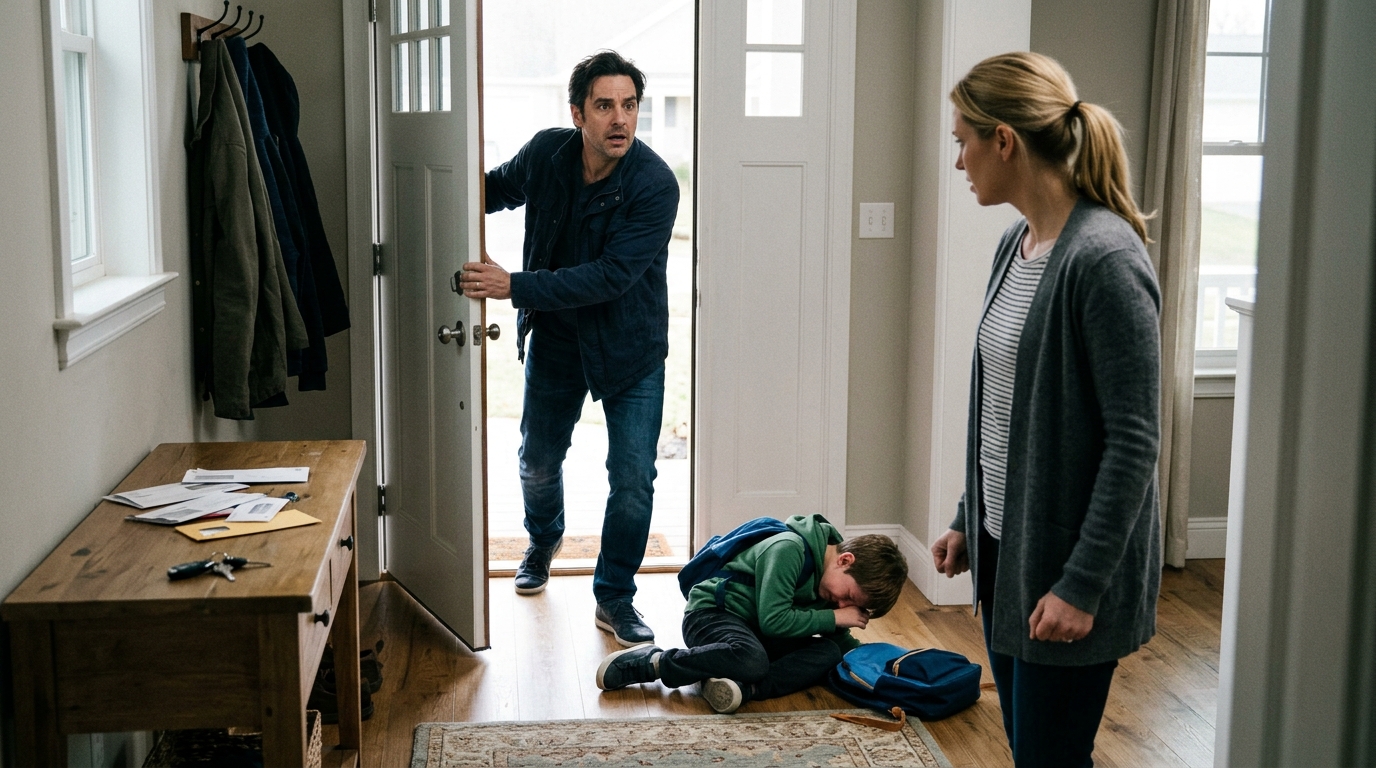
But before she could reach him, the front door swung open.
Daniel Whitman rushed inside, panic etched across his face.
He had clearly run from the driveway. His tie was loose, his work bag still hanging from one shoulder, his breathing uneven.
He saw Noah on the floor.
Then Grace by the sink.
Then the papers on the table.
His eyes moved over the room in a single, horrified sweep.
“What happened?”
Noah didn’t answer.
Grace couldn’t.
And the answer was lying right there between them.
Half-hidden beneath Noah’s fallen backpack.
A small phone.
Still recording.
The Sentence That Was Meant to Be Heard
Daniel noticed the phone because its screen was glowing.
It had slid out of the side pocket of Noah’s backpack when the bag hit the floor.
At first, Daniel thought it was Noah’s tablet from school.
Then he saw the red recording dot.
His expression changed.
He stepped closer, slowly.
“Noah,” he said gently, crouching beside his son. “Whose phone is this?”
Noah wiped his face with his sleeve.
“She gave it to me.”
Daniel’s jaw tightened.
“Who?”
Noah looked at the floor.
“Grandma.”
Grace’s eyes shut.
Of course.
Eleanor.
Daniel’s mother.
The woman who had smiled at Grace for years as if kindness were something she had to swallow with disgust.
Daniel picked up the phone.
It was not Noah’s.
It was not Grace’s.
It was one of Eleanor’s spare phones.
Daniel knew because his mother always carried three: one personal, one business, one for “household matters.”
He stopped the recording.
The silence that followed felt enormous.
Grace stepped forward.
“Daniel—”
He raised one hand.
Not harshly.
But enough to stop her.
He looked at Noah.
“What did Grandma say to you?”
Noah’s lower lip trembled.
“She came to school.”
Daniel’s face went pale.
“When?”
“After lunch.”
Grace gripped the back of a chair.
“She went to his school?”
Noah nodded, tears sliding down his cheeks again.
“She said she had permission.”
Daniel’s voice became dangerously calm.
“What else?”
Noah swallowed.
“She said… she said I needed to be brave. Because sometimes grown-ups lie when they want to keep things.”
Grace felt the room tilt.
Daniel looked at the phone in his hand.
“She gave you this?”
Noah nodded.
“She said I should put it in my backpack and keep it on when I got home.”
“Why?”
Noah’s face twisted.
“She said if Grace really loved me, she would say it. And if she didn’t…”
He looked at Grace.
His voice broke.
“She said I needed proof.”
Grace staggered back as if struck.
Daniel’s hand closed around the phone so tightly his knuckles whitened.
“She told you to record your mother?”
Noah whispered:
“She said she’s not my mother.”
Grace made a sound then.
Small.
Broken.
Daniel looked at her, and for the first time since entering, his anger shifted.
Not away from her entirely.
He had heard what she said.
He saw what it had done to their son.
But now he was beginning to see the trap around it.
The papers.
The recording.
The timing.
The school visit.
His mother had not come for the truth.
She had come for a sound bite.
Grace’s worst moment.
Captured.
Packaged.
Ready for court.
Daniel stood slowly.
“What papers are those?”
Grace’s voice was barely audible.
“She served me.”
“Who?”
“Your mother’s attorney.”
Daniel crossed to the table.
He picked up the envelope.
Read the header.
Then the first page.
Then the second.
His face grew colder with every line.
“This is custody paperwork.”
Grace nodded.
“She says our adoption paperwork should be reviewed.”
Daniel looked up.
“Our adoption paperwork is legal.”
Grace’s eyes filled.
“She’s saying I coerced you. That I misrepresented myself to Noah. That because I’m not his biological mother, and because Maya’s family was never properly notified, I—”
“Stop.”
Daniel’s voice cracked through the room.
Noah flinched.
Daniel immediately softened.
“Not you, buddy. I’m not angry at you.”
Noah looked at him with a fear that made Daniel’s face twist.
Then the little boy whispered:
“Is it true?”
The room went still.
Daniel crouched again.
“What part?”
Noah looked from Daniel to Grace.
“That she’s not my real mom.”
Grace pressed both hands to her mouth.
Daniel took Noah’s small hands in his.
“Listen to me very carefully.”
Noah’s eyes filled again.
“Is it true?”
Daniel swallowed.
“She is not the woman who gave birth to you.”
Noah’s face crumpled.
“But she is your mother.”
Noah looked confused.
Daniel’s voice grew rough.
“She is the mother who held you in the hospital when you were too tiny to keep warm. She is the mother who learned every medicine schedule. She is the mother who slept sitting up for three weeks when you had pneumonia because you cried every time she put you down.”
Grace began to cry silently.
Daniel continued:
“She is the mother who cut grapes into tiny pieces because she was terrified you would choke. The mother who sang the wrong words to every cartoon song. The mother who saved every drawing you ever made, even the ones that were mostly scribbles.”
Noah’s gaze moved to Grace.
She looked destroyed.
Daniel squeezed his hands.
“And she is the mother who just said something terrible because someone scared her very badly.”
Noah whispered:
“Why would she say that?”
Grace fell to her knees in front of him.
This time, she did not stop herself.
“Noah,” she sobbed. “Because I was afraid they were going to take you from me.”
He stared at her.
“I thought if I said the wrong thing, if I held you, if I called myself your mother, they would use it to say I was lying to you. And then I said the worst thing anyway.”
Her voice broke.
“I hurt you. I hurt you so badly. And I am so sorry.”
Noah’s face trembled.
“You told me not to call you Mom.”
Grace bowed her head.
“I know.”
“You said you’re not my real mother.”
“I know.”
“You made it sound like you don’t want me.”
Grace looked up sharply, shattered.
“No. Never.”
The word came out fierce.
Then softer:
“I have wanted you every second since the first time I saw you.”
The Story They Never Told Him
Noah had always known he was loved.
That was why the shock had been so violent.
The Whitman house had never been cold before.
Not in the way some houses are.
Grace filled every room with evidence of Noah.
His drawings on the fridge.
His tiny sneakers near the door.
His dinosaur toothbrush in the downstairs bathroom because he hated going upstairs before dinner.
Photos everywhere.
Noah asleep on Daniel’s chest as a baby.
Noah in Grace’s arms at the pumpkin patch.
Noah with spaghetti sauce across his cheeks.
Noah smiling with missing front teeth.
Grace had been there in every memory he could name.
But there had always been one story they had not told fully.
They told him he had grown in someone else’s belly because Grace’s belly could not grow a baby.
They told him that family could be chosen.
They told him adoption meant love written down and promised forever.
But they had not told him about Maya.
Not yet.
They thought eight was too young.
They thought waiting was kindness.
Now Eleanor had weaponized the truth before they could hand it to him gently.
Daniel sat on the floor beside Noah and Grace.
For a while, no one moved.
Then Noah asked:
“Who is Maya?”
Grace looked at Daniel.
Daniel nodded.
Grace wiped her cheeks.
“Maya was your birth mother.”
Noah leaned against the wall, clutching Teddy, which had fallen halfway out of his backpack.
“Did she not want me?”
Grace’s face twisted.
“She loved you.”
“Then why didn’t she keep me?”
Daniel answered this time.
“She was very sick.”
“Like a cold?”
“No, buddy. Not like a cold.”
Noah looked down.
“Did she die?”
Grace closed her eyes.
“Yes.”
The truth landed softly, but it still landed.
Noah was quiet.
Daniel continued:
“Maya was young. She didn’t have family who could help her. She knew Grace from a shelter program where Grace volunteered.”
Grace’s voice trembled.
“She asked me to visit her at the hospital after you were born.”
Noah looked at her.
“You saw me when I was a baby?”
Grace let out a broken laugh through tears.
“You were the smallest baby I had ever seen. So angry. You screamed like the world owed you an explanation.”
Daniel smiled sadly.
“That has not changed much.”
Noah almost smiled.
Almost.
Grace continued:
“Maya knew she was dying. She asked if we would make sure you were loved.”
“Did she give me away?”
Grace shook her head.
“She trusted us.”
“Did you know Daddy then?”
“Yes,” Daniel said. “Grace and I were married. We had tried for years to have a baby, but it didn’t happen.”
Grace’s voice softened.
“I thought my heart had already broken all the way. Then Maya placed you in my arms.”
Noah looked at her.
“What happened?”
Grace touched her own chest.
“It broke differently. Bigger.”
Noah didn’t understand, but he listened.
Daniel placed one hand on his shoulder.
“We adopted you. Legally. Completely. You became our son in every way that matters.”
Noah looked toward the phone.
“Then why did Grandma say I’m not yours?”
Daniel’s jaw tightened.
“Because Grandma thinks blood is the only thing that makes family.”
Grace looked down.
“And because she never forgave me for being the woman who became your mother.”
Eleanor Whitman
Eleanor Whitman had never approved of Grace.
Not truly.
She tolerated her because Daniel loved her.
Then resented her because Daniel chose her.
When Grace and Daniel struggled to have children, Eleanor became quietly cruel.
Small comments.
Sharp smiles.
Articles about surrogacy printed and left on tables.
Names of “proper clinics” sent by email.
Then Noah arrived.
Eleanor smiled for photographs.
Brought expensive gifts.
Called him “our miracle.”
But Grace always sensed something underneath.
Possession.
Not affection.
Eleanor loved the idea of Noah as a Whitman heir.
She did not love that Grace was the center of his world.
When Noah was three and had night terrors, he cried for Grace, not Eleanor.
When he fell at a birthday party, he ran past everyone and into Grace’s arms.
When Eleanor tried to teach him to call her “Grandmama,” he called her “Grandma Ellie” and then forgot.
Eleanor never forgave small humiliations.
She simply stored them.
Then, two months earlier, Daniel’s father died, and the family estate entered legal restructuring.
That was when Eleanor changed.
She started asking about Noah’s adoption papers.
Maya’s family.
Birth records.
Legal standing.
Daniel shut it down.
Grace thought it was over.
It wasn’t.
Eleanor found a weak spot.
Maya’s estranged older brother had never been formally notified before the adoption because no one could locate him at the time. The court had waived the requirement after documented efforts.
That was legal.
But Eleanor found an attorney willing to turn legal into suspicious.
Then she went to Noah’s school.
Not to comfort him.
To shake the foundation beneath him.
Grace stood up slowly.
“I should have told you the second the attorney left.”
Daniel looked at her.
“Yes.”
She accepted it.
“I was ashamed.”
“Of what?”
“That maybe she was right. That maybe I had no right to call myself his mother if a court could question it.”
Daniel’s face softened with pain.
“Grace…”
She shook her head.
“I know. I know what you’re going to say. But when someone puts your worst fear in legal language, it starts to sound like fact.”
Noah looked at her.
“What’s your worst fear?”
Grace knelt again.
“That someone would tell you I wasn’t your mother, and you would believe them.”
Noah’s lips trembled.
“I did for a minute.”
“I know.”
“It hurt.”
“I know.”
“Did it hurt you?”
Grace nodded.
“So much.”
Noah looked at Teddy.
Then at her.
“I still wanted you to say you loved me.”
Grace broke.
She reached for him slowly, giving him time to pull away.
He didn’t.
She wrapped him in her arms, and for a second he stayed stiff.
Then he collapsed against her and sobbed.
“I’m sorry,” she whispered again and again. “I’m so sorry. I love you. I love you more than anything. I am your mother if you still want me to be.”
Noah cried into her shoulder.
“I do.”
Daniel looked away, covering his face.
The three of them stayed on the kitchen floor until the light outside faded completely.
Then Daniel stood.
Picked up Eleanor’s phone.
And called his mother.
The Call
Eleanor answered on the second ring.
“Daniel.”
Her voice was calm.
Too calm.
As if she had been waiting.
Daniel put the phone on speaker.
Grace stiffened.
Noah clung to her arm.
Daniel’s voice was low.
“You went to my son’s school.”
A pause.
Then Eleanor sighed.
“I went because someone had to tell that child the truth.”
Grace closed her eyes.
Daniel’s hand tightened around the phone.
“You gave him a recording device.”
“I gave him protection.”
“You used him.”
“I protected him from emotional manipulation.”
Daniel laughed once.
There was no humor in it.
“Emotional manipulation? You told an eight-year-old his mother didn’t love him.”
“I told him to ask a question.”
“You told him to record the answer.”
“And Grace gave one, didn’t she?”
The room went cold.
Grace flinched.
Noah looked up at Daniel.
Daniel’s voice sharpened.
“You do not get to use my wife’s worst moment after you engineered it.”
Eleanor’s voice hardened.
“She is not his biological mother.”
“She is his legal mother.”
“For now.”
Grace’s face drained of color.
Daniel spoke slowly.
“If you come near Noah’s school again, I will have you removed from every approved contact list.”
“You would keep my grandson from me?”
“I will keep my son from anyone who hurts him.”
“He deserves to know where he comes from.”
“Yes. From us. From Maya. From love. Not from your poison.”
Eleanor went silent.
Then she said the sentence that revealed everything.
“That boy belongs with blood.”
Noah whispered:
“I can hear you.”
The line went silent.
Daniel looked at him.
Noah leaned closer to the phone, still holding Grace’s hand.
“Grandma?”
Eleanor’s voice changed instantly.
Soft.
Sweet.
Fake.
“Oh, sweetheart, I only wanted—”
Noah interrupted her.
“You made me think Mom didn’t want me.”
Eleanor inhaled.
“Noah, I was trying to help you understand—”
“You made me cry at school.”
Grace covered her mouth.
Daniel’s face tightened.
Noah continued, voice shaking but clear.
“You told me to hide the phone. You told me to make her say it.”
Eleanor’s softness vanished.
“She said it because it was true.”
Noah looked at Grace.
Then back at the phone.
“No.”
Eleanor paused.
Noah’s voice grew stronger.
“She said it because you scared her.”
Daniel closed his eyes.
Grace began crying again.
Noah took a deep breath.
“My mom is my mom.”
Eleanor said nothing.
Then Noah added:
“And you can’t come to my school anymore.”
Daniel ended the call.
No one spoke for a long moment.
Then Noah looked at him.
“Can I really say that?”
Daniel crouched.
“Yes.”
Grace wiped her cheeks.
“You can say who feels safe to you.”
Noah leaned against her.
“Then I don’t want to see Grandma right now.”
Daniel nodded.
“Then you won’t.”
The Meeting at School
The next morning, Daniel and Grace took Noah to school together.
Not because he was ready.
Because he asked them to.
He wore his blue jacket.
Carried the same backpack.
But this time, Grace held one hand and Daniel held the other.
At the front office, the principal looked pale before they even sat down.
Eleanor Whitman’s visit had been recorded in the visitor log as “family lunch.”
She had been allowed to take Noah into the counseling room.
No staff member had stayed.
No one had called Daniel.
No one had called Grace.
The principal said the words people say when liability enters the room:
“We followed standard procedure.”
Daniel placed Eleanor’s phone on the desk.
“Your standard procedure allowed an adult to isolate my son and instruct him to secretly record his mother during a custody dispute.”
The principal swallowed.
Grace placed the legal envelope beside it.
“And this adult is actively attempting to challenge his family placement.”
The principal’s face went white.
Noah sat between them, silent.
Daniel looked at him.
“Do you want to wait outside?”
Noah shook his head.
“I want them to know.”
So Grace asked gently:
“What do you want them to know?”
Noah stared at the principal.
“My grandma told me my mom wasn’t my mom.”
The principal’s eyes filled with guilt.
Noah continued:
“Then kids knew.”
Grace’s stomach dropped.
“What?”
Noah looked down.
“Evan said I was adopted wrong. He said my mom was fake.”
Daniel turned back to the principal.
“How did a child know that?”
The principal looked helpless.
“I don’t know.”
Daniel’s voice went cold.
“You will find out.”
They did.
By noon.
Eleanor had spoken loudly enough in the office for another parent to overhear. That parent told her child. The child told classmates.
By dismissal, half the class had heard some version of Noah’s private life before Noah himself had been told properly.
Grace sat in the car afterward, shaking with rage.
Not because Noah was adopted.
There was no shame in that.
Because his story had been ripped from his hands and turned into playground cruelty.
Daniel reached across the console and took her hand.
“We fix this.”
“How?”
“Together.”
She looked at him.
“And if the court—”
“No.”
“But—”
“No court gets to decide whether you are the mother who loved him. They can create paperwork. They cannot rewrite eight years.”
Grace looked down.
“I still said it.”
Daniel was quiet.
Then he said:
“Yes.”
She closed her eyes.
“I don’t know how to forgive myself.”
“You don’t start there.”
“Where do I start?”
He looked toward the school doors where Noah had disappeared inside with his teacher, still small but walking upright.
“You start by letting him tell you how much it hurt.”
The Night of Questions
That evening, Noah asked for pancakes for dinner.
Grace made them.
Badly.
She burned the first two because she kept crying.
Noah watched from the counter.
“You’re making sad pancakes.”
Grace wiped her cheek and laughed weakly.
“I am.”
“Mommy used to make dinosaur ones.”
Grace froze.
Then looked at him.
“Mommy?”
Noah shrugged, suddenly shy.
“You.”
Her face crumpled.
Daniel, from the table, looked down quickly.
Grace tried to shape the pancake into a dinosaur.
It looked more like a melted shoe.
Noah stared at it.
“That is not a dinosaur.”
Grace laughed through tears.
“No. It is not.”
Noah took a bite anyway.
Later, after dinner, they sat in the living room with a box of old photos.
Not to prove anything.
To tell the story properly.
There was Maya in the hospital, smiling weakly with newborn Noah in her arms.
There was Grace beside her, crying.
There was Daniel holding Noah like he was afraid babies might break from too much love.
There was the adoption day.
The judge.
The tiny blue outfit.
Grace’s hands pressed to her mouth.
Noah stared at the photos for a long time.
“She was pretty,” he said.
Grace nodded.
“She was.”
“Did she love me?”
“Yes.”
“Do I have to love her too?”
Daniel answered carefully.
“You don’t have to feel anything on command.”
Grace added:
“But you can know she mattered.”
Noah looked at the adoption day photo.
“Was I happy?”
Daniel smiled.
“You screamed through most of it.”
Noah looked pleased.
“Because I knew court was boring.”
Grace laughed.
“Yes. Exactly.”
Then his face grew serious.
“Did you choose me?”
Grace moved closer.
“Yes.”
“Could you have said no?”
The question hurt.
“Yes.”
“But you didn’t?”
“No.”
“Why?”
Grace’s voice shook.
“Because the second I held you, I knew I wanted to spend my whole life making sure you never wondered if you were loved.”
Noah looked at her.
“But I wondered yesterday.”
Grace nodded, tears falling.
“I know. And I will be sorry for that forever.”
Noah leaned against her.
“Forever is long.”
“Yes.”
“You can say sorry sometimes. Not all the time.”
Grace kissed the top of his head.
“Okay.”
After a while, Noah whispered:
“If someone asks, what do I say?”
Daniel asked, “About what?”
“About my real mom.”
Grace held her breath.
Noah looked at her.
“Can I say I had two? One who grew me and one who stayed?”
Grace began crying again.
Noah sighed.
“Happy crying?”
Daniel laughed softly.
Grace nodded.
“Yes. Very happy crying.”
Court
Eleanor filed the petition anyway.
That was who she was.
She had already spent too much money and pride to stop because a child told her she hurt him.
But things did not go the way she expected.
The recording she had hoped to use against Grace became evidence of manipulation.
The school visit became evidence of emotional harm.
The custody petition’s timing, the unauthorized contact, the hidden phone, the leaked information at school — all of it built a picture Eleanor could not polish.
Maya’s estranged brother was found.
He had no interest in custody.
He wrote a statement that said:
“If my sister chose this family for her son, I respect that choice.”
Grace cried when she read it.
Daniel’s attorney presented years of medical records, school records, family photos, adoption documents, and testimony from pediatricians, teachers, neighbors, and the social worker who had handled Noah’s placement.
Then came the hardest part.
Grace testified.
Eleanor’s attorney played the recording.
Grace’s own voice filled the courtroom.
Don’t call me that.
Noah was not present.
Daniel had insisted.
Grace sat still as the words played.
I’m not your real mother.
Her face folded with pain, but she did not look away.
When asked if she had said those words, she answered:
“Yes.”
When asked if she believed them, she answered:
“No.”
The attorney tried to press.
“So you lied to the child?”
Grace looked at the judge.
“No. I harmed him because I was afraid. I take responsibility for that. But fear is not truth.”
The courtroom was silent.
She continued:
“I am not proud of what I said. I will spend my life repairing it if he lets me. But motherhood is not a sentence you earn only by biology and lose in one terrible moment. It is the daily work of loving a child. I have done that work. I failed him that day. I did not stop being his mother.”
Daniel closed his eyes.
The judge listened.
In the end, Eleanor’s petition was denied.
More than that, her access to Noah was restricted pending therapeutic review and supervised contact, should Noah ever choose it.
He did not.
Not for a long time.
The New Word
Months passed.
Not easily.
Noah had nightmares for a while.
He asked Grace more than once:
“If I do something bad, will you stop being my mom?”
Every time, Grace answered the same way.
“No.”
“If I get mad?”
“No.”
“If I say I hate you?”
“That would hurt. But no.”
“If Grandma says—”
“No.”
Sometimes he tested it.
Children do that when safety has cracked.
He refused bedtime.
Yelled.
Cried.
Called her Grace once during a tantrum.
Then immediately looked terrified, as if the name itself might summon abandonment.
Grace knelt in front of him.
“You can be angry.”
He stared.
“You can call me Grace if you need to. You can call me Mom when you’re ready. My love does not change names.”
He cried then.
Hard.
She held him until he slept.
The next morning, he came into the kitchen wearing mismatched socks and carrying Teddy under one arm.
Grace was making toast.
He stood by the doorway for a long time.
Then said:
“Mom?”
She turned slowly.
“Yes?”
“Can I have dinosaur pancakes?”
Grace smiled.
“They will look terrible.”
“I know.”
“Then yes.”
He climbed onto the stool.
After a moment, he added:
“You’re my real mom.”
Grace’s hand tightened around the spatula.
Noah looked at her seriously.
“But Maya is real too.”
Grace nodded.
“Yes.”
“And I’m real.”
Daniel, entering the kitchen behind him, stopped in the doorway.
Grace smiled through tears.
“Very real.”
Noah considered that.
“Then Grandma was wrong.”
Daniel walked over and kissed the top of his head.
“Yes, buddy.”
Noah nodded once, satisfied.
Then pointed at the pan.
“That pancake looks like a foot.”
Grace looked down.
It did.
They all laughed.
The Backpack
The backpack stayed by the door for a long time.
Grace could not look at it without remembering the sound it made when it hit the floor.
Noah noticed.
One Saturday, he dragged it into the living room and emptied it.
Crayons.
Homework.
A broken pencil.
Teddy’s emergency blanket.
A small toy car.
Then he picked up the backpack and handed it to Grace.
“It’s not bad,” he said.
She looked at him.
“The backpack?”
He nodded.
“It just carried the phone. It didn’t know.”
Grace sat beside him.
“You’re right.”
“Can we wash it?”
“Yes.”
They washed it together in the bathtub, scrubbing mud from the bottom and pencil marks from the side.
Then they hung it in the sun.
When it dried, Noah clipped a new keychain to it.
A small wooden heart Grace had carved badly at a craft fair.
On one side, she had written:
N.W.
Noah Whitman.
On the other:
Chosen. Loved. Real.
Noah read it three times.
Then slipped it onto the backpack zipper.
“Good,” he said.
Grace smiled.
“Good?”
“Yeah. If people say stuff, I can show them.”
Daniel leaned against the bathroom door.
“And if people still say stuff?”
Noah looked at him.
“Then they’re being dumb.”
Daniel nodded.
“Accurate.”
What Was Hidden Right Before Them
Years later, Daniel would still remember walking through that front door.
Noah on the floor.
Grace by the sink.
The legal papers.
The glowing phone.
At first, he thought the hidden answer was the recording.
Then the custody petition.
Then Eleanor’s plan.
But over time, he understood the real answer had been even closer.
It was in Noah’s question.
They said you don’t love me, but you do, right?
That was the only question that mattered.
Not who gave birth.
Not who had blood.
Not who could hire better lawyers.
Not who could twist biology into a weapon.
A child had come home asking if love was still there.
And for one terrible moment, fear answered before love could.
Grace never forgot that.
Neither did Daniel.
Neither did Noah.
But they did not let that moment become the whole story.
They returned to it carefully.
Honestly.
In therapy.
At bedtime.
Over burned pancakes.
In the car after school.
They learned that truth given cruelly can wound, but truth held gently can heal.
Noah learned he had two mothers in his story.
Maya, who gave him life and trusted him to love.
Grace, who stayed and made that love daily.
He learned that “real” was not a word other people got to use like a knife.
He learned to say:
“My birth mom was Maya. My mom is Grace.”
Sometimes people understood.
Sometimes they didn’t.
But Noah did.
That was enough.
And Grace learned something too.
Motherhood was not made fragile by the fact that it had been chosen.
It was made stronger by choosing again after fear.
Again after pain.
Again after the worst sentence.
Again after a child asks if he is still wanted.
One evening, nearly a year after the day of the backpack, Noah stood at the front door after school.
Grace was in the kitchen.
Daniel was just pulling into the driveway.
The house was warm with the smell of almost-burned pancakes because Noah had requested breakfast for dinner again.
He stepped inside and shouted:
“Mom!”
Grace turned.
This time, she did not freeze.
She ran to him.
And when he threw himself into her arms, laughing, backpack thudding against her side, she held him tightly and answered the only way she ever should have.
“I’m here.”