The First Day at Northwood High
“YOU DON’T BELONG HERE!”
The shout cut across the courtyard just before the textbooks hit the pavement.
The sound was sharp.
Heavy.
Final.
Three books landed at Elijah Carter’s feet, their pages bursting open against the scorching concrete. A notebook slid beneath a bench. Loose papers scattered in the dry wind, skimming across the courtyard like frightened birds.
Elijah did not move.
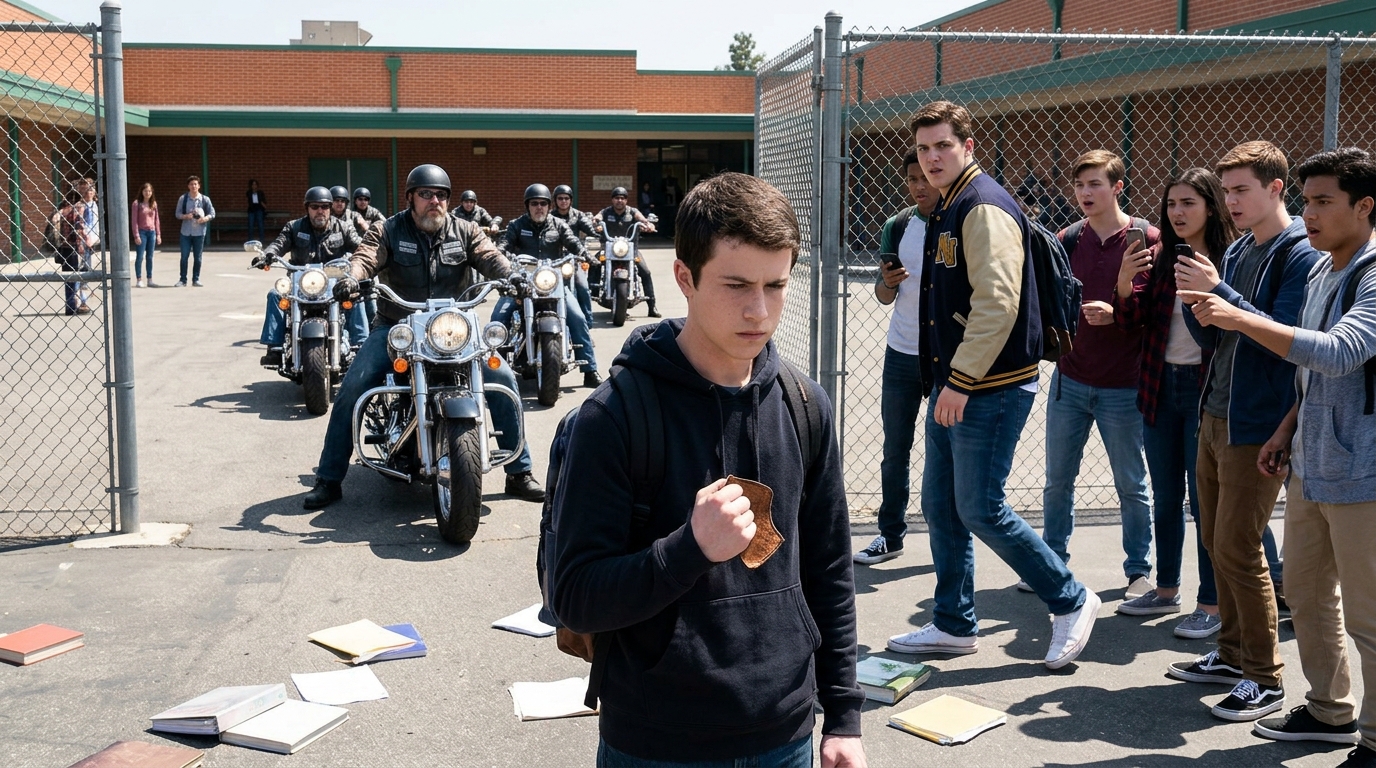
He stood in the center of Northwood High’s front courtyard with his backpack half-zipped, one strap slipping from his shoulder, and the eyes of half the school turning toward him.
First day.
New campus.
New faces.
New rules he had not learned yet.
And already, everyone knew his name for the wrong reason.
The boy standing in front of him was Mason Cole.
Elijah had learned that name less than ten minutes earlier.
Mason was tall, athletic, and confident in the way boys become confident when they have never been meaningfully stopped. His letterman jacket hung open over a white shirt. A silver chain flashed at his neck. Two boys stood behind him like shadows, laughing before they even knew what was funny.
Around them, students began to gather.
Some backed away.
Some leaned closer.
Some lifted phones.
That was what made Elijah’s stomach tighten.
Not Mason.
Not the shove.
The phones.
People did not just watch humiliation anymore.
They saved it.
Mason stepped closer.
“You deaf?” he said.
Elijah bent slowly to pick up one of his books.
Mason kicked it away before his fingers reached the cover.
Laughter cracked through the circle.
A girl near the fountain whispered, “Oh my God.”
Another student said, “This is bad.”
But no one stepped in.
Elijah straightened.
His face remained calm.
Too calm, apparently, because Mason’s eyes narrowed.
“You think you’re tough?”
Elijah said nothing.
He had learned silence from adults who carried grief like weather.
Silence did not mean weakness.
But boys like Mason often mistook it for fear.
Mason shoved him.
Hard enough to make Elijah stumble back two steps.
The crowd reacted with a low wave of sound.
Phones lifted higher.
Someone from the outer edge muttered, “Bro, first day?”
Mason ignored it.
“Go back to wherever you came from.”
The words struck more deeply than the shove.
Elijah’s jaw tightened.
Not because Mason knew anything.
Because Mason knew nothing.
Nothing about the motel rooms.
Nothing about the hospital bills.
Nothing about his mother packing their lives into two suitcases and saying, “We just need somewhere quiet for a while.”
Nothing about the patch in Elijah’s pocket.
Nothing about the promise tied to it.
Mason leaned close enough for Elijah to smell mint gum on his breath.
“This school doesn’t need charity cases.”
The circle shifted.
A few students laughed.
Others looked away.
Elijah’s hand moved slowly into his pocket.
Mason noticed and tensed.
“What, you got something?”
Elijah pulled out a small, worn leather patch.
It was old.
Dark brown.
Soft at the edges from years of being held.
The stitching had frayed along one side, but the symbol in the center remained visible: a black wolf’s head with a silver line through it.
Beneath the symbol were three faded words:
Iron Wolves MC
Elijah did not show it to Mason.
He did not threaten anyone with it.
He simply closed his fist around it.
His knuckles went pale.
For one moment, nothing happened.
Then the ground began to tremble.
At first, the sound was distant.
Low.
Almost imagined.
A deep rumble from beyond the athletic fields.
Students began turning toward the front gate.
The rumble grew.
One engine.
Then more.
Louder.
Heavier.
The courtyard stopped breathing.
Ten massive, chrome-heavy motorcycles burst through the school gates in flawless formation.
The engines roared against the brick walls of Northwood High, shaking windows, scattering conversation, drowning every whisper beneath a sound that felt older and stronger than the courtyard itself.
The motorcycles rolled in slowly.
Controlled.
Not reckless.
Not chaotic.
The sun flashed off black leather jackets, polished tanks, and silver handlebars.
At the front rode a towering man with a grizzled beard, broad shoulders, and eyes that moved over the courtyard like he had already understood the whole scene before stopping.
The motorcycles came to a halt.
One by one, the engines cut.
The silence that followed was heavier than the roar.
Mason’s smirk vanished.
The lead rider swung one boot to the pavement and stepped off his bike.
He looked at Mason.
Then at Elijah.
Then at the leather patch clenched in the boy’s fist.
His face changed.
Not surprise.
Recognition.
He walked forward.
The crowd parted without being asked.
When he reached Elijah, the man’s voice came low and rough.
“Where did you get that patch, son?”
Elijah swallowed.
For the first time that morning, his calm cracked.
“My dad gave it to me.”
The biker went still.
Behind him, the other riders exchanged looks.
The lead rider’s eyes softened in a way that made the entire courtyard feel smaller.
“What was his name?”
Elijah looked down at the patch.
Then lifted his gaze.
“Caleb Carter.”
The biker’s face drained of color.
A sound moved through the riders behind him — not speech, not shock exactly, but something like old grief waking up.
The lead rider slowly lowered himself to one knee in front of Elijah.
The crowd stared.
Mason took half a step back.
The huge biker looked up at the boy and said:
“Your father saved my life.”
The Patch in the Pocket
Elijah had never known his father as a man who rode with clubs.
He knew him as photographs.
A laugh in old videos.
A pair of work boots by the back door that his mother had kept long after they stopped smelling like him.
He knew him through stories told carefully, as if each memory had sharp edges.
Caleb Carter had died when Elijah was three.
At least, that was the simple version.
A construction accident.
A fall.
A closed casket.
A settlement so small Elijah’s mother once laughed when the check arrived, then cried so hard she had to sit on the kitchen floor.
His mother, Rachel, never spoke badly of Caleb.
But she also never told the whole story.
Whenever Elijah asked about the leather patch, she would touch it gently and say, “That belonged to a chapter of his life that loved him before I did.”
“Were they bad men?” Elijah once asked.
Rachel looked out the window for a long time.
“No,” she said. “They looked like bad men to people who didn’t know what kindness cost them.”
That was all.
The patch had been tucked into a small metal box with Caleb’s watch, a photograph, and a folded note.
Rachel gave it to Elijah when they moved to Northwood.
“You don’t need to show this to anyone,” she told him. “But keep it with you.”
“Why?”
Her face tightened.
“Because this town has ghosts.”
Elijah did not understand.
Now, standing in the courtyard with ten bikers before him and Mason Cole suddenly silent behind him, he began to.
The lead rider rose slowly.
“My name is Jonah Briggs,” he said.
Elijah knew that name.
Not well.
But he had heard it once.
His mother whispering into a phone at night.
“No, Jonah. I can’t come back there. Not yet.”
He had pretended to be asleep.
But he remembered.
“You know my mom,” Elijah said.
Jonah nodded.
“I knew both your parents.”
The principal’s voice cut in from the steps.
“What is going on here?”
Principal Howard stood near the main entrance, his face red, one hand gripping a radio. Two security officers hovered behind him, uncertain whether to approach the bikers or stay where they were.
Jonah did not raise his voice.
“That boy was being assaulted in your courtyard.”
Mason snapped, “I didn’t assault anybody!”
Half the courtyard turned toward him.
Someone laughed nervously.
Elijah did not.
Jonah looked at the phones raised around them.
“I’m guessing those cameras caught enough.”
Mason’s face hardened.
“This is private school property. You can’t just ride in here.”
Jonah’s eyes moved to him.
Slowly.
“You must be Mason Cole.”
Mason froze.
That was the first sign.
The first crack.
Jonah knew his name.
Not because Elijah had said it.
Not because a student whispered it.
He knew before he arrived.
Mason recovered quickly, or tried to.
“Yeah. So what?”
Jonah glanced toward the main building.
“Your father still owns the construction company that built the east gym wing?”
Principal Howard’s expression changed.
Subtle.
But Elijah saw it.
So did several teachers now gathering near the steps.
Mason’s jaw clenched.
“What does that have to do with anything?”
Jonah looked at Elijah.
Then at the patch.
“Everything.”
The courtyard, already silent, seemed to tighten further.
Elijah felt suddenly cold despite the sun.
Because now this was not just about textbooks on pavement.
Not just about a shove.
Not just about a rich bully choosing the new kid because he looked easy.
This was about something older.
Something Elijah’s mother had run from.
Something his father had died near.
Caleb Carter and the Iron Wolves
Jonah did not explain everything in the courtyard.
That was not his way.
He looked at Principal Howard and said, “We need to speak somewhere with cameras and more than one adult witness.”
The principal stiffened.
“This is highly inappropriate.”
“So was letting a group of students surround a new kid while half the courtyard filmed it.”
The security officers looked uncomfortable.
A teacher near the fountain lowered her eyes.
Principal Howard opened his mouth, then closed it.
Mason tried to slip away.
Jonah did not look at him, but one of the bikers shifted his stance near the path. That was enough. Mason stopped.
Elijah gathered his books with shaking hands.
This time, no one kicked them.
A girl with curly hair stepped forward and picked up his notebook from beneath the bench.
“Here,” she said softly.
“Thanks.”
Her eyes flicked toward Mason.
“I’m sorry.”
Elijah nodded, though he did not know what to do with apologies from people who had watched.
Jonah noticed that too.
They moved into the administration building.
The bikers did not all enter.
Only Jonah and two others: Diesel, sharp-eyed and lean, and Hank, older, broad, with a limp he tried to hide.
Mason was brought in.
So were Principal Howard, the school resource officer, and a vice principal named Mrs. Lane.
Elijah sat at the far end of the conference table with his backpack in his lap.
Jonah sat beside him.
Not too close.
Just close enough to make clear that Elijah was no longer alone.
Principal Howard folded his hands.
“Mr. Briggs, whatever connection you have to this child, riding motorcycles onto school grounds is not acceptable.”
Jonah leaned back.
“Neither is bullying.”
“We will investigate.”
“You had a courtyard full of witnesses.”
“We will review footage.”
“You should.”
Mason crossed his arms.
“This is insane. He started it.”
Elijah looked at him.
For the first time, he spoke clearly.
“No, I didn’t.”
Mason rolled his eyes.
“Oh, now he talks.”
Jonah’s voice cut in.
“Careful.”
One word.
Mason shut his mouth.
Principal Howard looked irritated.
“Mr. Briggs, you do not discipline students here.”
Jonah nodded.
“You’re right. That’s your job. I’m waiting to see you do it.”
Mrs. Lane cleared her throat.
“Perhaps we should call Elijah’s mother.”
Elijah’s hand tightened on the patch.
“She’s working.”
Jonah’s expression softened.
“At the clinic?”
Elijah looked at him sharply.
“How do you know that?”
Jonah sighed.
“Because your mother called me two weeks ago when she found out you were moving back to Northwood.”
Elijah stared.
“She did?”
“She didn’t want us near you unless needed.”
“Why?”
Jonah looked toward the principal.
“Because last time your family was in this town, powerful people made sure no one helped until it was too late.”
The room went still.
Mason’s face changed again.
Principal Howard looked suddenly older.
Elijah whispered, “What does that mean?”
Jonah’s eyes moved to him.
“It means your father didn’t fall.”
The East Gym Wing
Northwood High had an east gym wing named after Cole Construction.
The plaque outside the entrance read:
Donated by Cole Family Development
In support of student excellence
Students passed it every day without thinking.
Elijah had seen it that morning but had not cared.
Now the name burned in his mind.
Cole.
Mason Cole.
Cole Construction.
His father’s accident.
Jonah asked Principal Howard for a private room to wait for Rachel Carter.
The principal refused at first.
Then Jonah placed a small file folder on the conference table.
“I brought copies.”
Principal Howard stared at it.
“Copies of what?”
“Old inspection reports.”
The room’s air changed.
Mason’s face flushed.
“My dad’s lawyers already dealt with all that.”
Jonah looked at him.
“So you do know.”
Mason’s mouth snapped shut.
Elijah turned toward him.
“What do you know?”
Mason looked away.
That answer hurt more than anything he could have said.
Jonah opened the folder.
Inside were photographs.
Not many.
But enough.
A construction site.
Steel beams.
Concrete forms.
A handwritten note.
A photograph of Caleb Carter wearing a hard hat, smiling with one arm around a younger Jonah Briggs, both covered in dust.
Elijah reached for the picture.
His fingers trembled.
He had seen many photos of his father, but never this one.
Caleb looked younger.
Alive in a way old family photos often failed to capture.
Jonah let him hold it.
“Your father worked on the original east gym expansion,” he said. “Cole Construction rushed the project. Cut corners. Used cheaper supports than specified.”
Principal Howard said sharply, “Those allegations were never proven.”
Jonah did not look at him.
“Because the man who found the problem died before he could testify.”
Elijah’s heart pounded.
“My dad?”
Jonah nodded once.
“Caleb found the substitution. He told his supervisor. Then he called me.”
“Why you?”
“Because I had just come home from a bad stretch and your father was the only one who could tell when I was lying about being fine. He asked me to meet him that night at the site. Said if anything happened, I should make sure Rachel got the patch.”
Elijah looked down at the leather in his fist.
“He knew?”
“He suspected.”
Mason shook his head.
“This is crazy.”
Diesel, standing near the door, spoke for the first time.
“Your father said the same thing when we asked why the security footage disappeared.”
Mason glared at him.
“My dad didn’t do anything.”
Jonah looked at the boy for a long moment.
“You sure about that? Or is that just what he needed you to believe?”
Mason’s face twisted.
For one second, he looked less like a bully and more like a child standing too close to a truth he did not choose.
Then the door opened.
Rachel Carter walked in.
Rachel Carter
Elijah had seen his mother tired.
He had seen her worried.
He had seen her cry quietly over bills, then wipe her face and smile when she noticed him watching.
But he had never seen her look like she did when she entered that conference room.
Her face went pale the moment she saw Jonah.
Then her eyes moved to Elijah.
Then Mason.
Then the folder on the table.
“Oh no,” she whispered.
Elijah stood.
“Mom.”
Rachel crossed the room and pulled him into her arms so tightly he could barely breathe.
“What happened?”
“I’m okay.”
Her hands moved over his shoulders, his face, his arms, checking for injuries the way mothers do when words are not enough.
Then she looked at Jonah.
“I told you not to come unless I called.”
Jonah’s voice was gentle.
“You didn’t have to. The patch did.”
Her eyes dropped to Elijah’s fist.
Pain crossed her face.
“Elijah…”
He stepped back.
“Dad didn’t fall?”
Rachel closed her eyes.
The room waited.
For years, Elijah had lived inside the clean version of his father’s death.
Accident.
Bad luck.
Unsafe footing.
Tragedy.
Now he saw adults exchanging looks around the edges of that story, and he understood the clean version had been made for him.
Or perhaps for everyone.
Rachel opened her eyes.
“I don’t know everything,” she said.
Jonah leaned forward.
“But you know enough.”
She looked at him sharply.
“I know what I could survive knowing.”
That silenced him.
Elijah looked from one adult to the other.
“Tell me.”
Rachel shook her head.
“Not here.”
“Yes,” Elijah said.
His own voice surprised him.
Rachel stared at him.
He had never spoken to her that way.
Not with disrespect.
With need.
He placed the patch on the table.
“Everyone keeps saying this town has ghosts. I’m the one getting shoved in the courtyard because of them. So tell me.”
Rachel’s face broke.
She sat slowly.
Then she told him.
Not everything.
Not yet.
But enough.
Caleb Carter had found evidence that Cole Construction used substandard steel on the east gym wing. He planned to report it. He met Jonah at the site the night before the final inspection.
When Jonah arrived, Caleb was already on the ground.
Injured.
Barely conscious.
He kept saying, “They changed the load sheets.”
Jonah called 911.
By the time police arrived, Caleb’s bag was missing.
So were the documents.
Cole Construction claimed Caleb had been drinking on-site.
A toxicology report later showed trace alcohol, enough for rumors, not enough for truth. Rachel insisted he did not drink that night. Jonah insisted too.
The company settled quietly.
The school accepted the donation.
The plaque went up.
Rachel left town with Elijah.
“And now we’re back,” Elijah said.
Rachel nodded, tears in her eyes.
“I thought enough time had passed.”
Jonah looked at Mason.
“Some families teach their sons history as pride. Some teach it as warning.”
Mason stood abruptly.
“I’m calling my dad.”
“No need,” Diesel said from the door.
Everyone turned.
Outside the conference room windows, a black pickup pulled into the school lot.
A man stepped out in a navy suit.
Mason’s father had arrived.
Richard Cole
Richard Cole looked exactly like the kind of man who expected doors to open.
Tall.
Silver-haired.
Expensive suit.
Face built from charm and threat in equal measure.
He entered the conference room without knocking, followed by a lawyer who looked too polished for a school discipline issue.
His eyes moved first to Mason.
Then to Elijah.
Then to Rachel.
Then Jonah.
He smiled.
It did not reach his eyes.
“Well,” Richard Cole said. “This is quite a reunion.”
Rachel stiffened.
Elijah noticed and moved closer to her.
Jonah remained seated.
“Richard.”
“Jonah Briggs. Still playing soldier with motorcycles?”
“Still hiding behind lawyers?”
The attorney stepped forward.
“I advise everyone here to be careful with accusations.”
Jonah nodded toward the folder.
“Good. I advise everyone here to preserve evidence.”
Richard glanced at the folder.
Only for a second.
But Elijah saw it.
Recognition.
Not surprise.
Richard turned to Principal Howard.
“My son was assaulted by a gang entering school grounds.”
Mason looked startled.
“I wasn’t—”
Richard silenced him with one glance.
Elijah stared.
So this was how it worked.
Not with fists first.
With narrative.
Richard continued smoothly.
“I want these men removed, charges considered, and my son protected from harassment.”
Rachel stood.
“Your son threw Elijah’s books on the ground and shoved him.”
Richard looked at her with mild pity.
“Rachel. Still emotional.”
Jonah’s hand closed into a fist on the table.
Rachel lifted her chin.
“No. Just less afraid than before.”
Richard’s smile thinned.
“That would be a mistake.”
The room chilled.
Elijah felt his mother’s fear, but this time he also felt something else.
Anger.
His own.
He stepped forward.
“You know what happened to my dad.”
Richard looked down at him.
For a moment, his polished mask almost faltered.
Then he said, “Your father’s death was tragic. But tragedy does not become conspiracy because grief needs someone to blame.”
Elijah reached into the folder and picked up the photograph of Caleb and Jonah.
“My dad said you changed the load sheets.”
Rachel whispered, “Elijah.”
Richard’s eyes hardened.
“Your father said many things near the end.”
Jonah stood so quickly his chair scraped back.
“You watch your mouth.”
The lawyer raised a hand.
“This meeting is over.”
“No,” said a new voice.
Everyone turned.
The girl from the courtyard — the one who had picked up Elijah’s notebook — stood in the doorway.
Behind her were at least twenty students.
Phones in hand.
But this time, they were not filming a boy being humiliated.
They were holding evidence.
The girl stepped forward.
“My dad works in city records,” she said, voice shaking. “After what happened outside, I asked him about the east gym wing.”
Principal Howard went pale.
Richard Cole’s face went still.
The girl looked at Elijah.
“My name is Maya. I’m sorry I didn’t help sooner.”
She held up her phone.
“But I found something.”
The File That Never Disappeared
Maya’s father worked in municipal archives.
He had seen rumors over the years about the Northwood High east gym wing, but rumors were common in old construction projects.
When Maya texted him that morning asking about Caleb Carter and Cole Construction, he searched out of curiosity.
What he found was not supposed to exist.
A backup scan.
Misfiled under a temporary permit number.
One page.
A load sheet.
Original.
Not the version Cole Construction submitted after Caleb’s death.
The original steel specifications showed stronger supports.
The revised sheet, submitted after the accident, listed the cheaper grade.
Both bore approval stamps.
But only one had Caleb Carter’s handwritten note in the margin:
Substitution unsafe. Do not certify. — C.C.
Maya’s father had sent her the image.
She brought it straight to the office.
Richard Cole stared at the phone.
For the first time, his face showed something raw.
Not guilt exactly.
Fear.
His lawyer stepped forward.
“That document is unverifiable.”
Maya’s voice shook harder, but she did not step back.
“My dad already sent it to the city inspector and the police.”
The room erupted.
Principal Howard demanded order.
Richard’s lawyer began speaking rapidly.
Mason looked like he might be sick.
Rachel sat down as if her legs had given way.
Elijah stared at the phone.
At his father’s handwriting.
He had seen that handwriting on birthday cards.
On old labels in the garage.
On a note tucked inside a children’s book.
Now it stood before him like a voice returned.
Do not certify.
His father had tried to stop it.
And someone had stopped him.
Jonah’s eyes filled, though his face stayed hard.
“I knew it,” he whispered.
Rachel covered her mouth.
Richard Cole turned toward his son.
“Mason, we’re leaving.”
Mason did not move.
His eyes were on the document too.
“Dad,” he said quietly. “Did you know?”
Richard’s face tightened.
“This is not the place.”
Mason looked up.
“Did you?”
The question landed harder than any accusation.
Because it came from his own son.
Richard’s expression hardened into command.
“Now.”
Mason stepped back.
Not toward his father.
Away.
That was the first decent thing Elijah had seen him do.
The Courtyard Again
Police came to the school before lunch.
City inspectors came by afternoon.
By evening, the east gym wing was closed pending structural review.
Northwood High sent an email to parents calling it “an abundance of caution.”
Everyone knew it was more.
The bullying video spread first.
Then the motorcycle arrival.
Then Maya’s document.
Then the name Caleb Carter.
For years, Elijah’s father had been a dead worker attached to a rumor.
Now he was a man with handwriting.
A warning.
A son.
A widow who had been told to move on.
Richard Cole was not arrested that day.
Power rarely collapses on the same schedule as truth.
But the investigation reopened.
Old witnesses were contacted.
Former employees came forward.
One retired site supervisor admitted Caleb had confronted management over material substitutions.
Another said security footage from the night of Caleb’s death had been removed before police arrived.
Jonah handed over his own files.
Rachel gave a statement.
And Mason Cole disappeared from school for a week.
When he returned, he was quieter.
The courtyard watched him differently now.
No smirk.
No circle.
No laughter waiting for permission.
Elijah did not forgive him.
Not then.
Maybe not ever.
But one afternoon, Mason approached him near the same spot where the textbooks had fallen.
Students slowed to watch.
Elijah looked up.
Mason’s hands were empty.
No phone.
No friends.
“I didn’t know,” Mason said.
Elijah said nothing.
Mason swallowed.
“I mean, I knew there was some old lawsuit. My dad said your dad was careless. That your mom was trying to get money.”
Elijah’s jaw tightened.
Mason looked down.
“I believed him.”
“That’s convenient.”
“I know.”
Silence stretched between them.
Mason took a breath.
“I’m not asking you to forgive me.”
“Good.”
Mason nodded once.
Then bent down and picked up a pencil someone had dropped near Elijah’s shoe.
He placed it on the bench.
A small gesture.
Not enough.
But not nothing.
Elijah watched him walk away.
Maya stepped beside him.
“That was awkward.”
Elijah almost smiled.
“Yeah.”
“Good awkward or bad awkward?”
“Unknown awkward.”
She nodded.
“Fair.”
The Iron Wolves’ Promise
The Iron Wolves did not become Elijah’s bodyguards.
Rachel refused that immediately.
“My son is going to school,” she told Jonah. “Not entering witness protection with a motorcycle escort.”
Jonah nodded.
“Understood.”
Then he showed up two blocks away every morning for a week.
Rachel glared at him from the car.
He pretended not to see.
Elijah secretly liked it.
Not because he wanted protection.
Because the sight of the bikes reminded everyone at Northwood that Elijah Carter was not alone.
The leather patch stayed in his pocket.
But it changed meaning.
Before, it had been a mystery.
A relic.
A piece of his father he did not fully understand.
Now it was a key.
Not to revenge.
To memory.
Jonah told him stories about Caleb.
Not saint stories.
Real ones.
How Caleb once lost a wrench and accused everyone in the shop before finding it in his own boot.
How he sang badly while repairing bikes.
How he carried extra gloves because Jonah always forgot his.
How he loved Rachel so openly the bikers teased him for becoming “soft,” and Caleb replied, “If you’re not soft for someone, what’s the point of being hard?”
Elijah loved that one.
Rachel cried when he repeated it.
The Iron Wolves had given Caleb the patch after he helped Jonah through a dangerous time years before Elijah was born. Caleb was never a full club member, but he was family.
Family, Jonah explained, was not always about blood or patches.
“It’s about who shows up when there’s no advantage in showing up.”
Elijah thought about the courtyard.
The students who watched.
Maya, who came later.
The bikers, who arrived because his mother made one call weeks before and because a patch carried history.
He began to understand that showing up was not always instant.
But it mattered whether people came when truth called.
The Gym Wall
The structural review of the east gym wing found serious concerns.
Not immediate collapse.
Not a dramatic headline.
Something worse in its quiet way.
Years of risk.
Years of students walking beneath supports that should have been stronger.
Years of administrators trusting paperwork.
The wing was closed for major reinforcement.
The Cole Family Development plaque came down.
Nobody announced that part.
But students noticed.
Elijah stood in front of the blank wall where it had been.
For a long time, he simply looked.
Maya stood beside him.
“What should go there?” she asked.
Elijah shrugged.
“Nothing.”
She nodded.
Then said, “Maybe not nothing forever.”
Months later, after the investigation became formal and the school board could no longer avoid public pressure, a new plaque was installed.
Not large.
Not flashy.
It read:
In memory of Caleb Carter, who raised a safety concern before this wing opened.
May every warning be heard before harm is done.
Rachel attended the small ceremony.
So did Jonah and the Iron Wolves.
So did Maya.
So, surprisingly, did Mason.
His father did not.
Richard Cole had been indicted by then on charges tied to falsified records, obstruction, and fraud. Other legal battles would take years. But the story was no longer buried.
At the ceremony, Rachel stood beside Elijah and touched the plaque with trembling fingers.
“He would hate this,” she whispered.
Elijah looked up.
“The plaque?”
“The attention.”
Jonah, standing behind them, said, “He’d pretend to hate it. Then ask if the lettering made him look cool.”
Rachel laughed through tears.
Elijah smiled.
It was the first time his father’s name had felt less like a wound and more like a place to stand.
Northwood Learns
The school changed after that.
Not completely.
No place changes completely because one truth comes out.
But enough.
The bullying policy stopped being a paragraph hidden in a handbook and became something students actually discussed.
Phone videos were no longer treated only as problems. They became evidence. Responsibility. Witness.
Maya started a student group called Stand Close.
Elijah thought the name sounded like a band.
Maya ignored him.
The group’s rule was simple:
If someone is being humiliated, do not just film from a distance. Stand close enough that the person knows they are not alone. Get help. Record if needed. Speak if safe. Do not let cruelty have the whole circle.
At the first meeting, only six students came.
By spring, there were forty.
Elijah did not lead it.
He attended.
Sometimes spoke.
Mostly listened.
One day, a freshman asked, “What if standing up makes you the next target?”
Elijah thought of his first morning.
Of textbooks on hot pavement.
Of Mason’s shove.
Of the rumble from the gates.
Then he said, “That’s why nobody should stand alone.”
Maya wrote that on the board.
It became the group’s unofficial motto.
Nobody should stand alone.
The Last Ride of the School Year
On the final day of school, Elijah expected to leave quietly.
He had survived freshman orientation, the investigation, the whispers, the pity, the curiosity, the reporters who once waited outside the gates, and the awkward way teachers suddenly treated him like both student and symbol.
He was tired.
But not the same kind of tired as before.
At dismissal, he walked toward the courtyard.
Then stopped.
Motorcycle engines rumbled beyond the front gate.
Students turned.
Teachers smiled knowingly.
Rachel stood near the parking lot with her arms crossed, pretending irritation and failing.
The Iron Wolves rolled in slowly.
Not ten this time.
Twenty-three.
They parked in a long line outside the gate, not entering school grounds without permission now.
Jonah removed his helmet.
Elijah walked toward him.
“What is this?”
Jonah handed him a small box.
Inside was a new leather patch.
Not the old Iron Wolves one.
This one was smaller.
Custom-made.
A black wolf’s head with a silver line.
Beneath it were four words:
Caleb Carter Rode With Us
Elijah’s throat tightened.
“I don’t ride.”
Jonah smiled.
“Not yet.”
Rachel glared.
Jonah quickly added, “Possibly never. Strictly symbolic.”
Elijah laughed.
The sound surprised him.
Mason appeared near the steps, watching from a distance.
Elijah saw him.
Mason lifted one hand slightly.
Not a wave exactly.
An acknowledgment.
Elijah nodded once.
Not forgiveness.
Not friendship.
But something less poisoned than before.
Rachel walked over and touched the patch.
“Your father would’ve loved this.”
Elijah looked at her.
“Do you?”
Her eyes filled.
“Yes.”
Jonah cleared his throat.
“We’re doing a memorial ride to the old site.”
Rachel nodded.
“I know.”
Elijah looked between them.
“You planned this?”
His mother smiled.
“Your father deserved one ride that wasn’t secret.”
What Belonged
They rode slowly through town.
Elijah did not ride a motorcycle.
Rachel would have ended Jonah’s life.
Instead, Elijah rode in his mother’s car behind the bikes, the new patch in his lap, the old patch in his pocket.
People came out of shops to watch.
Some knew the story.
Some only saw leather, chrome, and a line of riders moving with solemn purpose.
They stopped at the old construction site where the east gym materials had once been stored. Nothing remained of the original structure there now. Just an empty lot, weeds, and a chain-link fence.
Jonah stood at the fence and said a few words.
Not polished.
Not dramatic.
“Caleb Carter wasn’t a club officer. Wasn’t a biker in the official sense. Didn’t care much for rules, which frankly made him one of us anyway.”
A few riders chuckled.
Jonah’s voice roughened.
“He saw something wrong and said so. That should not be brave, but sometimes it is. He paid for it. His family paid for it. We should have done more then.”
Rachel closed her eyes.
Jonah looked at her.
“I should have done more.”
Rachel’s voice was soft.
“You were hurt too.”
“I was alive.”
“So was I,” she said. “And I ran.”
Elijah looked at his mother.
Rachel held his gaze.
“I thought leaving protected you. Maybe it did. Maybe it also left the lie standing longer. I don’t know.”
Elijah reached for her hand.
She held on tightly.
Jonah placed a small metal emblem on the fence.
Not permanent.
Not official.
Just there.
Then he turned to Elijah.
“You want to say anything?”
Elijah looked at the empty lot.
He thought of the courtyard.
The shove.
The patch.
The roar.
His father’s handwriting.
The plaque.
The students who watched.
The ones who later stood close.
He stepped forward.
“My dad didn’t belong to the lie they told about him,” he said.
The riders went still.
Elijah swallowed.
“And I don’t belong to the fear it left behind.”
Rachel’s hand covered her mouth.
Jonah lowered his head.
Elijah looked toward Northwood High in the distance.
“I belong where the truth is.”
No one spoke for a moment.
Then Jonah placed one heavy hand gently on his shoulder.
“Yeah,” he said. “You do.”
The Boy in the Courtyard
By the next school year, Elijah was no longer simply “the new kid.”
He was Elijah.
Quiet.
Good at history.
Terrible at basketball.
Friends with Maya.
Polite to teachers unless they said something stupid, in which case his face betrayed him completely.
The bullying did not vanish from Northwood.
No school becomes kind overnight.
But the courtyard changed.
Students remembered what happened when cruelty formed a circle and truth rode through the gate.
They remembered Mason’s smirk disappearing.
They remembered the patch.
They remembered that the boy everyone thought was alone had history behind him.
More importantly, they learned that not everyone has motorcycles coming.
So they had to become the ones who stepped forward.
Maya’s group grew.
Teachers began responding faster.
Students intervened earlier.
And when new kids arrived, Elijah sometimes noticed the way they stood near the edges, holding schedules, pretending not to be terrified.
He would walk up and say, “You need help finding class?”
Sometimes they said no.
Sometimes yes.
Either way, they knew someone had seen them.
That mattered.
One afternoon, near the end of sophomore year, Elijah found a freshman standing in the courtyard while two older boys mocked his shoes.
Elijah walked over.
He did not shout.
He did not threaten.
He simply stood beside the freshman.
Maya joined him.
Then two more students.
Then another.
The older boys looked around, suddenly uncomfortable.
“What?” one snapped.
Elijah looked at the freshman.
“You okay?”
The boy nodded quickly, though his eyes were wet.
The older boys muttered something and left.
No engines.
No dramatic entrance.
No roaring motorcycles.
Just students standing close enough that cruelty lost its stage.
Maya smiled at Elijah.
“See? Stand Close works.”
Elijah rolled his eyes.
“Still sounds like a band.”
“A good band.”
“No.”
The Patch
Elijah kept the old leather patch.
Not in his pocket forever.
Eventually, he placed it in a small frame beside the photograph of Caleb and Jonah at the construction site.
The new patch stayed on his desk.
Sometimes, when homework frustrated him or the investigation dragged through another delay, he would pick it up and run his fingers over the stitched wolf.
The symbol no longer felt mysterious.
It felt like a reminder.
Not that bikers would always come.
Not that every wrong would be made right.
Not even that his father’s case would end perfectly.
It reminded him that truth needs carriers.
A patch.
A note.
A scan in a city archive.
A student brave enough to bring her phone to the office.
A mother willing to return to the town that hurt her.
A biker who kept old files because grief told him to.
A boy who refused to let thrown textbooks define him.
Years later, when Elijah graduated, the east gym wing had been fully repaired and reopened. The Caleb Carter plaque remained near the entrance.
On graduation day, Elijah walked past it in his cap and gown.
He stopped.
Rachel stood beside him.
Jonah waited near the parking lot with the Iron Wolves, pretending not to cry behind sunglasses.
Maya was already yelling at people to line up properly.
Elijah touched the plaque.
“Thanks, Dad,” he whispered.
Rachel slipped her hand into his.
“You think he’d be proud?”
Elijah looked toward the courtyard where everything had started.
The pavement was cooler now beneath the shade of newly planted trees.
Students laughed near the fountain.
No circle.
No phones raised for cruelty.
No boy standing alone.
“Yeah,” Elijah said.
Then he smiled.
“I think he’d say the lettering makes him look cool.”
Rachel laughed.
For once, the sound carried no pain.
Only memory.
Only love.
Only the strange, hard-won peace of a name returned.
Where He Belonged
On his first day at Northwood High, Elijah Carter had been told he did not belong.
By a boy who thought belonging came from money.
By a crowd that thought silence kept them safe.
By a school that had built part of itself over a buried warning.
But belonging, Elijah learned, was not granted by people guarding gates.
It was built.
By truth.
By memory.
By the ones who show up.
His father belonged in the story of Northwood High because he had tried to protect it.
His mother belonged in the town because she had survived it.
The Iron Wolves belonged not because they roared through the gates, but because they came when a promise called.
Maya belonged because she stopped watching and started acting.
Even Mason, maybe, belonged to the long work of becoming different from the man who raised him.
And Elijah?
He belonged wherever he chose to stand without lowering his eyes.
That was what the courtyard taught him.
The day the textbooks struck the pavement, everyone thought they were watching a new kid get broken.
They were wrong.
They were watching the first crack in an old lie.
Then came the rumble.
The roar.
The motorcycles.
The patch.
The truth.
And from that day forward, whenever Elijah walked through Northwood’s courtyard, he did not hear Mason’s voice first.
Not anymore.
He heard engines.
He heard his father’s handwriting in his mind.
Do not certify.
He heard Jonah’s rough voice.
Your father saved my life.
He heard his mother telling the truth at last.
And he heard his own words from the empty lot:
I belong where the truth is.
So he kept walking.
Head high.
Not because he was never afraid.
But because he finally knew something Mason Cole had not understood that first morning.
A person does not need permission from a bully to belong.
Sometimes the ground only starts shaking when the wrong person is told to leave.