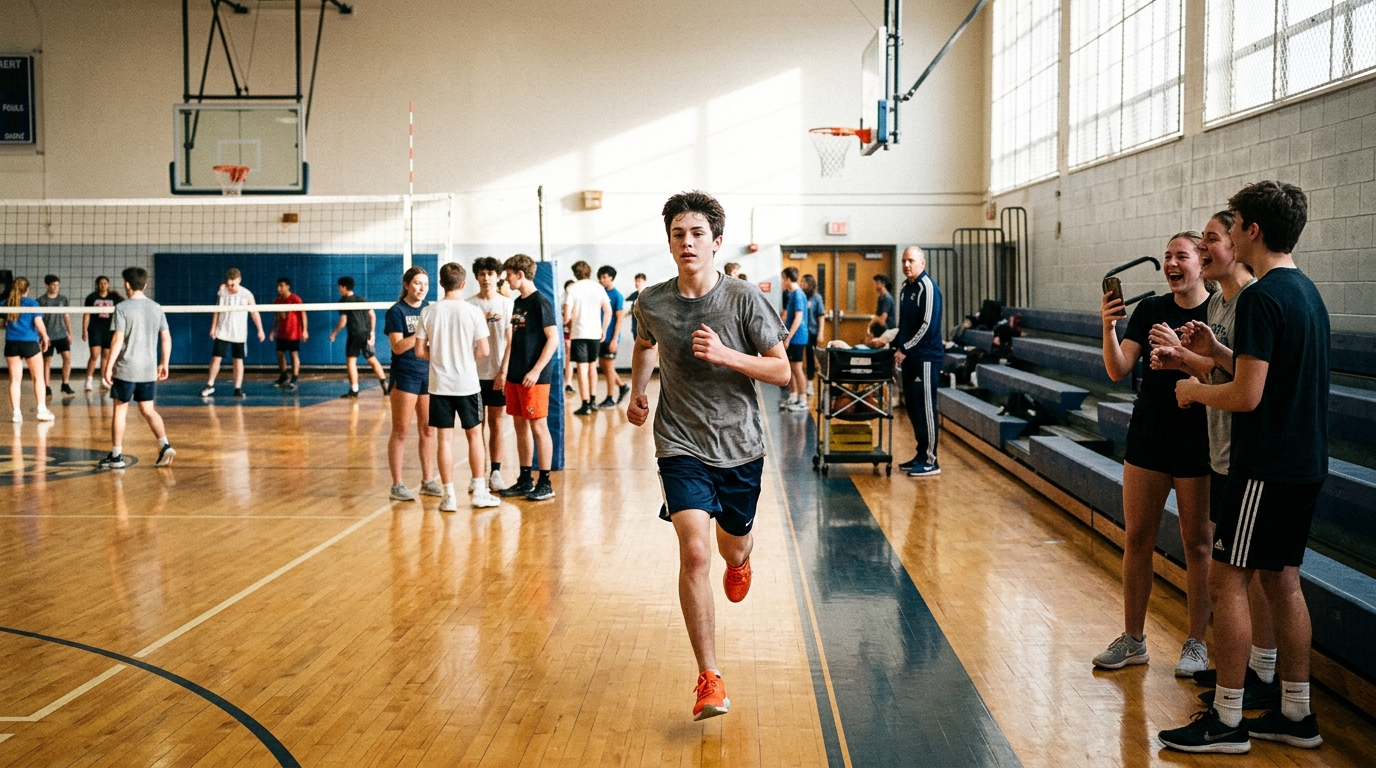
The Brightest Room Felt Like the Hardest Place to Breathe
They laughed, recorded, and thought it was all just a joke.
But in that bright gym, beneath the white lights and echoing whistles, the silence finally reached its breaking point.
It was supposed to be an ordinary physical education class.
No one woke up that morning planning to ruin anyone’s life. No one thought of themselves as cruel. That was the strange truth Liam would only understand much later.
To them, it was just teasing.
Just a video.
Just a laugh before lunch.
Just another moment that would vanish into the endless noise of school.
But for Liam, physical education had never been about games.
It was about surviving the gym.
The squeak of sneakers on polished wood. The slam of basketballs. The shrill burst of a whistle. The smell of rubber mats and old sweat. The way voices bounced off the walls until every laugh sounded like it might be aimed at him.
He hated the changing room most.
Not because anyone always did something terrible there.
Because terrible things didn’t have to happen every day to make a place feel unsafe.
Sometimes all it took was the possibility.
The quick glance at his shoes.
The whisper about his secondhand shorts.
The way boys stopped talking when he walked past, only to start laughing when he turned away.
Liam had learned to move through school like a shadow.
Head down.
Shoulders narrow.
Books held close.
Never too fast, because running made people notice.
Never too slow, because lagging behind made people notice too.
The trick was to remain just ordinary enough to pass.
But that day, in gym class, ordinary wasn’t enough.
Mr. Nolan had announced timed laps.
“Four rounds around the gym,” he said, clapping his hands once. “Best effort. No walking unless you need to. Let’s go.”
A groan rolled through the class.
Some students complained dramatically. Others stretched like professional athletes. A few already had their phones hidden in their sleeves, ready to record anything funny.
Liam stood near the back of the line.
He tried to breathe slowly.
Four laps.
That was all.
He could do four laps.
He had walked farther than that carrying groceries home when his mother’s shift ran late. He had climbed six flights of stairs when the elevator in their apartment building broke. He had run after the bus in rain, shoes slipping, backpack bouncing painfully against his spine.
But running in the gym was different.
Here, everyone could see.
Here, every mistake had an audience.
Mr. Nolan blew the whistle.
The first group took off.
The fast boys surged forward immediately, laughing, pushing each other, turning the assignment into a race no one had officially asked for.
Liam waited for his group.
His hands felt cold.
His throat felt dry.
“Try not to trip over your own feet, Hale,” someone muttered behind him.
Liam didn’t turn.
The voice belonged to Tyler Grant.
Of course it did.
Tyler had the effortless confidence of someone who had never wondered whether he belonged in a room. He was tall, loud, and popular in the lazy way some boys became popular simply because people were afraid not to laugh at their jokes.
He wasn’t the worst person in the school.
That was what made it harder.
If he had been purely cruel, people might have recognized it.
But Tyler smiled when he insulted people.
He made it sound light.
He made everyone else feel as if refusing to laugh meant taking things too seriously.
Liam stepped up to the line.
Mr. Nolan lifted the whistle.
“Ready?”
The whistle cut through the gym.
Liam ran.
The Laugh That Started Small
At first, he did better than expected.
His legs moved steadily. His breathing held. The first turn came quickly, then the second. He kept his eyes on the far wall and tried not to notice the students standing along the side.
One lap.
Then two.
His chest burned, but not badly.
He could hear Tyler behind him, running slower than he could have, keeping pace for a reason Liam understood without looking.
“Look at him go,” Tyler called out. “Track star.”
A few laughs.
Small at first.
Liam kept running.
His shoes slapped the floor unevenly. The left one had a worn sole that sometimes dragged if he didn’t lift his foot high enough. He focused on that.
Lift.
Step.
Breathe.
Lift.
Step.
Breathe.
“Hey, Liam!” another boy shouted. “Your shoe’s trying to quit before you do!”
More laughter.
Liam’s face warmed.
He rounded the next corner.
Three laps.
Almost done.
Then Tyler sped up beside him.
Not passing.
Matching him.
Too close.
“Come on,” Tyler said, grinning. “Push yourself.”
Liam said nothing.
Tyler leaned in as they ran.
“You’re not gonna cry, right?”
Someone near the wall made a dramatic crying sound.
Liam’s steps faltered.
Just once.
Enough.
His left shoe caught slightly against the floor.
He recovered.
But the moment had already happened.
Phones rose.
Someone said, “Wait, wait, film this.”
Liam heard it.
His whole body tightened.
That was the worst part.
Not the insult.
The recording.
A laugh in the moment could fade.
A video could follow you.
A video could be replayed in the cafeteria, posted in group chats, sent to people who weren’t even there. A video could turn one second of humiliation into a version of you that lived longer than the truth.
He tried to run faster.
Maybe if he finished quickly, it would end.
Maybe if he didn’t react, they would get bored.
Maybe if he became smaller inside himself, there would be less for them to hold onto.
He pushed harder.
His lungs burned now.
The far wall blurred slightly.
Tyler’s voice followed him.
“Whoa, he’s actually trying!”
The crowd laughed louder.
Liam reached the final turn.
His foot slipped.
Not dramatically.
Not like in a movie.
Just enough.
His body tilted.
His hands flew forward.
His knee hit the floor first.
Then his palms.
The sound cracked through the gym.
For half a second, everything stopped.
Then laughter erupted.
Loud.
Instant.
Relieved, almost.
As if everyone had been waiting for permission.
Liam stayed on the floor.
His knee stung.
His palms burned.
His breath came in shallow, ragged pulls.
Around him, phones pointed down like small black mirrors.
Tyler bent over, laughing.
“Bro, I told you not to trip over your own feet.”
Someone else said, “That was perfect.”
Another voice: “Post it.”
Liam pushed himself onto his knees.
He looked at the polished floor beneath him.
There was a tiny red mark where his skin had scraped.
Nothing serious.
Not enough for adults to understand why his chest felt like it was breaking.
Mr. Nolan blew the whistle.
“Enough,” he called, but his voice had the tired impatience of a teacher managing noise, not harm. “Phones away.”
Some students lowered their phones.
Others only pretended.
Liam stood.
His knee throbbed.
His face burned.
The whole gym seemed too bright.
“Liam, you okay?” Mr. Nolan asked.
It should have been a kind question.
But it came from across the room.
Public.
Casual.
The kind of question that required him to answer in a way that didn’t make everyone more uncomfortable.
Liam nodded.
“I’m fine.”
Tyler smirked.
Of course he did.
Because “I’m fine” was the sentence everyone wanted from him.
It allowed the class to continue.
It allowed the teacher to move on.
It allowed the students to keep believing nothing had really happened.
So the moment should have ended there.
But it didn’t.
Not that day.
The Video
By lunch, the video had spread.
Liam knew before he saw it.
He knew from the way people looked up when he entered the cafeteria.
Not everyone.
Only enough.
A few heads turned.
A few whispers passed.
A boy at the far table glanced at his phone, then at Liam, then back at the phone.
Someone laughed too loudly.
Liam walked to the lunch line with his tray held tightly in both hands.
He did not look around.
He bought the cheapest meal option: plain pasta, an apple, and water.
He sat at the end of a table near the wall.
Usually, that spot worked.
Not hidden, exactly.
But far enough from the center that most people forgot to perform around him.
Today, it didn’t.
Two girls at the next table were watching something on a phone.
One of them whispered, “Is that him?”
The other glanced over quickly.
Liam stared at his pasta.
He was not hungry.
A chair scraped across from him.
For one strange second, he thought Tyler had come to finish the joke.
But it wasn’t Tyler.
It was Maya Ellis.
Maya was in his English class. She had curly hair, a serious face, and a habit of drawing tiny stars in the margins of every worksheet. She wasn’t one of the loud popular students, but she wasn’t invisible either. She had friends. She raised her hand in class. Teachers remembered her name.
She placed her tray down and sat across from Liam.
He looked up, confused.
Maya didn’t smile.
“I deleted it,” she said.
Liam blinked.
“What?”
“The video.” Her voice was low. “I had it. I deleted it.”
He stared at her.
“You recorded it?”
Her face reddened.
“For like two seconds. Everyone was filming. I didn’t even think.”
Liam looked back down at his tray.
“Oh.”
“I’m sorry.”
He didn’t answer.
She shifted uncomfortably.
“I know that’s not enough.”
Still, he said nothing.
Maya picked at the corner of her napkin.
“I don’t know why I did it. I mean, I do. But it sounds awful.”
Liam’s voice came out flat.
“Because everyone else was.”
She winced.
“Yeah.”
A silence settled between them.
Not easy.
Not friendly.
But honest.
That was rare enough to matter.
Maya looked toward the cafeteria doors.
“Tyler posted it in the class group chat. Someone reposted it.”
Liam’s stomach turned.
“Great.”
“I reported it.”
He looked up.
She met his eyes.
“I know that also doesn’t fix it.”
“Why are you telling me?”
“Because I should have done something in the gym.”
The sentence landed differently from her apology.
Not softer.
More useful.
Liam studied her.
“What would you have done?”
Maya opened her mouth.
Then closed it.
“I don’t know.”
He almost laughed, but there was no humor in it.
“Exactly.”
She nodded slowly.
“Yeah. Exactly.”
For a moment, they sat with that.
The truth that most people imagined themselves brave until a moment asked something from them.
Then Maya said, “I think that’s the problem.”
Liam looked at her.
“What?”
“Nobody knows what to do, so everyone does nothing. And then doing nothing starts to look normal.”
Liam pushed his pasta around with his fork.
“It is normal.”
“It shouldn’t be.”
That sentence annoyed him.
Not because it was wrong.
Because it was easy to say after.
Maya seemed to understand.
“I’m not trying to make myself feel better,” she said.
“Then what are you trying to do?”
She looked down at her tray.
“I don’t know yet.”
Liam almost told her to leave.
But he didn’t.
Because for the first time all day, someone had sat across from him without pretending the video was just a joke.
The Quiet House
Liam did not tell his mother.
Not that night.
She came home at 7:40 p.m., exhausted from her shift at the pharmacy, still wearing the blue vest with her name tag clipped crookedly near her shoulder.
“Hey, baby,” she said, dropping her keys into the bowl near the door. “How was school?”
Liam sat at the kitchen table with homework open in front of him.
“Fine.”
There it was again.
The word that protected everyone from needing to know more.
His mother paused.
She was better than most people at hearing what “fine” did not say.
But she was tired.
And Liam knew the electricity bill was due.
And his little sister Sophie had a cough.
And the sink had started leaking again.
So when his mother looked at him for one extra second, he forced a small smile.
“Just boring.”
She nodded slowly.
“Okay.”
He hated himself for feeling relieved.
Later, in his room, Liam opened his phone.
He told himself not to.
Then did anyway.
The video had been shared in three places he could see.
Probably more he couldn’t.
In the clip, he looked worse than he remembered.
Smaller.
Awkward.
His fall replayed too quickly, then looped.
Someone had added laughing emojis.
Another person had written:
New kid speedrun humiliation.
Liam stared at the screen until his eyes burned.
Then he turned the phone off and slid it under his pillow.
He lay in the dark.
From the living room, he could hear his mother coughing softly while trying not to wake Sophie.
The apartment heater clicked, then failed to start.
A car passed outside, light sweeping across the ceiling.
Liam pressed his palms against his eyes.
He did not cry.
That felt important, though he didn’t know why.
Maybe because the video already had enough of him.
It did not get this too.
The Second Day
The next morning, the gym felt different.
Not to everyone.
To most students, it was just another day.
Basketballs bounced.
Sneakers squeaked.
Someone complained about the smell of the mats.
But to Liam, the whole room had teeth.
He changed quickly in the locker room and kept his eyes down.
Tyler was already there, leaning against a locker, laughing with his friends.
When Liam entered, the laughter changed shape.
Not louder.
Sharper.
“Careful,” Tyler said. “Floor’s slippery.”
The boys laughed.
Liam closed his locker.
His hands were steady.
That surprised him.
They shouldn’t have been.
He had barely slept.
He had imagined this moment all night.
In some versions, he shouted.
In others, he said something clever and everyone fell silent.
In the worst versions, he did nothing, and everything continued exactly as before.
Reality was quieter.
He walked past Tyler without speaking.
Tyler stepped in front of him.
“Did you see the video?”
Liam looked at him.
“Yes.”
Tyler grinned.
“Pretty funny, right?”
Liam did not answer.
Tyler leaned closer.
“You’re not mad, are you?”
That was the trap.
If Liam said yes, he was too sensitive.
If he said no, Tyler won.
If he said nothing, Tyler could fill the silence.
Before Liam could decide, Maya’s voice came from the locker room doorway.
“Take it down.”
Everyone turned.
Maya stood there with her arms crossed, looking nervous but determined.
Tyler laughed.
“This is the boys’ locker room.”
“I’m in the doorway.”
“You can’t be here.”
“You can’t record people falling and post it online.”
Tyler’s smile tightened.
“It was a joke.”
Maya’s voice shook slightly.
“Then why isn’t he laughing?”
The locker room went quiet.
Not silent.
But quiet enough.
Liam looked at her.
Maya did not look away.
Tyler rolled his eyes.
“Whatever. Mind your business.”
“It is my business,” she said. “I recorded too.”
That caught everyone.
Her face flushed deeper, but she kept going.
“I deleted mine. I reported yours. And I’m telling Mr. Nolan.”
Tyler’s expression changed.
Just a little.
“You’re serious?”
“Yes.”
“Over a joke?”
Maya looked at Liam.
Then back at Tyler.
“It stopped being a joke when the person it happened to wasn’t allowed to be a person anymore. He became something to share.”
No one had expected that sentence.
Not Tyler.
Not Liam.
Not even Maya, judging from the way she swallowed after saying it.
Then Mr. Nolan’s voice came from the hallway.
“What’s going on?”
Everyone turned.
Tyler opened his mouth.
Maya spoke first.
“Someone posted a video from class yesterday. Liam falling. People are still sharing it.”
Mr. Nolan’s face tightened.
He looked at Liam.
“Is that true?”
Liam hated the question.
Not because it was unfair.
Because answering meant stepping fully into the room.
He could feel everyone watching him.
Tyler.
The other boys.
Maya.
Mr. Nolan.
The old instinct rose: make it easier for everyone.
Say it’s fine.
Say it doesn’t matter.
Say no.
Liam took a breath.
Then, for the first time, he chose not to fade.
“Yes,” he said.
The word was small.
But it did not shake.
The Assembly
Schools do not always know what to do with quiet harm.
They understand fights better.
Blood.
Bruises.
Broken property.
A loud insult with a clear target.
But humiliation shared through laughter is harder for adults. It hides behind tone. It wears the mask of friendship. It says, “We were just messing around.”
For a while, Northwood tried to treat it that way.
Tyler was told to delete the video.
His parents were emailed.
Mr. Nolan apologized to Liam in a careful voice that sounded partly sincere and partly afraid of making things worse.
But the video had already spread beyond Tyler’s phone.
Students kept whispering.
Some defended him.
Some defended Tyler.
Most just waited to see where the crowd would settle.
Then something unexpected happened.
Maya wrote about it.
Not naming Liam at first.
Not naming Tyler.
She wrote a post for the school’s student message board titled:
When We Laugh Because Everyone Else Does
It was not dramatic.
Not angry.
That made it harder to dismiss.
She wrote about how quickly a room can decide someone is entertainment. How phones can turn a moment into a weapon. How silence is not neutral when someone is surrounded. How she had recorded too, for two seconds, because everyone else was doing it, and how ashamed she felt.
By the next morning, half the school had read it.
By lunch, teachers had too.
By Friday, the principal announced an assembly.
The gym filled again.
Same bright lights.
Same polished floor.
Same echoing walls.
Liam sat near the middle with his hands folded in his lap.
He wished he were anywhere else.
Tyler sat three rows ahead, arms crossed, jaw tight.
Maya sat beside Liam, not too close, but close enough.
Principal Reeves spoke first.
Then the school counselor.
Then Mr. Nolan.
There were phrases Liam expected.
Respect.
Digital responsibility.
Community values.
Think before you post.
They were not wrong.
But they sounded too polished.
Too far from the feeling of being on the floor while phones pointed down.
Then the counselor did something no one expected.
She said, “I asked Liam if he wanted to speak today. He said no. Then he changed his mind. He has asked that no one record him.”
The gym shifted.
Liam’s heart slammed against his ribs.
For one second, he almost stood and said he changed his mind again.
Then Maya whispered, “You don’t have to.”
That helped.
Because it was true.
He didn’t have to.
So when he stood, it was because he chose to.
The walk to the microphone felt longer than any four laps.
He faced the gym.
So many faces.
Some curious.
Some guilty.
Some bored.
Some kind.
Some unreadable.
His hands trembled.
He gripped the sides of the podium.
“I don’t have a big speech,” he said.
His voice sounded strange through the speakers.
A few students shifted.
He continued.
“Yesterday, I fell. That’s all that happened at first.”
His throat tightened.
“People fall all the time.”
A faint nervous laugh moved through the gym, then died quickly.
“But then everyone laughed. And recorded. And shared it. And it stopped being me falling.”
He looked at the rows of students.
“It became something else. Like I wasn’t really there anymore. Like I was just a clip.”
The gym was silent now.
Not polite silence.
The kind that listens because it has no easy way out.
Liam looked down at his hands.
“I know some people didn’t mean to hurt me.”
His voice shook.
He let it.
“That doesn’t mean it didn’t hurt.”
He looked up.
“That’s all.”
He stepped back from the microphone.
For half a second, nothing happened.
Then someone clapped.
Not loudly.
Maya.
Then another student.
Then another.
The applause grew, but Liam did not know what to do with it.
It felt uncomfortable.
Almost too much.
He returned to his seat quickly.
Maya did not say anything.
She only slid his water bottle closer.
That was exactly the right thing.
Tyler’s Silence
Tyler did not apologize that day.
Not publicly.
Not dramatically.
In some stories, the bully breaks down, confesses everything, and everyone learns a lesson before the final bell.
Real life is slower.
Tyler avoided Liam for a week.
Then two.
The video disappeared from the places Liam could see, though he knew nothing truly vanished once shared.
Some students became nicer.
Others became awkward.
A few acted as if Liam had caused trouble by refusing to laugh at his own humiliation.
That hurt too, but differently.
The gym did not become easy.
But it became possible.
Mr. Nolan changed the phone policy during class. He watched more carefully. He also made mistakes, but he tried.
Maya remained part of Liam’s life in an uncertain way at first.
They were not instantly best friends.
That would have been too simple.
But they sat together sometimes.
They talked about English assignments, cafeteria food, and the weird smell near the science hallway.
One afternoon, she said, “I still feel bad.”
Liam shrugged.
“I know.”
“I don’t want you to feel like you have to make me feel better.”
“Good. Because I don’t.”
She laughed.
Then he did too.
A little.
It surprised both of them.
Tyler finally approached Liam three weeks later.
It happened after gym, near the water fountain.
No audience.
No friends.
No phones.
Tyler stood there with his backpack over one shoulder.
“I deleted it,” he said.
Liam took a drink of water.
“Okay.”
“And I told people to stop sending it.”
“Okay.”
Tyler shifted.
“I didn’t think it would be a whole thing.”
Liam wiped his mouth with his sleeve.
“That’s the problem.”
Tyler looked annoyed for a second.
Then tired.
“Yeah.”
Silence stretched.
“I’m sorry,” Tyler said.
The words sounded uncomfortable in his mouth.
Liam studied him.
He wanted the apology to fix more than it did.
It didn’t erase the fall.
Or the laughter.
Or the way his stomach still tightened when someone raised a phone too quickly.
But it was something.
“Don’t do it to someone else,” Liam said.
Tyler nodded.
“I won’t.”
Liam wanted to believe him.
He decided belief was not required.
Only watching what happened next.
The Line on the Floor
Months later, the gym held another timed run.
Four laps.
Same bright lights.
Same polished floor.
But not the same Liam.
He still hated running in front of people.
His hands still went cold before the whistle.
His left shoe had been replaced after his mother found a sale and insisted it was “practical,” though Liam suspected she had noticed more than he told her.
He stood at the line.
Maya stood near the wall, ready for her group.
Tyler was in a different group now.
Mr. Nolan lifted the whistle.
Liam looked at the far wall.
Lift.
Step.
Breathe.
The whistle blew.
He ran.
Not fast.
Not gracefully.
But steadily.
One lap.
Then two.
Someone cheered from the wall.
Not mockingly.
Maya.
“Keep going, Liam!”
A few others joined.
He almost hated that too.
Attention still felt dangerous.
But this was different.
Not phones raised.
Not laughter waiting for failure.
Just voices saying he could finish.
Three laps.
His lungs burned.
His legs ached.
The final corner came.
For one flickering second, memory returned — the slip, the floor, the laughter.
His stride faltered.
Then he heard Mr. Nolan call, “You’ve got it.”
He heard Maya clap.
He heard nothing from Tyler.
That silence helped too.
Liam crossed the line.
He stopped, bent over, hands on knees, breathing hard.
No one laughed.
No one recorded.
No one turned him into a clip.
Mr. Nolan walked over and held out a stopwatch.
“Best time yet,” he said.
Liam looked at the numbers.
They were not impressive.
Not compared to the fastest students.
Not compared to anyone who ran easily.
But compared to himself, they were something.
He nodded.
“Thanks.”
Then he walked to the wall and sat down.
The gym buzzed around him again.
Basketballs.
Voices.
Whistles.
Sneakers.
But this time, he did not feel like the room was waiting to swallow him.
He felt present.
Still quiet.
Still careful.
But present.
What They Learned Too Late
Much later, when Liam thought back on that day, the strangest part was how ordinary everyone had seemed.
Tyler was not a monster.
Maya was not a hero when the moment began.
Mr. Nolan was not cruel.
The students holding phones were not all hateful.
That was what made the memory harder, not easier.
The harm had not required a villain.
Only a crowd willing to let one person become the joke.
Only laughter moving faster than empathy.
Only silence from people who knew something felt wrong but waited for someone else to name it.
No one intended to hurt him that day.
But intention had not protected him.
That was the lesson the gym eventually learned.
Kindness that stays private while cruelty goes public is not enough.
Feeling bad after is not the same as standing close during.
Deleting a video helps.
Reporting it helps.
Apologizing helps.
But the strongest moment is the one before the laughter spreads.
The moment someone can still say:
Stop.
Don’t record that.
Are you okay?
Come stand with me.
For Liam, the tipping point was not when the whole gym applauded.
It was not when Tyler apologized.
It was not when the school held an assembly.
It was the moment he stood at the microphone and said, in front of everyone, that he had been hurt.
Not destroyed.
Not defeated.
Hurt.
There was power in naming it simply.
Because once he said it, the room could no longer pretend he had disappeared.
The Boy Who Stayed Visible
By the end of the year, the video became old news.
That was what always happened.
People moved on.
New dramas replaced old ones.
New jokes traveled through group chats.
New mistakes filled the hallways.
But Liam did not return completely to the shadow he had once been.
He still liked quiet.
He still avoided the center of rooms when he could.
He still hated being filmed without warning.
But he no longer believed invisibility was the same as safety.
Sometimes, when a freshman sat alone at lunch, Liam invited him over.
Sometimes, when someone dropped books and laughter started to rise, he bent down first.
Sometimes, when he saw a phone lift at the wrong moment, he said, “Don’t.”
Not loudly.
Not dramatically.
But enough.
And often, enough was contagious.
Maya once told him, “You changed the gym.”
Liam shook his head.
“No. Everyone did a little.”
She smiled.
“That’s annoyingly fair.”
He shrugged.
“I’m growing as a person.”
She laughed so hard she nearly dropped her tray.
And Liam smiled too.
Not because everything was fixed.
Not because he had become fearless.
But because he had learned that silence was not the only way to survive.
The gym remained bright.
Still loud.
Still full of teenagers who sometimes forgot how fragile people could be.
But somewhere inside that noise, something had shifted.
A boy had fallen.
A crowd had laughed.
A video had spread.
Then the boy stood up, not just from the floor, but from the version of himself everyone else had tried to make permanent.
He spoke.
The room listened.
And from that day on, whenever laughter began to gather too sharply around someone smaller, quieter, or alone, there was usually at least one person who remembered the silence after Liam’s words.
One person who stepped closer.
One person who chose not to fade away.