The Girl in the Beige Shirt
The diner looked forgettable from the outside.
Just another dusty pit stop along Route 66.
A faded sign.
A cracked parking lot.
Two gas pumps that had stopped working years ago.
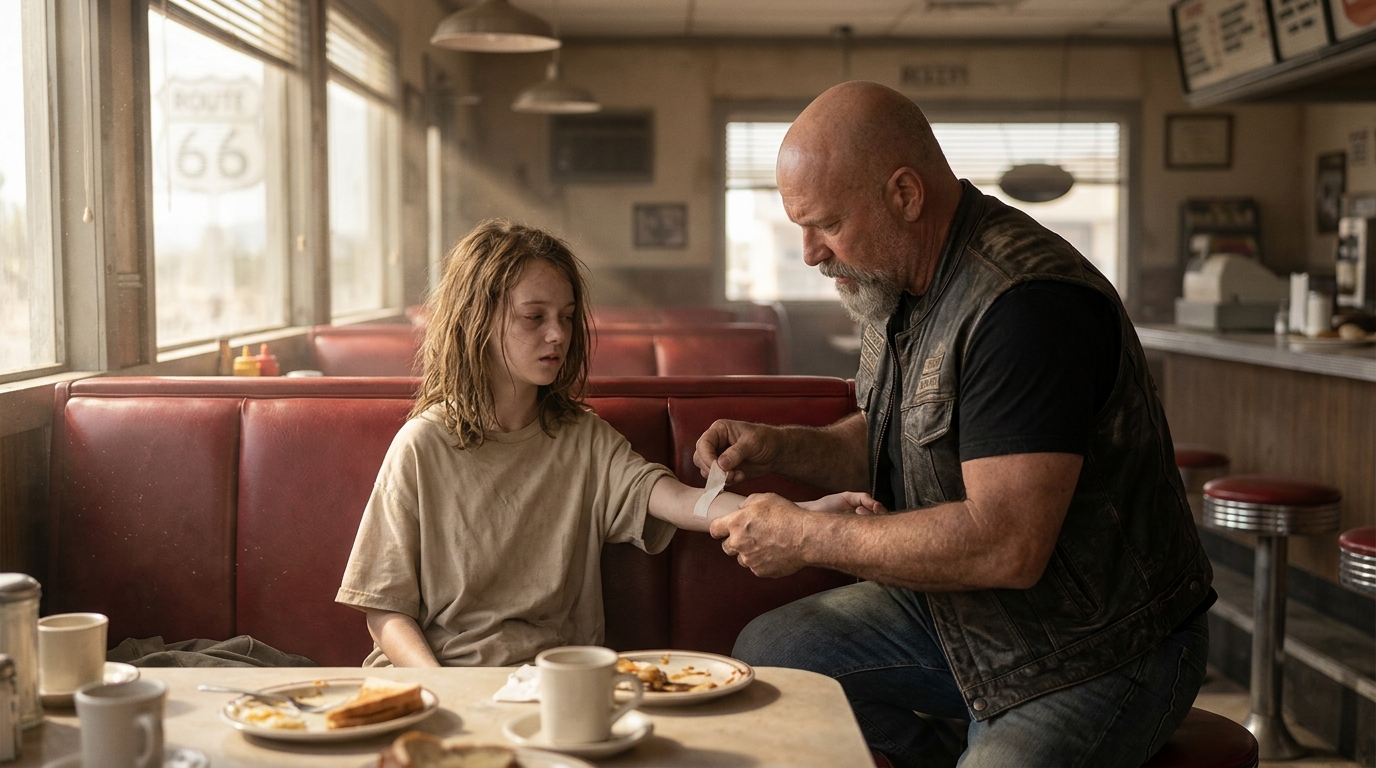
Sunlight poured through the front windows, catching dust in the air and turning the whole place golden in that tired desert way.
Inside, everything seemed ordinary.
Red vinyl booths.
Half-finished plates.
Coffee cups with brown rings around the rim.
A jukebox in the corner that hummed but never played.
Travelers came through, ate quickly, left a few dollars on the table, and forgot the place before the highway swallowed them again.
But inside the last booth near the window, something was wrong.
A big bald biker knelt beside a young girl in a baggy beige T-shirt.
Her hair was tangled.
Her face was pale.
Her lips looked dry, and her eyes carried the exhausted stare of someone who had not slept safely in a long time.
One sleeve of her shirt had been pulled up.
On her arm were red marks where tape had been wrapped too tightly.
The biker peeled the remaining strip away slowly.
Carefully.
His massive hands looked almost too large for the task, but he moved with surprising gentleness.
“Easy,” he murmured. “I’ve got you.”
The girl flinched anyway.
Not from pain.
From habit.
The biker’s name was Mason Riley.
But no one called him Mason anymore.
On the road, he was known as Tank.
Six feet four.
Shaved head.
Gray beard.
Old leather vest.
Hands scarred from engines, fights, and years of holding grief like it was something useful.
The patch on his back read:
IRON SAINTS MC
A waitress stood nearby with a clean towel and a glass of water, her face tense with worry.
Three other bikers sat at the nearby table, no longer eating.
One of them had already moved to the front window.
Another watched the back door.
The third kept his phone in his hand, thumb hovering over a number he had not dialed yet.
Tank looked at the girl’s arm again.
His jaw tightened.
“What did they do to you?”
The girl swallowed.
Her eyes moved to the window.
Then to the door.
Then to the empty highway beyond the glass.
She did not answer.
Tank softened his voice.
“Kid, listen to me. Nobody in this diner is going to hurt you.”
Her fingers curled into the hem of her oversized shirt.
For a moment, she looked like she might run.
Then she reached inside the collar of the shirt and pulled out a small envelope.
Plain.
White.
Bent at the corners.
She had been hiding it against her skin.
Tank stared at it.
“What is this?”
She pushed it toward him with trembling fingers.
“Read it.”
Her voice was barely audible.
Then she leaned closer.
“Quick. Before they find me.”
Something in her tone changed the diner.
The waitress stopped breathing.
The biker at the window straightened.
Tank looked down at the envelope.
There was no name written across the front.
No address.
No stamp.
Only a dark symbol pressed into the corner.
A black circle.
Inside it, three small lines shaped like a broken crown.
Tank went completely still.
All the color drained from his face.
The waitress whispered, “Tank?”
He did not answer.
His eyes lifted from the envelope to the girl.
He was not confused now.
He was afraid.
Genuinely afraid.
Then he grabbed the girl and pulled her down beside the booth.
“Get down!”
The other bikers reacted instantly.
Chairs scraped.
Cups rattled.
The waitress ducked behind the counter.
The front window filled with movement.
Through the dust and hard sunlight, a large group of motorcycles came speeding toward the diner.
Behind them came a white truck.
No markings.
No visible plates.
The girl clung to Tank’s vest, shaking so badly he could feel it in his chest.
Tank ripped open the envelope.
Inside was a single folded page.
He read the first line.
His breath stopped.
Then, in a voice barely more than a whisper, he said:
“…She’s my daughter?”
The Symbol
The symbol on the envelope belonged to a club that was not supposed to exist anymore.
Not officially.
Not on patches.
Not on buildings.
Not in daylight.
They called themselves the Crown.
Years ago, they had started as a small private security group. At least, that was the polite story. Men with money hired them when they wanted problems moved quietly.
Then the Crown changed.
Or perhaps it only revealed what it had always been.
They began transporting people.
Witnesses.
Runaways.
Debt victims.
Children caught in custody disputes where the wealthy parent wanted the law to become flexible.
They did not always use violence.
They did not need to.
Paperwork could be a cage.
Fake guardianship orders.
Private transport documents.
Unsigned custody transfers.
Medical release forms.
A frightened child in a white truck with no plates did not need to be chained if everyone along the route had been paid not to look too closely.
Tank knew the Crown because twelve years earlier, they had taken someone from him.
Her name was Nora.
Nora Bell.
She had been a nurse at a free clinic outside Amarillo.
Sharp tongue.
Soft hands.
Hair that smelled like rain.
A laugh that made Tank feel younger than the road had left him.
They had not been married.
They had not even had enough time to decide what they were.
But she had changed him.
For the first time in his life, Tank had considered leaving the club circuit behind and staying in one town long enough to plant tomatoes, fix fences, and learn what peace felt like.
Then Nora disappeared.
The official story was simple.
Too simple.
She had packed a bag and left.
A note was found.
Don’t look for me.
Tank never believed it.
Nora was not a woman who ran from hard things.
She ran toward them.
The week before she vanished, she had told Tank she had discovered something at the clinic — children being brought in with forged records, moved across state lines under “temporary care orders.”
She had copied files.
She had names.
She had a symbol.
A broken crown.
Then she was gone.
For years, Tank searched.
Bars.
Clinics.
Truck stops.
County offices.
Shelters.
Hospitals.
He found rumors.
Found fear.
Found people who stopped talking when he mentioned the Crown.
But he never found Nora.
Eventually, the Iron Saints told him to stop before he got himself buried.
Tank did not stop.
He only learned to search quietly.
And now a girl was shaking beside him in a roadside diner, carrying that same symbol and a letter claiming she was his daughter.
His daughter.
Tank looked down at the page again.
The handwriting was Nora’s.
Older.
Shakier.
But hers.
Mason, if this reaches you, I am sorry I let you believe I left. I was taken because I found their routes. I was already pregnant. I tried to get back to you. I tried more than once. They kept moving us.
Tank’s vision blurred.
His hands trembled.
He forced himself to keep reading.
Her name is Rose. She is eleven. She knows your name only because I whispered it to her every night like a prayer. She has your eyes and my stubbornness. If she found you, then I am either too late or gone. Please don’t let the Crown take her back.
Tank looked at the girl.
Rose.
She stared up at him, terrified and searching.
As if she had spent her whole life hearing about him and was now afraid the real man might not match the prayer.
Tank’s throat closed.
The motorcycles outside were closer now.
The white truck slowed behind them.
Dust rolled across the parking lot.
Tank folded the letter and slipped it inside his vest.
Then he cupped Rose’s face with one rough hand.
“Listen to me.”
She looked at him.
“My name is Mason Riley. Some people call me Tank. Your mama was Nora Bell.”
Rose’s lips parted.
“She said you’d remember her.”
Tank’s voice broke.
“I never forgot her.”
The girl’s eyes filled.
“She said… if I found you, I had to ask one thing.”
“What?”
Rose swallowed.
“Do you still ride with saints?”
Tank looked toward the front window.
His brothers were already in position.
He nodded slowly.
“Yeah, sweetheart.”
For the first time, something like hope flickered in her face.
Tank reached beneath his vest and pulled out an old silver pendant.
A small saint medal, scratched and worn.
Nora had given it to him the week before she disappeared.
Rose stared at it.
Then reached under her shirt and pulled out the same kind of medal, smaller, hanging on a string.
Tank’s breath caught again.
Rose whispered:
“She said the saints would know.”
The Men Outside
The motorcycles stopped in the parking lot.
Not Iron Saints.
Different patch.
Black jackets.
No names.
No colors that could be easily tied to a known club.
The riders formed a line between the diner and the highway, engines rumbling low.
The white truck stopped behind them.
Its windows were tinted.
No company logo.
No plates.
Nothing.
Tank’s friend, Cal, stood by the front window.
“Eight riders,” he said. “Maybe ten. Two in the truck.”
Moose, the largest of the Saints after Tank, checked the back door.
“Alley’s clear for now.”
Reverend, an old biker with a long white beard and a Bible verse tattooed on his wrist, looked at Tank.
“Your call.”
Tank looked at Rose.
She was curled low beside the booth, arms wrapped around herself, eyes squeezed shut.
He wanted to pick her up and run.
But the diner had too many windows.
The truck had the road blocked.
And if the Crown had found her this quickly, they had someone watching nearby.
Maybe someone had followed her.
Maybe someone had followed Tank.
Maybe the trap had been set long before the girl walked through the door.
The waitress crouched behind the counter, phone in hand.
“Police?” she mouthed.
Tank hesitated.
That hesitation told her enough.
He did not know which police could be trusted.
The Crown survived by placing paper in the right hands and money in the right pockets.
A sheriff could be honest.
Or bought.
A dispatcher could be helpful.
Or listening for the wrong people.
Tank looked at Reverend.
“Call Harper.”
Reverend nodded immediately.
Detective Elena Harper owed the Iron Saints nothing.
That was why Tank trusted her.
She had worked interstate child protection cases for years and hated private transport agencies with the kind of focus only personal loss creates.
If anyone would understand the Crown symbol, it was Harper.
Outside, the diner door opened.
A bell rang.
One man stepped inside.
Tall.
Clean-shaven.
Gray suit beneath a black riding coat.
He did not look like a biker.
He looked like a lawyer pretending to be dangerous, or a dangerous man pretending to be civilized.
His eyes scanned the room.
Then settled on Tank.
“Mason Riley.”
Tank stood slowly.
Rose’s fingers grabbed the back of his vest.
He placed one hand behind him, palm open, reassuring her without looking away from the man.
The stranger smiled.
“My name is Adrian Cole. I believe you have something that belongs to my client.”
Tank’s voice was quiet.
“Nothing in here belongs to you.”
Cole’s gaze dipped toward the booth.
“We are transporting a minor under lawful authority.”
Moose laughed from near the counter.
“Lawful authority in a truck with no plates?”
Cole did not look at him.
“Emergency protective transport. Plates removed for safety.”
Reverend muttered:
“That’s a new kind of stupid.”
Cole’s smile tightened.
Tank stepped forward.
“Show me the order.”
Cole reached into his coat.
Every biker in the diner shifted.
Slowly, Cole removed a folded document.
He held it up.
“Temporary custody authorization.”
Tank did not take it.
“From what court?”
“Sealed.”
“By what judge?”
“Confidential.”
“Who signed the transfer?”
Cole’s smile vanished.
“That child is not your concern.”
Tank’s eyes went cold.
“She is my daughter.”
The diner fell silent.
Cole’s face changed.
Only slightly.
But enough.
He had not expected Tank to know.
Behind him, outside, one of the men near the white truck lifted a radio.
Cole lowered his voice.
“You have no idea what you are interfering with.”
Tank stepped closer.
“I know exactly what I’m interfering with.”
Cole looked toward Rose.
“Rose, come out.”
The girl whimpered.
Tank’s hand curled into a fist.
Cole softened his voice.
“Rose, your mother is waiting.”
Rose lifted her head.
Every bit of color drained from her face.
Tank turned slightly.
“Rose?”
She whispered:
“He lies like that.”
Cole continued:
“She’s worried about you.”
Rose shook her head, tears spilling.
“She told me if they said that, it meant she was already gone.”
The diner went still.
Cole’s face hardened.
Tank took one step toward him.
“You better hope that isn’t true.”
The First Fight
Cole made one mistake.
He looked at his men outside and nodded.
Just once.
That was all it took.
The front door burst open.
Two men rushed in.
They expected fear.
They expected an old biker, a few truckers, a waitress, and one exhausted child.
They did not expect the Iron Saints to move like men who had spent decades surviving ambushes.
Moose hit the first man before he reached the booth.
Cal grabbed the second by the jacket and drove him into the counter hard enough to send napkin holders flying.
The waitress screamed and ducked.
A coffee pot shattered.
Cole stepped backward, reaching for something inside his coat.
Tank caught his wrist.
For one second, the two men locked eyes.
Cole’s confidence vanished.
Tank twisted his arm and slammed him face-first onto the nearest table.
“Don’t,” Tank said.
Cole went still.
Outside, engines roared.
The riders were dismounting.
Reverend shouted from the back door:
“Tank!”
The alley was no longer clear.
A second group had arrived.
They had planned for escape routes.
Of course they had.
Tank looked at Rose.
Then at the waitress.
“What’s your name?”
“Darla,” she gasped.
“Darla, is there a cellar?”
She pointed toward the kitchen.
“Trapdoor by the freezer.”
Tank turned to Moose.
“Take Rose.”
Rose grabbed Tank’s vest tighter.
“No!”
He crouched in front of her.
“I’m not leaving you.”
“You are.”
“No. I’m making sure they can’t see where you go.”
She shook her head violently.
“My mom said if people split up, they don’t come back.”
Tank’s face softened despite the chaos.
“Your mom was right most of the time.”
Rose stared at him.
“But not this time.”
He pulled the silver saint medal from his neck and pressed it into her hand.
“I come back for what’s mine.”
Her eyes searched his.
“You promise?”
Tank’s voice broke.
“I promise.”
Moose lifted her carefully, not like a fighter grabbing a target, but like a man carrying something sacred.
Darla led them toward the kitchen.
Rose looked over Moose’s shoulder until the swinging door closed.
Tank stood.
His face changed.
Whatever softness had been there vanished.
Cole, pinned to the table, laughed weakly.
“You think hiding her in a diner cellar changes anything?”
Tank leaned close.
“No.”
His voice was quiet.
“It gives me time to decide how much of you walks out.”
The Woman on the Phone
Detective Harper answered Reverend’s call on the fourth ring.
He put her on speaker.
“Tell me you’re not calling about unpaid parking tickets,” she said.
Reverend looked toward the windows where men were closing in.
“Route 66 diner, twelve miles east of Barstow. Crown symbol. Minor female. White transport truck. No plates. We need clean law.”
Harper went silent.
Then:
“Say that again.”
“Crown symbol,” Reverend repeated. “Girl has an envelope. Says she’s Tank’s daughter.”
Another pause.
Shorter.
Sharper.
“Do not hand that child to anyone. I don’t care what paperwork they show.”
Tank grabbed the phone.
“Harper.”
“Mason, listen to me carefully. The Crown has active warrants in three states, but not under that name. Their current front is Family Continuity Services. They use emergency custody documents and private escorts.”
“Who signs?”
“Sometimes real judges. Sometimes forged signatures. Sometimes clerks who get paid to stamp fast and ask nothing.”
Tank looked at Cole.
The man’s expression was no longer smug.
“How far out are you?” Tank asked.
“Too far. I’m calling state police directly. Not county. State.”
“Make it fast.”
“Mason.”
Her voice changed.
“What?”
“If the girl is Nora Bell’s daughter, the Crown will not let her go.”
Tank’s throat tightened.
“You knew Nora’s case?”
“I read it years ago. She was one of the first clinic witnesses who connected them to child movement routes. Her file disappeared. So did she.”
Tank closed his eyes.
“For twelve years, everyone told me she left.”
Harper’s voice softened.
“She didn’t.”
Tank opened his eyes.
Outside, one of the Crown riders kicked open the diner’s side gate.
“I know that now.”
The Cellar
The cellar beneath the diner smelled like potatoes, dust, and old concrete.
Moose carried Rose down the narrow steps while Darla followed with a flashlight.
The space was small.
Shelves lined the walls.
Canned goods.
Cleaning supplies.
Old crates.
A freezer hummed in the corner.
Rose shook violently, clutching Tank’s saint medal.
Moose set her down gently behind a stack of boxes.
“You stay low.”
Darla knelt beside her.
“Honey, are you hurt anywhere else?”
Rose shook her head.
Then nodded.
Then looked confused, as if pain had become too normal to name.
Darla’s face tightened.
“How old are you?”
“Eleven.”
“You hungry?”
Rose hesitated.
Moose looked at Darla.
Darla grabbed a packet of crackers from a shelf and opened it.
Rose took one slowly.
Then another.
Then ate too fast.
Darla held out water.
“Slow.”
Rose obeyed.
Above them, something crashed.
She flinched so hard water spilled down her shirt.
Moose moved toward the stairs.
Rose whispered:
“Don’t leave.”
He stopped.
This huge man, who had once thrown another man through a bar door for calling him soft, looked completely helpless.
He crouched.
“I’m right here.”
“You’re not him.”
“No.”
She looked at the medal.
“He’s really my father?”
Moose’s eyes softened.
“If Nora said he is, then he is.”
“Did he love her?”
Moose smiled sadly.
“Kid, that man spent twelve years pretending he wasn’t still looking down every road for her.”
Rose’s chin trembled.
“She said he had kind eyes.”
Moose snorted softly.
“Tank?”
Rose looked frightened.
Moose quickly added:
“He does. He just hides them under all the bald.”
Despite herself, Rose let out the smallest laugh.
Then she covered her mouth like laughter was dangerous.
Darla’s eyes filled.
Above them, shouting erupted.
Rose looked at the ceiling.
“They’ll take me back.”
Moose shook his head.
“No.”
“They always do.”
“Not today.”
She stared at him.
“Why?”
Moose looked at the stairs.
“Because your father just found out he has a daughter.”
He gave a faint smile.
“And nobody in this world is ready for what that does to a man like Tank.”
The Envelope’s Second Page
Upstairs, the diner had become a battlefield without becoming a massacre.
Tank and the Saints held the front.
The Crown men pushed but hesitated.
They were not trying to destroy the diner.
They were trying to retrieve Rose cleanly enough to preserve paperwork.
That gave Tank room.
Barely.
Cole sat tied to a chair with Darla’s apron strings and an extension cord.
He looked offended by the apron strings most of all.
Tank searched his coat and found three IDs, two phones, and a folded custody transfer packet.
The packet listed Rose under a different name:
Emily Carter.
Age nine.
Temporary relocation.
No known biological father.
Mother unavailable.
Tank’s hand tightened around the page.
The document did not just steal Rose.
It erased her.
Reverend came over.
“Harper says state police are fifteen out.”
“Fifteen is a long time.”
“Yep.”
Tank pulled Nora’s letter from his vest again.
He unfolded the page.
Only then did he realize there was writing on the back.
His heart lurched.
He read quickly.
If Rose reaches you with the envelope, she has already done the impossible. But there is more. The Crown is not only moving children now. They are creating records that make them disappear legally. Rose has the ledger key. She doesn’t know that’s what it is.
Tank looked toward the kitchen.
The ledger key.
He kept reading.
The charm on her bracelet opens the storage case hidden under mile marker 118. If I failed to reach you, the evidence is there. Names, routes, judges, payments. Enough to burn them. Enough to bring the children home.
Tank’s breath caught.
Mile marker 118.
That was less than four miles east.
A Crown rider outside shouted:
“Send her out, Riley! This doesn’t involve you!”
Tank looked at Cole.
“It does now.”
Cole smiled thinly.
“You think evidence changes things? We have judges.”
Tank folded the letter.
“Judges sleep indoors.”
Cole frowned.
Tank leaned close.
“Men like you forget roads belong to people who don’t.”
The Choice
When state police were still ten minutes away, the white truck moved.
Not away.
Closer.
It backed toward the diner’s front entrance.
Cal cursed.
“They’re going to ram.”
Tank looked toward the kitchen.
If the truck came through the front, the chaos would give them a chance to search.
If they found the cellar—
No.
Tank turned to Reverend.
“Take two bikes out the back. Get to mile marker 118.”
Reverend stared.
“You’re sending men away now?”
“Evidence is there.”
“We need bodies here.”
“We need proof more.”
Reverend understood then.
Holding the diner saved Rose today.
The evidence could save every child after her.
He nodded once.
“Moose stays with her.”
“Yeah.”
“And you?”
Tank looked at the truck.
“I make noise.”
Reverend almost smiled.
“You do have a gift.”
The white truck accelerated.
Tank shouted:
“Move!”
The truck smashed through the front windows.
Glass exploded inward.
Tables overturned.
Dust and sunlight blasted into the diner.
But the Saints had already moved sideways.
The truck’s front end crashed into the counter and stalled.
Before the doors opened, Tank was there.
He ripped the driver’s door open and dragged the man out by his jacket.
Outside, the Crown riders surged forward.
Then another sound split the desert air.
Sirens.
Not one.
Many.
The Crown men faltered.
State police vehicles appeared over the rise, lights flashing.
Behind them came two unmarked SUVs.
Detective Harper.
Cole saw the lights and closed his eyes.
For the first time since entering the diner, he looked tired.
Tank stood amid broken glass, chest heaving.
He pointed at Cole.
“That one talks.”
Cole smiled weakly.
“You think I’m afraid of prison?”
Tank looked toward the kitchen where Rose was hidden.
“No.”
Then he looked back at Cole.
“I think you’re afraid of her growing up with your name in her testimony.”
Cole’s smile vanished.
Mile Marker 118
Reverend found the storage case exactly where Nora said it would be.
Buried beneath a loose metal drainage cover near mile marker 118.
The charm on Rose’s bracelet opened the lock.
Inside were three flash drives, paper ledgers sealed in plastic, photographs, child transfer lists, route maps, names of county officials, and payment records tied to Family Continuity Services.
There were children listed under false names.
Some marked “placed.”
Some marked “rerouted.”
Some marked “unconfirmed.”
Rose’s real name was there too.
Rose Bell Riley.
Father: Mason Riley.
Status: concealed.
Risk: high if paternal link discovered.
Nora had known.
For years, she had known.
And somehow, trapped inside the Crown’s network, she had gathered proof piece by piece.
Not enough to free herself.
Enough to guide Rose out.
Enough to finish what she started.
When Harper saw the files, she went pale.
“This is bigger than we thought.”
Tank stood beside her outside the ruined diner, Rose wrapped in a blanket at his side.
She had refused to let go of his hand since coming up from the cellar.
“Can you use it?” he asked.
Harper looked at him.
“Yes.”
“Fast?”
Her mouth tightened.
“Not as fast as you want.”
Tank’s jaw flexed.
Rose spoke quietly:
“There are others.”
Everyone turned.
She stared at the ground.
“Other kids. In trucks. In houses. Some don’t know their names anymore.”
Harper crouched in front of her.
“Can you help us find them?”
Rose looked at Tank.
He squeezed her hand.
“You don’t have to do anything today.”
She looked back at Harper.
“My mom said names matter.”
Harper nodded.
“They do.”
Rose lifted her chin.
“I remember some.”
Nora
They found Nora three days later.
Not alive.
Tank had known before Harper said it.
Something in him had known from the moment he read the line:
If I am either too late or gone.
Still, hearing it nearly brought him to his knees.
Nora had been found in a desert medical site used by the Crown, abandoned after the diner incident. She had been gone less than twenty-four hours.
That meant when Rose walked into the diner, Nora might still have been alive.
That truth almost destroyed Tank.
Rose took it differently.
Quietly.
Too quietly.
She sat on the motel bed where protective services had placed her and held the silver saint medal in both hands.
Tank sat beside her.
He did not know what to say.
How do you tell an eleven-year-old that her mother saved her and died before seeing safety?
How do you explain justice to someone who has already paid too much for it?
Rose spoke first.
“She said if she didn’t come, I shouldn’t wait.”
Tank swallowed.
“She loved you.”
Rose nodded.
“She said love means getting someone out even if you can’t go.”
Tank covered his mouth.
Rose leaned against him slowly.
Not fully trusting yet.
But trying.
He placed one arm around her.
Carefully.
She did not pull away.
After a while, she whispered:
“Do I have to call you Dad?”
Tank’s heart broke in a new way.
“No.”
“Are you mad?”
“No, sweetheart.”
“What do I call you?”
“Whatever feels safe.”
She thought about that.
Then said:
“Mason.”
He nodded.
“That works.”
A minute later, she whispered:
“Maybe Tank sometimes.”
He smiled through tears.
“Tank sometimes works too.”
The Hearing
The Crown tried to take Rose back through the courts.
Even after the diner.
Even after the truck.
Even after the evidence.
That was how systems built on paperwork fight.
They claimed Rose was a minor under protective transport.
They claimed Tank was a violent biker with no custodial standing.
They claimed Nora had been unstable.
They claimed the letter was unreliable.
Then Harper brought the ledger.
The charm.
The bracelet.
The sealed documents.
The birth record hidden in Nora’s files.
The DNA test confirmed what the envelope had already told Tank’s bones.
Rose was his daughter.
In court, Rose sat beside Harper and a child advocate.
Tank sat across the aisle in a clean shirt that Moose said made him look like a confused funeral director.
Rose noticed.
For the first time since the diner, she smiled.
Just a little.
The judge reviewed the evidence for emergency placement.
The Crown’s attorney tried to speak smoothly.
Tank hated him immediately.
Then Rose asked if she could say something.
The courtroom grew still.
The judge softened.
“You may.”
Rose stood.
Her hands shook, but her voice held.
“My mom told me my name every night so I wouldn’t forget it. She told me Mason Riley was my father. She told me if I found him, I should look at his eyes, because he would look angry when he was scared.”
A few people glanced at Tank.
His eyes filled.
Rose continued:
“He looked angry.”
A faint ripple moved through the room.
“But he didn’t send me away.”
Her voice trembled.
“He covered me when the motorcycles came. He gave me his medal. He came back.”
The judge listened.
Rose looked at the Crown attorney.
“They changed my name in papers. But my mom said names matter.”
Then she looked at Tank.
“My name is Rose Bell Riley.”
Tank lowered his head.
The judge granted emergency paternal custody pending full proceedings.
Rose walked out of the courthouse holding Tank’s hand.
Not because anyone made her.
Because she reached for it.
Home
Tank’s house was not ready for a child.
That was an understatement.
It had one bedroom, one spare room full of motorcycle parts, a refrigerator containing mustard, eggs, and three things Moose insisted were still edible, and a bathroom sink that made a noise like a dying trumpet.
Rose stood in the doorway and looked around.
Tank braced himself.
“I know it’s not much.”
She stepped inside.
“Is it locked?”
“Yes.”
“Who has keys?”
“Me. Moose. Reverend for emergencies.”
She thought about that.
“Can Reverend knock first?”
Tank smiled.
“I’ll make it a law.”
The spare room became hers.
The bikers descended like a strange army of uncles.
Moose carried boxes.
Cal assembled a bed badly.
Reverend brought curtains.
Darla from the diner mailed a quilt with tiny red flowers.
Harper arranged counseling and school protections.
Tank bought too many things because he did not know what eleven-year-old girls needed and apparently believed the answer was “all of Target.”
Rose accepted some.
Rejected others.
Kept the quilt.
Kept the notebook.
Kept the small lamp shaped like a moon because she said her mother used to draw moons in the margins of stolen paper.
Nights were hardest.
Rose woke often.
Sometimes silent.
Sometimes gasping.
Tank learned to sit outside her door.
Not inside unless she asked.
Not crowding.
Not disappearing.
At first, she called him Mason.
Then Tank.
Then, one morning three months later, while he burned pancakes and set off the smoke alarm, she shouted from the table:
“Dad, they’re black!”
Tank froze.
The spatula in his hand stopped midair.
Rose froze too.
Her face went red.
“I mean—”
He turned away quickly, pretending to cough.
“Yeah,” he said, voice rough. “Your dad is bad at pancakes.”
She looked down at her plate.
Then smiled.
A real one.
Small.
But real.
The Diner Again
A year later, the diner was rebuilt.
New windows.
Same red booths.
A small plaque near the last booth read:
For Nora Bell, who carried the truth farther than fear could follow.
Rose chose the words.
Tank thought they were perfect.
The day of the reopening, Iron Saints filled half the parking lot. State police filled the other half, though Harper insisted she was there for pie, not sentiment.
Darla hugged Rose so tightly Tank almost intervened.
Rose laughed instead.
That sound still startled him sometimes.
Joy from a child who had lived too long without it.
They sat in the same booth where everything began.
Rose ran her fingers over the edge of the table.
“This is where I gave you the envelope.”
Tank nodded.
“I remember.”
“You looked scared.”
“I was.”
“You’re not supposed to admit that.”
“New rule. I admit things now.”
She studied him.
“Because of me?”
He smiled.
“Because your mother raised a daughter who can spot lies from across a diner.”
Rose looked at the plaque.
“I wish she could see this.”
Tank’s voice softened.
“I think she knows.”
Rose leaned against him.
Not as carefully as before.
Easier now.
“Dad?”
“Yeah?”
“Can we bring flowers here every year?”
“Yes.”
“And pie?”
He looked at her.
“For Nora?”
“For me.”
Tank laughed.
The sound filled the booth, deep and warm.
“Yeah, Rosie. We can bring pie.”
She smiled at the nickname.
Outside, motorcycles gleamed in the sun.
Inside, coffee poured.
Travelers came and went, not knowing that one ordinary-looking diner on Route 66 had once become the place where a girl reclaimed her name, a father found his daughter, and a dead woman’s envelope brought an empire of lies into the light.
The Envelope
Tank kept the envelope.
Not the original.
That stayed in evidence for a long time.
But Harper gave him a copy after the case broke open.
He framed it with Nora’s first letter, Rose’s bracelet charm, and the saint medal he had given his daughter on the diner floor.
The frame hung in the hallway outside Rose’s room.
Not because he wanted to remember the fear.
Because he wanted to remember the moment fear lost.
The Crown did not vanish overnight.
Networks like that never do.
But the ledger from mile marker 118 tore through them.
Raids followed.
Children were found.
Records corrected.
Names restored.
Some families reunited.
Some children had nowhere safe to return, and that truth broke Rose in ways Tank could not fix.
So she began writing names in a notebook.
Every child she remembered.
Every child Harper later found.
Every child still missing.
Tank once found her at the kitchen table, writing carefully under a lamp.
“You okay?” he asked.
She looked up.
“No.”
He nodded.
“Want company?”
She thought about it.
Then nodded.
He sat across from her.
They did not talk.
Sometimes love means staying quiet at the same table while someone writes down the names the world tried to erase.
Years later, Rose would say the envelope saved her.
Tank would say Nora saved her.
Harper would say evidence saved her.
Darla would say the diner pie helped.
They were all right in different ways.
But Tank knew the truth was larger.
A girl walked into a dusty diner carrying a letter against her skin.
A biker saw a symbol from his worst memory and chose not to look away.
A mother’s handwriting crossed twelve years of silence.
A daughter’s name survived fake documents.
And the first line of that letter changed every life it touched.
Mason, if this reaches you, I am sorry I let you believe I left.
He had believed many things in his life.
That grief made a man hard.
That roads were easier than homes.
That some losses had to stay lost because looking too long would destroy what remained.
Then Rose came.
And he learned that some doors do not close forever.
Some names do not stay buried.
Some daughters find their fathers in diners beneath broken neon, carrying envelopes, fear, and impossible hope.
And some men, even after years of pretending they have nothing left to protect, discover in one trembling child’s eyes that their whole life has been waiting for the words:
“She’s my daughter.”