The Girl at the Door
“SIR… DO YOU NEED A MAID?”
Her voice was so faint the rain almost swallowed it.
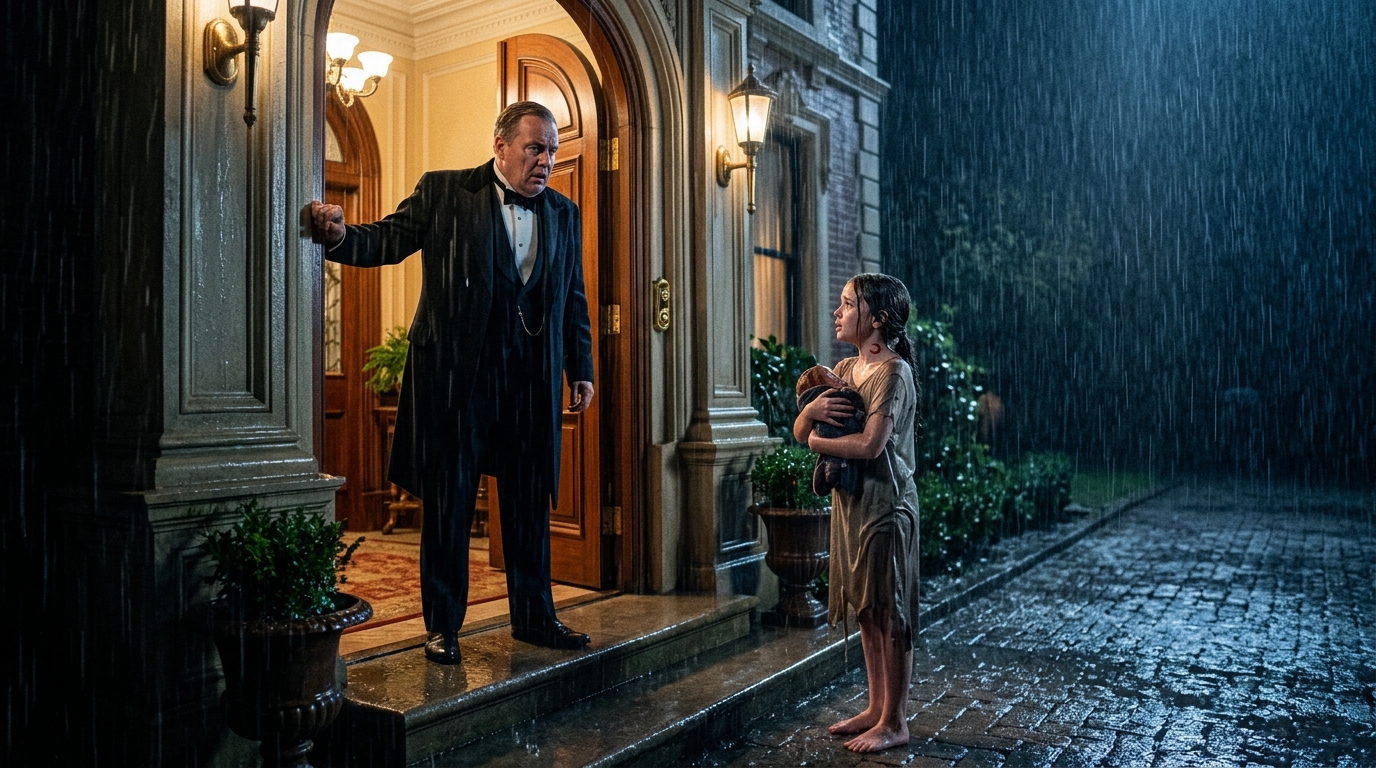
Sebastian Hartwell stood in the doorway of his mansion, one hand still resting on the brass handle, dressed in a black evening suit that had been tailored in London and pressed until not a single line dared move out of place.
Behind him, the entry hall glowed with warmth.
Marble floors.
Crystal sconces.
A staircase curving upward beneath a painted ceiling.
The faint smell of cedar, candle wax, and expensive silence.
Outside, the world was all rain.
The girl standing on his front step looked as if the storm had built her out of cold and sorrow.
She could not have been more than twelve.
Her hair clung in dark strands to her cheeks. Her dress was soaked through, too thin for the weather, frayed at the hem, and patched at one sleeve with thread that did not match. Her bare ankles were streaked with mud. One shoe was split at the toe.
Against her chest, she held a small wet bundle.
At first, Sebastian thought it was clothing.
Then it moved.
A child.
A much younger girl, maybe three or four, wrapped in a ragged blanket, face half-hidden beneath the edge, shivering so hard the fabric trembled.
Sebastian’s expression hardened out of habit.
The Hartwell estate sat on the hill above the city, behind iron gates and high hedges. People came there with requests more often than he cared to admit.
Money.
Favors.
Jobs.
Old debts.
False stories.
Real tragedies.
After enough years of wealth, even compassion became something people tried to trick out of you.
He looked down at the girl and said nothing.
She swallowed, misreading his silence as rejection.
“I can do anything,” she whispered quickly. “I can wash floors. I can cook simple food. I can clean windows. I won’t steal.”
Her voice broke on the last sentence, as if someone had made her repeat it before.
Sebastian’s gaze moved from her face to the bundle.
“My sister is hungry,” she added. “Please. I don’t need a bed. Just work.”
Rain struck the stone steps around her.
Water dripped from the ends of her hair.
The younger child stirred and let out a weak little whimper.
Sebastian glanced past them toward the dark drive.
No carriage.
No car.
No adult waiting near the gates.
Only rain moving through the hedges like a curtain.
He should have called the police.
He should have called his housekeeper.
He should have done anything except stand there like a statue while two children froze on his doorstep.
But something about the girl’s stillness bothered him.
She was desperate, yes.
Terrified, yes.
But not empty.
She was watching him the way frightened children watch adults when they have already learned that mercy can disappear without warning.
Sebastian’s mouth tightened.
“You’re too young to work.”
Her face fell.
“I’m strong.”
“That is not what I said.”
“I can learn.”
“I said you’re too young.”
Her fingers tightened around the bundle.
“Then just let her eat,” she whispered. “I’ll go after. She didn’t do anything wrong.”
Something inside him shifted.
Not softened.
Not yet.
But shifted.
He lowered his gaze again.
The collar of her wet dress had slipped slightly from one shoulder. When she turned to shield the younger child from the wind, a small mark appeared beneath her left ear.
Sebastian stopped breathing.
A tiny crimson crescent moon.
Not drawn.
Not inked.
A birthmark.
Just below the ear, curved like a red sliver of moon hidden against the skin.
The world seemed to fall away.
The rain blurred.
The mansion behind him faded.
The girl kept speaking, unaware of the way his face had changed.
“I won’t ask for money first,” she said. “Only food. Please.”
Sebastian stared at the mark.
Twelve years vanished.
He was no longer standing in his doorway.
He was in a hospital room filled with white light and the smell of antiseptic.
His wife’s hand limp in his.
A newborn crying once.
Only once.
A nurse turning the baby’s head and saying, “Look, Mr. Hartwell. She has a little moon.”
A crimson crescent beneath the ear.
His daughter.
His dead daughter.
The child he had been told stopped breathing before dawn.
Sebastian gripped the doorframe.
“My God…”
The words came out broken.
The girl flinched.
“I’m sorry,” she said quickly. “I’ll leave.”
She turned.
Sebastian reached out.
Not roughly.
Not touching her yet.
Just desperate enough to stop her.
“Wait.”
She froze on the step.
He forced himself to lower his voice.
“What is your name?”
The girl looked back cautiously.
“Lena.”
The name struck him almost as hard as the mark.
His wife’s name had been Helena.
Everyone called her Lena.
Sebastian’s throat tightened.
“Lena what?”
The girl hesitated.
“Just Lena.”
“No last name?”
She looked down.
“The woman who raised me said last names were for people who belonged somewhere.”
The words hit the entryway like a quiet accusation.
Behind Sebastian, footsteps approached.
Mrs. Whitcomb, his housekeeper, appeared near the staircase, her gray hair pinned tightly, her expression already disapproving.
“Mr. Hartwell? Is everything all right?”
Sebastian did not look away from the girl.
“No,” he said softly. “It is not.”
Then he stepped aside.
“Come in.”
The girl did not move.
Rain ran down her face, but her eyes stayed fixed on him.
“I don’t have money.”
“I didn’t ask for money.”
“I can work after she eats.”
“No.”
Her expression tightened with fear.
Sebastian softened his voice as much as he could.
“You will not work tonight. You will come inside. Your sister will eat. You will both get warm.”
She stared at him as if kindness were a language she had heard once but never learned to trust.
Then the small child in her arms coughed.
That decided it.
Lena crossed the threshold.
And as the mansion doors closed behind her, Sebastian Hartwell understood that the life he had buried twelve years ago had just walked back into his house, barefoot and starving.
The Mark Beneath Her Ear
Mrs. Whitcomb moved quickly once she understood the children were not leaving.
She ordered towels, warm broth, dry clothes from storage, and a fire in the small blue sitting room near the kitchen. She had served the Hartwell family for thirty years and had seen enough scandal, grief, and cruelty to know when questions could wait.
The younger child’s name was Mila.
She clung to Lena with both hands until the bowl of soup arrived. Then hunger overpowered fear. She ate with tiny, urgent spoonfuls while Lena watched every bite as if counting survival.
Sebastian stood near the mantel, one hand closed into a fist around nothing.
He could not stop looking at the mark.
When Lena turned her head to help Mila drink, the crimson crescent flashed beneath her ear again.
It was real.
Not memory.
Not madness.
Real.
Mrs. Whitcomb noticed him staring.
Then she saw the mark.
Her face went white.
“Sir…”
Sebastian lifted one hand slightly.
Not now.
Lena looked between them.
“What?”
Sebastian forced himself to breathe.
“Nothing.”
The lie tasted bitter.
Lena did not believe it.
Children like her did not survive by missing the changes in adult faces.
She pulled Mila closer.
“If you’re going to send us away, please wait until morning.”
Mrs. Whitcomb’s expression cracked.
“Oh, child.”
Sebastian stepped forward slowly and lowered himself into the chair across from Lena, leaving enough space that she would not feel trapped.
“I’m not sending you away.”
“You don’t know us.”
“No.”
“You don’t let strangers stay.”
“Usually, no.”
“Then why?”
The question had been waiting in the room from the moment she crossed the threshold.
Sebastian looked at the fire.
Then back at her.
“Because you have a mark under your ear.”
Lena’s hand flew instinctively to her neck.
Her eyes widened.
“What about it?”
“May I see it?”
“No.”
The answer was immediate.
Sharp.
Mila stopped eating and looked at her sister.
Sebastian nodded.
“All right.”
That surprised Lena.
She had expected argument.
He continued, “Can you tell me if you were born with it?”
Lena’s fingers remained against her neck.
“I think so.”
“Who told you?”
“The woman who raised me.”
“What was her name?”
Lena looked down.
“Ruth.”
Sebastian’s pulse changed.
Ruth.
There had been a nurse named Ruth Mallory at the hospital the night Helena died.
He remembered because she had been the last person to hold his daughter before the doctor told him the child was gone.
“Ruth what?” he asked carefully.
Lena’s eyes narrowed.
“Why?”
Sebastian leaned back.
Because he suddenly felt as if he were approaching a wounded animal, and one wrong movement could send her running into the storm.
“I knew a woman named Ruth once.”
Lena’s face shifted.
“Ruth Mallory?”
Mrs. Whitcomb gasped softly.
Sebastian’s blood went cold.
“Yes,” he said. “I knew Ruth Mallory.”
Lena stopped breathing for a moment.
Then she reached into the wet bundle of clothes beside her chair and pulled out a small oilcloth packet tied with string.
Her fingers shook as she placed it on the table.
“She told me if I ever reached this house, I should give this to the man with sad eyes.”
Sebastian stared at the packet.
His voice barely worked.
“When did she tell you that?”
“Before she died.”
The room went quiet.
Rain struck the windows.
The fire popped softly.
Sebastian looked at the packet as if it might burn him.
Then he reached for it.
Inside was a folded letter, brittle at the edges, stained with age and moisture.
His name was written on the front.
Sebastian Hartwell
The handwriting was not Helena’s.
It was Ruth Mallory’s.
He opened it.
The first line made his vision blur.
Forgive me. Your daughter did not die.
The Night Helena Died
Sebastian read the sentence three times before his mind allowed the meaning to fully enter.
Your daughter did not die.
His daughter.
The baby he had mourned.
The tiny coffin he had stood beside.
The nursery he had ordered sealed for twelve years.
The lullaby Helena wrote but never sang.
Not dead.
Stolen.
Hidden.
Raised in poverty while he slept beneath a roof large enough to shelter a village.
His hand shook so badly the paper rattled.
Lena watched him silently.
Mrs. Whitcomb sat down without being invited.
Sebastian forced himself to continue.
Mr. Hartwell,
I have written this letter many times and burned it every time. Cowardice is easier when it calls itself survival. I do not deserve your forgiveness, but the child deserves the truth.
The night your wife Helena gave birth, your daughter lived. She was weak, but alive. She had a crimson crescent mark beneath her left ear. You saw it. I saw you see it.
Sebastian closed his eyes.
He had seen it.
He had touched it with one trembling finger.
He had whispered, “A little moon.”
Helena, pale and exhausted, had smiled.
“Our moon,” she said.
Then the doctors rushed around her.
Then everything became blood, shouting, grief, and doors closing.
He continued reading.
Your mother ordered the baby removed.
Sebastian stopped.
The room tilted.
His mother.
Adelaide Hartwell.
Dead now for six years.
Elegant.
Cold.
A woman who believed reputation was more sacred than blood.
Mrs. Whitcomb covered her mouth.
Lena whispered, “Your mother?”
Sebastian did not answer.
He kept reading.
Lady Adelaide said the child would destroy you. She said Helena’s bloodline was weak, that the baby might be ill, that the Hartwell estate could not be tied forever to a woman she never accepted. She told Dr. Voss to declare the infant dead. She told me I could either help or be blamed for negligence during the birth.
I was young. Afraid. Poor. I had a sick brother and debts I could not pay. She offered money. I took the baby. I told myself at least the child would live.
A sound came from Sebastian’s throat.
Not a sob.
Not a word.
Something in between.
Mila stopped eating and climbed into Lena’s lap.
Lena wrapped both arms around her.
The letter continued.
I was supposed to deliver her to a private institution outside the city. I did not. I could not. I kept her. At first, I planned to bring her back when Lady Adelaide died, or when I found courage, or when life gave me a clean moment. Life never did. I named her Lena after her mother because I could not bear calling her anything else.
Sebastian looked at the girl.
Lena stared back, pale and frozen.
She is yours. I swear it before God. She has Helena’s eyes and your father’s stubborn chin. When she was six, she began asking why rich houses made me cry. I told her nothing. I failed her in that too.
There is more. Lady Adelaide did not act alone. Your brother-in-law, Martin Vale, knew. He arranged the false burial records. He has kept documents that could prove what happened, likely for leverage. If he learns Lena is alive, she may be in danger.
Sebastian’s grip tightened.
Martin Vale.
Helena’s older half-brother.
A charming parasite who had lived off the edges of their marriage, always asking for loans, favors, introductions. After Helena died, he vanished from Sebastian’s life with surprising speed.
I am dying now. I have no right to ask anything of you, but I am asking anyway. If Lena reaches your door, do not punish her for my cowardice. She has protected Mila, the orphan child I took in after her mother died. Lena calls her sister because love made them so. Please let that count for something.
Your daughter did not die. She was carried away. And every day since, I have heard her cry as a newborn in my dreams.
Ruth Mallory
Sebastian lowered the letter.
The fire seemed too loud.
The room too warm.
His life too large around the child who should have grown inside it.
Lena’s voice came softly.
“What does it say?”
Sebastian looked at her.
He had commanded boardrooms, dismissed governors, negotiated contracts worth millions, faced public scandal without blinking.
But he did not know how to tell a starving child that her whole life began with a theft.
He folded the letter carefully.
Then said, “It says Ruth lied to protect you, then lied too long.”
Lena’s face tightened.
“About what?”
He could not answer quickly.
That would be another cruelty.
So he looked at Mrs. Whitcomb.
“Take Mila to the kitchen for more soup.”
Lena gripped Mila.
“No.”
Sebastian nodded.
“All right. She stays.”
He turned fully toward Lena.
“The woman who raised you was not your mother.”
Lena’s eyes filled immediately.
“She never said she was.”
That answer pierced him.
“What did she say?”
“That my real mother was gone. That my father was somewhere too high for people like us.”
Sebastian pressed a hand to his mouth.
Lena watched him.
Then whispered, “Are you him?”
No amount of preparation could have made that question gentle.
Sebastian’s eyes burned.
“Yes,” he said.
Lena stared.
No tears at first.
No movement.
Only disbelief.
Then anger.
Fast.
Bright.
Alive.
“You’re lying.”
“I wish I were.”
“No.”
She stood so quickly Mila nearly slipped from her lap.
“You’re rich. You don’t get to just say that.”
“I know.”
“My father would have looked for me.”
The words landed exactly where they were meant to.
Sebastian flinched.
Lena’s voice broke.
“He would have found me.”
Mrs. Whitcomb turned away, crying silently.
Sebastian did not defend himself.
He had defenses.
He had been told she died.
He had buried an empty coffin.
He had trusted doctors, records, his mother, grief.
But none of that mattered to the child standing before him.
Because the truth from her side was simpler.
She had been cold.
Hungry.
Homeless.
And he had been here.
“I should have,” he said.
Lena’s face crumpled.
That was worse than denial.
If he had argued, she could have hated him cleanly.
His admission left her with nowhere to place the pain.
She grabbed the wet blanket around Mila and stepped backward.
“I shouldn’t have come.”
Sebastian stood, panic rising.
“Lena—”
“Don’t call me that.”
He stopped.
The room held its breath.
She looked at him through tears.
“That name came from her. From Ruth. It’s mine. You don’t get it yet.”
Sebastian lowered his head.
“You’re right.”
That answer stopped her again.
He looked up.
“You don’t have to believe me tonight. You don’t have to forgive me. You don’t have to call me anything. But you and Mila are safe here. Not as servants. Not as charity. As children under my roof.”
Lena’s chin trembled.
“For tonight?”
“For as long as you choose.”
She stared at him, searching for the trick.
He offered none.
Finally, she sat back down.
But she did not eat.
And she did not take her eyes off him.
The Room That Had Waited
Sebastian did not sleep that night.
Neither did Lena.
Mila did, after two bowls of soup and a warm bath that she resisted until Mrs. Whitcomb produced a wooden duck from some forgotten storage drawer. The little girl fell asleep in the blue sitting room, wrapped in a blanket before the fire.
Lena sat beside her on the floor, refusing the sofa.
Sebastian sat in the chair across from them, not because he thought she wanted him there, but because he could not bring himself to leave.
Sometime after midnight, Lena spoke.
“What was my mother’s name?”
He sat straighter.
“Helena.”
Her fingers touched the edge of Mila’s blanket.
“Ruth called me Lena.”
“I know.”
“Did she know?”
“Your mother?”
Lena nodded.
“Did she know I lived?”
Sebastian’s throat tightened.
“I don’t know.”
“Did she want me?”
The question was quiet.
Too quiet.
It contained every year of hunger, every doorway closed, every stranger who had looked away, every night Ruth had refused to answer too much.
Sebastian leaned forward.
“Yes.”
Lena’s eyes lifted.
He continued, voice unsteady.
“Your mother wanted you before you were born. She spoke to you every night. She sang badly. She argued with me over names. She said if you were a girl, you would be fierce because you kicked whenever my mother entered the room.”
A small, unwilling crack appeared in Lena’s expression.
Not a smile.
Something almost like one, quickly swallowed.
Sebastian stood slowly.
“May I show you something?”
She tensed.
“Where?”
“Upstairs.”
“No.”
“All right.”
He sat back down.
Lena looked surprised.
After a moment, she said, “What is it?”
“Your room.”
Her gaze sharpened.
“I had a room?”
“Yes.”
“You kept it?”
He looked toward the dark staircase beyond the open door.
“I sealed it.”
“Why?”
“Because I was a coward in a different way.”
She absorbed that.
Then, softly, “Show me.”
Mrs. Whitcomb stayed with Mila while Sebastian led Lena upstairs.
They walked slowly.
The mansion seemed to listen.
At the end of the east corridor stood a white door with a brass moon on the handle.
Sebastian had not opened it in twelve years.
His hand shook as he unlocked it.
The door swung inward.
The nursery smelled faintly of cedar and old lavender.
White curtains.
A small crib with carved rails.
Shelves of untouched books.
A rocking chair near the window.
On the wall, Helena had painted tiny silver moons and red stars by hand because she refused to let decorators make the room “tasteful and dead.”
Lena stood at the threshold.
She did not step in.
Sebastian watched her face carefully.
“This was yours,” he said.
She looked at the crib.
“At the same time I was sleeping where?”
He closed his eyes briefly.
“I don’t know.”
“Ruth’s old room had mice.”
The words came without accusation.
That made them worse.
Sebastian whispered, “I’m sorry.”
Lena stepped inside.
Her fingers touched the edge of the crib.
Then the stack of folded blankets.
Then a tiny pair of shoes that had never been worn.
She stopped at the rocking chair.
“What was she like?”
Sebastian entered slowly.
“Your mother?”
Lena nodded.
He looked at the painted moons.
“She was kind when kindness cost something. Not the easy kind. The real kind. She argued with everyone. She hated this house at first.”
“Why?”
“She said it was too quiet.”
Lena looked around.
“It is.”
“She wanted to fill it with music.”
“Did she?”
“For a while.”
Lena touched the wall where Helena’s painted moons shimmered faintly in the low light.
“Ruth said my mother had hands that smelled like oranges.”
Sebastian smiled through sudden tears.
“She used orange oil on everything. Her violin. The furniture. Me, when she thought I looked too serious.”
Lena looked at him then.
Really looked.
For the first time, not as a threat or a rich stranger, but as someone who might have known the woman she had only inherited in fragments.
“Did she play violin?”
“Yes.”
“Ruth had one. Broken. She said it belonged to someone who loved impossible songs.”
Sebastian’s hand went to the crib rail.
“That was Helena’s.”
Lena stared.
“She kept it under her bed.”
“Do you still have it?”
“Yes.”
“Can I see it tomorrow?”
“Anything.”
She flinched slightly at the word.
Anything was too large.
Too sudden.
Too much like promises people made before disappearing.
Sebastian corrected himself.
“Yes,” he said gently. “You can see it tomorrow.”
Lena looked back at the painted wall.
After a long silence, she asked, “What was my name supposed to be?”
Sebastian could barely speak.
“Celeste.”
Lena repeated it soundlessly.
Celeste.
A name from a life stolen before it could begin.
Then she shook her head.
“I’m Lena.”
“Yes,” Sebastian said. “You are.”
Martin Vale Returns
By morning, Sebastian’s private physician had examined both girls.
Mila had a mild fever, exhaustion, and signs of long hunger, but she was stable. Lena refused most of the exam until Mrs. Whitcomb sat beside her and promised no one would touch the mark beneath her ear without permission.
Sebastian ordered breakfast sent to the small sitting room instead of the formal dining room. Lena ate carefully, slowly, watching every adult as if expecting the plates to be taken away. Mila ate with both hands until she fell asleep again against a cushion.
At 10:17 a.m., Sebastian called his attorney.
At 10:42, he called a private investigator.
At 11:05, he requested hospital records from the night Helena died.
At 11:26, Martin Vale called him.
Sebastian stared at the phone screen.
He had not spoken to Martin in years.
The timing was not coincidence.
He answered without greeting.
Martin’s voice came smooth and light.
“Sebastian. I heard you had unexpected visitors last night.”
Sebastian’s hand tightened around the phone.
“Who told you?”
A soft laugh.
“Servants talk. Gates have eyes. Old friends worry.”
“You have no old friends in my house.”
“Don’t be dramatic. I’m only calling to warn you.”
“About what?”
“A girl with a story can be a dangerous thing. Especially when grief makes men eager to believe.”
Sebastian felt something inside him turn cold and clear.
“You know who she is.”
Silence.
Only for a second.
Then Martin sighed.
“I know who she might claim to be.”
“She claimed nothing. She asked to be a maid.”
“How poetic.”
Sebastian’s voice dropped.
“Come to the house.”
“I don’t think—”
“Come now, or I send Ruth Mallory’s letter to every lawyer, journalist, and court officer I know before lunch.”
Martin stopped breathing.
There it was.
Fear.
Small.
But real.
“You always were emotional where Helena was concerned,” Martin said.
“And you were always a coward where money was concerned.”
The call ended.
Martin arrived within the hour.
He wore a camel overcoat, polished shoes, and the same amused expression Sebastian remembered wanting to strike years earlier. Age had softened his jaw but not his arrogance.
Lena watched from the upper landing, hidden behind the railing. Sebastian knew she was there. He did not expose her.
Martin entered the study as if he had been invited socially.
“Where is the child?”
“Safe.”
“That remains to be seen.”
Sebastian closed the study doors.
Martin glanced toward the desk and saw Ruth’s letter placed in the center.
His expression tightened.
“Ruth was unstable.”
“She names you.”
“Conveniently, now that she is dead.”
Sebastian stepped closer.
“Why did my mother steal my daughter?”
Martin removed his gloves slowly.
“Your mother did what she thought necessary.”
“Answer me.”
Martin looked at him.
“Because Helena changed her will.”
Sebastian froze.
“What?”
Martin smiled faintly.
“You didn’t know? Of course not. My dear sister was more strategic than you realized.”
Sebastian’s grief sharpened into attention.
“Explain.”
“Helena inherited assets from our father’s side. Not Hartwell money. Vale money. Smaller, but not insignificant. Before the birth, she placed everything into a trust for the child. Her child. Not you. Not your family. Not me.”
Sebastian stared.
“Why would that matter to my mother?”
“Because the trust included voting rights in Vale medical holdings. Holdings your mother needed for her private hospital expansion.”
The room darkened around the edges.
Martin continued.
“If the baby lived, control eventually passed outside Adelaide’s reach. If the baby died, Helena’s assets reverted temporarily to the Vale estate under contested terms, and your mother could negotiate with me.”
Sebastian’s voice became very quiet.
“So you sold my child.”
Martin’s expression hardened.
“I preserved family leverage.”
Sebastian crossed the room in two strides and grabbed him by the collar.
For one violent second, all his restraint vanished.
Martin’s eyes widened.
Then a small voice came from the doorway.
“Don’t.”
Sebastian turned.
Lena stood there.
Pale.
Trembling.
But present.
“If you hurt him,” she said, “he becomes the injured one.”
The sentence stopped him.
It sounded nothing like a child’s sentence.
It sounded like survival learned too young.
Sebastian released Martin.
Martin staggered back, adjusting his collar, trying to recover dignity.
His eyes moved to Lena.
And then to the mark beneath her ear.
For one second, his face betrayed him.
Recognition.
Disgust.
Fear.
Lena saw it.
“You know me,” she said.
Martin forced a smile.
“I know your type.”
Sebastian’s hand curled into a fist.
Lena stepped into the room.
“I asked for work because my sister was hungry. That’s my type.”
Martin looked away first.
That was the moment Sebastian knew something had shifted.
The child in the doorway, soaked from the world and still standing, had more authority than the man who helped steal her.
Helena’s Second Letter
Martin denied everything formally within the hour.
Then his attorney called.
Then Sebastian’s attorney called back.
Then the first sealed request went to the hospital archive.
By evening, the story had grown larger than any of them.
Ruth’s letter had mentioned documents.
Martin had them, yes.
But Helena had hidden something too.
Mrs. Whitcomb found it.
Not in the nursery.
Not in the study.
In the violin case beneath a false lining.
The violin had indeed been broken, stored away after Helena’s death. Ruth must have kept another instrument, but Helena’s original remained in the house, untouched for twelve years.
Inside the lining was a sealed envelope addressed to Sebastian.
He opened it with Lena sitting across from him.
This time, he did not hide the truth from her.
The letter was dated two weeks before Helena gave birth.
My love,
If you are reading this, then I became frightened enough to hide words instead of speaking them. Forgive me. Your mother has been kind in public and cruel in private. She has asked too many questions about the baby’s inheritance, too many about doctors, too many about whether I understand what giving birth to a Hartwell means.
I do understand. That is why I changed the trust. Our child will not be owned by anyone’s name, not mine, not yours, not Adelaide’s. If she is a girl, I want her to have choices. If she is a boy, I want him to learn tenderness before power.
Sebastian paused.
His eyes blurred.
Lena sat very still.
He continued.
If something happens to me, protect the baby from this house until the house becomes worthy of her.
The words struck like judgment.
Sebastian lowered the letter.
Lena whispered, “She knew?”
“She was afraid.”
“Of your mother?”
“Yes.”
“Of you?”
The question hurt because it deserved an answer.
Sebastian looked at the letter.
“I don’t know.”
Lena watched him.
He forced honesty.
“Maybe. Not because I would hurt her. But because I might not see what was happening fast enough.”
Lena nodded slowly.
That answer seemed to matter more than reassurance.
He read the final lines.
There is a crescent beneath her ear. I saw it in a dream before she was born. If the world ever tries to convince you she is gone, remember the moon. The moon disappears and returns.
Sebastian could not continue.
He handed the letter to Lena.
She read the last line herself.
The moon disappears and returns.
Her fingers rose to the mark beneath her ear.
For the first time since arriving, she cried.
Not loudly.
Not like a child demanding comfort.
Quietly, as if tears were something she had learned to keep private.
Sebastian did not move toward her.
He wanted to.
Every part of him wanted to cross the room and hold his daughter.
But Lena had spent years belonging to no one safely. He would not take even comfort without permission.
Mila, half-asleep beside her, reached up and patted Lena’s cheek.
“Don’t cry,” she murmured.
Lena pulled her close.
“I’m not sad.”
Mila frowned.
“Wet face.”
Lena laughed through tears.
Sebastian closed his eyes.
The sound was small.
But it was the first piece of music the house had heard in years.
The Proof
The proof came in pieces.
Hospital logs with altered times.
A death certificate filed before a doctor officially examined the infant.
Payment records from Adelaide Hartwell to Ruth Mallory.
A hidden transfer of Helena’s trust assets to a Vale holding company controlled by Martin.
A nurse who had disappeared from the city after signing one document and later resurfaced under a married name in Oregon.
Most powerful of all, a blood test.
Lena was Celeste Helena Hartwell.
Sebastian’s biological daughter.
Helena’s child.
The baby with the crimson crescent.
The girl who had asked to be a maid in her own father’s house.
The confirmation did not heal her.
It enraged her.
For three days after the result, Lena barely spoke to Sebastian.
She spoke to Mrs. Whitcomb.
To Mila.
To the stable boy who showed her the old horses.
To the cook, who learned quickly that Lena liked bread warm but did not trust butter unless she spread it herself.
But not to Sebastian.
He accepted it.
Badly.
Quietly.
With the discipline of a man learning that fatherhood could not be reclaimed by paperwork.
On the fourth day, he found her in the nursery, sitting on the floor beneath Helena’s painted moons.
Mila slept beside her on a cushion.
Lena held the DNA report in both hands.
“I was real,” she said without looking up.
Sebastian stood in the doorway.
“Yes.”
“All this time.”
“Yes.”
“They made me poor on purpose.”
His throat tightened.
“Yes.”
“They made you think I was dead.”
“Yes.”
She finally looked at him.
“Which is worse?”
He did not answer quickly.
Then said, “For me, thinking you were dead. For you, being left alive without what you were owed. I don’t think grief should compete.”
She looked down again.
After a while, she asked, “Do I have to be Celeste now?”
“No.”
“Everyone keeps saying it.”
“They are wrong to push it.”
“It sounds like a girl who wore clean dresses.”
Sebastian sat carefully on the floor across from her, leaving space.
“She would have, probably.”
Lena touched the hem of her borrowed dress.
“I don’t know her.”
“Neither do I.”
That surprised her.
He continued, “I know the baby I lost. I know the name your mother chose. I know the room we prepared. But the girl in front of me is Lena. I would like to know her.”
Her face tightened.
“I’m difficult.”
“I have been told the same about myself.”
“I steal bread sometimes.”
“Were you hungry?”
“Yes.”
“Then we will call it survival.”
“I don’t trust people.”
“Good. Trust should be earned.”
She studied him for a long time.
Then asked, “Will Mila stay?”
Sebastian answered immediately.
“Yes.”
“Even if I leave?”
The question cut.
He kept his voice steady.
“Yes. But I hope you don’t.”
Lena looked toward the painted moons.
“I don’t know how to be someone’s daughter.”
Sebastian felt his eyes burn.
“I don’t know how to be your father yet.”
She looked back.
That answer, somehow, was the right one.
“Then what do we do?”
He glanced at Helena’s letter lying beside her.
“We learn.”
The House Becomes Worthy
The Hartwell mansion changed.
Not quickly enough for Lena.
Too quickly for the old staff who had preferred grief when it was silent and well-dusted.
Sebastian ordered the east wing reopened.
The nursery became Lena’s room only after she chose it. She refused the crib, obviously, and asked for the painted moons to stay. Mila got the adjoining room and insisted the wooden duck sleep beside her pillow.
Sebastian dismissed two staff members who whispered that “street habits” would be hard to train out of the girls.
Lena heard.
Sebastian made sure she also heard him tell them to leave.
Not loudly.
Not theatrically.
Simply.
“This house failed one child already. It will not insult another.”
Mrs. Whitcomb approved.
She did not say so, but her mouth softened at the edges, which from her was practically applause.
Martin Vale fought the case.
He claimed Ruth lied.
He claimed Helena was unstable.
He claimed Sebastian was exploiting a child for control of old assets.
Then Helena’s letter became public in court.
Then the hospital nurse testified.
Then the trust records surfaced.
Martin’s charm withered under documentation.
He was eventually charged with fraud, falsification of inheritance documents, and conspiracy tied to the concealment of a living heir. Other charges followed more slowly.
Adelaide Hartwell, being dead, escaped the law.
She did not escape the record.
Sebastian commissioned no grand revenge against her memory. He simply removed her portrait from the main hall and placed it in the archive room with a plaque:
Adelaide Hartwell
Matriarch
Responsible for the concealment of Celeste Helena Hartwell, known as Lena.
Lena stood before the plaque for a long time.
“Is that mean?” she asked.
Sebastian looked at the portrait.
“No. It is accurate.”
“Good.”
He almost smiled.
The Violin
The broken violin was repaired.
Lena had asked.
Sebastian warned her that restoration might change the sound.
She said broken things already had changed sound, and that did not mean they should stay silent.
The repair took two months.
When the violin returned, its wood gleamed warmly beneath the sitting room lamps. The crack along the body remained faintly visible, like a scar.
Lena held it as if it might vanish.
“Did my mother play this?”
“Yes.”
“Can I?”
“If you want.”
“I don’t know how.”
“We can find a teacher.”
She frowned.
“Not someone mean.”
“No.”
“Not someone who talks to me like I’m stupid.”
“No.”
“Not someone who says poor posture means poor character.”
Sebastian blinked.
“Has someone said that to you?”
“Ruth made me take lessons once from a woman who smelled like vinegar.”
“I will screen for vinegar.”
Lena laughed.
It came suddenly, and Sebastian turned away because it affected him more than he expected.
Mila clapped for no reason, which made Lena laugh harder.
The first lessons were difficult.
Lena became angry when she failed.
Angrier when she succeeded too quickly.
Sometimes she put the violin down and walked away.
Sometimes she cried because her fingers hurt.
Sometimes she played one note so pure that Sebastian felt Helena in the room with them.
He never said that to Lena.
That would have been too much weight.
Instead, he sat quietly and listened.
One evening, months after the rain, Lena played a simple melody Helena had once written in a notebook. The notes were hesitant, uneven, but unmistakably alive.
Sebastian closed his eyes.
When the song ended, Lena said, “You’re doing the sad face.”
He opened his eyes.
“I am feeling many things.”
“That sounds like sad face with money.”
He laughed.
A real laugh.
Mila laughed too, though she did not understand why.
Lena smiled.
The house, once too quiet, had begun to sound like living.
The Doorway Again
A year after Lena arrived, rain returned hard against the mansion windows.
Not the same storm.
But close enough.
Lena stood in the doorway where Sebastian had first seen her, now wearing a warm blue sweater and boots she had chosen herself. The crimson crescent beneath her ear was visible because she had begun tying her hair back.
She no longer hid it.
Mila ran circles in the hall behind her, chasing the wooden duck tied to a string.
Sebastian approached slowly.
“Do you remember?”
Lena looked out at the rain.
“I remember being cold.”
“I remember being blind.”
She glanced at him.
“You saw the mark.”
“Yes.”
“Eventually.”
He accepted the correction.
“Yes. Eventually.”
They stood together in silence.
The steps had been cleaned many times since that night, but Sebastian still saw the image clearly: a soaked child, a wet bundle, a request no child should have had to make.
Sir, do you need a maid?
He would hear that sentence for the rest of his life.
Not as guilt alone.
As instruction.
A house with more rooms than people had no right to turn away a hungry child.
Lena looked at him.
“I’m glad you opened the door.”
His throat tightened.
“So am I.”
“I still get angry.”
“You should.”
“At you too.”
“I know.”
“But less.”
He nodded.
“I’ll take less.”
She smiled faintly.
Then, after a long pause, she leaned her shoulder lightly against his arm.
It was not an embrace.
Not yet.
But it was contact freely given.
Sebastian did not move.
He barely breathed.
Mila crashed into his leg and shouted, “Duck emergency!”
The moment broke.
Lena rolled her eyes and chased her.
Sebastian stood in the doorway, rain falling beyond him, warmth behind him, and understood that fatherhood had not returned to him like a title.
It had arrived like a child in a storm, asking for work because hunger had taught her not to ask for love.
The Crimson Moon
Years later, people would tell the story as if the birthmark saved her.
The crimson crescent beneath Lena’s ear.
The tiny moon that broke a rich man’s face open.
The mark that proved blood.
But Sebastian knew the mark only opened the first door.
The harder work came after.
Believing Ruth’s letter.
Facing Helena’s fear.
Exposing Adelaide’s crime.
Standing against Martin’s lies.
Letting Lena remain Lena.
Letting Mila belong without blood demanding proof.
Learning not to rush forgiveness just because love was impatient.
The crimson moon was not magic.
It was memory made visible.
A sign Helena had once told him to remember.
A sign he had forgotten how to search for because grief had taught him to accept death when he should have questioned power.
Lena grew into a fierce young woman.
She kept the name Lena Hartwell-Mallory for years, honoring both the mother who birthed her and the flawed woman who raised her. Later, she added Helena as a middle name. Celeste remained in legal papers, quiet but present, like a room she could enter when ready.
Mila grew up calling Sebastian “Papa” long before Lena called him anything close to father.
The first time Lena did, she was sixteen.
She had just finished a difficult violin performance at a benefit concert for missing and displaced children — a foundation she had insisted on creating with funds recovered from Martin Vale’s estate.
Sebastian handed her flowers afterward.
She took them awkwardly, then said, “Thanks, Dad.”
Both of them froze.
Mila, then seven, gasped as if witnessing a royal event.
Lena’s face turned red.
Sebastian’s eyes filled instantly.
“Don’t make it weird,” Lena warned.
“Impossible,” Mila whispered.
Sebastian laughed through tears.
“I’ll try.”
He failed.
Lena let him.
What Changed
The Hartwell mansion was never again simply a mansion.
Part of it became a residence for children awaiting safe placement. Not an institution. Lena hated that word. A residence with warm rooms, legal advocates, medical care, and doors children could close.
The blue sitting room became the intake room.
Mrs. Whitcomb trained staff personally until her retirement, terrifying all of them into kindness.
A plaque was placed near the front entrance, not grand, not gold, but plain brass:
No child who comes to this door will be asked to earn shelter.
Lena wrote the line herself.
Sebastian read it every morning.
Sometimes he paused beside it and thought of the night she arrived.
The soaked dress.
The wet bundle.
The desperate little voice.
The mark beneath her ear.
The way she recoiled from kindness because every kindness in her life had come with a price.
He could not undo those years.
No money could.
No name could.
No court could.
But he could ensure the door opened faster for the next child.
That became the work.
Not redemption exactly.
Redemption was too neat a word.
More like responsibility.
The ongoing kind.
The kind that wakes up every day and asks what must be repaired now.
And sometimes, on rainy nights, Lena would stand at the top of the staircase and watch a new child arrive.
Frightened.
Angry.
Silent.
Holding a bag.
Holding a sibling.
Holding nothing.
She would look at Sebastian across the hall, and he would know what she was remembering.
Then she would go down herself.
Not as the lost daughter.
Not as the rescued girl.
As someone who knew the exact shape of the cold outside.
She would kneel in front of the child and say:
“You don’t have to work to eat here.”
And every time, Sebastian heard the door from that first night opening again.
Only wider.
Only sooner.
Only better.
Because the moon had disappeared once.
But it returned.
And this time, the house was finally worthy of its light.