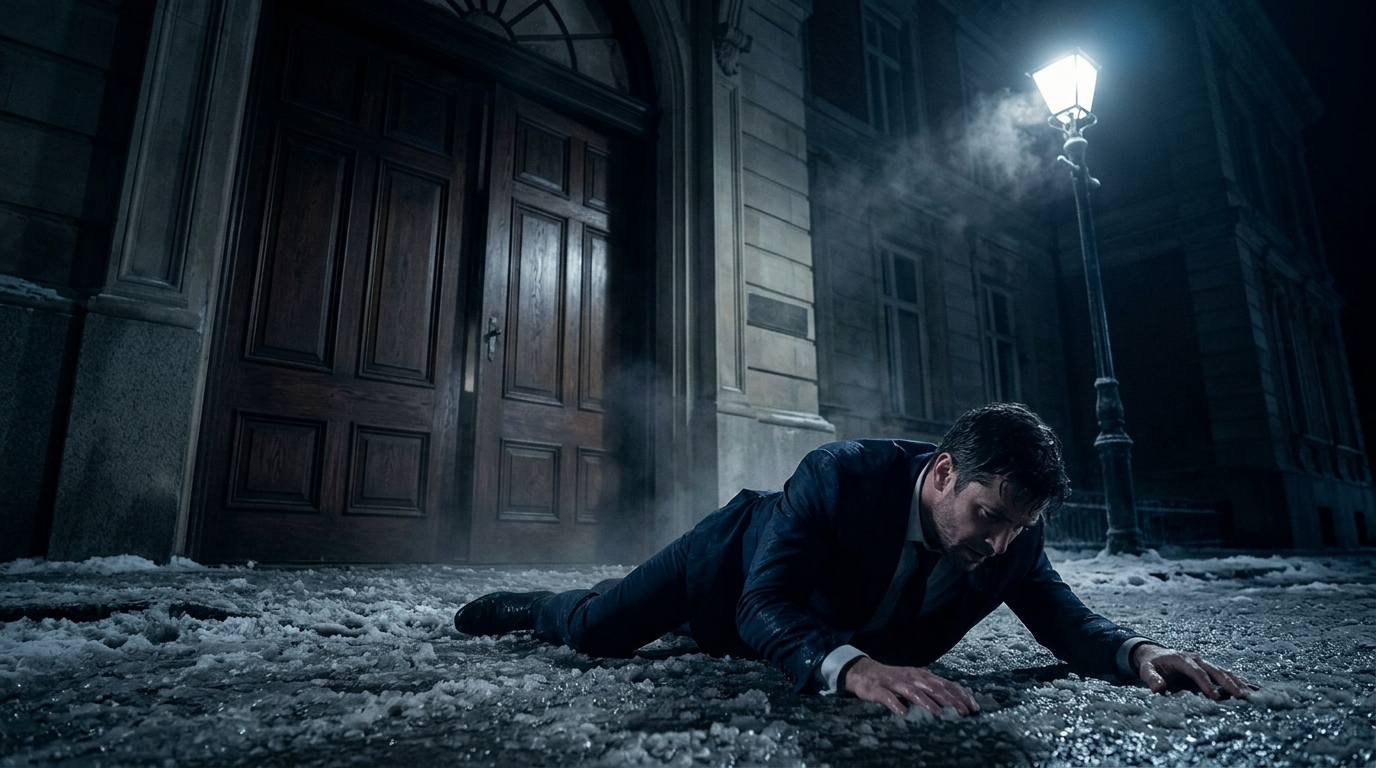
The Night the Doors Closed
“GET OUT! YOU OWE NOTHING!”
The sturdy oak doors of the Sterling estate slammed shut behind Damien with a force that seemed to shake the winter night itself.
He hit the slush hard.
One knee first.
Then both palms.
Cold water soaked through the sleeves of his expensive suit, turning the dark fabric heavy against his skin. Gray snow splashed across his shirt. His breath came out in a jagged white cloud beneath the moonlight.
For a moment, he did not move.
Behind him, the mansion glowed.
Warm windows.
Golden chandeliers.
Marble staircases.
A hundred years of Sterling wealth standing untouched behind iron gates.
And Damien Sterling knelt outside it like a beggar.
From the balcony above, laughter rang out.
His older brother’s laughter.
Victor Sterling leaned over the stone railing with a glass in one hand, his tuxedo immaculate, his smile cruel enough to cut through the cold.
“You’re a nobody now, Damien!” he shouted. “Go rot in the streets!”
More laughter followed.
Guests.
Cousins.
Board members.
People who had eaten at Damien’s table, borrowed his influence, smiled at him in daylight, and now watched him bleed dignity into the snow.
Damien stayed silent.
He did not plead.
He did not curse.
He did not look up at them.
That seemed to disappoint Victor most.
“Nothing to say?” Victor called. “No speech? No noble little farewell?”
Damien slowly pushed himself upright.
His hands stung from the ice.
His right palm was scraped where it had struck a hidden stone beneath the slush.
A drop of blood slid down his wrist and disappeared beneath his cuff.
The front courtyard stretched before him, white and black under the winter moon. The fountain had frozen over. The hedges stood sharp and lifeless. Beyond the estate gates, the private road vanished into darkness.
He had known betrayal was coming.
Not tonight.
Not like this.
But somewhere deep inside him, he had felt the house turning against him for weeks.
The missing documents.
The changed locks.
The sudden silence from lawyers who once answered on the first ring.
The way Victor smiled too easily after their father’s funeral.
The way their uncle refused to meet Damien’s eyes during the will reading.
Still, knowing a blade exists does not stop it from cutting.
Victor had done it perfectly.
A private family council.
A forged debt record.
A claim that Damien had misused company funds.
A board vote held before Damien even saw the documents.
Then, in front of the gathered Sterlings, Victor declared him disinherited, disgraced, and removed from the estate until the courts “clarified” his status.
Courts could take years.
Reputation could die overnight.
That was Victor’s true weapon.
Not the doors.
The story.
Damien had been framed before he could defend himself.
A gust of wind cut across the courtyard.
He reached into his coat pocket, perhaps for his phone, perhaps only to stop his hand from shaking.
Something slipped free.
A small iron ring.
Dull.
Plain.
Almost ugly.
It struck the icy stones with a faint sound and rolled away.
Damien’s breath caught.
The ring spun once, twice, then began rolling toward the dark mouth of the sewer grate at the edge of the courtyard.
“No.”
The word escaped before he could stop it.
He lunged.
His knees hit the slush again.
His fingers scraped ice and stone as the ring reached the grate.
For one terrifying second, it balanced on the iron edge.
Then Damien’s fingertips closed around it.
He pulled it back and clutched it to his chest.
The ring had been the last thing his father gave him.
Not the company.
Not a house.
Not a seat.
A ring.
An old, dull iron ring wrapped in a cloth and hidden in the bottom drawer of his father’s study.
On the night before his death, Arthur Sterling had gripped Damien’s wrist with surprising strength and whispered:
“If they cast you out, do not beg to be let back in. Hold the ring. Let it call what blood cannot.”
Damien had thought it was fever.
Grief.
A dying man’s poetry.
Now, as his bloody palm closed around the metal, the ring grew warm.
Then hot.
Not burning.
Awakening.
A deep crimson light seeped through his fingers.
Damien stared.
The dull iron did not simply gleam.
It pulsed.
Once.
Twice.
Like a heartbeat beneath the metal.
The snow around his hand turned red.
Not with blood.
With light.
The laughter from the balcony stopped.
Victor straightened.
“What is that?”
Damien slowly opened his hand.
The iron ring glowed crimson against his palm.
On its surface, markings he had never seen before began to appear — ancient lines, tiny symbols, a crest hidden beneath rust and time.
A wolf encircled by a crown of thorns.
Then the stillness of the suburb shattered.
A low rumble rolled through the road beyond the gates.
Engines.
Not one.
Many.
The sound deepened, steady and synchronized, vibrating through the frozen pavement.
Headlights appeared at the curve of the private road.
Twelve black SUVs rounded the corner in perfect formation.
Their headlights cut through snow and darkness like blades.
The gates of the Sterling estate opened before anyone touched them.
Victor’s glass slipped from his hand and shattered on the balcony stone.
The SUVs entered the courtyard and stopped in a flawless arc around Damien.
For one breath, nothing moved.
Then the doors opened in perfect unison.
Men in black tactical coats stepped out, disciplined, silent, faces unreadable beneath the winter shadows. None of them looked at the mansion.
None of them looked at Victor.
Every gaze turned toward Damien.
The lead operative stepped forward.
He was older than the rest, with silver at his temples and a scar running from his jaw to his collar. He crossed the slush without hesitation, then lowered himself to one knee before Damien.
The courtyard went utterly silent.
The man opened a black case with trembling hands.
Inside lay a folded midnight-blue cloak, a sealed document tube, and a silver emblem matching the crest now glowing on the iron ring.
The operative bowed his head.
“The iron ring has called, Young Master,” he said. “Your exile is over.”
Damien rose slowly.
The crimson light reflected in his eyes.
For the first time that night, he looked up at the balcony.
Victor had gone pale.
Damien’s voice was quiet.
Almost gentle.
“Then let the house hear what it buried.”
The Ring No One Was Supposed to See
The iron ring had no place in the Sterling family archives.
At least, not in the official ones.
The Sterling family loved gold.
Gold crests.
Gold cufflinks.
Gold seals on contracts.
Gold trim around portraits of dead men who had made fortunes by smiling in public while cutting throats in boardrooms.
Iron was different.
Iron belonged to older things.
Harder things.
Promises that were not meant for display.
When Arthur Sterling gave the ring to Damien, he had done it in secret.
Damien remembered the room clearly.
The study had smelled of old leather, medicine, and rain. His father lay beneath a wool blanket in the armchair near the fireplace because he refused to die in bed. The doctors had already left. The lawyers waited downstairs. Victor had been pacing the hall, impatient for signatures.
Arthur’s face was thinner than Damien had ever seen it.
But his eyes remained sharp.
“Your brother will move quickly,” Arthur whispered.
Damien had leaned closer.
“Victor?”
Arthur gave a dry laugh.
“Do not insult me by pretending surprise.”
Damien said nothing.
Arthur’s fingers trembled as he reached toward the drawer.
“Inside.”
Damien opened it and found the cloth bundle.
He unwrapped the ring.
It looked worthless.
A dull band of blackened iron, heavy and cold, with no gem and no visible engraving.
“This was never meant for Victor,” Arthur said.
“What is it?”
“The first contract.”
Damien frowned.
“A ring is not a contract.”
“This one is.”
Arthur coughed, and for a moment Damien thought he would lose him right there.
Then his father continued.
“The public Sterling family was built on money. The real house was built on protection.”
Damien looked toward the door, uneasy.
“What does that mean?”
“It means our ancestors made enemies powerful enough to destroy us, and allies dangerous enough to preserve us.”
“You’re talking in riddles.”
“I am dying. Riddles are efficient.”
Despite everything, Damien almost smiled.
Arthur’s grip tightened around his wrist.
“Listen carefully. The Iron Covenant was formed before the Sterling name entered Parliament, before the banks, before the estates. A private order. Twelve houses. Twelve guardians. Bound not to wealth, but to bloodline legitimacy.”
Damien stared.
“This sounds medieval.”
“It is older than that in spirit. Younger in paperwork.” Arthur coughed again. “The ring calls them when the rightful heir is cast out by fraud, coercion, or blood betrayal.”
Damien looked at the dull iron.
“Why would I need this?”
Arthur’s eyes darkened.
“Because Victor was born first, but you were named heir.”
The words struck the air.
Damien did not move.
“What?”
Arthur closed his eyes briefly.
“The will they read after I die will not be the will I signed.”
“Father—”
“Victor has already begun replacing staff, courting board members, moving loyal counsel aside. He thinks I am too ill to see it.”
“Then expose him now.”
Arthur looked toward the fire.
“I tried. The first set of documents disappeared. The second witness recanted. The third was found dead in his car last week.”
Damien’s blood went cold.
Arthur looked back at him.
“Your brother is not working alone.”
“Who?”
“Your uncle Marcus. Perhaps others. I do not know how deep it goes.”
“Then let me call the police.”
Arthur’s expression softened with painful affection.
“My son, men like Marcus do not fear police until evidence has already escaped the room.”
He pressed the ring into Damien’s palm.
“If they leave you inside the house, fight with law. If they cast you out, hold the ring. It will call those who still honor the first contract.”
Damien had wanted to ask more.
He never got the chance.
Arthur Sterling died before dawn.
By noon, Victor controlled the household.
By nightfall, the first official will had vanished.
And three weeks later, Damien was on his knees in the snow, clutching the ring his brother thought was nothing.
The Men From the Covenant
The lead operative’s name was Silas Graves.
Damien recognized him only after he stood.
Silas had once been his father’s head of external security, though he had left the Sterling payroll ten years earlier after a disagreement no one explained. Damien remembered him as a quiet man who never entered a room without first noticing every exit.
Now Silas stood in the snowy courtyard with twelve black SUVs behind him and a black case open in his hands.
Victor’s voice came from the balcony, strained but trying to recover authority.
“What is the meaning of this?”
Silas did not look up.
Damien did.
His brother stood above them in perfect evening clothes, but the performance had cracked. His face was pale. His eyes kept dropping to the glowing ring.
Damien held it up.
“You don’t know?”
Victor scoffed.
“Some old trinket? You think theatrics will change what happened tonight?”
“No,” Damien said. “The truth will.”
Victor’s jaw tightened.
“You have no truth. You have accusations and desperation.”
Silas finally turned toward the balcony.
“Victor Sterling, by activation of the Iron Covenant, all estate actions taken after Arthur Sterling’s death are now under private injunction pending bloodline and document verification.”
Victor laughed once.
It sounded wrong.
“You have no authority here.”
Silas lifted the silver emblem from the case.
One of the men behind him opened a tablet and began transmitting something. Another moved to the main gate. A third placed a sealed notice against the front door.
Silas spoke calmly.
“The Sterling estate is bound under the original covenant charter signed by Elias Sterling in 1847 and reaffirmed by Arthur Sterling three months before his death.”
Victor froze.
That detail hit.
Three months.
Recent enough to matter.
Hidden enough to terrify.
Silas continued.
“Any attempt to remove, destroy, alter, or transfer assets from this estate will trigger immediate notification to civil authorities, international trustees, and the covenant houses.”
Victor gripped the balcony railing.
“You are trespassing.”
“No,” Silas said. “We are answering a legal summons older than your claim.”
Uncle Marcus appeared beside Victor.
Marcus Sterling was a narrow man with silver hair, a scholar’s posture, and a snake’s patience. He had always spoken gently to Damien, which Damien now understood had been a form of practice.
Marcus looked down at Silas.
“This is absurd. The Iron Covenant is ceremonial. A relic.”
Silas’s eyes hardened.
“Only to men who never expected to be judged by it.”
Marcus’s face changed.
Just a little.
Damien saw it.
Fear.
Not of force.
Of memory.
The mansion doors opened behind him.
Several family members stepped onto the front steps, drawn by the engines and shouting. Cousin Lydia held a shawl around her shoulders. Old Aunt Beatrice leaned on her cane. Two board members whispered near the doorway.
The guests who had laughed now looked trapped between spectacle and scandal.
Damien stood in the slush, still soaked, still bruised, but no longer alone.
Silas handed him the midnight-blue cloak.
Damien looked at it.
“I don’t need ceremony.”
Silas’s voice lowered.
“It is not ceremony. You are freezing.”
That almost broke the tension.
Damien took the cloak and draped it over his shoulders. It was warm, heavy, and lined with black wool. On the inside, near the clasp, was the same wolf-and-thorn crest.
Victor saw it.
His expression darkened.
“Damien, don’t be a fool. Whatever they promised you, it won’t hold in court.”
Damien looked up at him.
“You threw me out before the court could hear me.”
“You disgraced this family.”
“No,” Damien said. “You staged a disgrace because you feared what Father left behind.”
Victor’s lips parted.
Then closed.
Damien saw the answer before hearing it.
His brother knew.
Maybe not everything.
But enough.
Silas handed Damien the sealed document tube.
“This was to be opened only upon activation.”
Damien broke the black wax seal.
Inside was a letter.
His father’s handwriting.
Strong.
Angled.
Unmistakable.
Damien read the first line silently.
Then aloud.
“To my son Damien, if you are reading this in the snow, then your brother has done exactly what I feared.”
The courtyard went still.
Victor’s face lost the last of its color.
Arthur Sterling’s Last Letter
Damien’s voice did not shake as he read.
That surprised him.
Perhaps the cold had frozen the trembling out of him.
Perhaps betrayal had burned through fear and left only clarity.
“My son,
If the iron ring has called, then you have been cast out from the house under false claim. Do not waste grief on the cruelty of the moment. Your brother chose his path long before tonight.
Victor believes inheritance is possession. Marcus believes legacy is control. They are both wrong.
The Sterling house was not left to the oldest son. It was left to the one who would protect it from becoming a weapon.
That heir is you.”
A murmur moved through the courtyard.
Victor shouted, “Forgery!”
Silas turned one page toward the nearest camera held by one of his operatives.
“The letter is sealed under Arthur Sterling’s covenant mark, notarized in private registry, and witnessed by three covenant houses.”
Marcus stepped forward.
“Those houses have no standing in modern estate law.”
Aunt Beatrice’s voice cut through the cold.
“They have standing with me.”
Everyone turned.
She stood on the front step in a long black coat, her white hair pinned severely back, her cane planted against the stone.
Victor looked startled.
“Aunt Beatrice—”
“Do not aunt me tonight.”
Her voice was thin but sharp enough to slice glass.
“I told Arthur the covenant should have been invoked years ago.”
Marcus’s face tightened.
“You always loved drama.”
Beatrice looked at him.
“And you always loved rooms where witnesses died before speaking.”
The courtyard froze.
That sentence changed everything.
Damien lowered the letter.
“What does that mean?”
Beatrice came slowly down the steps.
No one helped her.
No one dared.
She stopped beside Damien and looked at him with eyes that were old, tired, and furious.
“Your father’s witness was my driver’s son.”
Damien’s chest tightened.
“The man found in the car?”
Beatrice nodded.
“Elias Ward. He did not drink. He did not crash by accident. He called me the night before he died and said Marcus had paid a clerk to switch trust documents.”
Marcus’s voice turned cold.
“You senile old woman.”
Silas moved instantly.
Not forward.
Just enough.
Marcus stopped speaking.
Beatrice smiled without humor.
“Careful, Marcus. I may be old, but I am not the one surrounded by men who came for a ring you thought dead.”
Victor gripped the balcony railing so hard his knuckles whitened.
“This proves nothing.”
Damien lifted the letter again.
He continued reading.
“Inside the sealed archive beneath the east wing are the original trust documents, board recordings, and my final testament. Victor cannot open it. Marcus cannot open it. The archive requires the iron ring and the blood of the named heir.
If I failed to protect you in life, let this protect you after my death.
Do not seek revenge first.
Seek proof.
Then let the proof decide who deserves mercy.”
Damien lowered the letter.
The red glow from the ring pulsed once.
The air itself seemed to wait.
Silas turned toward him.
“You have the right to enter the archive now.”
Victor’s voice cracked.
“No.”
Damien looked up.
That one word told him more than any confession.
The archive was real.
And Victor knew what was inside.
The East Wing Archive
They entered the mansion through the same doors that had been slammed in Damien’s face less than an hour earlier.
No one stopped him now.
The guests parted.
Some lowered their eyes.
Others watched with the eager horror of people realizing they had laughed too early.
Damien’s soaked shoes left gray marks across the polished floor.
For once, he did not care.
Victor and Marcus were escorted inside by Silas’s men, not restrained, but surrounded closely enough that no one mistook freedom for control.
Aunt Beatrice walked beside Damien.
“You should know,” she murmured, “your father tried to tell you sooner.”
“Why didn’t he?”
“He was afraid you would confront Victor before the documents were secured.”
“He was right.”
“Yes,” she said. “You have always had more courage than patience.”
Damien gave her a faint look.
“I’m bleeding, frozen, and recently homeless. Is now the best time for character notes?”
Beatrice snorted.
“You are still a Sterling.”
They reached the east wing.
Damien had not entered that part of the mansion in years. It had been closed after his grandmother died, officially due to structural repairs. As a child, he remembered sneaking near the corridor and being dragged away by Marcus, who said the old rooms were unsafe.
Now Silas stopped before a tall bookcase at the end of the hall.
One of his operatives scanned the wall.
“No electronic lock,” the man said.
Silas looked at Damien.
“The old way.”
Damien lifted the iron ring.
The symbols glowed brighter.
A slot opened in the carved wooden panel behind the bookcase.
Damien inserted the ring.
Nothing happened.
Then Silas held out a small silver blade.
Damien looked at him.
“Blood of the named heir?”
Silas nodded.
“A drop is enough.”
Victor laughed harshly from behind them.
“This is madness. You’re all playing at ancient rituals in a house with Wi-Fi.”
Damien looked back.
“Then you have nothing to fear.”
Victor’s jaw clenched.
Damien pressed the blade to his thumb.
A bead of blood welled.
He touched it to the ring.
The wood groaned.
Deep inside the wall, old mechanisms shifted.
The bookcase unlocked and swung inward.
A narrow staircase descended into darkness.
Cold air rose from below.
Not damp.
Preserved.
Silas handed Damien a flashlight.
“I go first,” Silas said.
Damien shook his head.
“My father left it for me.”
Silas studied him.
Then stepped aside.
Damien descended.
The staircase spiraled downward into a chamber beneath the east wing. Stone walls. Iron lamps. Shelves sealed behind glass. A long table at the center.
At the far end stood a black safe embedded in the wall.
Above it was carved:
Blood may inherit wealth. Only truth may inherit the house.
Damien stood before the safe.
His chest tightened.
For the first time that night, grief rose above anger.
His father had prepared all of this because he knew his sons would stand against each other.
How lonely Arthur Sterling must have been in those final months.
How betrayed.
How afraid that the wrong child would inherit not just money, but the power to bury everything good left in the family.
Damien placed the ring against the safe.
It opened.
Inside were three leather folders, a recording device, several drives, and a small velvet box.
Silas lifted a camera and began documenting everything.
Aunt Beatrice lowered herself into a chair near the table.
“Start with the blue folder,” she said.
Damien looked at her.
“How do you know?”
“Because your father was predictable when terrified. Blue for legal. Red for blood. Black for burial.”
That answer sent a chill through him.
He opened the blue folder.
The original will lay inside.
Signed.
Witnessed.
Clear.
Arthur Sterling had named Damien sole controlling heir of the Sterling estate, while leaving Victor significant financial support under trustee oversight. Victor was not cut off.
Not humiliated.
Not abandoned.
Protected from himself, perhaps.
But not ruined.
Victor had chosen war anyway.
Damien opened the red folder.
Inside were medical reports.
Private investigator notes.
Payment trails.
Documents showing Marcus had been slowly poisoning Arthur’s medication schedule — not killing him outright, but weakening him, manipulating symptoms, isolating him from independent doctors.
Damien’s vision blurred.
He turned to Marcus.
His uncle’s face had gone gray.
Victor looked genuinely shocked.
That mattered.
Not enough to redeem him.
But enough to show the rot had roots even he had not fully seen.
“You knew?” Victor whispered to Marcus.
Marcus said nothing.
Damien opened the black folder.
Beatrice closed her eyes.
Inside were photographs of Elias Ward’s car.
A police report.
A second private report contradicting it.
A voice transcript.
And a note from Arthur:
Marcus ordered the witness silenced. Victor benefited but may not know. If Damien activates the ring, let law decide the distinction. Do not let grief decide it for him.
Damien gripped the table.
His father had thought of everything.
Even his rage.
Especially his rage.
Then he opened the velvet box.
Inside was a second ring.
Gold.
Polished.
Marked with the public Sterling crest.
Under it was a note.
For Victor, if he chooses truth before power.
Damien stared at it.
Victor saw.
His expression changed in a way Damien had never seen before.
Not fear.
Not envy.
Shame.
Victor’s Collapse
They played the first recording in the archive chamber.
Arthur’s voice filled the stone room.
Weak.
But unmistakable.
“This is Arthur Sterling. Final testimony, recorded in the presence of covenant witness Silas Graves and Lady Beatrice Sterling.”
Victor sank slowly into a chair.
Marcus remained standing, rigid and pale.
The recording continued.
“My brother Marcus has altered financial records, pressured staff, and attempted to isolate me from legal counsel. I believe he intends to place Victor in control as a manageable heir. Victor is ambitious, resentful, and easily flattered by authority. These are weaknesses Marcus can use.”
Victor flinched.
Damien looked at him.
For once, there was no satisfaction in seeing his brother wounded.
Arthur’s voice grew softer.
“I have failed both my sons. Victor by indulging his pride when I should have corrected it. Damien by trusting his resilience too much. If this testimony is heard, then my failures have reached their consequence.”
The recording paused.
A cough.
Then:
“Damien, do not become cruel because they were cruel to you. Cruelty is not strength. It is fear with better posture.”
Damien closed his eyes.
The sentence struck him harder than any accusation.
Silas stopped the recording after the first section.
“There is enough here for immediate legal action.”
Marcus laughed suddenly.
A thin, ugly sound.
“You think any of this will hold? Ancient covenants? Deathbed paranoia? Family theatrics?”
Beatrice looked at him.
“Arthur also transferred copies to three banks, two courts, and one journalist.”
Marcus stopped laughing.
Damien turned to Silas.
“Is that true?”
Silas nodded.
“The ring activation releases all sealed copies if the archive is opened.”
Victor whispered, “What have you done?”
Silas’s phone buzzed.
Then another operative’s.
Then another.
Silas looked at the screen.
“The first packet has been received by the High Court registry.”
Another buzz.
“Second by the financial crimes bureau.”
Another.
“Third by the press.”
The room went silent.
Above them, somewhere in the mansion, phones began ringing.
One.
Then many.
The Sterling house was waking to the truth.
Marcus moved suddenly toward the stairs.
Two operatives blocked him.
He stopped.
His face twisted.
“You have no idea what you’re destroying.”
Damien looked at him.
“No. I know exactly what we’re ending.”
Victor lowered his head into his hands.
For the first time that night, he looked less like an enemy and more like a man realizing the throne he stole had been placed on a trapdoor.
Damien walked to him.
Victor did not look up.
“Did you know Marcus was poisoning Father?”
Victor’s jaw tightened.
“No.”
Damien believed him.
He hated that he believed him.
“Did you know the will was forged?”
Victor closed his eyes.
“Yes.”
The word was quiet.
There it was.
The clean line.
Not all guilt.
But enough.
Damien nodded once.
“Did you know about Elias Ward?”
Victor shook his head.
“No.”
Marcus scoffed.
“Sentimental liar.”
Victor stood so quickly his chair scraped back.
He turned on Marcus.
“You told me Father was confused. You told me Damien manipulated him. You told me the old man was destroying the company.”
Marcus stared at him with contempt.
“And you were so eager to believe it.”
Victor went silent.
Because that was true.
Damien watched him absorb it.
His brother had not built the entire crime.
But he had opened the door for it.
Pride had made him useful.
Resentment had made him blind.
Victor turned to Damien.
For the first time all night, his voice held no performance.
“What happens now?”
Damien looked at the gold ring in the velvet box.
Then at the iron ring in his palm.
“Now we let proof decide.”
The Mansion Above
By the time they returned upstairs, the Sterling estate had transformed.
The guests who had once laughed now stood in anxious clusters, whispering into phones. Board members were pale. Staff moved quickly but quietly through the hall, as if the house itself had changed ownership before paperwork could catch up.
News alerts began appearing within twenty minutes.
Sterling Estate Documents Trigger Emergency Legal Review
Arthur Sterling’s Final Testament Challenges Victor Sterling Claim
Financial Crimes Bureau Confirms Receipt of Sterling Archive Packet
Victor read one headline and sat down heavily near the staircase.
Marcus was escorted to a private room under guard until civil authorities arrived.
He did not speak.
That was wise.
Damien stood in the center of the grand foyer, wrapped in the midnight cloak, his suit still soaked beneath it, the iron ring no longer glowing but warm in his palm.
Lydia approached him first.
His cousin had been among those who laughed from the doorway earlier.
Now her face was pale.
“Damien,” she said. “I didn’t know.”
He looked at her.
“You didn’t ask.”
She flinched.
He did not soften it.
Not because he hated her.
Because some truths deserved to remain uncomfortable.
One by one, people tried to explain.
They had been misled.
They trusted Victor.
They thought there must be evidence.
They did not want to interfere.
They were confused.
They were sorry.
Damien heard versions of the same sentence again and again:
We did not know enough to stand with you.
And each time, he wondered how much people needed to know before cruelty became worth interrupting.
Aunt Beatrice sat near the fireplace, exhausted but satisfied.
Silas remained close to Damien.
Not hovering.
Guarding the space.
At last, the front doors opened again.
This time, not to cast Damien out.
To admit the law.
Officials entered.
Lawyers.
Investigators.
Uniformed officers.
A court representative with emergency authority over contested estate assets.
The night became procedure.
Statements.
Seals.
Phones confiscated.
Rooms secured.
Marcus taken away.
Victor questioned.
Damien asked to sign documents with hands still raw from the ice.
At one point, he stepped outside alone.
The courtyard was marked by tire tracks, footprints, and the dark patch of slush where he had fallen.
His blood had stained the snow near the sewer grate.
The place looked smaller now.
Less like the scene of his destruction.
More like the point where the lie overreached.
Silas joined him quietly.
“You should get warm.”
Damien looked at the grate.
“If the ring had fallen…”
“It did not.”
“But if it had?”
Silas looked out toward the gates.
“Then we would have come another way.”
Damien turned.
“You knew?”
“Your father made several contingencies.”
“Then why wait for the ring?”
“Because the choice had to be yours.”
Damien looked down at his scraped hand.
“I didn’t choose. I grabbed it because I was afraid to lose the last thing he gave me.”
Silas nodded.
“Often, that is what choosing looks like.”
The Brother in the Empty Hall
Near dawn, Damien found Victor in the portrait gallery.
No guards stood close now, though two remained at the far entrance.
Victor sat beneath their grandfather’s portrait, jacket off, bow tie loosened, hair disordered for the first time Damien could remember.
He looked up when Damien entered.
For several seconds, neither brother spoke.
The gallery had witnessed generations of Sterling men pretending their conflicts were principles when they were usually greed.
Tonight, it witnessed something stranger.
Two brothers with the same father, different wounds, and one ruined inheritance between them.
Victor spoke first.
“I hated that he trusted you.”
Damien stayed near the doorway.
“I know.”
Victor laughed softly.
“Of course you knew. Everyone knew. I made a career of it.”
“You could have had your own life.”
“I wanted his respect.”
“You had his love.”
Victor’s face twisted.
“Not the same.”
“No,” Damien said. “But one mattered more.”
Victor looked down.
For a moment, he seemed very young.
“When he named you heir, I thought it meant I was nothing.”
Damien’s anger shifted.
Not vanished.
Changed shape.
“So you made me nothing first.”
Victor closed his eyes.
“Yes.”
The honesty struck harder than denial would have.
Damien walked closer, but not too close.
“Did you enjoy it?”
Victor looked up.
“The balcony?”
“Yes.”
Pain crossed his face.
“For about ten seconds.”
“And then?”
Victor looked toward the window, where the first gray light of morning touched the snow.
“Then the engines came.”
Despite everything, Damien almost smiled.
Victor did not.
“I thought I was taking back what should have been mine,” he said. “But when I saw the ring… I realized Father had prepared for me. Not against Marcus. Against me.”
Damien said nothing.
Victor’s voice broke slightly.
“He knew I would do it.”
“He hoped you wouldn’t.”
“That’s worse.”
“Yes.”
Silence settled.
Then Victor asked, “What will you do with me?”
Damien thought of the letter.
Do not let grief decide it for him.
“You confessed to knowing the will was forged. You will give a sworn statement. You will cooperate fully. You will surrender all authority over Sterling assets.”
Victor nodded slowly.
“And after?”
“That depends on what else you did.”
Victor looked at him.
“No mercy?”
Damien’s voice was quiet.
“Mercy is not pretending harm did not happen.”
Victor absorbed that.
Then nodded once.
“No. I suppose it isn’t.”
Damien turned to leave.
Victor spoke again.
“Damien.”
He stopped.
“I’m sorry.”
The words were small.
Too small for the night.
Too small for the doors.
Too small for the laughter.
Too small for their father’s deathbed fear.
Damien looked back.
“I believe you.”
Victor’s face changed.
Hope, maybe.
Damien ended it before it grew too large.
“That does not clear the debt.”
Then he left the gallery.
The Real Battle
By morning, the world knew.
By noon, the board froze Victor’s authority.
By evening, Marcus Sterling’s name appeared in headlines beside words the family had spent generations avoiding: fraud, coercion, suspicious death, estate manipulation.
Damien did not sleep for thirty-six hours.
He gave statements.
Read documents.
Met with investigators.
Watched the Sterling empire turn from inheritance into crime scene.
Every room contained another secret.
Every account another question.
Every loyal employee another person who had been afraid to speak until the iron ring called men with enough power to make silence less profitable.
The battle that followed was not fought with weapons.
It was fought in courtrooms, boardrooms, sealed archives, private hearings, and long nights over documents that smelled of dust and betrayal.
Marcus tried to bargain.
Victor cooperated.
Then resisted.
Then cooperated again.
Aunt Beatrice gave testimony so sharp that one attorney asked for a recess after twenty minutes.
Silas remained near the edges, protecting witnesses, moving evidence, making sure no one disappeared the way Elias Ward had.
Damien learned quickly that taking back a house was easier than cleansing it.
The Sterling estate had been rotting behind polished doors for years.
Marcus had used family loyalty as camouflage.
Victor had used resentment as justification.
Board members had used ignorance as shelter.
Damien had used duty as blindness.
That was hardest to admit.
He had known the family was cruel.
He had known the company crushed smaller firms.
He had known staff were afraid of Marcus.
He had known Victor lied when convenient.
But knowing in fragments had allowed him to continue living inside the whole.
Now the whole was broken open.
There was no going back.
Three months after the night in the snow, Damien stood before the Sterling board as legal heir, not yet fully confirmed by every court, but recognized under emergency authority.
He wore a dark suit.
No cloak.
No theatrics.
On his hand was the iron ring.
Dull again.
Silent.
Victor sat at the far end of the table, stripped of title, present only as cooperating witness and minority beneficiary under review.
He looked thinner.
Older.
Less polished.
Marcus was absent.
Awaiting trial.
Damien addressed the board.
“This family has mistaken survival for secrecy for too long.”
No one interrupted.
“The Sterling estate will comply fully with every investigation. Funds tied to fraudulent transfers will be frozen. Witness protection costs will be paid by the estate. The Ward family will receive formal restitution and public acknowledgment.”
A board member shifted.
“That could expose us to enormous liability.”
Damien looked at him.
“Yes.”
The man opened his mouth.
Then closed it.
Damien continued.
“We will also dissolve the internal authority structure Marcus used to bypass oversight. No family member will control estate security, medical access, or trust documents without independent review again.”
Victor looked down at the table.
Damien saw him.
Then added:
“And no one will be cast out of this house by private vote in the middle of the night again.”
Silence.
Aunt Beatrice, seated near the window, smiled faintly.
Silas stood near the door.
For the first time in months, Damien felt the ring cool against his skin.
As if something ancient inside it had finally stopped bracing.
The Ring’s True Meaning
Damien had once thought the iron ring was a weapon.
That night in the snow, with engines shaking the pavement and Victor pale on the balcony, it had felt like one.
A call to power.
A dramatic reversal.
A crown returning to the rightful head.
But the longer he wore it, the more he understood his father’s final lesson.
The ring did not exist to make him untouchable.
It existed to make him accountable.
To the dead.
To the living.
To the truth buried beneath family language.
To the idea that inheritance was not permission to dominate, but obligation to protect what others could not.
The covenant records revealed that the ring had been activated only four times in nearly two centuries.
Each time, not during ordinary inheritance disputes, but when a house tried to devour one of its own.
An eldest daughter locked away.
A younger son framed for treason.
A widow forced to sign away a trust.
A child heir declared unstable by greedy guardians.
Now Damien.
The pattern humbled him.
He was not unique.
He was part of a long history of families confusing blood with ownership.
One evening, nearly a year after his exile, Damien returned alone to the courtyard.
The winter had passed.
Spring rain dampened the stones.
The sewer grate remained at the edge of the drive.
He stood over the place where the ring had almost disappeared.
Victor came out after a while.
Damien heard his footsteps but did not turn.
“You wanted me?” Victor asked.
“Yes.”
Damien removed the gold ring from his pocket — the one Arthur had left in the velvet box.
He held it out.
Victor stared.
“What is that?”
“You know what it is.”
Victor did not take it.
“I don’t deserve that.”
“No,” Damien said. “You don’t.”
Victor looked up.
Damien continued.
“Father left it for you if you chose truth before power. You chose power first. Then truth when power failed.”
Victor flinched.
“So why show it to me?”
“Because I’m not giving it to you today.”
Victor’s mouth tightened.
Damien closed his fingers around the gold ring.
“I’m showing you what can still exist if you spend the rest of your life earning what Father hoped for you.”
Victor looked away.
“That sounds like a sentence.”
“It is.”
“For how long?”
Damien looked at the grate.
“As long as it takes.”
Victor laughed softly, without humor.
“You sound like him.”
Damien slipped the gold ring back into his pocket.
“I hope not entirely.”
“No,” Victor said. “Not entirely.”
They stood in silence.
Not reconciled.
Not enemies in the simple way they had been that night.
Something harder.
Brothers with a broken bridge between them and no promise it would hold if rebuilt too quickly.
The House After the Snow
The Sterling estate changed slowly.
Not enough for those who wanted spectacle.
Too much for those who preferred rot under polish.
Portraits were moved.
Not destroyed.
Moved.
The grand hallway no longer displayed only men who inherited power. It now included those who had protected the house at cost: women, servants, witnesses, forgotten cousins, even Elias Ward, whose photograph hung near the east wing with a plaque acknowledging his role in preserving Arthur’s final evidence.
Some family members hated it.
Damien let them.
The sealed archive became a monitored legal repository.
The east wing reopened, not for parties, but for records and oversight.
Aunt Beatrice took over a room near the library and claimed she was too old to move out again. No one argued.
Silas Graves refused any formal title.
“Titles make men stupid,” he said.
Damien appointed him anyway as independent head of covenant security.
Silas said that proved his point.
Victor left the estate for a while.
Not exiled.
Not forgiven.
Just away.
He gave testimony in Marcus’s trial, and what he said helped secure convictions tied to document fraud, medical coercion, and witness intimidation. He also admitted his own role in the forged will. The court considered his cooperation. The family did not forget.
Damien visited him once a month.
Sometimes they spoke.
Sometimes they sat in silence.
Once, Victor asked, “Do you hate me?”
Damien answered honestly.
“Some days.”
Victor nodded.
“What about today?”
Damien looked at him.
“Today I’m tired.”
Victor laughed.
Then cried.
It was the first time Damien had seen his brother cry since they were children.
He did not comfort him.
But he did not leave.
The Night Remembered
Years later, people told the story of Damien Sterling’s exile as if it had been clean and glorious.
The doors slamming.
The brother laughing.
The iron ring glowing red in the snow.
The twelve black SUVs appearing from darkness.
The lead operative kneeling in the slush.
Your exile is over.
It made a good story.
People loved the reversal.
The humiliated heir rising.
The cruel brother silenced.
The hidden order answering the call.
Damien never corrected the broad shape of it.
But he knew the truth was messier.
He had been afraid that night.
Not noble.
Not calm.
Afraid.
He had lunged for the ring not because he believed in ancient covenants, but because it was the last thing his father’s hand had touched before death.
He had wanted revenge.
Badly.
He had imagined Victor dragged down the steps, Marcus exposed, the house forced to watch him return in triumph.
But Arthur’s letter stopped him.
Do not seek revenge first.
Seek proof.
Then let the proof decide who deserves mercy.
That sentence saved him from becoming another Sterling man ruled by injury.
Sometimes, when the ring felt heavy on his hand, Damien walked to the courtyard and stood by the sewer grate.
A small iron cover had been placed over it now, not to block water, but to prevent anything small from falling through. Aunt Beatrice called it sentimental nonsense. Damien noticed she was the one who ordered it installed.
On the inside of the cover, invisible unless lifted, were engraved the words:
What nearly fell was not the ring, but the house.
Damien liked that.
Because it was true.
The Last Conversation With Beatrice
Aunt Beatrice died three winters after the night of the ring.
She lived long enough to testify, insult three judges, outlast Marcus’s first appeal, and tell Victor he had “improved from intolerable to occasionally useful.”
On her final afternoon, she asked Damien to bring the iron ring.
He sat beside her bed in the east wing, where she had insisted on staying.
Snow fell outside the window.
“Full circle,” she murmured.
Damien held out his hand.
The iron ring rested on his finger, dull and plain.
Beatrice touched it with one thin finger.
“Do you know why it glowed red?”
“I assumed some chemical reaction.”
She gave him a look.
“You have become boring.”
He smiled.
“What would you prefer? Magic?”
“I prefer humility in the face of things men have not bothered to understand.”
Damien looked at the ring.
“Do you know?”
“No.”
He laughed softly.
She smiled.
“Good. Let one mystery survive this family’s obsession with records.”
They sat quietly.
Then she said, “You did not become merciful too quickly. Good.”
“I’m not sure Victor would agree.”
“Victor should thank God you did not become just like him.”
Damien looked down.
“I wanted to.”
“I know.”
“That scares me.”
“It should.” Her voice softened. “That fear is useful. Keep it.”
He nodded.
Beatrice closed her eyes.
“Arthur would be proud.”
Damien’s throat tightened.
“Would he?”
“Yes. And annoyed. Proud men are always annoyed when their sons exceed them in ways they should have managed first.”
Damien laughed through tears.
Beatrice opened her eyes one last time.
“Remember, Damien. The ring did not call soldiers.”
He frowned.
“What did it call?”
“Witnesses.”
She died that night.
Damien kept that sentence longer than any legal document.
What the Ring Called
In the end, Beatrice was right.
The ring had not called an army.
Not truly.
It called witnesses.
Silas, who had kept Arthur’s covenant alive.
Beatrice, who remembered what Marcus tried to bury.
The sealed archive, where documents waited longer than fear.
The court registries, where truth arrived before the family could destroy it.
Even Victor, eventually, forced to witness himself without the flattering mirror of entitlement.
And Damien too.
The most important witness.
The one who had to see his family clearly and still choose what kind of man to become after seeing it.
The Sterling estate survived.
But not unchanged.
Never unchanged.
Its doors remained oak.
Its halls remained grand.
Its history remained complicated.
But the night Damien was thrown into the snow became part of the house’s official record.
Not hidden.
Not softened.
Not described as a “family misunderstanding.”
The archive entry was titled simply:
The Exile and Return of Damien Sterling
Under it were displayed:
The forged will.
Arthur’s final letter.
The photograph of Elias Ward.
The velvet box that had held Victor’s gold ring.
And a replica of the iron ring.
The real one stayed on Damien’s hand.
Not as a crown.
As a warning.
Because power that returns through suffering can easily become cruel if it mistakes pain for wisdom.
Damien tried not to.
Some days, he succeeded.
Some days, he had to return to the courtyard and remember himself on his knees, soaked, humiliated, reaching desperately for the last thing his father gave him.
That memory kept him human.
And whenever winter came again, and snow gathered in the cracks of the Sterling courtyard, Damien would stand beneath the balcony where Victor once laughed and listen.
Not for engines.
Not for applause.
Not for revenge.
For the silence after the doors closed.
For the heartbeat of iron in his palm.
For his father’s voice in a letter from the dead.
For the lesson the house had nearly learned too late:
An heir is not the one who owns the doors.
An heir is the one who refuses to let the truth be locked outside them.