The Necklace at Table Seven
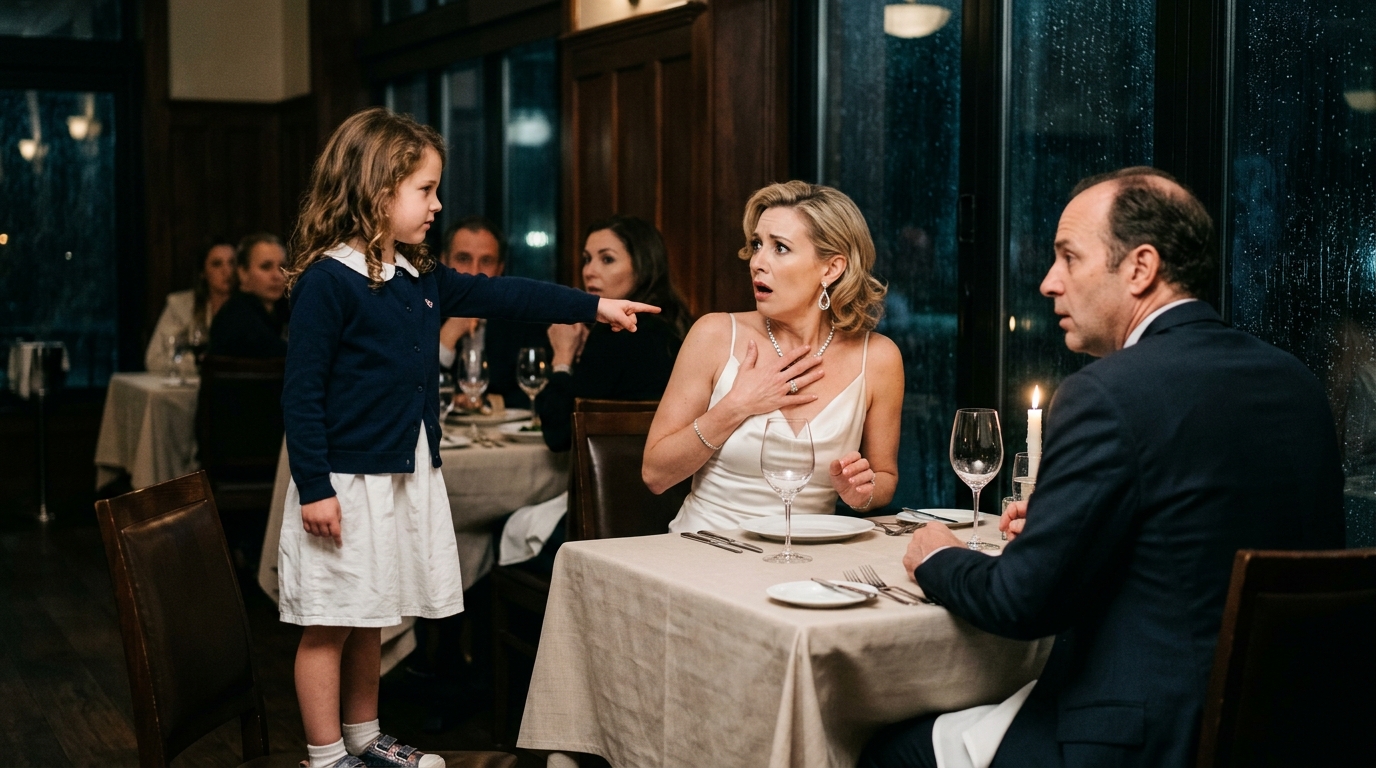
“THAT NECKLACE BELONGS TO MY MOTHER!”
The words cut through the restaurant like a glass breaking.
Every fork stopped.
Every conversation died.
The candlelight seemed to freeze over the white tablecloths, the crystal glasses, the polished silverware, and the faces of guests who had paid too much money to be disturbed by anything real.
At table seven, a stylish woman in a white dress sat with her husband, one hand wrapped around the stem of a champagne glass.
Her name was Caroline Whitmore.
She was elegant in the way women become elegant when wealth has trained every movement. Her hair was pinned in a soft twist. Her makeup was flawless. Her white dress shimmered faintly beneath the chandelier light. Around her neck rested a diamond teardrop necklace worth more than most people earned in a year.
The stone caught the candlelight beautifully.
That was why the little girl had noticed it.
Seven years old.
Small.
Wet from the rain.
Standing beside a table she had no permission to approach.
Her coat was too thin. Her shoes were muddy. Her dark hair clung to her cheeks. But her eyes were fixed on the necklace with such certainty that no one in the room could dismiss her as merely confused.
Caroline stared at the child.
For a moment, she looked offended.
Then embarrassed.
Then carefully kind, because the entire restaurant was watching.
“I’m sorry, sweetie,” she said, forcing a gentle smile. “But this was a gift from my husband.”
Her husband, Julian Whitmore, sat beside her in a dark tailored suit.
His smile had vanished.
Not gradually.
Instantly.
The little girl did not look at him.
She kept staring at the necklace.
“My mom has the exact same one.”
A faint murmur moved through the restaurant.
A server holding a tray of wine glasses paused near the wall.
The maître d’ took one step forward, unsure whether to remove the child or wait for the wealthy couple to decide what kind of scene this was allowed to become.
Caroline’s smile faltered.
“That’s impossible,” she said.
But her hand had already risen to the necklace.
Protective.
Instinctive.
Afraid.
“She hides it under her pillow every night,” the girl continued. “She says it’s the only thing left of the life she used to have.”
The restaurant grew quieter.
Caroline felt the color drain from her cheeks.
Julian had told her the necklace was one of a kind.
A private commission.
A gift for their tenth anniversary.
He had fastened it around her neck himself that afternoon, smiling as he said, “There is nothing else like it in the world.”
Now a child in a soaked coat stood in front of her, saying another woman had the same one hidden under a pillow.
Caroline turned slightly toward her husband.
Julian’s jaw had tightened.
His eyes were not on the child.
They were on the glass doors at the front of the restaurant.
Caroline noticed.
Something cold moved through her.
She leaned toward the little girl.
“Is your mother here?”
The girl nodded slowly.
Then turned and pointed toward the rain beyond the glass doors.
Outside, across the wet pavement, under the yellow glow of a streetlamp, stood a woman in a dark coat.
Motionless.
Thin.
Drenched.
Her face partly hidden by rain and shadow.
Caroline rose so quickly her chair screeched against the marble floor.
Julian reached for her wrist.
“Caroline, don’t.”
The words came too quickly.
Too sharply.
She looked down at his hand.
Then at his face.
“What is going on?”
His mouth opened.
No answer came.
Caroline pulled away.
Guests leaned aside as she moved toward the entrance. Her heels clicked across the floor, fast and uneven now. The little girl followed a few steps behind, clutching her wet sleeves.
Caroline reached the glass doors and stared into the rain.
The woman beneath the streetlamp lifted her head.
The light touched her face.
Caroline stopped breathing.
She had seen that face before.
In photographs.
In a silver frame Julian kept locked in his study.
In the story he had told her on their second date, voice heavy with grief.
“My first wife died ten years ago.”
But the woman standing in the rain was not dead.
She was looking straight at Julian.
The Woman Who Was Supposed to Be Gone
For ten years, Caroline had known the name Elena Whitmore as a tragedy.
Julian’s first wife.
The woman he had loved before grief hollowed him out.
The woman who died in a car accident on a mountain road, leaving Julian broken and alone.
That was the story.
Everyone knew it.
His friends spoke of Elena softly. His mother cried when her name came up. Julian kept a photograph in his study but never spoke of it unless wine and late nights made memory difficult to avoid.
Caroline had respected that grief.
She had even loved him more for it.
A man who mourned deeply seemed, to her, like a man capable of loving deeply.
But the woman outside the restaurant was breathing.
And the little girl beside Caroline was watching her with the desperate hope of a child who had brought proof to people powerful enough to ignore it.
Caroline pushed open the glass door.
Cold rain swept into the warmth of the restaurant.
“Elena?” she whispered.
The woman under the streetlamp flinched.
Not at the name.
At being seen.
The little girl ran past Caroline.
“Mom!”
The woman dropped to her knees as the child threw herself into her arms. She held the girl tightly, one hand cradling the back of her head, the other gripping the child’s coat as if the world might take her again.
Caroline stood in the doorway, rain hitting her face, diamond necklace cold against her throat.
Behind her, the restaurant had gone completely silent.
Then Julian appeared behind her.
“Elena,” he said.
The woman looked up.
If Caroline expected a reunion, she did not get one.
There was no longing in Elena’s face.
No love.
No shock.
Only terror hardened by years of survival.
“Stay away from my daughter,” Elena said.
Julian’s face twitched.
“Your daughter?”
The little girl turned.
“Our daughter,” she said.
The words landed harder than thunder.
Caroline’s hand flew to her mouth.
Julian stepped back as if struck.
“Elena,” he said quietly, “what have you told her?”
Elena rose slowly, keeping one arm around the girl.
“The truth.”
“No,” Julian snapped. “You don’t get to do this here.”
Caroline turned toward him.
“Do what?”
He looked at her.
Then at the doorway full of staring guests.
Then back at Elena.
His face rearranged itself into something controlled.
Sad.
Reasonable.
Dangerous.
“Caroline,” he said softly, “this woman is unwell.”
Elena gave a bitter laugh.
“Still using that?”
Julian’s eyes sharpened.
Caroline caught it.
That split-second flash of rage before he buried it under concern.
“She disappeared years ago,” Julian said. “She was unstable. I thought she had died. We all did.”
Elena took one step forward.
“You didn’t think I died.”
Her voice shook, but it did not break.
“You paid people to make sure everyone else did.”
The rain fell harder.
Caroline looked from one face to the other.
“What does that mean?”
Elena’s eyes moved to the diamond at Caroline’s throat.
“That necklace was mine.”
Caroline touched it.
Julian spoke quickly.
“That is absurd. Caroline, listen to me—”
Elena interrupted.
“The back of the clasp has an engraving.”
Caroline froze.
Elena’s voice dropped.
“Two initials. E.W. And a date.”
The restaurant behind them seemed to inhale at once.
Caroline slowly reached behind her neck.
Her fingers found the clasp.
She had never looked closely at the back.
Why would she?
Julian had fastened it for her.
Julian had told her it was new.
Julian had told her everything.
Her hands shook as she unclipped the necklace and turned the clasp toward the light from the doorway.
Tiny engraved letters gleamed against the metal.
E.W.
Below them, a date.
Ten years old.
Caroline’s blood went cold.
She turned toward Julian.
“You said this was made for me.”
Julian’s face had gone still.
“Caroline—”
“You said it was unique.”
He said nothing.
The little girl stared at him with tears in her eyes.
“My mom said you took everything.”
Julian’s expression changed then.
Not guilt.
Annoyance.
As if the child had spoken out of turn.
That was the moment Caroline understood something awful.
This was not a misunderstanding.
This was a door opening into a room her marriage had been built to hide.
The First Lie
Elena had not planned to come inside.
She had not planned to confront Julian in a restaurant full of wealthy patrons, reporters, donors, and people whose names appeared on hospital wings and art galleries.
She had come because her daughter, Lily, saw the necklace through the glass.
They had been walking past the restaurant in the rain after leaving a legal aid office that had closed before they could be seen. Elena had promised Lily hot soup from the diner three streets over if they had enough coins left.
Then Lily stopped.
Her small hand tightened around Elena’s.
“Mom,” she whispered.
Elena followed her gaze.
Through the glass, beneath the chandelier, a woman in white sat beside Julian Whitmore wearing Elena’s necklace.
For a moment, Elena could not move.
The necklace was not simply expensive.
It was evidence.
Julian had given it to her on the day Lily was born, back when he still pretended tenderness. The teardrop diamond had belonged to his grandmother. He had said it symbolized water, memory, and forever.
Elena had believed him.
Back then, she believed too many things.
She believed Julian loved her.
She believed his family accepted her.
She believed the papers he asked her to sign after childbirth were “just estate protections.”
She believed his concern when he said she was too tired, too anxious, too emotional to handle visitors.
Then came the postpartum fog.
The doctor’s pills.
The weeks where she could barely stay awake.
The strange documents.
The whispered conversations.
The night she woke and heard Julian telling his mother, “If she fights this, we make it medical.”
By the time Elena understood she was trapped, Julian had already begun building the story.
She was unstable.
She was paranoid.
She had run away with jewelry and money.
Then, after she escaped, his story changed again.
She had died.
A tragic accident.
A body badly damaged.
A private funeral.
Elena never saw the death certificate until years later.
By then, she was living under another name in a town where no one asked questions because everyone had their own reasons for being invisible.
She kept the necklace hidden under her pillow.
Not because she loved Julian.
Because it was the only thing she owned that proved she had once been Elena Whitmore.
The wife.
Not the ghost.
The mother of his child.
Not the madwoman he erased.
But three months earlier, the necklace disappeared.
Their landlord entered the apartment while they were out and claimed he was checking pipes. Elena suspected nothing until that night, when she reached under her pillow and found only cloth.
She searched for days.
Cried for one.
Then stopped.
Survival does not allow endless mourning.
Now the necklace was around Caroline’s throat.
And Lily, who had inherited her mother’s stubbornness, refused to keep walking.
“Mom,” she said, “we have to tell her.”
“No.”
“He lied to her too.”
Elena had looked at the woman in white through the glass.
Elegant.
Protected.
Clueless.
Wearing stolen proof against her skin.
Then Lily let go of her hand and ran inside before Elena could stop her.
Caroline Sees Her Marriage Clearly
Caroline did not speak for several seconds.
She stood in the restaurant doorway, rain touching the hem of her white dress, Elena’s necklace resting in her palm.
Behind her, guests whispered.
Someone had started recording.
The maître d’ hovered helplessly near the bar.
Julian moved toward Caroline with his hands raised slightly, as if approaching a frightened horse.
“Come inside,” he said. “We can discuss this privately.”
Caroline looked at him.
“How long have you known she was alive?”
He inhaled sharply.
“I didn’t.”
Elena laughed once.
Julian’s head snapped toward her.
“Be careful.”
Lily stepped closer to her mother.
Caroline saw that too.
The way the child reacted to his voice.
Not confusion.
Fear.
Her stomach turned.
She looked at Elena.
“Do you have proof?”
Julian cut in.
“Caroline—”
She shouted then.
“Do you have proof?”
The entire restaurant froze again.
Elena reached into her coat with shaking hands and pulled out a folded plastic sleeve. Inside were documents, old and creased from being carried too long.
A birth certificate.
A hospital bracelet.
A photograph of Elena in a maternity bed holding newborn Lily while Julian stood beside her, his hand on Elena’s shoulder.
Caroline took the photo.
The baby in Elena’s arms had a tiny hospital cap and a wrinkled face.
Julian was smiling.
Not posing.
Smiling.
Caroline had never seen that expression on him.
Not even at their wedding.
She turned the photo over.
On the back, in faded ink:
Lily Rose Whitmore. Born May 14.
Caroline’s voice came out hollow.
“You have a daughter.”
Julian said nothing.
Not denial.
Not explanation.
Nothing.
That silence condemned him more than any confession.
Elena’s voice trembled.
“He took her name off the records. He said if I tried to contact him, I’d be committed. Later, he said I was dead.”
Julian stepped toward Caroline.
“She abducted the child.”
Elena’s eyes flashed.
“I saved her from you.”
“You stole my daughter.”
“You erased her first!”
The words exploded between them.
Caroline stepped back.
Her mind raced through ten years of marriage.
The locked drawer in Julian’s study.
The private calls he ended when she entered.
His hatred of surprise visitors.
His insistence that she never speak with old staff from his first marriage.
The way his mother once said, “Elena was a lesson,” then stopped when Julian looked at her.
The necklace.
The date.
The initials.
The lie was no longer one lie.
It was a system.
And Caroline had lived inside it, decorated it, smiled beside it, worn it around her neck.
She turned toward the restaurant.
“Call the police.”
Julian’s face changed.
“Caroline, don’t be foolish.”
She looked back at him.
“Call the police.”
This time, the maître d’ moved.
Julian’s voice dropped.
“You will regret this.”
Caroline stared at the man she had called husband for a decade.
“No,” she said quietly. “I think I already do.”
The Woman in White and the Woman in Rain
The police took statements in a private dining room at the back of the restaurant.
Julian’s attorney arrived before the first officer finished writing Elena’s name.
That told Caroline more than she wanted to know.
People with nothing to hide do not summon defense before questions are asked.
Elena sat with Lily beside her, a blanket around the child’s shoulders. Caroline had ordered soup, tea, and dry towels. Elena accepted them stiffly, suspicious of kindness that came wrapped in wealth.
Caroline understood.
She sat across from them, still in the white dress, the diamond necklace on the table between them.
It looked smaller now.
Less beautiful.
More like a weapon.
“I didn’t know,” Caroline said quietly.
Elena did not answer.
Lily watched her with guarded eyes.
Caroline swallowed.
“I am not asking you to comfort me. I just need you to hear that I didn’t know.”
Elena finally looked at her.
“I believe that.”
Caroline exhaled.
A strange relief.
Then Elena added, “But you benefited from not knowing.”
The words struck cleanly.
Not cruel.
True.
Caroline looked down.
“Yes.”
For the first time that night, she did not defend herself.
That mattered.
Elena noticed.
Caroline touched the necklace gently.
“This belongs to you.”
Elena stared at it.
For years, she had imagined getting it back.
She thought she would seize it, hold it, cry over it, tuck it under her pillow again as proof she had not invented her past.
But now, seeing it on the table, she felt only exhaustion.
“It belongs to Lily,” Elena said.
Lily’s eyes widened.
“Mom?”
Elena brushed damp hair from her daughter’s face.
“One day. Not now.”
Caroline nodded.
“I’ll make sure it’s placed wherever you want it legally.”
Elena almost smiled.
“Legally?”
Caroline’s voice hardened.
“Yes. I think legality matters very much tonight.”
Across the room, Julian sat with his lawyer, face calm again.
Too calm.
He looked not like a man caught in grief, but like a man calculating which parts of the truth could still be controlled.
Caroline had seen him negotiate like that in boardrooms.
Now she saw him do it with lives.
She turned back to Elena.
“What do you need?”
Elena looked startled by the question.
“I don’t know.”
“Safe housing?”
Elena’s face tightened.
“I don’t want your charity.”
“It isn’t charity,” Caroline said. “It’s restitution.”
Elena studied her.
“You can’t pay back ten years.”
“No,” Caroline said. “But I can stop helping him steal the next one.”
That was the first sentence Elena believed completely.
What Julian Had Buried
The investigation did not move quickly.
Truth rarely travels as fast as lies.
Julian had money, influence, lawyers, and a family history of making ugliness disappear behind medical language.
But this time, he had made one critical mistake.
He had stolen the necklace and given it to Caroline.
The clasp engraving connected the piece to Elena.
The date matched Lily’s birth.
The photograph proved Julian knew the child existed.
The hospital records, altered but not perfectly erased, showed inconsistencies.
The death certificate for Elena Whitmore had been filed in another county with a body identified under questionable conditions. The funeral home records listed a closed casket and private burial arranged by Julian’s family attorney.
When authorities petitioned to exhume the grave, Julian fought it.
He claimed trauma.
Privacy.
Respect for the dead.
Elena stood in court and said, “I am the dead woman.”
The judge granted the order.
The coffin was opened two weeks later.
Inside were stones wrapped in a weighted funeral cloth.
No body.
No remains.
Only a nameplate.
Elena Whitmore. Beloved Wife.
Caroline vomited when she heard.
Elena did not.
She sat very still in the lawyer’s office, Lily’s hand in hers, and stared at the report.
“I wondered,” she said softly.
Her attorney looked up.
“You wondered?”
“If he had buried someone else in my name.”
The room went quiet.
That was what Julian had done to her.
Made even horror seem plausible.
The deeper records showed more.
A doctor paid to certify Elena’s supposed instability.
A private investigator hired to track her for two years after she fled.
Payments to the landlord who stole the necklace.
Documents showing Julian attempted to locate Lily several times, not to support her, but to ensure she had no legal identity tied to the Whitmore estate.
Caroline turned over every document she could access.
Bank records.
Estate files.
Emails.
A locked cabinet in Julian’s study.
In that cabinet, she found a small box containing Lily’s original hospital bracelet.
She brought it to Elena herself.
No cameras.
No lawyers in the room.
Just the bracelet on a kitchen table in the safe apartment Caroline had arranged through a victims’ advocacy group.
Elena picked it up and broke.
Not quietly.
Not elegantly.
She sobbed with a force that frightened Lily and Caroline both.
“My baby,” she cried. “He kept this. He kept this while we had nothing.”
Lily wrapped her arms around her mother.
Caroline stood frozen, ashamed to witness a grief she had been part of without knowing.
Later, Elena looked up at her with red eyes.
“Don’t look away.”
Caroline nodded.
“I won’t.”
And she didn’t.
Caroline’s Divorce
Caroline filed for divorce before Julian was formally charged.
Her lawyer advised caution.
Her father advised silence.
Her friends advised distance without drama.
“You don’t want to be dragged into Elena’s story,” one woman told her over the phone.
Caroline looked at the necklace, sealed now in an evidence box.
“I was already in it.”
The divorce became public.
So did parts of the investigation.
Society reacted as society always does.
First with shock.
Then denial.
Then careful revision.
People who had toasted Julian at galas began saying they had always found him cold.
Women who envied Caroline’s marriage now called her brave.
Men who had done business with Julian suddenly remembered “concerns.”
Caroline found it disgusting.
The truth had been invisible only because everyone benefited from not looking.
Julian tried to destroy her reputation.
He claimed she was jealous.
Unstable.
Manipulated by Elena.
Then Caroline released one statement through her attorney:
I wore a necklace that was not mine because I trusted a man who built our marriage on a stolen life. I will spend the rest of this process telling the truth, even when that truth includes my own blindness.
It did not make everyone forgive her.
That was not the point.
Elena read the statement twice.
Then said, “At least she didn’t make herself the victim.”
Her attorney smiled faintly.
“That’s rare.”
Julian’s control weakened.
His mother, old and ill, refused to testify at first. Then investigators found correspondence between her and the attorney who handled the false death. Facing charges, she gave a statement.
She blamed Julian.
Julian blamed Elena.
The old doctor blamed the family.
The family blamed grief.
But blame is not the same as innocence.
The case continued.
Lily Meets the Father She Feared
Lily did not want to see Julian.
Elena did not force her.
But the court eventually required a supervised meeting as part of the legal process around paternity and child support claims. Elena objected. Her attorney objected. The judge allowed only a short, monitored session in a child advocacy center.
Lily wore a blue sweater and held Elena’s hand until the last possible second.
Caroline waited in the hallway.
She had no legal reason to be there.
She came because Lily asked.
That surprised everyone.
Especially Caroline.
Julian entered the room in a navy suit, looking thinner but still composed. He smiled at Lily with practiced sorrow.
“Lily.”
She sat across from him, silent.
“I have wanted to meet you for a very long time,” he said.
Lily looked at the social worker.
“Is he allowed to lie here?”
The social worker blinked.
Julian’s smile tightened.
“I know your mother has told you things.”
“My mother told me you said she was dead.”
He sighed.
“Elena was very troubled.”
Lily’s hands curled into fists.
“My mother was hungry.”
Julian stopped.
“What?”
“She was hungry. A lot. So was I. You knew we were alive, and we were hungry.”
For the first time, Julian’s polished mask failed.
Only for a second.
Lily saw it.
“You don’t care that I’m your daughter,” she said.
His mouth opened.
“You care that people know.”
The social worker leaned forward gently.
“Lily, do you want to continue?”
Lily looked at Julian.
She had imagined him as a monster for years.
Then as a father.
Then as the man in the restaurant whose face went cold when she spoke.
Now she saw him clearly.
Small, somehow.
Not harmless.
But small.
“No,” she said.
Julian’s eyes flashed.
“Lily—”
She stood.
“My name is Lily Elena Whitmore because my mother kept me alive. Not because you gave me anything.”
Then she walked out.
Elena stood in the hallway, arms open.
Lily went straight into them.
Caroline turned away, crying silently.
The Necklace Returns
The necklace remained in evidence for almost a year.
When it was finally released, the court returned it to Elena.
Caroline attended the handover, at Elena’s request.
The three of them sat in a small legal office with fluorescent lights and worn carpet. Not glamorous. Not dramatic. Nothing like the restaurant where it first reappeared.
The attorney opened the box.
The diamond teardrop caught the dull office light.
Elena looked at it for a long time.
Then pushed it toward Lily.
Lily shook her head.
“I don’t want it.”
Elena’s face softened.
“I know.”
Caroline said quietly, “You could sell it.”
Elena looked at her.
Caroline added, “Use the money for school. Housing. Whatever you want. It doesn’t have to remain sacred just because powerful people made it painful.”
Elena touched the clasp.
E.W.
Her initials.
Her stolen name.
Her buried life.
“I slept with it under my pillow for years,” she said. “I thought it proved I was real.”
Lily whispered, “You don’t need it for that anymore.”
Elena looked at her daughter.
Then smiled through tears.
“No. I don’t.”
They sold the necklace through a private auction.
Not to a collector who wanted scandal.
To a museum fund that acquired jewelry tied to women’s legal histories and donated the full value to a trust for Lily’s education and to a domestic legal defense organization.
Caroline added money of her own.
Elena almost refused.
Caroline said, “Please don’t make my discomfort more important than what the money can do.”
Elena accepted.
That, too, was rare.
The Restaurant Years Later
Three years later, Lily returned to the restaurant.
Not by accident.
By choice.
It had changed owners and name, but the glass doors remained. The chandelier remained. Table seven remained, though it had been moved slightly after renovation.
Elena came with her.
Caroline too.
Their relationship had become something no one knew how to label.
Not friendship exactly.
Not family.
Not forgiveness.
Something built from truth, accountability, and the strange bond of surviving the same man from different sides of his lie.
They sat near the window.
Outside, rain softened the streetlamp glow.
Lily looked at the doorway where she had stood at seven years old and shouted.
“That was the scariest thing I ever did,” she said.
Elena reached for her hand.
“You were very brave.”
“I was very angry.”
“Sometimes that helps.”
Caroline smiled faintly.
“You terrified me.”
Lily looked at her.
“Good.”
Caroline laughed.
For years, that laugh would have felt impossible at this table.
Now it felt like proof that the room had lost some of its power.
The waiter brought dessert.
No champagne.
None of them wanted it.
Elena looked out at the rain.
“I used to think if someone saw me, everything would be fixed.”
Caroline said, “And was it?”
Elena shook her head.
“No. Being seen was only the beginning.”
Lily leaned back.
“What fixed it?”
Elena thought for a moment.
“Being believed. Then being protected. Then being allowed to be angry without people asking me to become grateful too quickly.”
Caroline lowered her eyes.
“I asked that of you once.”
“Yes,” Elena said.
Caroline looked up.
“I’m sorry.”
“I know.”
Not forgiveness wrapped in a bow.
But acknowledgment.
A door left unlocked.
What the Little Girl Saw
People later told the story as if it was about the necklace.
The $50,000 diamond teardrop.
The engraved clasp.
The rich wife in white.
The woman in the rain.
The husband whose dead first wife was alive outside the glass.
But Lily knew the necklace was only the shiny part.
The real story was about recognition.
A child saw something adults missed because adults had been trained not to question wealth.
She saw the necklace and remembered her mother’s hands hiding it under a pillow.
She saw Caroline wearing it and knew that something stolen had been placed in the light.
She saw Julian’s face and understood fear before she had words for evidence.
And she spoke.
That was what changed everything.
Not because children should have to rescue adults.
They should not.
But because sometimes truth enters through the smallest voice in the room.
Julian was eventually convicted on multiple fraud-related charges tied to falsified documents, insurance claims, and identity concealment. Other charges became tangled in time, influence, and legal complexity. His fortune shrank. His name disappeared from boards. His mother died before the final civil judgments ended.
Elena rebuilt her life slowly.
Not perfectly.
Not publicly.
She trained as a patient advocate for women whose medical records had been used against them. She helped mothers recover documents, names, and custody rights. She never again hid proof under a pillow.
Lily grew into a young woman who did not lower her eyes when wealthy people entered a room.
Caroline founded a legal fund for spouses unknowingly used to launder lies, assets, or reputations through marriage. It was her way of doing something with shame besides decorating it.
They did not speak of Julian often.
That was its own victory.
One autumn evening, years after the restaurant, Lily found a photograph in Elena’s apartment.
It showed Elena young, wearing the diamond necklace, holding baby Lily near a window.
Julian had been cut out of the edge.
Lily smiled.
“You kept this?”
Elena nodded.
“I kept the part that was true.”
Lily studied the necklace in the photo.
“Do you miss it?”
Elena considered.
“No.”
“Not even a little?”
“No,” she said. “Because when I had it, I was hiding. When it came back, I was found. And when I let it go, I finally believed I did not need it.”
Lily placed the photo back carefully.
That night, rain tapped against the windows.
No one stood outside under a streetlamp.
No one watched from behind glass.
No one wore a stolen diamond at dinner.
But somewhere in the city, another woman was sitting with papers no one believed, another child was carrying a truth too large for her hands, another powerful man was trusting silence to protect him.
Elena knew that.
Caroline knew that.
Lily knew that most of all.
So they kept telling the story.
Not because of the necklace.
Because of the moment a seven-year-old girl stood in a restaurant full of adults, pointed at something glittering around a stranger’s throat, and said the sentence no one could ignore:
“That belongs to my mother.”
And this time, the world listened.