The Necklace
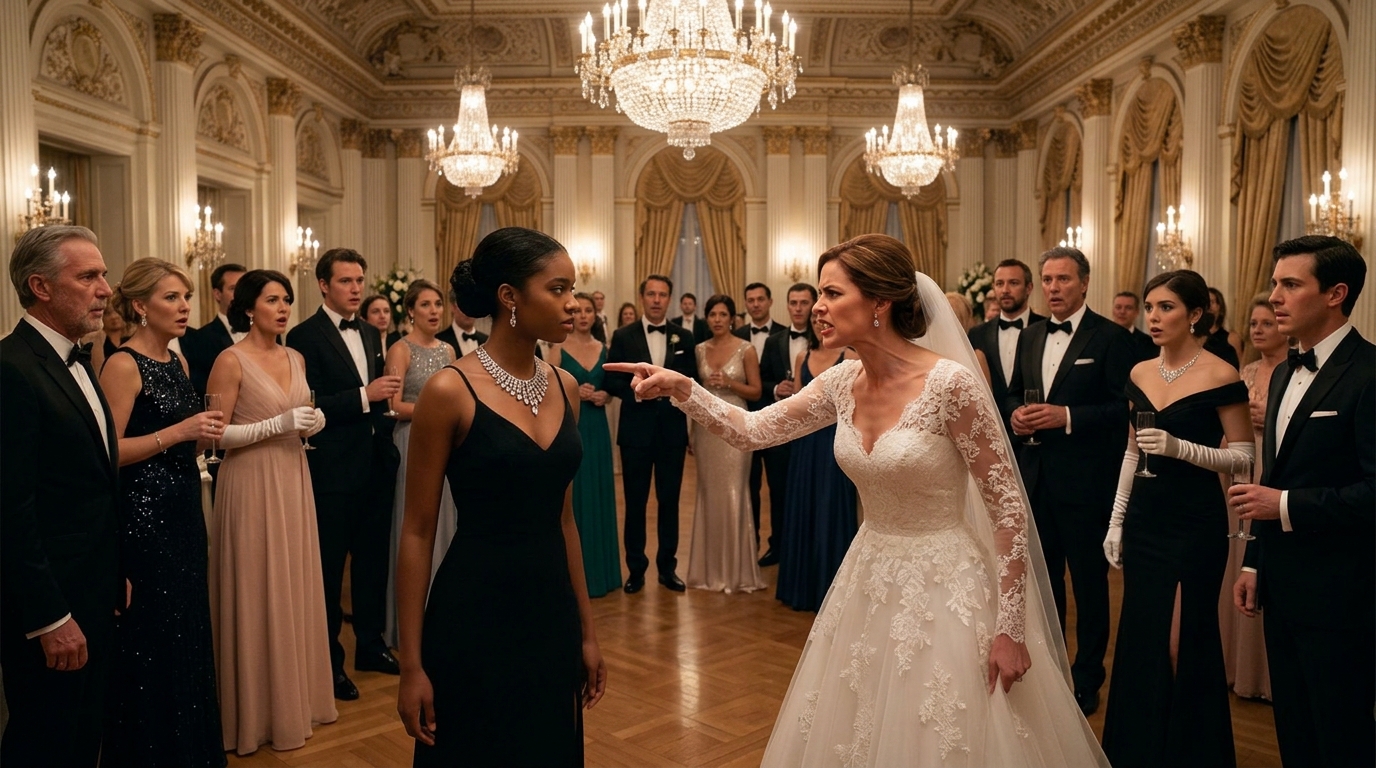
“TAKE OFF THAT NECKLACE RIGHT NOW!”
The command sliced through the lavish ballroom like a blade.
Every conversation stopped.
Every glass paused halfway to someone’s lips.
The string quartet near the marble staircase faltered, then went silent altogether.
At the center of the room stood the bride.
Vanessa Hart.
Luminous in white lace.
Perfect hair.
Perfect makeup.
Perfect smile gone completely.
Her eyes burned with fury as she stared across the ballroom at a young woman standing near the champagne table.
The woman was not dressed like a wedding guest.
Not really.
She wore a simple black dress, plain heels, and no visible jewelry except one impossible thing.
A diamond necklace.
Vanessa’s diamond necklace.
Or at least, the necklace Vanessa believed was hers.
It rested against the young woman’s collarbone, glittering beneath the chandelier light with a kind of quiet defiance.
A bold centerpiece.
Custom-cut stones.
Delicate silverwork.
A teardrop diamond at the center.
Vanessa knew every detail of it because she had designed it herself.
Three months of private consultations.
Two fittings.
A hidden payment.
A note from her fiancé, Dave, promising it would be waiting for her before the vows.
And now another woman was wearing it.
In her ballroom.
On her wedding day.
Vanessa’s fists clenched.
“Do you have any idea what you’re wearing?”
The young woman looked down at the necklace.
Then back at Vanessa.
Her expression remained calm.
Too calm.
“I saw it first,” she said softly.
A few guests gasped.
Vanessa’s face flushed with rage.
“You saw it first?”
The woman’s lips curved slightly.
“Now it belongs to me.”
The room stirred.
Whispers moved like wind through silk.
Vanessa stepped forward, her lace train dragging behind her.
“That necklace was custom-made for my wedding.”
Her voice rose.
“For my wedding!”
The young woman did not move.
That made Vanessa angrier.
“Security!”
The word echoed against the high ceiling.
Two men near the ballroom entrance straightened.
But before they could approach, the young woman smiled.
Slowly.
Unsettlingly.
Her gaze shifted from the necklace to Vanessa’s face.
“I’m not talking about the necklace.”
The ballroom went still.
Vanessa froze.
“What?”
The young woman touched the diamond at her throat.
“I’m talking about Dave.”
A heavy silence fell.
Then she said the sentence that shattered the entire wedding before the vows had even begun.
“I’m his fiancée.”
Vanessa’s mouth fell open.
The fury vanished from her face.
In its place came something far worse.
Dread.
Because this was no longer about a necklace.
It was about everything.
The Bride Who Had Planned Everything
Vanessa Hart had planned her wedding like a military campaign.
Nothing had been left to chance.
The flowers were white orchids flown in from Singapore.
The chairs were imported gold-backed designs she had seen in an Italian magazine.
The cake was seven tiers.
The photographer had a waiting list that stretched over a year, but Vanessa got him in six weeks because money and pressure were often the same language.
The ballroom belonged to the Harrington Grand Hotel, the most expensive venue in the city.
Her dress had been handmade in Paris.
Her shoes had crystals stitched into the heels.
Every table setting was arranged with a precision that made the staff nervous.
Vanessa wanted the day perfect.
Not beautiful.
Perfect.
And she wanted everyone to see it.
Her old classmates.
Her business rivals.
Her father’s investors.
Her mother’s social circle.
Everyone who had whispered that Vanessa Hart was too intense, too ambitious, too difficult to love.
Today was supposed to prove them wrong.
Today, she would marry David “Dave” Whitmore — charming, polished, wealthy, adored.
The kind of man who looked good beside power.
The kind of man who knew how to smile for cameras and hold a woman’s waist like he understood the value of appearances.
Dave had proposed to Vanessa on the terrace of a private restaurant overlooking the city.
He cried.
Or at least, his eyes turned glossy.
He told her she was the woman who made him want to become better.
Vanessa believed him.
Not because she was naive.
She did not think of herself that way.
She believed him because Dave was good at being believed.
He listened carefully.
Remembered details.
Sent flowers on hard days.
Praised her ambition instead of shrinking from it.
When Vanessa said she wanted a wedding that felt unforgettable, Dave said:
“Then let’s make them remember.”
Those words had sealed it.
She thought he understood her.
She thought he saw the girl beneath the armor.
The girl who had grown up in a house where affection had to be earned through achievement.
The girl whose mother corrected her posture before hugging her.
The girl whose father once told her, “People respect a woman more when she becomes expensive to disappoint.”
So Vanessa became expensive.
Expensive clothes.
Expensive taste.
Expensive expectations.
But Dave made her feel chosen.
Not tolerated.
Chosen.
That was why the necklace mattered.
Not because of the diamonds.
Because Dave had said:
“I want something made only for you.”
Only for you.
Now those words were lying in the center of the ballroom, around another woman’s neck.
The Woman in Black
The young woman’s name was Claire Bennett.
Vanessa did not know that yet.
All she saw was the black dress, the calm eyes, and the necklace that should not have been there.
Claire looked younger than Vanessa.
Maybe twenty-six.
Maybe twenty-seven.
Not glamorous.
Not poor, exactly, but clearly not part of this crowd.
She had the quiet stillness of someone who had already survived the worst part of the moment before entering it.
That stillness bothered Vanessa more than shouting would have.
“You’re lying,” Vanessa said.
Her voice came out too thin.
Claire looked toward the main staircase.
“Ask him.”
Every head turned.
Dave stood frozen halfway down the stairs.
His tuxedo was perfect.
His boutonniere still pinned.
His groom’s smile gone.
For a moment, he looked like a man trying to decide which reality would cost less.
Vanessa’s breath caught.
Because his face had already answered before his mouth did.
“Dave,” she said slowly.
He did not move.
Claire looked at him.
“Hello, David.”
Not Dave.
David.
The name landed differently.
Too intimate.
Too familiar.
The guests felt it.
Vanessa felt it too.
Dave came down the remaining steps carefully, as if the stairs might collapse beneath him.
“Claire,” he said quietly. “What are you doing here?”
A sound passed through the room.
A collective intake of breath.
He knew her.
Vanessa turned toward him.
“You know her?”
Dave opened his mouth.
Closed it.
Then tried the smile.
The one Vanessa had seen him use in uncomfortable business dinners.
The smile that made waiters relax and investors lean in.
“Vanessa, this is not what it looks like.”
Claire laughed.
Not loudly.
That made it worse.
“That’s interesting,” she said. “Because it looks exactly like what it is.”
Dave’s jaw tightened.
“Not here.”
Claire’s eyes hardened.
“Where, then? Your office? My apartment? The church where you proposed to me? Or the courthouse where you told me we would sign paperwork next week?”
Vanessa felt the blood leave her face.
Courthouse.
Paperwork.
Proposed.
Her mother, Caroline Hart, moved forward from the front row.
“This is absurd,” she snapped. “Security, remove this woman.”
Claire did not look at the guards.
She reached into her small black handbag and pulled out a folder.
Then she held it up.
“If anyone touches me before Vanessa sees this, I will send every page to the press before I leave the building.”
The guards stopped.
Caroline froze.
Vanessa stared at the folder.
Dave’s expression changed completely.
Fear.
Real fear.
Claire looked at Vanessa then.
For the first time, her voice softened.
“I didn’t come here to hurt you.”
Vanessa almost laughed.
“You didn’t?”
“No.”
“You walked into my wedding wearing my necklace and announced you’re my fiancé’s fiancée.”
Claire’s eyes flicked down.
“He gave it to me first.”
Vanessa’s breath hitched.
“No.”
Claire reached behind her neck and unclasped the necklace.
The room watched as she lowered it into her palm.
Then she turned it over.
On the back of the center diamond setting was a tiny engraving.
Vanessa already knew what it was supposed to say.
D + V
Dave had shown her the sketch.
D for Dave.
V for Vanessa.
Together.
Forever.
But Claire lifted the necklace into the light.
The engraving read:
D + C
The ballroom disappeared around Vanessa.
She heard nothing.
Not the whispers.
Not her mother’s sharp inhale.
Not the rustle of guests shifting in their chairs.
Only her own heartbeat.
D + C.
Dave and Claire.
The necklace had not been stolen from her.
It had never been hers.
It had been repurposed.
Repackaged.
Resold emotionally, if not financially.
A symbol of devotion recycled for another woman with only a story changed.
Vanessa turned slowly toward Dave.
“What did you do?”
The First Proposal
Claire did not cry when she began speaking.
That, more than anything, convinced the room she was telling the truth.
Liars often perform.
Claire looked exhausted by honesty.
“I met David two years ago,” she said. “At St. Agnes Hospital.”
Dave flinched.
Vanessa noticed.
Claire continued:
“My mother was receiving treatment there. David was visiting the children’s wing with one of his charity groups.”
A woman near the front whispered, “The Whitmore Foundation.”
Claire nodded slightly.
“Yes. He told me he ran community outreach. He said he had lost someone to cancer and wanted to make hospital stays less lonely.”
Vanessa looked at Dave.
He had told her that story too.
Only in her version, he had been visiting an elderly uncle.
Claire’s voice remained steady.
“He brought my mother books. Sat with her when I worked late. He was kind.”
Her mouth tightened.
“Very kind.”
Dave whispered:
“Claire, please.”
She ignored him.
“Six months later, he asked me to marry him.”
Vanessa gripped the edge of a nearby chair.
Claire opened the folder.
“The proposal was private. No photographers. No big scene. Just the hospital chapel after my mother’s final treatment.”
She pulled out a photograph.
Dave on one knee.
Claire crying.
The same necklace box in his hand.
The same man.
The same smile.
Vanessa’s throat closed.
“After my mother died,” Claire said, “David helped me handle everything. Funeral paperwork. Insurance. My apartment lease. He said we should wait to announce the engagement until things were calmer.”
She looked at him.
“I thought that was love.”
Dave stared at the floor.
Claire turned back to Vanessa.
“Then he began traveling more. Working late. Missing calls. I thought he was grieving too, in his way. He said the foundation was under pressure.”
Vanessa’s voice was barely audible.
“When did you find out about me?”
“This morning.”
The answer struck Vanessa.
Claire opened another page.
“My mother’s estate attorney called because a payment from my mother’s trust had been flagged. David had convinced me to authorize temporary access, saying it would help consolidate debts after her medical bills.”
Dave’s face went gray.
Claire continued:
“The attorney found transfers to a wedding vendor.”
Guests gasped.
Vanessa’s eyes widened.
No.
Claire looked directly at her.
“Your wedding vendors.”
Vanessa’s knees nearly weakened beneath her.
Claire was not done.
“Flowers. Venue deposit. Jewelry consultation. Photographer retainer. All partially paid through accounts linked to my mother’s estate.”
Caroline Hart’s face shifted from outrage to calculation.
Vanessa whispered:
“That’s not possible.”
Claire held out the documents.
“I wish it wasn’t.”
Vanessa took the papers with numb hands.
Line after line.
Payments.
Transfers.
Shell accounts.
Vendor names she recognized because she had approved every detail.
Dave had told her his family was covering certain costs.
She had believed him because the Whitmores had money.
Or appeared to.
Now the truth sat in her hands.
Her wedding had been decorated with another woman’s inheritance.
Her necklace had been bought first as another woman’s promise.
Her perfect day had been funded by grief.
Dave’s Defense
The room waited for Dave.
People always wait for the accused to explain, even when the evidence is already bleeding on the floor.
Dave looked around.
At Vanessa.
At Claire.
At the guests.
At the guards.
At the cameras.
Because of course phones were raised now.
Phones had been raised since Claire said the word fiancée.
Dave inhaled slowly.
Then began.
“I made mistakes.”
Vanessa laughed once.
The sound surprised even her.
Mistakes.
A burned dinner was a mistake.
A wrong turn was a mistake.
A double engagement funded by stolen estate money was something else.
Dave turned to her.
“Vanessa, I was trying to fix everything before today.”
“Fix?” she repeated.
He stepped closer.
“I was under pressure. My father’s accounts were frozen. The foundation had obligations. Your family expected a certain standard—”
“My family expected you not to be engaged to someone else.”
Claire’s face remained still.
Dave looked at her.
“I loved you.”
Claire’s eyes flashed.
“No.”
“I did.”
“You loved being trusted.”
The words hit him.
Good.
Vanessa felt them too.
Dave’s voice hardened.
“You don’t understand what I was carrying.”
Claire stared at him.
“My mother was dying.”
“And I was there for you.”
“You were studying my signature.”
The ballroom went silent.
Dave’s face flushed.
Vanessa looked at the documents again.
One page showed authorization forms.
Claire’s signature.
Another showed digital access approvals.
Claire said quietly:
“The attorney believes some documents were signed after my mother’s death.”
Dave’s mouth tightened.
Caroline Hart stepped backward as if distance might protect her family from scandal.
Vanessa saw it.
Her mother had already begun abandoning the scene.
That made something inside Vanessa go cold.
Her whole life, she had feared public embarrassment.
Now she stood inside it.
And for the first time, embarrassment was not the worst thing in the room.
Betrayal was.
Dave reached toward Vanessa.
She stepped back.
“Don’t.”
“Vanessa, listen to me. This can be handled privately.”
There it was.
Privately.
The word of men who trusted closed doors more than truth.
Claire’s voice cut through.
“That’s what he told me.”
Vanessa looked at her.
Claire continued:
“When I found the first transfer, he said we could handle it privately. When I asked about the necklace, he said I was emotional. When I asked why the jeweler had another invoice with Vanessa Hart’s name on it, he said rich women copy each other all the time.”
A murmur moved through the ballroom.
Vanessa looked at Dave with disgust.
“You told her I copied her?”
Dave said nothing.
Claire’s smile was sad.
“He told me a lot of things.”
Vanessa turned back to the folder.
Her hands were no longer shaking.
That scared her.
A few minutes ago, she had been ready to have Claire dragged out.
Now the room had split open, and Vanessa could see herself standing on the wrong side of the first scream.
She had shouted at Claire.
Humiliated her.
Called security.
Demanded the necklace.
Because Vanessa had assumed she was the injured party before asking who else had been wounded.
That realization burned.
The Bride Removes Her Veil
Vanessa reached up and slowly removed her veil.
Her mother’s eyes widened.
“Vanessa,” Caroline warned.
Vanessa ignored her.
She folded the veil once.
Then again.
Then placed it on the nearest chair.
The gesture was small.
But everyone understood.
The wedding was dying.
Dave understood too.
“Don’t do this,” he said.
Vanessa looked at him.
“I haven’t done anything yet.”
His voice dropped.
“You know what this will do to both families.”
She smiled faintly.
There was no warmth in it.
“My family will survive humiliation. Will yours survive investigation?”
Dave’s face hardened.
Claire looked at Vanessa then with something like surprise.
Caroline stepped in quickly.
“Vanessa, think. We need legal counsel before you make a public statement.”
Vanessa turned toward her mother.
“Did you know?”
Caroline froze.
“Know what?”
“Did you know Dave’s family was in financial trouble?”
Caroline’s face shifted.
Barely.
But Vanessa had learned from the best.
She saw it.
“You knew.”
Caroline lowered her voice.
“This is not the place.”
Vanessa laughed softly.
“Apparently this is exactly the place.”
Her mother moved closer.
“Every engagement has complexities.”
Claire’s face tightened.
Vanessa stared.
“Complexities?”
Caroline’s eyes flicked toward Claire.
“We did not know about… her.”
Her.
Not Claire.
Her.
Vanessa looked at the young woman in black holding the folder of evidence like it was the last thing left from her mother.
Something in Vanessa’s chest twisted.
She turned back to Caroline.
“But you knew he needed money.”
Caroline’s lips thinned.
“We knew the Whitmores were experiencing temporary liquidity challenges.”
“And you still encouraged the wedding.”
“Marriage is often strategic.”
That sentence did it.
Not Dave.
Not the necklace.
Not even the stolen funds.
That sentence.
Vanessa suddenly saw the entire room differently.
The flowers.
The guests.
The dress.
The family alliances.
The polished smiles.
The perfect photographs that had not yet been taken.
Her mother had not cared whether Dave loved her.
Only whether the match looked powerful enough.
Dave had not cared whether Vanessa loved him.
Only whether marrying her could save him.
And Vanessa herself had almost cared more about the necklace than the woman wearing it.
She looked down at the white lace wrapped around her body.
For the first time, it felt like costume instead of beauty.
She turned to Claire.
“I’m sorry.”
The room went still.
Claire blinked.
Vanessa forced herself to continue.
“When you walked in, I thought you were trying to steal from me. I spoke to you like you were nothing.”
Claire said nothing.
Vanessa’s voice tightened.
“I was wrong.”
Claire studied her.
Then gave a small nod.
Not forgiveness.
Acknowledgment.
That was enough.
The Police Arrive
Security did not remove Claire.
Instead, they blocked the exits.
Not dramatically.
Quietly.
At Vanessa’s instruction.
Dave noticed too late.
“What are you doing?”
Vanessa looked at him.
“Making sure you stay for the next part.”
He turned toward the main doors.
Two uniformed officers entered.
Behind them came a woman in a navy suit with a badge clipped at her waist.
Detective Mara Ellison.
Claire exhaled.
Vanessa looked at her.
“You called them?”
Claire nodded.
“Before I came in.”
Dave’s face twisted.
“You set me up.”
Claire looked at him, truly looked at him, as if seeing the man beneath every performance.
“No, David. I gave you an audience.”
Detective Ellison approached.
“David Whitmore?”
Dave took one step back.
The officers moved.
Caroline said sharply:
“Detective, this is a private event.”
Mara Ellison glanced around the ballroom.
“Not anymore.”
Vanessa almost smiled.
The detective turned to Claire.
“Ms. Bennett?”
Claire handed over copies of the documents.
“The originals are with my attorney.”
“Good.”
Dave looked at Vanessa, desperation entering his voice.
“Vanessa, don’t let this happen.”
She stared at him.
The man she had almost married.
The man who had proposed with polished words and another woman’s money.
The man who had let her stand at the edge of a vow built on theft.
“I’m not letting anything happen,” she said. “I’m finally not stopping it.”
The officers took Dave by the arms.
He struggled only once.
Not enough to look violent.
Enough to look pathetic.
As they led him away, he turned back.
“You’ll regret this.”
Both women answered at the same time.
“No.”
For the first time all evening, Vanessa and Claire looked at each other and almost laughed.
Not because anything was funny.
Because the same lie had finally stopped working on both of them.
The Reception Without a Groom
The wedding did not happen.
Obviously.
But the ballroom did not empty immediately.
People lingered in strange clusters, unsure whether to leave, gossip, comfort, or pretend they had urgent calls.
Vanessa stood near the head table, veil removed, necklace gone, her future disassembled in front of two hundred guests.
Claire stood beside the champagne table, still holding the folder.
The diamond necklace lay between them on a folded napkin.
Neither wanted to touch it.
A symbol can become filthy without changing shape.
Caroline approached Vanessa.
“We should leave.”
Vanessa did not move.
“Why?”
“Because this is humiliating.”
Vanessa looked at her mother.
“Yes.”
Caroline’s face softened in the way she used when trying to regain control.
“Darling—”
“No.”
The word stopped her.
Vanessa had said no to many people before.
But rarely to her mother.
Caroline’s expression hardened.
“You are emotional.”
“For once, yes.”
“This will be everywhere.”
“Good.”
Caroline stared.
Vanessa looked around the ballroom.
“All these people came to watch me marry a fraud. They can stay long enough to watch me not marry him.”
Claire looked over.
Something like respect entered her face.
Vanessa walked to the microphone near the band platform.
The feedback squealed softly.
Guests turned.
Her heart pounded.
For years, she had imagined speaking at her wedding.
A polished speech.
A witty thank-you.
A few tears at the perfect moment.
This was not that.
“My apologies,” Vanessa said.
Her voice echoed through the ballroom.
“This evening will not continue as planned.”
A few nervous laughs.
No one knew if laughing was allowed.
Vanessa looked at Claire.
Then at the necklace.
“I owe someone in this room a public apology.”
Claire looked down.
Vanessa continued:
“When Claire Bennett entered wearing a necklace I believed was mine, I treated her as an intruder. I demanded security remove her. I assumed she was the problem because that was easier than considering that the man I was about to marry might be.”
The room was silent now.
“I was wrong.”
Claire’s fingers tightened around the folder.
Vanessa swallowed.
“David Whitmore deceived both of us. Worse, he appears to have used funds connected to Claire’s late mother to pay for parts of this wedding.”
Gasps.
Whispers.
A few people who had not understood the documents now understood enough.
Vanessa’s voice grew steadier.
“This reception is paid for. The food is here. The staff should not lose wages because of his crimes or my family’s vanity.”
Caroline’s face went pale.
Vanessa continued:
“So anyone who wishes to stay may eat. The bar will remain open. The band will be paid. The staff will receive double gratuity.”
Her mother inhaled sharply.
Vanessa ignored it.
“And the gift table will be closed. Anyone who brought a gift may take it back or donate it. There is a children’s hospital fund listed near the entrance. A real one. Not connected to the Whitmore Foundation.”
A few people clapped.
Awkwardly at first.
Then more.
Not everyone.
But enough.
Vanessa stepped down from the platform.
Her hands were shaking now.
Claire approached slowly.
“You didn’t have to do that.”
Vanessa looked at her.
“Yes, I did.”
Claire’s eyes softened slightly.
“My mother would have liked that part. About the staff.”
“What was her name?”
“Evelyn.”
Vanessa nodded.
“I’m sorry about Evelyn.”
Claire looked at the necklace.
“So am I.”
The Necklace’s True Owner
Detective Ellison returned later that evening after taking Dave away.
She spoke with both women in a private side room near the ballroom.
The necklace sat in an evidence bag on the table.
Vanessa stared at it.
Claire did not.
The detective explained what they already suspected.
Dave had been under quiet investigation for financial fraud related to charitable accounts. Claire’s attorney had escalated the matter that morning. The wedding transfers connected several missing pieces.
The necklace itself had been ordered under Claire’s name, then modified, then re-invoiced under Vanessa’s.
Technically, it belonged to neither of them until the payments were untangled.
Emotionally, it belonged to a lie.
Vanessa looked at Claire.
“Do you want it back?”
Claire shook her head immediately.
“No.”
Vanessa nodded.
“Neither do I.”
Detective Ellison glanced between them.
“That can be addressed later.”
Claire leaned back in her chair.
“My mother’s estate paid for part of it, didn’t it?”
“Likely.”
Claire closed her eyes.
Vanessa said quietly:
“Then when the case is over, sell it.”
Claire opened her eyes.
Vanessa continued:
“Use whatever comes from it to restore your mother’s estate.”
Claire looked at her for a long moment.
“And your part?”
Vanessa almost laughed.
“My part was humiliation. I’ve already received it.”
Claire’s mouth curved faintly.
Then she said:
“You know, when I came here, I hated you.”
“I know.”
“I thought you must have known.”
“I didn’t.”
“I believe you now.”
Vanessa lowered her gaze.
“Thank you.”
Claire’s voice changed.
“But you were cruel when you thought I was beneath you.”
Vanessa accepted that.
“Yes.”
“I don’t want to become friends because we were hurt by the same man.”
Vanessa nodded.
“Good. That would be too neat.”
Claire looked surprised.
Then she smiled a little.
“Exactly.”
Vanessa looked at the evidence bag.
“Maybe we just become witnesses.”
“To what?”
“To the fact that he doesn’t get to tell either story.”
Claire considered that.
Then nodded.
“I can live with that.”
Dave’s Collapse
The scandal broke before midnight.
Someone leaked video of Claire’s entrance.
Someone else leaked Dave being led out.
By morning, the city had watched Vanessa scream about a necklace, Claire reveal the engagement, and Dave lose his perfect mask under chandelier light.
The Whitmore Foundation issued a statement.
Then deleted it.
Then issued another.
The Hart family issued nothing because Vanessa refused to let her mother write the statement.
Dave’s father denied knowledge of any wrongdoing.
Documents later showed he knew enough.
Within weeks, accounts were frozen.
Civil suits followed.
Criminal charges expanded.
Claire’s mother’s estate became one of several linked to Dave’s fraud.
There were others.
Not fiancées necessarily.
But donors.
Patients’ families.
Small charities.
People who had trusted his soft voice and polished grief.
Vanessa watched the case unfold from a distance.
At first, she expected to feel only rage.
She did feel rage.
Plenty of it.
But beneath it was shame.
Not for being deceived.
That was Dave’s crime.
The shame came from the moment before the truth.
When she had looked at Claire and seen an obstacle.
A thief.
A woman to be removed.
Not a person.
That moment stayed with her.
It made her change things.
Quietly at first.
Then publicly.
She stepped away from several family boards.
Caroline called it emotional self-sabotage.
Vanessa called it breathing.
She sold the Paris wedding dress and donated the money to the hospital where Claire’s mother had been treated.
Not as apology.
Claire made it clear she did not want gestures dressed as redemption.
So Vanessa gave anonymously.
Then told no one.
That made it feel cleaner.
Claire, meanwhile, rebuilt what Dave had damaged.
Not quickly.
Legal recovery took time.
Grief took longer.
She moved out of the apartment Dave had helped choose.
She returned his ring to evidence.
She kept one thing only: the photograph of his proposal.
Not because she loved it.
Because she wanted to remember how convincing a lie could look when photographed from the right angle.
One Year Later
A year after the wedding that never happened, Vanessa received an envelope.
No return address.
Inside was a small card.
The necklace sold. My mother’s estate is restored. I thought you should know.
— Claire
There was no warmth in the message.
No invitation.
No sentimental ending.
Vanessa appreciated that.
She placed the card in her desk drawer beside the canceled marriage license.
Then she sat for a long time, looking out at the city.
Her assistant knocked.
“Ms. Hart? The charity audit committee is here.”
Vanessa stood.
“Good.”
The audit committee was new.
Independent.
Uncomfortable.
Necessary.
If she had learned anything from Dave, it was that charm becomes dangerous when no one checks the books.
She walked into the conference room and began the meeting on time.
No flowers.
No champagne.
No perfect image.
Just records.
Receipts.
Questions.
Truth.
For the first time in her life, Vanessa found the imperfection comforting.
What the Necklace Revealed
People later told the story as if the necklace destroyed the wedding.
That was not true.
The necklace only revealed what was already broken.
Dave had broken the wedding long before Claire entered the ballroom.
He broke it when he proposed twice.
When he used grief as a bank account.
When he took Claire’s trust and Vanessa’s ambition and braided them into a rope he hoped would pull him out of ruin.
Vanessa had broken something too.
Not the wedding.
Something inside herself.
The part that believed being chosen by the right man in the right room would finally prove she was enough.
Claire broke something as well.
The silence.
The private shame.
The quiet suffering men like Dave depend on.
She walked into a room designed to exclude her and made it listen.
The necklace glittered in the center of it all.
Beautiful.
Expensive.
Rotten with meaning.
A custom piece for a wedding that was never honest.
A promise engraved with the wrong initials.
A diamond bright enough to blind everyone until one woman dared to turn it over.
Years later, Vanessa would still remember the exact moment Claire said:
“I’m talking about Dave.”
That was when the room shifted.
That was when fury became fear.
That was when a bride realized the woman she wanted removed might be the only person telling the truth.
And she would remember what came after.
The apology.
The evidence.
The police.
The canceled vows.
The reception that became something stranger than a celebration.
An escape.
A correction.
A public refusal to keep performing a lie.
Vanessa never wore a diamond necklace again.
Not because diamonds were ruined.
Because she had learned that some things shine hardest when they are trying to distract from rot.
And Claire, when asked years later whether she regretted walking into that ballroom, always said the same thing:
“No. I regret trusting him. I don’t regret exposing him.”
Then, sometimes, she would add:
“The bride screamed at me first. But in the end, she listened.”
That was not friendship.
Not forgiveness.
But it was something.
Two women standing on opposite sides of the same lie, each holding enough truth to bring the whole beautiful room down.