The Man They Laughed At
The old man walked into the dealership looking like a punchline.
That was their first mistake.
The showroom was all glass, chrome, polished tile, and expensive confidence. Sunlight poured through the tall windows and slid across the hood of a red sports car positioned in the center like a jewel on display.
The car was impossible to miss.
Low.
Sleek.
Bright red.
The kind of car people photographed even when they knew they would never own it.
Salesmen in fitted suits moved through the room with practiced smiles. Customers spoke in low voices. A woman in a beige blazer tapped at a tablet near the coffee station. Somewhere in the back, a manager’s office door sat half-open.
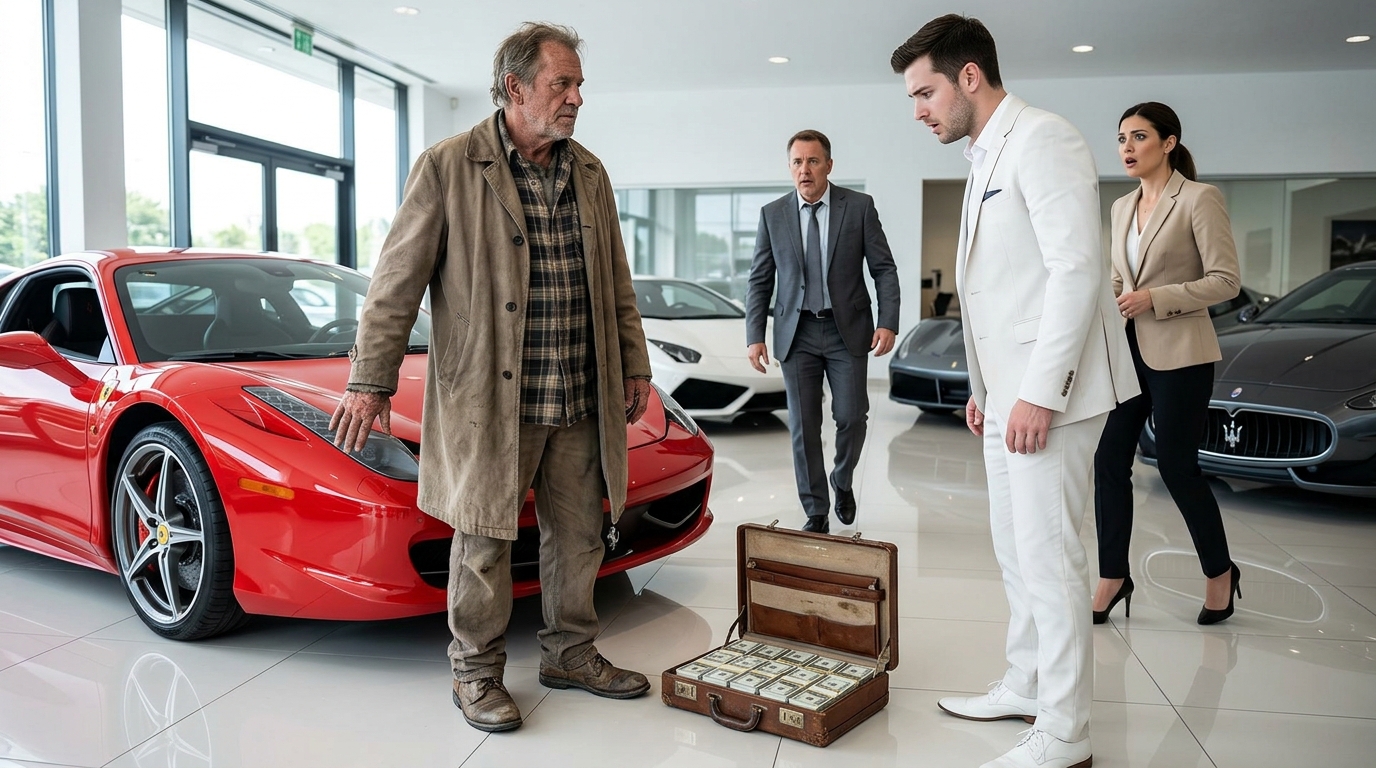
Then the old man stepped inside.
Faded brown coat.
Worn plaid shirt.
Beat-up shoes.
A battered leather briefcase in one hand.
His gray hair was combed neatly, but the wind had disturbed it. Dust clung faintly to the cuffs of his trousers. He looked less like a buyer and more like someone who had wandered in from the wrong bus stop.
The salesman in the white suit saw him first.
His name was Brandon Whitmore.
Twenty-eight years old.
Perfect haircut.
Perfect watch.
Perfect smile.
The kind of man who believed expensive clothes made him important, even when the importance belonged mostly to the building around him.
He looked the old man up and down once.
Just once.
That was all it took for him to decide.
The old man did not belong here.
Brandon strolled over with a smile that had no warmth in it.
“Can I help you find something?”
The old man’s eyes stayed on the red sports car.
“That one,” he said.
Brandon glanced at the car, then back at him.
His smile widened.
“That one?”
“Yes.”
“That’s a limited edition model.”
“I can see that.”
“Six figures.”
“I assumed.”
A salesman standing near the reception desk chuckled under his breath.
Brandon leaned slightly closer, lowering his voice just enough to sound polite while still making sure nearby people could hear.
“You can’t even afford a tire on this car.”
The colleague laughed.
“Maybe we should print him a bus schedule instead.”
A few heads turned.
The woman in the beige blazer covered her smile with her coffee cup.
The old man did not flinch.
He did not blush.
He did not argue.
He did not try to prove himself with a speech.
He simply walked closer to the red sports car and studied the curve of the hood as if measuring a memory.
Brandon followed, amused now.
“Careful,” he said. “The paint costs more than that coat.”
The old man placed his leather briefcase on the glossy tile.
The sound was small.
But something about it cut through the laughter.
“That’s enough,” he said.
His voice was not loud.
It did not need to be.
“I’m buying this one.”
Brandon’s smirk deepened.
“With what? Pocket lint?”
The old man bent down slowly, flipped the two brass latches, and opened the briefcase.
The laughter vanished.
Inside were tightly bundled stacks of cash.
Not a few bills.
Not a down payment.
Enough to buy the car outright.
The showroom fell silent.
The woman in the beige blazer stopped smiling first.
Then Brandon’s expression changed too — not into respect, but confusion.
Because rich men were supposed to look rich.
They were supposed to arrive polished, announced, expected.
This man looked like he had stepped in from a forgotten road, dust still on his sleeves and history in his hands.
The old man closed the briefcase.
“Cash,” he said.
From the back office, the sales manager glanced up.
His name was Paul Mercer.
At first, he looked irritated by the sudden silence. Then he saw the old man.
He froze mid-step.
All color drained from his face.
Then he moved quickly across the showroom.
“Mr. Thomas,” he said, almost breathless. “Good to see you.”
Brandon looked from the manager to the old man.
“Mr… Thomas?”
Paul’s voice tightened.
“Get him the keys. Full price.”
Brandon went pale.
The woman in the beige blazer stepped backward.
Because now they understood two things at once.
This was not a broke man pretending to be wealthy.
And they had just insulted someone so powerful that the manager looked frightened of disappointing him.
Brandon tried to recover.
“Sir, I—I didn’t realize—”
“No,” Mr. Thomas said quietly. “You realized exactly what you wanted to realize.”
The whole showroom went still.
Then, instead of taking the keys, the old man rested one rough hand on the hood of the red car.
“I’m not here because I want the car.”
Paul Mercer’s face lost whatever color remained.
Mr. Thomas looked directly at Brandon.
“I’m here because twenty years ago, in this exact showroom, your father said the same thing to me.”
Twenty Years Earlier
Twenty years ago, Elijah Thomas had not been rich.
He had not been poor in spirit, but he was certainly poor in ways people could measure.
He worked nights repairing industrial machines in a factory outside town. During the day, he took whatever odd work came his way: fixing engines, hauling scrap, patching roofs, rebuilding broken lawn mowers for neighbors who paid him in cash and sometimes in food.
He wore the same brown coat back then.
Newer, but still cheap.
The same leather briefcase too.
It had belonged to his father, a school janitor who believed a man should carry his papers with dignity even if the papers were unpaid bills.
Elijah’s wife, Ruth, used to tease him about that briefcase.
“You look like a lawyer who got lost in a machine shop,” she would say.
And Elijah would answer, “One day this thing will carry something important.”
Ruth believed him.
That was her gift.
She believed in things before they looked believable.
She had believed in Elijah when he was a quiet young man with grease under his fingernails and no idea how to talk about love except by fixing things before anyone asked.
She believed in their little garage behind the house, where Elijah rebuilt engines long after midnight.
She believed in his drawings of safer lift systems and stronger hydraulic components.
She believed in the small inventions he scribbled on napkins.
She believed even when everyone else smiled politely and told him to be realistic.
For their twentieth anniversary, Elijah wanted to do one beautiful, unreasonable thing.
Ruth had never asked for much.
Not jewelry.
Not vacations.
Not expensive dinners.
But when they were young, before bills and grief and years of work bent their shoulders, she once pointed at a red sports car in a magazine and said:
“If I ever win the lottery, I want one ride in that.”
Not ownership.
Not status.
One ride.
Elijah remembered.
For three years, he saved.
Not from abundance.
From sacrifice.
He repaired machines after shifts. He sold a patent idea to a local manufacturer for far less than it was worth because he needed cash. He skipped lunches, took buses, patched his boots, and hid every spare dollar in envelopes Ruth never found.
By the time their anniversary came, he had enough to buy a used red sports car from Whitmore Luxury Motors.
Not new.
Not the most expensive model.
But red.
Beautiful.
Fast.
A machine that looked like joy.
He walked into the dealership with the same leather briefcase in his hand.
Cash inside.
Not because he wanted to show off.
Because the bank would not finance him cleanly, and he did not want debt hanging over Ruth’s one unreasonable dream.
He asked for the red car near the window.
The salesman who approached him was Harold Whitmore.
Brandon’s father.
Harold was older then than Brandon was now, but the smile was the same.
Same polished cruelty.
Same quick eyes.
Same belief that money announced itself through fabric, watches, and confidence.
Harold looked at Elijah’s coat and said:
“You can’t afford the floor mats in that thing.”
Elijah remembered every word.
Not because insults are rare.
Working men hear plenty.
But because Ruth was outside in the parking lot that day, sitting in their old truck, waiting.
He had wanted to surprise her.
He had planned to bring the salesman out, place the keys in her hand, and watch her face change.
Instead, through the glass, she saw Harold laughing.
She saw other salesmen laughing.
She saw Elijah standing there with the briefcase in his hand, trying to keep his dignity while being treated like dirt on polished tile.
Elijah opened the briefcase that day too.
The laughter stopped then, just as it stopped twenty years later.
But Harold Whitmore did not apologize.
He looked at the cash and said:
“Where’d you get that kind of money?”
Not with curiosity.
With suspicion.
A security guard stepped closer.
Elijah closed the briefcase.
“I earned it.”
Harold smirked.
“I’m sure.”
That was the moment Elijah decided not to buy the car.
He could have.
He had enough.
But something in him refused to let Ruth’s dream be handed over by a man who had spit on it first.
So he walked out.
Ruth said nothing when he climbed into the truck.
She simply placed her hand over his.
He expected pity.
Instead, she whispered:
“Good.”
He looked at her.
She smiled gently.
“I don’t want a beautiful thing from ugly hands.”
That sentence stayed with him longer than the insult.
The Road After Humiliation
Ruth died three years later.
Cancer.
Fast enough to feel cruel.
Slow enough to make hope painful.
Elijah never got her the ride in the red car.
That became one of the regrets he carried quietly.
Not the biggest.
There are larger griefs than missed gestures.
But some small regrets have sharp edges because they seem so fixable from the wrong side of time.
After Ruth passed, Elijah worked because stopping would have killed him.
He went back to the garage.
Back to machines.
Back to sketches.
The patent he had sold too cheaply was improved by the company that bought it. They made millions. He made almost nothing.
That should have broken him.
Instead, it taught him.
The next invention he kept.
A safer locking system for hydraulic lifts.
Then a modular repair component.
Then a diagnostic tool that saved factories hours of downtime.
Slowly, the man who had been laughed out of Whitmore Luxury Motors became the owner of Thomas Industrial Systems.
Then Thomas Manufacturing.
Then Thomas Mobility.
He did not become flashy.
Money did not teach him to wear better coats.
It taught him to pay his workers before himself.
To remember names.
To distrust polished men who smiled downward.
To keep the old briefcase.
He built factories that had break rooms cleaner than executive lounges. He created scholarships for trade-school students. He funded widow assistance programs for families of workers killed in industrial accidents.
People called him eccentric.
Humble.
Difficult to read.
He preferred useful.
But one thing never left him.
Whitmore Luxury Motors.
Not because of the car.
Because of what the showroom had revealed.
A culture can be inherited like a building.
A son can learn a father’s handshake, his business, his cruelty.
Elijah watched from a distance as Harold Whitmore grew older, then retired, then handed influence to his son Brandon.
The dealership declined quietly.
Bad loans.
Overextended inventory.
Legal complaints.
A reputation for humiliating customers who did not look “qualified.”
Then, six months before Elijah walked in with the briefcase again, Thomas Mobility acquired the dealership’s debt.
Paul Mercer, the sales manager, knew.
The final ownership transfer had not yet been announced.
Elijah could have signed the papers from an office.
He could have fired half the showroom by email.
He could have destroyed the Whitmore name cleanly, legally, without ever stepping inside.
Instead, he came in person.
Wearing the old coat.
Carrying the old briefcase.
Not to buy a car.
To see whether the place had changed.
It had not.
The Showroom Learns His Name
Back in the present, nobody in the showroom moved.
Brandon looked as if someone had pulled the floor from under him.
“My father?” he said.
Elijah Thomas studied him.
“You have his smile.”
Brandon swallowed.
Paul Mercer stepped forward quickly.
“Mr. Thomas, I sincerely apologize. This is unacceptable. Brandon, go to my office immediately.”
“No,” Elijah said.
Paul stopped.
Elijah’s hand remained on the hood of the red sports car.
“Let him stay.”
Brandon looked trapped now.
The other salesmen avoided his eyes.
The woman in the beige blazer tried to return to her desk, but Elijah glanced toward her.
“You too.”
She froze.
“Yes, sir.”
Elijah looked around the showroom.
“Everyone who laughed can stay.”
No one spoke.
A customer near the coffee station slowly set down his cup.
Elijah lifted the briefcase onto the hood of the car, then thought better of it and set it on the floor beside him.
“This dealership has a habit,” he said. “It mistakes clothing for character.”
Paul’s jaw tightened.
Elijah turned toward him.
“You knew I was coming.”
“Yes, sir.”
“Did you warn them?”
“I told the staff we were expecting a major client.”
Elijah looked at Brandon.
“And this is how they treat unexpected ones.”
Paul had no answer.
Brandon finally found his voice.
“Mr. Thomas, I apologize. It was a joke.”
Elijah’s eyes sharpened.
“A joke requires everyone to be allowed to laugh.”
Brandon flushed.
“I didn’t mean—”
“Yes, you did.”
The words were not shouted.
That made them worse.
“You meant to remind an old man that he was beneath you. You meant to make your colleague laugh. You meant to make the room understand that this car, this showroom, this world, belonged to people who looked like you.”
Brandon’s mouth opened.
Nothing came out.
Elijah continued:
“You were wrong about the money. But that is the least important thing you were wrong about.”
The silence was complete now.
Even the mechanics visible through the glass partition to the service bay had stopped working.
Elijah looked toward the red car.
“Twenty years ago, your father told me I could not afford a tire on a red car parked in this same spot. I had the money then too.”
Brandon’s eyes widened slightly.
“You did?”
“Yes.”
“Then why didn’t you buy it?”
Elijah’s face softened, but only for a moment.
“Because my wife said she did not want a beautiful thing from ugly hands.”
The sentence moved through the showroom slowly.
Some people looked down.
Others looked at Brandon.
The woman in the beige blazer’s face changed.
Not fear now.
Shame.
Elijah picked up the keys from the hood. Paul must have placed them there without anyone noticing.
He looked at them for a long time.
Then held them out to Brandon.
“Sell me the car.”
Brandon blinked.
“What?”
“Sell me the car.”
Paul looked startled.
“Mr. Thomas—”
Elijah raised a hand.
Brandon stared at the keys like they might burn him.
“I… yes. Of course. I can—”
“No,” Elijah said. “Not like that.”
Brandon froze.
“Sell it to me the way you would have if I had walked in wearing a tailored suit.”
Brandon’s face reddened.
“I don’t understand.”
“That is part of the problem.”
The Sale That Became a Test
For the next ten minutes, the showroom became the most uncomfortable classroom in the city.
Elijah stood beside the red car with his old coat, beat-up shoes, and cash-filled briefcase.
Brandon stood across from him, pale and sweating in his white suit.
“Tell me about the car,” Elijah said.
Brandon cleared his throat.
“It’s a limited edition V12—”
“Look at me when you speak.”
Brandon did.
His eyes flickered with embarrassment.
“It’s a limited edition V12 coupe. Six-speed manual. Carbon ceramic brakes. Custom interior package. Only two hundred made in this configuration.”
“What makes it worth the price?”
Brandon hesitated.
“The performance. The exclusivity. The engineering.”
Elijah nodded.
“Good. Now ask me what I need.”
Brandon looked confused.
“What you need?”
“Yes.”
“But you already said—”
“A salesman who only hears the price never learns the customer.”
Brandon swallowed.
“What do you need, sir?”
Elijah looked at the car.
“I need to know if it can carry a memory without making a fool of it.”
No one understood the answer.
But no one dared laugh.
Brandon looked at him, really looked this time.
Not at the coat.
Not at the shoes.
At the man.
“I don’t know,” he said quietly.
Elijah studied him.
“That is the first honest thing you have said.”
Brandon lowered his gaze.
The lesson continued.
Financing.
Registration.
Delivery.
Inspection.
Warranty.
At every step, Elijah asked questions Brandon should have known how to answer without arrogance.
Sometimes Brandon answered well.
Sometimes badly.
Each mistake revealed something.
Not only about him.
About the dealership.
How customers were sorted.
How assumptions were made.
How respect was rationed based on appearance.
Paul Mercer stood nearby, looking increasingly sick.
Finally, Elijah signed the paperwork.
He paid full price.
Cash verified.
Receipt printed.
Keys ready.
The sale was complete.
Everyone expected the tension to end.
It did not.
Elijah took the keys, placed them on top of the paperwork, and slid them back across the desk.
Brandon frowned.
“Sir?”
“I will not be driving it today.”
Paul looked alarmed.
“Was there an issue?”
“No.”
Elijah stood.
“The car will remain here until tomorrow morning.”
“Of course,” Paul said quickly. “We can arrange delivery wherever you—”
“I want it placed in the front window.”
Paul blinked.
“The front window?”
“Yes.”
Elijah looked toward the showroom glass.
“With a sign.”
Brandon’s face tightened.
“What kind of sign?”
Elijah looked at him.
“The kind that tells the truth.”
The Sign in the Window
By sunset, the red sports car sat in the front window.
Polished.
Perfect.
Bright under the showroom lights.
Next to it stood a simple white sign with black lettering.
No dealership slogans.
No financing promotions.
No sales language.
Just words Elijah Thomas had written by hand and asked the staff to print cleanly:
This car was purchased by a man who was told he could not afford a tire.
Treat every person who walks through these doors like they may be carrying a dream, a memory, or a grief you cannot see.
The sign drew attention immediately.
People stopped outside.
Took photos.
Read it twice.
Some came inside to ask.
Paul hated the publicity at first.
Then feared it.
Then realized it was the only thing keeping the day from becoming something worse.
Brandon stood near the back, silent.
For the first time since he started working at the dealership, nobody wanted his jokes.
At closing time, Elijah remained in the showroom alone with Paul.
The staff had gone home, except Brandon, who lingered near the service hallway.
Elijah knew he was there.
So did Paul.
“Elijah,” Paul said quietly, using his first name for the first time. “I should have done more.”
Elijah looked at him.
“You were here twenty years ago.”
Paul nodded.
“I was a porter. Washing cars. I saw what Harold did.”
“And?”
Paul’s face tightened.
“And I did nothing.”
“You were young.”
“That excuse helped me sleep for a while.”
Elijah waited.
Paul continued:
“When I became manager, I told myself I would run things differently. But Harold still owned the place. Then Brandon came in. Then the habits stayed.”
“Habits do not stay by themselves,” Elijah said.
Paul nodded.
“No. People keep them.”
Elijah looked toward the red car.
“Tomorrow morning, the acquisition becomes public.”
Paul closed his eyes briefly.
“I thought so.”
“The Whitmore family will no longer control this dealership.”
Paul nodded.
“What happens to the staff?”
“That depends.”
“On what?”
Elijah turned toward the service hallway.
“Whether they can learn.”
Brandon stepped out slowly.
His face was pale.
“You knew I was there?”
Elijah almost smiled.
“I’m old, not deaf.”
Brandon approached, no smirk now.
No performance.
“Mr. Thomas…”
He stopped.
Swallowed.
Then started again.
“I’m sorry.”
Elijah said nothing.
Brandon looked at the floor.
“I know that’s not enough.”
“No.”
“I grew up around this place. My father used to say people tell you their worth before they open their mouths. Shoes. Watches. Cars. He said poor-looking customers waste time.”
Elijah’s expression did not change.
Brandon continued:
“I thought it was business.”
“No,” Elijah said. “It was laziness.”
Brandon flinched.
“It was cruelty,” Elijah added.
Brandon nodded.
“Yes.”
The word cost him something.
Good.
Elijah picked up the keys again.
“Do you know what your father did after I left twenty years ago?”
Brandon shook his head.
“He laughed. Then he sold the car to a banker who totaled it within six months.”
Brandon looked up.
Elijah’s voice softened.
“My wife died before I ever gave her that ride.”
The room went still.
Brandon’s face changed.
For once, there was no practiced expression to hide behind.
“I’m sorry,” he whispered.
This time, the words sounded different.
Elijah heard it.
But he did not rescue him from the discomfort.
“Tomorrow,” Elijah said, “you report to the service bay.”
Brandon blinked.
“What?”
“No suit. No sales desk. No commission.”
Paul looked surprised but stayed quiet.
Elijah continued:
“You will spend six months learning every part of the business that your father taught you to look down on. You will clean cars. Change tires. Shadow mechanics. Handle customer complaints from people whose clothes do not impress you. If after six months the service manager says you have learned humility, you may apply to return to sales.”
Brandon stared.
“That’s… a demotion.”
“Yes.”
“Are you firing me?”
“No.”
“Why not?”
Elijah looked at him for a long moment.
“Because someone should have taught your father before he taught you.”
Brandon’s eyes lowered.
He nodded.
“I’ll do it.”
Elijah’s voice remained firm.
“You will not do it as punishment.”
Brandon looked up.
“You will do it as education.”
Ruth’s Ride
The next morning, the story spread.
A video of Brandon mocking Elijah had been posted online by a customer.
Then the briefcase.
Then the manager’s panic.
Then the sign beside the red car.
By noon, people were driving past the dealership just to take photos.
Some praised Elijah.
Some mocked Brandon.
Some turned the whole thing into a joke, because the internet has a talent for flattening human lessons into entertainment.
Elijah ignored most of it.
At ten o’clock, he returned to the dealership.
This time, he did not come alone.
In his hand, he carried a small wooden box.
Paul met him at the door.
“The car is ready.”
Elijah nodded.
Brandon stood near the service bay in a dark work shirt, not the white suit. His hands were already dirty from helping move tires.
He looked uncomfortable.
But present.
Elijah noticed.
Said nothing.
The red car waited outside, engine warm, top down.
Sunlight touched the hood.
For the first time, Elijah allowed himself to look at it without bitterness.
It was beautiful.
Not because of status.
Because Ruth would have laughed.
He opened the wooden box.
Inside was a small framed photograph.
Ruth at thirty-five, standing beside their old truck, hair blown across her face, smiling like she had just won an argument.
Elijah placed the photograph carefully on the passenger seat.
Paul looked away.
Brandon stood motionless near the service door.
Elijah climbed into the driver’s seat.
His knees complained.
His hands rested on the wheel.
For a moment, twenty years collapsed.
He was younger.
Ruth was outside the dealership.
Harold Whitmore was laughing.
The briefcase was in his hand.
The dream was still possible.
Then he looked at the photograph.
“Ready?” he whispered.
Of course there was no answer.
But in his memory, Ruth smiled and said:
“Don’t drive like an old man.”
Elijah laughed once.
Softly.
Then he drove.
Not fast at first.
Just out of the lot.
Down the main road.
Past the place where he and Ruth used to buy cheap coffee after late shifts.
Past the factory where he had worked nights.
Past the little house where she planted marigolds every spring.
Then, on the open road outside town, Elijah pressed the pedal.
The engine roared.
Wind filled the car.
Ruth’s photograph trembled slightly on the passenger seat.
And for one brief, impossible moment, the regret loosened.
He could not give her the ride while she was alive.
But he could stop letting ugly hands own the memory.
The Dealership Changes
Elijah did not rename the dealership immediately.
That surprised everyone.
He could have removed the Whitmore name in a day.
Instead, he placed a temporary banner beneath it:
Under New Ownership. Under New Standards.
Then he did the harder work.
He changed pay structures so salespeople were not rewarded only for squeezing the highest possible profit from the easiest-looking buyers.
He created a policy requiring every customer to be greeted within thirty seconds with the same script, no matter how they looked.
He removed the private “qualification language” Harold Whitmore had used for years.
No more “tire kickers.”
No more “credit ghosts.”
No more “bus people.”
If any employee was heard using those words, they spent a week in customer service training.
Second offense meant termination.
He also created a community program with the service department: free basic safety inspections once a month for elderly drivers, single parents, and low-income workers.
Paul Mercer cried when Elijah announced that.
Quietly.
In his office.
Elijah pretended not to notice.
Brandon lasted one week in the service bay before his hands blistered.
Two weeks before he stopped complaining.
A month before he learned how much a tire actually cost.
Three months before a woman came in with an old minivan, two children, and a purse full of coupons, and Brandon spent twenty minutes helping her understand which repair was urgent and which could safely wait.
The service manager told Elijah later:
“He didn’t look at her shoes once.”
Elijah nodded.
“Progress.”
Six months later, Brandon applied to return to sales.
Elijah interviewed him personally.
“Why do you want to sell cars?” he asked.
Brandon did not answer quickly this time.
“I used to think selling meant winning,” he said. “Getting the customer to sign before they understood they could walk away.”
Elijah waited.
“Now I think it means helping someone make the right decision without making them feel small.”
Elijah studied him.
“And do you believe that?”
Brandon looked embarrassed.
“I’m trying to.”
“Trying is not enough forever.”
“I know.”
Elijah leaned back.
“What would you say if a man in an old coat came in asking about a six-figure car?”
Brandon swallowed.
“I’d ask what drew him to that model.”
Elijah’s mouth twitched.
“And if your colleague laughed?”
“I’d tell him to shut up before the customer had to.”
Elijah nodded once.
“Welcome back to sales.”
The Father
Harold Whitmore came to the dealership two days after Brandon returned to the sales floor.
He was older now.
Heavier.
His hair white at the temples.
But the smile was the same.
He walked in like the building still belonged to him.
Brandon saw him first.
His face tightened.
Elijah watched from Paul’s office.
Harold looked around with distaste.
“What have they done to the place?”
Brandon approached.
“Dad.”
Harold glanced at his son’s simple navy suit.
“No white today?”
“No.”
“Shame. You looked sharp.”
Brandon said nothing.
Harold’s eyes moved to the sign still displayed near the front window, now framed permanently on the wall.
He read it.
His face hardened.
“So he kept that little sob story up?”
Brandon looked at the sign.
Then back at his father.
“It’s not a sob story.”
Harold laughed.
“Don’t tell me you bought into it.”
Brandon’s jaw tightened.
“I was there.”
“You made a joke.”
“I humiliated a man because you taught me to.”
Harold’s smile vanished.
Elijah stepped out of the office.
“Harold.”
The old salesman turned.
For a moment, the years disappeared.
The two men looked at each other across the showroom where one had once laughed and the other had once chosen dignity over a dream.
Harold forced a smile.
“Elijah Thomas. Heard you bought the place.”
“I did.”
“Always knew you had ambition.”
Elijah almost laughed.
“No, you didn’t.”
Harold’s face tightened.
Brandon stood between them, visibly uncomfortable.
Harold glanced at him.
“You going to let him talk to me like that in my own dealership?”
Brandon took a slow breath.
“It’s not yours anymore.”
The words hit harder than expected.
Harold stared at his son.
Then at Elijah.
Then back at Brandon.
“You’ve gotten soft.”
Brandon’s voice was quiet.
“No. Just less proud of being cruel.”
For the first time, Harold had no clever reply.
Elijah did not smile.
Victory over old men rarely feels as satisfying as imagined.
Sometimes it only reveals how small the original wound was compared to the years spent carrying it.
Harold left without shaking hands.
Brandon watched him go.
Elijah stood beside him.
“That was hard.”
Brandon nodded.
“Yes.”
“Good.”
Brandon looked at him.
“Good?”
“Means it mattered.”
The Briefcase
Elijah kept the leather briefcase in his office after that.
Not as decoration.
As a reminder.
Inside it, he no longer carried cash.
He carried letters.
From trade-school students who received scholarships.
From workers whose medical bills had been covered by the Ruth Thomas Relief Fund.
From customers who came into the dealership expecting humiliation and left with dignity.
One letter came from Brandon.
Handwritten.
No expensive stationery.
No performance.
Mr. Thomas,
I used to think respect was something customers had to earn before I gave it. I know now that was backward. Thank you for not firing me before teaching me why I deserved it.
Brandon
Elijah read that one twice.
Then placed it in the briefcase beside Ruth’s photograph.
A year after the acquisition, the dealership was renamed:
Ruth Thomas Motors
Under the name, in smaller letters:
Beautiful things. Honest hands.
At the opening ceremony, Elijah did not give a long speech.
He simply stood beside the red sports car, now displayed in the showroom permanently, not for sale.
Ruth’s photograph sat inside on the passenger seat.
Brandon stood among the employees.
Paul stood near the service department.
Customers gathered.
Reporters too.
Elijah looked at the crowd and said:
“Twenty years ago, I walked into this building with money in a briefcase and left without the car I came to buy. At the time, I thought I had lost something.”
He paused.
“Turns out I had kept something.”
The room went quiet.
“My wife told me she did not want a beautiful thing from ugly hands. This place is now dedicated to making sure nobody has to choose between beauty and dignity.”
That was all.
It was enough.
The Old Man and the Red Car
Years later, people still told the story of the old man with the briefcase.
Some versions made him sound ruthless.
Some made Brandon look worse than he was.
Some left Ruth out entirely, which Elijah hated most.
Because without Ruth, the story became revenge.
With Ruth, it was memory.
The truth was not that Elijah Thomas walked into a dealership to humiliate a salesman.
The truth was that he came back to the place where a dream had once been poisoned and decided the poison would not be passed down forever.
Brandon became one of the dealership’s best salesmen.
Not because he closed the biggest deals.
Because customers trusted him.
He made mistakes.
Still caught himself judging sometimes.
Then corrected it.
That mattered more to Elijah than perfection.
Paul retired three years later, finally free from the guilt of being the young porter who once said nothing.
At his retirement dinner, he raised a glass to Elijah and said:
“Thank you for buying the place before it became exactly what it deserved.”
Elijah replied:
“Thank you for helping it become something else.”
The red sports car remained in the showroom under soft lights.
Children loved it.
Old men admired it.
Workers polished it carefully every Friday morning.
And sometimes, after closing, Elijah would sit in the driver’s seat with Ruth’s photograph beside him and talk about ordinary things.
The weather.
The staff.
The marigolds outside the entrance.
How Brandon was doing better.
How the world still had too many Harold Whitmores in it, but maybe one fewer than before.
Then he would rest his hand on the steering wheel and remember the day he almost bought a dream from ugly hands.
He was glad he didn’t.
Because twenty years later, he bought more than a car.
He bought the chance to change the room.
And the next time an old man in a faded coat walked into Ruth Thomas Motors, every salesperson stood a little straighter.
Not because he might be rich.
Because he was human.
That was the lesson Elijah had paid for long before he opened the briefcase.