Chapter 1: The Rain at the Gate
The rain made everything feel harsher.
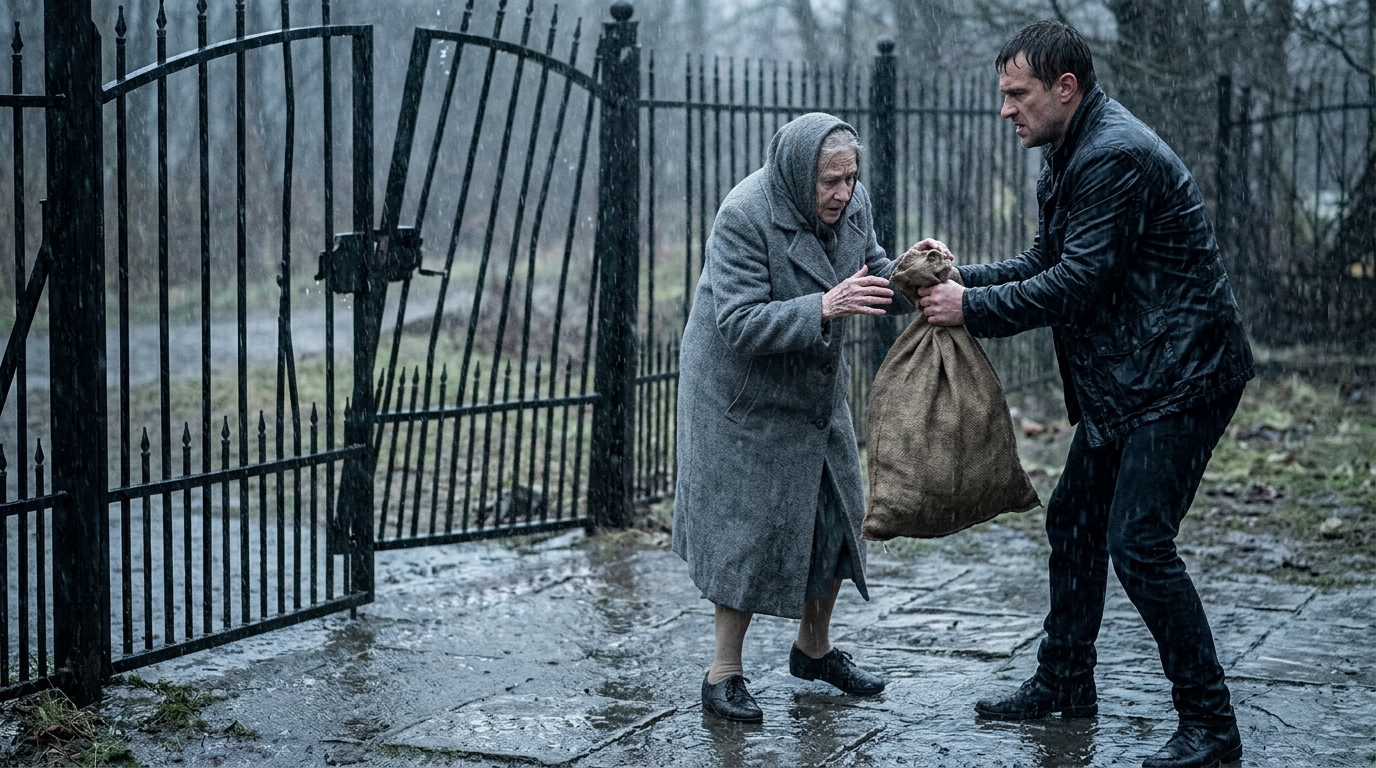
It struck the black iron gate in silver sheets, rattling the bars whenever the wind rose. Water streamed down the stone path, filling the cracks between the tiles, washing fallen leaves into the corners of the yard.
At the gate stood an old woman wrapped in a gray coat.
Her name was Martha.
Her hands were thin, marked by years of washing, cooking, sewing, carrying, and giving. Her shoulders had rounded with age, not only from time, but from burdens she had never placed on anyone else.
Before her stood her son.
Daniel.
His black jacket was soaked through. Rain dripped from his hair onto his face, but he did not wipe it away. His jaw was clenched so tightly it looked painful. His eyes refused to meet hers.
That refusal hurt more than the weather.
Behind him, beneath the warm light of the doorway, stood his wife.
Clara.
Young. Beautiful. Still. Watching.
She wore a silk robe and held a cup of tea with both hands, as though this scene outside the gate was merely unpleasant weather she did not wish to step into.
Martha saw her.
Daniel knew she saw her.
That was why his voice came out hard.
Too hard.
“Take the rice and go, Mom.”
He thrust a heavy burlap sack into her arms.
Martha nearly stumbled beneath the weight.
For a moment, her old fingers could not grip it properly. The rain had made the sack rough and slippery. She pulled it against her chest as if it were a child.
Daniel stepped back quickly.
Almost angrily.
As though distance was the only thing keeping him from breaking.
Martha looked at him.
“My son…”
“Go,” he said.
The word was sharp.
But his voice cracked at the edge.
A mother hears things strangers miss.
The village, the neighbors, even the wife in the doorway might have heard rejection.
Martha heard pain.
She heard a boy trying not to cry.
She heard the same child who once hid behind her apron after breaking a window and said, “Don’t look at me, Mama, or I’ll cry.”
Only now he was a grown man standing in the rain, pretending cruelty was strength.
Martha nodded once.
Not because she believed he wanted her gone.
Because sometimes mothers accept cruelty gently when they recognize it as pain in disguise.
She shifted the sack higher in her arms.
The weight made her breath catch.
Daniel looked as if he wanted to reach for it again.
He didn’t.
Behind him, Clara’s lips curved faintly.
A small, satisfied smile.
Martha saw that too.
Daniel turned his head slightly, just enough to know his wife was still watching.
Then he said louder:
“You have enough now. Don’t come back asking again.”
The words struck like stones.
Martha lowered her eyes.
“Yes,” she whispered. “I understand.”
But she did not.
Not fully.
Not yet.
She turned and walked away from the gate.
Alone.
Through the rain.
Across the slick stones.
The sack pressed against her chest, heavier with every step.
Behind her, the gate did not close.
And Daniel did not move.
Chapter 2: The Room at the End of the Lane
Martha lived in a narrow rented room at the end of a small lane behind the market.
It had one bed.
One wooden table.
One chair.
A little shelf for dishes.
A rain-streaked window that looked out toward a wall covered in moss.
It was not a home.
Not really.
It was where she slept after giving her home away.
Years earlier, when Daniel married Clara, Martha had insisted they take the house.
The family house.
The one her late husband built one room at a time, paycheck by paycheck, during years when cement was expensive and dreams were cheaper than food.
Daniel refused at first.
“This is your house, Ma.”
Martha laughed at him.
“What will I do with so many rooms? Argue with the walls?”
But the truth was simpler.
She wanted Daniel to begin married life with dignity.
She wanted him to bring his wife into a home, not a rented apartment.
She wanted him to have what she and his father never had at the beginning.
So she moved out “temporarily.”
That was the word she used.
Temporary became one month.
Then six.
Then three years.
At first, Daniel visited often.
He brought groceries.
Fixed her leaking faucet.
Replaced the old fan.
Sat at her table and ate soup from a chipped bowl while complaining that no one cooked like her.
Then Clara began calling during his visits.
Then Daniel began leaving earlier.
Then he stopped coming inside and only dropped things at the door.
Then sometimes he didn’t come at all.
Martha never blamed him out loud.
She blamed work.
Marriage.
Life.
Traffic.
Anything but the possibility that her son was being pulled away from her piece by piece.
That night, soaked and trembling, she reached her room and set the burlap sack on the wooden table.
It landed with a heavy thud.
For a long moment, she only stared at it.
Rice.
That was what he had said.
Take the rice and go.
She should have felt grateful.
Rice meant food.
Food meant another few weeks without asking anyone for help.
But her chest hurt.
Not from age.
From memory.
She saw Daniel at seven years old, standing on a chair, trying to stir porridge for her when she was sick.
She saw him at twelve, giving her half his school lunch and lying that he wasn’t hungry.
She saw him at nineteen, kneeling beside his father’s coffin, whispering:
“I’ll take care of you now, Ma.”
She pressed her hand to her mouth.
Rain tapped against the glass.
The room was dim.
Cold.
She untied the rope around the sack.
Her hands shook.
She expected to see rice spill against the table.
White grains.
Something ordinary.
Something humiliating but useful.
Instead—
Nothing spilled.
Inside the sack was not rice.
Only a white envelope.
Thick.
Dry.
Carefully wrapped in plastic.
On the front, in Daniel’s handwriting, was one word:
Mom
Martha stopped breathing.
She reached inside the sack with trembling fingers and pulled out the envelope.
It was heavy.
Heavier than paper should have been.
She opened it.
A thick bundle of cash slid into her lap.
More money than she had held in years.
Beneath it was a folded note.
Her fingers shook so violently she almost tore it while unfolding.
The first line struck her immediately.
I’m sorry, Mom.
Her eyes filled.
She continued reading.
I couldn’t say it in front of her.
The room seemed to freeze around her.
Rain tapped the window harder.
Martha pressed the paper flat with both hands.
Daniel’s handwriting was uneven, rushed, as if he had written while trying not to fall apart.
I know how it looked tonight. I know what you must have felt when I said those words. I hate myself for making you hear them. But Clara was watching. If I showed you kindness at the gate, she would have followed you here tomorrow. She would have made sure you suffered for it.
Martha sank slowly onto the chair.
Her knees had gone weak.
She read on.
She has been angry for months because I refused to sign the papers to sell Dad’s house. She said you were still controlling me. She said a man who chooses his mother over his wife is not a man.
A tear fell onto the page.
She wanted me to cut you off completely. No visits. No money. No calls. She said if I helped you again, she would make sure you were thrown out of your room and humiliated in front of everyone.
Martha covered her mouth.
Not because she doubted it.
Because suddenly, many things made sense.
The missed calls.
The short visits.
Daniel’s tired eyes.
The way Clara smiled when Martha stood outside the gate.
Martha returned to the note.
So I played the part she wanted to see. I gave you the sack like I was ashamed of you. I spoke harshly because she needed to believe she had won. But she hasn’t. Not anymore.
Martha’s heart began to pound.
The money is for you. Not charity. Not pity. It is what I should have given you long ago. Tomorrow morning, Mrs. Alvarez will come with a driver. She will take you to the apartment I rented in your name. It’s warm. It has an elevator. It has sunlight in the kitchen. You will not sleep in that cold room again.
Martha sobbed once.
A broken sound.
The note blurred.
She wiped her eyes and forced herself to keep reading.
I also transferred the title of Dad’s house back to you. I should never have let you leave it. I thought I was building a marriage. I didn’t realize I was allowing someone to turn my mother into an outsider.
Her hand flew to her chest.
The house.
Her husband’s house.
The front step where Daniel learned to walk.
The kitchen wall with the tiny mark where his father measured his height every birthday.
Back to her?
She shook her head, overwhelmed.
Then she read the last lines.
I gave Clara one choice tonight. Respect you and repair what she broke, or leave my life. She laughed. Then she told me to choose.
A pause in the writing.
The ink looked darker there, pressed harder.
So I chose.
Martha’s breath caught.
My wedding ring is gone because my marriage is over.
She stood so quickly the chair scraped against the floor.
The note fell from her trembling hands.
She moved toward the window.
Pushed aside the thin curtain.
Looked out into the rain.
And there he was.
Daniel.
Still by the gate at the far end of the lane.
Alone.
Soaked.
Crying where no one could see.
His left hand hung at his side.
Bare.
No wedding ring.
Martha’s hand flew to her mouth.
And just before he turned away into the rain, she understood.
Her son had not cast her out.
He had come back.
Chapter 3: The Marriage Behind the Door
Daniel did not go home that night.
Not at first.
He walked through the rain until his legs ached and his shoes filled with water.
He did not know where to go.
The house no longer felt like his.
The room where his mother slept was no longer hers.
The marriage he had defended for years had become something unrecognizable.
He stopped beneath an old awning near a closed pharmacy and looked at his bare hand.
The skin beneath the ring was pale.
A visible circle of absence.
It hurt more than he expected.
Not because he missed the ring.
Because he remembered the man who wore it first.
A hopeful man.
A man who believed love could be built if he worked hard enough.
A man who thought patience could soften cruelty.
Daniel had ignored the signs for too long.
At first, Clara’s comments were small.
“Your mother calls too much.”
“She acts like you’re still a child.”
“She needs to learn boundaries.”
“Why does she always look so helpless?”
Daniel defended Martha.
Then Clara cried.
Then he comforted her.
That became the pattern.
Clara insulted.
Daniel objected.
Clara became wounded.
Daniel apologized for the tone of his objection.
Little by little, she taught him that peace meant surrender.
When Martha visited, Clara became cold.
When Daniel sent money, Clara called it “emotional dependency.”
When he wanted to bring Martha back into the family home, Clara said:
“So I’m supposed to live under your mother’s shadow forever?”
Daniel began splitting himself in two.
One self for his mother.
One self for his wife.
Both incomplete.
Both ashamed.
The final fight began over the house.
Clara wanted to sell it.
“It’s wasted here,” she said. “Old design. Bad neighborhood. We can move somewhere better.”
“It was my father’s house.”
“It is our house now.”
Daniel didn’t answer.
Clara noticed.
“What?”
“It was never really ours.”
Her face hardened.
“What does that mean?”
“It was Ma’s. She left because I asked her to let us start there.”
Clara stared at him.
Then laughed.
A short, ugly laugh.
“So your mother owns the ghost in every room too?”
That was the first time Daniel felt something inside him close.
The second time came later that evening, when Clara said:
“If you give her one more cent, I’ll make sure she understands exactly where she stands.”
Daniel looked at her.
“What does that mean?”
Clara smiled.
“Try me.”
He did.
Quietly.
He went to his lawyer.
He checked the property records.
He moved savings into an account only he controlled.
He rented an apartment under Martha’s name.
And he prepared the burlap sack.
Not because he wanted drama.
Because Clara watched everything.
His phone.
His bank alerts.
His visits.
His face.
He needed her to see humiliation where there was protection.
He needed her to believe Martha had been sent away.
Only then could Daniel move without Clara striking at his mother first.
That night at the gate, when he shoved the sack into Martha’s arms, every word cut him as it left his mouth.
But the worst moment was when his mother nodded.
She had accepted pain from him gently.
That broke something in him beyond repair.
When he returned to the house near midnight, Clara was waiting.
The rain had stopped.
Her tea sat untouched on the table.
She looked at his hand first.
Then at his face.
“Where is your ring?”
Daniel closed the door.
“In the drawer.”
Her eyes narrowed.
“Why?”
“Because I’m done pretending.”
Clara stood slowly.
“Excuse me?”
Daniel removed a folder from inside his soaked jacket and placed it on the table.
“You wanted me to choose.”
Clara’s expression flickered.
For the first time, uncertainty entered her face.
“So I did,” Daniel said.
Chapter 4: The Papers on the Table
Clara stared at the folder as if it were a weapon.
In a way, it was.
Not because it could hurt her physically.
Because it contained truth.
And truth was the one thing she had always tried to manage before anyone else could touch it.
“What is this?” she asked.
“Separation papers.”
The silence that followed was sharp.
Then Clara laughed.
Not loudly.
Not convincingly.
“You’re being dramatic.”
Daniel said nothing.
That frightened her more than shouting would have.
She picked up the first page, scanned it, and went pale.
“You actually spoke to a lawyer?”
“Yes.”
“Without telling me?”
“Yes.”
Her voice rose.
“After everything I’ve done for this marriage?”
Daniel looked around the house.
The curtains Clara chose.
The furniture she insisted was “more suitable.”
The photographs of her family on the mantel, none of his mother.
The kitchen where Martha once cooked every Sunday, now redesigned so completely that nothing of her remained.
“What did you do for this marriage?” Daniel asked.
Clara’s mouth opened.
Closed.
Then hardened.
“I made you respectable.”
He almost smiled.
Not from humor.
From disbelief.
“I was respectable before I married you.”
“You were attached to your mother like a helpless boy.”
“She gave up her home for us.”
“She manipulated you with guilt.”
“She asked for nothing.”
“That’s worse,” Clara snapped. “Women like her make men feel obligated by suffering quietly.”
Daniel stared at her.
There it was.
The truth beneath all the polished language.
Martha’s kindness had not softened Clara.
It had offended her.
Because Clara understood control.
She did not understand sacrifice that expected no applause.
Daniel’s voice was low.
“You made her stand outside in the rain last month.”
Clara stiffened.
“She arrived unannounced.”
“She called first. You blocked her number from my phone.”
Clara’s eyes flashed.
Daniel continued:
“You told Mrs. Alvarez not to let her into the neighborhood gate.”
“She was embarrassing us.”
“She is my mother.”
“And I am your wife!”
Daniel struck the table with his palm.
Not hard enough to break anything.
Hard enough to stop the sentence from growing.
“No,” he said. “A wife does not ask a man to prove love by becoming cruel.”
Clara’s eyes filled instantly.
A familiar move.
Once, those tears would have made him panic.
Now they only made him tired.
“You’re leaving me over one argument?” she whispered.
Daniel’s face hardened.
“I’m leaving because I finally saw what my silence has cost.”
Clara’s tears vanished.
“So this is about the old woman.”
Daniel’s voice turned cold.
“Do not call her that.”
Clara crossed her arms.
“What will you do? Go live with Mommy? Let her cook for you and tell you what a good son you are?”
Daniel picked up another document.
“No. I’m moving out tonight. The house goes back to my mother. You have thirty days to leave according to the legal notice.”
Clara’s face changed completely.
“This is my home.”
“It never was.”
Her mouth fell open.
“You can’t do that.”
“I already did.”
“You’re nothing without me.”
Daniel looked at the empty space on his finger.
For a moment, he thought that sentence would hurt.
It didn’t.
Maybe because he had already lost enough illusions for one night.
“No,” he said quietly.
“I was becoming nothing with you.”
Chapter 5: The Mother Who Waited
Martha did not sleep.
She sat by the window until dawn, Daniel’s note folded in her lap, the bundle of cash untouched beside her.
Every few minutes, she looked toward the lane.
He did not return.
She told herself that was good.
He needed time.
He needed courage.
He needed to end what he had begun.
But a mother’s heart does not rest because logic gives permission.
At sunrise, someone knocked gently.
Martha opened the door and found Mrs. Alvarez standing there with an umbrella, a warm coat, and eyes that already knew too much.
“Your son asked me to come.”
Martha nodded.
Her voice was hoarse.
“He told you?”
“Enough.”
Behind Mrs. Alvarez, a small van waited.
Martha looked around her room.
The narrow bed.
The cracked table.
The damp wall.
She had survived there by telling herself she needed little.
But suddenly, she felt the full weight of how little she had accepted.
Mrs. Alvarez touched her arm.
“You don’t have to pack everything now.”
Martha looked down.
“I don’t have much.”
The older woman’s eyes softened.
“Then we’ll carry all of it.”
They packed in twenty minutes.
A few dresses.
A shawl.
Her late husband’s photograph.
A box of letters.
A small tin of sewing needles.
Daniel’s childhood drawing of their house with smoke coming from the chimney.
When Martha stepped outside, the rain had stopped.
The lane shone wet under the morning light.
At the end of it stood Daniel.
His eyes were red.
His clothes were changed, but he looked as if he had not slept.
Martha stopped.
For a long moment, neither moved.
Then Daniel walked toward her.
Slowly.
Like a man approaching judgment.
When he reached her, he lowered his head.
“I’m sorry, Mom.”
The words broke them both.
Martha dropped her bag and reached for him.
He fell into her arms like a child.
Not gently.
Completely.
His shoulders shook.
“I’m sorry,” he kept saying. “I’m sorry. I’m sorry.”
Martha held him with all the strength her old body had left.
“You came back,” she whispered.
Daniel sobbed harder.
“I never should have left you outside.”
She closed her eyes.
“No.”
“Yes.”
She pulled back enough to see his face.
“Listen to me. You did wrong.”
He nodded, tears falling.
“I know.”
“But you are here now.”
His lip trembled.
“I don’t know how to fix it.”
Martha touched his cheek.
“Start by not pretending pain is love.”
He closed his eyes.
That was the sentence he needed.
Not forgiveness.
Direction.
Chapter 6: The House That Remembered
Three days later, Martha returned to the family house.
Not as a guest.
Not as a burden.
As its owner.
Daniel unlocked the front gate and stepped aside.
Martha stood outside for a long time.
The house looked different.
Clara had changed the paint. Removed the old jasmine vines. Replaced the wooden bench where Martha’s husband used to sit with a stone sculpture that looked expensive and cold.
But beneath the changes, the house remembered.
The step was the same.
The one Daniel had fallen from at age four, crying more from surprise than pain.
The mango tree in the corner was still there, taller now, branches heavy from years of seasons Martha had missed.
The kitchen window still faced east.
Morning light would still enter the way her husband loved.
Daniel watched her carefully.
“I’ll change back anything you want.”
Martha shook her head.
“Not everything.”
He looked surprised.
She touched the gate.
“Some things change because time passes. That is not always bad.”
Then she turned toward the front door.
“But some things were removed because someone wanted me erased.”
Daniel lowered his eyes.
“Those we bring back.”
Together, they entered.
The house smelled unfamiliar.
Perfume.
Polish.
Cold air.
No soup.
No tea leaves.
No lived-in warmth.
Martha walked through each room silently.
Daniel followed like a boy awaiting punishment.
In the kitchen, she stopped.
On the wall beside the pantry, beneath fresh paint, was a faint unevenness.
She touched it.
Daniel’s eyes filled.
The height marks.
His father had carved little lines there every birthday.
Clara had painted over them.
Martha said nothing.
She only took a small knife from the drawer and carefully scraped away a thin layer of paint.
One line appeared.
Then another.
Daniel at six.
At seven.
At eight.
His father’s handwriting beside them.
Martha pressed her fingers to the wall.
Daniel turned away.
“I let her cover them.”
Martha did not look at him.
“Yes.”
He flinched.
She continued:
“But paint is not stone.”
She scraped gently again.
The marks returned slowly.
Not perfectly.
But enough.
Chapter 7: Clara’s Last Visit
Clara returned one week later.
Not with apology.
With lawyers.
She wore a cream coat, sunglasses, and an expression arranged to suggest injury.
Daniel met her at the gate.
Martha watched from the kitchen window.
This time, Daniel did not stand in the rain.
The sky was clear.
Clara’s lawyer spoke first.
There were claims.
Contributions.
Marital expectations.
Emotional distress.
Daniel’s lawyer answered calmly.
The house had been transferred back to Martha legally.
The funds used for maintenance had come primarily from Daniel’s separate account.
Clara had already signed acknowledgments years earlier, though she had apparently never read them carefully.
That was Clara’s mistake.
She often assumed signatures mattered only when she wanted them to.
Eventually, Clara removed her sunglasses.
Her eyes were sharp.
“This is humiliating.”
Daniel looked at her.
“No. Humiliation was making my mother stand outside her own gate.”
Her lips tightened.
“You’ll regret this.”
“I regret not doing it sooner.”
She glanced toward the house.
Martha stepped away from the window, but not before their eyes met.
For one second, Clara’s face held the same cold contempt Martha had seen in the doorway that rainy night.
Then something new crossed it.
Defeat.
Not repentance.
Just the recognition that control had slipped away.
Daniel saw it too.
Clara looked back at him.
“You chose a lonely life.”
Daniel shook his head.
“No. I left one.”
She had no answer to that.
Chapter 8: Rice on the Stove
The first Sunday back in the house, Martha cooked rice.
Not because they lacked other food.
Because rice had become a language between them.
She washed it slowly in a metal bowl, letting the water cloud, pouring it off, filling it again.
Daniel stood beside her.
Awkward.
Hovering.
“Can I help?”
“You can stop standing like a guilty ghost.”
He almost smiled.
“Sorry.”
“You apologize too much now.”
“I have a lot saved up.”
That made her laugh.
A small laugh.
But real.
He smiled then.
For the first time in weeks, his face looked like his own.
They cooked together.
Rice.
Fish stew.
Greens with garlic.
Food simple enough to remember them by.
Mrs. Alvarez came.
Old Tomas from next door came.
A few relatives who had quietly disapproved of Clara for years came but did not say “I told you so,” because Martha looked at them once and they decided wisdom was safer than pride.
Daniel placed his father’s photograph back on the main shelf.
Martha placed fresh flowers beside it.
Then she noticed Daniel’s bare left hand.
He saw her looking.
“It feels strange,” he said.
“Freedom often does at first.”
He looked at her.
“You sound like you know.”
Martha smiled sadly.
“I lived in that little room for three years, Daniel.”
His face fell.
“I didn’t mean—”
“I know. But I did.”
He lowered his head.
She touched his wrist.
“We will not heal by pretending wounds were smaller.”
He nodded.
“Okay.”
“Good. Now bring plates.”
They ate at the old table.
The one Clara had moved to storage because it looked “too rustic.”
Daniel had brought it back the day before.
Its surface was scratched.
Uneven.
Warm.
Martha ran her hand over it and remembered her husband fixing a broken leg on it after Daniel used it as a fort.
A house is not restored by furniture alone.
But sometimes furniture helps memory find its way back.
Chapter 9: The Sack
Martha kept the burlap sack.
Daniel hated it.
Every time he saw it folded near the pantry, his face darkened.
One afternoon, he said:
“Can we throw that away?”
Martha looked at it.
“No.”
“Mom.”
“It stays.”
“Why would you keep something from that night?”
She picked it up and smoothed the rough fabric.
“Because that night hurt. But it also told the truth.”
Daniel looked away.
She continued:
“You used a sack of rice to hide love because you were afraid. I opened it and found your apology. That is not something to throw away.”
His eyes filled.
“I hate that I made you carry it.”
“I carried you once,” she said softly. “You were heavier.”
He let out a broken laugh.
She folded the sack carefully and placed it back.
“One day,” she said, “you will look at it and remember not the cruelty, but the courage it took you to end it.”
Daniel was quiet for a long time.
Then he nodded.
“I hope so.”
“You will.”
Final Chapter: What the Rain Revealed
Years later, Daniel would remember the rain most clearly.
Not Clara’s face.
Not the legal papers.
Not even the empty place where his wedding ring had been.
The rain.
How cold it was.
How his mother’s hands trembled under the weight of the sack.
How she nodded as if he had not just broken her heart because she was still trying to protect his.
That was the kind of love he had almost lost.
Not loud love.
Not demanding love.
Not the kind that asks to be chosen by making someone else suffer.
Martha’s love had always been quieter.
Rice saved from her own bowl.
A lamp left on.
A repaired shirt.
A house given away.
A cruel sentence endured because she heard the crack beneath it.
Daniel spent years making amends.
Not with grand gestures.
With presence.
He came home when he said he would.
He answered calls.
He listened.
He learned to recognize control before it dressed itself as love.
He rebuilt the garden.
He restored the marks on the kitchen wall.
He brought his mother tea in the mornings and pretended not to notice when she watched him with the careful relief of someone still learning that abandonment had ended.
Sometimes, on rainy nights, Martha would sit by the window and touch the heart of the old house as if feeling its pulse.
Daniel would see her there and feel shame rise.
Then gratitude.
Then something steadier.
Responsibility.
One evening, he found her folding the old burlap sack again.
He sat beside her.
“You were right,” he said.
“About what?”
“I don’t see only that night anymore.”
She smiled.
“What do you see?”
He looked at the sack.
Then at her.
“I see the moment I stopped being afraid of losing someone who never truly loved me…”
His voice softened.
“…and started fighting for the one person who always did.”
Martha’s eyes filled, but she smiled through it.
Outside, rain began tapping against the window.
This time, the house was warm.
The gate was locked.
The rice was cooking.
And no mother stood outside waiting to be allowed back into the love she had built.