The Boy Who Saw Too Much
The boy smelled like rainwater, asphalt, and old smoke.
That was the first thing I noticed.
Not his torn cargo shorts.
Not the dirt pressed into the creases of his face.
Not even the way he stood directly in front of my seven-year-old daughter as if he had been waiting for us.
It was the smell.
The smell of someone who had slept outside, eaten from paper bags, and learned not to ask adults for help because adults usually became the problem.
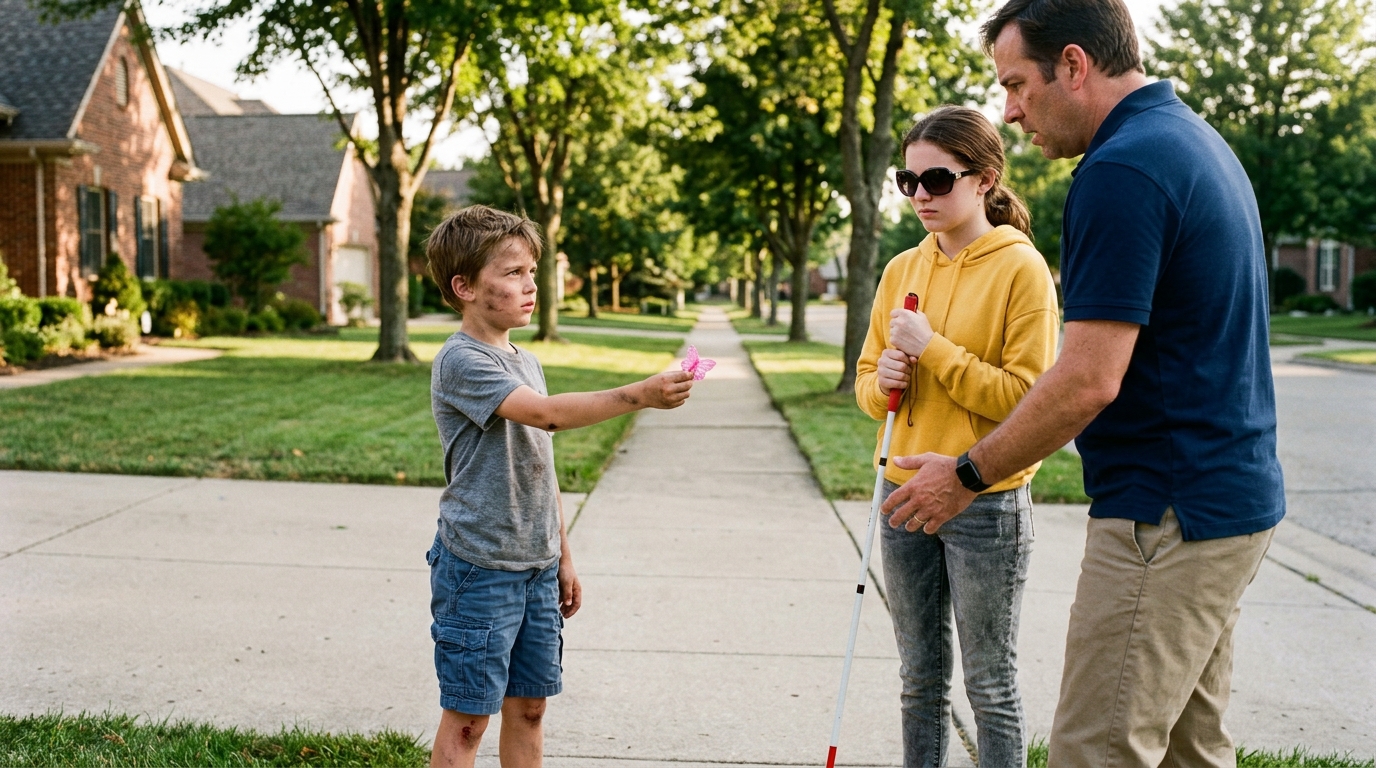
We were walking home from Lily’s vision therapy appointment when he stepped out from behind the maple trees lining Briarwood Lane.
It was a beautiful street.
Too beautiful for what happened there.
Fresh-cut lawns.
White mailboxes.
American flags hanging from wide porches.
The kind of neighborhood where people waved from SUVs and pretended tragedy could not cross the property line.
Lily stood beside me in her yellow hoodie, her small white cane gripped tightly in both hands. Dark sunglasses covered her eyes. She had worn them every day for eleven months.
Since the accident.
Since my brother Michael died.
Since my wife Eleanor told me Lily had stopped seeing the world.
The doctors called it trauma-induced blindness.
A rare psychological response, they said.
The brain protecting itself from something too unbearable to process.
I believed them.
I believed Eleanor.
I believed everyone because believing was easier than imagining my daughter had witnessed something worse than death.
Then the boy looked straight at Lily and said,
“She isn’t blind.”
My body reacted before my mind did.
I stepped in front of her.
“What did you just say?”
The boy did not flinch.
His eyes were gray, steady, and far too old for his face.
“She just doesn’t want to see you.”
The sentence hit me harder than an insult.
I felt heat rise in my chest.
A protective, ugly kind of anger.
For a split second, I wanted to grab him by the collar and drag him away from my daughter. Lily had already lost enough. She had already lived in darkness long enough.
And now some filthy stranger was turning her pain into a street performance.
“Walk away,” I said.
My voice sounded low.
Dangerous.
The boy ignored me.
He looked past me, directly at Lily.
“You can stop pretending now,” he said gently. “He wasn’t the one driving.”
The whole sidewalk seemed to tilt.
Lily made a sound.
Small.
Broken.
Not a gasp.
Not a sob.
Something trapped between both.
I spun toward her.
“Lily?”
Her fingers tightened around her cane until her knuckles turned white.
The boy took one step closer.
“She saw everything,” he said. “That’s why your wife covered her eyes before the police arrived.”
My mouth went dry.
The accident came back in flashes.
The black SUV crushed against the guardrail.
Rain on the windshield.
Police lights.
My brother Michael pronounced dead at the scene.
Eleanor standing on the shoulder with a blanket around her shoulders, shaking, saying Michael had insisted on driving because she was too tired.
Lily in the back seat.
Silent.
Unmoving.
Eyes wide open.
Until Eleanor covered them.
“No,” I whispered. “That’s not true.”
The boy reached into his cargo shorts.
Slowly.
Carefully.
Like he knew sudden movements could ruin everything.
Then he pulled out a small pink hair clip.
A butterfly.
Cheap plastic.
One wing cracked.
My heart stopped.
I knew that clip.
I had bought it for Lily at a pharmacy in Vermont because she cried when Eleanor said the fancy boutique ones were too childish.
Lily had worn it on the day of the crash.
Eleanor told me it was lost in the wreckage.
The boy held it out.
“She dropped it under the seat,” he said softly. “When she saw your wife switch places.”
Behind us, a car door slammed.
I turned.
Eleanor stood twenty feet away beside our black Mercedes, her face drained of color.
She wasn’t looking at me.
She was looking at the boy.
And when she spoke, her voice was barely human.
“Caleb,” she said. “I told you to stay away from my family.”
That was when I realized this boy was not a stranger.
The Hair Clip That Should Have Been Gone
Eleanor ran toward us.
Not walked.
Ran.
My wife never ran.
She moved through life like every floor belonged to her and every room had already agreed to admire her. Even after the crash, even through grief, she had remained composed. Fragile, yes. Beautifully broken, yes.
But never uncontrolled.
Now she looked terrified.
“Daniel,” she said, breathless. “Get Lily in the car.”
I did not move.
The boy—Caleb—took a step back, but he did not run.
Eleanor’s eyes flicked to the hair clip in his hand.
Just for a second.
But long enough.
That tiny glance did more damage than anything he had said.
“Where did you get that?” she demanded.
Caleb lifted his chin.
“Same place you threw it.”
Her face changed.
Not much.
But enough.
The mask slipped, then returned.
She turned to me with tears already forming, the kind that had saved her in hospital waiting rooms, police interviews, family dinners, and every painful conversation since Michael’s funeral.
“He’s unstable,” she whispered. “He’s been following me for months. He was near the crash site. He steals things. He makes up stories.”
“Then how does he know your name?” I asked.
She blinked.
I had never seen Eleanor caught between answers before.
It lasted less than a second, but I saw it.
“He must have heard it somewhere,” she said.
Lily’s breathing grew shallow.
I crouched beside her.
“Sweetheart,” I said carefully, “do you know this boy?”
She shook her head.
Too fast.
Too hard.
Like someone had trained her to deny before thinking.
Caleb looked at her, and his expression softened.
“She’s scared,” he said. “Not blind.”
Eleanor snapped.
“Shut your mouth.”
The words cracked across the sidewalk.
A neighbor watering her hydrangeas turned toward us.
A jogger slowed.
For the first time, Eleanor realized we had an audience.
Her voice changed instantly.
Softened.
“Daniel, please. Lily is overwhelmed. This is dangerous for her.”
That used to work on me.
Everything was dangerous for Lily.
Bright light.
Loud sounds.
Questions.
Memories.
Me asking too much.
Me pushing too hard.
Me grieving too loudly.
For nearly a year, Eleanor had built our house around Lily’s silence and called it healing.
I looked at the hair clip.
My daughter’s hair clip.
The one that should have burned, shattered, or vanished in the wreck.
“Give it to me,” I said.
Caleb placed it in my palm.
It was cold.
Dirt had collected inside the cracked butterfly wing. But beneath the grime was something darker along the metal hinge.
Grease.
Black and thick.
Not from the road.
From inside a car.
Eleanor noticed me studying it.
“Daniel,” she said sharply.
I closed my fingers around the clip.
“We’re going home.”
Relief crossed her face.
Then I added, “And we’re calling Detective Harris.”
Her relief disappeared.
Detective Harris had led the crash investigation. He had ruled it tragic but simple.
Rain.
Speed.
A bad curve.
Michael behind the wheel.
Eleanor in the passenger seat.
Lily in the back.
No other vehicle involved.
No criminal charges.
The perfect ending to a story no one wanted to reopen.
Eleanor stepped closer.
“You promised Lily we were done with police.”
I looked down at my daughter.
Her lips were trembling.
“Lily,” I said softly. “Did Mommy cover your eyes?”
For a moment, nothing happened.
Then one tear slipped from beneath her sunglasses.
Eleanor reached for her.
Lily flinched.
That flinch broke something in me.
My daughter had never flinched from her mother.
Not once.
Eleanor saw me see it.
Her face hardened.
Only for a moment.
But it was there.
The woman beneath the grief.
The woman behind the performance.
The woman my daughter had been hiding from behind dark glasses.
At home, I locked myself in my office with the hair clip and pulled out the crash report for the first time in months.
I had read it a hundred times after Michael died.
I had memorized the diagrams.
The weather notes.
The seat positions.
The injury summaries.
But grief makes you read for pain, not truth.
This time, I read differently.
Driver’s seat adjusted fully back.
Michael was five foot eight.
Eleanor was five foot eleven.
Passenger airbag bruising observed on decedent’s right side.
Right side.
Not left.
I kept reading.
Lily Harper, rear passenger, non-verbal at scene. Eyes open, responsive to mother’s voice. Possible shock.
Eyes open.
Responsive.
Not blind.
Not then.
My pulse hammered in my ears.
Then I found the detail that made me stop breathing.
One personal item recovered from beneath front driver’s seat: child’s pink hair accessory.
Recovered.
Not lost.
Recovered.
Logged.
Bagged.
Then marked transferred to family representative.
I stared at the line.
Family representative.
Eleanor.
My phone buzzed.
A blocked number.
I answered without thinking.
For three seconds, there was only breathing.
Then Caleb’s voice whispered,
“She kept more than the clip.”
Before I could ask what he meant, he said one sentence that turned my blood cold.
“Check what your brother left in the glove box.”
What Lily Was Forced to Forget
Michael’s things had been boxed up after the funeral.
I never opened most of them.
I told myself grief needed time.
The truth was simpler.
I was a coward.
His leather jacket still smelled like him.
His watch still had a cracked face from the crash.
His phone had been destroyed, according to the report.
But the glove box.
I had not thought about the glove box once.
The SUV had been Eleanor’s, but Michael was the kind of man who filled every car with receipts, gum wrappers, pens, cables, and emergency tools because he never trusted anyone else’s preparation.
If Caleb was right, something had been left behind.
The problem was that the SUV had been gone for eleven months.
Insurance took it.
Then the police released it.
Then it vanished into salvage paperwork Eleanor handled while I was planning a funeral and learning how to guide my daughter through doorways.
I called Detective Harris.
He sounded tired before I said my name.
“Daniel,” he said. “I know why you’re calling.”
That stopped me.
“What does that mean?”
A pause.
Too long.
“Someone came by the station this morning asking about the Harper crash.”
“Who?”
“A kid,” he said. “Dirty clothes. Wouldn’t give a last name.”
Caleb.
My hand tightened around the phone.
“What did he say?”
Another pause.
“That we missed something.”
I closed my eyes.
“You did.”
Harris did not argue.
That scared me more than denial would have.
“I looked at the archived photos after he left,” he said quietly. “There are inconsistencies.”
I stood very still.
“What inconsistencies?”
“The driver’s seat position. Blood transfer on the console. Bruising patterns.”
My breath caught.
“Michael wasn’t driving.”
Harris exhaled.
“I can’t say that yet.”
“But you’re thinking it.”
Silence.
Then he said, “Where’s Lily?”
I looked toward the office door.
Upstairs, Eleanor was playing soft piano music in Lily’s room. She had done that every night since the accident. She called it calming.
Now it sounded like control.
“She’s home.”
“Keep her away from Eleanor if you can.”
The sentence landed like a verdict.
I stepped out of the office and moved quietly upstairs.
Lily’s bedroom door was half-open.
The music played from a speaker on the nightstand.
Eleanor sat beside Lily’s bed, brushing her hair slowly.
Too slowly.
Like she was counting strokes.
Lily sat stiff under the blanket, sunglasses still on even in the dim room.
“Mommy loves you,” Eleanor whispered. “You know that, right?”
Lily nodded.
“And good girls don’t hurt people with bad memories.”
My stomach turned.
Eleanor looked up and saw me in the doorway.
The brush stopped.
For one second, neither of us spoke.
Then Lily said,
“Daddy?”
Her voice was tiny.
I stepped into the room.
“I’m here.”
She turned her face toward me.
Not toward my voice.
Toward me.
The movement was slight.
Almost nothing.
But I saw it.
Eleanor did too.
Her grip tightened around the brush.
I walked to the bed and knelt beside my daughter.
“Lily,” I said. “Can you see me?”
Her mouth trembled.
Eleanor stood.
“She’s tired.”
“Sit down,” I said.
My voice surprised both of us.
Eleanor did not sit.
Lily began to cry.
Not loudly.
Silently.
The way children cry when they have learned crying creates consequences.
I took off her sunglasses.
She did not resist.
Her eyes were open.
Wet.
Focused.
On my face.
I felt the room move beneath me.
For eleven months, I had missed those eyes.
I had mourned them while they were still there.
“Oh, sweetheart,” I whispered.
Lily broke.
“I’m sorry, Daddy.”
I pulled her into my arms.
“For what?”
She shook so hard I could feel her teeth chatter.
“Mommy said if I told, you would hate me.”
Eleanor’s face went white.
“Lily,” she warned.
But Lily kept going.
The dam had cracked.
“I saw Uncle Michael,” she sobbed. “He was sleeping. Mommy pulled him. She put him where the wheel was.”
My chest split open.
Eleanor moved toward the door.
I stood, blocking her.
Lily clutched my shirt.
“She said Uncle Michael was already gone. She said it didn’t matter. She said if people knew, you would go away too.”
My vision blurred with rage.
Not loud rage.
Not explosive.
Something colder.
A kind of rage that organized itself into action.
“Why did you cover her eyes?” I asked Eleanor.
She smiled.
A strange, empty smile.
“Because she was hysterical.”
“No,” Lily whispered.
We both looked at her.
Her eyes were squeezed shut now, as if memory itself had teeth.
“You covered them before the police came,” she said. “And you told me not to open them again until I could forget.”
Eleanor stared at our daughter.
Not with love.
With fury.
Then Lily whispered the sentence that changed everything again.
“Uncle Michael put the little camera in the glove box before Mommy started yelling.”
The Camera in the Wrecked SUV
I found Caleb behind the old gas station on County Road 18.
He was sitting on an overturned milk crate, eating fries from a paper bag, watching the street like he expected someone to come hunting for him.
Maybe someone already had.
Detective Harris came with me, though unofficially at first. He parked two blocks away and told me not to approach too fast.
“Kids like him run when adults bring authority,” he said.
But Caleb did not run.
He saw me.
Saw Harris.
Then looked at my hands.
“You found out,” he said.
I nodded.
His face did not change.
He had expected no less.
“How did you know about the glove box?” Harris asked.
Caleb looked at him with immediate distrust.
“I was there.”
“At the crash?”
Caleb nodded.
“I slept under the bridge by the curve. Cars slow there when it rains. People throw food out sometimes.”
He said it plainly.
No self-pity.
No performance.
Just fact.
“That night,” he continued, “I heard yelling before the crash.”
My throat tightened.
“Eleanor and Michael?”
He nodded again.
“The woman was driving. The man kept saying, ‘Pull over, Eleanor. You don’t want to do this with Lily in the car.’ Then the car swerved.”
Harris wrote nothing down.
He was listening too hard.
Caleb looked at me.
“After it hit, I ran over. Your daughter was awake. She was crying. The woman climbed out from the driver’s side.”
I closed my eyes.
“Then what?”
“She opened the passenger door. The man wasn’t moving. She pulled him across.”
His voice lowered.
“She was strong when she needed to be.”
A chill moved through me.
People always described Eleanor as delicate.
Fragile.
Elegant.
But I had seen her carry a sleeping Lily up two flights of stairs without breathing hard.
I had ignored so many things.
“She saw me,” Caleb said.
My eyes opened.
“She knew you were there?”
“Yeah. She told me to get lost or she’d say I caused it.”
He looked down at his fries.
“I believed her.”
Of course he did.
A homeless kid near a rich woman’s wrecked SUV.
Who would the police believe?
Caleb reached into his pocket and pulled out a small black piece of plastic.
An SD card.
“I went back later,” he said. “Tow truck dropped something from the glove box when they cleaned it out. I thought maybe I could sell it.”
Harris stepped forward.
Caleb pulled the card back instantly.
“No.”
Harris stopped.
Caleb looked at me.
“Not him. You.”
I held out my hand.
He placed the SD card in my palm.
It weighed almost nothing.
And yet it felt heavier than the hair clip.
Heavier than the crash report.
Heavier than every lie I had believed.
We took it to Harris’s station.
Not through the front door.
Through a side entrance.
He did not want Eleanor tipped off before he knew what was on it.
The first two files were corrupted.
The third opened.
The screen showed blackness at first.
Then rain.
The dashboard camera had been knocked crooked, facing partly toward the windshield and partly toward the cabin.
Michael’s voice filled the room.
“Eleanor, slow down.”
Then my wife.
Cold.
Controlled.
“You should have stayed out of my marriage.”
Michael again.
“I’m telling Daniel everything.”
My hands curled into fists.
The video shook.
Rain streaked across the glass.
Lily’s small voice came from the back seat.
“Mommy, I’m scared.”
Eleanor snapped, “Be quiet.”
Michael said, “Pull over now.”
Then came the sound of tires sliding.
A scream.
Impact.
The camera spun into darkness.
For several seconds, there was only static and rain.
Then Eleanor’s voice.
Breathing hard.
Alive.
“Michael?”
No answer.
“Michael?”
Still nothing.
A door opened.
Wind rushed in.
Then Lily crying.
“Mommy?”
Eleanor’s voice changed.
Not frightened anymore.
Decisive.
“Close your eyes, Lily.”
“I can see Uncle Michael—”
“I said close your eyes.”
The next sounds were movement.
Dragging.
Metal.
A dull impact.
Then Eleanor, closer to the microphone now, whispering words I would hear in my nightmares for the rest of my life.
“If you tell Daddy what you saw, he’ll hate you for killing his brother.”
I stopped breathing.
Harris paused the video.
No one spoke.
There are silences that are empty.
This one was full of everything I had failed to protect.
Then Harris’s phone rang.
He glanced at the screen.
His face changed.
“What?” I asked.
He looked up at me.
“Uniforms just arrived at your house.”
My blood went cold.
“Why?”
His jaw tightened.
“Eleanor called them. She says you kidnapped Lily.”
The Woman Who Needed Darkness
We reached the house in twelve minutes.
It felt like twelve years.
Police cars lined the curb.
Neighbors stood on porches, pretending not to stare while staring with their whole bodies.
Eleanor stood on the front lawn, wrapped in a cream cardigan, crying into a tissue.
Perfect.
Fragile.
Victimized.
Two officers stood near her.
Another held Lily by the shoulders near the porch steps.
My daughter was crying.
But she was not wearing sunglasses.
When she saw me, she pulled away from the officer and ran.
Not stumbled.
Not felt her way forward.
Ran.
Straight into my arms.
The entire lawn went silent.
Eleanor stopped crying.
For a moment, the whole performance collapsed.
The officers saw it.
The neighbors saw it.
Detective Harris stepped out of his car with the SD card evidence bag in one hand.
“Mrs. Harper,” he said, “we need to talk.”
Eleanor’s eyes moved from Harris to me to Lily.
Then to Caleb, who had stepped out from the back seat.
That was when her face truly changed.
Not because of me.
Because of the boy.
The witness she thought had disappeared into the gutters of the city.
“You,” she whispered.
Caleb stood behind Harris, small and dirty and unshaking.
“Me,” he said.
Eleanor tried one last move.
It was almost impressive.
“Daniel has been unstable since Michael died,” she told the officers. “He forced Lily to say things. He’s obsessed with blaming me because he can’t accept his brother caused the crash.”
Harris looked at her for a long moment.
Then he said, “Your daughter can see.”
Eleanor blinked.
“She has episodes.”
“No,” Lily said.
Her voice shook.
But she spoke.
“I can see.”
The words moved across the lawn like thunder.
Eleanor looked at her child with something like hatred.
Lily stepped closer to me.
“Mommy told me if I looked at Daddy, he’d know I let Uncle Michael die.”
I held her tighter.
“You didn’t let anyone die.”
Harris nodded to the officers.
“Mrs. Harper, turn around.”
Eleanor laughed once.
Sharp.
Disbelieving.
“You’re arresting me because a traumatized child and a homeless boy invented a story?”
Harris lifted the evidence bag.
“No,” he said. “I’m arresting you because your brother-in-law’s dash camera recorded the accident, the seat switch, and what you said to Lily afterward.”
For the first time since I had known her, Eleanor had no answer.
No tears.
No elegant pain.
No wounded wife performance.
Just silence.
Her eyes found mine.
And in them, I saw the truth I had avoided for years.
Eleanor had never needed Lily to be blind.
She needed me to be.
Blind to her control.
Blind to her coldness.
Blind to the way every story in our house began and ended with her version.
Blind enough to let my daughter disappear behind sunglasses while the woman who hurt her called it healing.
The officers cuffed her in front of the hydrangeas.
The same flowers our neighbor had been watering when Caleb first stopped us on the sidewalk.
Eleanor did not scream.
She did not beg.
She only looked at Lily and said,
“You’ll regret this.”
My daughter flinched.
Then she looked up at me.
Actually looked.
Right into my eyes.
“No,” Lily whispered. “I won’t.”
Months later, people would ask why Eleanor did it.
The answer was not simple, but it was not mysterious either.
Michael had discovered she was moving money from my late father’s trust into accounts under her maiden name. He had planned to tell me that night. Eleanor offered to drive him home, hoping to talk him out of it.
Lily had been in the back seat because Eleanor never imagined a child would become the most dangerous witness in the world.
The crash was not planned.
The cover-up was.
That was what the prosecutors said.
That was what the jury heard.
That was what the dashcam proved.
Caleb testified too.
He wore a navy blazer Harris bought him and shoes that pinched his feet. He hated the courtroom. He hated the questions. But he told the truth.
Afterward, I asked him why he had kept the hair clip all that time.
He shrugged.
“Somebody had to remember what really happened.”
Lily recovered slowly.
Not because her eyes needed healing.
Because truth does not fix fear overnight.
Some mornings, she still reached for the sunglasses.
Then stopped.
Some nights, she woke crying, whispering that she saw the rain again.
I would sit beside her until the room felt safe.
Until she remembered where she was.
Until she remembered Eleanor was gone.
The first time Lily asked to walk outside without her cane, we returned to Briarwood Lane.
The same sidewalk.
The same maple trees.
The same neat lawns pretending the world was simple.
She held my hand.
Caleb walked a few steps ahead of us, clean now, fed now, still suspicious of comfort but learning it slowly.
Lily stopped near the place where he had first spoken.
She looked up at the sky.
Blue.
Wide.
Bright.
Then she turned to me.
“I didn’t hate seeing you, Daddy,” she said.
Her voice trembled.
“I was scared that if I looked at you, you’d see the truth.”
I knelt in front of her.
“You never have to hide the truth from me again.”
She nodded.
Then, for the first time in nearly a year, my daughter reached up and clipped the little pink butterfly back into her hair.
One wing was still cracked.
The hinge still carried a faint black stain that would never fully wash away.
But Lily wore it anyway.
Not because it was pretty.
Because it had survived.
And so had she.