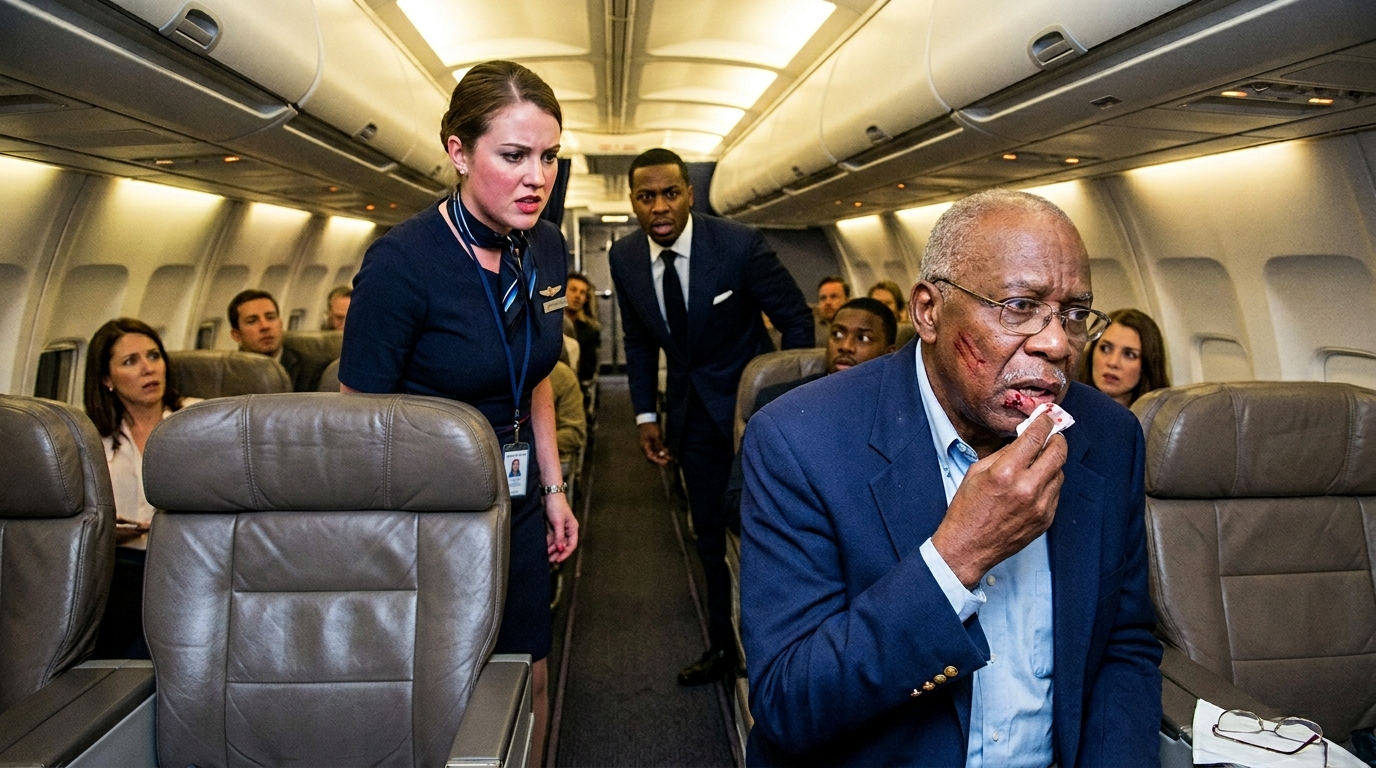
Chapter 1: The Slap in Business Class
“Get your dirty hands off that seat.”
Jessica Morrison’s voice sliced through the cabin.
Sharp.
Cold.
Loud enough for everyone in business class to hear.
The boarding line froze.
A few passengers looked up from their phones.
A man in a navy blazer stood beside seat 3A, one hand resting gently on the leather headrest as he tried to steady himself.
His name was Robert Hayes.
Seventy-two years old.
Retired postal worker.
Widower.
Dressed in the finest jacket he owned — a navy blazer his late wife, Margaret, had bought him for their fortieth wedding anniversary.
He had polished his shoes that morning.
Pressed his shirt twice.
Placed Margaret’s photograph carefully into his breast pocket before leaving home.
This was his first flight since she passed.
And now a flight attendant was gripping his collar in front of everyone.
“I’m sorry, ma’am,” Robert said quietly. “This is my seat.”
Jessica laughed.
Not a confused laugh.
A mocking one.
“Your seat?”
She looked him up and down.
At his old blazer.
At his worn suitcase.
At his trembling hands.
Then her mouth twisted.
“This is business class.”
Robert swallowed.
“Yes, ma’am. I know.”
She leaned closer.
“For paying customers.”
A few passengers shifted uncomfortably.
Robert reached into his jacket pocket.
“I have my boarding pass.”
Jessica snatched the paper from his hand before he could unfold it.
She glanced at it for half a second, then scoffed.
“This has to be wrong.”
“It has my name.”
“People like you always have an explanation.”
The cabin went quieter.
That sentence changed the air.
Three rows ahead, a man in a charcoal Tom Ford suit slowly lifted his head.
He had been reviewing documents on his tablet.
Now his eyes were fixed on the aisle.
Jessica pointed toward the back of the plane.
“Economy is that way.”
Robert’s voice stayed gentle.
“My son bought this ticket for me.”
“Of course he did.”
She turned toward the nearby passengers with a smirk, as if inviting them into the joke.
“Your son bought you business class?”
Robert nodded.
“He wanted me to be comfortable.”
Something about that answer seemed to irritate her more.
She reached for his small leather wallet, which he had opened to show his ID.
Before he could react, she pulled it from his hand and tossed it down the aisle.
It slid across the carpet and stopped near a passenger’s shoe.
A woman gasped.
Robert stared at the wallet.
Inside was Margaret’s photo.
His medical card.
His ticket receipt.
His hands shook as he bent down to retrieve it.
Jessica grabbed his shoulder.
“Don’t make a scene.”
“I’m only picking up my wallet.”
“You don’t listen, do you?”
Then her hand moved.
Fast.
Brutal.
The slap cracked across his face.
His glasses flew off and struck the floor.
One lens shattered.
Robert stumbled back against the seat.
Blood appeared at his split lip.
For one horrifying second, no one moved.
Robert did not shout.
Did not curse.
Did not swing back.
He simply stood there, one hand pressed against his mouth, blood running over his fingers, his broken glasses at his feet.
At seventy-two years old, he looked less shocked by pain than by the fact that no one had stopped it.
Jessica breathed hard, her face flushed.
“Now sit down in the back before I have security drag you off.”
Then a voice came from three rows ahead.
Low.
Controlled.
Dangerously calm.
“No.”
Everyone turned.
The man in the Tom Ford suit had risen from seat 1C.
His jaw was locked.
His eyes were not on Jessica.
They were on Robert.
And for the first time since boarding began, Robert’s face changed.
“David,” he whispered.
Jessica froze.
The man stepped into the aisle.
His voice remained quiet.
“That is my father.”
The cabin went still.
Then he added:
“And this is my airline.”
Chapter 2: Robert Hayes
Robert Hayes had not wanted business class.
He had argued with his son about it for three days.
“I don’t need all that,” he had said over the phone. “A regular seat is fine.”
His son, David Hayes, had sighed.
“Dad, your knees hurt after twenty minutes in a church pew. You are not flying cross-country squeezed between two strangers.”
“I spent thirty-six years walking mail routes in the rain. I can survive a plane seat.”
“That’s exactly why you’re getting business class.”
Robert had laughed.
“You sound like your mother.”
The silence after that was soft.
Both men missed Margaret differently.
David missed her in boardrooms, in phone calls he still wanted to make, in birthdays she no longer organized.
Robert missed her in the kitchen every morning.
In the empty chair across from him.
In the quiet after the TV was turned off.
Margaret had died five years earlier from cancer.
Two months before the diagnosis, she had given Robert the navy blazer.
“You always wear brown,” she had teased.
“What’s wrong with brown?”
“You look like a tired mailbox.”
He had laughed until she laughed too.
The blazer became precious after she was gone.
Not because it was expensive.
It wasn’t.
Because she had touched the sleeves.
Chosen the buttons.
Straightened the collar while smiling.
Told him he looked handsome.
Now Robert wore it on the flight to San Francisco, where David was being honored at a private aviation leadership summit.
David had insisted Robert attend.
“You should see what your sacrifices built,” he said.
Robert always rejected that phrase.
“My sacrifices?”
“Yes.”
“I delivered mail, David.”
“You delivered stability.”
Robert never knew what to say when his son spoke like that.
David had grown into a man who controlled rooms Robert would never understand.
Founder of an investment firm.
Majority owner of Aureon Airways, the airline they were now boarding.
Board chairman.
Publicly respected.
Privately still the boy who once sat at the kitchen table doing homework while Robert returned home with sore feet and Margaret reheated dinner.
Robert was proud of him.
Quietly.
Deeply.
But he never wanted special treatment.
That was why he boarded alone while David took a business call near the front.
He wanted to find his seat like everyone else.
Place his bag overhead.
Sit down.
Look at Margaret’s photo.
Tell her softly, as he sometimes still did:
“Our boy did all right.”
Instead, he found himself bleeding in the aisle.
Chapter 3: The Son in Seat 1C
David Hayes did not move quickly.
That was what frightened Jessica first.
Angry people rush.
Powerful people often don’t.
David stepped down the aisle with a stillness that made every passenger instinctively lean away.
He stopped beside his father.
“Dad.”
Robert shook his head faintly.
“I’m all right.”
David looked at the blood on his father’s lip.
Then the broken glasses on the floor.
Then the wallet lying open near the aisle.
Margaret’s photograph had slipped partly out.
David bent down.
Picked up the photo first.
Not the wallet.
The photo.
He wiped the corner gently with his thumb.
His mother smiled up from the paper.
Reading glasses perched on her nose.
Kitchen table behind her.
Alive in the only way paper allows.
David placed the photo back in the wallet and handed it to Robert.
Then he turned to Jessica.
She had gone pale.
“I didn’t know,” she said quickly.
David’s eyes narrowed.
“You didn’t know what?”
Her mouth opened.
No answer came.
“That he was my father?” David asked.
Jessica swallowed.
“I thought—”
“What?”
The cabin held its breath.
Jessica looked around, searching for support that was no longer there.
“I thought there was a seating issue.”
David’s voice remained calm.
“You slapped him because of a seating issue?”
She flinched.
A passenger in 2D spoke up.
“No. She called him a liar first.”
Another passenger said:
“She threw his wallet.”
A woman in 4A added, voice trembling:
“She said he didn’t belong here.”
Jessica turned sharply.
“That’s not what happened.”
The woman lifted her phone.
“Yes, it is.”
Several other phones were raised now.
The story had already escaped her control.
David looked toward the lead purser, who had hurried forward after hearing the commotion.
“What is your name?” David asked.
The purser stammered.
“Caroline Webb, sir.”
“Caroline, remove Ms. Morrison from service immediately.”
Jessica’s eyes widened.
“You can’t do that.”
David looked at her.
“I can.”
Her voice shook.
“Who are you?”
Caroline answered before David could.
Her face had drained of color.
“That’s David Hayes.”
Jessica stared blankly.
Caroline swallowed.
“Chairman of Aureon Airways.”
The cabin went silent all over again.
Jessica looked from David to Robert.
Robert stood quietly, blood still on his chin.
And in that moment, she understood the mistake only in the smallest, selfish way.
Not that she had assaulted an elderly man.
Not that she had humiliated a paying passenger.
But that she had chosen the wrong elderly man to humiliate.
David saw that too.
His voice dropped.
“You’re not sorry you hurt him.”
Jessica’s lips trembled.
“You’re sorry he wasn’t powerless.”
Chapter 4: The Captain Comes Out
The flight had not yet pushed back from the gate.
That mattered.
Once the captain was informed of an onboard assault, everything changed.
Boarding stopped.
Ground security was called.
The captain emerged from the cockpit, face stern.
“What happened?”
David turned slightly.
“This crew member assaulted a passenger.”
Jessica snapped:
“He was noncompliant.”
Robert finally spoke.
His voice was soft.
“I was trying to sit down.”
The captain looked at Robert’s bleeding lip.
Then at the broken glasses.
Then at the passengers holding phones.
His expression hardened.
“Ms. Morrison, step to the galley.”
Jessica’s voice rose.
“Captain, I was maintaining cabin order.”
“No,” Caroline said quietly.
Everyone looked at her.
The purser’s hands were shaking now, but her voice grew stronger.
“She escalated without cause. I heard part of it from the galley. I should have intervened sooner.”
Jessica glared at her.
Caroline lowered her eyes, ashamed.
David looked at the captain.
“My father needs medical attention.”
The captain nodded immediately.
“Paramedics will board.”
Robert protested.
“No, no. I’m fine. Please don’t delay the flight.”
David turned toward him.
“Dad.”
Robert looked embarrassed.
All eyes were still on him.
“I don’t want trouble.”
That sentence hurt David more than anything Jessica had said.
Because he knew where it came from.
A lifetime of being told to stay calm.
Stay polite.
Don’t make it worse.
Survive the moment.
Swallow the insult.
Get home safe.
David’s voice softened.
“You didn’t make trouble.”
Robert looked down.
David continued:
“Trouble found you. This time, it answers.”
Chapter 5: The Woman With the Phone
While paramedics boarded, the passenger in 4A stepped into the aisle.
She was a middle-aged woman named Grace Miller, a school principal traveling to visit her daughter.
Her hands trembled as she held out her phone to David.
“I recorded it,” she said.
Jessica’s head snapped toward her.
“You had no right.”
Grace looked at her with quiet fury.
“You slapped an old man and called it procedure. I had every right.”
David accepted the phone only long enough to confirm the footage existed.
Then he told Grace:
“Please send that directly to airport police and our legal team. Do not let anyone from the crew take your phone.”
Grace nodded.
Another passenger raised his hand.
“I recorded the wallet part.”
Someone else said:
“I have audio.”
The cabin, which had been silent during Robert’s humiliation, now began offering pieces of truth.
Too late to prevent the wound.
But not too late to expose it.
David noticed who did not speak.
The security contractor stationed at the jet bridge.
He had watched.
He had hesitated.
He had done nothing until David stood.
David looked at him through the open aircraft door.
“You saw this begin?”
The man shifted.
“I wasn’t sure—”
David cut him off.
“Exactly.”
The man went quiet.
Paramedics checked Robert’s lip, cheek, and blood pressure.
His glasses were beyond repair.
David removed his own reading glasses and placed them gently in his father’s hand.
“Use mine for now.”
Robert gave a faint smile despite everything.
“These cost more than my first car.”
“Then don’t lose them.”
For the first time since the slap, a few passengers let out a breath that almost sounded like relief.
But David did not smile.
Not fully.
Not yet.
Chapter 6: Jessica Morrison
Jessica Morrison had worked for Aureon Airways for fourteen years.
That was what made the next discovery worse.
This was not a new hire panicking under pressure.
Not a one-day breakdown.
Not a misunderstanding.
When David requested her employment record, Aureon’s HR director hesitated.
That hesitation told him enough.
By the time the flight was formally delayed and passengers were offered the option to deplane, David was in a private gate office reviewing Jessica’s file on a secured tablet.
His father sat nearby with an ice pack pressed to his lip.
Robert kept saying he was fine.
David kept ignoring that.
The file showed three prior passenger complaints involving discriminatory treatment.
Two involved Black passengers in premium cabins.
One involved a Latino passenger accused of “seat fraud” despite valid documentation.
All three complaints had been marked:
Resolved — insufficient evidence
David’s eyes darkened.
“Who closed these?”
The HR director looked sick.
“Regional inflight management.”
“Names.”
She gave them.
David wrote them down.
Then another report appeared.
A cabin crew peer complaint from six months earlier.
A junior flight attendant had reported Jessica for saying:
“Business class standards are slipping. They’ll let anyone sit up front now.”
The complaint had been classified as “interpersonal conflict.”
David stared at the phrase.
Interpersonal conflict.
A clean corporate label wrapped around rot.
Robert watched his son across the room.
“David.”
David did not look up.
“Dad, please don’t tell me to let it go.”
“I wasn’t going to.”
That made David look up.
Robert lowered the ice pack.
His lip was swollen.
His cheek scratched.
But his eyes were clear.
“I was going to tell you not to make this only about me.”
David went still.
Robert continued:
“She’s done this before, hasn’t she?”
David’s silence answered.
Robert nodded slowly.
“Then don’t just fire the hand that hit me. Find the room that let it keep swinging.”
Chapter 7: The Announcement at the Gate
Two hours later, Aureon Flight 447 was reassigned to a new crew.
Jessica Morrison was removed from duty, detained for questioning by airport police, and suspended pending termination proceedings.
But David knew a quiet removal would not be enough.
Not after what happened in public.
Not after passengers had watched an elderly man bleed in business class.
Before reboarding began, David stood at the gate.
Robert sat nearby, wearing David’s glasses and holding Margaret’s photo in one hand.
Passengers gathered quietly.
Some looked ashamed.
Some angry.
Some unsure whether they were about to witness another corporate apology full of smooth words and no weight.
David removed his cap and spoke without a microphone at first.
“My name is David Hayes. I am chairman of Aureon Airways.”
The gate area fell silent.
“Today, my father, Robert Hayes, boarded Flight 447 with a valid business class ticket. He was insulted, accused, physically assaulted, and humiliated by a member of our crew.”
No one moved.
David continued:
“I want to be clear. This was not a seating issue. This was not a misunderstanding. This was not customer service under stress.”
His jaw tightened.
“It was racism. It was abuse. And it happened inside a company I am responsible for.”
The words landed heavily.
Not many executives said the word plainly.
Racism.
Not bias incident.
Not passenger conflict.
Not unfortunate interaction.
David looked toward his father.
“My father spent thirty-six years delivering mail to people who often never knew his name. He raised me to believe dignity is not something wealth gives. It is something every person carries before they walk into a room, a store, a school, or an airplane.”
Robert lowered his head.
David looked back at the passengers.
“Today, one of our employees tried to take that dignity from him. She failed. But the fact that she felt free to try means this company has work to do.”
A few passengers nodded.
Grace Miller wiped her eyes.
David finished:
“This incident will be investigated publicly and independently. Prior complaints will be reopened. Crew training, reporting systems, and disciplinary review will be audited. And my father will receive the same thing every passenger deserves before any apology matters: safety, respect, and truth.”
For a moment, silence held.
Then someone began clapping.
Slowly.
Then others.
Robert did not clap.
He simply looked at his son with eyes full of something deeper than pride.
Recognition.
Chapter 8: Margaret’s Blazer
Robert almost chose not to continue the trip.
David offered him a private car home.
A later flight.
A medical check.
Anything.
Robert looked down at the navy blazer.
There was a small blood stain near the collar.
His thumb brushed it gently.
“Your mother bought me this jacket.”
“I know.”
“She said I looked handsome in it.”
“You do.”
Robert smiled faintly.
“She would be mad.”
“At Jessica?”
“At me if I went home.”
David blinked.
Robert looked toward the plane.
“Margaret didn’t raise you to shrink. She didn’t marry me because I ran from rooms where people tried to make me feel small.”
His hand trembled slightly as he adjusted the blazer.
“I’m getting on that plane.”
David studied him.
“Are you sure?”
Robert nodded.
“But I want my seat.”
David’s throat tightened.
“Of course.”
Robert stood slowly.
When boarding resumed, the new crew greeted him at the aircraft door.
The replacement lead attendant, a Black woman named Nadine Parker, looked him directly in the eye.
“Mr. Hayes,” she said gently, “welcome aboard. We’re honored to have you.”
Robert’s lips trembled.
“Thank you.”
He walked to seat 3A.
This time, no one questioned him.
This time, no one laughed.
This time, half the cabin watched with quiet respect as he sat down, placed Margaret’s photo on the small side table, and fastened his seat belt.
David sat three rows ahead.
Before takeoff, Robert leaned forward.
“David.”
“Yes, Dad?”
“You really own this airline?”
David almost laughed.
“Control it, technically.”
Robert shook his head.
“Your mother would have told everybody in church.”
David smiled for the first time all day.
“Yes, she would.”
Chapter 9: The Investigation
The video went public before the plane landed.
By the time Flight 447 touched down in San Francisco, the incident had spread across social media.
Millions saw Jessica yank Robert by the collar.
Millions heard her words.
Millions watched the slap.
But what angered David most was not the public outrage.
It was the internal silence that had preceded it.
Within seventy-two hours, the independent investigation uncovered a pattern.
Passenger complaints softened by management.
Crew misconduct relabeled as “tone issues.”
Discrimination claims resolved without speaking to the passenger.
Employees who reported bias marked as “not team-oriented.”
Premium cabin complaints treated as reputational threats rather than safety failures.
Jessica was terminated.
But Robert’s words stayed with David:
Don’t just fire the hand that hit me. Find the room that let it keep swinging.
So David did.
Two inflight regional managers resigned.
One HR review lead was dismissed.
Aureon created an independent passenger rights office outside the inflight management chain.
Crew disciplinary reviews were reopened for the past five years.
Body-worn incident documentation was piloted for gate conflict escalation.
Anti-discrimination training was rebuilt with outside civil rights experts, but David made one thing clear:
Training without accountability was theater.
The company also changed its reporting language.
No more “customer mismatch.”
No more “premium cabin dispute.”
No more “perceived bias.”
If the issue was racism, the report had to say racism.
If the issue was assault, it had to say assault.
Clean language had helped dirty behavior survive.
David wanted that over.
Chapter 10: Father and Son
A week after the flight, David visited Robert at his small brick house.
The same house where he had grown up.
The same porch where Margaret used to water plants in the morning.
Robert was sitting at the kitchen table with his repaired glasses, reading the newspaper slowly.
David placed a new blazer box on the table.
Robert looked at it.
“No.”
“You haven’t opened it.”
“I know what it is.”
“Dad.”
“I don’t need another jacket.”
“The old one was stained.”
Robert folded the newspaper.
“Your mother gave me that one.”
David sat down across from him.
“I know.”
Robert’s voice softened.
“I’ll clean it.”
David nodded.
“Okay.”
For a while, neither spoke.
Then Robert said:
“I saw your statement.”
David looked down.
“You shouldn’t have had to.”
“No. I’m glad I did.”
He studied his son.
“You were angry.”
“Yes.”
“Still are?”
“Yes.”
“Good.”
David looked up.
Robert continued:
“Anger isn’t always bad. Sometimes it tells you where love got hit.”
David’s throat tightened.
“I keep thinking about how many times something like that happened to you and I never knew.”
Robert smiled sadly.
“Son, a Black man born in 1952 has a long memory whether he wants one or not.”
David closed his eyes.
Robert reached across the table and touched his hand.
“But that day, you stood up.”
“I should have stood up before.”
“You didn’t know.”
“I should have known enough.”
Robert didn’t argue.
That was the thing about his father.
He offered comfort.
But not lies.
Finally, Robert said:
“Then know now.”
Final Chapter: Seat 3A
Months later, Aureon Airways held its annual leadership summit.
David changed the opening session.
No celebrity speaker.
No polished brand video.
No executive panel on growth strategy.
Instead, Robert Hayes walked onto the stage.
Slowly.
In the same navy blazer.
Cleaned.
Pressed.
The audience stood before he reached the podium.
Robert looked uncomfortable.
David stood offstage, watching.
Robert adjusted the microphone.
“My son asked me to speak today,” he began. “I told him no.”
The audience laughed gently.
Robert smiled.
“He gets stubborn from his mother.”
David looked down, smiling through sudden tears.
Robert continued:
“I am not an airline expert. I delivered mail. I know routes, dogs, rain, bad knees, and how people treat you when they think your job makes you small.”
The room went quiet.
“I was hurt on one of your planes. But before that, I was dismissed. There is a difference. Pain heals faster than being told you don’t belong.”
Some people lowered their eyes.
Robert’s voice stayed steady.
“I do not want your pity. I sat in seat 3A because I had a ticket. That should have been enough.”
Silence.
“Every passenger who walks onto your aircraft has a story you do not know. Maybe they saved for years. Maybe they are going to a funeral. Maybe they are seeing a grandchild. Maybe they are taking the first peaceful trip after losing someone they loved.”
He touched the pocket where Margaret’s photo rested.
“You are not just moving bodies from one city to another. You are carrying people’s dignity at thirty thousand feet.”
David wiped his eyes.
Robert looked out at the room.
“So when someone walks in and you think they don’t belong, I want you to ask yourself one thing.”
He paused.
“Who taught you what belonging is supposed to look like?”
The room stayed silent long after he finished.
Then the applause came.
Not corporate applause.
Not polite.
Real.
Robert stepped back from the podium, embarrassed and touched.
David met him at the side of the stage.
“You did great.”
Robert sighed.
“I still don’t like speeches.”
“I know.”
“Your mother would’ve liked that one.”
David smiled.
“She would’ve told everyone in church.”
Robert laughed.
And for a moment, the wound from Flight 447 did not disappear, but it became part of something larger.
Not just outrage.
Change.
Not just punishment.
Truth.
Because Jessica Morrison had looked at an elderly Black man in business class and saw someone she thought had no power.
She never understood that dignity is not power.
It does not come from money.
It does not come from seat numbers.
It does not come from who your son is.
Robert Hayes had dignity before he boarded.
Before the ticket.
Before the airline.
Before anyone knew his name.
And when the slap echoed through that cabin, it did not expose him.
It exposed everyone who thought silence was safer than standing up.
So here’s the question:
If you were on Flight 447, watching an elderly man get humiliated in front of everyone…
Would you stay silent?
Or would you stand up before you knew who his son was?
Team STAY QUIET or Team STAND UP?