The Child Who Walked Into the Gala
The first thing I noticed was not the girl.
It was the silence that followed her.
A charity gala is never truly quiet. Not even during speeches. There is always the soft clink of crystal, the low murmur of wealthy people pretending not to discuss money, the rustle of silk gowns, the careful laughter of men who want to sound generous without ever feeling exposed.
That night, the ballroom at the Whitmore House glittered like a lie.
Chandeliers threw gold over marble floors. Waiters moved between tables with silver trays. Women in diamonds leaned toward each other with practiced smiles. At the front of the room, a banner announced the purpose of the evening in elegant blue letters.
For The Forgotten Children.
I hated that phrase.
I had approved it anyway.
My name was Arthur Whitmore, and by then, I had spent nearly half my life turning grief into philanthropy. Hospitals. Schools. Scholarships. Shelters. Foundations. Every building carried my daughter’s name in some polished corner.
The Lydia Whitmore Children’s Fund.
People called it noble.
They did not understand.
It was not noble.
It was penance.
My daughter Lydia died twenty-one years earlier in a fire at our lake house. She was twenty-two, fierce, brilliant, impatient, and too honest for a family built on quiet arrangements. They told me the fire took her quickly. They told me there was nothing anyone could have done. They told me the body could not be viewed.
So I buried a sealed coffin.
And with it, I buried half of a heart-shaped locket.
The other half still hung beneath my shirt every day.
No one knew that.
Not the guests.
Not the board members.
Not Vivian Rowe, the diamond-clad woman seated two chairs to my right, smiling for donors as if she had not spent twenty years making herself indispensable to my foundation.
Vivian had been my daughter’s godmother.
My late wife’s closest friend.
My most trusted adviser after Lydia died.
That was what made what happened next feel impossible.
The side doors opened.
A child stepped inside.
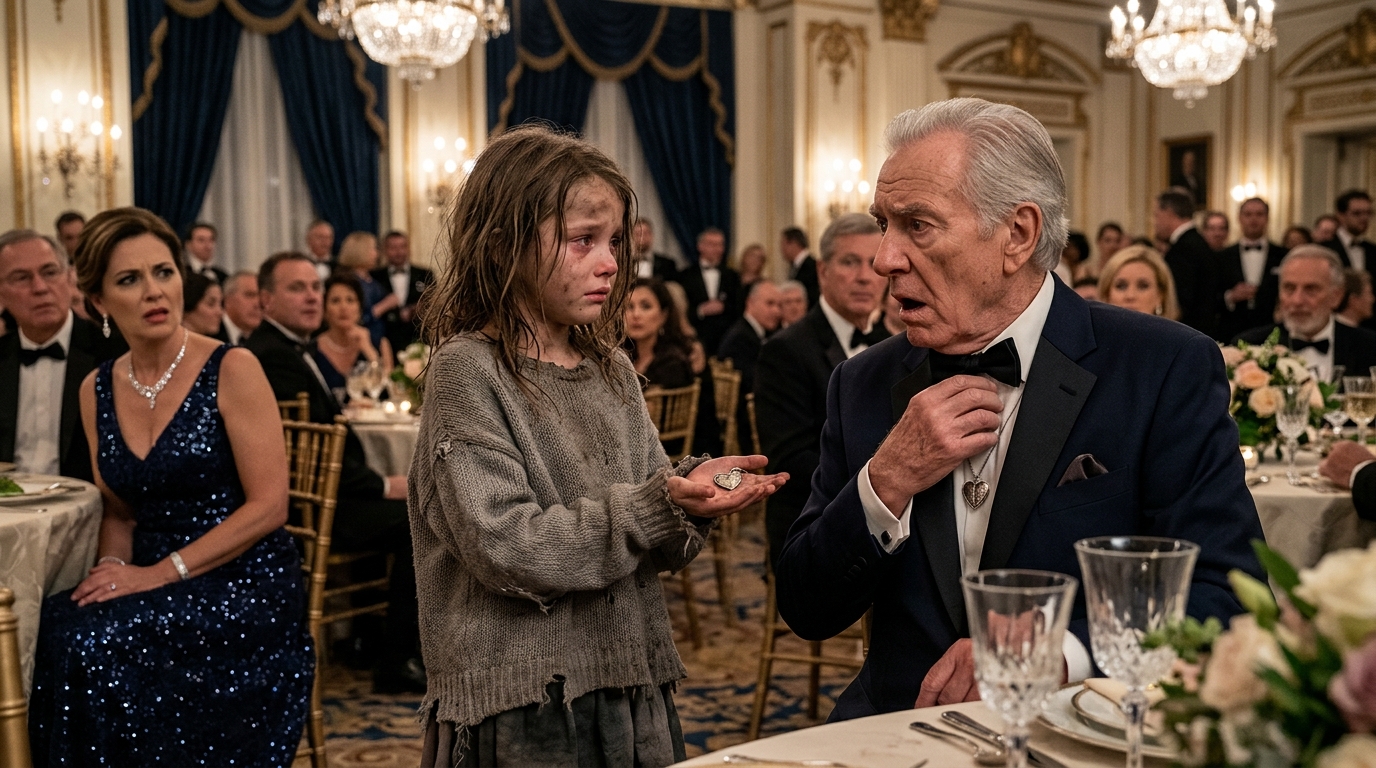
She was small, maybe nine or ten, though hunger makes children difficult to age. Her hair clung damply to her cheeks. Her sweater was torn near one sleeve. The hem of her dress was muddy, and her shoes looked like they had survived more winters than she had.
The room noticed her all at once.
Conversation thinned.
A waiter stopped mid-step.
A woman near the front touched her necklace as if poverty were contagious.
Vivian turned first.
Her smile vanished.
“Who let her in here?”
The girl froze.
For one moment, I thought security would reach her before anyone understood she was afraid. Then she swallowed, lifted her chin, and walked straight toward the head table.
Every step sounded too loud.
Soft shoes against marble.
Tiny.
Determined.
Terrified.
A security guard moved from the wall.
I raised my hand.
He stopped.
The girl came within five feet of me and looked up.
Her eyes were dark.
Too familiar.
“My mother told me he would recognize me,” she whispered.
A few people laughed softly.
Not because it was funny.
Because rich people laugh when they want discomfort to become someone else’s problem.
Vivian leaned forward.
“Sweetheart, this is not the place.”
The girl did not look at her.
She opened her hand.
Inside her palm was half of a heart-shaped locket.
Gold.
Worn thin at the edge.
A tiny crack near the hinge.
My fingers moved to my chest before I could stop them.
To the matching half beneath my shirt.
The room disappeared.
The chandeliers.
The donors.
The cameras.
The polished cruelty.
All gone.
There was only the locket.
And a grave.
And my daughter’s laugh from twenty-one years ago.
“No,” I breathed.
My voice did not sound like mine.
I stood so quickly my chair struck the floor behind me.
The girl flinched, but did not close her hand.
I reached toward the locket, then stopped before touching it, afraid that if I did, it would vanish.
“I buried the other half with my daughter.”
The silence that followed was no longer polite.
It was frightened.
The girl’s face crumpled.
Tears slipped down her cheeks as she whispered,
“Then why did my mother say I was your lost child?”
Vivian made a sound beside me.
Small.
Sharp.
Almost nothing.
But I heard it.
And when I turned, I saw that every bit of color had left her face.
The Locket That Should Have Been Buried
I took the girl to the private library behind the ballroom.
Not because I trusted the room.
Because I trusted no one else in the ballroom.
The library had belonged to my father before me. Dark oak shelves. Green glass lamps. A fireplace no one had lit in years. Portraits of men who built fortunes and women who learned to survive them.
The girl sat on the leather chair across from my desk, both hands wrapped around the locket as if someone might still snatch it away.
My security chief, Daniel Price, stood near the door.
Vivian tried to enter with us.
I stopped her.
“This is family business.”
Her expression tightened.
“Arthur, you cannot seriously believe—”
“I said family.”
For the first time in twenty years, Vivian Rowe did not know what to say to me.
The door closed in her face.
The girl watched it shut.
Only then did she breathe.
“What is your name?” I asked.
“Clara.”
The name struck me strangely.
My wife had wanted that name if we ever had another daughter.
Lydia had known that.
I forced myself to sit slowly, though every nerve in my body wanted to run into the ballroom and start overturning tables until the truth fell out.
“Who is your mother?”
The girl looked down.
“She said her name used to be Lydia.”
My heart stopped.
There are moments when the mind protects itself by refusing meaning.
I heard the words.
I understood them.
But for several seconds, I rejected every possible world in which they could be true.
“Lydia is dead.”
Clara nodded, crying harder now.
“That’s what she said you would say.”
The room shifted under me.
Daniel Price, loyal and silent behind me, took one step closer.
“Where is your mother now?” I asked.
Clara shook her head.
“She was at Mercy House. But two men came yesterday. She hid me in the laundry room and told me if she didn’t come back, I had to find the room with chandeliers.”
“The gala,” I whispered.
“She said you would be there because rich people like to feel sad in pretty rooms.”
For one terrible second, I almost laughed.
That sounded like Lydia.
Not the words exactly.
The blade inside them.
My daughter had never respected ceremony unless it was useful.
Clara reached into the pocket of her torn sweater and pulled out a folded paper.
“She told me to give you this after the locket.”
My hands shook as I opened it.
The handwriting broke me before the words did.
Lydia’s handwriting had always leaned sharply to the right, impatient to arrive before the sentence was finished. I had saved enough birthday cards, school notes, and furious letters from her adolescence to know it anywhere.
Dad,
If this reaches you, then I either failed to run far enough or waited too long.
I am alive.
I know they told you I died in the fire.
I know you buried a coffin.
I know you buried my locket.
You did not bury me.
You buried what Vivian needed you to believe.
I pressed one hand flat against the desk.
The paper blurred.
Daniel said my name quietly, but I ignored him.
I kept reading.
Clara is mine.
She is yours.
Do not let Vivian near her.
Do not call the foundation lawyers.
Do not trust the death certificate.
Ask for Nurse Elaine Bell at Mercy House.
Tell her the lake house fire started after I found the adoption ledger.
The room turned cold.
Adoption ledger.
Vivian’s charity work.
The children’s fund.
The annual gala.
The phrase on the banner outside.
For The Forgotten Children.
I looked up at Clara.
“Did your mother tell you anything else?”
She nodded.
“She said if the diamond lady smiles, run.”
My eyes moved toward the closed door.
Outside it, beyond the library, the gala continued in a strained murmur. Guests were likely whispering. Phones were likely out. Vivian was certainly trying to control the story before I returned.
But she did not know about the note.
Not yet.
I folded it carefully and placed it inside my jacket.
Then I held out my hand.
“May I see the locket?”
Clara hesitated.
“It’s okay,” I said. “I only want to look.”
She placed it in my palm.
The gold was warm from her skin.
I turned it over.
On the inside edge, almost too small to see, were two engraved letters.
L.W.
Lydia Whitmore.
I had engraved them myself.
The day she turned sixteen.
The day I gave her half the locket and told her that no matter how far she went, half my heart would always know the way back.
I looked at Daniel.
“Find out who brought that child through the side entrance.”
He nodded.
“And lock down the building.”
“Yes, sir.”
Clara’s eyes widened.
“No. She said not to lock doors.”
“Why?”
Her voice dropped to a whisper.
“Because Vivian always keeps another way out.”
Before I could answer, the library lights flickered once.
Then went out.
And from the ballroom came the sound of a woman screaming.
The Shelter Where My Daughter Hid
The power returned in thirty seconds.
Vivian was gone.
So was Clara.
That was the second time I lost a child in that building.
The first had happened years before, though I did not know it yet.
The security footage showed the library blackout was no accident. A fire alarm was triggered in the service corridor behind the kitchen. During the confusion, one of the waitstaff opened the rear door.
Clara ran.
Or was taken.
The angle did not show enough.
It showed only her small figure vanishing into the service hall, then Vivian’s assistant stepping deliberately into the camera’s view with a stack of linens to block the frame.
By midnight, the ballroom was empty.
The donors had been sent home with careful language.
A medical episode.
A distressed child.
A private family matter.
I had used those phrases for years without understanding how useful they were to guilty people.
Now every polished sentence tasted rotten.
At 2:17 in the morning, I walked into Mercy House.
Daniel Price came with me.
So did one private investigator I had trusted since my wife was alive.
Mercy House stood in the east district, far from the marble glow of my foundation. Brick walls. Flickering sign. Women smoking near the back entrance. Children asleep on plastic chairs in the waiting area.
The receptionist looked at my suit, then at my face.
Before I spoke, she said, “You’re too late.”
Those words nearly took my legs out from under me.
“Where is Elaine Bell?”
The receptionist hesitated.
Then a voice behind her said, “Let him through.”
Nurse Elaine Bell was older than I expected. Small, gray-haired, with sharp eyes and a spine that did not bend for money. She led us into an office filled with stacked files and mismatched chairs.
On her desk sat a blue blanket.
Folded neatly.
My daughter’s blanket.
I remembered it from the lake house.
Lydia used to keep it on the couch when she read late into the night.
Elaine touched it gently.
“She came here with that and the child nine months ago.”
I could not speak.
“Was it Lydia?”
Elaine looked at me with pity, which I hated because I deserved it.
“Yes.”
I sat down.
Daniel remained standing.
“Where is she?”
Elaine’s mouth tightened.
“Vivian’s men found her yesterday. Lydia told me to hide Clara, but the child slipped out after midnight. She said she had to find you before the gala ended.”
My hands closed into fists.
“Where did they take Lydia?”
Elaine opened a drawer and removed a file.
“No one has been able to prove that. But she believed they would take her back to Briar Hall.”
The name entered the room like mold.
Briar Hall was a private recovery facility outside the city. I had funded one of its wings after Lydia died. Vivian said traumatized children needed quiet places to heal.
Children.
Quiet places.
Heal.
My stomach turned.
Elaine slid the file toward me.
Inside were photographs.
Not many.
Enough.
Lydia at thirty.
Thin.
Hair cut short.
A scar along her left temple.
But alive.
Beside her, Clara at five or six, standing in front of a bus station with the locket visible around her neck.
The next page contained copied medical records.
Jane Rowe.
Female.
Long-term cognitive instability.
Restricted visitors.
No family contact.
The birthdate listed beneath the false name was Lydia’s.
I stared at it.
“They kept her alive under another name.”
Elaine nodded.
“Sedated when necessary. Moved between facilities when questions came too close.”
“Why?”
Elaine looked at the closed door, then lowered her voice.
“Because Lydia found the ledger.”
The adoption ledger.
The phrase from her note.
Elaine continued.
“Your foundation was supposed to fund shelters, clinics, foster support, child advocacy. A good portion of it did. Enough to look real. But another stream moved through private placement agencies. Children without stable families. Mothers in crisis. Babies marked unclaimed. Some were adopted illegally through wealthy networks. Some simply disappeared into domestic work, private homes, or institutions.”
Daniel swore under his breath.
I felt nothing for a moment.
Nothing at all.
Then the shame arrived.
Not sharp.
Heavy.
I had built the fund in my daughter’s name.
Vivian had used that name as a curtain.
Lydia discovered it before the fire.
So Lydia had to become dead.
“Why didn’t she come to me?” I asked.
Elaine’s eyes softened.
“She tried.”
The answer hit harder than accusation.
“She sent letters. They were returned. She called your office. She was told you refused contact. She went to the foundation once. Security removed her under Vivian’s order.”
I thought of all the years Vivian had told me grief made people vulnerable to scams.
All the letters she filtered.
All the desperate people she said were exploiting Lydia’s name.
My daughter had been one of them.
Elaine pulled one final photograph from the file.
It showed a young Lydia in a hospital bed holding a newborn.
Clara.
On the back, in Lydia’s handwriting, were three words.
Tell my father.
I covered my mouth with one hand.
For twenty-one years, my daughter had been alive somewhere in the world, and I had been signing checks under her name.
Elaine leaned closer.
“There’s something else.”
I looked up.
She tapped the locket half on the desk.
“The one you buried was not in the coffin when the grave was opened.”
My breath stopped.
“What?”
“Lydia had the real half. She said a funeral worker smuggled it out before the coffin was sealed because there was no Lydia inside to bury it with.”
The room went still.
Daniel’s phone buzzed.
He checked it, then looked at me.
His face had gone pale.
“Sir,” he said, “we found Clara.”
I stood too fast.
“Where?”
He swallowed.
“At Briar Hall.”
Then he added the sentence that made Elaine close her eyes.
“She’s not alone.”
The Building Paid For With My Grief
Briar Hall looked peaceful from the outside.
That was the most obscene part.
Red brick. White columns. Soft lights glowing behind tall windows. A sign near the entrance surrounded by winter roses.
Briar Hall Recovery Institute.
Compassion. Privacy. Renewal.
My name was on the east wing.
Arthur Whitmore Children’s Pavilion.
I nearly vomited when I saw it.
Police would come later. Federal agents too. Lawyers. Reporters. Investigators. But that night, we did not wait for the machinery of justice to warm itself up.
Elaine had called a detective she trusted.
Daniel had called men he trusted more than the local precinct.
I called no one from my foundation.
Not one.
We entered through a service door Elaine remembered from her nursing days. The hallway smelled of bleach, medicine, and old carpeting. Somewhere, a television played softly behind a closed door.
The deeper we went, the more the building stopped feeling like a hospital and started feeling like a storage facility for people no one was supposed to ask about.
We found Clara in a small room near the back.
She sat on a cot, knees to her chest, clutching the locket chain in both hands. A woman in scrubs stood beside her with a clipboard.
When I entered, Clara sprang to her feet.
“Mr. Whitmore!”
The nurse turned.
Daniel moved first, stepping between them.
“Leave the room.”
The nurse began to protest.
Daniel did not repeat himself.
She left.
Clara ran into me.
I had not held a child that small since Lydia.
The force of it nearly undid me.
“Where is your mother?”
Clara pulled back, crying.
“They said she was confused. They said she didn’t want me.”
“No,” I said. “No, sweetheart. That is not true.”
“She’s here,” Elaine said from the doorway.
We followed her down another corridor.
Past locked doors.
Past rooms with women staring blankly at walls.
Past a nursery that should not have existed in a recovery institute.
At the end of the hall was a private room with a keypad.
Elaine entered a code.
The door opened.
My daughter was sitting by the window.
For a moment, I did not move.
The human heart is not built to receive the dead back casually.
Lydia looked older, of course. Thin. Pale. Her hair streaked with silver at the temples. A blanket covered her lap. Her wrist bore the bruised yellow shadow of an IV line.
But her eyes—
Her eyes were exactly the same.
Sharp.
Defiant.
Wounded.
Alive.
She turned toward the door slowly.
Her gaze found Elaine first.
Then Clara.
Then me.
I watched recognition fight through years of medication, lies, and terror.
“Dad?”
I crossed the room and fell to my knees in front of her chair.
Not elegantly.
Not like a wealthy man.
Like a father who had been buried alive with his grief and had finally clawed through.
“I’m here,” I said.
She touched my face with shaking fingers.
“They told me you signed the papers.”
“No.”
“They told me you gave Clara away.”
“No.”
“They told me you buried me because it was easier.”
I broke then.
There is no dignified way to hear what your child was made to believe about you.
“I buried a lie,” I whispered. “Not you.”
Clara climbed into her mother’s lap, sobbing.
Lydia wrapped both arms around her daughter and closed her eyes.
For a few seconds, the room held something close to mercy.
Then Vivian spoke from behind us.
“How sentimental.”
I turned.
She stood in the doorway in a silver evening gown, diamonds still at her throat, as if she had come directly from the gala to admire the damage she had done.
Two men stood behind her.
Not doctors.
Security.
Her security.
Vivian looked at Lydia with disgust.
“You always were dramatic.”
Lydia’s face changed.
Not fear.
Rage.
“You used my name.”
Vivian shrugged.
“I preserved your father’s legacy.”
“You stole children.”
Vivian’s eyes flicked toward Clara.
“I cleaned up what poverty leaves behind.”
That was when I understood her completely.
Not madness.
Not desperation.
Philosophy.
Vivian believed people like Clara were raw material. Stories for galas. Photographs for brochures. Lives to be sorted, purchased, renamed, and hidden when inconvenient.
“You forged Lydia’s death,” I said.
Vivian looked at me almost gently.
“Arthur, you were drowning. I gave you a purpose.”
“You gave me a grave.”
“I gave you an empire of compassion.”
The room went cold.
Lydia laughed once.
Weakly.
Bitterly.
“You always thought language could perfume rot.”
Vivian’s face hardened.
One of the men behind her stepped forward.
Daniel appeared at the end of the corridor with two armed federal agents behind him.
Vivian saw them.
For the first time all night, uncertainty entered her face.
Elaine stepped beside me and lifted her phone.
“I recorded everything from ‘How sentimental.’”
Vivian stared at her.
Then at me.
Then at the locket half in Clara’s hand.
The same locket she had failed to bury.
The same locket that had walked into her gala dressed in rags.
Her mouth opened.
No words came.
Because every lie she built had finally met the one child she forgot to erase.
The Child No One Could Erase
The investigation lasted eighteen months.
That is what people never understand about truth.
It may arrive in one impossible moment, in a ballroom, in a child’s open palm.
But after that, truth becomes paperwork.
Testimony.
Depositions.
Indictments.
Exhumations.
Bank records.
Medical charts.
Names.
So many names.
The first grave opened was Lydia’s.
There was no daughter in that coffin.
Only the remains of a woman later identified as a patient who had died in a state facility two counties away. Her body had been processed through a funeral home Vivian controlled through a shell company. Her records had been altered. Her family had been told she was cremated.
Even in death, Vivian had stolen someone.
The second grave opened belonged to the foundation.
Not a literal grave.
A financial one.
Buried beneath scholarships and shelter grants were payments to private adoption brokers, sham clinics, coercive maternity homes, and “recovery residences” like Briar Hall.
The Lydia Whitmore Children’s Fund had helped thousands publicly.
That was how Vivian hid the hundreds it harmed privately.
Enough good to shield the evil.
Enough charity to purchase silence.
Enough applause to cover crying.
Vivian was arrested before sunrise.
So were two foundation attorneys, a Briar Hall administrator, a private placement director, and the funeral contractor who admitted removing Lydia’s locket from the false coffin before burial. He said he gave it to a nurse who begged for proof that Lydia had lived.
That nurse carried it to Lydia.
Lydia carried it to Clara.
Clara carried it to me.
A chain of frightened women had done what my fortune could not.
They kept the truth alive.
Lydia’s recovery was not simple.
Stories like this want the daughter found, the villain exposed, the mansion filled with light by morning.
Life is less generous.
My daughter had spent years drugged, moved, dismissed, and told her own father had abandoned her. Some days, she could not look at me. Some nights, she woke screaming that she could smell smoke. Sometimes she stared at Clara too long, as if afraid her daughter might be taken again if she blinked.
Clara did not trust beds.
She slept on the rug beside Lydia’s room for weeks until Lydia finally joined her there with blankets and pillows, and the two of them slept on the floor like survivors of a shipwreck who did not yet believe in land.
I let them.
The house had too many rooms anyway.
We changed the foundation first.
Not rebranded.
Changed.
The board was dissolved. Every placement case was reopened. Independent advocates were appointed. Missing records were turned over to federal investigators. Every family harmed by the network received legal support funded not by donations, but by my personal assets.
I sold the lake house.
I could not bear it.
Lydia asked me not to destroy it.
So I gave it to the survivors’ trust.
“Let it become useful,” she said.
That was my daughter.
Even after everything, she still wanted broken things repurposed instead of burned.
At Vivian’s trial, the courtroom filled every day.
Former donors sat in stunned silence.
Reporters filled two rows.
Women from shelters came with folders in their laps.
Children, now adults, came carrying names they had only recently learned were theirs.
Vivian wore black.
No diamonds.
It did not help.
Without the glitter, she looked smaller.
Not remorseful.
Never that.
Just reduced.
Lydia testified for two days.
Her voice shook at first.
Then steadied.
She described the fire, the ledger, the night she realized children were being moved through her father’s foundation. She described confronting Vivian. She described waking in Briar Hall under a false name.
Then Clara testified.
She brought the locket.
The prosecutor asked her what she remembered from the gala.
Clara looked toward me.
“I remember everyone looking at me like I was dirty,” she said.
The courtroom went quiet.
“Then Grandpa looked at the locket like he already knew me.”
I lowered my head.
Because I had.
Not fully.
Not logically.
But the blood knows before the mind signs permission.
Vivian was convicted on every major count.
Fraud.
Conspiracy.
Identity falsification.
Unlawful confinement.
Child trafficking through fraudulent placement networks.
Evidence tampering.
The judge called her crimes “philanthropy turned predatory.”
Vivian did not cry.
She looked at Lydia once as they led her away.
“You would have wasted it,” she said.
Lydia answered calmly.
“No. I would have saved them for free.”
That was the last thing Vivian heard from us.
Months after the verdict, we held another gala.
Not at the ballroom.
Never there again.
We held it outside, in the courtyard of the new advocacy center built where an old administrative wing once stood. No chandeliers. No crystal flutes. No speeches about pity.
Families came.
Survivors came.
Nurses came.
Elaine Bell cut the ribbon while Clara stood beside her holding the repaired locket.
The two halves had been joined again by an old jeweler with careful hands. He left the crack visible because Clara asked him to.
“Proof,” she said.
That evening, Lydia sat beside me on a bench while Clara ran across the courtyard with other children.
For a long time, neither of us spoke.
Then Lydia reached for my hand.
“I tried to come home,” she said.
“I know.”
“I hated you for not finding me.”
“I know.”
“I don’t want to hate you anymore.”
That hurt more than if she had said she forgave me.
Forgiveness can be too clean.
This was truer.
Messier.
Alive.
I squeezed her hand.
“I’ll wait as long as it takes.”
She looked at the courtyard.
At Clara laughing under strings of warm lights.
At the building that no longer carried her name as decoration, but as a promise with teeth.
Then she said, “She asked me once what family means.”
“What did you tell her?”
Lydia smiled faintly.
“I told her I didn’t know anymore.”
My chest tightened.
“And now?”
She watched Clara run toward us, breathless, bright-eyed, locket shining at her throat.
“Now I think it means someone believes you before the world gives them permission.”
Clara crashed into us a second later, laughing, alive, impossible.
I held my daughter with one arm and my granddaughter with the other.
Across the courtyard, Elaine Bell raised a glass.
Daniel Price stood near the gate, watching the doors because some men show love by making sure exits stay open.
Above us, the sky deepened into blue.
No chandeliers.
No marble.
No fake generosity.
Only light.
Real light.
The kind that did not make poverty sparkle for donors.
The kind that helped lost children find the door.
For twenty-one years, I believed my daughter was buried with half my heart.
I was wrong.
Half my heart had been walking toward me the whole time.
Barefoot.
Hungry.
Terrified.
Carrying proof in her palm.
And brave enough to open her hand in a room full of people who had mistaken her for powerless.