The Photograph on the Cobblestones
I did not know the photograph had fallen.
That was the detail that kept returning to me later, after the police reports, after the graves were opened, after the woman I had mourned for seven years touched my face with hands that trembled like she was afraid I might disappear too.
I did not know.
I was walking through the old quarter at sunset, past stone walls warmed by the last gold of the day, past shuttered bakeries and flower boxes hanging from iron balconies, carrying my grief in the pocket of my coat like I had done every day since Isabel died.
Her photograph was small.
Faded at the edges.
Soft from being touched too often.
She was smiling in it, hair loose in the wind, one hand shielding her eyes from the sun. I had taken it two months before the accident. Before the call. Before the sealed coffin. Before my mother told me some wounds survived only if you stopped looking at them.
I never stopped looking.
Not really.
My name was Adrian Vale, and for seven years, I had lived as a widower in the most respectable way possible. Quiet house. Polite condolences. Work that filled the day. Dinner invitations declined with enough gentleness that people eventually stopped asking.
Everyone thought I had accepted Isabel’s death.
They mistook silence for healing.
That evening, I walked because I could not stay inside my own home. It would have been our anniversary. The housekeeper had placed white lilies in the foyer, forgetting those had been funeral flowers too.
So I left.
No destination.
No plan.
Just the old quarter, the fading sun, and the sound of my shoes against cobblestone.
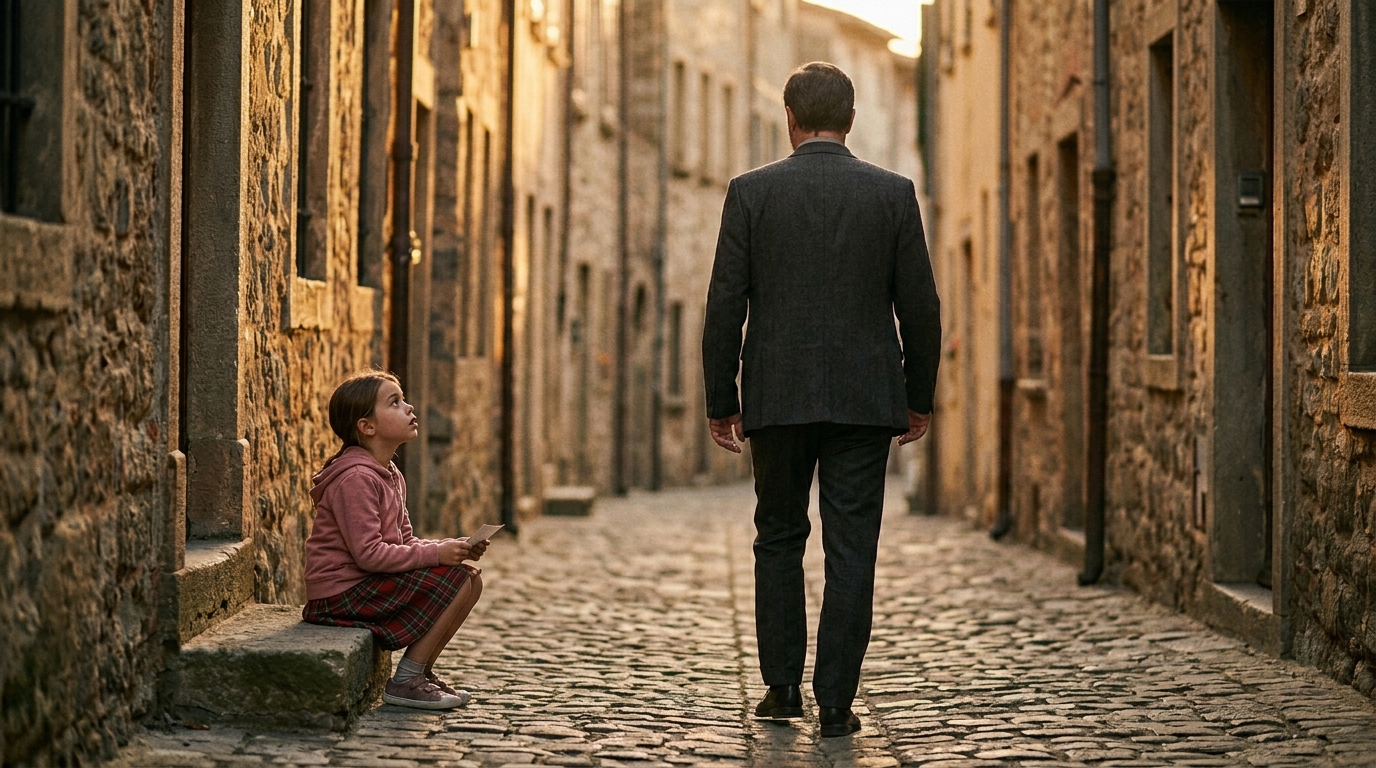
The photograph slipped from my pocket somewhere near Saint Arlen’s Alley.
I kept walking.
Behind me, a little girl picked it up.
“Mister…”
Her voice was soft.
So soft it should not have stopped me.
But it did.
I paused with one foot still half-raised, my body reacting before my mind did. Something in the way she spoke carried no fear, no shyness, no request for money. Just certainty.
I turned slowly.
She sat on a low stone step beside an old blue door, wearing a pink hoodie under a plaid skirt. Her knees were dusty. Her shoes did not match. Her dark hair fell across one cheek, and she held the photograph with both hands.
The moment I saw it in her fingers, irritation struck first.
Then panic.
That photograph was the only thing I carried that still felt alive.
I stepped toward her.
“Where did you get that?”
She did not answer immediately.
She looked from the photograph to my face.
Then back again.
Her expression changed.
Not confusion.
Recognition.
“Mister,” she asked, “why do you have a picture of my mommy?”
The alley seemed to lose sound.
No footsteps.
No distant traffic.
No birds shifting on the rooftops.
Only that sentence.
My mommy.
I stared at the child.
“What did you say?”
She lifted the photograph higher, as if maybe I had misunderstood the object and not the words.
“My mommy.”
My mouth went dry.
“That is my wife.”
The child blinked once.
Not frightened.
Not corrected.
Certain in the devastating way only children can be certain.
I heard myself say, “She died seven years ago.”
The girl hugged the photograph to her chest for one brief second, as if protecting Isabel from my sentence.
Then she held it back out.
“No,” she said softly. “My mom is alive.”
I should have dismissed it.
Children confuse faces. Children invent things. Children repeat stories adults feed them. The world is full of grief scams and cruel coincidences.
But then I stepped close enough to see her face clearly.
And everything inside me went cold.
Her eyes.
Isabel’s eyes.
Not just the color, though that was bad enough. Gray with a ring of green near the iris. Rare. Unmistakable.
It was the way she looked at me.
Directly.
As if truth were not something to fear.
Isabel had looked at me like that the first night we met, when I was too young and arrogant to understand how quickly a person could become necessary.
The girl placed the photograph in my hand.
Her fingers brushed mine.
Small.
Cold.
Real.
“What is your name?” I asked.
“Lena.”
My chest tightened.
Isabel had wanted that name.
If we ever had a daughter, she once told me, sitting barefoot on our kitchen counter at midnight, eating cherries from a bowl. Lena. Short for Magdalena. Strong but gentle.
We never had children.
At least, that was what I had believed.
Lena looked past me toward the end of the alley.
Then back.
“My mom said if I ever saw your face,” she whispered, “not to let you walk away again.”
Before I could ask what she meant, the old blue door behind her opened.
A woman’s voice called from inside.
“Lena?”
The child turned.
Too late.
A thin woman in a gray cardigan appeared in the doorway.
When she saw me, her face went white.
Not pale.
White.
As if I were not a man, but a ghost who had finally found the wrong door.
And then she whispered the name no stranger in that alley should have known.
“Adrian.”
The Woman Behind the Blue Door
Her name was Marta Bell.
At least, that was what she told me first.
She stood in the doorway with one hand gripping the frame, eyes moving from my face to the photograph in my hand, then to Lena as if checking whether the child had been harmed by recognition itself.
“Inside,” she said.
Not warmly.
Not politely.
Urgently.
Lena obeyed at once.
That frightened me more than if she had argued.
I followed them into a narrow stairwell that smelled of damp stone, boiled cabbage, and old wood. The blue door closed behind us with a soft click. Somewhere above, a radio played a song in another language. Somewhere below, pipes groaned.
Marta led us up two flights to a small apartment under the roof.
The room was poor but clean. A narrow bed. A table with two chairs. A cracked mirror. A stove no larger than a suitcase. On the windowsill, a chipped cup held three wilted flowers.
Lena went straight to the bed and sat with both hands folded in her lap.
Too quiet.
Too trained.
I looked at Marta.
“How do you know my name?”
Her eyes filled with something like pity.
I hated her for it.
“I knew your wife.”
The word wife struck the room.
Lena looked at me.
Marta noticed and lowered her voice.
“Isabel.”
My knees nearly weakened.
I had not heard anyone outside my family say Isabel’s name in years.
Not naturally.
Not like she belonged to the living.
“Where is she?” I asked.
Marta did not answer quickly enough.
The silence made my hands close into fists.
“Where is my wife?”
Lena flinched.
I forced my hands open.
Marta saw that too.
“She is alive,” Marta said. “But she is not safe.”
The room tilted.
Alive.
The word had no shape at first.
It entered me as sound, then pain, then something so large I had to grip the back of a chair to keep standing.
“No.”
Marta’s face hardened.
“Yes.”
“I buried her.”
“You buried a sealed coffin.”
I stopped breathing.
Seven years earlier, the police told me Isabel’s car had gone off the coastal road during a storm. It burned before anyone could reach it. Her mother, Celeste Marrow, handled the identification because I was in Zurich for a financing deal and did not reach the hospital until the next morning.
By then, everything was already decided.
Closed casket.
Private service.
No viewing.
No questions.
Celeste told me the body had been too damaged.
My mother agreed.
My father signed documents.
The funeral director spoke in a voice soft enough to make resistance feel indecent.
And I, shattered and stupid with grief, believed them.
I buried a coffin.
Marta stepped to the small cupboard and removed a tin box. She placed it on the table, unlocked it with a key from around her neck, and took out a folded stack of papers.
On top was a photograph.
Isabel.
Older.
Thinner.
Hair cut short.
A scar along her temple.
Holding a newborn wrapped in a pale yellow blanket.
Lena.
I reached for the table and missed.
The chair scraped beneath me as I sat.
Lena watched my face carefully.
Too carefully.
A child should never have to study adults that way.
“This was taken six years ago,” Marta said.
I looked at the baby.
My daughter.
My daughter.
The words did not fit inside me.
“Why didn’t she come to me?”
Marta’s expression changed.
“She tried.”
Of course.
The answer I feared most.
The answer that carried accusation without raising its voice.
“She wrote letters. She called your office. She went to your family home once.”
“No.”
My voice sounded hollow.
“She was removed by private security before you came downstairs.”
My mind raced backward.
Six years ago, a woman had caused a disturbance at the front gate. My mother told me it was a mentally ill person obsessed with Isabel. I never saw her.
I never asked to.
Grief had made me obedient.
That shame entered slowly.
Then all at once.
Marta placed a second paper in front of me.
A medical release form.
Patient name: Elise Warren.
Birthdate: Isabel’s.
Facility: Saint Rowan Recovery House.
Authorized guardian: Celeste Marrow.
Secondary guardian: Helena Vale.
My mother.
I stared at the line until the letters blurred.
“My mother signed this?”
Marta nodded.
“And Isabel’s mother.”
“Why?”
Lena’s small voice cut through the room.
“Because Grandma said Mommy was bad for you.”
I looked at her.
“What?”
Lena lowered her eyes.
“She said you were important. Mommy was going to ruin your life.”
Marta closed her eyes.
That was when I knew the child had heard more than any child should.
Marta pulled one final item from the tin box.
A silver bracelet.
Broken clasp.
Small blue stone.
I had given it to Isabel on our first anniversary.
“I found her wearing this the night she escaped,” Marta said. “She told me if anything happened, Lena should find the man in the photograph. She said he would either save her…”
Marta hesitated.
“Or prove she had been wrong to wait.”
The room went silent.
Then a sharp knock struck the apartment door.
Three times.
Marta’s face changed.
Lena slid off the bed instantly and crawled beneath it without being told.
My blood turned cold.
A man’s voice came from the hallway.
“Marta. Open the door.”
She looked at me and whispered,
“If they see you here, they’ll move Isabel before midnight.”
The House Where the Dead Were Kept
Marta did not open the door.
She moved to the stove, lifted a loose panel behind it, and pointed to a narrow service passage.
“Take Lena.”
“No.”
“Yes.”
“I’m not leaving without answers.”
“You won’t get any if they find her.”
That was the first moment I understood the shape of Isabel’s life after death.
Everything was movement.
Hide.
Run.
Delay.
Whisper.
Trust no door for too long.
Lena crawled out from beneath the bed with a little backpack already in her arms.
Ready.
Packed.
A child prepared for escape before she understood bedtime.
The knock came again.
Harder.
“Marta.”
I took Lena’s hand.
She did not resist.
Marta pushed the tin box into my arms.
“Saint Rowan closed three years ago,” she whispered. “But the private wing is still used. North road. Black gate. Ask for no one. Trust no doctor. And if you see Celeste—”
The door shook under a heavy blow.
Marta’s voice dropped.
“Do not let her speak first.”
The wood cracked as Lena and I slipped into the service passage.
The space was barely wide enough for my shoulders. We climbed down rusted stairs into an alley behind the building while the apartment door splintered above us.
Lena did not cry.
That broke my heart more than tears would have.
My car was two streets away. I carried her the last half block, though she insisted she could walk. Once inside, I called the only person in my life who had ever disliked my family enough to be useful.
Arthur Bell.
My former attorney.
My father fired him after Isabel’s death.
At the time, I thought Arthur had mishandled estate matters.
Now I wondered what he had known.
He answered on the fourth ring.
“Adrian?”
“I found a child.”
A pause.
Then his voice sharpened.
“Where are you?”
“Old quarter. Saint Arlen’s.”
“Does the child have gray eyes?”
The world stopped again.
I looked at Lena in the rearview mirror.
She watched me silently.
Arthur knew.
“Tell me what you know,” I said.
“Not on the phone. Drive to my office. Use back streets. If anyone follows you, do not go home.”
“Arthur.”
His voice softened.
“I tried to tell you she was alive.”
The line went dead.
For several seconds, I could not move.
Then Lena whispered from the back seat,
“Are you mad?”
I turned toward her.
“At you? Never.”
“At Mommy?”
“No.”
“At yourself?”
The question entered like a blade.
Children are merciless because they are often right.
“Yes,” I said.
She nodded as if that was acceptable.
Arthur’s office sat above a closed bookstore near the courthouse. He was seventy-five now, stooped but sharp-eyed, wearing a cardigan over a wrinkled shirt. He opened the back door before I knocked.
When he saw Lena, his face crumpled.
“My God,” he whispered. “She looks like Isabel.”
Lena stepped closer to me.
Arthur let us in.
His office smelled of paper, dust, and old coffee. Files covered every surface. On his desk was a folder already waiting.
“Start from the beginning,” I said.
Arthur did not.
He started from the death certificate.
“It was fraudulent.”
I sat across from him with Lena beside me.
“The body in the crash was never independently identified,” he continued. “Celeste Marrow petitioned to seal the report. Your mother supported it. Your father pressured the coroner. I objected. Then I was removed from all family matters.”
“And you didn’t go to the police?”
“I did. Twice. The file disappeared.”
His shame looked old.
Not performed.
Carried.
“Why would they do this?”
Arthur opened the folder.
Inside were trust documents.
Vale Industries.
Marrow Holdings.
Marriage contract.
Succession clauses.
I had never cared about the structure. I was thirty-one when Isabel died, drowning in grief and executive responsibility. My father told me to sign what stabilized the company. My mother told me legal details could wait.
They had waited seven years.
Arthur tapped one clause.
“If Isabel had divorced you, she would have retained a significant equity share tied to the merger between your company and her family’s assets. If she died without children, control consolidated between your mother and Celeste Marrow as trustees of the memorial foundation.”
“If she had a child?”
Arthur looked at Lena.
“Then the child inherited Isabel’s protected share.”
Lena picked at the sleeve of her hoodie, unaware that everyone in the room had just turned her into a threat worth millions.
“Isabel was pregnant when she disappeared?”
Arthur nodded.
“She discovered the foundation was being used to move assets through fake patient-care grants. She planned to expose it and leave you until she knew whether you were involved.”
The words hurt.
But they did not surprise me.
I had been absent too much.
Too trusting of my parents.
Too willing to let Isabel fight alone in rooms I believed were beneath my attention.
Arthur continued.
“She never made it to court. The accident happened the night before her filing.”
Lena whispered, “Mommy said the car was not an accident.”
Arthur and I both turned to her.
She looked down.
“She remembers fire.”
My mouth went dry.
“Lena, were you in the car?”
She shook her head.
“I wasn’t born.”
Right.
Of course.
But then she added,
“Mommy was.”
The room went still.
“What does that mean?” I asked.
Lena looked up at me.
“She said the fire was before me, but the locked room was after.”
Arthur closed his eyes.
“Saint Rowan.”
I turned to him.
“What is Saint Rowan?”
His jaw tightened.
“A recovery house for people wealthy families wanted hidden.”
The Mother Who Signed the Lie
We reached Saint Rowan just before midnight.
Arthur insisted on coming.
I tried to refuse.
He reminded me that I had spent seven years trusting the wrong people and should consider trying the opposite.
Fair enough.
Saint Rowan Recovery House sat beyond the north road behind a black iron gate and a line of cypress trees. The main building was dark, officially closed. But one wing glowed faintly at the back.
Private wing.
Marta had been right.
I parked beneath the trees and left Lena with Arthur in the car.
She grabbed my sleeve.
“If you see Mommy,” she whispered, “tell her I didn’t let you walk away.”
My throat closed.
“I will.”
The side entrance was locked, but Arthur had brought keys.
I looked at him.
He shrugged.
“I was thorough before they fired me.”
Inside, the hallway smelled of bleach and old flowers. The walls were painted a soft cream, the kind of color meant to soothe people who had no control over where they were taken.
We moved quietly.
Past empty therapy rooms.
Past a nurse’s station with no nurse.
Past framed photographs of donors, including my mother.
Helena Vale.
Elegant.
Serene.
Smiling beneath the words Compassion Through Care.
Arthur found the patient directory in a locked drawer.
No Isabel Vale.
No Elise Warren.
But one name was written by hand on a back page.
I. V.
Room 9.
My body moved before my mind did.
Room 9 was at the end of the west hall.
The door was locked from the outside.
I heard breathing inside.
Soft.
Uneven.
I took the key from Arthur and opened it.
The room was dim except for one lamp near the bed.
A woman sat by the window in a gray robe, hair falling over one shoulder, face turned toward the glass.
For one second, I saw only the outline.
Then she turned.
The world ended.
Then began again.
Isabel.
Older.
Thinner.
A pale scar near her temple.
But Isabel.
My wife.
Alive.
Her eyes found mine, and for a moment neither of us moved.
Not because we doubted.
Because the body cannot survive impossible joy without first mistaking it for danger.
“Adrian?” she whispered.
I crossed the room and dropped to my knees in front of her.
She touched my face with both hands.
Slowly.
As if confirming bone, skin, warmth.
“They said you signed the papers,” she said.
“No.”
“They said you never came.”
“I didn’t know.”
Her face broke.
I had imagined finding her so many times in dreams that I thought I knew what I would say.
I knew nothing.
There are no prepared words for holding the living person you buried.
I pulled her into my arms.
She was shaking.
So was I.
“Lena?” she asked suddenly, pulling back. “Where is Lena?”
“She’s safe. In the car with Arthur.”
Isabel exhaled like she had been holding that breath for years.
Then footsteps sounded in the hall.
Slow.
Measured.
Familiar.
My mother appeared in the doorway.
Helena Vale wore a camel coat over a black dress, pearls at her ears, silver hair arranged perfectly. She looked at me, then at Isabel, with no shock whatsoever.
Only disappointment.
“Adrian,” she said. “You should have gone home.”
I stood slowly.
Arthur stepped into the doorway behind her with his phone in hand.
My mother glanced at him.
“Still clinging to relevance, Arthur?”
He did not answer.
I looked at the woman who raised me.
The woman who held me at Isabel’s funeral.
The woman who told me grief could make men vulnerable to fantasy.
“You knew.”
Helena sighed.
“She was unstable.”
Isabel flinched.
I felt it more than saw it.
“She was pregnant,” I said.
“She was reckless.”
“She was my wife.”
“She was going to destroy you.”
The sentence came out clean.
Practiced.
She had said it before, if not to me.
I stepped closer.
“By telling the truth?”
My mother’s eyes hardened.
“Truth is not a virtue when it burns down everything your family built.”
There she was.
Not mother.
Not comfort.
Custodian of a kingdom built on sealed rooms.
Arthur lifted his phone.
“Keep talking, Helena.”
Her gaze flicked to it.
Only then did she understand he was recording.
Her face changed.
Small.
Fatal.
From behind her, another voice entered the hall.
“Mother?”
Celeste Marrow stepped into view.
Isabel’s mother.
The woman who had identified the false body.
The woman who had wept at the coffin.
The woman who sent me a handwritten note every anniversary saying grief was the last form of love.
She saw Isabel awake.
Then me.
Then Helena.
For the first time, I saw fear.
Not guilt.
Fear of losing control.
Celeste whispered, “You found her.”
Isabel rose unsteadily from the chair.
“They told me you thought I was dead,” she said to her mother.
Celeste looked almost offended.
“You were safer here.”
“Safer?” Isabel’s voice cracked. “You took my child.”
“We protected her from this,” Celeste snapped, gesturing toward me. “From the Vale name, from the scandal, from being used as a weapon in your childish war.”
I felt cold spread through me.
“Where is the foundation ledger?”
Both women went still.
Isabel gripped my arm.
“I hid a copy,” she whispered.
Helena’s head snapped toward her.
“What did you say?”
Isabel’s voice shook, but did not break.
“I hid a copy before the crash.”
Celeste stepped forward.
“Where?”
Isabel looked at me.
“In the photograph.”
For a moment, I did not understand.
Then I remembered the small photo in my coat.
The one I had dropped.
The one Lena picked up.
I pulled it out.
My hands shook as I turned it over.
The back was thicker than it should have been.
A sealed layer.
Arthur took out a small knife and carefully lifted the edge.
Inside was a thin strip of microfilm.
Helena lunged.
I stepped back.
Arthur shouted.
Celeste grabbed Isabel’s wrist.
Then a small voice rang from the hallway.
“Let go of my mom.”
Lena stood near the nurse’s station, Arthur’s coat draped over her shoulders, eyes fixed on Celeste.
Behind her were two police officers and a federal agent.
Arthur Bell, it seemed, had been more thorough than any of us knew.
The Daughter Who Refused to Let Go
My mother did not run.
That would have required believing she could lose.
Celeste did.
She made it six steps before one of the officers caught her by the arm. She screamed that Isabel was unwell, that I had been manipulated, that Lena was a confused child, that Arthur was a bitter old man.
The federal agent took the microfilm.
Arthur gave him the recording.
Isabel held Lena so tightly the child squeaked, then laughed and cried at the same time.
That sound did more to destroy me than anything else that night.
Not because it was sad.
Because it was ordinary.
A mother holding her daughter.
A daughter complaining she could not breathe.
A small life insisting on normalcy in a hallway built to erase it.
The microfilm opened everything.
The memorial foundation created after Isabel’s “death” had been used to transfer assets between Vale Industries and Marrow Holdings under the appearance of grief grants, patient care subsidies, and private recovery funding. Saint Rowan hid witnesses, inconvenient heirs, unstable spouses, and anyone whose existence threatened a merger, trust, or public reputation.
Isabel had discovered it before the crash.
My mother and Celeste arranged her death on paper.
The car fire was staged with another body from an unclaimed morgue case. The coffin was sealed. The grief was public. The assets moved. Isabel was confined under a false identity and drugged whenever she demanded access to Lena or me.
Lena had been kept outside the official family structure because naming her would activate Isabel’s protected share.
But Isabel had smuggled pieces of truth wherever she could.
A bracelet.
A photo.
A name.
A message to Marta.
And, eventually, a command to her daughter.
If you ever see his face, don’t let him walk away again.
She had trusted a child to do what adults had failed to do.
And the child did it.
The trials took two years.
My mother was convicted first.
Celeste second.
Doctors, administrators, foundation officers, and two private security contractors followed. Arthur testified for three days. Marta testified despite threats. The federal agent called Lena “the first living key witness,” a phrase I hated but understood.
Isabel testified too.
She was not fragile on the stand.
Thin, yes.
Shaking, sometimes.
But not fragile.
When Celeste’s attorney asked why she had not escaped sooner, Isabel looked straight at her mother and said, “Because every door had my family’s money on the lock.”
The courtroom went silent.
My mother never looked at me during sentencing.
Not once.
Maybe that was her last act of control.
Maybe it was shame.
I no longer try to give kind names to cruel things.
After Saint Rowan, Isabel did not come home with me immediately.
People expect that part to be simple.
A wife found alive.
A daughter discovered.
A family restored.
But life does not resume just because the lie is exposed.
The house where I had mourned her felt like a shrine built by the people who stole her. Every room held something false. Every portrait belonged to a bloodline she no longer trusted. Every family document seemed to whisper that paper could imprison as easily as protect.
So we rented a small apartment above a bakery.
Not on Mercer Street.
Not in the old quarter.
Somewhere new.
Somewhere with morning light.
Lena loved it because she could smell bread before opening her eyes. Isabel loved it because there was only one door and she had the key. I loved it because they were there.
Slowly, we learned each other.
Not again.
Again would imply we were returning.
We were not.
We were starting from wreckage.
Lena did not call me Dad at first.
She called me Adrian with solemn precision, as if testing whether the name stayed attached to the man.
Then Mr. Adrian when she wanted something.
Then, one rainy afternoon when I burned toast and Isabel laughed for the first time without flinching afterward, Lena sighed and said, “Dad, you’re bad at breakfast.”
I turned away so she would not see me cry.
Isabel touched my shoulder.
She saw anyway.
She always had.
The photograph stayed on our kitchen shelf.
The same one I dropped.
The same one Lena found.
The same one that had carried the microfilm inside its back and the living truth on its front.
Sometimes I looked at it and thought about how close I came to walking away.
One more step down the alley.
One more second of not hearing a child’s voice.
One more habit of believing grief had already told me everything.
That is the most frightening part of any lie.
Not how well it is built.
How easily the wounded agree to live inside it.
Years later, we returned to Saint Arlen’s Alley.
The blue door had been repainted green. Marta had moved to a safer place with money from a witness fund and a stubborn refusal to accept anything directly from me unless Isabel asked her to.
The stone step remained.
Lena sat on it, older now, swinging her legs.
“This is where I found you,” she said.
I smiled.
“I think I found you.”
She shook her head.
“No. You were walking away.”
Fair.
Isabel stood beside me, her hand in mine.
She looked at the alley, the cobblestones, the narrow strip of sky above the rooftops.
“I was so afraid you wouldn’t believe her,” she said.
“I almost didn’t.”
“I know.”
The honesty between us still hurt sometimes.
But it was clean pain.
The kind that heals because it does not hide.
Lena pulled the old photograph from her pocket.
She carried it now on important days.
It was more fragile than ever, protected in a clear sleeve Arthur had made for it.
She held it up in the sunset, just as she had years before.
“Mister,” she said, with theatrical seriousness, “why do you have a picture of my mommy?”
Isabel laughed.
I did too.
This time, the alley did not freeze.
No one came through a door.
No one was taken.
No one had to run.
I took the photograph gently and looked at the woman in it.
My wife.
Not dead.
Not gone.
Not restored to who she had been before.
Something more honest.
A survivor.
Then I looked at our daughter.
The child who had refused to let me keep walking.
The child who had carried her mother’s hope in a sentence too heavy for her age.
The child who became the hinge between a buried past and a living future.
For seven years, I thought grief meant loving someone after death.
I was wrong.
Sometimes grief is what happens when other people convince you to bury the living.
And sometimes love returns as a little girl on a stone step, holding a photograph in both hands, asking the one question powerful liars forgot to fear.