The Boy on the Cardboard
Manhattan never pauses for grief.
Yellow cabs sliced through the winter light. Strangers hurried past with coffee cups, shopping bags, wool coats, and faces trained to look straight ahead. Storefront windows reflected people who would never speak to one another, even if tragedy brushed against their sleeves.
I was holding my son Ethan’s hand outside a grocery store when he suddenly stopped.
“Mom—wait!”
Before I could tighten my grip, he pulled free.
The shopping bag slipped from my arm.
Apples rolled across the sidewalk.
“Ethan!”
My voice cut through the traffic, sharp enough to make heads turn.
He didn’t look back.
My six-year-old son darted between coats, briefcases, and impatient pedestrians. He wasn’t running toward a toy store. He wasn’t chasing candy or a street performer.
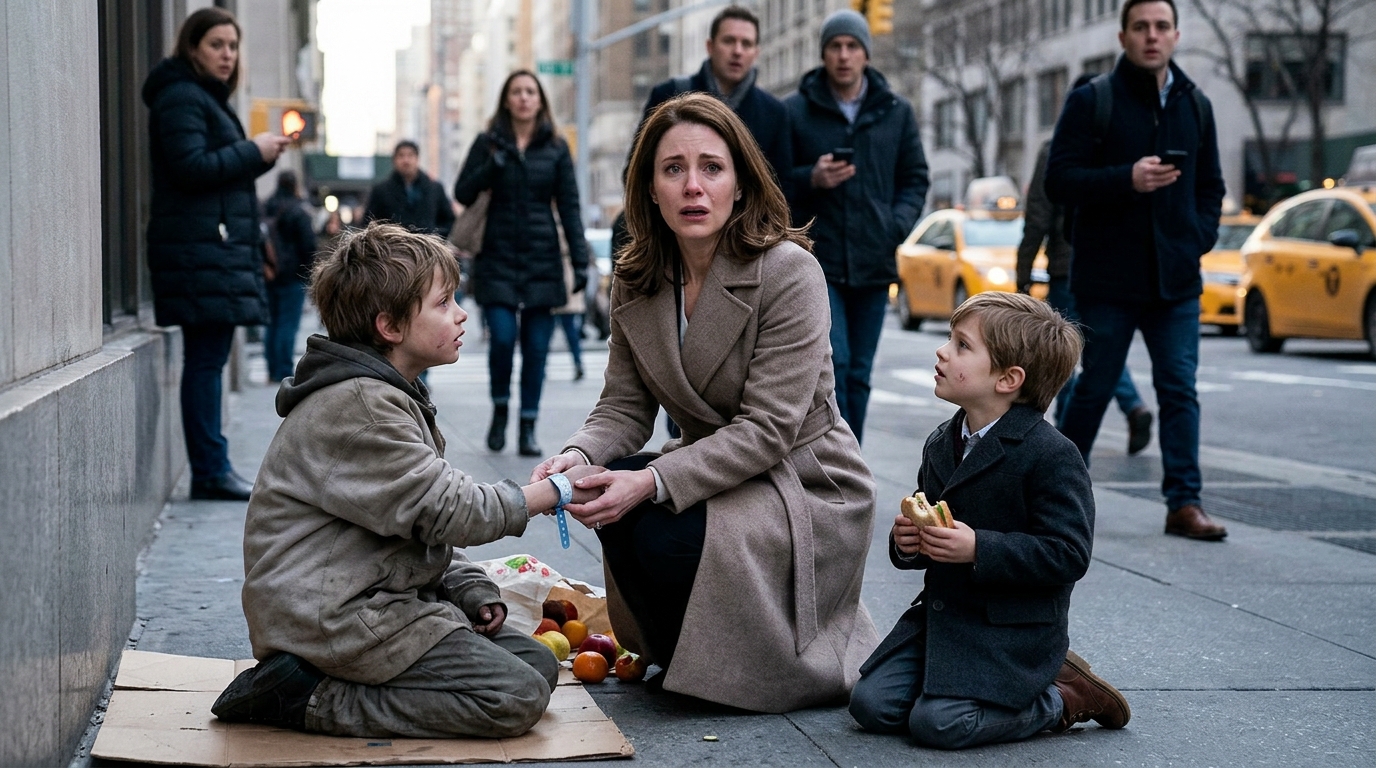
He was running toward a piece of cardboard leaning against a stone wall.
A child lay there.
Small.
Still.
Wrapped in an oversized brown coat that swallowed his body. His hands were tucked beneath his chin. His face was pale from the cold, cheeks hollow, lips cracked.
Too young to be alone.
Too quiet to be sleeping peacefully.
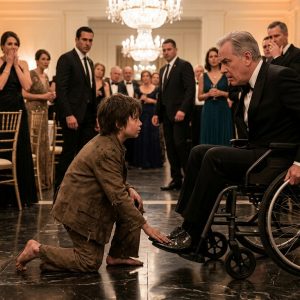
Ethan dropped to his knees beside him without hesitation.
He opened his lunch bag, pulled out the sandwich I had packed that morning, and placed it gently into the child’s hands.
“Here,” he whispered. “It’s yours.”
The boy stirred.
His eyes fluttered open.
Weakly.
Slowly.
And then the whole sidewalk changed.
A courier stopped in the bike lane.
A woman beside a taxi lowered her phone.
A man holding two coffees stared like he had forgotten where he was going.
Because the boy on the cardboard looked exactly like Ethan.
Same age.
Same dark eyes.
Same nose.
Same small crease near the corner of his mouth.
Only hunger and cold had carved away the softness my son still had.
I reached them breathless.
Then froze.
The world narrowed to that child’s face.
“No…”
The word escaped before I could stop it.
Ethan looked up at me, confused.
“Mom… why does he look like me?”
I couldn’t answer.
My hands trembled at my sides.
The child on the cardboard slowly raised one weak arm. His sleeve slipped back.
Around his wrist was an old hospital baby bracelet.
Faded.
Cracked.
Still attached.
I collapsed to my knees on the cold pavement.
A sob tore from my chest.
The bracelet was yellowed with age, but the printed letters were still there.
MOTHER: AMELIA CARTER
BABY B
TWIN DELIVERY
MERCY WEST HOSPITAL
My name.
My hospital.
My impossible past.
Six years earlier, after a car crash sent me into emergency labor, doctors told me I had given birth to twin boys.
Then they placed one baby in my arms.
Ethan.
Alive.
Tiny.
Crying.
And told me the other baby had not survived.
I never saw him.
Never held him.
Never buried him.
They said it would be too traumatic.
Now that baby was lying in front of me on a Manhattan sidewalk, wearing the bracelet they told me belonged to a child who was gone.
“They told me only one baby survived,” I whispered.
Ethan’s eyes widened.
The homeless boy swallowed hard.
Then, in a fragile, cracked voice, he asked:
“Why did you take him… and leave me?”
The Hospital Lie
“No,” I said, shaking my head. “No, sweetheart. I didn’t know.”
The boy stared at me.
He didn’t look angry.
That would have been easier.
He looked wounded.
Like the answer had already hurt him for years, and now he was simply asking the person who owed it to him.
“What’s your name?” I whispered.
He hesitated.
“Jonah.”
My heart broke again.
Jonah.
That was the name I had chosen for the second baby.
Only three people knew that.
Me.
My late husband, Daniel.
And Daniel’s mother, Victoria.
The crowd around us grew thicker.
Someone called 911. Someone else offered a coat. Ethan removed his scarf and wrapped it around Jonah’s shoulders with trembling hands.
Jonah looked at him like kindness was dangerous.
Ethan only said, “You’re cold.”
An ambulance arrived minutes later.
Jonah refused to get inside unless Ethan came too.
So my son climbed in beside the boy who had his face, holding the sandwich between them like a peace offering.
At the hospital, doctors confirmed what my heart already knew.
The bracelet was real.
Old, but real.
The printed hospital code matched Mercy West’s neonatal records from six years ago.
The date matched my delivery.
The twin status matched.
Baby B.
My second son.
Alive.
Detective Laura Quinn arrived before sunset.
She was calm, careful, and sharp-eyed. She listened as I told her everything: the car accident, the emergency C-section, Daniel dying before he ever saw the boys, the doctor telling me only one child survived, Victoria managing the funeral, the medical papers, the estate documents, every memory I had spent six years trying not to touch.
When I finished, Detective Quinn looked toward the hospital bed.
Jonah was asleep under three blankets.
Ethan sat beside him, refusing to leave.
The detective’s voice was quiet.
“Mrs. Carter, a child does not keep a newborn hospital bracelet on his wrist for six years by accident.”
I already knew that.
But hearing someone else say it made the room tilt.
“Someone kept him undocumented,” she continued. “Or moved him through places where no one asked questions.”
I covered my mouth.
“Who would do that?”
Detective Quinn did not answer immediately.
Then she asked, “Who benefited if only one child survived?”
I knew before she finished.
Daniel’s estate.
His family trust.
His company shares.
His father had left a complicated inheritance structure. I never understood most of it. After Daniel died, Victoria told me not to worry.
“You have Ethan,” she said. “That is enough to carry.”
I was grieving. I was recovering from surgery. I was twenty-seven years old and newly widowed.
I let her carry the paperwork.
I let her speak to doctors.
I let her tell lawyers I was too fragile for details.
I let her decide what pain I could bear.
That night, after Jonah was admitted, my phone rang.
Unknown number.
Detective Quinn nodded for me to answer on speaker.
I did.
A woman’s voice came through.
Soft.
Elegant.
Familiar.
“Amelia.”
My blood turned cold.
Victoria.
My mother-in-law.
She sighed gently, the way she used to when I cried too loudly after Daniel died.
“You should have called me before making a public scene.”
My hand tightened around the phone.
“You knew.”
A pause.
Then she said, “You were never meant to find him like this.”
The room went silent.
I looked at Jonah sleeping beneath hospital blankets.
Then at Ethan, who was staring at the phone with wide eyes.
My voice came out barely above a whisper.
“You told me he died.”
Victoria’s tone cooled.
“No, Amelia. I told you what you were capable of surviving.”
The line went dead.
The Woman Who Chose One Child
The police searched Victoria’s townhouse the next morning.
She was gone.
Of course she was.
But she left behind what powerful people often leave behind when they believe no one will ever challenge their version of history.
Records.
Files.
Copies.
Proof wrapped in arrogance.
In a locked cabinet behind her study desk, detectives found neonatal photographs from Mercy West.
Two babies.
Both alive.
Both wearing hospital bracelets.
Baby A.
Baby B.
Ethan and Jonah.
My sons.
Side by side beneath warming lights.
I stared at the photographs until my vision blurred.
For six years, I had imagined my second baby as a grief without a face.
Now I saw him.
Tiny.
Breathing.
Real.
The next folder held legal documents tied to Daniel’s estate.
If both sons survived, the Carter family trust would split equally and move under independent court-supervised management.
If only one child survived, Victoria remained trustee until Ethan turned twenty-one.
That was the first reason.
The second was worse.
A handwritten note from Victoria to a private attorney:
Baby B presents complications. Amelia is emotionally unstable and physically weak. If one heir is recorded, family control remains intact. Temporary private placement is preferable until long-term options are arranged.
Temporary private placement.
Long-term options.
My newborn son had been treated like a problem to be managed.
A detective found the payment trail next.
A nurse at Mercy West had received money the week of my delivery.
A doctor had signed a false infant death notice.
A private placement agency with no legal license had transported Jonah under a fake name.
At eighteen months old, he had been moved again.
At three, he disappeared from the placement records.
At five, he was seen near a shelter in Queens.
At six, Ethan found him sleeping on cardboard.
When they finally found Victoria, she was at a private airport under her maiden name, carrying cash, passports, and a folder of recent photographs of Ethan.
That detail nearly stopped my heart.
“She was watching him?” I asked Detective Quinn.
“Yes.”
“Why?”
The detective’s expression hardened.
“Because Jonah resurfacing could threaten her control of the estate. If Ethan appeared unsafe or emotionally unstable after the discovery, she may have planned to challenge your guardianship.”
I sat down.
The room spun.
One son had been stolen.
The other was being prepared as the next target.
This time, I was awake.
This time, I would not let her stand beside my hospital bed and decide what truth I could survive.
The Question That Hurt Most
Jonah stayed in the hospital for eleven days.
He had malnutrition, mild frostbite, old bruises, and pneumonia that had gone untreated too long.
He hid bread under his pillow.
He woke screaming if anyone closed the door.
He flinched when nurses touched his wrist.
When they tried to remove the old hospital bracelet for evidence, he cried so hard they stopped.
“It’s mine,” he whispered.
So they photographed it, documented it, and waited until he was ready.
Ethan visited every day.
He brought sandwiches, socks, crayons, toy cars, and once, a stuffed dinosaur Jonah said he didn’t want, then slept with under his arm.
At first, Jonah barely spoke to me.
He watched me like a child watching a door that might lock.
I did not force him.
You cannot demand trust from a child who was abandoned by the world and then told his mother chose it.
One night, after Ethan fell asleep in the chair beside his bed, Jonah looked at me.
“Did you know I cried?”
The question nearly broke me.
“When?”
“When I was a baby.”
I closed my eyes.
“I don’t know, sweetheart. I wasn’t there.”
He stared at the blanket.
“Miss Vale said you kept Ethan because he was quiet.”
My stomach turned.
Miss Vale.
Victoria.
“She lied,” I said.
“She said I cried too much.”
“No.”
“She said rich mothers don’t keep difficult babies.”
I pressed my hand to my mouth.
Every instinct in me wanted to say, “That’s not true,” too quickly, too loudly, to wash the words away.
But those words had lived inside him for years.
They deserved to be answered with steadiness.
I moved closer, slowly.
“I did not choose Ethan instead of you,” I said. “They put him in my arms and told me you were gone. I asked to see you. They said no. I believed people I should not have believed.”
His eyes filled.
“Why didn’t you find me?”
There it was.
The question no court could answer for me.
“I should have fought harder,” I whispered. “I should have asked more questions. I should have demanded to hold you.”
Tears slid down my face.
“I failed you without knowing I was failing you. And I am so sorry.”
Jonah turned his face toward the window.
For a long time, he said nothing.
Then Ethan stirred in the chair and mumbled, half asleep, “You can share my room if you want.”
Jonah looked at him.
Ethan’s eyes were still closed.
“I have bunk beds in my head,” Ethan said sleepily. “Not real ones yet.”
Jonah wiped his nose on the blanket.
“That’s weird.”
Ethan opened one eye.
“You’re weird.”
Jonah almost smiled.
Almost.
It was the first beginning.
The Trial of a Grandmother
Victoria’s trial took sixteen months.
Her lawyers said she was grieving.
They said she made difficult decisions during a medical emergency.
They said records were confusing.
They said memories after trauma were unreliable.
Then prosecutors showed the neonatal photographs.
Two boys alive.
They played the call where Victoria said I was not meant to find him like this.
They showed the payment records.
The false death notice.
The illegal placement papers.
The folder of recent photos of Ethan.
The jury watched all of it.
But the moment that changed the courtroom came from Jonah.
He did not testify in person. The judge allowed a recorded statement.
In the video, he sat beside Ethan at a small table. Ethan stayed just out of frame, but I could see their hands clasped under the edge.
The interviewer asked, “What do you want people to know?”
Jonah looked down at his wrist.
The bracelet was still there.
Then he said:
“I wasn’t dead.”
Three words.
That was all.
It was enough.
Victoria was convicted of kidnapping conspiracy, falsifying medical records, child endangerment, inheritance fraud, and obstruction.
The doctor and nurse who helped her took plea deals.
The private placement operator was arrested in another state.
Daniel’s trust was restructured under independent supervision, but by then I cared less about the money than everyone expected.
Money mattered, yes.
It would pay for therapy, medical care, legal protection, school, stability.
But it could not buy back six years.
It could not erase cardboard.
It could not make Jonah believe overnight that a bed was not temporary.
After the verdict, the court restored his legal name.
Jonah Daniel Carter.
Twin brother of Ethan James Carter.
Son of Amelia Carter and Daniel Carter.
Alive.
When the new birth certificate arrived, I placed it on the kitchen table.
Jonah stood in the doorway, uncertain.
“Is that mine?”
“Yes.”
He approached slowly and touched the paper with one finger.
“My name looks official.”
“It is.”
“Does that mean I have to stay?”
My chest tightened.
“No,” I said carefully. “It means you have the right to stay. We build the rest together.”
He considered that.
Then Ethan leaned over his shoulder.
“You still need to learn how to write your last name better.”
Jonah glared at him.
“You write like a chicken.”
“I write like a fast chicken.”
For the first time, Jonah laughed.
Small.
Surprised.
Real.
I turned away so he would not see me cry.
The Two Faces in the Window
Healing was not clean.
It never is.
People love reunion stories because they end at the embrace.
Real life begins after it.
Jonah hoarded food.
Ethan became jealous, then ashamed of being jealous.
Jonah hated closed doors.
Ethan hated that strangers kept calling them “the miracle twins.”
Jonah sometimes called me Amelia when he was angry.
Mom when he was tired.
Both were allowed.
We went to therapy.
All of us.
We learned how trauma sits at the dinner table even when no one invited it.
We learned not to force affection into shapes it wasn’t ready to hold.
We learned that Ethan had lost something too—the simple certainty that his life was whole.
One night, months after the trial, I found both boys standing by the apartment window.
Snow fell over Manhattan.
Soft.
Quiet.
Covering the sidewalks where Jonah had once slept.
Ethan had wrapped a blanket around his shoulders.
Jonah had the other.
Their reflections overlapped in the glass.
Same face.
Different histories.
Ethan asked, “Do you still think Mom left you?”
Jonah was quiet for a long time.
Then he said, “Sometimes.”
My heart cracked.
Ethan nodded.
“But less?”
Jonah leaned his forehead against the glass.
“Less.”
That was healing.
Not gone.
Less.
I stepped into the room.
They both turned.
For one impossible second, I saw them as they should have been from the beginning: two boys in pajamas, safe by a window, arguing about nothing, waiting for hot chocolate.
“Are you hungry?” I asked.
Ethan smiled immediately.
Jonah pretended to think.
Then nodded.
In the kitchen, Jonah slipped his hand into mine.
Not dramatically.
Not like a movie.
Just a small hand finding a place it had been denied.
I held it gently.
Never too tight.
Years later, the hospital bracelet was placed in a frame beside their newborn photographs.
Jonah decided that.
He did not want to wear it forever.
But he did not want it thrown away.
Under it, he wrote:
They said only one survived. They were wrong.
That frame hangs in our hallway.
Not as decoration.
As witness.
Sometimes I stand before it after the boys have gone to sleep and let myself feel the full weight of what was stolen.
Then I listen down the hall.
Two voices.
Arguing.
Laughing.
Living.
Manhattan still does not pause for grief.
But that day on the sidewalk, Ethan did.
He stopped for a child everyone else stepped around.
He gave him a sandwich.
Then he gave him back his name.
And when Jonah asked why I took one baby and left the other, the question nearly destroyed me.
But it also opened the door to the truth.
I had not chosen one son.
One had been placed in my arms.
The other had been taken from them.
Both survived.
One in a warm apartment.
One against the cold pavement.
But both survived.
And because one little boy refused to ignore another little boy with his face, the lie finally ended on a Manhattan sidewalk.