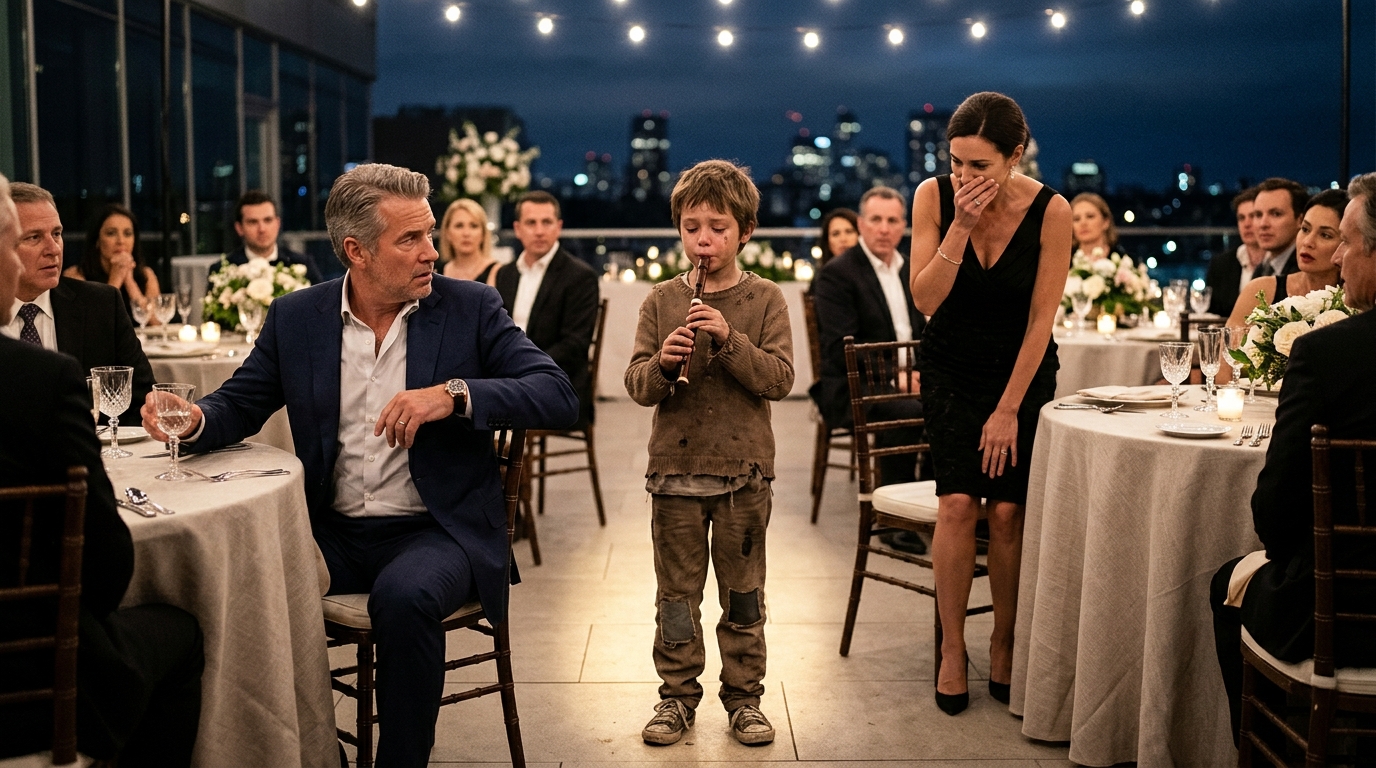
The Boy on the Terrace
“Hey! Get him out of here!”
The shout sliced through the terrace.
Heads turned.
Conversations stopped mid-sentence.
A waiter froze beside a bottle of wine, one hand still wrapped around the neck. Forks hovered above plates. A woman in pearls slowly lowered her champagne glass.
The guests at Maison Aurelia were not used to interruptions.
The rooftop terrace overlooked the city like wealth had climbed above ordinary life and decided to dine there. White tablecloths moved gently in the evening breeze. Crystal glasses caught the sunset. Men in tailored jackets laughed softly beside women in silk dresses and diamond bracelets.
Then the boy appeared.
Small.
Thin.
Trembling.
His clothes were torn at the sleeves. His shoes looked too large and too old. In his hands, he held a tiny wooden flute as if it were the last thing he owned.
For one long second, no one moved.
“Please,” the boy said.
His voice was soft.
Too soft for a room full of people trained to ignore desperation.
“I need money. My mom is unwell.”
Some guests looked away immediately.
Others stared harder, as if poverty were a performance they had not agreed to watch.
At the head table, Sebastian Vale leaned back in his chair.
Everyone knew Sebastian.
Hotel heir.
Real estate investor.
Donor.
Widower, according to old gossip.
A man with a clean jaw, expensive watch, and a reputation for turning discomfort into amusement.
He studied the boy.
Then a smirk spread across his face.
“Oh really?” Sebastian said. “Then show us what you’ve got.”
The terrace grew tighter.
His business partner, Claire, touched his wrist.
“Sebastian, don’t.”
But he leaned forward, elbows on the table.
“Surprise us.”
A few people chuckled.
Not loudly.
Just enough to make the boy lower his eyes.
For a moment, it looked like he might run.
Instead, he lifted the flute.
The first note was fragile.
Almost too delicate to survive the terrace.
Then the melody rose.
Clear.
Pure.
Beautiful.
The sound moved through the air like something searching for a room it had once belonged to.
The laughter died.
Forks froze mid-bite.
A glass trembled in someone’s hand.
Near the railing, an elegant older woman slowly stood. Her face changed first with confusion, then recognition, then something close to fear.
Sebastian stopped breathing.
Because he knew that tune.
No one here should have known it.
It was not famous.
It was not published.
It was not part of any performance.
It was a melody he had written twelve years earlier on the back of a restaurant receipt for a woman named Elena Marlowe.
Elena had laughed at it.
Then played it on her flute until it sounded like something worth remembering.
Sebastian had called it unfinished.
Elena had called it a promise.
The boy played with his eyes closed.
Tears slipped down his cheeks, but his fingers never faltered.
The melody filled the terrace.
Haunting.
Familiar.
Impossible.
Then it stopped.
Just like that.
Silence crashed down.
The boy reached into his pocket and pulled out a small, battered photograph.
He stepped toward Sebastian.
The security guard moved, but Sebastian raised one hand without looking away.
The boy held out the photo.
Sebastian took it carelessly.
Or tried to.
But the moment his eyes landed on the image, his smirk vanished.
His fingers tightened.
The photograph showed a young woman sitting on the steps of a tiny apartment building, holding a newborn baby wrapped in a pale blue blanket.
The woman was Elena.
Alive.
Tired.
Smiling.
And beside her, taped crookedly to the edge of the photo, was an old hospital bracelet.
Baby boy.
Mother: Elena Marlowe.
Father: Sebastian Vale.
Sebastian’s voice changed completely.
“Where did you get this?”
The boy looked straight at him.
Calm now.
Certain.
“My mom said you’d remember me.”
The elegant older woman covered her mouth.
Someone whispered.
No one understood.
But everyone felt it.
Something buried had just stood up at the table.
Sebastian looked from the photo to the boy.
Same dark eyes.
Same jaw.
Same small dimple near the left cheek.
His face drained of color.
“What’s your name?” he whispered.
The boy swallowed.
“Leo.”
Sebastian’s hand began to shake.
Because Leo was the name he and Elena had chosen for the child he was told had never been born.
The Woman They Said Disappeared
Sebastian did not faint.
He wished he had.
Fainting would have given him a few seconds away from the truth.
Instead, he sat frozen beneath the terrace lights while the poor boy stood in front of him with a flute, a photograph, and a face that made twelve years collapse.
“Elena died,” Sebastian said.
His voice sounded hollow even to himself.
The boy shook his head.
“No. She’s sick.”
Claire stood too quickly.
“Sebastian, this is a scam.”
The boy flinched at her voice.
Sebastian noticed.
So did the older woman by the railing.
That woman was Sebastian’s mother, Vivian Vale.
For years, Vivian had carried herself with the stillness of old money and old secrets. But now her face was pale, her hand pressed against her throat.
She knew the song too.
Elena had played it once in the Vale family house, years before everything went wrong.
Claire stepped closer to Sebastian.
“That photograph could be fake. Children are used for things like this.”
The boy looked at her.
“My mom said the lady in white would say that.”
Claire’s face changed.
Only for a second.
But Sebastian saw it.
The terrace went silent again.
“What does that mean?” he asked.
Claire forced a laugh.
“Nothing. He’s repeating lines.”
The boy reached into his coat and pulled out a folded envelope.
“My mom wrote it.”
Sebastian took it.
His name was on the front.
Not typed.
Written.
In Elena’s handwriting.
His chest tightened so hard he could barely breathe.
He opened the envelope.
The first line nearly destroyed him.
Sebastian, if Leo reaches you, then I failed to stay hidden. Or I finally stopped being afraid.
He read on.
I did not leave you. I was told you had rejected me after the accident. I was told your family would take the baby if I came near you. I wrote. I called. I came to the hotel twice. Claire found me both times.
Sebastian looked up.
Claire had gone white.
Vivian sat down slowly, as if her legs could no longer hold the weight of what she knew.
The letter continued.
Leo is your son. I named him the way we planned. I taught him the melody because I knew no one could fake that part of us. If he plays it for you and you still remember, help him. Not for me. For him.
Sebastian’s vision blurred.
He looked at Leo.
The boy was trying very hard not to cry.
“Where is she?”
“At St. Mercy Clinic,” Leo said. “Near the tracks. The doctor said if we don’t pay, she can’t stay.”
A sound escaped Vivian.
Not a sob.
Something worse.
Sebastian turned toward his mother.
“You knew?”
Vivian’s lips trembled.
“I thought she took the money.”
“What money?”
Claire stepped between them.
“This is not the place.”
Sebastian stood.
The terrace seemed to shrink around him.
“What money?”
Vivian’s eyes filled.
“Your father said Elena accepted a settlement and left before the birth. He said the child didn’t survive. He showed us papers.”
“Who brought the papers?”
Vivian did not look at Claire.
She did not have to.
Sebastian turned.
Claire’s face had hardened now.
The fear was gone.
In its place was calculation.
“You were recovering,” she said. “You were unstable after the crash. Elena was a risk.”
“A risk?”
“To the company. To your inheritance. To everything your father built.”
Sebastian stared at her.
“She was carrying my child.”
Claire’s mouth tightened.
“And she knew it.”
The terrace erupted in whispers.
Leo stepped back.
Sebastian reached for him, then stopped, afraid of frightening him.
“Leo,” he said softly, “will you take me to your mother?”
The boy nodded.
Claire grabbed Sebastian’s arm.
“If you walk out now, you are choosing a stranger’s story over your family.”
Sebastian looked at the photograph in his hand.
Then at the boy.
“No,” he said. “I’m choosing the part of my family you buried.”
The Clinic Near the Tracks
St. Mercy Clinic was not the kind of place Sebastian had ever entered.
Not because he was cruel.
Because wealth builds routes around suffering.
The clinic sat between a pawn shop and an abandoned warehouse, its green door chipped at the edges, its waiting room crowded with people who looked too tired to explain why they deserved help.
Leo ran ahead.
“Mom!”
Sebastian followed him down a narrow hallway.
Room 6.
The door was half open.
Elena lay in a narrow bed beneath a thin blanket.
For a moment, Sebastian could not move.
Twelve years had changed her.
Her face was thinner. Her hair shorter. Her hands too fragile against the white sheet.
But it was Elena.
Alive.
Her eyes opened when Leo climbed onto the bed.
“I found him,” Leo whispered.
Elena turned her head.
Then she saw Sebastian.
Her lips parted.
All the years between them filled the room at once.
“Sebastian.”
He gripped the doorway.
“Elena.”
She tried to sit up, but a cough bent her forward.
Sebastian crossed the room and reached for her.
Then stopped.
He did not know if he had the right.
Elena looked at his hand.
Then took it.
That broke him.
“I thought you were dead,” he whispered.
“I thought you let them erase us.”
The words hit harder because they were not angry.
They were tired.
Leo curled beside her.
Sebastian looked from mother to son.
Every detail felt unbearable.
Leo’s too-thin wrists.
Elena’s hollow cheeks.
The cheap blanket.
The flute on the bedside table.
All of it existed because somewhere, years ago, he had believed the wrong people.
“What happened?” he asked.
Elena closed her eyes.
“The accident happened after I came to tell you I was pregnant. I woke in a private hospital wing. Claire was there.”
Sebastian’s jaw tightened.
“She said you blamed me for the crash. She said your father would take the baby. She said if I signed the papers, I could leave quietly and keep him.”
“What papers?”
“Settlement papers. Medical release. A statement saying I accepted money and cut all ties.”
“I never saw them.”
“She said you signed first.”
Sebastian shook his head.
“I was unconscious for three days.”
Elena’s eyes filled.
“I know that now.”
Leo reached beneath the pillow and pulled out a folder wrapped in plastic.
“Mom said give him the blue one.”
Sebastian opened it.
Inside were letters.
Returned envelopes.
Hospital forms.
A birth certificate.
Leo Sebastian Marlowe.
Father: Sebastian Vale.
His son had existed on paper.
Just not in the life Sebastian was allowed to see.
Then came the document that made the whole room turn cold.
A trust restructuring agreement dated two weeks after the accident.
If Sebastian had no living biological heir, certain family voting shares would pass into a management structure overseen by his father and Claire Whitmore.
Claire had not hidden Elena only out of jealousy.
She had hidden Leo because his birth would have changed the money.
Sebastian sat down slowly.
“I signed this?”
Elena’s voice was soft.
“You were medicated.”
He remembered nothing.
Only waking.
Pain.
Claire beside the bed.
His father saying, “Don’t chase a woman who left you.”
Vivian entered the room behind him, tears streaming down her face.
Elena looked at her.
For a long moment, neither woman spoke.
Then Vivian whispered, “I believed them.”
Elena answered, “So did he.”
There was no forgiveness in her voice.
Only truth.
Sebastian looked at Leo.
The boy was watching all of them like a child who had learned adults could change the weather without warning.
“I’m sorry,” Sebastian said to him.
Leo blinked.
“For what?”
“For not knowing.”
Leo looked down at his flute.
“My mom said maybe you didn’t.”
That sentence nearly ended him.
Elena had left room for him to be innocent.
After all that.
After twelve years.
She had still left a door open.
The Woman in White
Police arrived at Sebastian’s penthouse before Claire could destroy the files.
Vivian called them.
Not quietly.
Not through lawyers.
She called Detective Laura Quinn, a financial crimes investigator who had been trying to examine the Vale family trust for months but had never gotten past the company’s private counsel.
Claire came with an attorney within the hour.
She wore white.
Of course she did.
Her expression was calm, wounded, almost noble.
“Sebastian,” she said, “this is grief manipulating you.”
Elena sat on the sofa, wrapped in Vivian’s coat.
Leo sat beside her, holding his flute with both hands.
Sebastian stood between them and Claire.
That small position changed everything.
Claire noticed.
“You are making a terrible mistake,” she said.
“No,” Sebastian replied. “I made it twelve years ago.”
Detective Quinn placed the blue folder on the table.
“We have hospital access logs showing Ms. Whitmore entered both recovery rooms multiple times after the crash. We also have trust documents witnessed by her while Mr. Vale was under heavy medication.”
Claire’s attorney began to speak.
Detective Quinn raised a hand.
“I’m not finished.”
She opened another folder.
“Searches of archived correspondence show multiple letters from Elena Marlowe were received at Vale corporate offices and redirected to Ms. Whitmore’s private assistant.”
Vivian inhaled sharply.
Claire’s face tightened.
Elena looked down.
She had known, but hearing it still hurt.
Detective Quinn continued.
“We also found private investigator invoices tied to locating Ms. Marlowe and her child over the past decade.”
Sebastian turned toward Claire.
“You watched them?”
Claire said nothing.
“You knew where they were?”
Still nothing.
Leo whispered, “The man with the gray car came every winter.”
Sebastian closed his eyes.
Claire had not simply buried them.
She had made sure they stayed buried.
The warrant for Claire’s townhouse came the next morning.
Inside a locked cabinet, investigators found everything.
Elena’s letters.
Photos of Leo at different ages.
Copies of unsigned custody challenges.
A forged psychiatric report labeling Elena unstable.
And a contingency plan titled:
If Child Appears Publicly
Sebastian read only the first page.
It included proposed statements accusing Elena of exploiting a minor for money.
It included instructions to question Leo’s identity.
It included language describing the flute performance as “manufactured emotional coercion.”
Claire had prepared for the truth.
She just had not prepared for the song.
Because no lawyer could explain how a poor boy knew the melody Sebastian had written before anyone knew Leo existed.
The Song Nobody Could Forge
The trial took nearly two years.
Claire’s lawyers argued that Elena had accepted money willingly.
That Sebastian’s memory after the crash was unreliable.
That Leo’s birth certificate was incomplete.
That the melody proved nothing.
Then the prosecutor asked Leo to play it.
The courtroom became completely silent as the boy lifted the flute.
The first note trembled.
Then steadied.
Sebastian sat behind the prosecution table with his hands clasped so tightly they hurt.
Elena sat beside him.
Still recovering.
Still too thin.
Still not ready to forgive him fully.
But present.
Leo played the whole melody.
The lullaby Sebastian had never written down.
The song Elena had carried through poverty, fear, and illness.
The song she had given their son because she believed memory might survive where law failed.
When Leo finished, the prosecutor asked Elena, “Where did he learn that?”
Elena said, “From me.”
“And where did you learn it?”
She looked at Sebastian.
“He wrote it for our baby.”
The jury understood.
Not legally.
Humanly.
Claire was convicted of fraud, forged medical and legal documentation, custodial interference, evidence suppression, and conspiracy tied to the trust restructuring.
Sebastian’s father had died before the trial.
That left some truths unreachable.
But enough remained.
Enough to restore Leo’s legal identity.
Enough to unwind the trust fraud.
Enough to return a stolen child to the record.
Enough to show that money had not protected the Vale family.
It had hidden the rot until a boy with a flute walked through a terrace and played one honest song.
The Terrace That Listened
A year after the trial, Sebastian reopened Maison Aurelia.
But not as it had been.
No velvet ropes.
No private terrace for people who liked beauty without interruption.
The space became a music hall and dining program attached to St. Mercy Clinic. Families who needed medical help could eat there, meet advocates, and attend performances without proving their pain to donors over dessert.
Elena chose the name.
The Blue Note Room.
Leo hated dressing up for opening night.
Sebastian did not make him.
He wore clean jeans, a green jacket, and shoes that actually fit.
Elena wore a blue scarf. Vivian sat in the front row, quieter than she used to be, still carrying guilt carefully because Elena had not let her put it down too quickly.
That was fair.
Healing did not require everyone to feel better at the same speed.
Before the first performance, Sebastian crouched beside Leo near the stage.
“Nervous?”
“No.”
“Liar.”
Leo smiled.
A small smile.
A real one.
“Maybe a little.”
Sebastian touched the edge of the flute.
“You don’t have to play that song.”
Leo looked toward Elena.
“She likes it.”
“So do I.”
“I know.”
Then he stepped onto the stage.
No one shouted for security.
No one laughed.
No one asked him to prove he deserved help.
He lifted the flute and played.
The melody moved across the terrace again.
But this time, it did not sound like accusation.
It sounded like return.
When he finished, the room stayed quiet for one breath.
Then applause rose.
Gentle.
Respectful.
Not the applause of rich people congratulating themselves for feeling something.
The applause of people who understood they had been trusted with a wound.
Later, after the guests left, Sebastian found Elena near the railing.
The city glowed below them.
For a while, neither spoke.
Then Elena said, “You mocked him.”
Sebastian closed his eyes.
“Yes.”
“He was hungry.”
“I know.”
“He was scared.”
“I know.”
She looked at him.
“And still, he played.”
Sebastian’s throat tightened.
“He was braver than I ever was.”
Elena did not comfort him.
Not immediately.
Then she said, “Be useful with that.”
So he did.
Years passed.
Leo grew taller.
Elena grew stronger, though never fully free of what the lost years had cost her.
Sebastian learned fatherhood late and awkwardly.
He learned that money could buy medicine but not trust.
A room but not sleep.
Food but not the end of hiding bread under pillows.
He learned that apologies were not doors.
They were keys offered again and again until the person harmed decided whether to use them.
Sometimes Leo called him Sebastian.
Sometimes Dad.
Both were allowed.
One evening, Leo asked why Elena sent him to the terrace instead of the office.
Sebastian already knew the answer, but he let his son hear it from her.
Elena smiled sadly.
“Because offices listen to papers. Terraces listen to embarrassment.”
Leo frowned.
“What does that mean?”
“It means rich men hate being surprised in public.”
Sebastian laughed softly.
“She’s right.”
Leo looked at him.
“Were you embarrassed?”
Sebastian thought of the smirk.
The command.
Surprise us.
The flute.
The photograph.
The face of his son staring back at him from poverty he had been taught not to see.
“Yes,” he said. “But not because of you.”
Leo nodded like he understood more than a child should.
Then he lifted the flute and played the first three notes of the lullaby.
Not the whole song.
Just enough.
The sound moved through the room.
And Sebastian understood, finally, why it had worked.
The boy had not come to the terrace to beg.
He had come to remind a man who he used to be.
Before wealth taught him to smirk.
Before grief taught him to obey.
Before lies taught him Elena was gone.
The flute did what letters could not.
It slipped past lawyers, guards, money, shame, and memory loss.
It reached the one place Claire had failed to lock.
The part of him that still knew the song.