The Girl Under the Crystal Lights
The private school fundraiser was quiet enough to hear the flashbulbs.
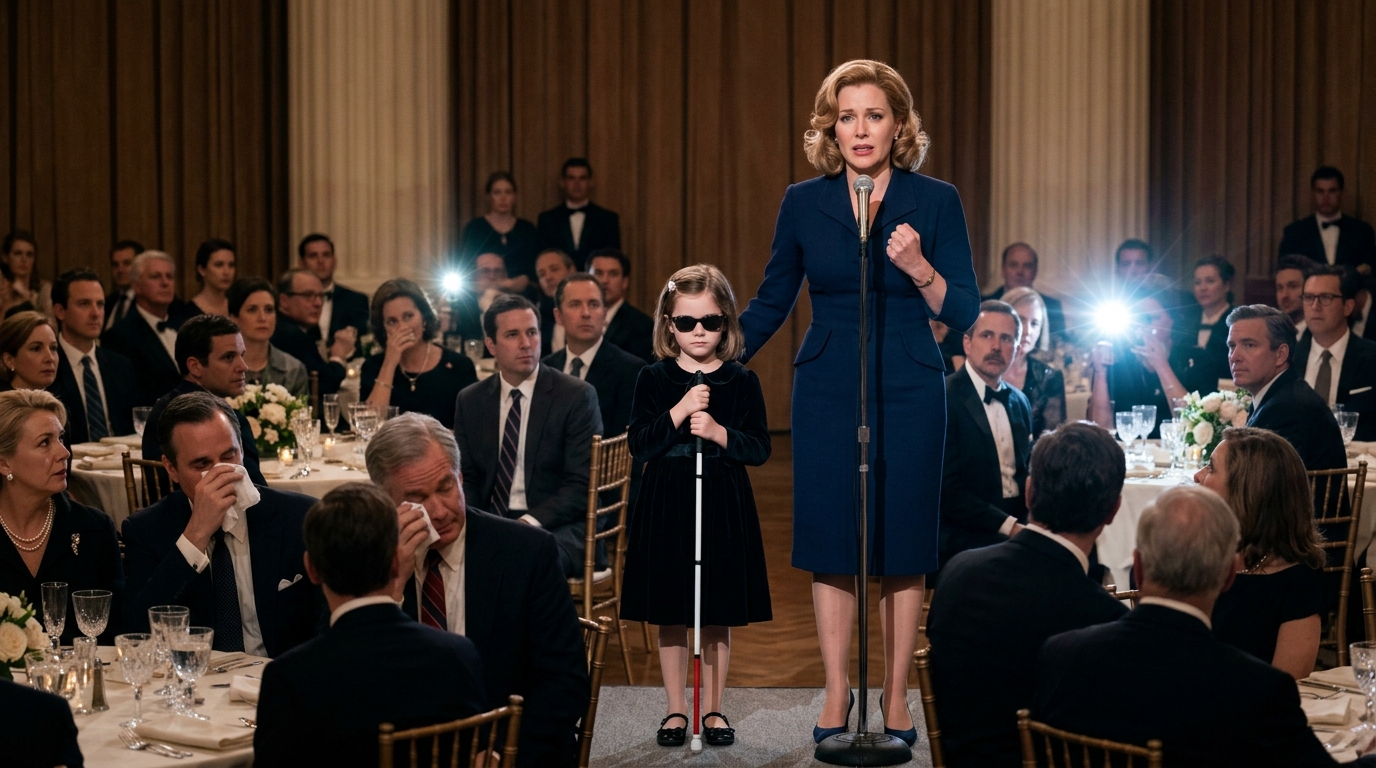
Crystal lights warmed the auditorium. Parents sat in pressed suits and pearl earrings, their donation cards resting neatly on their laps. Teachers stood along the walls with careful smiles. At the back of the room, photographers waited for the moment everyone had been told would be “deeply moving.”
Onstage, eight-year-old Emily Whitmore stood beside her stepmother.
Dark sunglasses covered her eyes.
A white cane rested in both hands.
She wore a pale blue dress, white shoes, and a ribbon tied perfectly around her hair.
She looked like a child arranged to make adults feel generous.
Her stepmother, Vivian, held the microphone close.
Her voice trembled perfectly.
“She hasn’t seen the world since the accident.”
A few mothers wiped their eyes.
Someone in the front row whispered, “Poor little thing.”
Emily didn’t move.
Didn’t blink.
Didn’t look toward anyone.
Her father, Nathan Whitmore, sat in the front row with his hands locked together so tightly his knuckles had gone white.
For fifteen months, he had carried the guilt of the accident like a stone in his chest.
He had been away on business when Emily fell from the back terrace steps. Vivian said she had found the child unconscious near the garden door. Doctors said trauma had affected Emily’s vision. Some called it neurological. Some called it permanent. Others said recovery was possible, but unpredictable.
Vivian took charge after that.
Medication.
Specialists.
Therapy schedules.
School arrangements.
Fundraisers.
Public updates.
She said Nathan was too emotional to manage everything alone.
And he believed her.
Because grief makes control look like care when it arrives dressed gently enough.
Vivian turned toward the donors.
“Tonight, we ask for your support—not only for Emily, but for every child living in darkness.”
The auditorium softened.
Then a chair scraped in the very last row.
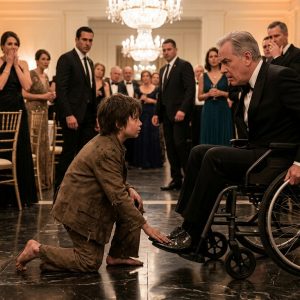
A boy stood up.
Small.
Dirty.
Wearing a torn gray hoodie.
His hair was messy, his sneakers split at the toes, and one sleeve hung loose where the seam had ripped.
He did not belong in that room.
Everyone knew it.
But he stood anyway.
Certain.
“She can see you.”
The room turned.
Vivian froze before anyone else did.
That was what Nathan noticed first.
Not outrage.
Not confusion.
Fear.
Nathan stood sharply.
“What did you just say?”
The boy pointed at the stage.
“She moved before the sound.”
At that exact second, the microphone resting on the small table beside Emily tipped.
It slipped slowly.
Silently.
Before it hit the stage, Emily flinched sideways.
The microphone crashed against the floor.
The sound cracked through the auditorium.
But Emily had already moved.
The room went completely silent.
Nathan stopped breathing.
Vivian rushed toward Emily too fast.
“Don’t listen to him!”
But the boy lifted something from his pocket.
A torn label.
From a bottle.
His hand shook, but his voice held.
“She was never blind.”
Emily’s lips parted.
Her voice came out so small that the microphone on the floor barely caught it.
“Daddy…”
Nathan turned toward her.
She touched the edge of her sunglasses with trembling fingers.
“Why do the drops burn?”
Vivian stopped halfway across the stage.
And every flashbulb in the room suddenly felt like evidence.
The Boy in the Last Row
The boy’s name was Caleb Reed.
He was eleven years old.
He had slipped into the auditorium through the service entrance while the kitchen staff unloaded trays for the donor reception. Nobody noticed him at first because people like Caleb were easy not to notice in buildings like that.
Until he stood.
Until he pointed.
Until he said what no adult in the room had been brave enough to say.
Vivian recovered quickly.
She always did.
“This is cruel,” she said, turning toward the audience with tears already forming. “That child has no idea what our family has been through.”
Caleb didn’t look at the audience.
He looked only at Nathan.
“My mom worked at your house.”
Nathan’s throat tightened.
“What was her name?”
“Rosa Reed.”
The name struck him harder than he expected.
Rosa.
Emily’s first home-care aide after the accident.
Quiet. Patient. Warm in a way that never felt forced.
Emily had liked her.
That should have mattered more.
But Vivian said Rosa was “confusing the child” by encouraging her to describe shadows and colors.
“She’s giving Emily false hope,” Vivian had told him. “Hope can be dangerous when it makes a child deny reality.”
A week later, Rosa was gone.
Vivian said she quit.
Nathan had signed the agency form without reading it carefully.
Now Rosa’s son stood in the last row holding a torn medicine label.
Caleb walked down the aisle.
A teacher moved to stop him, but Nathan lifted one hand.
“Let him come.”
Vivian’s eyes sharpened.
“Nathan, no.”
He did not look at her.
Caleb stopped at the foot of the stage.
“My mom said Emily could see some things,” he said. “Light. Shapes. Colors. Not always. Not clearly. But she could see.”
Vivian’s face hardened.
“Your mother was unstable.”
Caleb’s voice cracked.
“No. She was scared of you.”
A murmur passed through the auditorium.
Emily began crying behind her sunglasses.
Nathan climbed onto the stage and knelt in front of his daughter.
“Emily,” he said softly, “what drops?”
Vivian stepped closer.
“She’s overwhelmed.”
Nathan looked at her.
“Don’t answer for her.”
The sentence changed the room.
Emily’s small hands tightened around the cane.
“The bitter ones,” she whispered. “Before pictures. Before doctors. Before school things.”
Nathan felt something cold move through him.
“What do they do?”
Emily’s mouth trembled.
“They make the lights hurt. Then everything gets blurry. Vivian says it means I’m sick.”
Caleb held out the torn label.
Nathan took it.
Only half the print remained, but enough was visible.
EMILY WHITMORE
ADMINISTER BEFORE VISUAL RESPONSE EVALUATION / PUBLIC APPEARANCE
Public appearance.
Not pain.
Not treatment.
Appearance.
Nathan’s hand began to shake.
Vivian reached for the label.
He pulled it back.
“Where is the bottle?”
Caleb said, “My mom found one in the trash. Then she got fired.”
Vivian’s voice sharpened.
“This is ridiculous.”
Caleb looked straight at her.
“You threw another one away yesterday.”
The room went silent again.
He reached into his hoodie and pulled out a small plastic bag.
Inside was a brown glass bottle.
No label.
Only a strip of glue where one had been peeled away.
Vivian’s face lost all color.
The Drops Before the Donors
The police were called before Vivian could leave the auditorium.
So was Dr. Elaine Ward, Emily’s original neurologist.
Vivian had removed Dr. Ward from Emily’s care months earlier, saying the doctor was too aggressive, too optimistic, too willing to push a fragile child.
Now Dr. Ward walked onto the stage, looked at Emily, and went still.
“Take the sunglasses off,” she said gently.
Emily looked toward Vivian.
That tiny movement broke Nathan.
His daughter was still asking permission from the person who had been hurting her.
Dr. Ward crouched.
“Emily, she doesn’t get to decide what your eyes do.”
Slowly, Emily removed the sunglasses.
Her eyes were red.
Irritated.
Sensitive to the auditorium lights.
But they moved.
They reacted.
They tracked Dr. Ward’s hand when she lifted it.
Not perfectly.
Not like a child with normal vision.
But clearly enough that the room understood.
Dr. Ward’s face became controlled in the way doctors become controlled when anger would frighten the patient.
“This child has functional vision,” she said.
Vivian whispered, “Partial reflexes don’t prove—”
Dr. Ward turned.
“No. But repeated chemical irritation might explain why her progress kept disappearing before every evaluation.”
Nathan looked at his wife.
The woman who had stood beside his daughter in every newspaper photo.
The woman who had organized the fundraisers.
The woman who had built herself into the story of Emily’s suffering.
“What did you give her?”
Vivian’s eyes filled with tears.
Not the stage tears.
Different ones.
Fearful.
“I was protecting her from disappointment.”
Caleb shouted, “You were making her worse!”
The auditorium gasped.
Emily covered her ears.
Nathan turned back to her immediately.
“I’m sorry,” he whispered. “I’m so sorry.”
Emily blinked at him through tears.
“Am I bad if I can see?”
The question destroyed him.
“No,” he said, voice breaking. “No, sweetheart. Never.”
Behind them, Detective Mara Quinn sealed the bottle and torn label into evidence bags.
She asked Caleb where his mother was.
The boy looked down.
“She died.”
The room fell quiet.
Nathan’s heart sank.
Caleb swallowed hard.
“She was hit by a car after she said she was going to show you the files.”
Vivian looked away.
Detective Quinn noticed.
So did Nathan.
The fundraiser was over.
But the real story had only begun.
The Files Rosa Left Behind
Rosa Reed had not quit.
She had been fired, threatened, and followed.
That was what police discovered after Caleb gave them the shoebox he had kept hidden under a loose floorboard in his aunt’s apartment.
Inside were photographs.
Medication logs.
Videos.
Copies of therapy notes.
And a handwritten letter addressed to Nathan.
Mr. Whitmore,
Emily is not fully blind. Her original injury is real, but her decline is being manipulated. I found unlisted drops in her routine before appointments and public events. After those doses, her eyes burn, her tracking weakens, and she becomes sensitive to light.
Mrs. Whitmore is controlling access to doctors and using Emily’s condition to raise money through the foundation.
If something happens to me, believe Caleb. He knows where I hid the label.
Please listen to your daughter.
Nathan read the letter in the hospital waiting room while Emily slept under observation.
He read the last line again and again.
Please listen to your daughter.
He had loved Emily.
But he had not listened fast enough.
The hospital tests confirmed exposure to a chemical irritant and sedating compound. It had not caused the original accident. But it had worsened Emily’s symptoms and made her recovery appear to fail again and again.
Police searched the Whitmore house that night.
In Vivian’s locked office, they found bottles, private pharmacy receipts, deleted emails, and a binder labeled:
Vision Fund Narrative Strategy
Inside were notes that made Nathan physically sick.
Maintain dark glasses for donor recognition.
Avoid independent evaluation without Vivian present.
Administer drops before photography if tracking response improves.
Father must not attend unscheduled therapy.
Public message: permanent darkness, brave child, devoted stepmother.
Permanent darkness.
Brave child.
Devoted stepmother.
His daughter had been turned into a fundraising image.
Vivian had built a career on standing beside a child she was secretly keeping impaired.
The foundation had raised millions.
Some went to legitimate programs. Enough to look clean. Enough to avoid suspicion.
But large amounts moved through consulting companies linked to Vivian.
The worse Emily appeared, the more sympathy flowed.
The more sympathy flowed, the more money moved.
And the more essential Vivian became.
The Witness Nobody Invited
Vivian was arrested two weeks later.
Child endangerment.
Medical abuse.
Fraud.
Evidence tampering.
Obstruction.
Rosa Reed’s death was reopened.
That case took longer.
The dead do not get to point.
But Rosa had left enough behind.
Phone records showed Vivian called her seven times the day she died. A private driver connected to Vivian was near the scene. Deleted messages revealed threats. Payment records tied that driver to a shell company used by the foundation.
Caleb testified through a child advocate.
Vivian’s lawyer tried to make him seem unreliable.
“You were living with relatives after your mother’s death, correct?”
“Yes.”
“You had no permanent home at the time?”
Caleb looked at him.
“No.”
“So you expect this court to believe that a child in your situation uncovered what doctors, teachers, and Mr. Whitmore himself did not?”
Caleb’s face tightened.
“My mom uncovered it.”
The lawyer paused.
“And you?”
Caleb looked toward the judge.
“I just made sure rich people couldn’t ignore it.”
The courtroom went silent.
Emily testified by video.
She wore no sunglasses.
She said the drops burned.
She said Vivian told her seeing things would make Daddy sad because it meant all his money and hope had been wasted.
She said she learned to keep her eyes still because Vivian rewarded her when she “looked blind properly.”
Nathan left the courtroom before the recording ended.
Not because he didn’t want to hear it.
Because he could not breathe.
Vivian was convicted on most charges.
The foundation was dissolved, then rebuilt under independent control and renamed for Rosa Reed.
Its new mission was Emily’s choice:
Second opinions for children whose caregivers control the first one.
When Nathan told Caleb, the boy shrugged like it meant nothing.
Then he went into the hallway and cried where he thought nobody could hear.
The First Thing She Chose to See
Emily’s recovery was not a miracle.
Nathan refused to let anyone call it that.
Some days she could read large letters.
Some days light hurt too much.
Some days she used her cane because depth and movement confused her.
Some days she threw her sunglasses across the room because she hated them.
No one punished her for that.
No one made her perform hope.
No one made her perform darkness either.
Her eyes belonged to her again.
Caleb came to live with his aunt, supported through a legal trust Nathan set up carefully, with no hidden conditions and no emotional debt attached. Nathan had learned that help could become another kind of control if the person receiving it had no power to refuse.
Emily and Caleb became friends slowly.
Not sweetly.
They argued too much for that.
One afternoon, Emily asked, “Were you scared when you stood up?”
Caleb said, “No.”
She stared at him.
He sighed.
“Fine. Yes.”
“Then why did you do it?”
He looked embarrassed.
“My mom wrote that if adults clap for a lie, interrupt.”
Emily smiled.
That became one of her favorite sentences.
A year after the fundraiser, Emily asked to return to the auditorium.
Not for cameras.
Not for donors.
Just once.
Nathan took her on a Saturday morning. Caleb came too, hands shoved into the pockets of a hoodie that was no longer torn but still too big because he liked it that way.
The auditorium was empty.
No flashbulbs.
No crystal-lit audience.
No Vivian.
Emily walked to the center of the stage and stood where she had once held the cane with both hands.
She looked toward the last row.
“That’s where you stood,” she said.
Caleb nodded.
“You looked tiny,” she added.
“You looked fake blind,” he said.
She turned and glared at him.
He grinned.
Nathan almost laughed.
Then Emily removed her sunglasses.
Slowly.
By choice.
She blinked against the light.
“What do you see?” Nathan asked.
She looked around.
“The red seats.”
Her voice was steady.
“The gold curtain.”
Then she looked at him.
“Your tie is ugly.”
Caleb burst out laughing.
Nathan cried so hard Emily groaned.
“Dad, seriously.”
But he couldn’t stop.
He had spent fifteen months mourning a world his daughter had not fully lost.
He had spent fifteen months thanking the woman who kept dimming it.
Now Emily stood under the lights, irritated, imperfectly seeing, fully herself.
Near the exit, the school had replaced the old fundraiser plaque.
The new one read:
For Rosa Reed, who believed a child’s eyes before the world believed her story.
Caleb stood in front of it for a long time.
He pretended his eyes were not wet.
Emily let him pretend.
Nathan stood behind them, watching both children.
The daughter who had been taught to hide her sight.
The boy who had been poor enough to be dismissed, but brave enough to interrupt a room full of donors.
That day, Nathan understood something he would carry for the rest of his life.
Truth does not always enter through the front door.
Sometimes it comes from the last row.
Wearing a torn hoodie.
Holding a ripped label.
Pointing at a stage where everyone else is clapping for a lie.
And sometimes all it takes to break the performance is one child saying:
“She can see you.”