The Man in Booth 4
The old man waited until he had finished every bite before reaching for his pocket.
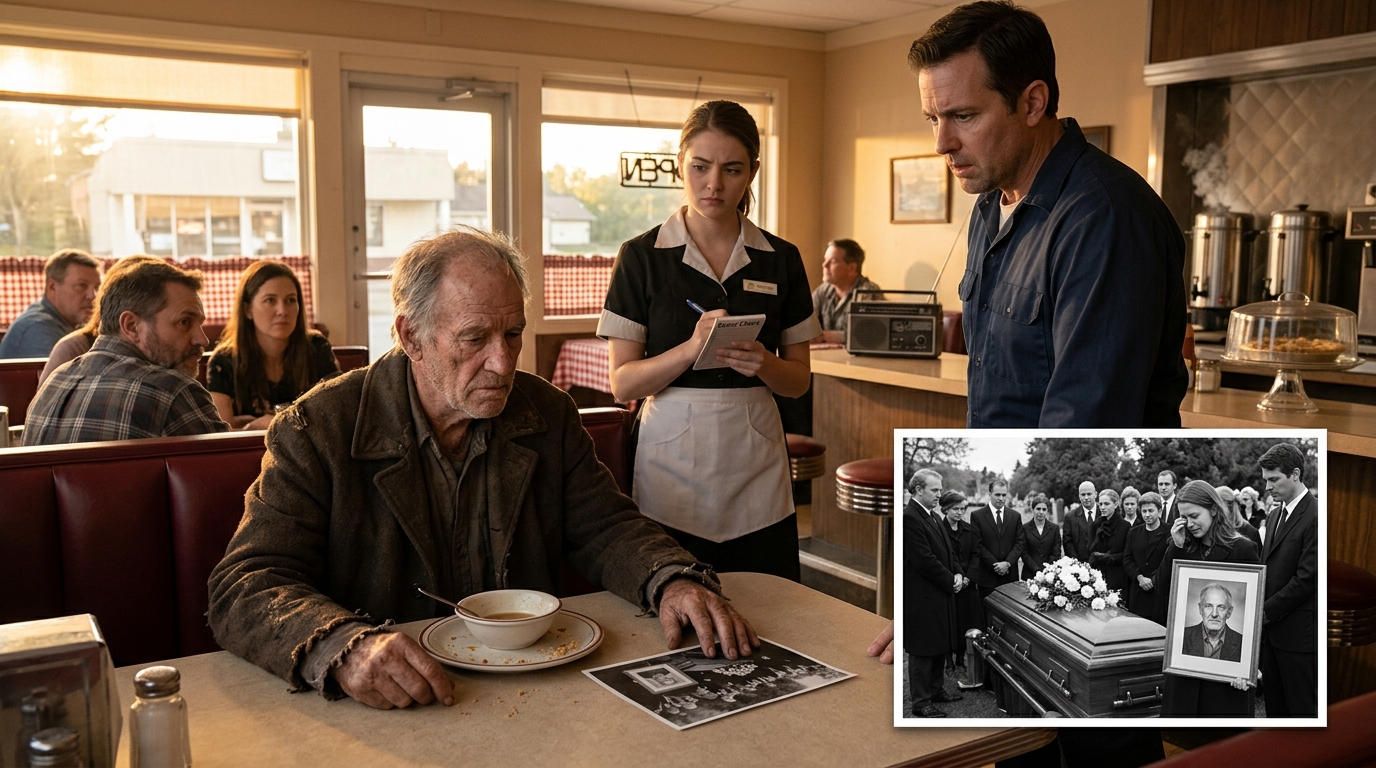
The diner was warm with late afternoon light. Coffee steamed behind the counter. A country song played softly from the radio near the pie case. Outside, rain gathered in silver streaks along the windows, turning the highway into a blur of headlights and wet asphalt.
He had ordered the cheapest meal on the menu.
Soup.
Toast.
Nothing more.
He ate slowly, as if each bite needed to be earned twice—once by hunger, once by memory.
When he was finished, the young waitress stopped beside his booth with the check in her hand. Her name tag read Maddie. She was nineteen, tired, and already annoyed by the old man’s frayed coat sleeves, gray beard, and shoes that looked older than the floor beneath them.
“Sir,” she said, sharp now, “if you can’t pay, you need to say that before you eat.”
A few customers turned to look.
The old man did not argue.
He only reached into his coat pocket and pulled out a photograph.
Carefully.
Almost reverently.
Then he placed it on the table.
“I was hoping this would be enough.”
Maddie stared at it.
Then laughed.
Not cruelly at first.
More from disbelief.
“Sir, this is a diner. We don’t take pictures.”
But the diner owner had already stepped out from behind the counter.
His name was Noah Ward.
Forty-two years old.
Broad shoulders.
Quiet eyes.
A man who had inherited his mother’s diner, his mother’s stubbornness, and a life built around a story he had never thought to question.
He reached the booth and picked up the photo.
Then the color drained from his face.
It was a funeral picture.
Black suits.
White flowers.
A closed casket.
And standing beside it was Noah’s mother, Lydia Ward, twenty years younger, crying beside a framed portrait of the same old man now sitting in Booth 4.
Noah stopped breathing.
“That’s impossible.”
The old man looked up at him with tired eyes.
“Your mother told the town I was dead.”
Every sound in the diner faded.
The radio.
The coffee machine.
The rain against the glass.
Noah stared at the photograph as if it might change if he looked long enough.
His father had died when Noah was twenty-two.
That was what he had always known.
A fire at the old grain warehouse.
A body too badly burned to identify.
A closed casket.
A grieving mother.
A town full of whispers that died every time Noah entered the room.
He turned the photograph over.
On the back, in handwriting he recognized from old birthday cards and shop ledgers, were six words:
Give this to Noah when he asks.
Noah’s hand began to shake.
Because that was his father’s handwriting.
His real father.
Elias Ward.
Noah looked back at the old man.
His voice broke.
“If you were alive…”
His fingers tightened around the photograph.
“Who did we bury?”
The old man lowered his eyes.
And for the first time, Noah saw fear on his father’s face.
Not shame.
Not confusion.
Fear.
Then Elias whispered:
“The man your mother begged me not to name.”
The Funeral That Closed Too Fast
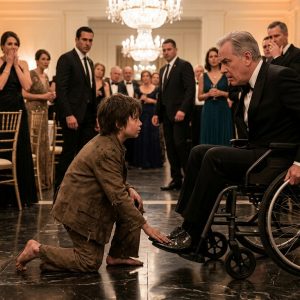
Noah had been twenty-two when his father died.
Old enough to carry a casket.
Young enough to believe adults who spoke with certainty.
The fire happened at the grain warehouse on County Road 8, the same night Elias was supposed to meet a bank auditor about missing diner funds.
That part Noah only learned later.
At the time, he knew only what his mother told him.
“There was an accident.”
“Your father was alone.”
“They found him too late.”
“The casket has to stay closed.”
Noah remembered the funeral in fragments.
His mother’s black dress.
The smell of lilies.
The preacher saying things about honest men and hard work.
The closed casket.
The portrait beside it.
His father’s face frozen in a frame while everyone walked past, murmuring, “Such a tragedy.”
Then Victor Crane placed one hand on Noah’s shoulder.
Victor owned the bank.
Victor owned half the buildings on Main Street.
Victor had been Elias’s business partner for three years, though Noah never understood why his father trusted him.
“You’re the man of the family now,” Victor said.
Noah hated him for saying it.
But his mother squeezed his hand so hard he said nothing.
After the funeral, everything changed.
The diner almost closed.
Then Victor “helped.”
He arranged the loans.
Handled the insurance.
Settled the warehouse claim.
Told Lydia what papers to sign.
Told Noah where to stand.
Within a year, Victor had become the person everyone thanked for saving Ward’s Diner.
Within two years, Noah stopped asking why his mother flinched when Victor entered.
Within five years, the town forgot that Elias Ward had ever owned the place before his death became a sentence people used to explain Noah’s silence.
Now Elias sat alive in Booth 4, looking older than death should have made him.
Noah slid into the seat across from him.
Maddie stood frozen near the table.
The customers watched without pretending not to.
Noah placed the photograph between them.
“Tell me.”
Elias looked at the window.
Rain ran down the glass like the past had finally started leaking in.
“I didn’t die in the warehouse fire.”
Noah swallowed.
“I can see that.”
“I was supposed to meet an auditor that night. I found out Victor was using the diner accounts to move money through the warehouse. He had loans in your mother’s name. Notes she never signed. Insurance policies I never approved.”
Noah’s eyes darkened.
“My mother knew?”
“Not at first.”
Elias’s voice grew rough.
“When I found the papers, I confronted him. That was my mistake. I thought a man like Victor could still be shamed.”
“What happened?”
“He had men waiting.”
The diner went completely still.
Elias touched the edge of the photo.
“They beat me behind the warehouse. Took my wallet. Took my wedding ring. Took my coat.”
Noah’s breathing changed.
“The body?”
Elias closed his eyes.
“There was a man named Caleb Pike. A drifter. Sometimes slept near the loading dock. I used to give him coffee and old biscuits. He had no family anyone knew of.”
Noah’s stomach turned.
“They put your coat on him.”
Elias nodded.
“Set the fire. Left my ring on the body. Made sure the town believed what it was easier to believe.”
Maddie covered her mouth.
Noah whispered, “Where were you?”
“Dumped near the state line. I woke up in a charity hospital under another man’s name. No papers. Head injury. Couldn’t remember everything at first. By the time I remembered enough to come home…”
His voice broke.
“Victor had already gone to your mother.”
The Mother Who Cried Beside the Casket
Lydia Ward had died six months earlier.
Noah had buried her behind the Methodist church beside the grave marked with his father’s name.
Now he wondered whose bones lay there.
That thought nearly made him sick.
Elias saw it on his face.
“I didn’t stay away because I wanted to.”
Noah’s jaw tightened.
“You let me bury you.”
His father flinched.
The words were fair.
That made them worse.
“I came back three weeks after the funeral,” Elias said.
Noah stared.
“What?”
“I got as far as the alley behind the diner. I saw your mother through the kitchen window. She was crying at the sink. I almost walked in.”
“Why didn’t you?”
“Victor was with her.”
Noah said nothing.
Elias continued.
“He had a gun on the counter. He told her if I ever came home, you would be next. He said the fire could take a son as easily as a father.”
Noah’s hand curled into a fist.
“My mother never told me.”
“She was trying to keep you alive.”
“She lied to me for twenty years.”
“Yes.”
The answer was quiet.
No excuse.
No decoration.
No softening.
Noah looked away.
The diner blurred.
He thought of his mother’s tired hands counting cash late at night. Her face when he asked about his father. The way she kept Elias’s old jacket in the hall closet but never touched it. The way she once slapped him—not hard, but suddenly—when he said he wanted to ask Victor about the warehouse fire.
Then she cried and held his face and said, “Some doors stay closed because they are holding back worse things.”
He had hated her for that.
Now he understood she had been standing in front of a door with her body pressed against it.
Elias pulled another folded paper from his coat.
“This was hers.”
Noah took it.
The paper was old, softened from being unfolded too many times.
His mother’s handwriting.
Elias,
If you are alive and this reaches you, forgive me for doing what you asked me never to do. I let them bury another man under your name. I let our son believe you were gone. I told myself fear was love if it kept him breathing.
Noah’s throat closed.
He kept reading.
Victor has the diner tied in debt. He has the sheriff. He has the insurance men. I do not know who is safe. If Noah ever asks the right question, give him the photograph. He deserves the truth when truth no longer gets him killed.
Noah looked up.
“Where did you get this?”
Elias touched his chest.
“She found me once.”
“When?”
“Four years after the funeral. At a bus station outside Tulsa. She came alone.”
Noah could barely speak.
“She knew you were alive?”
“Yes.”
The word landed like a second betrayal.
Elias’s eyes filled.
“She begged me not to come home. She said Victor had men watching you. She said you had just taken over the diner and were finally smiling again.”
Noah laughed once.
It came out broken.
“I wasn’t smiling.”
“I know that now.”
Elias looked down.
“She gave me the photograph. Told me if one day you looked at me and asked who we buried, I should tell you everything.”
Noah stared at the funeral picture.
His mother crying beside an empty lie.
No.
Not empty.
Caleb Pike.
A man who had been erased because everyone needed Elias Ward to be dead.
Noah stood suddenly.
The chair scraped hard against the floor.
Maddie jumped.
“Where are you going?” Elias asked.
Noah grabbed his coat from behind the counter.
“To the cemetery.”
The Grave With the Wrong Name
The rain had softened by the time they reached the Methodist cemetery.
Noah drove.
Elias sat in the passenger seat, both hands folded over his knees like a man being taken to judgment.
Maddie had insisted on coming.
So had half the diner, though Noah told them not to.
Small towns do not obey when the dead start walking.
The grave sat beneath an old maple tree.
ELIAS WARD
Beloved Husband and Father
1956–2004
Noah stood in front of the stone without speaking.
His father stood several feet away.
Not beside him.
Not yet.
The ground was wet. Leaves clung to the grass. Lydia’s grave rested beside the old stone, fresh compared to the one that had carried Elias’s name for twenty years.
Noah looked at both graves.
Then at his father.
“Did she love you?”
Elias’s face tightened.
“Yes.”
“Did you love her?”
“Every day.”
“Then why does love keep leaving me with lies?”
Elias had no answer.
That was the first honest thing he gave.
Noah knelt and touched his mother’s headstone.
“She died thinking I hated her for being cold.”
“She died keeping you alive.”
“Those can both be true.”
Elias nodded slowly.
“Yes.”
A truck pulled up near the cemetery gate.
Then another.
Noah looked over.
An old man stepped out with a cane.
Sheriff Martin Hale.
Retired now.
But twenty years ago, he had signed the warehouse fire report.
Behind him came Victor Crane.
Older.
Silver-haired.
Still wearing a long black coat like the world owed him room.
Noah stood.
Elias’s body went rigid.
Victor stopped when he saw him.
For the first time in Noah’s life, Victor Crane looked afraid.
Not shocked.
Afraid.
“Well,” Victor said softly. “This is inconvenient.”
Noah felt something cold and steady settle in him.
“You knew.”
Victor looked at the headstone.
“Your father should have stayed dead.”
The words passed through the cemetery like thunder.
Sheriff Hale closed his eyes.
Maddie, standing near the fence, lifted her phone.
Recording.
Noah saw Victor notice too late.
Elias stepped forward.
“Caleb Pike is in that grave.”
Victor’s face hardened.
“Caleb Pike was nobody.”
Noah moved before he realized it.
Elias grabbed his arm.
“Don’t.”
Noah turned.
His father’s hand shook against his sleeve.
“Don’t give him the only story he knows how to use.”
Victor smiled faintly.
“You always were dramatic, Elias.”
Then a woman’s voice came from behind the maple tree.
“Not dramatic. Recorded.”
Detective Laura Quinn stepped into view.
Noah recognized her from the county cold case office.
His mother had apparently sent letters before she died.
Not only to Elias.
To the law.
The right law this time.
Detective Quinn looked at Victor.
“We’ve been waiting to see whether Mr. Ward would confirm the body identity.”
Victor’s jaw tightened.
Sheriff Hale lowered his head.
“I can testify,” he said.
Victor turned on him.
“You old coward.”
Hale’s voice trembled.
“I was a coward then. I’m tired now.”
The detective nodded to the officers behind her.
Victor Crane was arrested beside the grave that had carried another man’s name for twenty years.
He shouted for lawyers.
For judges.
For people who owed him favors.
But rain does not care about favors.
Neither did the recording.
The Man They Buried
Caleb Pike became a person again.
That was what Noah insisted on first.
Before the diner.
Before the insurance fraud.
Before Victor’s charges.
Before the newspapers printed the story of Elias Ward returning from the dead.
Noah wanted the grave corrected.
The exhumation confirmed what Elias already knew.
The body buried under his name was not his.
Dental records eventually identified Caleb Pike, a missing veteran who had drifted through three counties after losing his family, his job, and apparently the right to be searched for when he disappeared.
Noah paid for a new stone.
Elias asked to pay.
Noah said no.
“You gave him biscuits,” he said. “I’ll give him his name.”
The new marker read:
CALEB PIKE
Beloved by Someone, Even If We Were Late to Know It
Elias cried when he saw it.
Noah did not comfort him.
Not because he was cruel.
Because grief had too many owners that day.
Victor Crane’s trial opened the town like a wound.
The warehouse fire.
The forged insurance files.
The diner loans.
The sheriff’s altered report.
The body misidentification.
The threats against Lydia.
The fake death.
The laundering through half of Main Street.
People who had whispered for twenty years suddenly remembered things.
Victor leaving the warehouse that night.
Lydia crying outside the bank.
Noah’s father arguing about audit papers.
Caleb Pike wearing a borrowed brown coat.
Truth had always been scattered across the town.
It had simply never been gathered by someone brave enough.
Lydia’s letters helped.
She had kept copies of everything she could.
Receipts.
Dates.
Names.
A note Victor left on her porch that said:
Dead men cannot own diners. Neither can sons who join them.
Noah read that line in court and finally understood his mother’s silence.
It had not been weakness.
It had been terror with an apron tied over it.
Victor was convicted of fraud, conspiracy, witness intimidation, evidence tampering, and charges connected to Caleb Pike’s death.
The murder charge did not stick the way Noah wanted.
Too much time.
Too many dead witnesses.
Too much rot.
But Victor died in prison three years later.
Noah did not visit.
Elias did.
Once.
When Noah asked why, Elias said, “I wanted to see if hate still had his face.”
“Did it?”
“Yes.”
“Was it worth it?”
“No.”
That was one of the few things they agreed on easily.
The Diner After the Dead Came Back
Elias did not move into Noah’s house.
Noah did not ask.
Not at first.
People think reunions erase abandonment.
They do not.
Even forced absence leaves scars shaped like choice.
For months, Elias stayed in the small apartment above the hardware store. He came to the diner every morning at seven, ordered coffee, and paid for it with exact change.
Noah never charged him for soup.
He charged him for toast.
Maddie said that was petty.
Noah said toast was business.
Elias smiled the first time he heard it.
“You sound like your mother.”
Noah almost told him not to say that.
Then didn’t.
Slowly, they learned how to sit in the same room.
Elias told him stories about Lydia before fear made her quiet. How she sang while sweeping. How she once threw a pie at a man who called the diner greasy. How she cried when Noah was born because he had Elias’s ears and she said no baby deserved that.
Noah pretended not to laugh.
Sometimes Elias asked about the years he missed.
Noah answered when he could.
Sometimes he couldn’t.
Sometimes he got angry over nothing.
A coffee cup placed too close.
A question asked too gently.
A memory that had no room for the father now sitting across from him.
Elias never told him to forgive faster.
That helped.
One evening, after closing, Noah found his father standing beside the old wall of photographs near the register.
There were pictures of the diner through the decades.
Grand openings.
Snowstorms.
Little league teams.
Lydia behind the counter.
Noah at fourteen holding a mop.
One empty space remained near the center.
For years, it had held Elias’s funeral portrait.
Noah had removed it after the truth came out.
Elias touched the blank square.
“What will you put there?”
Noah opened a drawer and pulled out a new frame.
Inside was a photograph of three people standing in front of Ward’s Diner.
Lydia.
Elias.
Noah as a baby.
All alive.
All smiling.
Before the lie.
Elias stared at it.
Noah placed it on the wall.
Then he added a second frame beside it.
Caleb Pike’s new grave marker.
Elias looked at him.
Noah shrugged.
“He was part of the story too.”
His father’s eyes filled.
“Your mother would be proud of you.”
Noah’s throat tightened.
“She should have told me.”
“Yes.”
“You should have found a way back.”
“Yes.”
“I don’t know if I forgive either of you yet.”
Elias nodded.
“I’ll be here anyway.”
That was the answer Noah needed.
Not an excuse.
Not a plea.
Presence.
The Photograph in Booth 4
Years later, Booth 4 became the place regulars asked for without knowing why.
It had the best afternoon light.
That was what Noah told people.
He did not tell them it was where his father returned from the dead with a funeral photograph and an impossible question.
The photograph stayed behind the counter in a wooden frame.
Front side visible.
Lydia crying beside the closed casket.
Back side copied beneath it.
Give this to Noah when he asks.
People sometimes read those six words and ask what they mean.
Noah tells them the story when he feels like it.
Not every day.
Some truths are too heavy to serve with coffee.
Elias lived six more years.
Not enough.
More than Noah thought he would get.
They never became the simple father and son people wanted them to be after the newspaper articles stopped.
They argued.
They disappointed each other.
They repaired things badly, then better.
Elias taught Maddie how to make soup the old way.
Maddie claimed it was too salty.
Then kept the recipe.
On Elias’s last day, he sat in Booth 4 with Noah across from him.
Soup.
Toast.
Nothing more.
Just like the first day.
Rain tapped the windows.
The radio played low near the pie case.
Elias pushed the old funeral photograph across the table.
“You keep it,” he said.
“I already do.”
“No.” Elias tapped the back of it. “Keep asking.”
Noah understood.
The danger had never been only Victor.
It had been the town’s willingness to accept a closed casket because it was easier than asking who was inside.
It had been a son accepting a story because grief made questions feel like betrayal.
It had been a mother choosing silence because terror wore the mask of protection.
It had been a world where Caleb Pike could vanish into another man’s grave because no one important claimed him.
Noah took the photograph.
“I will.”
Elias died two weeks later.
This time, the casket was open.
Noah insisted.
Not because he wanted spectacle.
Because no one in that family would ever again bury a question under polished wood.
At the funeral, Noah placed three photographs near the flowers.
Elias as a young man.
Lydia behind the diner counter.
Caleb Pike’s corrected headstone.
Then he stood before the town and said:
“My father came back with a photograph and a question. We thought the question was, ‘How are you alive?’ But the real question was, ‘Who did we decide didn’t matter enough to name?’”
The church went quiet.
Good.
Some silence should feel uncomfortable.
After the service, Maddie found Noah outside under the maple tree.
“You okay?”
“No.”
“You will be?”
He looked toward the cemetery.
At Lydia’s grave.
At Elias’s new one.
At the corrected stone for Caleb Pike.
“Maybe less not okay someday.”
Maddie nodded.
“That sounds about right.”
The diner stayed open.
The soup got better.
The toast was still charged separately.
And every afternoon, when the light came through the windows just right, Booth 4 glowed like a small, ordinary altar to the question that changed everything.
An old man once sat there with frayed sleeves, worn shoes, and no money for the cheapest meal on the menu.
The waitress thought he had nothing.
But he had a photograph.
A funeral.
A lie.
A name.
And the truth that finally made a son ask:
“If you were alive… who did we bury?”
The answer did not bring back the years.
It did not undo the fear.
It did not make grief clean.
But it opened the casket.
And sometimes, that is where justice begins.