The Ring at Her Feet
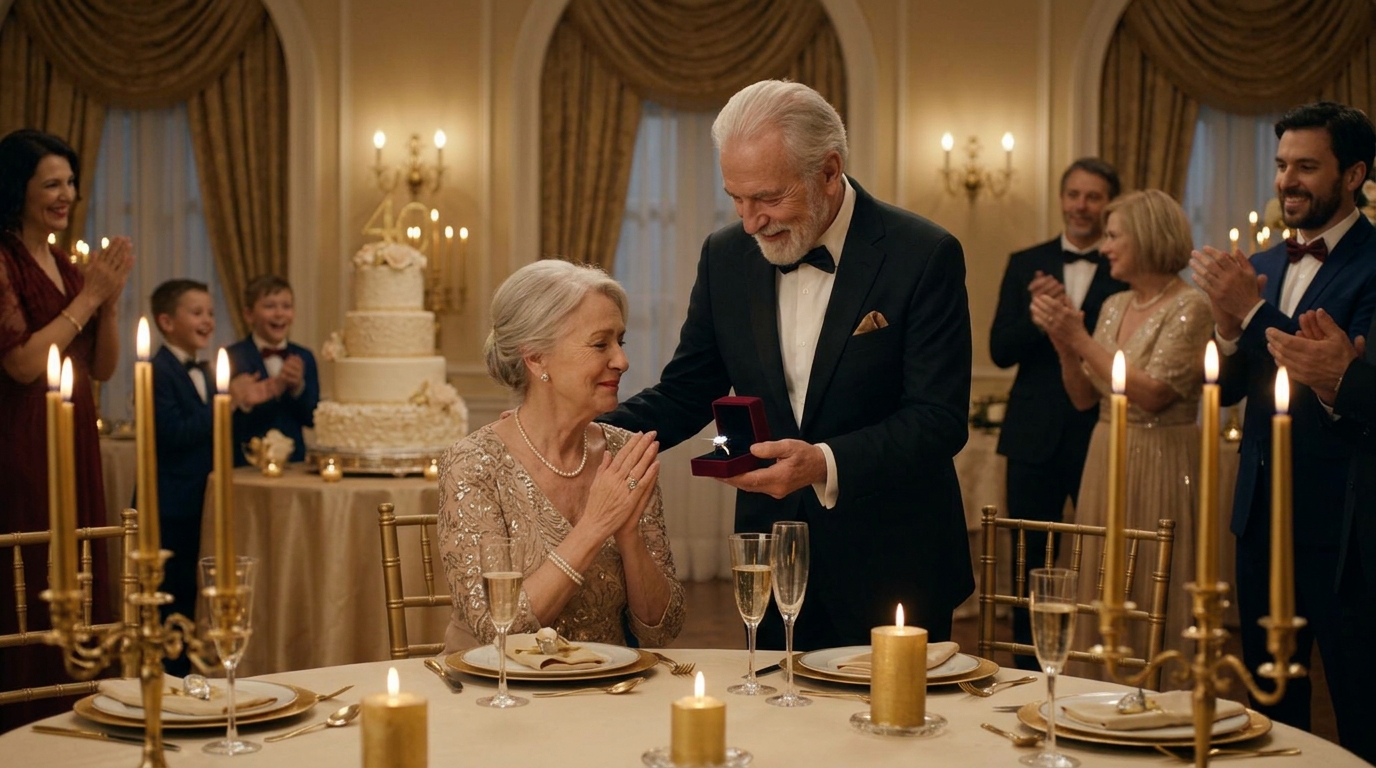
The anniversary party was supposed to be beautiful.
Forty years of marriage.
Gold candles on every table.
White roses wrapped around the staircase.
Grandchildren laughing near the cake while a pianist played soft love songs in the corner.
At the center of the room stood Henry Whitaker, eighty years old, still tall despite the cane beside his chair. His silver hair was neatly combed, his black suit pressed, his hands trembling slightly as he held a velvet box.
Beside him, his wife, Margaret, smiled through practiced tears.
Everyone clapped when Henry opened the box.
A new diamond ring.
Bright.
Perfect.
Expensive enough to make the room fall quiet for a moment.
Margaret lifted one hand to her chest.
“Oh, Henry…”
Their daughter, Clara, wiped her eyes.
The grandchildren cheered.
Phones rose.
For one soft second, the whole room believed in the picture.
Forty years.
A devoted husband.
A grateful wife.
A family built from loss and time.
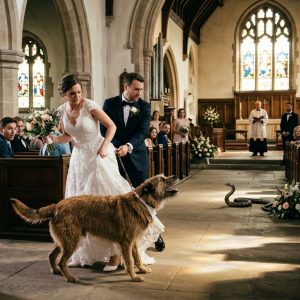
Then the dog came in from the garden.
Old Rufus.
Muddy.
Panting.
His gray muzzle wet with soil.
At first, people laughed.
“Rufus!” Clara called. “Not now, buddy.”
But the dog did not wag his tail.
He walked slowly through the room, past the cake, past the candles, past the polished shoes and champagne glasses.
Then he stopped in front of Margaret.
And dropped something at her feet.
A ring.
Not new.
Not clean.
A plain gold wedding band, dark with wet soil.
Margaret’s smile disappeared.
Henry stared at it like he had seen a ghost.
Clara bent down.
“Dad… whose ring is this?”
Rufus whined softly and pushed the muddy band closer with his nose.
Clara picked it up carefully.
Inside the ring, beneath the dirt, was an engraving.
Evelyn.
The room went still.
Nobody in the family said that name.
Not ever.
Because Evelyn Whitaker was Henry’s first wife.
The woman everyone was told had left him before vanishing forever.
The woman Margaret said had broken his heart.
The woman whose photographs had quietly disappeared from the house after Margaret moved in.
Henry’s face had gone pale.
“Where did he find that?” he whispered.
Margaret stepped forward too fast.
“Turn off your phones.”
Her voice cracked.
Too late.
Henry’s granddaughter, Lily, had already taken the ring from her mother and held it under the chandelier.
“There’s another line,” she said.
Her voice trembled as she read it.
Buried under the willow.
Henry’s hands began to shake.
Margaret reached for the ring.
Clara pulled it back.
“Mom?”
Margaret’s eyes flashed.
“That old ring means nothing.”
But Rufus turned toward the garden door.
Then looked back at Henry.
Whined once.
And started down the garden path.
Like he wanted them to follow.
The Name Nobody Said
Henry had not spoken Evelyn’s name in decades.
Not because he forgot her.
Because Margaret had taught the whole house to treat the name like a wound that should never be touched.
Evelyn had been Henry’s first wife.
Young.
Gentle.
Stubborn in quiet ways.
She loved old books, lemon tea, and the willow tree at the edge of the garden. Henry had planted it for her during their second year of marriage because she said every proper home needed “one tree that knew how to weep.”
Then she disappeared.
That was the story Henry had lived with.
One morning, forty-two years earlier, he woke to find her side of the bed empty. Her closet was half-open. A suitcase was gone. On the dining table sat a letter.
Henry,
I can’t live this life anymore. Don’t look for me.
Evelyn
Margaret found the letter.
Margaret, who had been Evelyn’s closest friend.
Margaret, who came over that morning because she “felt something was wrong.”
Margaret, who held Henry while he broke.
Then came the rumors.
Evelyn had been unhappy.
Evelyn had been seen speaking to a man near the train station.
Evelyn had taken money from the household account.
Evelyn had left because Henry was too proud to notice she felt trapped.
Henry looked for her for months.
Margaret helped.
Or seemed to.
She answered calls.
Spoke to police.
Managed reporters.
Comforted Henry’s mother.
Every lead ended nowhere.
Eventually, people stopped calling it a disappearance.
They called it abandonment.
And Margaret stayed.
One year later, Henry married her.
Not because he had stopped loving Evelyn.
Because he was tired of grieving alone, and Margaret had made herself the only person who understood the shape of his pain.
Now, forty years later, Evelyn’s wedding ring had returned from the garden.
Not from a drawer.
Not from an attic.
From the ground.
Henry followed Rufus with his cane digging into the wet stone path.
The party guests trailed behind him in stunned silence.
Clara carried the ring.
Lily kept recording.
Margaret followed last.
Her face was no longer tearful.
No longer soft.
It was hard.
Terrified.
The old dog stopped beneath the willow tree.
The branches hung low, dripping from the evening rain.
At the base of the tree, the soil had been disturbed. Rufus had dug near a cluster of roots, where something metal glinted beneath the mud.
Henry lowered himself slowly to his knees.
Clara rushed forward.
“Dad, let me.”
But he shook his head.
“No.”
His fingers, old and shaking, pushed aside the wet dirt.
A small tin box emerged.
Rusted.
Dented.
Wrapped in what remained of oilcloth.
Margaret whispered, “Henry, don’t.”
He looked at her.
For the first time that evening, he did not look like her husband.
He looked like a man waking from a long, drugged sleep.
“Why?”
Margaret said nothing.
Henry opened the tin.
Inside was a stack of letters.
A small brass key.
A faded photograph.
And a folded handkerchief embroidered with one letter.
E.
Henry touched it like it might vanish.
Then Clara picked up the first letter.
It was addressed to him.
In Evelyn’s handwriting.
The Letter Under the Willow
Clara read the letter because Henry could not.
His hands were shaking too badly.
His eyes were already full.
The garden was silent except for the rain dripping from the willow branches.
Clara unfolded the page.
Her voice broke on the first line.
My Henry,
Henry covered his mouth.
Margaret turned away.
Clara kept reading.
If this box is found, then I was right to hide it where only Rufus might remember. He always loved digging here, and I pray one day he—or whatever faithful creature follows him—brings someone back to this tree.
Lily looked down at old Rufus.
He sat beside Henry, muddy and tired, as if he had done the job he had been waiting years to do.
Clara continued.
I did not leave you. I did not write the letter they will show you. If you are reading this, ask Margaret why she had your banker prepare transfer papers before I vanished.
A sound moved through the family.
Margaret’s face went white.
Henry looked at her.
“What transfer papers?”
She shook her head.
“This is madness. Evelyn was unstable.”
Clara read louder.
Margaret says she is my friend, but she is not. I found the documents in the study. She and Victor Hale have been moving money through your company accounts. They need my signature to complete the sale of the north property because Father left part of it in my name. I refused.
Henry’s breath came short.
The north property.
He had lost it after Evelyn disappeared.
Margaret told him Evelyn had signed it away before leaving.
He believed her.
Clara’s hand trembled.
If I vanish, do not trust the letter on the dining table. I am leaving this here because Margaret knows every room in the house, every drawer, every place I would hide something inside. But she never liked the willow. She said it made the garden look sad.
Henry let out a broken laugh that turned into a sob.
Evelyn had loved that tree.
Margaret had tried to cut it down twice.
Clara reached the last lines.
I am afraid tonight. Margaret asked me to meet her in the garden after dinner. She says she wants to explain. I am bringing the copies, and I am wearing my ring because you told me once that if I ever felt lost, I should touch it and remember I had a home.
The paper shook in Clara’s hands.
If I do not come back, Henry, please know this: I did not choose to leave you.
No one spoke.
No one moved.
Henry bent over the letter as if every word had entered his body.
Then Lily whispered, “There’s a photo.”
She took it from the tin box.
The photograph showed Evelyn standing beneath the willow tree.
Young.
Alive.
Holding the same tin box.
Beside her stood Margaret.
Not smiling.
Watching.
On the back, in Evelyn’s handwriting, were four words:
She knows I know.
Margaret suddenly turned toward the house.
Clara stepped in front of her.
“Where are you going?”
Margaret’s voice was thin.
“I need air.”
Lily looked at her grandmother.
“No. You need a lawyer.”
The Wife Who Replaced Her
Police arrived before midnight.
Not because Margaret called them.
Lily had.
The ring, the letters, the photo, and the tin box were taken as evidence. The willow tree was roped off. Guests were sent home in silence, carrying the story on their phones before anyone in the family could decide whether to hide it.
Margaret sat in the drawing room, no longer wearing the new diamond ring.
It lay unopened in the velvet box on the anniversary table.
Henry sat across from her.
Between them was forty years of marriage.
And one name they had buried alive in silence.
“Tell me,” he said.
Margaret looked older now.
Not fragile.
Exposed.
“You were drowning after she left,” she said.
Henry’s voice cracked.
“She didn’t leave.”
Margaret closed her eyes.
“You don’t know what she was going to do.”
“She was going to expose theft.”
“She was going to destroy everything.”
“She was my wife.”
Margaret’s face twisted.
“She was always your wife.”
That sentence entered the room like a confession.
Clara stared at the woman she had called Mom her entire life.
“What does that mean?”
Margaret looked at her daughter.
For a moment, something like grief passed through her face.
Then it hardened again.
“I loved him first.”
Henry stared at her.
“You were Evelyn’s friend.”
“I was there before her.”
“No,” Henry whispered. “You were near me. That is not the same thing.”
Margaret flinched.
Then came the rest.
Not all at once.
People like Margaret did not confess cleanly.
The investigators pieced it together through documents, bank records, old land transfers, and testimony from a retired clerk who had stayed silent too long.
Margaret and Victor Hale, the family attorney, had been stealing from Henry’s company before Evelyn found the papers.
Evelyn confronted Margaret.
Margaret arranged the meeting beneath the willow.
Evelyn never returned to the house.
The forged letter appeared the next morning.
Victor filed property transfer documents weeks later using Evelyn’s forged signature.
Henry, shattered and humiliated, stopped fighting.
Margaret stepped in.
Comfort became control.
Then marriage.
Then forty years of a life built on the absence of the woman she had helped erase.
But one thing remained hidden.
The ring.
The tin box.
The letter.
And the willow tree Margaret hated but never dared remove because Henry once said Evelyn loved it too much.
The Garden Gives Back the Dead
The search beneath the willow took two days.
Henry did not watch.
Clara did.
Lily stayed with him in the kitchen while old Rufus slept at his feet, exhausted from digging up the first truth.
On the second afternoon, Detective Quinn came inside.
Her face was solemn.
Henry already knew.
Some truths arrive before words.
“They found remains,” she said softly.
Clara began to cry.
Henry closed his eyes.
“Evelyn?”
“We believe so. We’ll need confirmation.”
He nodded once.
Then his body seemed to fold inward.
For forty years, Evelyn had not been gone.
She had been home.
Under the tree she loved.
While Henry celebrated holidays yards away.
While children played in the garden.
While Margaret hosted parties under lights and flowers.
While Evelyn waited beneath the willow with her ring and her truth.
The confirmation came a week later.
Evelyn Morales Whitaker.
Henry’s first wife.
Cause of death could not be fully determined after so many years, but evidence supported foul play and concealment.
Victor Hale was dead by then.
Margaret was not.
She was arrested in the same house where she had planned to celebrate forty years of marriage.
When officers led her out, she looked back at Henry.
“You would have forgotten me if she lived.”
Henry’s face was empty.
“No,” he said. “I would have known you.”
That hurt her more.
Good.
The trial became the town’s obsession.
Not because of wealth.
Not because of the anniversary party.
Because everyone had known some version of the story.
Evelyn ran away.
Evelyn broke Henry.
Margaret saved him.
The town had repeated it for decades because it was easier than asking why Evelyn’s mother never believed it, why Margaret cut off every old friend who said Evelyn would not leave, why the willow tree was the one place in the garden Margaret never stood.
The prosecution played Lily’s video from the anniversary.
The dog dropping the ring.
Margaret demanding phones be turned off.
The second engraving.
Buried under the willow.
Then they read Evelyn’s letter.
Henry sat in court with Clara on one side and Lily on the other.
Old Rufus was not allowed in the courtroom, though Lily argued harder than anyone expected.
Margaret’s defense claimed Evelyn had written the letter in paranoia, that the remains could not prove Margaret’s involvement, that time had made memories unreliable.
Then the financial records came in.
Victor’s transfers.
Margaret’s accounts.
The forged signatures.
The clerk’s testimony.
The ring and tin box tied Evelyn’s fear to the night she vanished.
Margaret was convicted of conspiracy, fraud, evidence tampering, and charges connected to Evelyn’s disappearance and concealment.
The sentence could not equal forty stolen years.
No sentence could.
But when the judge said Evelyn’s name aloud, Henry wept.
Because the world had finally stopped calling her the woman who left.
The Anniversary That Ended the Lie
The next spring, Henry held another gathering.
Not an anniversary.
A memorial.
No gold candles.
No diamond ring.
No speeches about lasting marriage.
Just family, a few old friends, Father Thomas from the old church, and a small stone placed beneath the willow tree.
It read:
Evelyn Morales Whitaker
Beloved Wife
She Did Not Leave
Henry insisted on the last line.
Some people thought it was too direct.
Henry said directness was forty years overdue.
Clara stood beside him, holding the muddy gold band now cleaned and sealed in a small glass case. Lily held Rufus’s leash, though the old dog barely needed it. He sat near the tree, calm and proud, as if the garden finally smelled right again.
Henry spoke last.
His voice was weak but clear.
“I thought grief was the price of being abandoned,” he said. “Now I know grief was used to blind me. Evelyn loved this house. She loved this tree. She loved me. And I let someone else explain her silence.”
He touched the stone.
“I will spend the time I have left saying what should have been said from the beginning. She was here. She mattered. She did not leave.”
Clara cried quietly.
For her, the truth was complicated.
Margaret had raised her.
Margaret had also built her life on a buried woman.
Loving someone who did evil is its own grief.
No one tried to simplify that for her.
Lily, however, knew exactly where she stood.
She knelt beside Rufus and whispered, “Good boy.”
The dog wagged his tail once.
That evening, Henry removed Margaret’s portraits from the hall.
He did not burn them.
He boxed them.
Lily asked why.
Henry said, “Because hiding history is how this began.”
Then he restored Evelyn’s photographs.
Not as a shrine.
As truth.
Evelyn in the garden.
Evelyn laughing by the piano.
Evelyn standing beneath the willow, one hand over her eyes against the sun.
The house changed after that.
Not magically.
Houses do not cleanse themselves because the truth comes out.
But windows were opened.
Rooms were rearranged.
The willow was trimmed carefully, never cut.
And every year, on the date Evelyn vanished, Henry placed yellow flowers beneath the tree.
Not white.
White was for the anniversary lie.
Yellow was what Evelyn had planted the first spring they lived there.
Henry lived three more years.
Long enough to see Lily graduate.
Long enough to tell Clara stories about Evelyn that did not hurt quite as sharply by the end.
Long enough to sit beneath the willow with Rufus, two old souls waiting in the shade.
When Rufus died, Henry buried his ashes near the garden path.
Not under the willow.
Beside it.
“He already did his work there,” Henry said.
On Henry’s last afternoon, Clara found him looking at the old ring.
The engraving was visible now.
Evelyn.
Buried under the willow.
Clara sat beside him.
“Do you think she knew someone would find it?”
Henry smiled faintly.
“I think Evelyn trusted dogs more than people.”
Clara laughed through tears.
“She was right.”
Henry closed his hand gently around the ring.
“No,” he said. “She trusted love. The dog just remembered where we forgot to look.”
After Henry died, the ring stayed in the family.
Not as jewelry.
As witness.
Lily eventually placed it in a small frame beside the photograph from the tin box.
Underneath, she wrote:
The truth waited where the lie refused to stand.
People still talked about that anniversary party for years.
The gold candles.
The diamond ring.
The old dog covered in mud.
The name inside the band.
But Lily remembered the silence most.
The exact second after she read the second line.
Buried under the willow.
The moment every person in the room understood that a perfect marriage celebration had been built on the absence of another woman’s grave.
Margaret had wanted forty years to prove she belonged beside Henry.
Instead, the dog brought Evelyn back to the party.
Muddy.
Silent.
Undeniable.
And when Rufus turned toward the garden path, he did not just lead them to a tree.
He led them out of a lie.