The Child Who Wouldn’t Cry
The little boy stood beside his mother’s coffin without crying.
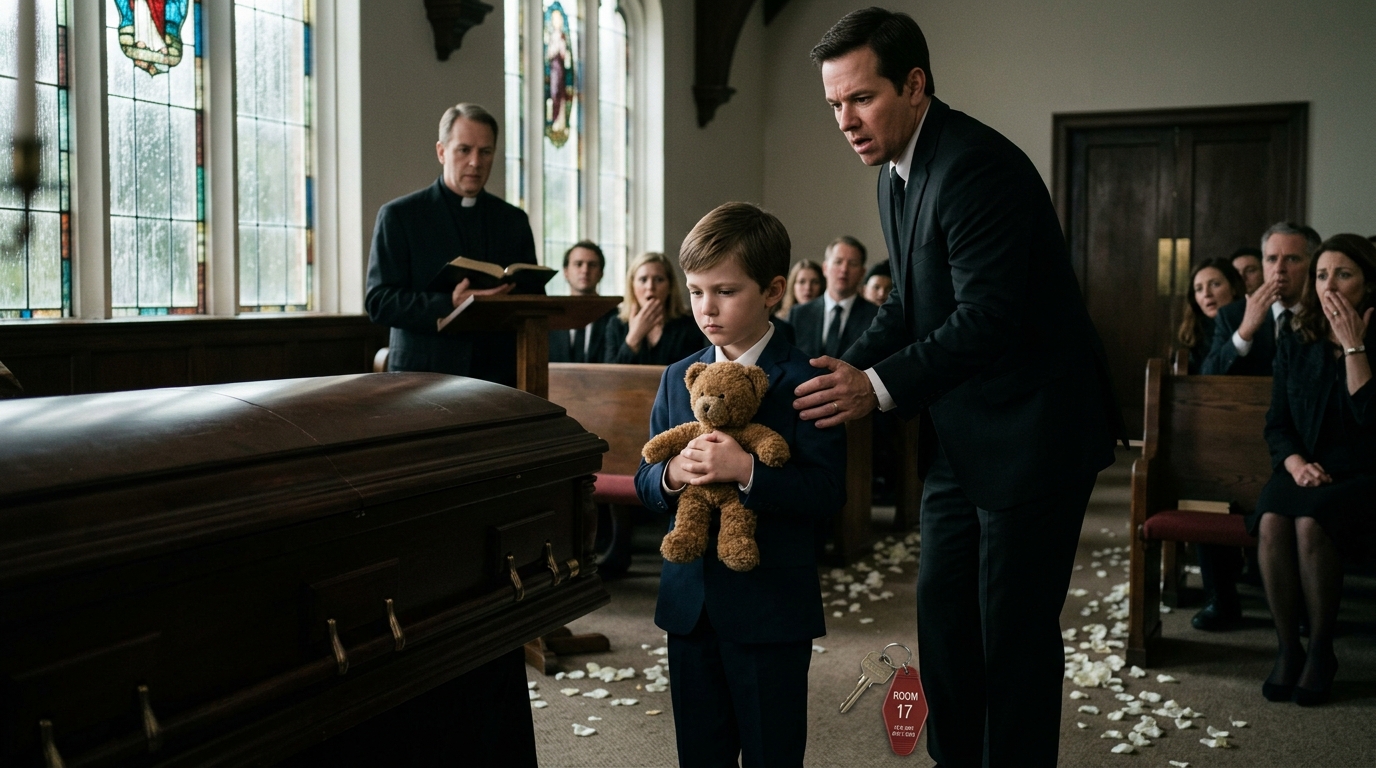
The chapel was silent except for the rain tapping against the stained-glass windows. White roses covered the aisle. Black coats filled the pews. Family members whispered prayers into folded hands while the pastor stood near the altar with the Bible half-open.
At the front of the room, Daniel Whitmore stood in a black suit with one hand resting on his son’s shoulder.
His face looked carefully broken.
The kind of grief people trust because it looks neat enough to be photographed.
His wife, Elena, had died in a terrible accident.
That was what he told everyone.
A wet road.
A shattered guardrail.
A car found at the bottom of a ravine.
No body recovered at first, then later, a sealed coffin.
The family had been told not to look.
Too much damage.
Too much pain.
Too much mercy in leaving the lid closed.
And so the coffin stayed locked beneath white roses.
Daniel’s son, Noah, stood beside it in a tiny black suit, holding a worn brown teddy bear against his chest.
The bear had one button eye, a stitched smile, and a faded blue ribbon around its neck.
Its name was Mr. Buttons.
Elena had given it to Noah when he was three.
Now he held it like it was the only living thing left in the room.
A woman in the front pew whispered, “Poor child. He’s in shock.”
Daniel lowered his head and squeezed Noah’s shoulder.
“My wife loved this boy more than anything,” he told the mourners, voice trembling in all the right places. “I only pray I can be strong enough to raise him without her.”
Several people began crying.
Noah looked at the coffin.
Then at his father.
Then back at the teddy bear in his arms.
And said:
“Mommy isn’t in there.”
Every head turned.
The pastor froze.
Daniel’s hand tightened on Noah’s shoulder.
“What did you say, buddy?”
Noah did not look confused.
He did not look frightened.
He looked like a child repeating something he had been told to remember exactly.
“Mommy isn’t in there.”
A ripple moved through the chapel.
Someone whispered that grief made children say strange things.
Someone else said, “He doesn’t understand.”
Daniel bent down quickly, forcing a soft smile.
“Don’t say that, buddy.”
But Noah pulled away.
His small face stayed serious.
Then he pointed at the teddy bear.
“She told me to bring Mr. Buttons only if Daddy lied.”
The chapel went colder than the rain outside.
Daniel’s smile disappeared.
“Noah.”
The warning in his voice was quiet.
But everyone heard it.
Noah clutched the bear tighter.
Daniel reached for it.
The boy stepped back.
“No.”
Before anyone could move, Noah pulled open the tiny stitched pocket in the bear’s back.
Something slipped out.
A motel key.
It hit the church floor with a small metallic sound that somehow echoed louder than thunder.
Room 17.
The tag was marked with a date.
Three days after the accident.
Daniel’s face drained of color.
He stepped backward so fast he knocked over a vase of white roses.
The flowers scattered across the aisle.
Noah looked at the locked coffin.
Then whispered:
“Mommy said the real box is in the basement.”
The pastor slowly lowered the Bible.
And that was when someone in the back of the chapel screamed.
Video: A Little Boy Opens His Teddy Bear at His Mother’s Funeral—and a Motel Key Falls Out
The Key That Shouldn’t Exist
For a moment, nobody moved.
The scream had come from an older woman standing near the chapel doors.
Her name was Margaret Hale, Elena’s aunt.
She had been quiet through the whole service, lips pressed together, eyes red but strangely alert. When Noah mentioned the basement, Margaret covered her mouth and stumbled backward as if the words had reached into a memory she had tried to bury.
Daniel turned sharply toward her.
“Margaret,” he said.
Not loudly.
But sharply enough to make her flinch.
Noah bent down and picked up the motel key before anyone else could touch it.
He held it against his chest with Mr. Buttons.
The pastor looked from the boy to Daniel.
“Mr. Whitmore,” he said carefully, “perhaps we should pause the service.”
Daniel straightened.
“No.”
The word came too fast.
Too hard.
The chapel heard it.
He corrected himself immediately.
“My son is confused. He lost his mother. He heard things he didn’t understand.”
Noah looked at him.
“I’m not confused.”
Daniel’s jaw tightened.
“Noah.”
The boy’s eyes filled with tears for the first time.
Not from grief.
From fear.
That was what changed the room.
Until then, people had been trying to explain his words away. Children grieve strangely. Children imagine things. Children repeat nonsense when they are frightened by death.
But Noah was not staring at the coffin like a child afraid of death.
He was staring at his father like a child afraid of what would happen if people stopped listening.
The pastor stepped down from the altar.
“Noah,” he said gently, “who gave you that key?”
Noah looked at Daniel first.
Then at Margaret.
Then at the pastor.
“Mommy.”
A murmur moved through the chapel.
Daniel laughed once.
It was a terrible sound.
“My wife was dead before that date.”
Noah shook his head.
“She was at the motel.”
The rain struck harder against the windows.
The pastor’s eyes moved to the key tag.
Room 17.
Date: October 14.
The accident had happened on October 11.
Daniel’s face had gone flat.
Controlled.
Dangerous.
He reached into his pocket.
“Everyone, please remain calm. I’m going to take Noah home. This is too much for him.”
He placed a hand on Noah’s arm.
Noah jerked away.
“No!”
The cry cracked through the chapel.
Daniel’s mask slipped.
Only for a second.
But the first pew saw it.
The pastor saw it.
Margaret saw it.
And the elderly church caretaker, Mr. Bell, who stood near the basement door at the back of the chapel, saw it too.
He slowly stepped away from the door.
Daniel noticed.
His eyes narrowed.
“Mr. Bell,” he said, “there is no need for drama.”
The old caretaker swallowed.
His voice was barely above a whisper.
“I heard something downstairs this morning.”
The chapel went completely silent.
Daniel’s face turned white.
“What?”
Mr. Bell looked toward the basement door.
“Scratching.”
Someone gasped.
The pastor turned.
“Why didn’t you say anything?”
“I thought it was pipes,” the old man whispered. “Or rats. Then the boy said…”
He could not finish.
The basement door stood at the back of the chapel, half-hidden behind a tall arrangement of white lilies.
Locked.
No one had thought about it.
No one had looked twice.
Now every eye in the room turned toward it.
Noah whispered:
“She said if they locked the church basement, Daddy already knew.”
The Accident That Never Felt Right
Three days before the funeral, the entire town had mourned Elena Whitmore.
She had been loved quietly.
Not the way rich people are loved, with public statements and charity plaques, but the way ordinary kindness survives in other people’s kitchens.
Elena remembered birthdays.
She brought soup to sick neighbors.
She paid for school supplies anonymously.
She spoke to staff by name.
She made people feel visible.
That was one reason Daniel’s grief had never sat comfortably with everyone.
He spoke beautifully about her.
Too beautifully.
At the police station, he gave the timeline without stumbling.
At the church, he selected flowers quickly.
At the funeral home, he insisted on a sealed coffin.
“The damage was too severe,” he said.
No one wanted to question a grieving husband.
That is how many lies survive.
They wear grief well.
But Margaret had doubted him from the beginning.
Elena had called her the night before the accident.
Her voice was shaking.
“Aunt Maggie,” she whispered, “if anything happens, don’t believe the first story.”
Margaret had sat up in bed.
“What happened?”
Elena did not answer directly.
“Daniel found the papers.”
“What papers?”
“The trust transfers. The life insurance changes. The custody forms.”
Margaret’s blood went cold.
Elena had recently discovered that Daniel was moving money through accounts in Noah’s name. She had been preparing to leave him quietly, with help from an attorney and a safe place arranged at a motel outside town.
Room 17.
Margaret knew the motel.
She had helped Elena choose it because the owner was an old friend who did not ask questions when women arrived with children and one suitcase.
Then Elena’s car went off the ravine road.
Daniel said she was alone.
Daniel said Noah was asleep at home.
Daniel said Elena must have been distracted by the rain.
And everyone accepted it.
Almost everyone.
Noah had not spoken much after the accident.
He carried Mr. Buttons everywhere.
When Daniel tried to take the bear away the morning of the funeral, Noah screamed until he vomited.
Daniel finally let him keep it.
Now everyone knew why.
Elena had hidden the first truth inside the toy her son would never willingly give up.
The Basement Door
The pastor walked toward the basement door.
Daniel moved faster.
He stepped into the aisle and blocked him.
“Pastor, I am asking you not to turn my wife’s funeral into a circus.”
The pastor stopped.
His voice was calm, but his hands were trembling.
“A child has produced evidence that your wife may have been alive after the accident.”
Daniel’s eyes hardened.
“A motel key is not evidence.”
Margaret’s voice broke from the back.
“It is if I arranged the room.”
Every face turned toward her.
Daniel looked like he might strike her with his eyes.
Margaret stepped into the aisle, shaking but standing.
“Elena called me,” she said. “She was leaving you.”
A collective gasp moved through the chapel.
Daniel’s mother stood.
“How dare you?”
Margaret ignored her.
“She found the papers. She knew about the accounts. She knew about the custody forms.”
Daniel’s voice dropped.
“You are grieving and confused.”
“No,” Margaret said. “I am late. That is not the same thing.”
The words landed heavily.
The pastor turned back to the basement door.
“Mr. Bell, do you have the key?”
The caretaker looked at Daniel.
Then at Noah.
Then nodded.
Daniel took one step forward.
“No one opens that door.”
That was the sentence that ended his performance.
Because an innocent man might plead.
An innocent man might rage.
An innocent man might demand answers.
But Daniel did not ask what they expected to find.
He simply tried to stop them from looking.
The security guard from the funeral home, who had been standing near the side wall, moved closer.
“Sir,” he said quietly, “step back.”
Daniel glared at him.
“This is my wife’s service.”
The guard looked at Noah.
“Then let them prove your son wrong.”
Daniel said nothing.
Mr. Bell unlocked the basement door.
The hinges groaned.
A damp, cold smell rose from below.
Noah grabbed Margaret’s hand.
The pastor descended first, holding his phone flashlight.
Mr. Bell followed.
The guard went behind them.
Three steps down, the pastor stopped.
“What is it?” someone called.
No answer.
Then a sound came from below.
A faint knock.
Not from pipes.
Not from rats.
Wood against wood.
Noah whispered, “Mommy.”
Daniel lunged toward the stairs.
Two men grabbed him before he could reach the door.
The chapel erupted.
Women screamed.
The pastor shouted from below:
“Call 911!”
The Real Box
They found the real box in the basement.
Not a coffin.
A shipping crate.
Long.
Wooden.
Locked from the outside.
It had been hidden behind old hymnals and storage cloths beneath the chapel floor.
The crate was marked with a delivery label from the funeral home.
Scheduled for removal after the service.
Inside was Elena.
Alive.
Barely.
Her wrists were bruised. Her lips were cracked. Her breathing was shallow. A white burial shawl had been wrapped around her body as if someone had prepared her for a second, quieter funeral.
When they opened the crate, she tried to speak.
Only one word came out.
“Noah.”
The boy broke free from Margaret and ran down the stairs before anyone could stop him.
He reached the basement as the pastor lifted Elena carefully from the crate.
“Mommy!”
Elena’s eyes opened.
Weak.
Unfocused.
But alive.
She reached for him with trembling fingers.
Noah pressed Mr. Buttons into her hand.
“I brought him,” he sobbed. “I did what you said.”
Elena tried to smile.
“My brave boy…”
Then she passed out.
The ambulance arrived within minutes.
So did the police.
Daniel was handcuffed in the aisle beside the white coffin while the mourners watched in stunned horror.
The coffin he had cried over remained closed.
When investigators opened it, they found sandbags wrapped under funeral cloth.
No body.
No wife.
Only weight.
A performance.
A locked coffin for a woman he planned to dispose of after everyone finished mourning her.
The white roses on the floor had begun to soak up rainwater from people’s shoes.
They looked ruined.
Like the whole room had finally stopped pretending.
What Happened in Room 17
Elena survived.
But the truth came slowly.
She woke in the hospital two days later with Noah sleeping in a chair beside her bed, one hand wrapped around Mr. Buttons, the other clutching her blanket.
Margaret sat nearby.
The pastor came once and cried so hard he could barely apologize.
Detective Laura Quinn took Elena’s statement after doctors cleared her.
The story was worse than anyone had imagined.
Elena had planned to leave Daniel on October 11.
She had packed a small bag for herself and Noah. She had hidden copies of financial records inside Mr. Buttons. She had arranged to meet Margaret at the motel.
But Daniel found the second phone.
The one Elena used to contact her attorney.
That night, he staged the crash.
He drove Elena’s car to the ravine road. He drugged her enough to make her appear disoriented, then pushed the car over the edge after removing her from it.
The fire destroyed enough evidence for the first story to work.
He took her to Room 17.
For two days, he tried to force her to sign papers granting him full control of Noah’s trust and Elena’s inheritance.
She refused.
She managed to hide the motel key in Mr. Buttons when Noah was briefly brought to see her under the lie that “Mommy is sick and needs quiet.”
That was when she whispered the instructions.
Bring the bear if Daddy lied.
Do not let him take the bear.
Tell them Mommy isn’t in the coffin.
Tell them the real box is in the basement.
Noah was only seven.
But terror can carve memory deep.
On the third day, Daniel moved Elena from the motel to the church basement, planning to keep her there until after the public funeral. The crate would be removed with old service materials and taken to a private cremation facility that had been paid in cash.
The plan was cruel.
Careful.
Almost successful.
But Daniel made one mistake.
He underestimated the child he thought grief would silence.
Mr. Buttons Had More Than a Key
Investigators examined the teddy bear.
Inside the stitched pocket, hidden beneath the lining, were more than loose threads.
There was a tiny memory card.
Elena had placed it there before the accident.
On it were photos of bank documents, recordings of Daniel threatening her, and one video she had made in the motel room before he found her phone.
In the video, Elena sat on the edge of the motel bed, face bruised, voice shaking but clear.
“If this is found, my name is Elena Whitmore. I am alive. My husband Daniel is trying to take my son’s inheritance and frame my death as an accident. If he stages a funeral, do not open only the coffin. Search the basement. Search the crate marked for removal. And please—believe Noah.”
The video ended with her looking off-screen.
Footsteps.
A door opening.
Then darkness.
That video became the center of the case.
Daniel’s lawyers tried to argue she was unstable.
That she had planned to frame him.
That the accident had confused everyone.
But the evidence kept answering.
The motel key.
The room records.
The basement crate.
The fake coffin.
The sedatives in Elena’s blood.
The documents in the teddy bear.
The delivery label signed by Daniel.
And Noah’s testimony.
The court protected him from facing his father directly. He gave his statement in a quiet room with a child advocate beside him and Mr. Buttons in his lap.
When asked why he brought the bear to the funeral, Noah said:
“Mommy told me the bear would know when people didn’t.”
That sentence made the prosecutor cry.
The Funeral That Became a Trial
Daniel Whitmore was not buried by scandal.
He was exposed by it.
The entire chapel had seen too much.
The mourners who came to comfort him became witnesses.
The pastor testified.
Mr. Bell testified.
Margaret testified.
Even Daniel’s own mother, who had defended him in the first minutes, broke down when shown the empty coffin.
“I thought grief made him strange,” she whispered in court. “I did not know evil could wear grief that well.”
Elena testified last.
She wore a simple blue dress and held Noah’s hand until she reached the witness stand.
Daniel did not look at her.
Not once.
The prosecutor asked, “Mrs. Whitmore, why did you hide the motel key in the teddy bear?”
Elena looked toward Noah.
“Because my son loved that bear more than he feared his father.”
The courtroom went silent.
“And why did you tell him to speak at the funeral?”
Her voice trembled.
“Because I knew Daniel would count on everyone being too polite to question a coffin.”
That was the truth.
Politeness had almost buried her.
A sealed casket had almost ended her life.
A room full of mourners had almost accepted a lie because grief told them not to ask uncomfortable questions.
Daniel was convicted of attempted murder, kidnapping, fraud, evidence tampering, conspiracy, and crimes related to the staged death.
The sentence was long.
Not long enough for Noah’s nightmares.
Not long enough for Elena’s fear of closed rooms.
Not long enough for Margaret’s guilt.
But long enough that Daniel would never again stand over a coffin and pretend to be the victim.
The House After the Coffin
Elena did not return to the house she had shared with Daniel.
Not immediately.
Maybe not ever.
She and Noah stayed with Margaret for months in a small cottage with yellow curtains, creaky floors, and no basement.
Especially no basement.
Noah slept with the lights on.
Elena did too.
Some nights, Noah woke screaming that the box was closing.
Elena would gather him into her arms and whisper, “We opened it. We opened it, baby.”
Sometimes she was saying it to him.
Sometimes to herself.
Mr. Buttons stayed with them.
The teddy bear became worn almost beyond repair. One button eye loosened. The blue ribbon frayed. The stitched pocket was sewn closed again, but Noah still checked it sometimes.
Just to make sure nothing else was hidden.
One afternoon, months after the trial, Noah asked:
“Mommy, did I save you?”
Elena looked at him.
He was sitting on the floor with Mr. Buttons in his lap, small shoulders tense, as if the answer might be too heavy.
She sat beside him.
“Yes,” she said. “You helped save me.”
His face crumpled.
“I was scared.”
“I know.”
“I almost didn’t say it.”
Elena pulled him close.
“But you did.”
He cried into her sweater.
“I didn’t want Daddy to be mad.”
Elena closed her eyes.
That was the wound she hated most.
Not the crate.
Not the coffin.
The fact that Daniel had made their child responsible for surviving his anger.
“You were not supposed to be brave like that,” she whispered. “I am proud of you. But I am sorry you had to be.”
Noah held onto her tighter.
That became the sentence she repeated whenever people called him a hero.
Because he was brave.
But he was also a child.
Both things had to be true.
The Chapel Door Stayed Open
A year later, Elena returned to the chapel.
Not for a funeral.
For a small gathering arranged by the pastor.
No cameras.
No reporters.
Only the people who had been there that day and still carried the sound of the axe-like truth splitting the room open.
The white coffin was gone.
The basement had been cleared.
The door at the back of the chapel no longer had a lock.
The pastor insisted on that.
“No room under God’s roof should be used to hide a living person,” he said.
Elena stood near the aisle where Noah had dropped the motel key.
Rain tapped against the stained glass again, softer this time.
Margaret stood beside her.
Noah held her hand.
Mr. Bell, the old caretaker, had placed a small wooden plaque near the basement door.
It read:
Listen when a child says something is wrong.
Elena touched the words gently.
For a long moment, she could not speak.
Then she looked at Noah.
“Are you okay?”
He nodded.
Then thought about it.
“Mostly.”
She smiled sadly.
“Mostly is enough for today.”
The pastor approached them with tears in his eyes.
“I should have opened the basement door sooner.”
Elena looked at him.
“You opened it when it mattered.”
He shook his head.
“I almost didn’t.”
“So did Noah.”
The boy looked down at Mr. Buttons.
Then up at the pastor.
“But we did.”
The pastor nodded.
“Yes,” he whispered. “You did.”
Years later, people still told the story of the boy at his mother’s coffin.
They talked about the teddy bear.
The motel key.
The fake coffin.
The real box in the basement.
The scream from the back of the chapel.
But Elena remembered a smaller moment most clearly.
Noah standing beside the coffin, tiny in his black suit, refusing to cry because he had a job no child should ever have been given.
He had looked at a room full of adults and told them the truth.
Mommy isn’t in there.
At first, they thought grief was speaking.
They were wrong.
It was love.
Love, hidden in a teddy bear.
Love, brave enough to interrupt a funeral.
Love, small enough to stand beside a coffin and strong enough to open a basement door.