The Boy in the Neon Rain
“YOU DID THIS TO ME! THIS IS YOUR FAULT!”
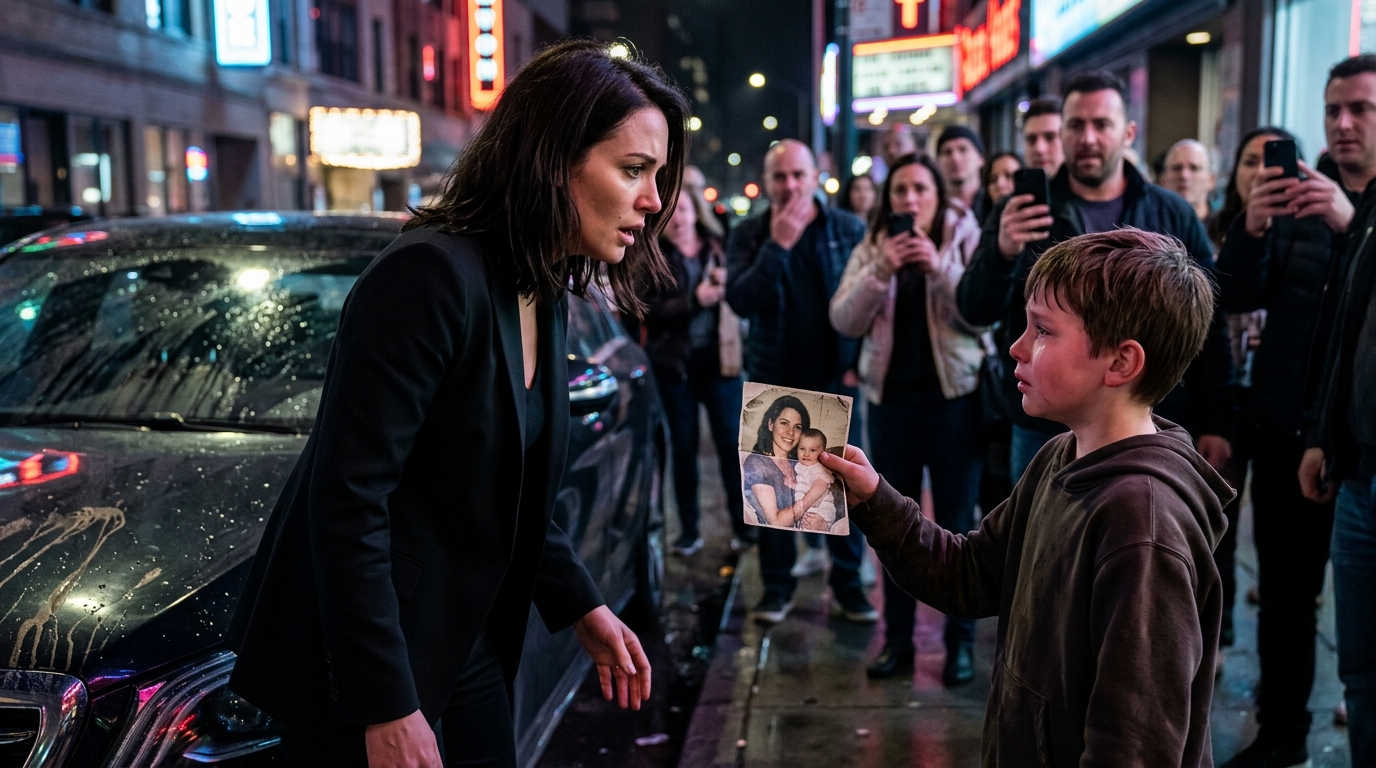
Muddy water exploded across the windshield of the black Mercedes.
The splash hit so hard the driver slammed the brakes.
Tires screeched against the wet street.
Neon signs flickered red and blue across the puddles. Rain had stopped only minutes earlier, leaving the city slick, shining, and restless. People outside the theater turned at once. A couple stepping out of a restaurant froze beneath their umbrella. A food delivery rider slowed near the curb.
Then phones came up.
The driver’s door flew open.
A woman stepped out.
Tall.
Flawless.
Furious.
She wore a cream coat, black heels, and diamond earrings that caught the neon light each time she moved. Her hair was swept neatly behind one ear. Everything about her looked expensive and controlled — except her face.
“What is wrong with you?” she shouted. “Are you insane?”
Across from her stood a boy.
He couldn’t have been more than eleven.
Thin shoulders.
Soaked hoodie.
Scuffed shoes.
Hands trembling at his sides.
The plastic bucket he had used lay overturned near the curb, still dripping muddy water into the gutter.
His face was streaked with rain and tears.
But his eyes were burning.
“You left us,” he said.
The woman stopped.
Not because she understood.
Because the words did not match the crime.
This was not a child laughing after a prank.
This was not a street kid trying to scare someone rich.
This boy looked like he had been waiting years for this exact moment.
The woman’s voice sharpened.
“I don’t know you.”
The boy shook his head hard.
“You drove away. You didn’t even look back.”
The crowd shifted.
Someone whispered, “What did he say?”
Another phone zoomed in.
The woman’s driver stepped around the car, alarmed.
“Mrs. Vale, please get back inside.”
But she didn’t move.
Her name was Evelyn Vale.
To the city, she was a wealthy widow, a hospital donor, a woman who appeared on charity boards and gala programs. She was known for being composed. Gracious. Private.
Now, under the neon glow, with muddy water sliding down her windshield, she looked suddenly uncertain.
“What are you talking about?” she asked.
The boy reached into his pocket.
Slowly.
Deliberately.
His hand shook as he pulled out something small and worn.
A photograph.
Old.
Faded.
Creased from being folded too many times.
He held it up.
The camera phones followed.
Evelyn stared.
At first, her expression remained hard.
Then the color drained from her face.
The photo showed a younger woman sitting near a hospital window, hair loose over her shoulders, eyes tired but happy, cradling a newborn baby in a blue blanket.
The woman was Evelyn.
Younger.
Softer.
Alive in a way she no longer looked.
The baby’s tiny fist rested against her chest.
The boy’s voice cracked.
“My mom said you were my mother.”
The city went silent.
Even the traffic seemed to pause.
Evelyn’s lips parted.
“That’s not possible.”
Her voice was barely a whisper.
The boy stepped back as if the words had struck him harder than any slap.
“I waited,” he said. “Every day.”
Evelyn’s hand dropped to her side.
The photograph trembled between them.
Behind her, the Mercedes engine hummed softly.
In front of her, a child stood shaking in the street with the face of a life she had been told never existed.
And for the first time in eleven years, Evelyn Vale felt the past move beneath her feet.
Video: A Boy Threw Mud at a Rich Woman’s Car—Then Showed Her a Photo That Made Her Go Pale
The Baby Evelyn Was Told Had Died
Eleven years earlier, Evelyn had given birth in a private hospital room under white lights and terrible rain.
She remembered fragments.
Pain.
Her late husband, Richard Vale, holding her hand.
A nurse telling her to breathe.
Thunder outside the window.
Then a baby crying.
A sound so small and fierce that Evelyn had turned her head toward it even through exhaustion.
“A boy,” someone had said.
She remembered seeing him for only a moment.
Dark hair.
Tiny mouth.
A blue blanket.
Then the room blurred.
Her blood pressure dropped.
Doctors moved quickly.
Richard’s voice became distant.
When Evelyn woke hours later, the room was quieter than it should have been.
No baby.
No crib.
No tiny sleeping breaths.
Only Richard sitting beside her bed, his face pale, his hand wrapped around hers.
He told her the baby had not survived.
The doctors confirmed it.
The hospital chaplain came.
The nurse cried.
Evelyn screamed until her stitches tore.
After that, grief became fog.
There was no funeral, not a real one. Richard said the baby had been too fragile. He handled the arrangements. He told her seeing anything more would destroy her.
For months, Evelyn lived like someone underwater.
The nursery door remained locked.
The blue blanket vanished.
The hospital records were summarized for her in gentle language she could not bear to read.
Richard stayed beside her through all of it.
Everyone praised him.
Such a devoted husband.
Such a tragic father.
Such strength.
Three years later, Richard died in a boating accident.
By then Evelyn had become a person the city recognized but did not truly know. She inherited his estate, his businesses, his charities, and his enemies. She gave money to hospitals because she could not save her own child. She appeared at galas because silence at home felt worse.
But she never had another baby.
She never opened the nursery.
And she never stopped hearing that first cry.
Now, standing in the street under neon light, she stared at a boy holding a photograph that should not exist.
Her voice shook.
“Where did you get that?”
The boy pulled the photo back against his chest.
“My mom kept it.”
“Who is your mother?”
His face tightened.
“Her name was Mara.”
Evelyn froze.
Mara.
The name was old.
Buried.
Not forgotten.
Mara Quinn had been a nurse at the private maternity wing where Evelyn gave birth. Evelyn remembered her dimly — kind eyes, soft voice, a silver cross around her neck. Mara had once brushed Evelyn’s hair away from her face and whispered, “He’s beautiful,” before the doctors took the baby.
Evelyn had never seen her again after that night.
The boy continued.
“She said if I ever found you, I had to show you the picture. She said you might not know.”
Evelyn took one step toward him.
“What’s your name?”
The boy hesitated.
“Noah.”
Evelyn’s breath caught.
Noah.
That had been the name she chose.
Richard had wanted Charles, after his father.
Evelyn had wanted Noah because it sounded gentle and strong at once.
No one knew that except Richard.
And the nurse who placed him in her arms.
Evelyn lifted a hand to her mouth.
The driver moved closer.
“Mrs. Vale, we should leave. This could be a setup.”
Noah’s expression hardened.
“I’m not lying.”
“I didn’t say you were,” Evelyn whispered.
But her mind was splitting open.
If Noah was alive, then everything she had mourned had been arranged.
If Noah was alive, then Richard had lied.
If Noah was alive, someone had stolen her child from a hospital room while she lay bleeding and helpless.
And if Mara had raised him, then the woman Evelyn barely remembered had carried a secret for eleven years.
“Where is Mara now?” Evelyn asked.
Noah looked down.
The answer was there before he spoke.
“She died last week.”
Evelyn closed her eyes.
The street seemed to sway.
Noah’s voice became smaller.
“Before she died, she told me to find you. But when I saw your car, I remembered what she said.”
“What did she say?”
His jaw trembled.
“She said a black car drove away the night everything changed. She said she ran after it with me, but it didn’t stop.”
Evelyn looked at her Mercedes.
Black.
Polished.
Expensive.
Wrongly familiar.
“Noah,” she said carefully, “I didn’t drive away from you.”
He stared at her, fighting between fury and hope.
“Then who did?”
The Nurse Who Kept the Photograph
Evelyn did not take Noah to the police first.
She should have.
Some part of her knew that.
But the boy stood in the street shaking, surrounded by cameras, strangers, and judgment. He had just accused her of abandoning him in front of half a block. He looked ready to run.
So Evelyn did the one thing she wished someone had done for her eleven years ago.
She lowered her voice.
“Noah, come with me somewhere safe. You can sit by the door. You can leave if you want. I won’t touch you. I won’t take that photo from you. But we need to talk before the wrong people hear too much.”
His eyes narrowed.
“You have guards.”
“I have a driver. He can stand outside.”
“I don’t trust rich people.”
Evelyn almost smiled.
“Sometimes that’s wise.”
That surprised him.
After a long silence, he nodded once.
They went to a small café two blocks away, one Evelyn had never entered before. Her driver remained outside by the window. Noah chose the chair closest to the exit. He kept the photograph in both hands.
Evelyn ordered hot chocolate for him.
He did not drink it until she took a sip first from her own cup.
That nearly broke her.
Children do not learn suspicion like that unless life teaches it carefully.
“Tell me about Mara,” Evelyn said.
Noah looked at the cup.
“She was my mom.”
Evelyn nodded slowly.
“She raised you?”
“She said she didn’t give birth to me, but she was my mom because she stayed.”
The words landed gently and painfully at once.
“What did she tell you about me?”
Noah’s mouth tightened.
“Not much. She said you were young when I was born. She said something bad happened. She said she tried to bring me back, but she got scared.”
“Scared of who?”
He unfolded another paper from his pocket.
A letter.
The edges were soft from being touched too often.
“My mom wrote this when she was sick.”
Evelyn took it only after he nodded.
The handwriting was weak but careful.
Noah,
If I don’t get better, you must find Evelyn Vale. She is your mother. I know that may hurt you. I know it may make you hate me for not telling you sooner.
But I need you to know this: she did not give you away.
Evelyn stopped reading.
Her eyes blurred.
Noah watched her with painful intensity.
She forced herself to continue.
That night at St. Camilla’s Hospital, your father told the staff you had died. He paid Dr. Harlan to falsify records. He ordered me to take you through the service exit and give you to a private adoption contact.
I could not do it.
You were breathing in my arms.
You opened your eyes.
I ran.
Evelyn pressed the page to the table, fighting for breath.
Noah whispered, “Keep reading.”
So she did.
I thought I could bring you back to her, but when I reached the parking lot, Richard Vale was already leaving in a black car. I screamed. I held you up. He looked at me through the window.
He saw us.
Then he drove away.
Evelyn’s hand shook so hard the paper rattled.
Richard.
Her husband.
The grieving father everyone had praised.
The man who held her hand and told her their son was gone.
The man who locked the nursery.
The man who had comforted her through the grief he created.
The letter continued.
I hid you because I thought if he found us, he would finish what he started. Later, when I tried to contact Evelyn, every number was blocked. Her mail was screened. Men came to my apartment twice. I moved constantly. I told myself I would find a safer way. Then years passed.
That is my sin.
I loved you like my own, but I should have fought harder to return you.
Forgive me if you can.
Find her.
Let the truth hurt where it must.
Mara.
Evelyn lowered the letter.
For a while, neither spoke.
Rain began again outside, soft against the café windows.
Noah’s voice was small.
“She said you might not believe me.”
Evelyn looked at the photograph.
At the baby.
At herself.
Then at him.
“I believe you.”
His face changed instantly.
Not relief.
Not joy.
Fear.
Belief meant the story was real.
And real meant everything he had known was broken.
The Man Who Wanted No Heir
Richard Vale had been born into a family that worshipped inheritance but feared losing control of it.
Evelyn learned that too late.
When she married him, she thought his caution came from responsibility. He was fifteen years older, already wealthy, already respected. He guided her gently through contracts, family trusts, property titles, charity boards. He said he wanted to protect her from people who might use her.
But Richard’s protection had always been a wall with him holding the key.
After the baby was supposedly lost, he became more controlling.
Not cruel in public.
Never.
He monitored visitors because she was “fragile.” He handled condolence letters because grief was “too heavy.” He dismissed one nurse after another because they were “unprofessional.” He moved them from the old family mansion to a penthouse because the nursery was “hurting her recovery.”
At the time, Evelyn thought he was saving her.
Now she understood.
He was isolating the only witness he had not been able to erase: her own memory.
But why?
Noah asked the question first.
“Why would he do that?”
Evelyn looked down at her hands.
She had worn no wedding ring since Richard died, but sometimes she still felt its weight.
“Because of money,” she said slowly. “And power.”
Noah frowned.
“He was already rich.”
“Yes,” Evelyn said. “But my son would have changed the trust.”
Richard had inherited the Vale family company through a complicated structure. If he had no living child, control of certain voting shares remained with him and later passed through his chosen foundation. But if he had a legitimate son, the trust transferred a protected portion to the child at birth, supervised by independent trustees — not Richard.
Evelyn had forgotten the details because grief swallowed them.
Richard had not.
A living son meant less control.
A dead son meant sympathy.
A wife too devastated to question documents.
A city that saw tragedy instead of theft.
Evelyn stood abruptly.
Noah jerked back.
She stopped.
“I’m sorry. I didn’t mean to scare you.”
“Where are you going?”
“To get proof.”
He stood too.
“I’m coming.”
“Noah—”
“I’m coming.”
The look in his eyes ended the argument.
They went to the Vale archive building, a private office where Richard’s old estate files were stored. Evelyn had not entered in years. She hated the smell of leather folders and polished wood. It reminded her of men telling her what had happened to her own life.
Her longtime attorney, Margaret Bell, arrived within thirty minutes after Evelyn called.
Margaret was seventy, sharp-eyed, and had disliked Richard from the first dinner they shared.
When she saw Noah, she became very still.
“Oh,” she whispered.
Evelyn looked at her.
“You knew?”
Margaret’s face tightened with grief.
“I suspected something was wrong. I did not know this.”
“That’s not an answer.”
Margaret accepted the rebuke.
“After the birth, I requested hospital records. Richard blocked me. He said you were too unstable for legal stress. Then he replaced half the estate team. I tried to reach you. He told me you wanted no contact.”
Evelyn closed her eyes.
“I believed him.”
“We all believed too much.”
Noah placed Mara’s letter on the table.
Margaret read it in silence.
Then she said, “We need the original hospital file.”
“Can we get it?”
“Not easily.”
Evelyn’s voice hardened.
“Then not easily.”
Margaret looked at her.
For the first time that night, something like approval crossed her face.
“There may be another way.”
She unlocked an old cabinet and removed a sealed folder labeled:
St. Camilla’s — Private Maternity Wing Inquiry.
Inside were letters Margaret had written years earlier.
Responses from hospital administrators.
One name appeared repeatedly.
Dr. Phillip Harlan.
The doctor Mara had named.
He had retired four years after Noah’s birth.
Then vanished from public practice.
Margaret tapped the page.
“If Harlan falsified records, Richard would not rely only on verbal agreements. He would have paid him. And Richard never paid anyone without documentation.”
Evelyn knew where to look then.
Richard’s private ledger.
The one locked behind his portrait in the old mansion.
The mansion she had not visited since his funeral.
The Portrait Safe
The old Vale mansion stood on a hill outside the city, dark against the rain.
Evelyn had avoided it for years.
Too many rooms.
Too many portraits.
Too many lies dressed as tradition.
Noah stared at it from the car.
“You lived here?”
“For a while.”
“Looks like a museum.”
“It felt like one too.”
Margaret came with them, along with Evelyn’s driver, who turned out to be more useful than expected because he had once worked private security and did not like the idea of letting his employer enter a dark mansion with an eleven-year-old and a scandal.
Inside, the air smelled of cedar, dust, and old money.
Evelyn led them to Richard’s study.
His portrait still hung above the fireplace.
Painted after his death.
Dignified.
Stern.
A man who looked incapable of anything messy.
Evelyn stared at it with sudden hatred.
Then she pulled the frame forward.
Behind it was the safe.
Her hands shook as she entered the code.
Noah watched from the doorway, clutching Mara’s photo.
The safe opened.
Inside were ledgers, letters, estate seals, passports, and a small velvet box.
Evelyn ignored the box at first.
Margaret went straight to the ledgers.
They searched for nearly an hour.
Then Noah, restless and silent, picked up the velvet box.
“Can I open this?”
Evelyn looked up.
“Yes.”
He lifted the lid.
Inside was a hospital bracelet.
Tiny.
Blue.
Faded.
Evelyn crossed the room so fast Margaret turned.
The bracelet read:
Baby Boy Vale
St. Camilla’s
Noah
Evelyn made a sound that did not feel human.
She took the bracelet from Noah with both hands.
Her knees weakened.
Noah whispered, “He kept it?”
Margaret’s expression darkened.
“Trophies sometimes look like grief.”
Beneath the bracelet was a folded note in Richard’s handwriting.
Not addressed to Evelyn.
To Dr. Harlan.
Payment delivered as agreed. No further contact. The child is not to surface under any circumstance. Nurse Quinn must be located before she becomes a liability.
Evelyn felt the room go silent around her.
There it was.
Not suspicion.
Not memory.
Proof.
Noah stared at the note.
His face had gone pale.
“Mara was the nurse.”
Margaret nodded.
“Yes.”
Evelyn turned toward Richard’s portrait.
For eleven years, she had blamed her body, fate, God, doctors, storms, and grief.
She had never blamed the man who held her hand while lying.
Now the lie sat in black ink.
And with it came something grief had never given her.
Direction.
The Woman Who Opened the Nursery
The police became involved that night.
Not local first.
Margaret insisted on state investigators because Richard’s influence had stretched too deeply into the city. The hospital records were subpoenaed. Dr. Harlan was located in a gated retirement community under another state’s medical board protection. Mara’s death was reviewed. Her apartment was searched.
There, hidden beneath floorboards in a closet, investigators found more.
Copies of hospital forms.
A second photograph of Evelyn with Noah.
A recording of Mara speaking the truth, made years earlier in case something happened.
And a list of names Richard had paid after the birth.
The story widened.
A doctor.
A hospital administrator.
A private adoption broker.
Two security men.
A lawyer who quietly adjusted trust filings.
Most were older now.
Some dead.
Some pretending not to remember.
But paper remembers.
Bank transfers remember.
Old photographs remember.
And children grow into faces that lies cannot easily explain.
Evelyn took Noah to her home two days later.
Not to keep him.
She knew better than to assume motherhood could be claimed by biology after eleven missing years.
She invited him because he asked to see where he would have lived.
The penthouse was cold and beautiful.
Noah hated it immediately.
“Do you live here alone?”
“Yes.”
“That’s sad.”
Evelyn almost laughed.
“It is.”
Then she took him to the locked nursery.
The door had remained closed since the day Richard told her their son had died. Even after moving back into the city years later, she had recreated the room in the penthouse like a shrine she could not enter.
Noah stood beside her while she unlocked it.
Inside, dust softened everything.
A wooden crib.
A rocking chair.
Blue curtains.
A shelf of untouched books.
A stuffed elephant still wrapped with a ribbon.
Noah stepped in slowly.
Evelyn stayed near the door.
“This was for you,” she said.
He looked at the crib.
Then at her.
“I was never here.”
“No.”
His jaw tightened.
“Mara made me a bed out of laundry baskets when I was little.”
Evelyn closed her eyes.
The cruelty of comparison was unbearable.
A nursery waiting empty.
A child sleeping in laundry baskets.
Both because one man chose control over love.
Noah picked up the stuffed elephant.
“Can I keep this?”
Evelyn’s voice broke.
“Yes.”
He hugged it awkwardly, as if embarrassed by wanting something meant for a baby he had been.
Then he looked at her.
“Are you my mom?”
The question was small.
Terrible.
Evelyn did not rush to answer.
She wanted to say yes.
Every cell in her body screamed yes.
But Mara’s letter echoed too.
She was my mom because she stayed.
Evelyn knelt slowly so she was level with him.
“I gave birth to you,” she said. “I loved you before I knew your name. I mourned you because I thought you were gone.”
His eyes filled.
“But Mara raised you. She was your mom too. I will never take that from her.”
He swallowed hard.
“So what are you?”
Evelyn’s tears finally spilled.
“If you let me, I can be your mother now. Not instead of her. After her.”
Noah looked down at the elephant.
Then at the old photograph in his pocket.
“I don’t know how.”
“Neither do I.”
That made him smile a little through tears.
For the first time, he looked like a child.
“Can we learn?”
Evelyn nodded.
“Yes.”
The Truth at the Hospital Wing
Six months later, St. Camilla’s Hospital held an emergency board hearing.
The private maternity wing had long since been renovated, renamed, and hidden beneath layers of public relations. The hospital hoped the scandal would remain historical.
Evelyn made sure it did not.
She arrived with Noah, Margaret, investigators, and Mara’s sister, who had been found in another county after years of believing Mara had simply vanished into addiction and poverty.
The board room was full of people who spoke in careful phrases.
Legacy practices.
Documentation failures.
Past leadership decisions.
Complex circumstances.
Evelyn listened until she could not.
Then she stood.
“My son was not a documentation failure.”
No one spoke.
She placed the blue hospital bracelet on the table.
“He was breathing. He was named. He was stolen.”
The chairman lowered his eyes.
Evelyn continued.
“For eleven years, this hospital accepted donations from me in memory of a child it helped erase.”
No one could look at her then.
Noah sat beside her, holding the stuffed elephant in his lap. He did not speak. He did not need to.
His existence was testimony.
Dr. Harlan eventually confessed under pressure from financial evidence. He claimed Richard threatened him. He claimed debt. He claimed fear. He cried when speaking of the baby.
Evelyn did not forgive him.
Some tears arrive after being useful to the guilty for too long.
The legal consequences were complicated because Richard was dead and years had passed, but the truth became public. The hospital issued a statement Evelyn refused to call an apology until it included Mara Quinn’s name.
Mara had not been a criminal.
Not a kidnapper.
Not a liar.
She had been a nurse who refused to hand a living baby into a corrupt private adoption chain and then spent the rest of her life hiding from the man powerful enough to destroy her.
Evelyn paid for her headstone.
Noah chose the words.
Mara Quinn
She stayed.
At the cemetery, Noah stood between Evelyn and Mara’s sister, staring at the fresh stone.
“I threw mud at your car,” he said suddenly.
Evelyn looked down.
“You did.”
“Sorry.”
“I understand why.”
“It was still rude.”
A surprised laugh escaped her.
“Yes. It was.”
He looked up at her.
“Did it ruin the car?”
“No.”
“Good.”
A pause.
Then he added, “I’m not sorry enough to pay for it.”
This time, Evelyn laughed so hard she cried.
Noah smiled.
Small.
Real.
Mara’s sister cried quietly beside them.
The Day Noah Stopped Waiting
Evelyn did not become Noah’s mother in one dramatic moment.
There was no instant healing.
No perfect reunion.
No scene where the lost child ran into her arms and all the years disappeared.
The years did not disappear.
They had to be named.
Noah had nightmares. He hid food in drawers. He mistrusted locked doors. He called Evelyn by her first name for months, then sometimes “Mom” by accident, then avoided her for a day afterward because the word felt like betrayal.
Evelyn learned patience the hard way.
She learned not to flinch when he mentioned Mara as his mom.
She learned not to buy forgiveness.
At first, she tried.
New clothes.
A new bedroom.
Tutors.
Toys.
Trips.
Noah accepted almost nothing.
Then one evening, he asked if she knew how to make soup.
Evelyn did not.
Mara had made potato soup when he was sick.
So Evelyn learned.
Badly at first.
The first batch burned.
The second was too salty.
The third made Noah stare into the bowl for a long time before saying, “This is close.”
Close became enough.
They built life that way.
Close.
Careful.
Trying.
Evelyn opened the nursery fully and let Noah decide what stayed. He kept the elephant, two books, and the blue curtains because he liked how they looked in sunlight. The crib was donated to a shelter for young mothers. The rocking chair stayed in the corner, not as a shrine but as a place where Noah sometimes sat while reading.
The black Mercedes was sold.
Noah asked why.
Evelyn told the truth.
“Because every time I saw it, I remembered the car Mara chased.”
Noah thought about that.
“Can we get something blue?”
“Blue?”
“Mara liked blue.”
So Evelyn bought a blue station wagon that made her society friends blink in confusion. Noah loved it immediately.
A year after the night in the neon street, Evelyn and Noah walked down that same block together.
The restaurant was still there.
The theater lights still glowed.
The curb still dipped where the bucket had fallen.
Noah stopped.
“This is where I yelled at you.”
“Yes.”
“I thought you left me.”
Evelyn’s chest tightened.
“I know.”
He looked at the traffic.
“I waited because I thought if I found you, everything would make sense.”
“Did it?”
He shook his head.
“No.”
Then he reached for her hand.
“But it got bigger.”
Evelyn looked down at their joined hands.
“What did?”
“My family.”
She could not speak for a moment.
Noah squeezed her fingers once, awkwardly, as if affection was still a language he was learning.
Then he said, “Mara said truth hurts where it has to.”
Evelyn smiled through tears.
“She was right.”
They stood under the neon light, no cameras this time, no crowd, no muddy water, no screaming.
Just a mother who had lost a son she never stopped loving.
A boy who had lost one mother and found another.
And a dead nurse whose courage had crossed eleven years to bring them to the same street.
Richard Vale had believed money could bury a living child.
He had believed grief could silence a woman.
He had believed time could turn a crime into history.
He was wrong.
A photograph survived.
A letter survived.
A boy survived.
And on a rainy night beneath neon signs, the truth finally splashed against the windshield of the life Evelyn had been forced to live.
It was messy.
Public.
Painful.
Impossible to ignore.
But it was real.
And sometimes, after years of polished lies, the truth has to arrive covered in mud.